🌸 Gladiolus Cultivation — NABARD Model Bankable Scheme
Gladiolus is India's most commercially important cut flower after rose. This lesson covers NABARD's model project for gladiolus cultivation including corm production, planting density, cost of cultivation, income from cut flowers and corms, and financing parameters for exams.
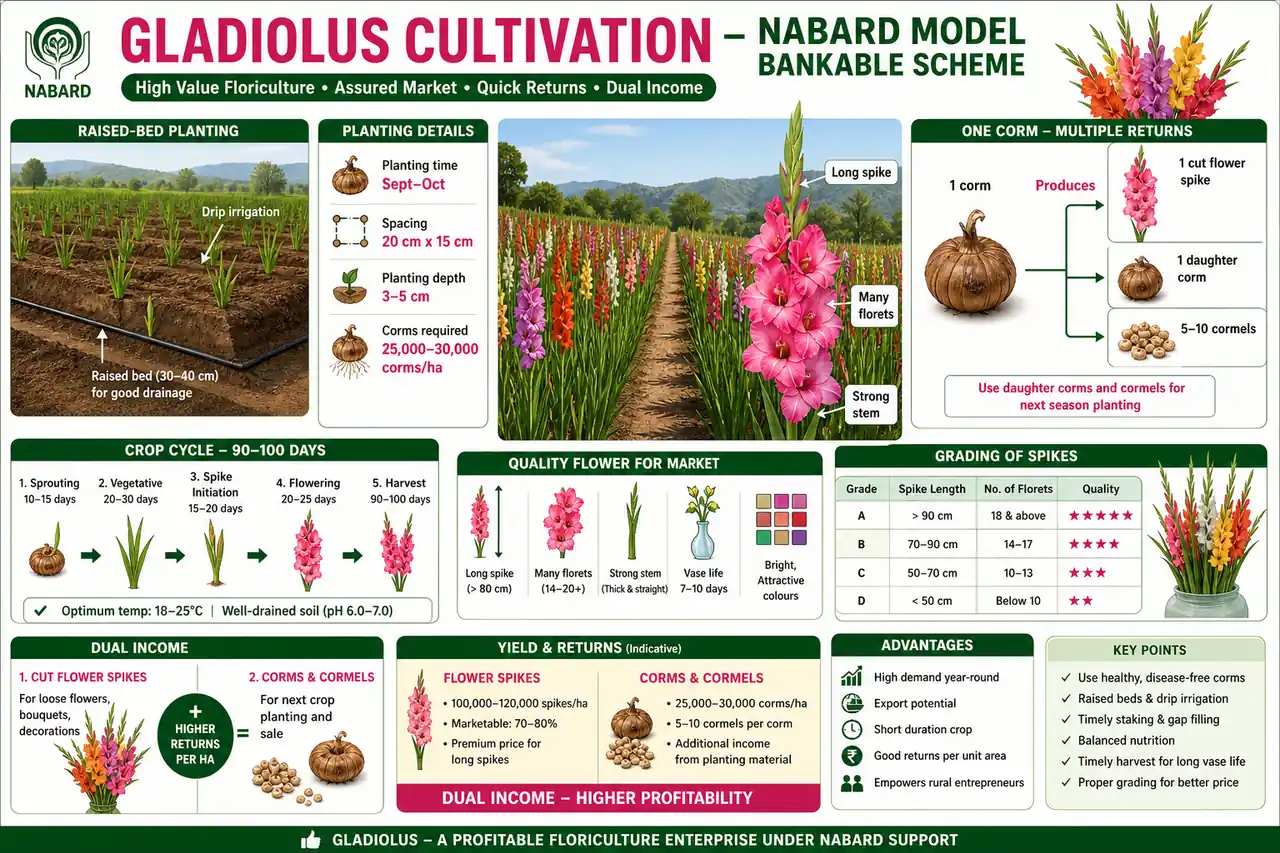
Gladiolus (Gladiolus hybridus) is India's most important commercial cut flower after rose, dominating urban flower markets and export bouquets. Unlike most horticultural crops, gladiolus offers a short crop cycle of just 90–100 days, enabling 2–3 crops per year and rapid return on investment.
- Commercial cultivation concentrated in: West Bengal, Karnataka, Himachal Pradesh, J&K, Maharashtra, Tamil Nadu, Haryana
- Two revenue streams: cut flower spikes (primary) + corms/cormels (secondary/planting material)
- One of the few floricultural crops where the planting material itself (corm) is also saleable
NOTE
Exam trap: Gladiolus has a dual income model — cut flowers AND corms. In each cropping cycle, one planted corm produces 1 daughter corm + 5–10 cormels. This makes it self-perpetuating if corms are retained for replanting.
Agro-Climatic Requirements
| Parameter | Requirement |
|---|---|
| Temperature | 10–25°C for best growth; above 35°C reduces flower quality |
| Soil | Well-drained, sandy loam to loam; pH 5.5–6.5 |
| Irrigation | Assured; critical at planting, spike emergence, and post-harvest |
| Altitude | Plains to 2,000 m MSL |
Key: Gladiolus is a cool-season flower in plains but can be grown year-round in hilly regions. In plains, main season is October–March when temperatures are moderate.
Pro Content Locked
Upgrade to Pro to access this lesson and all other premium content.
₹99 charged monthly · Cancel anytime
- All Agriculture & Banking Courses
- AI Lesson Questions (100/day)
- AI Doubt Solver (50/day)
- Glows & Grows Feedback (30/day)
- AI Section Quiz (20/day)
- 22-Language Translation (100/day)
- Recall Questions (20/day)
- AI Quiz (15/day)
- AI Quiz Paper Analysis (100/day)
- AI Step-by-Step Explanations (100/day)
- Spaced Repetition Recall (FSRS)
- AI Tutor
- Immersive Text Questions
- Audio Lessons — Hindi & English
- Mock Tests & Previous Year Papers
- Summary & Mind Maps
- XP, Levels, Leaderboard & Badges
- Generate New Classrooms
- Voice AI Teacher (AgriDots Live)
- AI Revision Assistant
- Knowledge Gap Analysis
- Interactive Revision (LangGraph)
🔒 Secure via Razorpay · Cancel anytime · No hidden fees
Gladiolus (Gladiolus hybridus) is India's most important commercial cut flower after rose, dominating urban flower markets and export bouquets. Unlike most horticultural crops, gladiolus offers a short crop cycle of just 90–100 days, enabling 2–3 crops per year and rapid return on investment.
- Commercial cultivation concentrated in: West Bengal, Karnataka, Himachal Pradesh, J&K, Maharashtra, Tamil Nadu, Haryana
- Two revenue streams: cut flower spikes (primary) + corms/cormels (secondary/planting material)
- One of the few floricultural crops where the planting material itself (corm) is also saleable
NOTE
Exam trap: Gladiolus has a dual income model — cut flowers AND corms. In each cropping cycle, one planted corm produces 1 daughter corm + 5–10 cormels. This makes it self-perpetuating if corms are retained for replanting.
Agro-Climatic Requirements
| Parameter | Requirement |
|---|---|
| Temperature | 10–25°C for best growth; above 35°C reduces flower quality |
| Soil | Well-drained, sandy loam to loam; pH 5.5–6.5 |
| Irrigation | Assured; critical at planting, spike emergence, and post-harvest |
| Altitude | Plains to 2,000 m MSL |
Key: Gladiolus is a cool-season flower in plains but can be grown year-round in hilly regions. In plains, main season is October–March when temperatures are moderate.
Varieties
Major colour groups and popular varieties:
- White: Snow Princess, Sylvia
- Red: Peter Pears, Traderhorn
- Pink: Friendship, Aarti
- Yellow: Novalux, Gold Field
- Purple/Mauve: Blue Isle, Oscar
Selection criteria for commercial cultivation: Stem length ≥ 80 cm, minimum 16 florets per spike, vase life ≥ 7 days, disease tolerance.
Planting System
| Parameter | Value |
|---|---|
| Planting method | Raised beds (15–20 cm height) |
| Spacing | 20 cm × 15 cm (row × plant) |
| Corm density | 25,000–30,000 corms/ha |
| Corm size | Size 4+ (≥4 cm diameter) for commercial cut flowers |
| Planting depth | 8–10 cm |
| Crop duration | 90–100 days from planting to harvest |
Crop cycle in plains: 2–3 crops/year possible; staggered planting for continuous market supply.
Cost of Cultivation (0.4 ha — Commercial Unit)
| Item | Cost (₹) |
|---|---|
| Corms (10,000 @ ₹3–5 each) | ₹30,000–50,000 |
| Land preparation and bed making | ₹5,000 |
| Fertilizers (NPK, FYM) | ₹6,000 |
| Plant protection chemicals | ₹4,000 |
| Irrigation | ₹3,000 |
| Labour (planting to harvest) | ₹8,000 |
| Post-harvest handling, packaging | ₹4,000 |
| Total cost/crop/0.4 ha | ₹60,000–80,000 |
Annual cost (2 crops, 0.4 ha): ₹1.20–1.60 lakh
Income and Financial Analysis
Revenue per crop (0.4 ha, 10,000 corms planted):
| Product | Quantity | Price | Revenue |
|---|---|---|---|
| Cut flower spikes | 8,000–9,000 spikes (90% success) | ₹8–15/spike | ₹64,000–1,35,000 |
| Daughter corms | 8,000–9,000 corms (Grade 1–3) | ₹3–8/corm | ₹24,000–72,000 |
| Cormels (mini-corms) | 40,000–90,000 | ₹0.50–1.00 | ₹20,000–90,000 |
| Gross Revenue/crop | ₹1.08–2.97 lakh |
Annual net income (2 crops):
- Gross revenue: ₹2.16–5.94 lakh
- Operating cost: ₹1.20–1.60 lakh
- Net income: ₹0.96–4.34 lakh/year (on 0.4 ha)
NOTE
In gladiolus, corm quality is critical — only Grade 4 corms (≥4 cm diameter) produce quality commercial spikes with ≥16 florets. Smaller corms produce fewer florets and shorter stems, reducing market price significantly.
NABARD Financing Parameters
| Parameter | Value |
|---|---|
| Unit size | 0.4–1.0 ha |
| Total project cost (0.4 ha) | ₹2.00–2.50 lakh (incl. working capital 2 cycles) |
| Bank loan (85%) | ₹1.70–2.13 lakh |
| Margin money (15%) | ₹0.30–0.37 lakh |
| Repayment period | 3–5 years |
| Moratorium | 6 months (first crop) |
Exam Summary
| Parameter | Value |
|---|---|
| Crop duration | 90–100 days |
| Crops per year (plains) | 2–3 |
| Planting density | 25,000–30,000 corms/ha |
| Spacing | 20 cm × 15 cm |
| Revenue sources | Cut flowers + corms + cormels |
| Optimal temperature | 10–25°C |
| Soil pH | 5.5–6.5 |
| Key commercial states | West Bengal, Karnataka, HP |
| Loan component | 85% |
| Moratorium | 6 months |
Sources & References
Primary source for this lesson is NABARD's official Model Bankable Projects portal.[1] Lesson-specific report copy used for this topic.[2]
References
2 sources • [1] [2]
References
Used for: Official NABARD portal for model bankable project documents and updates.
Used for: Reference copy used in this lesson for project parameters and worked figures.
The figures in this lesson reflect the cost norms and technical parameters as published in the NABARD document. Actual costs may vary by state, season, and year of implementation. Always refer to the latest NABARD circular for current norms.
Summary Cheat Sheet
| Concept / Topic | Key Details / Explanation |
|---|---|
| Rank in India | Most important commercial cut flower after rose |
| Scientific name | Gladiolus hybridus |
| Crop duration | 90–100 days from planting to harvest |
| Crops per year (plains) | 2–3 (staggered planting for continuous supply) |
| Main season (plains) | October–March (cool season) |
| Temperature | 10–25°C; above 35°C reduces flower quality |
| Soil pH | 5.5–6.5; well-drained sandy loam to loam |
| Spacing | 20 cm × 15 cm (row × plant) |
| Planting density | 25,000–30,000 corms/ha |
| Corm size for commercial | Size 4+ (≥4 cm diameter) — smaller corms = fewer florets, lower price |
| Planting depth | 8–10 cm; raised beds 15–20 cm height |
| Dual income | Cut flower spikes (primary) + corms/cormels (secondary) |
| Corm multiplication | 1 planted corm → 1 daughter corm + 5–10 cormels |
| Spikes (90% success, 10,000 corms) | 8,000–9,000 spikes at ₹8–15/spike |
| Gross revenue per crop (0.4 ha) | ₹1.08–2.97 lakh |
| Annual net income (2 crops, 0.4 ha) | ₹0.96–4.34 lakh |
| Unit size | 0.4–1.0 ha |
| Total project cost (0.4 ha) | ₹2.00–2.50 lakh (including 2-cycle working capital) |
| Bank loan | 85% = ₹1.70–2.13 lakh |
| Margin money | 15% = ₹0.30–0.37 lakh |
| Moratorium | 6 months (first crop) |
| Repayment | 3–5 years |
| Commercial quality criterion | Stem ≥80 cm, ≥16 florets/spike, vase life ≥7 days |
| Key states | West Bengal, Karnataka, Himachal Pradesh, J&K, Maharashtra, Tamil Nadu, Haryana |
Lesson Doubts
Ask questions, get expert answers