🥭 Mango Cultivation — NABARD Model Bankable Scheme (1.0 ha)
Mango is India's most important fruit crop by production and the 'King of Fruits.' This lesson covers NABARD's model project for 1-hectare mango cultivation including variety selection, high-density planting, cost of cultivation over the gestation period, income projections, and bank financing parameters.
Mango (Mangifera indica) is India's most important fruit crop — both by area and economic value. India is the world's largest mango producer, contributing ~40–50% of global mango production, yet remains largely domestic-consumption oriented with export potential far below production capacity.
- India's mango area: ~25 lakh hectares
- India's mango production: ~180–200 lakh tonnes/year
- Average yield (traditional orchards): 5–6 t/ha (very low)
- Improved HDP yield potential: 15–20 t/ha
NOTE
Exam trap: India produces ~40–50% of world's mangoes but exports only 1–2% of production. Most is consumed domestically. The low export share despite top production rank is a key policy concern.
Major Varieties and Their Regions
| Variety | Region | Known For |
|---|---|---|
| Alphonso (Hapus) | Konkan (Maharashtra, Goa) | Export quality, best flavour |
| Dashehari | UP (Lucknow-Malihabad) | Most traded in North India |
| Langra | Varanasi (UP), Bihar | Fibreless, late season |
| Chausa | UP | Very sweet, late season |
| Totapuri | AP, Karnataka, Tamil Nadu | Processing, pickling |
| Himsagar | West Bengal | Eastern India |
| Neelam | South India | Long shelf life |
| Kesar | Gujarat (Junagadh) | GI tagged; sweet, saffron-coloured |
NOTE
Pro Content Locked
Upgrade to Pro to access this lesson and all other premium content.
₹99 charged monthly · Cancel anytime
- All Agriculture & Banking Courses
- AI Lesson Questions (100/day)
- AI Doubt Solver (50/day)
- Glows & Grows Feedback (30/day)
- AI Section Quiz (20/day)
- 22-Language Translation (100/day)
- Recall Questions (20/day)
- AI Quiz (15/day)
- AI Quiz Paper Analysis (100/day)
- AI Step-by-Step Explanations (100/day)
- Spaced Repetition Recall (FSRS)
- AI Tutor
- Immersive Text Questions
- Audio Lessons — Hindi & English
- Mock Tests & Previous Year Papers
- Summary & Mind Maps
- XP, Levels, Leaderboard & Badges
- Generate New Classrooms
- Voice AI Teacher (AgriDots Live)
- AI Revision Assistant
- Knowledge Gap Analysis
- Interactive Revision (LangGraph)
🔒 Secure via Razorpay · Cancel anytime · No hidden fees
Mango (Mangifera indica) is India's most important fruit crop — both by area and economic value. India is the world's largest mango producer, contributing ~40–50% of global mango production, yet remains largely domestic-consumption oriented with export potential far below production capacity.
- India's mango area: ~25 lakh hectares
- India's mango production: ~180–200 lakh tonnes/year
- Average yield (traditional orchards): 5–6 t/ha (very low)
- Improved HDP yield potential: 15–20 t/ha
NOTE
Exam trap: India produces ~40–50% of world's mangoes but exports only 1–2% of production. Most is consumed domestically. The low export share despite top production rank is a key policy concern.
Major Varieties and Their Regions
| Variety | Region | Known For |
|---|---|---|
| Alphonso (Hapus) | Konkan (Maharashtra, Goa) | Export quality, best flavour |
| Dashehari | UP (Lucknow-Malihabad) | Most traded in North India |
| Langra | Varanasi (UP), Bihar | Fibreless, late season |
| Chausa | UP | Very sweet, late season |
| Totapuri | AP, Karnataka, Tamil Nadu | Processing, pickling |
| Himsagar | West Bengal | Eastern India |
| Neelam | South India | Long shelf life |
| Kesar | Gujarat (Junagadh) | GI tagged; sweet, saffron-coloured |
NOTE
Malihabad (UP) is called the "Mango Capital of India" — it has the highest concentration of mango orchards for Dashehari. Alphonso from Ratnagiri/Devgad (Maharashtra) has GI tag.
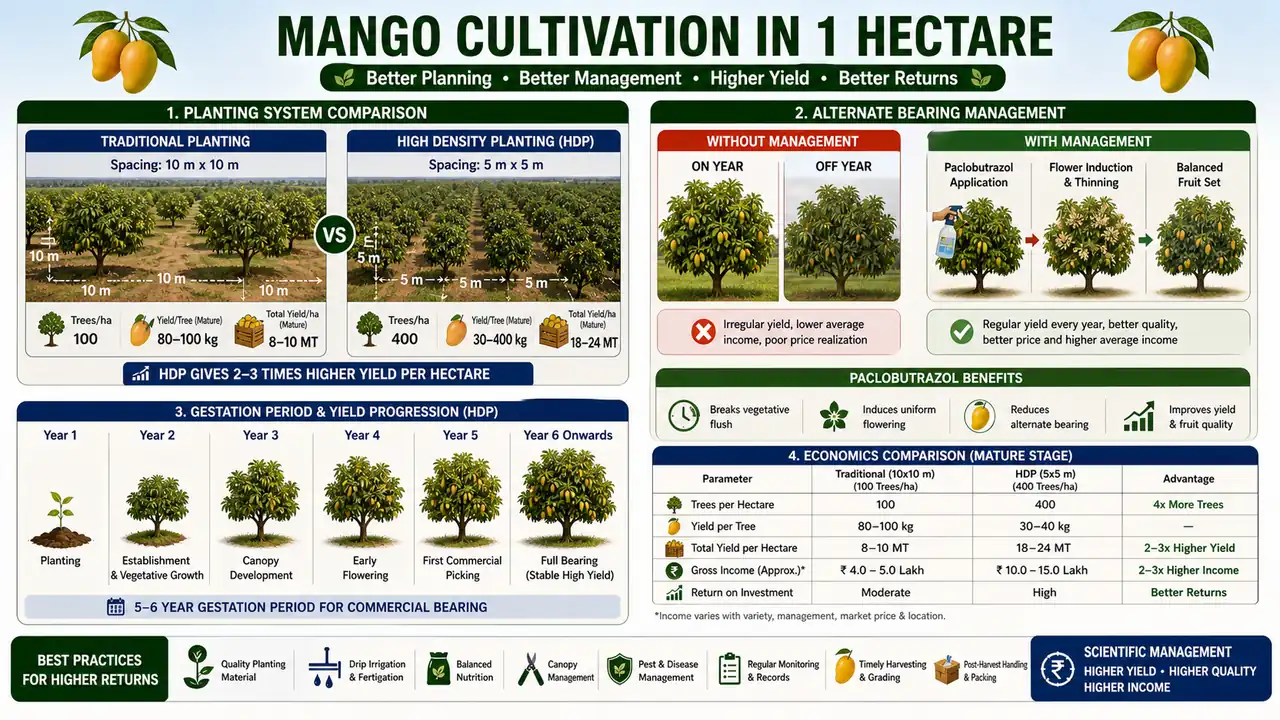
Planting Systems
Traditional Spacing:
| System | Spacing | Plants/ha |
|---|---|---|
| Square | 10 m × 10 m | 100 |
| Rectangular | 10 m × 8 m | 125 |
High Density Planting (HDP):
| Type | Spacing | Plants/ha |
|---|---|---|
| HDP | 5 m × 5 m | 400 |
| Ultra HDP (with pruning) | 2.5 m × 2.5 m | 1,600 |
Why HDP? Traditional orchards with 100 trees/ha never realize full yield potential because trees are too widely spaced in early years. HDP with canopy management gives commercial yields by Year 5–6 vs Year 8–10 in traditional.
Cost of Cultivation (1.0 ha — Traditional 100 trees)
| Year | Key Activities | Cost (₹) |
|---|---|---|
| Year 1 | Pits (1m×1m×1m), grafted plants (100 @ ₹60–80), FYM, fertilizers | ₹25,000–30,000 |
| Year 2–4 | Weeding, irrigation, fertilizers, pest management | ₹12,000–18,000/year |
| Year 5–7 | Start of bearing, full management | ₹20,000–25,000/year |
| Total (7 years) | ₹1.30–1.60 lakh |
Project finance (7-year basis):
| Parameter | Value |
|---|---|
| Total project cost | ₹1.50 lakh/ha |
| Bank loan (85%) | ₹1.28 lakh |
| Margin money (15%) | ₹0.22 lakh |
| Moratorium | 5 years |
| Repayment period | 10–12 years |
Income Projections
| Year | Yield (t/ha) | Price (₹/kg) | Gross Income |
|---|---|---|---|
| Year 5 | 2–3 | 20–40 | ₹40,000–1,20,000 |
| Year 8 | 6–8 | 20–40 | ₹1,20,000–3,20,000 |
| Year 10+ (full) | 8–10 | 20–40 | ₹1,60,000–4,00,000 |
Net income at full bearing (traditional 100 trees/ha): ₹1.20–3.20 lakh/ha/year
HDP (400 trees/ha, Year 10+): Gross income potential ₹6.00–12.00 lakh/ha
Key Cultivation Facts for Exam
- Gestation period: 5–6 years (grafted); 8–10 years (seedling — never use for commercial)
- Fruit bearing cycle: Alternate bearing is a major problem — most varieties bear heavily every other year
- Flowering trigger: Cool, dry weather in November–December induces flowering
- Mango malformation: Caused by Fusarium mangiferae; destroys inflorescence
- Stone weevil (Sternochetus mangiferae): Internal pest; quarantine issue for exports
- Fertilizer: NPK 1:1:1 ratio in young trees; shift to high K and P at bearing stage
NOTE
Alternate bearing is the single biggest productivity constraint in mango. Paclobutrazol (soil application) and ethephon sprays are used to regulate and synchronize flowering — a frequent exam question on horticultural management.
Exam Summary
| Parameter | Value |
|---|---|
| India's global rank | 1st producer (~40–50% of world) |
| India's area | ~25 lakh ha |
| Standard spacing (traditional) | 10 m × 10 m = 100 plants/ha |
| HDP spacing | 5 m × 5 m = 400 plants/ha |
| Gestation (grafted) | 5–6 years |
| Full bearing yield | 8–10 t/ha (traditional) |
| Moratorium | 5 years |
| Repayment | 10–12 years |
| Key constraint | Alternate bearing |
| Alphonso region | Konkan coast (Maharashtra, Goa) |
| Dashehari region | Malihabad, UP |
Sources & References
Primary source for this lesson is NABARD's official Model Bankable Projects portal.[1] Lesson-specific report copy used for this topic.[2]
References
2 sources • [1] [2]
References
Used for: Official NABARD portal for model bankable project documents and updates.
Used for: Reference copy used in this lesson for project parameters and worked figures.
The figures in this lesson reflect the cost norms and technical parameters as published in the NABARD document. Actual costs may vary by state, season, and year of implementation. Always refer to the latest NABARD circular for current norms.
Summary Cheat Sheet
| Concept / Topic | Key Details / Explanation |
|---|---|
| Scientific name | Mangifera indica; "King of Fruits" |
| India's global rank | 1st producer — ~40–50% of world mango production |
| India's area | ~25 lakh ha |
| India's production | ~180–200 lakh tonnes/year |
| Export share | Only 1–2% of production exported (despite top rank) |
| Traditional yield | 5–6 t/ha (very low; alternate bearing problem) |
| HDP yield potential | 15–20 t/ha |
| Standard spacing (traditional) | 10 m × 10 m = 100 plants/ha |
| HDP spacing | 5 m × 5 m = 400 plants/ha |
| Ultra HDP | 2.5 m × 2.5 m = 1,600 plants/ha (with canopy management) |
| Pit size | 1 m × 1 m × 1 m |
| Grafted plant cost | ₹60–80 each |
| Gestation (grafted) | 5–6 years (NEVER use seedling — 8–10 years) |
| Full bearing yield | 8–10 t/ha (traditional); 15–20 t/ha (HDP) |
| Total project cost (7 yr) | ₹1.50 lakh/ha |
| Bank loan | 85% = ₹1.28 lakh |
| Margin money | 15% = ₹0.22 lakh |
| Moratorium | 5 years |
| Repayment | 10–12 years |
| Gross income (full bearing) | ₹1.60–4.00 lakh/ha/year (traditional); ₹6–12 lakh/ha (HDP) |
| Key constraint | Alternate bearing — heavy crop every other year |
| Remedy for alternate bearing | Paclobutrazol (soil drench) + ethephon spray to synchronise flowering |
| Flowering trigger | Cool, dry weather in November–December |
| Alphonso (Hapus) | Konkan coast — Ratnagiri/Devgad (Maharashtra, Goa); GI tagged; export quality |
| Dashehari | Malihabad, UP — "Mango Capital of India" |
| Kesar | Junagadh (Gujarat); GI tagged; saffron-coloured |
| Totapuri | AP, Karnataka, Tamil Nadu — processing and pickling |
| Mango malformation | Caused by Fusarium mangiferae; destroys inflorescence |
| Stone weevil | Sternochetus mangiferae — internal pest; quarantine issue for exports |
Lesson Doubts
Ask questions, get expert answers