🍎 Pomegranate Cultivation (Rajasthan) — NABARD Model Bankable Scheme
Pomegranate is the most drought-tolerant commercial fruit crop, making it ideal for arid Rajasthan. This lesson covers the NABARD model bankable scheme for pomegranate cultivation in Rajasthan — covering varieties, spacing, irrigation, cost of cultivation, income projections, and bank financing parameters.
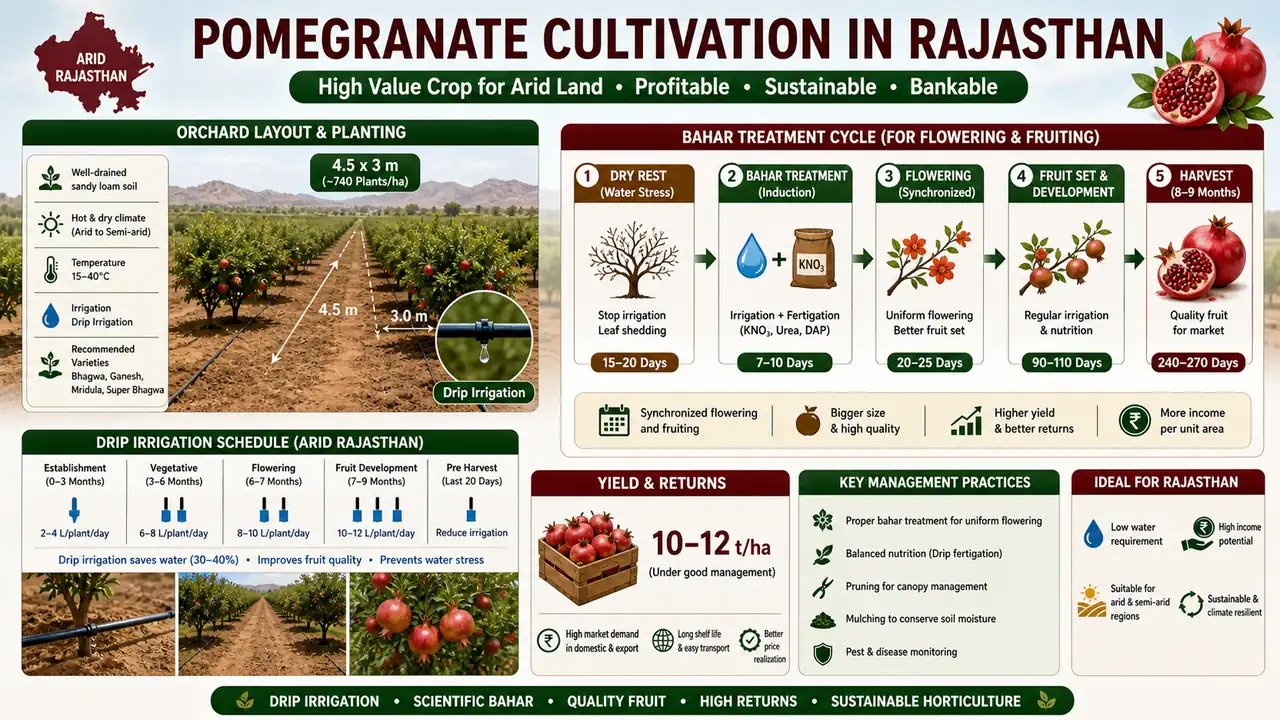
Pomegranate (Punica granatum) is India's most drought-hardy commercial fruit crop, thriving where most fruits fail — in arid, semi-arid, and saline soils. This NABARD scheme is specifically designed for Rajasthan, which has rapidly emerged as a major pomegranate-producing state.
- India's pomegranate area: ~2.8–3.0 lakh hectares
- Top states: Maharashtra (leader), Karnataka, Andhra Pradesh, Gujarat, Rajasthan (growing)
- India is among the top global exporters of pomegranate; key markets are Europe and Middle East
- Fruit is rich in antioxidants, anthocyanins, and punicic acid — high consumer demand
NOTE
Exam trap: Maharashtra dominates pomegranate cultivation in India (Solapur, Sangli, Nashik). Rajasthan is an emerging state — this scheme specifically targets Rajasthan's arid conditions where pomegranate is preferred over water-intensive crops.
Agro-Climatic Requirements
| Parameter | Requirement |
|---|---|
| Temperature | 25–35°C (optimal); tolerates up to 45°C |
| Rainfall | 500–800 mm/year; can be grown with just drip irrigation |
| Soil | Well-drained, loam to sandy loam; tolerates pH 5.5–8.0 |
| Salinity tolerance | Medium; can be grown in slightly saline soils |
| Water requirement | Low — ideal for water-scarce regions |
Why pomegranate suits Rajasthan:
Pro Content Locked
Upgrade to Pro to access this lesson and all other premium content.
₹99 charged monthly · Cancel anytime
- All Agriculture & Banking Courses
- AI Lesson Questions (100/day)
- AI Doubt Solver (50/day)
- Glows & Grows Feedback (30/day)
- AI Section Quiz (20/day)
- 22-Language Translation (100/day)
- Recall Questions (20/day)
- AI Quiz (15/day)
- AI Quiz Paper Analysis (100/day)
- AI Step-by-Step Explanations (100/day)
- Spaced Repetition Recall (FSRS)
- AI Tutor
- Immersive Text Questions
- Audio Lessons — Hindi & English
- Mock Tests & Previous Year Papers
- Summary & Mind Maps
- XP, Levels, Leaderboard & Badges
- Generate New Classrooms
- Voice AI Teacher (AgriDots Live)
- AI Revision Assistant
- Knowledge Gap Analysis
- Interactive Revision (LangGraph)
🔒 Secure via Razorpay · Cancel anytime · No hidden fees
Pomegranate (Punica granatum) is India's most drought-hardy commercial fruit crop, thriving where most fruits fail — in arid, semi-arid, and saline soils. This NABARD scheme is specifically designed for Rajasthan, which has rapidly emerged as a major pomegranate-producing state.
- India's pomegranate area: ~2.8–3.0 lakh hectares
- Top states: Maharashtra (leader), Karnataka, Andhra Pradesh, Gujarat, Rajasthan (growing)
- India is among the top global exporters of pomegranate; key markets are Europe and Middle East
- Fruit is rich in antioxidants, anthocyanins, and punicic acid — high consumer demand
NOTE
Exam trap: Maharashtra dominates pomegranate cultivation in India (Solapur, Sangli, Nashik). Rajasthan is an emerging state — this scheme specifically targets Rajasthan's arid conditions where pomegranate is preferred over water-intensive crops.
Agro-Climatic Requirements
| Parameter | Requirement |
|---|---|
| Temperature | 25–35°C (optimal); tolerates up to 45°C |
| Rainfall | 500–800 mm/year; can be grown with just drip irrigation |
| Soil | Well-drained, loam to sandy loam; tolerates pH 5.5–8.0 |
| Salinity tolerance | Medium; can be grown in slightly saline soils |
| Water requirement | Low — ideal for water-scarce regions |
Why pomegranate suits Rajasthan:
- Drip-irrigated pomegranate uses only 600–700 mm water/year equivalent
- Thrives in the dry heat with minimal disease pressure (unlike humid crops)
- Sandy soils with good drainage prevent root rot
Varieties
| Variety | Characteristics | Region |
|---|---|---|
| Bhagwa | Bright red, soft seeds, export quality | Maharashtra, now Rajasthan |
| Ganesh | Pink-red, sweet, thick rind | Maharashtra |
| Mridula | Deep red, early, soft seeds | Karnataka |
| Ruby | Large fruit, attractive colour | AP |
| Kesar (Jalore Seedless) | Local Rajasthan variety | Rajasthan |
Bhagwa is the dominant commercial variety for fresh market and exports — exam-important.
Planting System
| Parameter | Value |
|---|---|
| Standard spacing | 4.5 m × 3 m = 740 plants/ha |
| High density | 3 m × 2 m = 1,666 plants/ha |
| Propagation | Hard wood cuttings (20–25 cm, Sept–Oct) |
| Planting season | July–August (monsoon) or Feb–March |
| Pit size | 60 cm × 60 cm × 60 cm |
Why cuttings (not grafts)? Pomegranate roots easily from hardwood cuttings — low cost, high success rate, maintains true-to-type character.
Cost of Cultivation (1.0 ha — 4.5m × 3m, 740 plants)
| Year | Activity | Cost (₹) |
|---|---|---|
| Year 1 | Pits, cuttings/plants, drip installation, FYM, fertilizers | ₹65,000–80,000 |
| Year 2 | Training, pruning, fertilizers, plant protection | ₹25,000–30,000 |
| Year 3 | First bearing; full management | ₹30,000–35,000 |
| Year 4+ | Recurring annual cost | ₹35,000–45,000/year |
| Total (5-year) project cost | ₹1.90–2.20 lakh |
Drip irrigation is non-negotiable — without drip, pomegranate in arid Rajasthan is not viable.
| Financing | Value |
|---|---|
| Total project cost | ₹2.00–2.20 lakh/ha |
| Bank loan (85%) | ₹1.70–1.87 lakh |
| Margin money (15%) | ₹0.30–0.33 lakh |
| Moratorium | 2–3 years |
| Repayment | 7–9 years |
Income and Viability
| Year | Yield (kg/ha) | Price (₹/kg) | Gross Income |
|---|---|---|---|
| Year 3 (first) | 3,000–4,000 | 40–80 | ₹1.20–3.20 lakh |
| Year 5 (full) | 10,000–12,000 | 40–80 | ₹4.00–9.60 lakh |
| Year 5 (export grade) | 6,000–8,000 | 60–120 | ₹3.60–9.60 lakh |
Net income at full bearing: ₹3.00–8.00 lakh/ha/year (one of the highest-income crops in dryland horticulture)
NOTE
Pomegranate bears twice a year in some regions (Ambe bahar — February flowering; Hasth bahar — September flowering; Mrig bahar — June flowering). Mrig bahar (June–July) is preferred in Maharashtra and Rajasthan because the fruit matures during October–January when prices peak.
Bahar treatment: Withholding irrigation for 2–3 months to stress the plant, then resuming to synchronize flowering — a critical management practice and frequent exam topic.
Exam Summary
| Parameter | Value |
|---|---|
| Best variety (export) | Bhagwa |
| India's top state | Maharashtra (Solapur) |
| Spacing (standard) | 4.5 m × 3 m = 740 plants/ha |
| Propagation method | Hardwood cuttings |
| Water requirement | Low (500–800 mm); drip mandatory |
| Gestation period | 2–3 years |
| Full bearing yield | 10–12 t/ha |
| Loan component | 85% |
| Moratorium | 2–3 years |
| Key management | Bahar treatment (Mrig bahar preferred) |
| Soil tolerance | pH 5.5–8.0; tolerates mild salinity |
Sources & References
Primary source for this lesson is NABARD's official Model Bankable Projects portal.[1] Lesson-specific report copy used for this topic.[2]
References
2 sources • [1] [2]
References
Used for: Official NABARD portal for model bankable project documents and updates.
Used for: Reference copy used in this lesson for project parameters and worked figures.
The figures in this lesson reflect the cost norms and technical parameters as published in the NABARD document. Actual costs may vary by state, season, and year of implementation. Always refer to the latest NABARD circular for current norms.
Summary Cheat Sheet
| Concept / Topic | Key Details / Explanation |
|---|---|
| Scientific name | Punica granatum |
| Key trait | Most drought-hardy commercial fruit crop in India |
| India's area | ~2.8–3.0 lakh ha |
| Top state | Maharashtra (Solapur, Sangli, Nashik) |
| NABARD model focus | Rajasthan (arid/semi-arid adaptation) |
| Temperature | 25–35°C optimal; tolerates up to 45°C |
| Rainfall | 500–800 mm/year with drip irrigation |
| Soil pH | 5.5–8.0; tolerates mild salinity |
| Best variety (export) | Bhagwa — bright red, soft seeds, dominates fresh market and exports |
| Rajasthan local variety | Kesar (Jalore Seedless) |
| Propagation | Hardwood cuttings (20–25 cm, Sept–Oct) — NOT grafts |
| Standard spacing | 4.5 m × 3 m = 740 plants/ha |
| High density spacing | 3 m × 2 m = 1,666 plants/ha |
| Pit size | 60 cm × 60 cm × 60 cm |
| Gestation | 2–3 years (one of shortest among fruit crops) |
| Full bearing yield | 10,000–12,000 kg/ha |
| Farm gate price | ₹40–80/kg; export grade ₹60–120/kg |
| Net income (full bearing) | ₹3.00–8.00 lakh/ha/year |
| Total project cost (5 yr) | ₹2.00–2.20 lakh/ha |
| Bank loan | 85% = ₹1.70–1.87 lakh |
| Margin money | 15% = ₹0.30–0.33 lakh |
| Moratorium | 2–3 years |
| Repayment | 7–9 years |
| Drip irrigation | Mandatory — no drip = not viable in arid Rajasthan |
| Bahars (flowering seasons) | Ambe bahar (Feb), Mrig bahar (June), Hasth bahar (Sept) |
| Preferred bahar | Mrig bahar (Jun–Jul) — fruit matures Oct–Jan when prices peak |
| Bahar treatment | Withhold irrigation 2–3 months → resume to synchronise flowering |
| Key export markets | Europe and Middle East |
Lesson Doubts
Ask questions, get expert answers