🍄 Mushroom Cultivation in Himachal Pradesh — NABARD Model Bankable Scheme
Mushroom cultivation is a land-independent, high-return activity perfectly suited to Himachal Pradesh's cool climate. This NABARD model covers button mushroom and oyster mushroom production — substrate preparation, spawn, cropping cycles, costs, income, and financing parameters for competitive exam preparation.
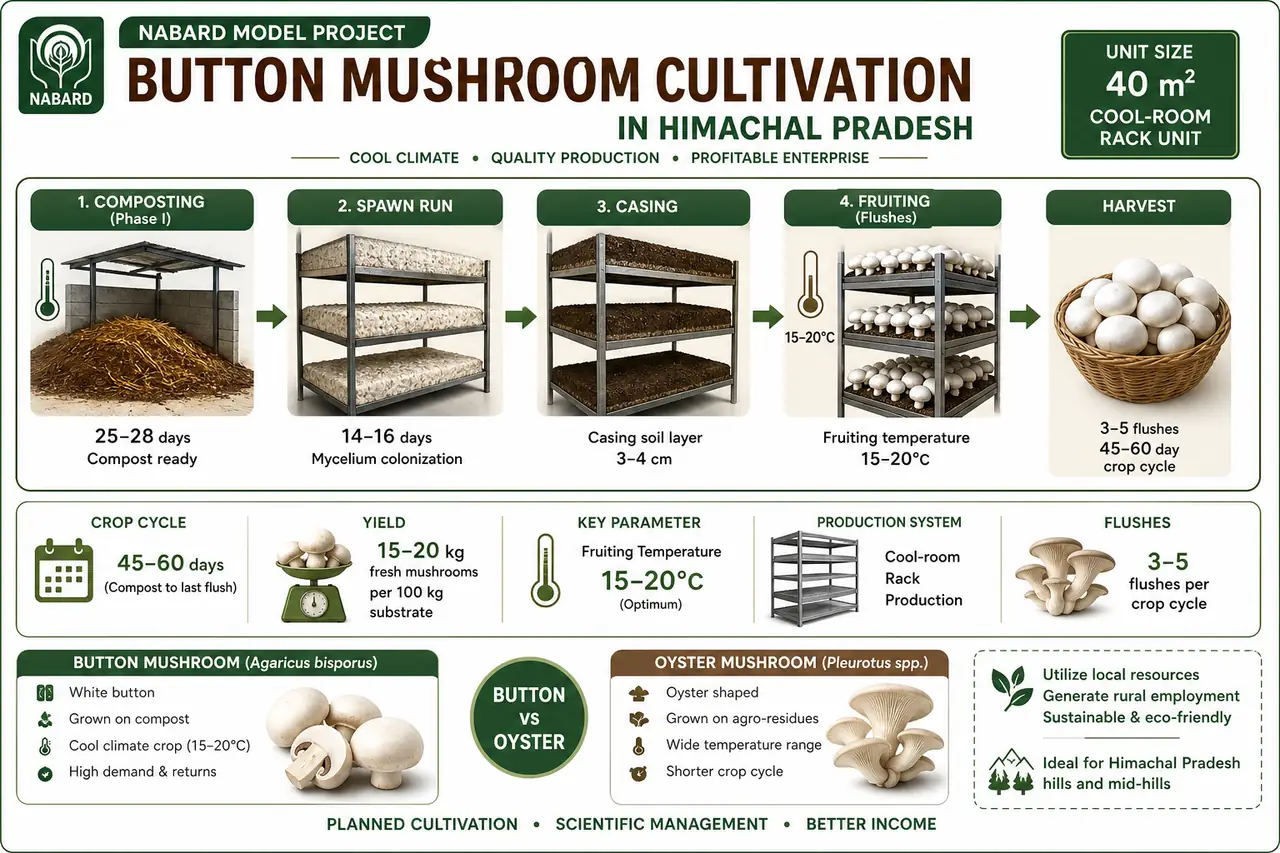
Mushroom cultivation is one of the most capital-efficient agricultural enterprises — it requires no farmland, thrives on agricultural waste, and generates income in just 45–60 days from substrate preparation. Himachal Pradesh's cool climate is ideal for button mushroom (Agaricus bisporus) production year-round.
- India's mushroom production: ~1.8–2.0 lakh tonnes/year
- Button mushroom accounts for ~70–75% of total production
- Key growing states: Himachal Pradesh, Uttar Pradesh, Haryana, Punjab, Uttarakhand
- HP advantage: Cool temperatures (15–20°C) without refrigeration cost
NOTE
Exam trap: Button mushroom (Agaricus bisporus) is the most produced variety in India (~70–75% share). Oyster mushroom (Pleurotus spp.) comes second. Dhingri is the local name for oyster mushroom in HP.
Types of Mushroom in HP
| Type | Scientific Name | Season/Temp | Substrate |
|---|---|---|---|
| Button | Agaricus bisporus | 15–20°C (fruiting) | Composted wheat/paddy straw |
| Oyster | Pleurotus spp. | 20–28°C | Paddy straw, sawdust |
| Shiitake | Lentinula edodes | 12–18°C | Hardwood sawdust/logs |
Button Mushroom: Technical Process
Step 1: Substrate Preparation (Composting)
Pro Content Locked
Upgrade to Pro to access this lesson and all other premium content.
₹99 charged monthly · Cancel anytime
- All Agriculture & Banking Courses
- AI Lesson Questions (100/day)
- AI Doubt Solver (50/day)
- Glows & Grows Feedback (30/day)
- AI Section Quiz (20/day)
- 22-Language Translation (100/day)
- Recall Questions (20/day)
- AI Quiz (15/day)
- AI Quiz Paper Analysis (100/day)
- AI Step-by-Step Explanations (100/day)
- Spaced Repetition Recall (FSRS)
- AI Tutor
- Immersive Text Questions
- Audio Lessons — Hindi & English
- Mock Tests & Previous Year Papers
- Summary & Mind Maps
- XP, Levels, Leaderboard & Badges
- Generate New Classrooms
- Voice AI Teacher (AgriDots Live)
- AI Revision Assistant
- Knowledge Gap Analysis
- Interactive Revision (LangGraph)
🔒 Secure via Razorpay · Cancel anytime · No hidden fees
Mushroom cultivation is one of the most capital-efficient agricultural enterprises — it requires no farmland, thrives on agricultural waste, and generates income in just 45–60 days from substrate preparation. Himachal Pradesh's cool climate is ideal for button mushroom (Agaricus bisporus) production year-round.
- India's mushroom production: ~1.8–2.0 lakh tonnes/year
- Button mushroom accounts for ~70–75% of total production
- Key growing states: Himachal Pradesh, Uttar Pradesh, Haryana, Punjab, Uttarakhand
- HP advantage: Cool temperatures (15–20°C) without refrigeration cost
NOTE
Exam trap: Button mushroom (Agaricus bisporus) is the most produced variety in India (~70–75% share). Oyster mushroom (Pleurotus spp.) comes second. Dhingri is the local name for oyster mushroom in HP.
Types of Mushroom in HP
| Type | Scientific Name | Season/Temp | Substrate |
|---|---|---|---|
| Button | Agaricus bisporus | 15–20°C (fruiting) | Composted wheat/paddy straw |
| Oyster | Pleurotus spp. | 20–28°C | Paddy straw, sawdust |
| Shiitake | Lentinula edodes | 12–18°C | Hardwood sawdust/logs |
Button Mushroom: Technical Process
Step 1: Substrate Preparation (Composting)
- Base material: Wheat straw + poultry manure + gypsum
- Phase I composting: 25–28 days outdoor windrow composting
- Phase II pasteurization: 60–65°C for 6–8 hours (kills competitors, pathogens)
- Final compost: Dark brown, non-sticky, ammonia-free, moisture ~68–72%
Step 2: Spawning
- Spawn rate: 500g per 100 kg substrate (0.5% by weight)
- Spawn run period: 14–16 days at 25°C
- Casing layer: pH 7.5–8.0 soil applied after spawn run
Step 3: Cropping
- First flush: 18–22 days after casing
- Total flushes: 3–5 flushes over 60–70 days
- Yield: 15–20 kg per 100 kg substrate (15–20% biological efficiency)
Production Unit Setup (NABARD Model)
Unit size: 40 m² cropping area (standard model unit)
| Infrastructure | Cost (₹) |
|---|---|
| Cropping room construction (40 m²) | ₹80,000–1,00,000 |
| Pasteurization unit (drum/room) | ₹20,000–30,000 |
| Shelving, trays, containers | ₹15,000–20,000 |
| Spawn production/procurement setup | ₹10,000 |
| Miscellaneous tools | ₹5,000 |
| Fixed cost | ₹1.30–1.55 lakh |
Working capital (per crop cycle, 40 m²):
| Item | Cost (₹) |
|---|---|
| Substrate materials (500 kg) | 3,000 |
| Spawn (3 kg) | 1,500 |
| Chemicals (formaldehyde, carbendazim) | 1,000 |
| Labour (2 cycles/month) | 2,500 |
| Electricity/fuel | 1,500 |
| Working capital/month | ₹9,500–10,000 |
Income Analysis
Per 40 m² unit, per crop cycle (45–60 days):
| Parameter | Value |
|---|---|
| Substrate loaded | 500 kg |
| Expected yield | 75–100 kg mushrooms |
| Selling price (fresh, local) | ₹80–120/kg |
| Gross revenue/cycle | ₹6,000–12,000 |
| Cycles per year | 6–8 |
| Annual gross revenue | ₹36,000–96,000 |
| Annual operating cost | ₹60,000–80,000 |
| Net income | ₹20,000–40,000/year (small unit) |
Scaling up: A 200 m² unit generates net income of ₹1.00–2.00 lakh/year.
NOTE
The biological efficiency (BE) of button mushroom is 15–20% — meaning 100 kg substrate produces 15–20 kg mushrooms. Oyster mushroom has higher BE of 50–100% but lower market price. The lower BE of button mushroom is compensated by much higher price (₹80–150/kg vs ₹30–50/kg for oyster).
NABARD Financing (HP Model)
| Parameter | Value |
|---|---|
| Model unit area | 40–100 m² |
| Total project cost | ₹2.00–3.00 lakh |
| Bank loan (85%) | ₹1.70–2.55 lakh |
| Margin money (15%) | ₹0.30–0.45 lakh |
| Moratorium | 6 months |
| Repayment period | 3–5 years |
| Subsidy available | Under NHM/MIDH — 40% for SC/ST; 25% general |
Exam Summary
| Parameter | Value |
|---|---|
| Most produced type in India | Button mushroom (~70–75%) |
| Button mushroom temp (fruiting) | 15–20°C |
| Composting duration | 25–28 days (Phase I) |
| Spawn run period | 14–16 days |
| Biological efficiency (button) | 15–20% |
| Yield per 100 kg substrate | 15–20 kg |
| Flushes per crop | 3–5 |
| Crop cycle duration | 45–60 days |
| Cycles per year | 6–8 |
| HP advantage | Natural cool climate |
Sources & References
Primary source for this lesson is NABARD's official Model Bankable Projects portal.[1] Lesson-specific report copy used for this topic.[2]
References
2 sources • [1] [2]
References
Used for: Official NABARD portal for model bankable project documents and updates.
Used for: Reference copy used in this lesson for project parameters and worked figures.
The figures in this lesson reflect the cost norms and technical parameters as published in the NABARD document. Actual costs may vary by state, season, and year of implementation. Always refer to the latest NABARD circular for current norms.
Summary Cheat Sheet
| Concept / Topic | Key Details / Explanation |
|---|---|
| India's production | ~1.8–2.0 lakh tonnes/year |
| Most produced type | Button mushroom (Agaricus bisporus) — ~70–75% share |
| 2nd most produced | Oyster mushroom (Pleurotus spp.) — local name in HP: Dhingri |
| HP advantage | Natural cool climate (15–20°C) eliminates refrigeration cost |
| Button mushroom fruiting temp | 15–20°C |
| Oyster mushroom temp | 20–28°C |
| Phase I composting | Wheat straw + poultry manure + gypsum; outdoor windrow; 25–28 days |
| Phase II pasteurisation | 60–65°C for 6–8 hours (kills competitors and pathogens) |
| Compost moisture | 68–72% |
| Spawn rate | 500 g per 100 kg substrate (0.5% by weight) |
| Spawn run period | 14–16 days at 25°C |
| Casing layer pH | 7.5–8.0 soil; applied after spawn run |
| First flush | 18–22 days after casing |
| Total flushes | 3–5 flushes over 60–70 days |
| Biological efficiency (button) | 15–20% (100 kg substrate → 15–20 kg mushrooms) |
| Biological efficiency (oyster) | 50–100% (but lower market price ₹30–50/kg) |
| Crop cycle duration | 45–60 days |
| Cycles per year | 6–8 |
| Selling price (button, fresh) | ₹80–150/kg |
| Unit size (NABARD model) | 40 m² cropping area |
| Annual gross revenue (40 m²) | ₹36,000–96,000 |
| Annual net income (40 m²) | ₹20,000–40,000 |
| Net income (200 m² unit) | ₹1.00–2.00 lakh/year |
| Total project cost | ₹2.00–3.00 lakh |
| Bank loan | 85% = ₹1.70–2.55 lakh |
| Margin money | 15% = ₹0.30–0.45 lakh |
| Moratorium | 6 months |
| Repayment | 3–5 years |
| Subsidy | Under NHM/MIDH — 40% (SC/ST); 25% (general) |
| Key states | HP, UP, Haryana, Punjab, Uttarakhand |
Lesson Doubts
Ask questions, get expert answers