🍵 Tea Plantation for Small Tea Growers in Himachal Pradesh — NABARD Model Scheme
Himachal Pradesh produces some of India's finest orthodox and Kangra tea, but most small growers lack access to institutional credit. This NABARD model covers tea plantation economics for small growers — land preparation, spacing, planting material, cost over the gestation period, green leaf yield, income, and financing parameters.
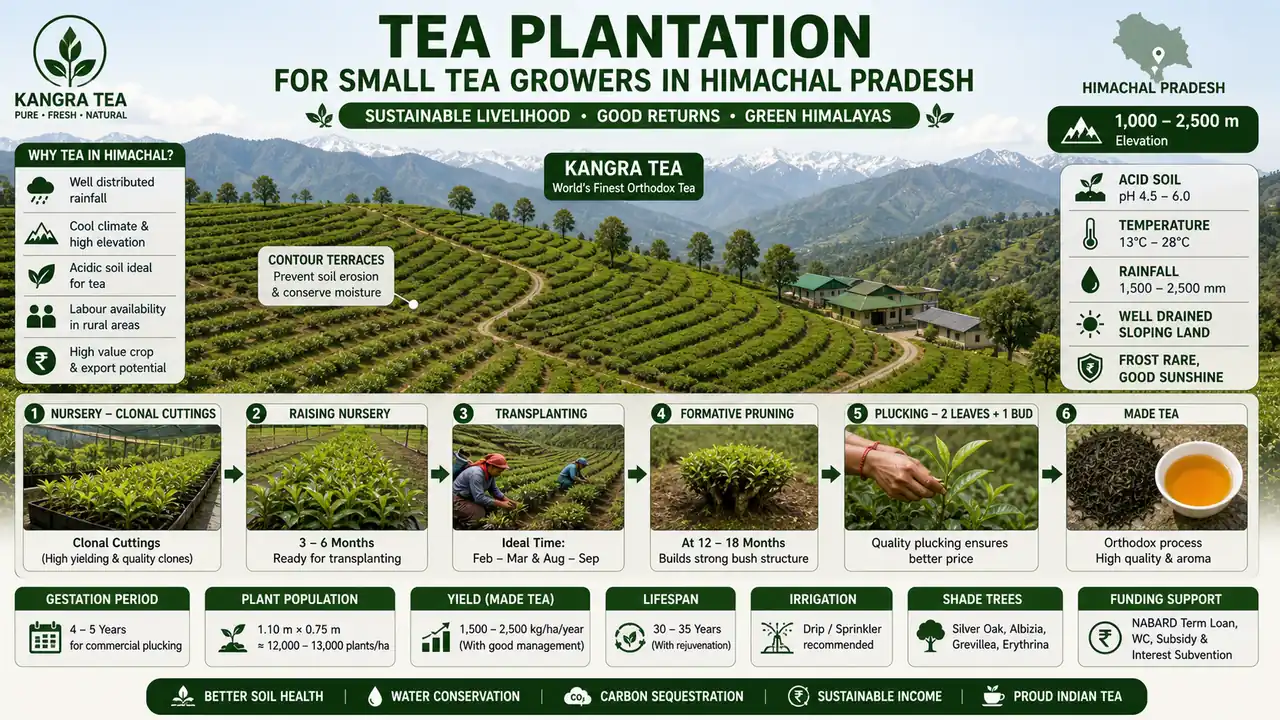
Tea (Camellia sinensis) is India's largest foreign exchange earner among agricultural commodities and the nation's most consumed beverage. India is the world's second largest producer of tea and the largest consumer, with Himachal Pradesh's Kangra tea occupying a premium niche in the orthodox tea segment.
- India's total tea production: ~1,350–1,400 million kg/year
- Global rank: 2nd largest producer (after China); largest consumer
- Major tea regions: Assam (50%+), West Bengal/Darjeeling (~25%), Tamil Nadu (~15%), Kerala, HP
- HP tea (Kangra): Known for delicate flavour, exported to Europe; premium price
NOTE
Exam trap: India is the 2nd largest producer of tea globally (China is 1st) but the largest consumer (domestic consumption absorbs ~80% of production). This is why export share is relatively small despite high production.
Pro Content Locked
Upgrade to Pro to access this lesson and all other premium content.
₹99 charged monthly · Cancel anytime
- All Agriculture & Banking Courses
- AI Lesson Questions (100/day)
- AI Doubt Solver (50/day)
- Glows & Grows Feedback (30/day)
- AI Section Quiz (20/day)
- 22-Language Translation (100/day)
- Recall Questions (20/day)
- AI Quiz (15/day)
- AI Quiz Paper Analysis (100/day)
- AI Step-by-Step Explanations (100/day)
- Spaced Repetition Recall (FSRS)
- AI Tutor
- Immersive Text Questions
- Audio Lessons — Hindi & English
- Mock Tests & Previous Year Papers
- Summary & Mind Maps
- XP, Levels, Leaderboard & Badges
- Generate New Classrooms
- Voice AI Teacher (AgriDots Live)
- AI Revision Assistant
- Knowledge Gap Analysis
- Interactive Revision (LangGraph)
🔒 Secure via Razorpay · Cancel anytime · No hidden fees
Tea (Camellia sinensis) is India's largest foreign exchange earner among agricultural commodities and the nation's most consumed beverage. India is the world's second largest producer of tea and the largest consumer, with Himachal Pradesh's Kangra tea occupying a premium niche in the orthodox tea segment.
- India's total tea production: ~1,350–1,400 million kg/year
- Global rank: 2nd largest producer (after China); largest consumer
- Major tea regions: Assam (50%+), West Bengal/Darjeeling (~25%), Tamil Nadu (~15%), Kerala, HP
- HP tea (Kangra): Known for delicate flavour, exported to Europe; premium price
NOTE
Exam trap: India is the 2nd largest producer of tea globally (China is 1st) but the largest consumer (domestic consumption absorbs ~80% of production). This is why export share is relatively small despite high production.
Himachal Pradesh Tea Overview
- HP tea regions: Kangra, Mandi, Shimla, Chamba, Solan, Kullu
- Kangra tea has Geographical Indication (GI) status
- Most HP tea is orthodox green/black tea — hand-rolled, artisanal, premium-priced
- Small tea growers (< 10 ha) account for a growing share of HP tea area
Why small growers need NABARD financing:
- Tea is a perennial crop with 4–5 year gestation before commercial yields
- Land preparation (terracing on slopes) is expensive
- Young plants require intensive management for 3–4 years before first plucking
Agro-Climatic Requirements
| Parameter | Requirement |
|---|---|
| Temperature | 15–30°C; frost-free required |
| Rainfall | 1,500–2,500 mm/year; well-distributed |
| Altitude | 1,000–2,500 m MSL in HP |
| Soil | Deep, well-drained, acidic; pH 4.5–6.0 |
| Humidity | High (>70%) promotes quality |
Critical: Tea roots are highly sensitive to waterlogging. Well-drained slopes at altitude are ideal.
Planting Material
- Propagation: Vegetative (rooted cuttings) exclusively for commercial tea; ensures clone uniformity
- Popular clones: T78, S3A3, TV1, TV26 (for HP conditions)
- Seedlings not used — clones have consistent biochemistry and yield
- Planting material: 12–18 month old rooted cuttings from certified nurseries
Why clonal tea? The flavour compounds (polyphenols, catechins, thearubigins) are genetically fixed — clonal material ensures uniform quality. Seedling tea shows wide variation.
Planting System
| Parameter | Value |
|---|---|
| Spacing (single hedge) | 1.5 m × 0.75 m = 8,888 plants/ha |
| Spacing (double hedge) | 1.35 m × 0.75 m × 0.75 m |
| Recommended density | 7,000–9,000 plants/ha |
| Planting season (HP) | March–April or September–October |
| Slope management | Terracing mandatory on slopes >15° |
Cost of Cultivation (1.0 ha — HP Small Grower)
| Year | Activity | Cost (₹) |
|---|---|---|
| Year 1 | Terracing/land prep, rooted cuttings (8,000 @ ₹3–5), transplanting, shade trees, fertilizers | ₹60,000–80,000 |
| Year 2 | Infilling (gap filling 10%), weed control, fertilizers | ₹20,000–25,000 |
| Year 3 | Fertilizers, formative pruning, first light plucking | ₹18,000–22,000 |
| Year 4–5 | Progressive plucking; full management | ₹25,000–30,000/year |
| Total project cost (5 years) | ₹1.50–1.75 lakh/ha |
| Financing | Value |
|---|---|
| Bank loan (85%) | ₹1.28–1.49 lakh |
| Margin money (15%) | ₹0.22–0.26 lakh |
| Moratorium | 4–5 years |
| Repayment period | 9–12 years |
Income and Viability
| Year | Green Leaf Yield (kg/ha) | Price (₹/kg) | Gross Income |
|---|---|---|---|
| Year 3 (trial) | 500–800 | 18–25 | ₹9,000–20,000 |
| Year 5 (commercial) | 4,000–5,000 | 18–30 | ₹72,000–1,50,000 |
| Year 8+ (mature) | 8,000–10,000 | 20–35 | ₹1,60,000–3,50,000 |
Green leaf conversion: ~4.5 kg green leaf = 1 kg made (processed) tea
- Kangra orthodox tea sells at ₹400–800/kg at specialty markets vs ₹180–250/kg for CTC
NOTE
The conversion ratio (green leaf to made tea) is critical: 4–4.5 kg green leaf → 1 kg made tea. This is frequently asked in NABARD/exams processing questions. For CTC tea the ratio is similar but quality is lower.
Productive life of tea bush: 50–80 years — extraordinarily long asset life that makes the long moratorium financially justified.
Exam Summary
| Parameter | Value |
|---|---|
| India's global rank (production) | 2nd (after China) |
| India's status (consumption) | Largest consumer |
| HP tea GI | Kangra Tea |
| Soil pH for tea | 4.5–6.0 (acidic) |
| Planting density | 7,000–9,000 plants/ha |
| Propagation | Vegetative (rooted cuttings/clones) |
| Gestation period | 4–5 years |
| Full bearing yield | 8,000–10,000 kg green leaf/ha |
| Green leaf: made tea ratio | 4–4.5 : 1 |
| Productive life | 50–80 years |
| Moratorium | 4–5 years |
| Repayment | 9–12 years |
Sources & References
Primary source for this lesson is NABARD's official Model Bankable Projects portal.[1] Lesson-specific report copy used for this topic.[2]
References
2 sources • [1] [2]
References
Used for: Official NABARD portal for model bankable project documents and updates.
Used for: Reference copy used in this lesson for project parameters and worked figures.
The figures in this lesson reflect the cost norms and technical parameters as published in the NABARD document. Actual costs may vary by state, season, and year of implementation. Always refer to the latest NABARD circular for current norms.
Summary Cheat Sheet
| Concept / Topic | Key Details / Explanation |
|---|---|
| Scientific name | Camellia sinensis |
| India's global rank | 2nd largest producer (China 1st); largest consumer (80% domestic consumption) |
| India's production | ~1,350–1,400 million kg/year |
| Major regions | Assam (50%+), West Bengal/Darjeeling (~25%), Tamil Nadu (~15%), Kerala, HP |
| HP GI tea | Kangra Tea — orthodox, premium, exported to Europe |
| HP tea regions | Kangra, Mandi, Shimla, Chamba, Solan, Kullu |
| Temperature | 15–30°C; frost-free required |
| Rainfall | 1,500–2,500 mm/year; well-distributed |
| Altitude (HP) | 1,000–2,500 m MSL |
| Soil pH | 4.5–6.0 (acidic) — critical; tea is very acid-tolerant |
| Propagation | Vegetative (rooted cuttings/clones) exclusively — NOT seeds |
| Popular HP clones | T78, S3A3, TV1, TV26 |
| Spacing (single hedge) | 1.5 m × 0.75 m = 8,888 plants/ha |
| Recommended density | 7,000–9,000 plants/ha |
| Planting season (HP) | March–April or September–October |
| Gestation period | 4–5 years |
| Total project cost (5 yr) | ₹1.50–1.75 lakh/ha |
| Bank loan | 85% = ₹1.28–1.49 lakh |
| Margin money | 15% = ₹0.22–0.26 lakh |
| Moratorium | 4–5 years |
| Repayment | 9–12 years |
| Full bearing yield | 8,000–10,000 kg green leaf/ha (Year 8+) |
| Green leaf: made tea ratio | 4–4.5 kg green leaf → 1 kg made tea |
| Kangra orthodox price | ₹400–800/kg (vs CTC ₹180–250/kg) |
| Productive life | 50–80 years (justifies long moratorium) |
| Key exam trap | India = 2nd producer (NOT 1st); largest consumer; Kangra has GI tag |
Lesson Doubts
Ask questions, get expert answers