🥝 Kiwi Cultivation — NABARD Model Bankable Project
Kiwi is a high-value temperate fruit with massive import substitution potential — India imports kiwi worth hundreds of crores annually despite having ideal growing conditions in HP, J&K, and Uttarakhand. This NABARD model covers kiwi cultivation economics, vine management, costs, income, and financing parameters for competitive exams.
Kiwi (Actinidia deliciosa) is among India's most expensive retail fruits — imported mainly from New Zealand and Italy at ₹200–400/kg. India spends hundreds of crores annually on kiwi imports despite having ideal growing conditions in Himachal Pradesh, Jammu & Kashmir, Uttarakhand, Sikkim, Meghalaya, and Arunachal Pradesh.
- Global kiwi production leaders: China (65%), Italy, New Zealand, Iran, Chile
- India's domestic production: negligible (~5,000–8,000 tonnes/year) — massive untapped potential
- HP is India's most developed kiwi-growing region
NOTE
Exam angle: Kiwi is a high import-substitution opportunity crop. India's kiwi import bill is a frequently cited policy concern. NABARD's model bankable project aims to enable credit access for farmers in suitable hill regions.
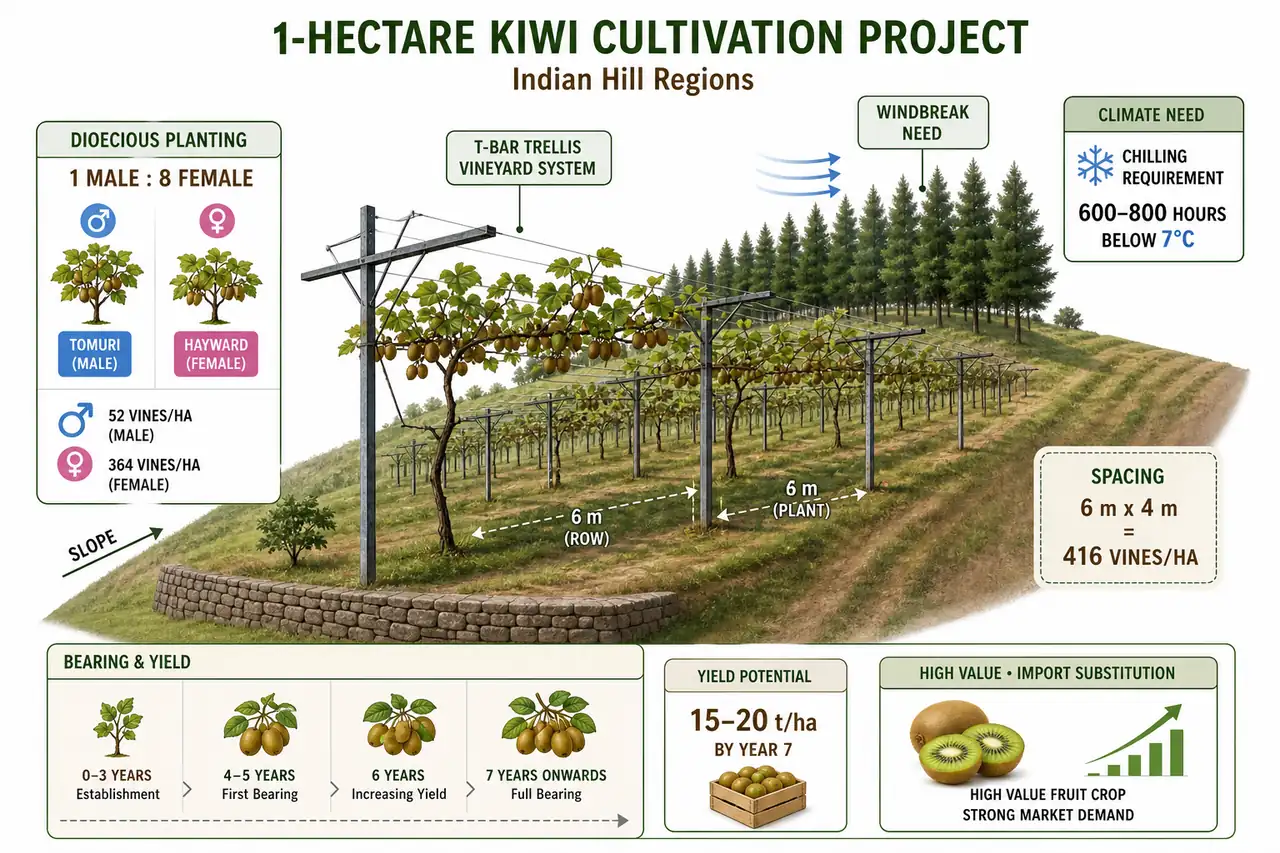
Agro-Climatic Requirements
| Parameter | Requirement |
|---|---|
| Temperature | 15–25°C growing season; needs 600–800 chilling hours |
| Chilling requirement | 600–800 hours below 7°C for dormancy break |
| Rainfall | 1,500 mm+; needs dry spell during harvest |
| Altitude | 1,000–2,500 m MSL (ideal for HP) |
| Soil pH | 6.0–6.5; deep, well-drained, high organic matter |
| Wind | Sensitive to strong winds — windbreaks required |
Critical: Kiwi is dioecious — separate male and female plants needed. One male plant pollinates 5–8 female plants. Without this ratio, no fruit is set.
Pro Content Locked
Upgrade to Pro to access this lesson and all other premium content.
₹99 charged monthly · Cancel anytime
- All Agriculture & Banking Courses
- AI Lesson Questions (100/day)
- AI Doubt Solver (50/day)
- Glows & Grows Feedback (30/day)
- AI Section Quiz (20/day)
- 22-Language Translation (100/day)
- Recall Questions (20/day)
- AI Quiz (15/day)
- AI Quiz Paper Analysis (100/day)
- AI Step-by-Step Explanations (100/day)
- Spaced Repetition Recall (FSRS)
- AI Tutor
- Immersive Text Questions
- Audio Lessons — Hindi & English
- Mock Tests & Previous Year Papers
- Summary & Mind Maps
- XP, Levels, Leaderboard & Badges
- Generate New Classrooms
- Voice AI Teacher (AgriDots Live)
- AI Revision Assistant
- Knowledge Gap Analysis
- Interactive Revision (LangGraph)
🔒 Secure via Razorpay · Cancel anytime · No hidden fees
Kiwi (Actinidia deliciosa) is among India's most expensive retail fruits — imported mainly from New Zealand and Italy at ₹200–400/kg. India spends hundreds of crores annually on kiwi imports despite having ideal growing conditions in Himachal Pradesh, Jammu & Kashmir, Uttarakhand, Sikkim, Meghalaya, and Arunachal Pradesh.
- Global kiwi production leaders: China (65%), Italy, New Zealand, Iran, Chile
- India's domestic production: negligible (~5,000–8,000 tonnes/year) — massive untapped potential
- HP is India's most developed kiwi-growing region
NOTE
Exam angle: Kiwi is a high import-substitution opportunity crop. India's kiwi import bill is a frequently cited policy concern. NABARD's model bankable project aims to enable credit access for farmers in suitable hill regions.
Agro-Climatic Requirements
| Parameter | Requirement |
|---|---|
| Temperature | 15–25°C growing season; needs 600–800 chilling hours |
| Chilling requirement | 600–800 hours below 7°C for dormancy break |
| Rainfall | 1,500 mm+; needs dry spell during harvest |
| Altitude | 1,000–2,500 m MSL (ideal for HP) |
| Soil pH | 6.0–6.5; deep, well-drained, high organic matter |
| Wind | Sensitive to strong winds — windbreaks required |
Critical: Kiwi is dioecious — separate male and female plants needed. One male plant pollinates 5–8 female plants. Without this ratio, no fruit is set.
Varieties
| Variety | Type | Characteristics |
|---|---|---|
| Hayward | Female | Most popular; large oval fruit; long shelf life |
| Allison | Female | Early bearing, smaller fruit |
| Bruno | Female | Elongated fruit |
| Tomuri | Male | Main pollinator for Hayward |
| Matua | Male | Alternate pollinator |
Hayward + Tomuri is the dominant commercial combination worldwide.
Planting System
| Parameter | Value |
|---|---|
| Spacing | 6 m × 4 m (T-bar trellis) or 5 m × 5 m |
| Plants/ha (6×4 m) | 416 plants (including ~55 male plants) |
| Male:Female ratio | 1:8 (one male per 8 females) |
| Training system | T-bar trellis or Pergola system |
| Trellis height | 1.8–2.0 m |
Why trellis is essential: Kiwi is a vigorous vine — it cannot support its own weight. The T-bar trellis is both a structural and a management investment, representing ~20–25% of total project cost.
Cost of Cultivation (1.0 ha)
| Year | Activity | Cost (₹) |
|---|---|---|
| Year 1 | Land prep, trellis installation, planting material (416 vines), irrigation | ₹1,80,000–2,20,000 |
| Year 2–3 | Training, pruning, fertilizers, plant protection | ₹40,000–50,000/year |
| Year 4–5 | First bearing, full management | ₹50,000–60,000/year |
| Total (5-year) project cost | ₹3.20–3.80 lakh |
Cost breakdown Year 1:
- Trellis (GI wire + posts): ₹80,000–1,00,000
- Planting material (416 vines @ ₹150–200): ₹62,000–83,000
- Land prep + pits + soil amendment: ₹20,000
- Drip irrigation: ₹30,000–40,000
| Financing | Value |
|---|---|
| Total project cost | ₹3.50–4.00 lakh/ha |
| Bank loan (85%) | ₹2.98–3.40 lakh |
| Margin money (15%) | ₹0.52–0.60 lakh |
| Moratorium | 4–5 years |
| Repayment | 10–12 years |
Income Projections
| Year | Yield (t/ha) | Farm Price (₹/kg) | Gross Income |
|---|---|---|---|
| Year 4 (first) | 2–4 | 60–100 | ₹1.20–4.00 lakh |
| Year 7 (full) | 15–20 | 60–100 | ₹9.00–20.00 lakh |
Net income at full bearing: ₹7.00–16.00 lakh/ha/year
This makes kiwi one of the highest-income-per-hectare crops in Indian hill horticulture.
NOTE
Kiwi's productive life is 25–40 years — making it an extraordinary long-term investment. The expensive trellis and infrastructure cost is amortized over decades. The payback period of 6–8 years is very favorable given the life of the orchard.
Exam Summary
| Parameter | Value |
|---|---|
| Botanical name | Actinidia deliciosa |
| Plant type | Dioecious vine (separate male/female) |
| Male:Female ratio | 1:8 |
| Chilling requirement | 600–800 hours below 7°C |
| Best variety | Hayward (female) + Tomuri (male) |
| Spacing | 6 m × 4 m = 416 vines/ha |
| Training system | T-bar trellis |
| Gestation period | 4–5 years |
| Full bearing yield | 15–20 t/ha |
| Productive life | 25–40 years |
| India's suitable regions | HP, J&K, Uttarakhand, Sikkim, NE India |
| Loan component | 85% |
| Moratorium | 4–5 years |
Sources & References
Primary source for this lesson is NABARD's official Model Bankable Projects portal.[1] Lesson-specific report copy used for this topic.[2]
References
2 sources • [1] [2]
References
Used for: Official NABARD portal for model bankable project documents and updates.
Used for: Reference copy used in this lesson for project parameters and worked figures.
The figures in this lesson reflect the cost norms and technical parameters as published in the NABARD document. Actual costs may vary by state, season, and year of implementation. Always refer to the latest NABARD circular for current norms.
Summary Cheat Sheet
| Concept / Topic | Key Details / Explanation |
|---|---|
| Scientific name | Actinidia deliciosa |
| Plant type | Dioecious vine — separate male and female plants required |
| Global leaders | China (65%), Italy, New Zealand, Iran, Chile |
| India's production | ~5,000–8,000 tonnes/year (negligible; massive import-substitution potential) |
| Suitable Indian regions | HP, J&K, Uttarakhand, Sikkim, Meghalaya, Arunachal Pradesh |
| Temperature | 15–25°C growing season |
| Chilling requirement | 600–800 hours below 7°C (dormancy break — critical) |
| Rainfall | 1,500 mm+; dry spell needed during harvest |
| Altitude | 1,000–2,500 m MSL |
| Soil pH | 6.0–6.5; deep, well-drained, high organic matter |
| Wind sensitivity | Needs windbreaks — sensitive to strong winds |
| Best female variety | Hayward — large oval fruit, long shelf life |
| Best male pollinator | Tomuri (main) + Matua (alternate) |
| Commercial combination | Hayward + Tomuri |
| Male:Female ratio | 1:8 (1 male per 8 females) |
| Spacing | 6 m × 4 m = 416 vines/ha (incl. ~55 male plants) |
| Training system | T-bar trellis (or Pergola); height 1.8–2.0 m |
| Trellis cost | ₹80,000–1,00,000/ha (GI wire + posts) — 20–25% of project cost |
| Gestation | 4–5 years (first bearing Year 4) |
| Full bearing yield | 15–20 t/ha (Year 7+) |
| Farm gate price | ₹60–100/kg |
| Net income (full bearing) | ₹7.00–16.00 lakh/ha/year |
| Total project cost (5 yr) | ₹3.50–4.00 lakh/ha |
| Bank loan | 85% = ₹2.98–3.40 lakh |
| Margin money | 15% = ₹0.52–0.60 lakh |
| Moratorium | 4–5 years |
| Repayment | 10–12 years |
| Productive life | 25–40 years |
| Key import context | India imports kiwi at ₹200–400/kg (New Zealand/Italy); import substitution is key policy goal |
Lesson Doubts
Ask questions, get expert answers