🐝 Beekeeping — NABARD Model Bankable Scheme
Beekeeping is a low-investment, high-return enterprise that produces honey, beeswax, and pollination services. This NABARD model scheme covers colony establishment, hive management, honey production targets, costs, income, and bank financing parameters critical for exams.
Beekeeping (Apiculture) is a triple-benefit enterprise: it produces honey (food/medicinal), beeswax (industrial), and provides pollination services that increase crop yields by 20–40% for surrounding farms. It requires minimal land, low initial capital, and generates income within the first year.
- India's honey production: ~1,20,000–1,40,000 tonnes/year
- India's rank in global honey production: 8th
- Primary bee species used: Apis mellifera (Italian bee, commercial), Apis cerana indica (Indian bee, traditional)
- Key honey-producing states: UP, Punjab, Himachal Pradesh, Uttarakhand, Rajasthan, West Bengal
NOTE
Exam trap: The two main honey bee species differ critically: Apis mellifera (Italian bee) is used for commercial beekeeping — high honey production (40–60 kg/colony/year). Apis cerana indica (Indian bee) produces only 6–8 kg/colony/year but is better for pollination in local ecosystems.
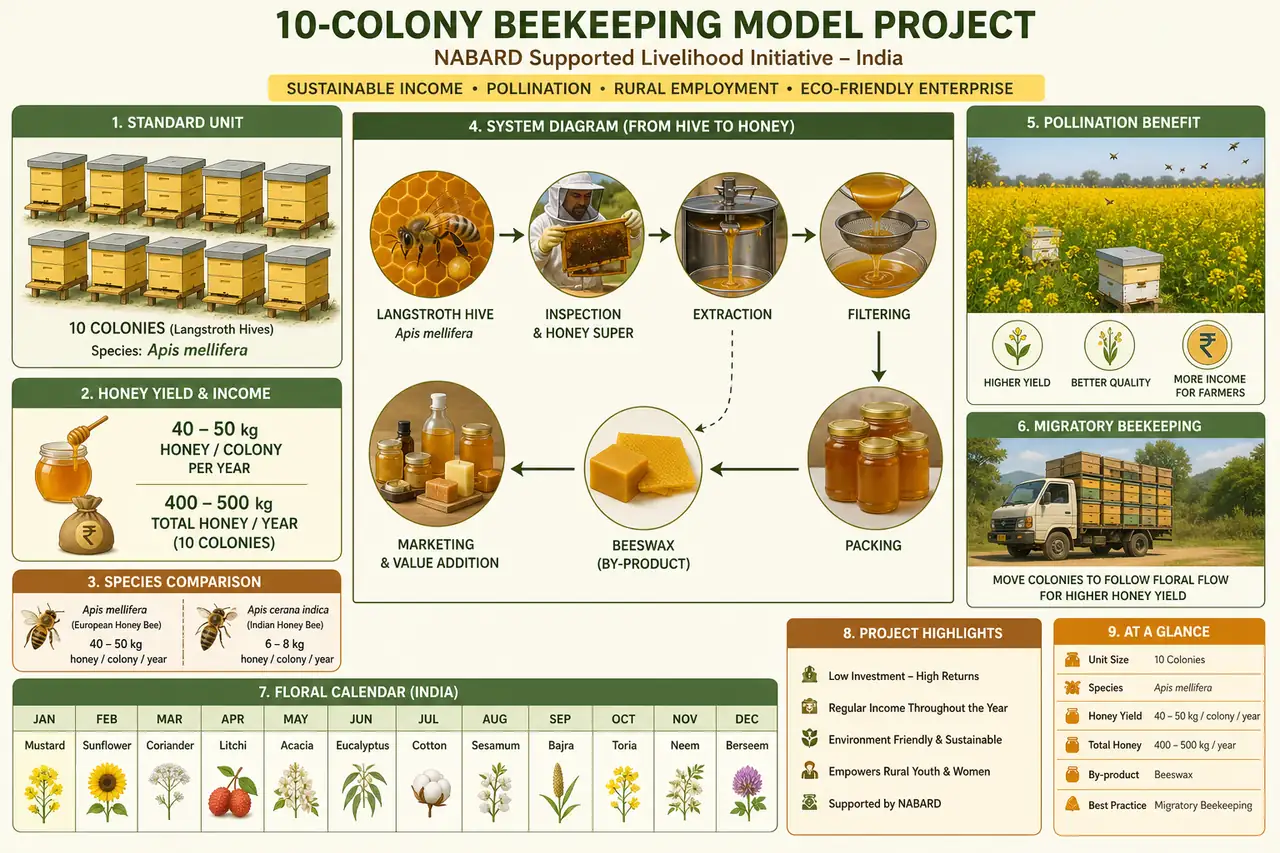
Bee Species Comparison
| Species | Type | Honey Yield | Nature | Use |
|---|---|---|---|---|
| Apis mellifera | Italian/Exotic | 40–60 kg/colony/year | Gentle, prolific | Commercial honey |
| Apis cerana indica | Indian/Native | 6–8 kg/colony/year | Defensive | Traditional, pollination |
| Apis dorsata | Rock bee | 36 kg/nest | Wild, aggressive | Cannot be domesticated |
| Apis florea | Little bee | <0.5 kg/nest | Wild | Cannot be domesticated |
Model Unit Setup (10 Colonies — NABARD Standard)
Equipment per hive (Langstroth hive — 10 box hives):
Pro Content Locked
Upgrade to Pro to access this lesson and all other premium content.
₹99 charged monthly · Cancel anytime
- All Agriculture & Banking Courses
- AI Lesson Questions (100/day)
- AI Doubt Solver (50/day)
- Glows & Grows Feedback (30/day)
- AI Section Quiz (20/day)
- 22-Language Translation (100/day)
- Recall Questions (20/day)
- AI Quiz (15/day)
- AI Quiz Paper Analysis (100/day)
- AI Step-by-Step Explanations (100/day)
- Spaced Repetition Recall (FSRS)
- AI Tutor
- Immersive Text Questions
- Audio Lessons — Hindi & English
- Mock Tests & Previous Year Papers
- Summary & Mind Maps
- XP, Levels, Leaderboard & Badges
- Generate New Classrooms
- Voice AI Teacher (AgriDots Live)
- AI Revision Assistant
- Knowledge Gap Analysis
- Interactive Revision (LangGraph)
🔒 Secure via Razorpay · Cancel anytime · No hidden fees
Beekeeping (Apiculture) is a triple-benefit enterprise: it produces honey (food/medicinal), beeswax (industrial), and provides pollination services that increase crop yields by 20–40% for surrounding farms. It requires minimal land, low initial capital, and generates income within the first year.
- India's honey production: ~1,20,000–1,40,000 tonnes/year
- India's rank in global honey production: 8th
- Primary bee species used: Apis mellifera (Italian bee, commercial), Apis cerana indica (Indian bee, traditional)
- Key honey-producing states: UP, Punjab, Himachal Pradesh, Uttarakhand, Rajasthan, West Bengal
NOTE
Exam trap: The two main honey bee species differ critically: Apis mellifera (Italian bee) is used for commercial beekeeping — high honey production (40–60 kg/colony/year). Apis cerana indica (Indian bee) produces only 6–8 kg/colony/year but is better for pollination in local ecosystems.
Bee Species Comparison
| Species | Type | Honey Yield | Nature | Use |
|---|---|---|---|---|
| Apis mellifera | Italian/Exotic | 40–60 kg/colony/year | Gentle, prolific | Commercial honey |
| Apis cerana indica | Indian/Native | 6–8 kg/colony/year | Defensive | Traditional, pollination |
| Apis dorsata | Rock bee | 36 kg/nest | Wild, aggressive | Cannot be domesticated |
| Apis florea | Little bee | <0.5 kg/nest | Wild | Cannot be domesticated |
Model Unit Setup (10 Colonies — NABARD Standard)
Equipment per hive (Langstroth hive — 10 box hives):
| Item | Cost/unit (₹) | Total (10 units) |
|---|---|---|
| Langstroth hive (complete) | 1,500–2,000 | ₹15,000–20,000 |
| Bee colony with queen | 1,500–2,500 | ₹15,000–25,000 |
| Protective equipment (suit, gloves, veil) | 2,000 | ₹2,000 (1 set) |
| Hive tool, smoker, brush | — | ₹2,000 |
| Honey extractor (manual) | — | ₹6,000–10,000 |
| Storage containers, strainer | — | ₹3,000 |
| Total Fixed Investment (10 colonies) | ₹43,000–62,000 |
Working capital (Year 1 feed/management): ₹10,000–15,000
Total project cost (10 colonies): ₹55,000–75,000
Income Analysis (10 Colonies, Apis mellifera)
| Parameter | Value |
|---|---|
| Honey yield per colony/year | 40–50 kg |
| Total honey (10 colonies) | 400–500 kg/year |
| Honey selling price | ₹200–350/kg (farm gate) |
| Honey income | ₹80,000–1,75,000/year |
| Beeswax yield (1–2% of honey) | 5–10 kg/year |
| Beeswax price | ₹300–400/kg |
| Beeswax income | ₹1,500–4,000 |
| Nucleus colony sales (surplus) | ₹10,000–20,000 |
| Total annual gross income | ₹91,500–1,99,000 |
| Operating cost/year | ₹15,000–20,000 |
| Net income (10 colonies) | ₹70,000–1,80,000/year |
NOTE
Honey yield varies greatly by flora calendar (availability of flowering plants). Peak honey flow months: February–April (mustard, fruit blossoms), September–November (cotton, sunflower, eucalyptus). Beekeepers migrate hives seasonally (migratory beekeeping) to follow flowering crops — this significantly boosts annual yield.
Financial Parameters (NABARD)
| Parameter | Value |
|---|---|
| Standard unit size | 10–50 colonies |
| Total project cost (10 colonies) | ₹55,000–75,000 |
| Bank loan (85%) | ₹47,000–64,000 |
| Margin money (15%) | ₹8,000–11,000 |
| Moratorium | 6 months (first harvest) |
| Repayment period | 3–5 years |
| Subsidy | Available under NHM/MIDH — 40% (SC/ST), 25% (general) |
Scaling up: 50-colony unit generates net income of ₹3.50–9.00 lakh/year — viable full-time enterprise.
Colony Multiplication
Starting with 10 colonies, beekeeper can multiply to 20 colonies by Year 2:
- Each strong colony can be split into 2 nucleus colonies (artificial swarming)
- Growth rate: colonies double every 1–2 years with proper management
Exam Summary
| Parameter | Value |
|---|---|
| Best commercial species | Apis mellifera (Italian bee) |
| A. mellifera yield | 40–60 kg honey/colony/year |
| A. cerana yield | 6–8 kg honey/colony/year |
| Cannot be domesticated | Apis dorsata (rock bee), Apis florea (little bee) |
| India's honey production | ~1.2–1.4 lakh tonnes/year |
| India's global rank | 8th |
| Standard NABARD unit | 10–50 colonies |
| Hive type used | Langstroth hive |
| Moratorium | 6 months |
| Repayment | 3–5 years |
| By-products | Honey, beeswax, propolis, royal jelly, pollination |
Sources & References
Primary source for this lesson is NABARD's official Model Bankable Projects portal.[1] Lesson-specific report copy used for this topic.[2]
References
2 sources • [1] [2]
References
Used for: Official NABARD portal for model bankable project documents and updates.
Used for: Reference copy used in this lesson for project parameters and worked figures.
The figures in this lesson reflect the cost norms and technical parameters as published in the NABARD document. Actual costs may vary by state, season, and year of implementation. Always refer to the latest NABARD circular for current norms.
Summary Cheat Sheet
| Concept / Topic | Key Details / Explanation |
|---|---|
| India's honey production | ~1.2–1.4 lakh tonnes/year |
| India's global rank | 8th in honey production |
| Commercial species | Apis mellifera (Italian bee) — 40–60 kg honey/colony/year |
| Indian/native species | Apis cerana indica — 6–8 kg/colony/year; better for local pollination |
| Rock bee | Apis dorsata — 36 kg/nest but cannot be domesticated |
| Little bee | Apis florea — <0.5 kg/nest; cannot be domesticated |
| Hive type | Langstroth hive (10-box) — standard for A. mellifera |
| Standard NABARD unit | 10–50 colonies |
| Honey yield (10 colonies, A. mellifera) | 400–500 kg/year |
| Honey farm gate price | ₹200–350/kg |
| Honey income (10 colonies) | ₹80,000–1,75,000/year |
| Beeswax yield | 1–2% of honey = 5–10 kg/year/10 colonies at ₹300–400/kg |
| Net income (10 colonies) | ₹70,000–1,80,000/year |
| Net income (50 colonies) | ₹3.50–9.00 lakh/year |
| Total project cost (10 colonies) | ₹55,000–75,000 |
| Bank loan | 85% = ₹47,000–64,000 |
| Margin money | 15% = ₹8,000–11,000 |
| Moratorium | 6 months (first harvest) |
| Repayment | 3–5 years |
| Subsidy | NHM/MIDH — 40% SC/ST, 25% general |
| Peak honey flow months | Feb–Apr (mustard/fruit blossoms), Sep–Nov (cotton/sunflower/eucalyptus) |
| Migratory beekeeping | Moving hives seasonally to follow flowering crops — boosts annual yield |
| Colony multiplication | Each colony splits to 2 nucleus colonies; colonies can double in 1–2 years |
| Triple benefit | Honey (food) + Beeswax (industrial) + Pollination services (crop yield +20–40%) |
| Key states | UP, Punjab, HP, Uttarakhand, Rajasthan, West Bengal |
Lesson Doubts
Ask questions, get expert answers