☀️ Solar Photovoltaic Pumpset — NABARD Model Bankable Project
Covers the NABARD model for Solar PV pumping systems (1800–5000 Wp) for small irrigation — cost models, subsidy structure, IRR, and repayment. JNNSM subsidy, MNRE programmes, and SPV system components are tested in exams and exams.
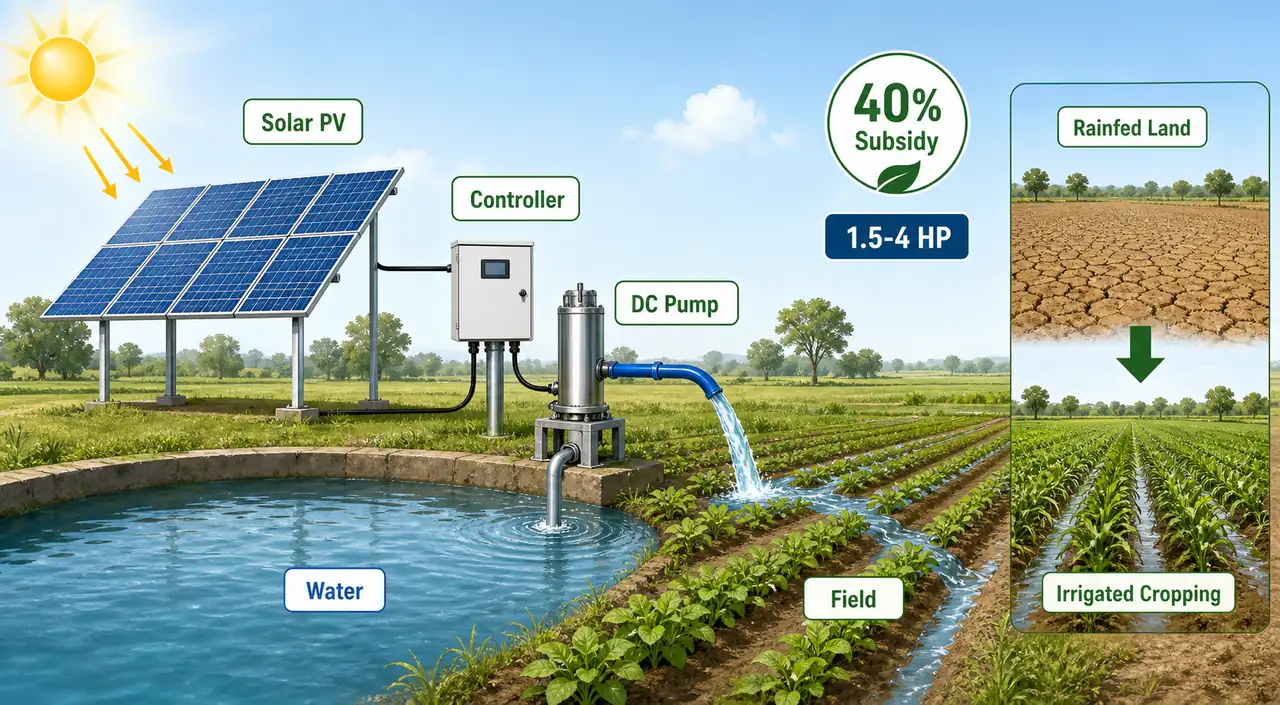
Why Solar Pumpsets?
India receives solar energy equivalent to 5,000 Trillion kWh/year with a daily average of 4–7 kWh/m². Most parts of India have 250–300 sunny days/year. Rural electrification remains incomplete, and where grid power exists, it is erratic during critical farming periods.
Solar PV pumping offers:
- No fuel cost (sunlight is free)
- No monthly electricity bills
- Reliable power independent of grid
- Ideal for remote, non-electrified areas
How SPV Pumping Works
Solar cells convert sunlight → electricity via the photovoltaic effect. Silicon-based cells with 10–12% efficiency drive DC motors connected to submersible pumps.
A solar array of 2–4 m² can discharge 6–8 litres/second at a head of 15–50 m, sufficient to irrigate 1.5–4 ha of land.
System components:
- SPV Module (panels)
- Array tracking structure
- Pumpset (submersible preferred)
- Mounting structure
- Controller (matches variable panel output to motor)
- Cable & wires
- Suction & delivery pipes
Four Models — Cost and Economics
| Model | Capacity | Total Cost (₹) | Cost Net of Subsidy (₹) | Incremental Benefit (₹/year) | IRR |
|---|---|---|---|---|---|
| Model I | 1800 Wp — 1.5 HP | 3,08,320 | 1,84,992 | 39,587 | 15.04% |
| Model II | 2200 Wp — 2 HP | 3,47,200 | 2,08,320 | 44,833 | 15.20% |
| Model III | 3000 Wp — 3 HP | 5,58,400 | 3,35,040 | 72,019 | 15.14% |
| Model IV | 5000 Wp — 4 HP | 7,67,200 | 4,60,320 | 98,729 | 15.06% |
BCR for all models = 1.00 : 1 (marginal viability — only viable with subsidy)
Pro Content Locked
Upgrade to Pro to access this lesson and all other premium content.
₹99 charged monthly · Cancel anytime
- All Agriculture & Banking Courses
- AI Lesson Questions (100/day)
- AI Doubt Solver (50/day)
- Glows & Grows Feedback (30/day)
- AI Section Quiz (20/day)
- 22-Language Translation (100/day)
- Recall Questions (20/day)
- AI Quiz (15/day)
- AI Quiz Paper Analysis (100/day)
- AI Step-by-Step Explanations (100/day)
- Spaced Repetition Recall (FSRS)
- AI Tutor
- Immersive Text Questions
- Audio Lessons — Hindi & English
- Mock Tests & Previous Year Papers
- Summary & Mind Maps
- XP, Levels, Leaderboard & Badges
- Generate New Classrooms
- Voice AI Teacher (AgriDots Live)
- AI Revision Assistant
- Knowledge Gap Analysis
- Interactive Revision (LangGraph)
🔒 Secure via Razorpay · Cancel anytime · No hidden fees
Why Solar Pumpsets?
India receives solar energy equivalent to 5,000 Trillion kWh/year with a daily average of 4–7 kWh/m². Most parts of India have 250–300 sunny days/year. Rural electrification remains incomplete, and where grid power exists, it is erratic during critical farming periods.
Solar PV pumping offers:
- No fuel cost (sunlight is free)
- No monthly electricity bills
- Reliable power independent of grid
- Ideal for remote, non-electrified areas
How SPV Pumping Works
Solar cells convert sunlight → electricity via the photovoltaic effect. Silicon-based cells with 10–12% efficiency drive DC motors connected to submersible pumps.
A solar array of 2–4 m² can discharge 6–8 litres/second at a head of 15–50 m, sufficient to irrigate 1.5–4 ha of land.
System components:
- SPV Module (panels)
- Array tracking structure
- Pumpset (submersible preferred)
- Mounting structure
- Controller (matches variable panel output to motor)
- Cable & wires
- Suction & delivery pipes
Four Models — Cost and Economics
| Model | Capacity | Total Cost (₹) | Cost Net of Subsidy (₹) | Incremental Benefit (₹/year) | IRR |
|---|---|---|---|---|---|
| Model I | 1800 Wp — 1.5 HP | 3,08,320 | 1,84,992 | 39,587 | 15.04% |
| Model II | 2200 Wp — 2 HP | 3,47,200 | 2,08,320 | 44,833 | 15.20% |
| Model III | 3000 Wp — 3 HP | 5,58,400 | 3,35,040 | 72,019 | 15.14% |
| Model IV | 5000 Wp — 4 HP | 7,67,200 | 4,60,320 | 98,729 | 15.06% |
BCR for all models = 1.00 : 1 (marginal viability — only viable with subsidy)
NOTE
Critical exam fact: SPV pumpsets are financially viable ONLY with a minimum 40% subsidy. Without subsidy, the economics do not work. The model assumes 40% subsidy for computing net cost and viability.
Subsidy Structure
| Scheme | Subsidy |
|---|---|
| JNNSM (Jawaharlal Nehru National Solar Mission) | 30% of capital cost (off-grid solar) |
| Additional State Government subsidy | Variable |
| Effective subsidy in model computation | 40% (Central + State combined) |
- MNRE/IREDA authorise dealers of SPV pumping systems
- State nodal agencies of MNES/MNRE channel subsidy to beneficiaries
Model I (1800 Wp / 1.5 HP) — Detailed Economics
| Item | Value |
|---|---|
| Total system cost | ₹3,08,320 |
| Less: 40% subsidy | ₹1,23,328 |
| Net cost to borrower | ₹1,84,992 |
| Annual incremental benefit | ₹39,587 |
| Maintenance cost (Year 5+) | ₹6,215/year |
| NPV @ 15% | ₹207 |
| BCR | 1.00 |
| IRR | 15.04% |
| Minimum area for viability | 0.83 ha |
Repayment: 10 years with 1 year grace period @ 12% interest. Loan = 90% of net cost = ₹1,66,493.
Component-wise Cost (Model I — 1800 Wp)
| Component | Cost (₹) |
|---|---|
| SPV Modules (8 nos.) | 1,07,600 |
| Pumpset (1.5 HP) | 65,000 |
| Mounting structure | 35,000 |
| Controller | 20,000 |
| Cable & wires | 9,000 |
| Suction & delivery pipes | 12,000 |
| Installation & civil work (@7.5%) | 18,645 |
| Maintenance — 5 years @2.5%/year | 31,075 |
| Miscellaneous | 10,000 |
| Total | 3,08,320 |
Minimum Area Requirements
| Structure Type | Minimum Area (ha) |
|---|---|
| Dugwell with SPV | 1.0 ha |
| Borewell with SPV | 1.6 ha |
| Shallow tubewell with SPV | 2.0 ha |
Sale of surplus water to neighbouring farms (up to 50% of loan repayment instalment) is permissible if guaranteed.
Incremental Farm Income (Farm Model — 1 ha)
The model computes benefit as the difference in farm income before and after SPV pumpset installation:
| Period | Total Farm Surplus |
|---|---|
| Pre-development (no irrigation) | ₹14,868/year |
| Post-development (with SPV irrigation) | ₹62,563/year |
| Net incremental income | ₹47,695/year |
Post-development crops include wheat, mustard, gram, coriander, orange — showing shift from rain-fed low-value to irrigated high-value crops.
Key Assumptions in the Model
- 40% subsidy (Central + State) applied to compute net cost
- 210 sunny days/year (120 days Rabi + 90 days other seasons) — varies state to state
- Maintenance contract from supplier for first 5 years at no extra cost
- Solar panel life: 20 years; pumpset life: 10 years
- No replacement cost during repayment period
- Head range: 10–50 m (low-to-medium head pumping)
- Interest rate: 12%
NOTE
Exam trap: The system is viable at 15% IRR — just meeting the hurdle rate. This explains why government subsidy is not optional but essential to make solar pumping bankable.
Repayment
- Repayment: 10 years with 1 year grace period
- Loan disbursed: 90% of net-of-subsidy cost
- Annual maintenance contract from 5th year: ₹6,215 (Model I) to ₹15,775 (Model IV)
- NABARD provides 100% refinance on bank loans for SPV pumpsets
Advantages Summary
| Advantage | Detail |
|---|---|
| Zero fuel cost | Sunlight is free and inexhaustible |
| Low maintenance | Occasional panel cleaning; motor servicing |
| Water conservation | Best combined with drip irrigation |
| Environmentally friendly | Zero carbon emissions |
| Energy security | Decentralised, local power generation |
| Modular | Easily expandable, portable components |
Sources & References
Primary source for this lesson is NABARD's official Model Bankable Projects portal.[1] Lesson-specific report copy used for this topic.[2]
References
2 sources • [1] [2]
References
Used for: Official NABARD portal for model bankable project documents and updates.
Used for: Reference copy used in this lesson for project parameters and worked figures.
The figures in this lesson reflect the cost norms and technical parameters as published in the NABARD document. Actual costs may vary by state, season, and year of implementation. Always refer to the latest NABARD circular for current norms.
Summary Cheat Sheet
| Concept / Topic | Key Details / Explanation |
|---|---|
| India's solar potential | 5,000 Trillion kWh/year; daily average 4–7 kWh/m²; 250–300 sunny days/year |
| System components | SPV modules + array structure + pumpset + mounting + controller + cables + pipes |
| Solar cell efficiency | 10–12% (silicon-based) |
| Discharge rate | 2–4 m² array → 6–8 litres/second at 15–50 m head |
| Irrigable area per unit | 1.5–4 ha per system |
| Model I | 1800 Wp / 1.5 HP; total cost ₹3,08,320; net after 40% subsidy: ₹1,84,992; IRR 15.04% |
| Model II | 2200 Wp / 2 HP; net cost ₹2,08,320; IRR 15.20% |
| Model III | 3000 Wp / 3 HP; net cost ₹3,35,040; IRR 15.14% |
| Model IV | 5000 Wp / 4 HP; net cost ₹4,60,320; IRR 15.06% |
| BCR (all models) | 1.00:1 — marginal viability; viable ONLY with subsidy |
| Key subsidy | JNNSM (Jawaharlal Nehru National Solar Mission) — 30% of capital cost (off-grid solar) |
| Effective subsidy in model | 40% (Central + State combined) |
| Without subsidy | NOT financially viable — subsidy is mandatory |
| Minimum area (Model I) | 0.83 ha for viability |
| Loan (Model I) | 90% of net cost = ₹1,66,493 |
| Interest rate | 12% |
| Repayment | 10 years with 1-year grace period |
| NABARD refinance | 100% refinance on bank loans for SPV pumpsets |
| Pre-development surplus | ₹14,868/year |
| Post-development surplus | ₹62,563/year; incremental benefit ₹47,695/year |
| Solar panel life | 20 years |
| Pumpset life | 10 years |
| Operating days assumed | 210 sunny days/year (120 Rabi + 90 other) |
| Minimum area (dugwell) | 1.0 ha; borewell: 1.6 ha; shallow tubewell: 2.0 ha |
| Key exam trap | IRR is exactly at 15% hurdle — viable ONLY with 40% subsidy; BCR = 1.00 |
Lesson Doubts
Ask questions, get expert answers