🏪 Market Structure: Types, Features & Agricultural Examples
Complete guide to market structures — perfect competition, monopolistic competition, oligopoly, monopoly & duopoly — with agricultural examples, comparison tables, and exam tips for exams, NABARD & exams
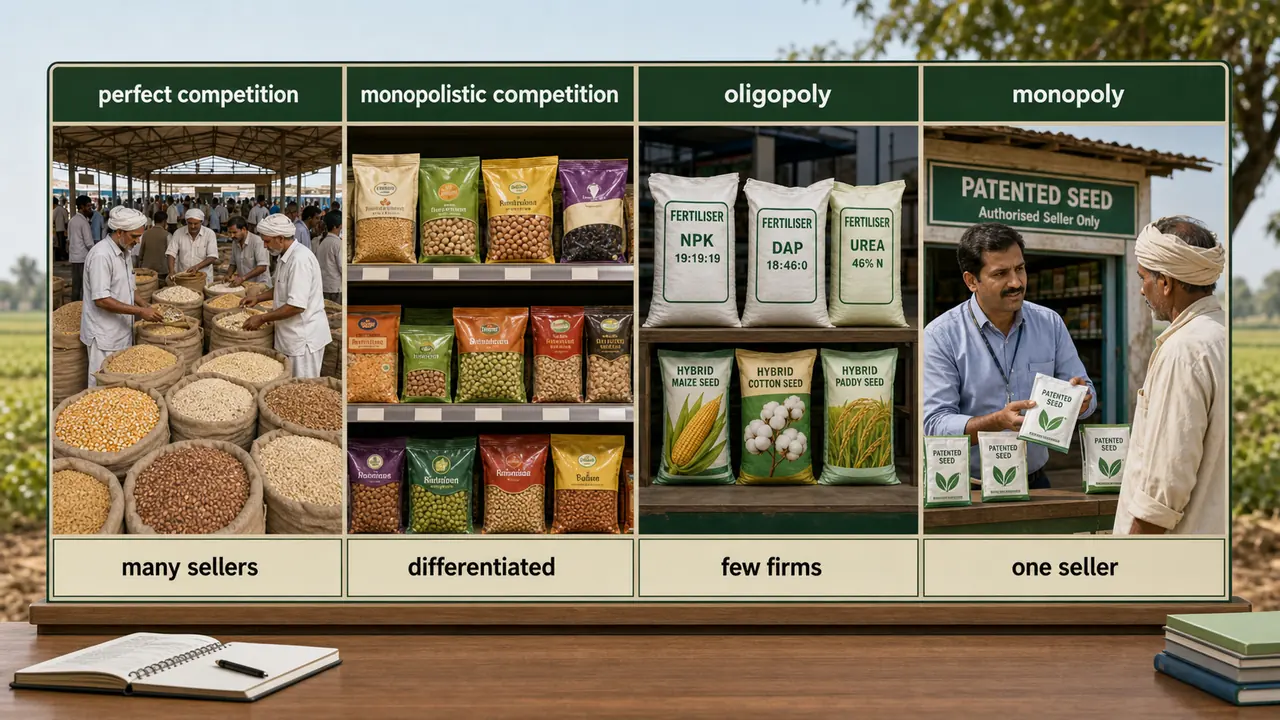
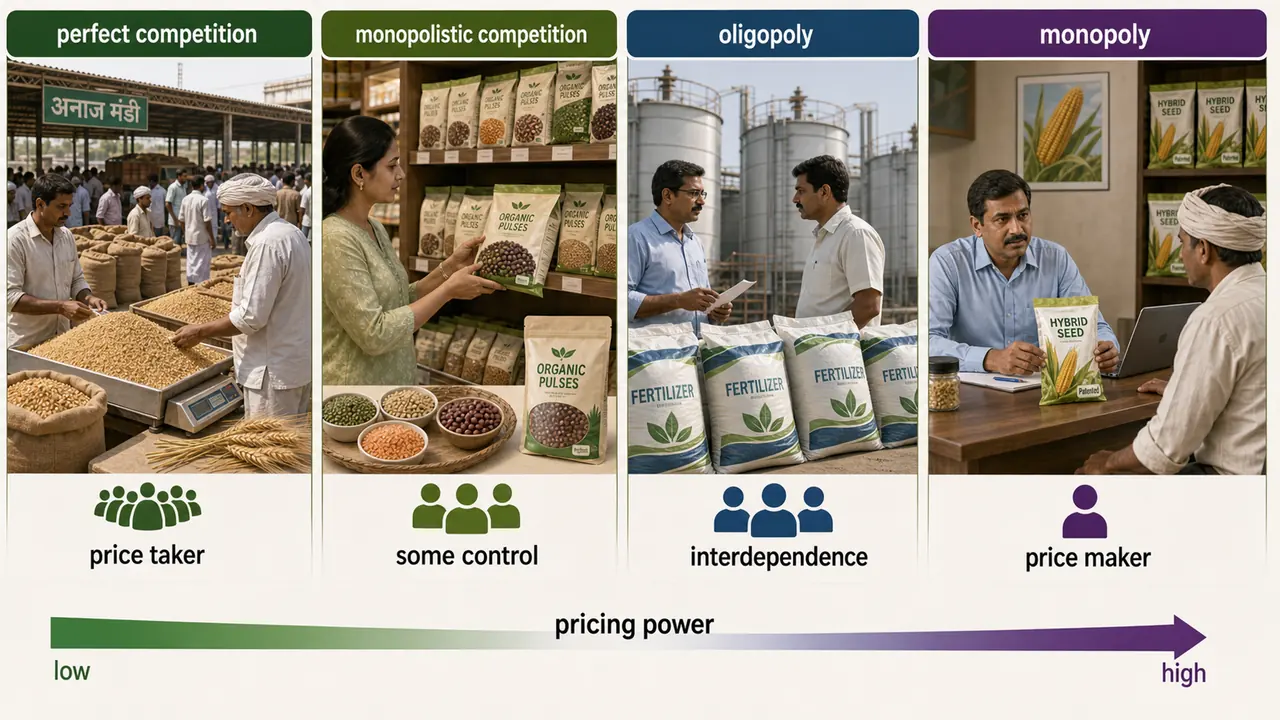
What is Market Structure?
When a farmer grows wheat and takes it to the local mandi, hundreds of other farmers are selling the same grain at the same price. The farmer has no power to charge more — buyers simply move to the next stall. This is the simplest form of market: perfect competition.
But when a single company like FCI controls procurement in a region, or when only two fertilizer brands dominate the market, the rules change entirely. Market structure describes how a market is organized based on the number of sellers, the type of product, barriers to entry, and pricing power.
Pro Content Locked
Upgrade to Pro to access this lesson and all other premium content.
Charged once for one year · ₹1188 total
Save ₹100/month vs ₹2388/year launch price
- All Agriculture & Banking Courses
- AI Lesson Questions (100/day)
- AI Doubt Solver (50/day)
- Glows & Grows Feedback (30/day)
- AI Section Quiz (20/day)
- 22-Language Translation (100/day)
- Recall Questions (20/day)
- AI Quiz (15/day)
- AI Quiz Paper Analysis (100/day)
- AI Step-by-Step Explanations (100/day)
- Spaced Repetition Recall (FSRS)
- AI Tutor
- Immersive Text Questions
- Audio Lessons — Hindi & English
- Mock Tests & Previous Year Papers
- Summary & Mind Maps
- XP, Levels, Leaderboard & Badges
- Generate New Classrooms
- Voice AI Teacher (AgriDots Live)
- AI Revision Assistant
- Knowledge Gap Analysis
- Interactive Revision (LangGraph)
🔒 Secure one-time yearly payment via Razorpay · No hidden fees
What is Market Structure?
When a farmer grows wheat and takes it to the local mandi, hundreds of other farmers are selling the same grain at the same price. The farmer has no power to charge more — buyers simply move to the next stall. This is the simplest form of market: perfect competition.
But when a single company like FCI controls procurement in a region, or when only two fertilizer brands dominate the market, the rules change entirely. Market structure describes how a market is organized based on the number of sellers, the type of product, barriers to entry, and pricing power.
Understanding market structure helps you answer questions like: Why can a wheat farmer not raise prices, but a patented seed company can?
1. Perfect Competition — The Farmer's Mandi
In perfect competition, there are many sellers offering an identical (homogeneous) product. No single seller can influence the market price.
Agricultural example: Wheat, rice, or potato markets at wholesale mandis. Thousands of farmers sell the same commodity. A buyer does not care whose wheat it is — quality is standardized. The farmer is a price taker.
Key features:
- Number of sellers: Very large
- Product type: Homogeneous (identical)
- Barriers to entry: Very low — anyone can start farming
- Pricing power: None — the market sets the price
- Competition based on: Price only
- Profit in long run: Normal profit (zero economic profit)
TIP
Exam mnemonic — "MANY-HOMO-NONE": Many sellers, Homogeneous product, None pricing power. If you see any of these three features in a question, it points to perfect competition.
2. Monopolistic Competition — Branded Agricultural Products
Here, many sellers exist, but each offers a slightly different product. Sellers compete through branding, quality, and marketing — not just price.
Agricultural example: Packaged organic food brands (e.g., organic dal by different companies like Tata Sampann, 24 Mantra, Pro Nature). The underlying product is similar, but packaging, certification, and branding create product differentiation.
Key features:
- Number of sellers: Many
- Product type: Differentiated (similar but not identical)
- Barriers to entry: Low
- Pricing power: Little — brands can charge slightly more
- Competition based on: Marketing, features, and price
- Profit in long run: Normal profit (new entrants erode excess profit)
How it differs from perfect competition: The product is not identical. A consumer may prefer "Organic Tattva" honey over a generic brand and pay a small premium.
3. Oligopoly — Fertilizer & Seed Giants
An oligopoly has only a few sellers who dominate the market. Each firm's decisions directly affect the others, leading to strategic behavior.
Agricultural example: The Indian fertilizer industry is dominated by a handful of companies — IFFCO, NFL, RCF, and Coromandel. Similarly, the global seed market is controlled by Bayer-Monsanto, Corteva, Syngenta, and BASF. Entry requires massive capital, R&D, and regulatory approvals.
Key features:
- Number of sellers: Few (typically 2-10 dominant firms)
- Product type: Can be homogeneous (cement, fertilizer) or differentiated (tractors, pesticides)
- Barriers to entry: High (capital, patents, regulations)
- Pricing power: Little to significant — firms watch each other's pricing
- Competition based on: Marketing, features, and price
- Interdependence: Key feature — one firm's price cut forces others to respond
NOTE
Oligopoly and collusion: Because there are few sellers, firms may collude (form cartels) to fix prices. In agriculture, fertilizer pricing is partly controlled by government subsidies, which limits this behavior.
4. Monopoly — The Single Seller
A monopoly exists when there is one seller with no close substitutes. The seller is a price maker with significant pricing power.
Agricultural example:
- FCI (Food Corporation of India) acts as a near-monopoly buyer (monopsony) in government procurement of wheat and rice in many states
- A company holding the patent on a GM seed variety (e.g., Bt Cotton by Monsanto before patent expiry) is a monopoly seller — farmers have no alternative for that specific trait
- Local sugar mills in some regions are the sole buyer of sugarcane from surrounding farmers
Key features:
- Number of sellers: One
- Product type: Unique (no close substitutes)
- Barriers to entry: Very high (patents, government license, natural barriers)
- Pricing power: Significant — the firm sets the price
- Competition based on: Advertising (to maintain demand, not to compete)
- Profit in long run: Supernormal profit possible (no competition to erode it)
TIP
Exam tip: If a question mentions "price maker" or "significant pricing power," the answer is monopoly. If it mentions "price taker" or "no pricing power," it is perfect competition.
5. Duopoly — A Special Case of Oligopoly
A duopoly is a market with only two sellers of a commodity. It is a special case of oligopoly.
Agricultural example: In some rural districts, only two companies may supply drip irrigation systems (e.g., Jain Irrigation and Netafim). Farmers must choose between these two, and each company watches the other's pricing closely.
Key features:
- Extreme interdependence between two firms
- Models studied: Cournot model (quantity competition) and Bertrand model (price competition)
- Both firms may end up behaving like an oligopoly or even collude like a monopoly
Master Comparison Table asked in exams
| Feature | Perfect Competition | Monopolistic Competition | Oligopoly | Monopoly |
|---|---|---|---|---|
| Number of Sellers | Many | Many | Few | One |
| Product Type | Homogeneous | Differentiated | Homogeneous or Differentiated | Unique |
| Barriers to Entry | Very low | Low | High | Very high |
| Type of Substitute | Very good (identical) | Good but differentiated | Good differentiated substitutes | No good substitutes |
| Nature of Competition | Price only | Marketing, features & price | Marketing, features & price | Advertising |
| Pricing Power | None (price taker) | Little | Little to significant | Significant (price maker) |
| Long-run Profit | Normal | Normal | Above normal possible | Supernormal possible |
| Agri Example | Wheat mandi | Organic brands | Fertilizer companies | Patented GM seed |
Market Equilibrium
The equality of quantity demanded and quantity supplied is called equilibrium quantity. At this point, the price at which the commodity is sold is called the equilibrium price.
Agricultural example: During the rabi season, if wheat supply at the mandi exactly matches buyer demand, the resulting price is the equilibrium price. If there is a bumper crop (excess supply), price falls below equilibrium. If there is a drought (short supply), price rises above equilibrium.
IMPORTANT
Key exam distinctions:
- Perfect competition = price taker (no pricing power)
- Monopoly = price maker (significant pricing power)
- Oligopoly = few sellers with high barriers and interdependence
- Monopolistic competition = many sellers with product differentiation
- Duopoly = two sellers (special case of oligopoly)
Exam Quick-Reference
| Question Clue | Answer |
|---|---|
| "Price taker" or "no pricing power" | Perfect Competition |
| "Product differentiation" + many sellers | Monopolistic Competition |
| "Few sellers" or "interdependence" | Oligopoly |
| "Two sellers" | Duopoly |
| "Price maker" or "significant pricing power" | Monopoly |
| "Homogeneous product" + many sellers | Perfect Competition |
| "No close substitutes" | Monopoly |
| "High barriers to entry" + few firms | Oligopoly |
TIP
Memory trick — count the sellers: Perfect Competition (∞ many) → Monopolistic (many but different) → Oligopoly (few) → Duopoly (2) → Monopoly (1). Think of it as a descending staircase from many to one. As sellers decrease, pricing power increases.
Summary Cheat Sheet
| Concept / Topic | Key Details / Explanation |
|---|---|
| Market Structure | How a market is organized based on number of sellers, product type, barriers to entry, and pricing power |
| Perfect Competition | Many sellers, homogeneous (identical) product, very low barriers, no pricing power (price taker), long-run = normal profit |
| Perfect Competition Example | Wheat/rice/potato at wholesale mandis — standardized commodity, thousands of sellers |
| Perfect Competition Mnemonic | MANY-HOMO-NONE — Many sellers, Homogeneous product, None pricing power |
| Monopolistic Competition | Many sellers, differentiated product (branding), low barriers, little pricing power, long-run = normal profit |
| Monopolistic Competition Example | Packaged organic food brands (Tata Sampann, 24 Mantra) — similar product, differentiated by branding and certification |
| Oligopoly | Few sellers (2-10 dominant firms), product can be homogeneous or differentiated, high barriers, key feature = interdependence |
| Oligopoly Example | Indian fertilizer industry (IFFCO, NFL, RCF); global seed market (Bayer-Monsanto, Corteva, Syngenta) |
| Oligopoly & Collusion | Few sellers may form cartels to fix prices; in agriculture, partly limited by government subsidies |
| Monopoly | One seller, unique product (no close substitutes), very high barriers (patents, licenses), price maker, long-run = supernormal profit possible |
| Monopoly Example | FCI as near-monopoly buyer (monopsony); patented GM seed (e.g., Bt Cotton); local sugar mills as sole buyer |
| Duopoly | Two sellers — special case of oligopoly; extreme interdependence; models: Cournot (quantity) and Bertrand (price) |
| Duopoly Example | Two drip irrigation companies in a rural district (e.g., Jain Irrigation and Netafim) |
| Price Taker vs Price Maker | Perfect competition = price taker (no power); Monopoly = price maker (significant power) |
| Barriers to Entry | Perfect competition = very low; Monopolistic = low; Oligopoly = high; Monopoly = very high |
| Long-run Profit | Perfect & Monopolistic competition = normal profit; Oligopoly = above normal possible; Monopoly = supernormal possible |
| Equilibrium Quantity | Where quantity demanded = quantity supplied; the price at this point = equilibrium price |
| Seller Count Staircase | Perfect (∞) → Monopolistic (many but different) → Oligopoly (few) → Duopoly (2) → Monopoly (1); as sellers decrease, pricing power increases |
| Exam Clue: "Product Differentiation" | Answer = Monopolistic Competition |
| Exam Clue: "Interdependence" | Answer = Oligopoly |
| Exam Clue: "No close substitutes" | Answer = Monopoly |
Lesson Doubts
Ask questions, get expert answers