💰 Capital & National Income: Types, Formulas & Agricultural Applications
Comprehensive guide to types of capital (fixed, working, sunk, floating, social, private) with farm examples, and national income concepts — GDP, GNP, NNP, personal income, disposable income, per capita income with formulas, mnemonics, and exam tips for AFO/NABARD/FCI.
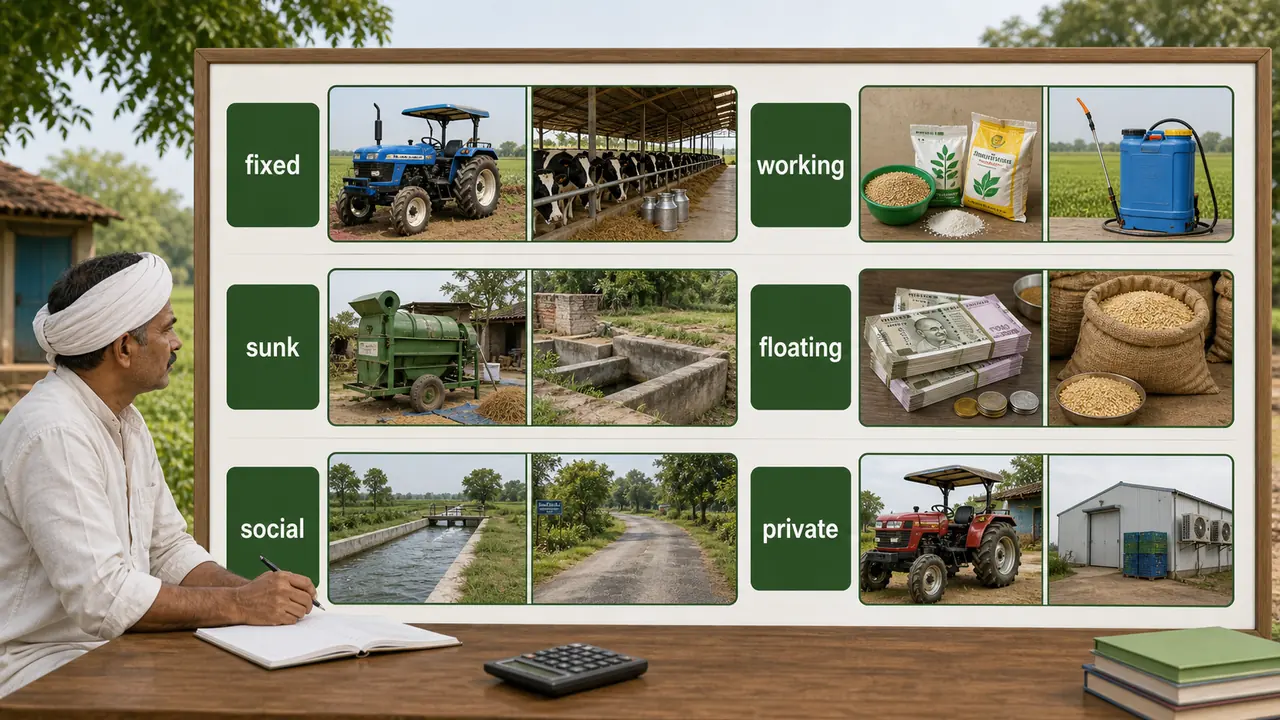
Why Capital Matters in Agriculture
Imagine a wheat farmer in Punjab preparing for the Rabi season. She needs a tractor (used year after year), diesel and fertilizers (consumed in one season), and a combine harvester (useful only at harvest). Each of these represents a different type of capital. Understanding these distinctions is essential — not just for economics exams, but for grasping how agricultural investment drives national income.
This lesson moves from the simplest capital concepts to the national income aggregates that exams test most frequently.
Part 1 — Types of Capital
1. Fixed Capital vs Working Capital
The most fundamental distinction: can the capital be reused?
Pro Content Locked
Upgrade to Pro to access this lesson and all other premium content.
Charged once for one year · ₹1188 total
Save ₹100/month vs ₹2388/year launch price
- All Agriculture & Banking Courses
- AI Lesson Questions (100/day)
- AI Doubt Solver (50/day)
- Glows & Grows Feedback (30/day)
- AI Section Quiz (20/day)
- 22-Language Translation (100/day)
- Recall Questions (20/day)
- AI Quiz (15/day)
- AI Quiz Paper Analysis (100/day)
- AI Step-by-Step Explanations (100/day)
- Spaced Repetition Recall (FSRS)
- AI Tutor
- Immersive Text Questions
- Audio Lessons — Hindi & English
- Mock Tests & Previous Year Papers
- Summary & Mind Maps
- XP, Levels, Leaderboard & Badges
- Generate New Classrooms
- Voice AI Teacher (AgriDots Live)
- AI Revision Assistant
- Knowledge Gap Analysis
- Interactive Revision (LangGraph)
🔒 Secure one-time yearly payment via Razorpay · No hidden fees
Why Capital Matters in Agriculture
Imagine a wheat farmer in Punjab preparing for the Rabi season. She needs a tractor (used year after year), diesel and fertilizers (consumed in one season), and a combine harvester (useful only at harvest). Each of these represents a different type of capital. Understanding these distinctions is essential — not just for economics exams, but for grasping how agricultural investment drives national income.
This lesson moves from the simplest capital concepts to the national income aggregates that exams test most frequently.
Part 1 — Types of Capital
1. Fixed Capital vs Working Capital
The most fundamental distinction: can the capital be reused?
| Feature | Fixed Capital | Working Capital (Variable / Circulating) |
|---|---|---|
| Definition | Durable goods used repeatedly over multiple production cycles | Goods consumed entirely in a single production cycle |
| Duration | Long-term (years) | Short-term (one season or cycle) |
| Varies with output? | No — level stays constant in the short run | Yes — increases when output increases |
| Farm examples | Tractor, tube-well, farm building, plough, dairy shed | Seeds, fertilizers, pesticides, diesel, hired labour wages |
| Non-farm examples | Factory machinery, office building | Raw materials, electricity bill |
TIP
Exam tip: If the question says "used only once," it is working capital. If it says "used many times," it is fixed capital. Think: Fixed = Forever (reusable), Working = Wasted (single use).
Agricultural illustration: A dairy farmer's milking machine is fixed capital (used daily for years). The cattle feed purchased each month is working capital (consumed immediately).
2. Sunk Capital vs Floating Capital
This classification is about transferability — can the capital be shifted to another use?
| Feature | Sunk Capital | Floating Capital |
|---|---|---|
| Definition | Capital dedicated to one specific purpose; cannot be easily transferred | Capital that can be freely moved between different uses |
| Flexibility | Rigid — locked into one function | Flexible — can serve any purpose |
| Farm examples | Sugarcane crusher, paddy thresher, tea processing unit, silkworm rearing house | Money, unsold grain stock, general-purpose warehouse |
| Non-farm examples | Blast furnace (steel), printing press | Bank deposits, government bonds |
TIP
Mnemonic — "Sunk = Stuck": Sunk capital is stuck in one job. A paddy thresher cannot thresh sugarcane. Floating capital (like money) floats to wherever it is needed.
3. Social Capital vs Private Capital
This classification is based on ownership.
| Feature | Social Capital | Private Capital |
|---|---|---|
| Definition | Owned by the government or society as a whole | Owned by private individuals or firms |
| Purpose | Public welfare and infrastructure | Private profit or personal use |
| Farm-related examples | Irrigation dam, canal network, rural road, government seed bank, KVK (Krishi Vigyan Kendra) building | Farmer's tractor, private cold storage, privately owned flour mill |
| Non-farm examples | National highway, government hospital, public school | Private factory, personal car |
NOTE
In Indian agriculture, social capital is critical. Government investments in irrigation dams, rural roads (PMGSY), and agricultural research stations (ICAR) create the infrastructure on which private farming depends.
Capital Types — Quick Comparison Summary
| Classification Basis | Type A | Type B | Key Question |
|---|---|---|---|
| Durability | Fixed Capital | Working Capital | Can it be reused? |
| Transferability | Sunk Capital | Floating Capital | Can it switch jobs? |
| Ownership | Social Capital | Private Capital | Who owns it? |
Part 2 — National Income Concepts asked in exams
National income measures how much a country produces and earns. These concepts build on each other — learn them in order.
Step 1: Gross Domestic Product (GDP)
GDP is the total market value of all final goods and services produced within the domestic territory of a country in one year.
- Key word: Domestic — production happening inside India's borders, regardless of who produces it.
- Agricultural context: The value of all wheat, rice, milk, and other farm output produced within India in a year is part of India's GDP.
- A foreign company running a food processing plant in Gujarat contributes to India's GDP.
Step 2: Gross National Product (GNP)
GNP adds income earned by Indian nationals abroad and subtracts income earned by foreigners within India.
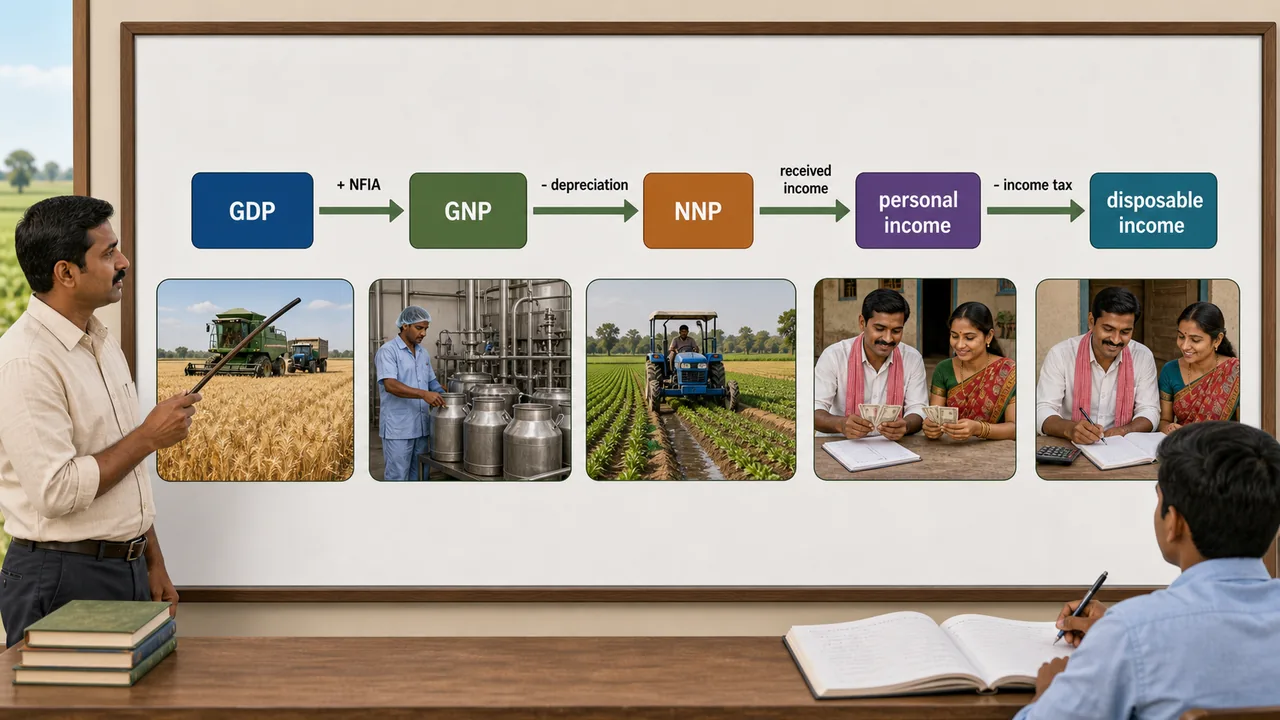
GNP = GDP + Net Factor Income from Abroad (NFIA)
Where:
NFIA = Income received by Indian nationals from abroad minus Income paid to foreign nationals working in India
- Agricultural context: An Indian agricultural scientist working for FAO in Rome earns income abroad — this is added. A Dutch engineer working at an Indian dairy plant earns income here — this is subtracted.
TIP
Memory aid — GDP vs GNP:
- GDP = Domestic = within Doors (borders)
- GNP = National = our Nationals (wherever they are)
Step 3: Net National Product (NNP)
Machines and equipment wear out over time. This wear-and-tear cost is called depreciation. NNP removes it.
NNP = GNP − Depreciation
- Agricultural context: If India's tractors, harvesters, and irrigation pumps collectively lose Rs 50,000 crore in value due to wear and tear, that amount is subtracted from GNP to get NNP.
- NNP at factor cost is commonly called National Income.
Step 4: Investment Concepts
| Concept | Formula | Agricultural Example |
|---|---|---|
| Gross Private Domestic Investment | Expenditure on new plant & equipment + change in inventories | A private dairy installs a new pasteurization unit (Rs 2 crore) + increase in butter stock (Rs 10 lakh) |
| Net Private Domestic Investment | Gross Private Domestic Investment − Depreciation | Same dairy's investment minus wear-and-tear on existing equipment |
Step 5: Personal Income (PI)
The total money income actually received by individuals from all sources in a year. This includes wages, rent, interest, dividends, and government transfer payments (pensions, subsidies).
- Agricultural context: A farmer's personal income includes earnings from crop sales, MGNREGA wages, PM-KISAN transfer (Rs 6,000/year), and interest from bank deposits.
Step 6: Disposable Income
What remains after paying income tax — the amount available for spending or saving.
Disposable Income = Personal Income − Income Tax
- Agricultural context: Since agricultural income is exempt from income tax in India, a farmer's disposable income equals personal income. A salaried agricultural officer, however, pays tax — so disposable income is lower than personal income.
Step 7: Per Capita Income
A simple average that shows income per person.
Per Capita Income = National Income ÷ Total Population
- Agricultural context: India's per capita income was approximately Rs 1.85 lakh (2023-24). However, per capita income in agriculture-dependent states like Bihar is significantly lower than in industrialised states like Maharashtra — highlighting rural-urban income disparity.
Step 8: Aggregate Demand & Aggregate Supply
| Concept | Definition | Agricultural Connection |
|---|---|---|
| Aggregate Demand | Total spending in the economy: consumer goods + government spending + investment + net exports | Includes consumer spending on food, government procurement of wheat/rice under MSP, agricultural exports (rice, spices) |
| Aggregate Supply | Total output (real national product) produced in a country | Includes total agricultural production — a good monsoon raises aggregate supply; drought reduces it |
National Income Formulas — Summary Table
| Concept | Formula | Key Word to Remember |
|---|---|---|
| GDP | Market value of final goods produced within domestic territory | Domestic |
| GNP | GDP + Net Factor Income from Abroad | National |
| NNP | GNP − Depreciation | Net (after wear & tear) |
| NFIA | Income from abroad − Income paid to foreigners | Abroad |
| Gross Investment | New equipment + inventory change | Gross = before depreciation |
| Net Investment | Gross Investment − Depreciation | Net = after depreciation |
| Personal Income | Total money received by individuals | Received |
| Disposable Income | Personal Income − Income Tax | After tax |
| Per Capita Income | National Income ÷ Population | Per person |
Exam Tips and Mnemonics
-
GDP-GNP-NNP chain: GDP → (+NFIA) → GNP → (−Depreciation) → NNP. Remember: "Go North Naturally" (GDP → NNP, moving from gross to net).
-
Depreciation appears twice: It separates Gross from Net in both NNP and Net Investment. If a question mentions "net," depreciation has been subtracted.
-
Domestic vs National: GDP counts by location (within borders). GNP counts by nationality (citizens anywhere). Exam questions often test this distinction directly.
-
Capital types mnemonic — "FiWo SuFl SoPr":
- Fixed vs Working (durability)
- Sunk vs Floating (transferability)
- Social vs Private (ownership)
-
Disposable income trick: For Indian farmers, Disposable Income = Personal Income (agricultural income is tax-exempt). This is a favourite exam distractor.
NOTE
Most tested formulas (AFO/NABARD/FCI): GNP = GDP + NFIA, NNP = GNP − Depreciation, Disposable Income = PI − Tax. Master these three and you cover 80% of national income questions.
Summary Cheat Sheet
| Concept / Topic | Key Details / Explanation |
|---|---|
| Fixed Capital | Durable goods used repeatedly over multiple production cycles (e.g., tractor, tube-well, dairy shed) |
| Working Capital | Goods consumed entirely in a single production cycle (e.g., seeds, fertilizers, diesel); also called variable/circulating capital |
| Sunk Capital | Capital stuck in one specific purpose, cannot be transferred (e.g., sugarcane crusher, paddy thresher) |
| Floating Capital | Capital that can be freely moved between uses (e.g., money, unsold grain stock) |
| Social Capital | Owned by government/society for public welfare (e.g., irrigation dam, rural road, KVK building) |
| Private Capital | Owned by private individuals/firms for profit (e.g., farmer's tractor, private cold storage) |
| Capital Classification Basis | Durability → Fixed vs Working; Transferability → Sunk vs Floating; Ownership → Social vs Private |
| GDP | Total market value of all final goods/services produced within domestic territory in one year |
| GNP | GDP + Net Factor Income from Abroad (NFIA); counts by nationality not location |
| NFIA | Income received by nationals from abroad minus income paid to foreign nationals within the country |
| NNP | GNP − Depreciation; NNP at factor cost = National Income |
| Depreciation | Wear-and-tear cost of capital goods; separates Gross from Net in both NNP and Net Investment |
| Gross Private Domestic Investment | Expenditure on new plant & equipment + change in inventories |
| Net Private Domestic Investment | Gross Private Domestic Investment − Depreciation |
| Personal Income (PI) | Total money income actually received by individuals (includes wages, rent, interest, dividends, transfer payments like PM-KISAN) |
| Disposable Income | PI − Income Tax; for Indian farmers, Disposable Income = PI (agricultural income is tax-exempt) |
| Per Capita Income | National Income ÷ Total Population |
| Aggregate Demand | Total spending: consumer goods + government spending + investment + net exports |
| Aggregate Supply | Total output (real national product) produced; good monsoon raises it, drought reduces it |
| GDP vs GNP Memory Aid | GDP = Domestic (within borders); GNP = National (our nationals wherever they are) |
| Capital Mnemonic | FiWo SuFl SoPr — Fixed/Working, Sunk/Floating, Social/Private |
| GDP-GNP-NNP Chain | GDP → (+NFIA) → GNP → (−Depreciation) → NNP ("Go North Naturally") |
Lesson Doubts
Ask questions, get expert answers