🔲 Agroforestry System Design -- Spatial, Temporal, and Functional
Spatial and temporal arrangements of components, functional classification (productive and protective), socio-economic classification, and ecological basis
Designing the Farm Like an Ecosystem
In the previous lessons, we studied the three major system types -- agrisilviculture (trees + crops), silvipasture (trees + animals), and agrisilvipasture (trees + crops + animals). Now we examine the design principles that underpin all of them: how components are arranged in space and time, and how systems are classified by function, economics, and ecology.
A Kerala home garden looks chaotic at first glance -- coconut palms, pepper vines, banana plants, turmeric on the ground, all seemingly random. But look closer and you see a precise design: tall species at the top catch maximum sunlight, medium species use the filtered light, and ground-level crops thrive in shade. Species are planted and harvested at different times, ensuring year-round production. This intentional arrangement in space and time is what makes agroforestry a science, not just mixed planting.
This lesson covers:
- Spatial arrangement -- dense, sparse, zonal, and boundary planting
- Temporal arrangement -- coincident, concomitant, intermittent, interpolated, separate
- Functional classification -- productive vs. protective
- Socioeconomic classification -- commercial, intermediate, subsistence
- Ecological classification -- matching systems to agro-ecological zones
Temporal arrangement types (especially interpolated) are high-frequency in Pre PG and IBPS AFO, NABARD, and FCI exams.
Pro Content Locked
Upgrade to Pro to access this lesson and all other premium content.
₹99 charged monthly · Cancel anytime
- All Agriculture & Banking Courses
- AI Lesson Questions (100/day)
- AI Doubt Solver (50/day)
- Glows & Grows Feedback (30/day)
- AI Section Quiz (20/day)
- 22-Language Translation (100/day)
- Recall Questions (20/day)
- AI Quiz (15/day)
- AI Quiz Paper Analysis (100/day)
- AI Step-by-Step Explanations (100/day)
- Spaced Repetition Recall (FSRS)
- AI Tutor
- Immersive Text Questions
- Audio Lessons — Hindi & English
- Mock Tests & Previous Year Papers
- Summary & Mind Maps
- XP, Levels, Leaderboard & Badges
- Generate New Classrooms
- Voice AI Teacher (AgriDots Live)
- AI Revision Assistant
- Knowledge Gap Analysis
- Interactive Revision (LangGraph)
🔒 Secure via Razorpay · Cancel anytime · No hidden fees
Designing the Farm Like an Ecosystem
In the previous lessons, we studied the three major system types -- agrisilviculture (trees + crops), silvipasture (trees + animals), and agrisilvipasture (trees + crops + animals). Now we examine the design principles that underpin all of them: how components are arranged in space and time, and how systems are classified by function, economics, and ecology.
A Kerala home garden looks chaotic at first glance -- coconut palms, pepper vines, banana plants, turmeric on the ground, all seemingly random. But look closer and you see a precise design: tall species at the top catch maximum sunlight, medium species use the filtered light, and ground-level crops thrive in shade. Species are planted and harvested at different times, ensuring year-round production. This intentional arrangement in space and time is what makes agroforestry a science, not just mixed planting.
This lesson covers:
- Spatial arrangement -- dense, sparse, zonal, and boundary planting
- Temporal arrangement -- coincident, concomitant, intermittent, interpolated, separate
- Functional classification -- productive vs. protective
- Socioeconomic classification -- commercial, intermediate, subsistence
- Ecological classification -- matching systems to agro-ecological zones
Temporal arrangement types (especially interpolated) are high-frequency in Pre PG and IBPS AFO, NABARD, and FCI exams.
Two Dimensions of System Design
All the systems we have studied -- from alley cropping to home gardens -- differ in how they organise their components. Two fundamental dimensions describe this organisation: where things are placed and when they share the land.
Every agroforestry system is organized along two fundamental dimensions:
| Dimension | Question It Answers | Key Variable |
|---|---|---|
| Spatial | Where are components placed relative to each other? | Physical arrangement on land |
| Temporal | When do components share the land? | Timing of co-occurrence |
Plants always receive first priority in arrangement -- even in systems with animals, plant management (e.g., rotational grazing) takes precedence.
Spatial Arrangement
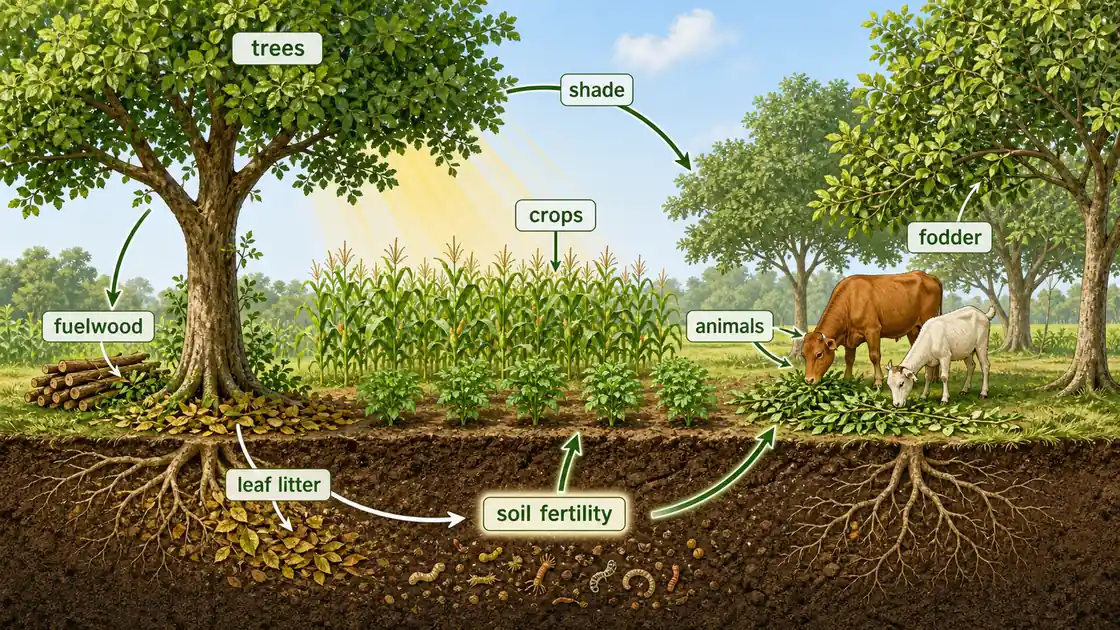
Spatial arrangement determines how efficiently light, water, and nutrients are shared between trees and crops. The choice depends on farm size, topography, and the degree of interaction desired between components.
Spatial arrangement = how species are physically distributed across the land area at any given point in time.
| Arrangement | Description | Example |
|---|---|---|
| Dense mixed stand | Many species packed closely in multiple vertical layers | Home gardens (Kerala) |
| Sparse mixed stand | Trees widely spaced with open areas between them | Trees on pasture land |
| Zonal (strip) | Species laid out in alternating strips or zones | Alley cropping (hedge intercropping) |
| Boundary planting | Trees planted only on edges of plots | Farm forestry on field boundaries |
Zonal Arrangements
| Scale | Description | Example |
|---|---|---|
| Microzonal | Narrow strips, closely spaced rows | Alley cropping with 4-6 m spacing |
| Macrozonal | Wide zones spanning several metres | Large shelterbelt + crop blocks |
TIP
Boundary planting is the simplest and most widely adopted form of agroforestry because it does not interfere with normal farming on the main field. Think of Poplar trees planted on bunds in Punjab.
Orientation of Tree Rows
When rows are deliberately planted for silviculture or agroforestry design, an East-West orientation is often preferred in exam-oriented forestry notes because it helps manage shading and light interception systematically across the field.
When Does Zonal AF Become Sole Cropping?
The key criterion is meaningful ecological or economic interaction between tree and crop components. If the zones are so wide that trees and crops do not interact (no shade, no root competition, no nutrient sharing), it is no longer agroforestry -- it is simply two separate crop systems side by side.
Temporal Arrangement
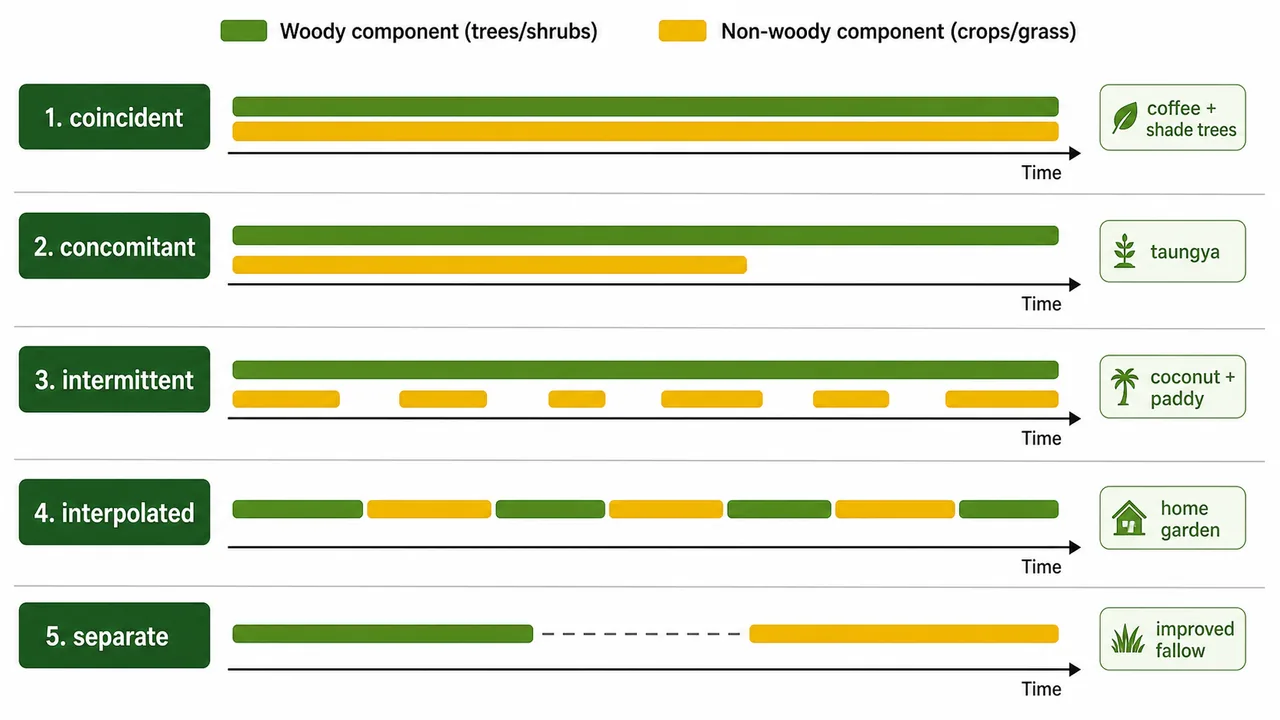
While spatial arrangement describes the physical layout, temporal arrangement describes the timing of component co-existence. This distinction is heavily tested -- exams often provide a system description and ask you to identify the temporal type.
Temporal arrangement = how components share the land over time.
| Type | Description | Example | Key Feature |
|---|---|---|---|
| Coincident | Both components occupy land together for entire lifecycle | Coffee under shade trees; pasture under trees | Permanent association |
| Concomitant | Components together for part of lifecycle | Taungya system (crops with young tree plantation) | Crops discontinued when canopy closes |
| Intermittent (space-dominated) | Annual crop repeatedly grown with permanent perennial | Paddy with coconut | Tree stays; crop rotates seasonally |
| Interpolated (space + time dominant) | Different components occupy space at different times | Home gardens Pre PG 2020 | Dynamic, ever-evolving composition |
| Separate (time-dominant) | Components occupy space in distinct sequential periods | Improved fallow in shifting cultivation | No overlap between tree and crop phases |
IMPORTANT
Interpolated arrangement (as in home gardens) is the most complex -- species are planted and harvested at different times throughout the year, creating a constantly changing landscape. This was asked in Pre PG 2020.
Comparison of Temporal Arrangements
| Parameter | Coincident | Concomitant | Intermittent | Interpolated | Separate |
|---|---|---|---|---|---|
| Overlap duration | Full lifecycle | Partial | Repeated | Variable | None |
| Complexity | Low | Medium | Medium | Highest | Low |
| Best example | Shade trees + coffee | Taungya | Coconut + paddy | Home garden | Jhum fallow |
| Management skill | Moderate | Moderate | Moderate | High | Low |
Functional Basis
Beyond spatial and temporal dimensions, agroforestry systems can also be classified by what they do -- the outputs they produce and the ecological services they provide. All agroforestry systems serve both productive and protective functions simultaneously.
Productive Functions (Tangible Goods)
| Output | Examples |
|---|---|
| Food | Fruits, nuts, vegetables, grains |
| Fodder | Tree leaves, grasses |
| Fuelwood | Prosopis, Acacia, Eucalyptus |
| Clothing | Rayon fibre (Eucalyptus) |
| Shelter | Timber for construction |
| NTFPs | Honey, gums, resins, medicinal plants |
Protective Functions (Ecological Services)
| Function | How It Works |
|---|---|
| Windbreaks | Reduce wind speed, protect crops |
| Shelterbelts | Deflect hot/cold winds over large areas |
| Soil conservation | Tree roots and leaf litter reduce erosion |
| Soil improvement | Nitrogen fixation, organic matter addition, nutrient cycling |
TIP
Exam tip: When asked about functions of agroforestry, always mention both productive AND protective. Most systems serve both simultaneously.
Socio-Economic Classification
Agroforestry systems also differ based on the economic scale and market orientation of the farmer. This classification helps in recommending appropriate systems for different farmer categories.
| Category | Scale | Management | Investment | Example |
|---|---|---|---|---|
| Commercial | Large-scale production | Corporate/large landholder | High | Oil Palm (Manipur), Rubber (Kerala), Coconut (South India), Poplar (Tarai) |
| Intermediate | Dual purpose (cash + food) | Medium-scale farmer | Moderate | Cash crops + food crops on same farm |
| Subsistence | Basic needs only | Owner + family labour | Low | Small homestead gardens for household food |
NOTE
Most Indian smallholder farmers practice intermediate or subsistence agroforestry. Commercial systems are typically found in plantation-based economies.
Ecological Classification
The final classification framework matches agroforestry systems to agro-ecological zones. This is practical knowledge -- the right system for an arid zone is very different from the right system for a humid tropical zone. Systems are matched based on climate, soil, and topography.
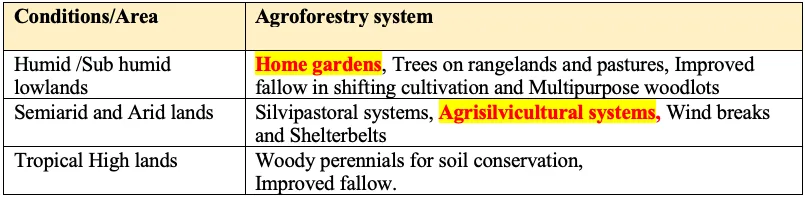
| Ecological Zone | Best-suited AF System | Reason |
|---|---|---|
| Arid and semi-arid | Silvipasture, shelterbelts | Moisture is limiting; trees provide shade and fodder |
| Sub-humid | Alley cropping, farm forestry | Moderate rainfall supports tree-crop combinations |
| Humid tropics | Home gardens, multi-tier systems | Abundant rainfall supports dense, diverse plantings |
| Highlands/hills | Contour hedgerows, terracing with trees | Erosion control on slopes |
| Coastal | Aquaforestry, mangrove-fish systems | Saline conditions; flood tolerance needed |
Agricultural Connection: Designing for the Indian Farmer
This table translates theory into practice -- matching design choices to real Indian farming contexts. It synthesises spatial and temporal concepts into actionable recommendations.
| Farmer Type | Recommended Design | Spatial | Temporal |
|---|---|---|---|
| Smallholder (rain-fed) | Boundary planting + intercropping | Macrozonal | Intermittent |
| Irrigated plains | Poplar + wheat/sugarcane | Zonal strips | Concomitant |
| Dryland | Prosopis + pearl millet | Sparse | Coincident |
| Hill farmer | Contour hedgerows + terraced crops | Microzonal | Intermittent |
| Homestead | Multi-tier home garden | Dense mixed | Interpolated |
Exam Tips
TIP
Frequently tested facts:
- Two dimensions of design -- Spatial and Temporal
- Dense mixed stand example -- Home gardens
- Zonal arrangement example -- Alley cropping
- Coincident = components together for entire lifecycle
- Concomitant = together for part of lifecycle (Taungya)
- Interpolated = space + time dominant (Home garden) Pre PG 2020
- Separate = no overlap (shifting cultivation fallow)
- Two functions -- Productive (goods) + Protective (services)
- Three socio-economic types -- Commercial, Intermediate, Subsistence
- Ecological classification matches systems to agro-ecological zones
Summary Table
| Topic | Key Fact |
|---|---|
| Two design dimensions | Spatial (where) + Temporal (when) |
| Spatial types | Dense mixed, Sparse mixed, Zonal (micro/macro), Boundary |
| Temporal types | Coincident, Concomitant, Intermittent, Interpolated, Separate |
| Most complex temporal | Interpolated (home gardens) |
| Two functional types | Productive (food, fuel, timber) + Protective (wind, soil, water) |
| Commercial AF example | Oil Palm, Rubber, Coconut plantations |
| Subsistence AF | Homestead gardens for family needs |
| Arid zone AF | Silvipasture, shelterbelts |
| Humid tropical AF | Home gardens, multi-tier systems |
| Boundary planting | Simplest, most widely adopted form |
Summary Cheat Sheet
| Concept / Topic | Key Details |
|---|---|
| AF System Design | Planning spatial, temporal, and functional arrangement of components |
| Spatial arrangement | How trees & crops are arranged in space (mixed, zonal, boundary) |
| Temporal arrangement | How components interact over time (simultaneous, sequential, overlapping) |
| Simultaneous system | Trees and crops grown at the same time (e.g., alley cropping) |
| Sequential system | Trees and crops in rotation (e.g., improved fallow) |
| Boundary planting | Simplest, most widely adopted form of agroforestry |
| Arid zone AF | Silvipasture, shelterbelts, scattered trees on cropland |
| Humid tropical AF | Home gardens, multi-tier systems, alley cropping |
| Semi-arid AF | Agrisilviculture, boundary planting, live fences |
| Functional classification | Productive (food/timber), Protective (soil/water conservation), Service (shade/N-fixing) |
| Species selection factors | Light, root depth, growth rate, N-fixation, allelopathy, market value |
| Multi-tier system | Multiple canopy layers; maximises light use efficiency |
| Tree–crop interaction | Complementary (different niches) vs Competitive (same resources) |
| Design goal | Maximise complementarity, minimise competition |
| Interpolated arrangement | Space + time dominant; home gardens; asked in Pre PG 2020 |
TIP
Next: Lesson 06 covers Diagnosis and Design (D&D) -- the systematic methodology developed by ICRAF for planning and evaluating agroforestry interventions at the farm level.