🌳 Silvicultural Systems (Detailed)
Comprehensive classification — clear felling, shelterwood (8 types), selection, accessory, and coppice systems for IBPS AFO, NABARD, and FCI exams
What are Silvicultural Systems? Asked in exams Mains 2022
In the previous lesson, we explored forest products -- timber, NTFPs, and industrial wood. But how are the forests that produce these products actually managed? That is the domain of silvicultural systems.
A silvicultural system is the set of silvicultural procedures worked out in accordance with accepted principles by which forest crops are tended, harvested, and replaced by new crops of distinctive form. It acts as a tool for achieving the objectives of forest management -- balancing timber extraction with forest regeneration.
In India, silvicultural systems are classified based on mode of regeneration -- whether the new forest grows from seeds (high forest system) or from vegetative sprouting (coppice system).
This lesson covers:
- High Forest Systems -- Clear felling, shelterwood (8 types), selection, and accessory systems
- Coppice Systems -- Simple coppice, coppice-with-standards, pollarding, and 4 other types
- Key comparisons -- Even-aged vs uneven-aged, seedling vs vegetative origin
This topic is heavily tested in exams mains -- the 2022 and 2023 papers both asked questions on silvicultural systems.
Pro Content Locked
Upgrade to Pro to access this lesson and all other premium content.
₹99 charged monthly · Cancel anytime
- All Agriculture & Banking Courses
- AI Lesson Questions (100/day)
- AI Doubt Solver (50/day)
- Glows & Grows Feedback (30/day)
- AI Section Quiz (20/day)
- 22-Language Translation (100/day)
- Recall Questions (20/day)
- AI Quiz (15/day)
- AI Quiz Paper Analysis (100/day)
- AI Step-by-Step Explanations (100/day)
- Spaced Repetition Recall (FSRS)
- AI Tutor
- Immersive Text Questions
- Audio Lessons — Hindi & English
- Mock Tests & Previous Year Papers
- Summary & Mind Maps
- XP, Levels, Leaderboard & Badges
- Generate New Classrooms
- Voice AI Teacher (AgriDots Live)
- AI Revision Assistant
- Knowledge Gap Analysis
- Interactive Revision (LangGraph)
🔒 Secure via Razorpay · Cancel anytime · No hidden fees
What are Silvicultural Systems? Asked in exams Mains 2022
In the previous lesson, we explored forest products -- timber, NTFPs, and industrial wood. But how are the forests that produce these products actually managed? That is the domain of silvicultural systems.
A silvicultural system is the set of silvicultural procedures worked out in accordance with accepted principles by which forest crops are tended, harvested, and replaced by new crops of distinctive form. It acts as a tool for achieving the objectives of forest management -- balancing timber extraction with forest regeneration.
In India, silvicultural systems are classified based on mode of regeneration -- whether the new forest grows from seeds (high forest system) or from vegetative sprouting (coppice system).
This lesson covers:
- High Forest Systems -- Clear felling, shelterwood (8 types), selection, and accessory systems
- Coppice Systems -- Simple coppice, coppice-with-standards, pollarding, and 4 other types
- Key comparisons -- Even-aged vs uneven-aged, seedling vs vegetative origin
This topic is heavily tested in exams mains -- the 2022 and 2023 papers both asked questions on silvicultural systems.
1. High Forest System
High forest systems produce the highest-quality timber because trees grow from seed for long periods, developing strong trunks and valuable heartwood. These systems dominate the management of India's major timber forests.
In this system, regeneration is of seedling origin (either natural or artificial) and the rotation is generally long -- often 60 to 120 years for species like Teak or Sal. exams
High forest systems are further classified into:
- A. Systems of Concentrated Regeneration — fellings concentrated on part of forest at a time
- B. Systems of Diffused Regeneration — fellings distributed over whole forest, producing irregular forests
- C. Accessory Systems — modifications of other even-aged systems resulting in irregular or two-storeyed high forests
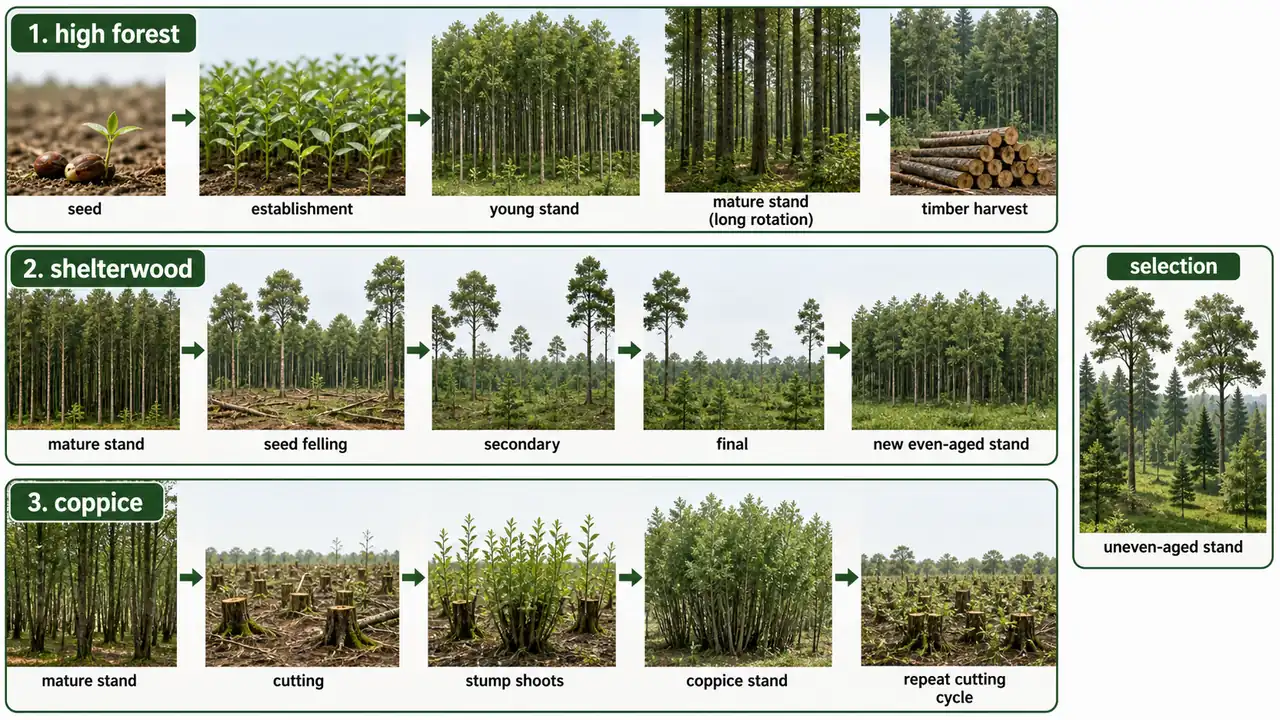
A. Systems of Concentrated Regeneration
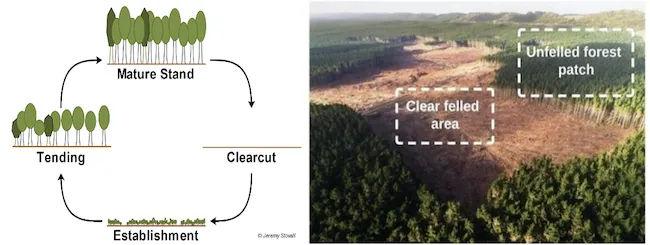
1. Clear Felling Systems
Clear felling is the removal of all trees from an area chosen for harvesting. Based on the pattern of felling, clear felling systems are subdivided into:
A. The Clear Felling System
- Equal or equi-productive areas of a mature crop are sequentially clear-felled in one operation
- Regenerated mostly artificially, sometimes naturally
- Crop produced: Even-aged
B. The Clear Strip System
- Felling is done in the form of strips which progress successively in one direction, preferably across the regeneration area
- Crop regenerated is even-aged within the strip
C. The Alternate Strip System
- A modified clear felling system in which clear felling in strips alternates with unfelled strips of similar width
- Clear cut strips oriented at right angle to the direction of wind
- Crop: Even-aged
2. Shelterwood Systems
In shelterwood systems, the mature crop is removed in a series of operations starting from seeding felling and ending with final felling. Intermediate fellings are called secondary fellings. The primary objective is to protect and shelter young recruits.
Vigorously growing trees are retained to:
- Provide shelter to new regenerants
- Provide vigorous seed for natural regeneration
- Get rapid diameter and value increment from retained trees
Based on the pattern of felling, shelterwood systems are classified into 8 sub-types:
A. The Uniform System
- Canopy is uniformly opened up over the whole area of a compartment for uniform regeneration
- Also known as shelterwood compartment system or compartment system
- Crop obtained: Even-aged
B. The Group System
- Regeneration fellings are carried out in scattered groups instead of uniformly all over the compartment
- Initial cut: 20-40% of canopy. Second cut after 10 years. Removal cut 5-10 years after second cut
- Failed in India because of extensive forest area and intensive working was not possible
- Applicable for: Deodar and Khail
- Crop obtained: Un-even aged initially, becomes even-aged at end of rotation
C. The Shelterwood Strip System
- Regeneration fellings done in strips from one side of the compartment, progressing against the direction of wind
- Main objective: protection against wind
D. Wagner's Blender Saumschlag
- A modification of shelterwood strip system where fellings are carried out in narrow strips extending in east-west direction and advancing from north to south
- Main objective: afford side protection from the sun to regeneration
- Crop is "even aged" along east-west direction, "uneven aged" in north-south direction
- Gives sloping profile to canopy
- Not applicable under tropical conditions (sun lies directly overhead)
E. Eberhard's Wedge System
- Modification where regeneration advances in wedge-shaped patterns
F. The Strip and Group System
- A modification of shelterwood strip system where fellings are done in strips following the group system instead of the uniform system
- Failed in India due to extensive forest area
G. The Irregular Shelterwood System
- Produces uneven-aged forests through irregular regeneration fellings over an extended period
H. The Indian Irregular Shelterwood System
- A modification specifically developed for Indian forest conditions
- Designed to work with the practical constraints of managing large, diverse Indian forests
NOTE
For exams, the most important shelterwood systems are: Uniform (even-aged, whole compartment), Group (scattered groups, Deodar/Khail), Strip (against wind), and Wagner's (N→S, not for tropics).
B. Systems of Diffused Regeneration
The Selection System
- Fellings comprise removal of trees either singly or in small groups scattered all over the forest
- Produces uneven-aged/irregular forests
- Suitable for shade-tolerant species
- In exam recall, exploitable girth and felling cycle are especially linked with the selection system
The Group Selection System
- Similar to selection system but trees removed in small groups rather than individually
C. Accessory Systems
These originate from other even-aged systems through slight modifications:
- Two-storeyed High Forest System — resulting in two distinct canopy layers
- High Forest with Reserve System — certain trees retained beyond normal rotation
- Improvement Felling — removal of inferior, defective, or unwanted trees to improve stand quality
2. Coppice Forest System
Unlike high forest systems that rely on seeds, coppice systems exploit the ability of many tree species to regenerate vegetatively from cut stumps. This makes them faster, cheaper, and particularly suited for producing fuelwood, small timber, and fodder on shorter rotations.
Coppice system refers to the silvicultural system in which the new crop originates mainly from coppice (vegetative regeneration) and where the rotation of crop is shorter than high forest systems -- typically 10 to 30 years.
Types of Coppice Systems
1. Simple Coppice System
- Old crop is clear-felled completely in one operation
- New crop grows naturally through stool coppice -- shoots sprout from the cut stumps (stools)
- Simplest and most straightforward coppice system -- requires minimal technical skill
- Produces even-aged stands because all trees are cut and regrow simultaneously
- Best suited for species with strong coppicing ability like Eucalyptus, Teak, and Sal
2. Coppice of Two Rotations System
- Two different rotation periods are used for different species or products within the same area
3. Shelterwood Coppice System
- Combines principles of shelterwood and coppice — some trees retained for shelter while others coppice
4. Coppice Selection System
- Trees of different ages are removed selectively, maintaining continuous canopy cover through coppice regeneration
5. Coppice-with-Standards System
- Selected trees (standards) are retained through more than one coppice rotation for timber
- Coppice produces small wood while standards provide quality timber
6. Coppice-with-Reserves System
- Similar to coppice-with-standards but reserves are retained for specific purposes (seed production, shelter)
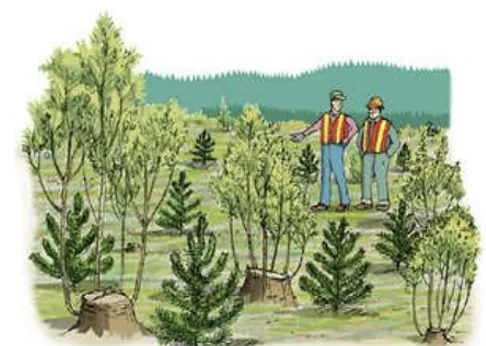
7. The Pollard System
- Stems cut at a height usually above browsing height (2--3 m) to obtain a flush of shoots -- this protects regrowth from cattle and goats
- Applicable for obtaining maximum fodder from the tree, since repeated cutting stimulates vigorous shoot production
- Salix (Willow) is pollarded in Kashmir valley for the cricket bat industry -- the straight, fast-growing shoots from pollard heads provide ideal bat willow
- Differs from coppicing in one critical way: pollarding cuts above ground level; coppicing cuts at ground level
TIP
High Forest = seedling origin, long rotation, quality timber. Coppice = vegetative origin, short rotation, quick regeneration. This is the most fundamental distinction in silvicultural systems.
Summary Cheat Sheet
| Concept / Topic | Key Details |
|---|---|
| Silvicultural system | Plan of management for a forest stand covering regeneration to harvest |
| Two broad categories | High forest systems (from seed) and Coppice systems (from stumps) |
| Clear felling | All trees removed in one operation; followed by artificial regeneration |
| Shelterwood | Trees removed in stages; mature trees shelter young seedlings |
| Selection system | Individual trees selected & removed; uneven-aged forest maintained |
| Selection-system markers | Exploitable girth and felling cycle |
| Coppice system | Regeneration from cut stumps (vegetative); short rotation |
| Simple coppice | All trees cut; regeneration from coppice shoots; even-aged |
| Coppice-with-Standards | Coppice + selected seedling-origin trees retained as standards |
| Pollarding | Cutting tree at 2–3 m height; shoots grow from pollard head |
| Pollarding vs Coppice | Pollard cut above ground level; coppice cut at ground level |
| Coppicers | Trees that regenerate from stumps (e.g., Teak, Sal, Eucalyptus) |
| Non-coppicers | Trees that don't coppice well (e.g., Pines, Deodar) |
| Even-aged systems | Clear felling, Shelterwood uniform, Simple coppice |
| Uneven-aged systems | Selection system, Irregular shelterwood |
| Wagner's Blender Saumschlag | Strips E--W, advancing N→S; not applicable in tropics |
| Group system applicable for | Deodar and Khail; failed in India (extensive forests) |
| Periodic blocks are linked with | Shelterwood system |
| Pollarding | Salix pollarded in Kashmir for cricket bat industry |
| Rotation period | Time from establishment to final harvest |
TIP
Next: the exam-oriented fact points from the old revision page are now integrated into the topic lessons -- use Forestry, Silviculture of Trees, Mensuration, Forest Legislation, and ISFR 2023 for targeted revision.