🪵 Forest Products -- Timber, NTFPs, and Industrial Wood
Productive and protective functions of forests, food from forests, industrial wood species, and 11 categories of non-timber forest products (NTFPs)
The Forest as a Supermarket
In the previous lesson, we examined wasteland development -- how degraded lands are classified and reclaimed. Forests are the opposite of wastelands: they are among the most productive land-use systems on Earth. But what exactly do forests produce, and why does it matter for agriculture?
A tribal family in Chhattisgarh collects tendu leaves to sell for bidi-making, gathers Mahua flowers for food and oil, taps resin from Chir Pine, harvests honey from forest trees, and cuts bamboo for house construction -- all without felling a single timber tree. These are Non-Timber Forest Products (NTFPs), and they sustain the livelihoods of over 275 million forest-dependent people in India.
This lesson covers:
- Two functions of forests -- Productive vs Protective
- Food, fuel, and timber -- What forests directly provide
- Industrial wood -- Species used for paper, plywood, matchwood, and toys
- NTFPs -- The 11 categories of non-timber forest products
- NTFP-agriculture connections -- How forest products link to farming
Understanding forest products is essential for IBPS AFO, NABARD Grade A, and FCI exams -- especially species-product associations.
Pro Content Locked
Upgrade to Pro to access this lesson and all other premium content.
₹99 charged monthly · Cancel anytime
- All Agriculture & Banking Courses
- AI Lesson Questions (100/day)
- AI Doubt Solver (50/day)
- Glows & Grows Feedback (30/day)
- AI Section Quiz (20/day)
- 22-Language Translation (100/day)
- Recall Questions (20/day)
- AI Quiz (15/day)
- AI Quiz Paper Analysis (100/day)
- AI Step-by-Step Explanations (100/day)
- Spaced Repetition Recall (FSRS)
- AI Tutor
- Immersive Text Questions
- Audio Lessons — Hindi & English
- Mock Tests & Previous Year Papers
- Summary & Mind Maps
- XP, Levels, Leaderboard & Badges
- Generate New Classrooms
- Voice AI Teacher (AgriDots Live)
- AI Revision Assistant
- Knowledge Gap Analysis
- Interactive Revision (LangGraph)
🔒 Secure via Razorpay · Cancel anytime · No hidden fees
The Forest as a Supermarket
In the previous lesson, we examined wasteland development -- how degraded lands are classified and reclaimed. Forests are the opposite of wastelands: they are among the most productive land-use systems on Earth. But what exactly do forests produce, and why does it matter for agriculture?
A tribal family in Chhattisgarh collects tendu leaves to sell for bidi-making, gathers Mahua flowers for food and oil, taps resin from Chir Pine, harvests honey from forest trees, and cuts bamboo for house construction -- all without felling a single timber tree. These are Non-Timber Forest Products (NTFPs), and they sustain the livelihoods of over 275 million forest-dependent people in India.
This lesson covers:
- Two functions of forests -- Productive vs Protective
- Food, fuel, and timber -- What forests directly provide
- Industrial wood -- Species used for paper, plywood, matchwood, and toys
- NTFPs -- The 11 categories of non-timber forest products
- NTFP-agriculture connections -- How forest products link to farming
Understanding forest products is essential for IBPS AFO, NABARD Grade A, and FCI exams -- especially species-product associations.
Two Functions of Forests
Every forest serves both productive and protective functions. Agroforestry systems are designed to maximize both.
| Productive Functions | Protective Functions |
|---|---|
| Food | Windbreaks |
| Fodder | Shelterbelts |
| Fuelwood | Soil conservation |
| Clothing (fibre) | Soil improvement |
| Shelter (timber) | Water regulation |
| NTFPs | Climate amelioration |
TIP
Exam tip: When asked "What are the functions of forests?", always mention BOTH productive and protective. Most questions test whether you understand this dual role.
Food from Forests
Forests provide food from virtually every plant part:
| Plant Part | Species Examples |
|---|---|
| Rhizome | Amorphophallus campanulatum, Cyperus rotundus |
| Root and Aerial | Dioscorea, Moringa oleifera, Caryota urens, Bauhinia variegata |
| Buds | Dillenia pentagyna, Phoenix sp. |
| Sap and Latex | Borassus flabellifer, Cissus repanda |
| Stems | Cycas pectinata, Dendrocalamus strictus (Bamboo) |
| Leaves | Tamarindus indica, Moringa oleifera |
| Flowers | Ficus glomerata, Madhuca indica, Bombax ceiba, Tamarindus indica |
| Seeds/Nuts | Anacardium occidentale, Juglans regia, Prunus amygdalus, Tamarindus indica |
NOTE
Many forest food species like Moringa, Tamarind, and Jackfruit are now also cultivated as agroforestry components on farms, bridging the gap between forests and agriculture.
Fuel from Forests
Fuelwood is the most basic and widespread forest product. Despite urbanisation and the spread of LPG, wood remains a critical energy source in rural India.
- Wood remains the major source of domestic fuel in rural India (over 70% of rural households depend on it for cooking and heating)
- Common fuelwood species: Acacia spp., Casuarina equisetifolia, Prosopis, Neem, Leucaena leucocephala -- these are fast-growing, coppicing species that regenerate quickly after cutting
- Agroforestry fuelwood plantations on farm boundaries reduce pressure on natural forests while providing a steady supply
- Calorific value varies by species -- dense hardwoods like Prosopis and Acacia produce more heat per unit weight than softwoods like Eucalyptus
Timber and Shelter
Timber is the most economically valuable forest product per unit. High-quality timber trees require long rotations (decades), making sustainable harvesting critical.
- Wood is used for construction of buildings, furniture, agricultural implements, and boat-building
- Key timber species: Teak (Tectona grandis -- the "King of Timber" for its durability and termite resistance), Sal (Shorea robusta), Rosewood (Dalbergia latifolia), Palmyra, Jackfruit
- Rayon cloth is made from Eucalyptus spp. wood pulp -- an industrial application that bridges forestry and the textile industry
- Timber quality depends on heartwood development -- older trees with larger heartwood proportion command higher prices
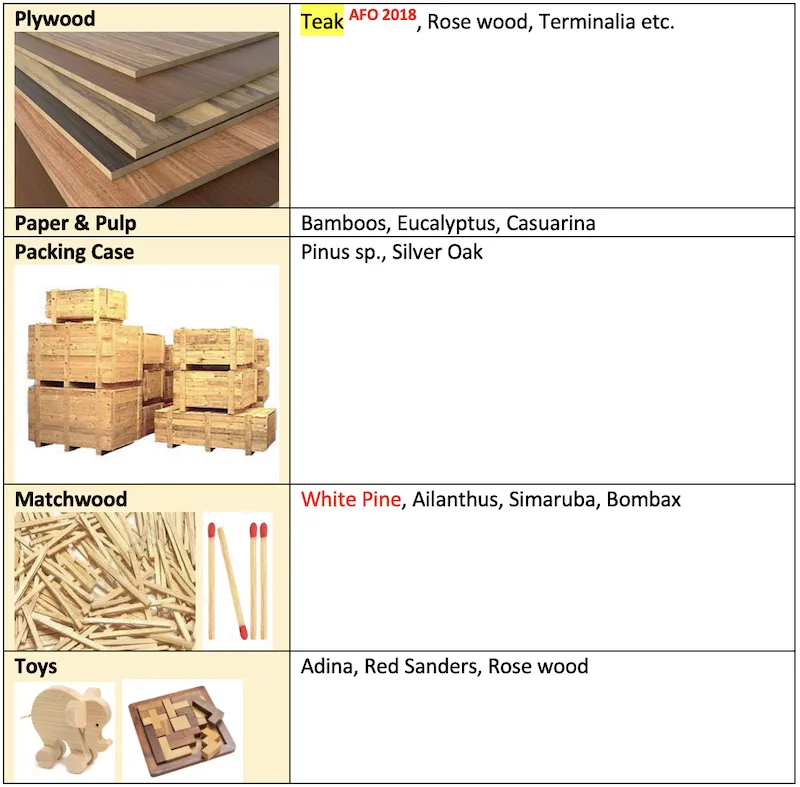
Industrial Wood asked in exams
| Product | Species Used | Agricultural Connection |
|---|---|---|
| Paper and Pulp | Bamboo, Eucalyptus, Casuarina | Eucalyptus planted on farm boundaries as cash crop |
| Packing Cases | Pinus sp., Silver Oak, Fir | Used for transporting agricultural produce |
| Plywood | Teak, Rosewood, Terminalia | Farm furniture, storage structures |
| Matchwood | Ailanthus, Simaruba, Bombax | Light, soft wood species ideal for splints |
| Toys | Adina, Red Sanders, Rosewood | Fine-grained wood for carving |
IMPORTANT
Frequently asked in exams: Paper = Bamboo/Eucalyptus, Plywood = Teak/Rosewood, Matchwood = Ailanthus/Bombax. Remember: "BEP" -- Bamboo-Eucalyptus for Paper.
- A few product-processing terms also appear in forestry exams. A thin sheet of uniform thickness of wood is called veneer, and plywood is made by gluing veneers together. After tree felling, the organised removal, conversion, and transport of wood from the forest is called logging. The unusable material left after logging is often dealt with through slash disposal.
Non-Timber Forest Products (NTFPs)
While timber and industrial wood get the most attention, the real lifeline of forest-dependent communities is NTFPs. These are all products obtained from forests other than timber -- and they include everything from fibres and oils to medicines and honey. NTFPs are a major source of livelihood for forest-dependent communities, especially tribal populations, and are classified into 11 categories.
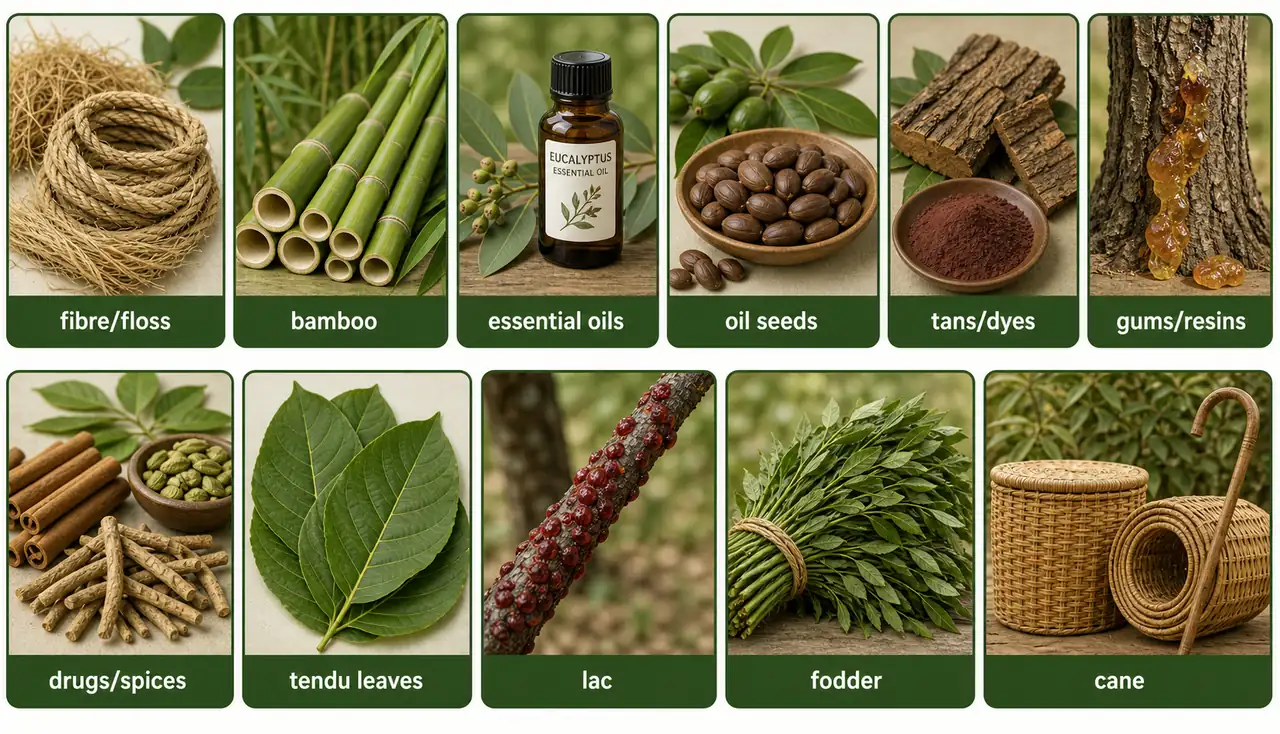
Complete Classification of NTFPs
| Category | Key Products | Important Species | Exam-relevant Fact |
|---|---|---|---|
| 1. Fibre and Flosses | Rope, Kapok | Ceiba pentandra (floss), Agave sisalana, Sterculia urens (fibre) | Flosses from Ceiba; fibres from bast tissue |
| 2. Grasses and Bamboos | Paper, Construction | Bamboo, various grasses | Raw material for paper and pulp industry |
| 3. Essential Oils | Eucalyptus oil, Sandalwood oil | Eucalyptus, Santalum album, Cymbopogon | High-value aromatic products |
| 4. Oil Seeds | Soap oil, Biodiesel | Madhuca indica, Pongamia pinnata, Azadirachta indica | Potential ~1 million tonnes of oil/year |
| 5. Tans and Dyes | Katha, Cutch, Tannins | Acacia catechu (Katha/Cutch), Emblica officinalis | Katha and Cutch from Acacia catechu |
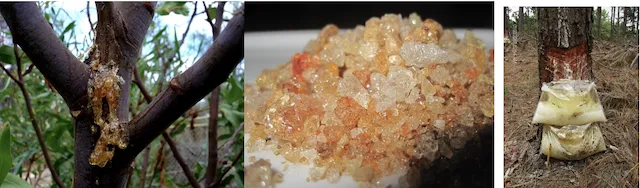
| 6. Gums and Resins | Gum arabic, Pine resin | Sterculia urens, Anogeissus latifolia, Pinus roxburghii (resin) | Resin from Chir Pine |
| 7. Drugs and Spices | Medicines, Insecticides | Rauvolfia serpentina, Cinnamomum, Pyrethrum, Neem | Neem as natural insecticide |
| 8. Tendu Leaves | Bidi wrapping | Diospyros melanoxylon | Tendu = bidi leaves; major tribal livelihood |
| 9. Lac and Silk | Lac, Silk, Honey | Butea monosperma (lac host), Morus alba (silkworm) | Lac insect's main host = Butea monosperma |
| 10. Fodder | Animal feed | Leucaena, Albizia lebbeck, Hardwickia binata | Links to silvipastoral agroforestry |
| 11. Cane | Walking sticks, Baskets | Rattan palms | Used for furniture, handicrafts |
NTFPs and Agriculture -- The Connection
The distinction between "forest product" and "agricultural input" is often blurred. Many NTFPs are directly used in farming -- as pesticides, fertilizers, animal feed, or pollination agents. This is why agroforestry is such a powerful system: it brings forest products onto the farm itself.
| NTFP | Agricultural Use |
|---|---|
| Neem oil and leaves | Natural pesticide and soil amendment |
| Pongamia oil | Biodiesel; seed cake as organic fertilizer |
| Mahua oil cake | Fish pond management (piscicide) |
| Leucaena leaves | Green manure and fodder |
| Bamboo | Farm fencing, storage structures |
| Honey | Pollination of agricultural crops by forest bees |
| Lac | Coating for fruits to extend shelf life |
Key Species to Remember
| Species | Product | Category |
|---|---|---|
| Acacia catechu | Katha and Cutch | Tans and Dyes |
| Pinus roxburghii | Resin | Gums and Resins |
| Diospyros melanoxylon | Tendu (bidi) leaves | Leaves |
| Butea monosperma | Main host for lac insect | Lac |
| Morus alba | Silkworm feed | Silk |
| Santalum album | Sandalwood oil | Essential Oils |
| Madhuca indica | Oil, flowers (food), oil cake (piscicide) | Oil Seeds |
| Bamboo (Dendrocalamus) | Paper, construction, food | Grasses/Bamboos |
| Rauvolfia serpentina | Medicinal drug (reserpine) | Drugs |
Exam Tips
TIP
High-frequency exam facts:
- Katha and Cutch from -- Acacia catechu
- Resin from -- Pinus roxburghii
- Tendu (bidi) leaves from -- Diospyros melanoxylon
- Lac insect main host -- Butea monosperma
- Paper from -- Bamboo and Eucalyptus
- Matchwood from -- Ailanthus, Bombax
- Plywood from -- Teak, Rosewood
- Silkworm feeds on -- Morus alba (Mulberry)
- Forest oil seeds potential -- ~1 million tonnes/year
- NTFPs sustain -- 275 million forest-dependent people
Summary Cheat Sheet
| Concept / Topic | Key Details |
|---|---|
| Timber | Primary forest product; used for construction, furniture, plywood |
| NTFPs | Non-Timber Forest Products; 11 categories; ~275 million people dependent |
| Tendu leaves | Diospyros melanoxylon; used for bidi wrapping; most valuable NTFP |
| Lac | Main host tree: Butea monosperma; resinous secretion of lac insect |
| Bamboo | AKA Green Gold; family Gramineae; used for paper, construction |
| Bamboo harvest | 80,000 tonnes annually |
| Silk (sericulture) | Host plant: Morus alba (mulberry) |
| Fibre/Flosses | Ceiba pentandra (exams); Agave sisalana |
| Essential oils | Eucalyptus, Sandalwood |
| Gums/Resins | Pinus roxburghii (resin) |
| Oil seeds | Madhuca indica, Pongamia, Neem |
| Tans/Dyes | Acacia catechu, Acacia nilotica |
| Drugs/Spices | Rauvolfia serpentina, Cinnamon, Cardamom |
| Fodder trees | Leucaena, Albizia, Hardwickia |
| Cane | Walking sticks, baskets, mats |
| Industrial wood | Paper = Bamboo/Eucalyptus; Plywood = Teak/Rosewood; Matchwood = Ailanthus/Bombax |
| Veneer | Thin uniform sheet of wood used in plywood |
| Logging | Removal and transport of usable wood from the forest |
| Slash disposal | Disposal of unusable material left after logging |
TIP
Next: Lesson 09 covers Silvicultural Systems -- the methods by which forests are tended, harvested, and regenerated. These systems (clear felling, shelterwood, selection, coppice) determine how we manage the forests that produce all the products covered here.