🔅 Minor Millets -- Nutri-Cereals for Dryland Agriculture
Complete guide to minor millets covering finger millet (ragi), foxtail, kodo, barnyard, proso, little, and Japanese millets with nutritional profiles, varieties, and exam-focused comparison tables.
In the tribal belts of Chhattisgarh, the rain-shadow hills of Karnataka, and the dry uplands of Tamil Nadu, minor millets have quietly fed communities for thousands of years on soils where rice and wheat cannot grow. These "nutri-cereals" are now gaining global attention for their exceptional nutritional profiles -- rich in calcium, iron, fibre, and low glycemic index.
In the previous lesson, we covered Pearl Millet (Bajra) -- the most drought-tolerant major millet. This lesson focuses on the seven minor millets that collectively play a vital role in food security for smallholder and tribal farmers. While pearl millet and sorghum dominate millet production, minor millets fill nutritional gaps that major cereals cannot.
This chapter covers:
- Why minor millets matter -- dryland agriculture, nutri-cereal status
- Individual millet profiles -- finger millet, foxtail, kodo, little, proso, barnyard, and Japanese millet
- Key varieties -- finger millet varieties for exams
- Comparison table -- botanical names, key distinctions, and maturity periods
For competitive exams, finger millet (ragi) dominates the question banks, but knowing the botanical names and key facts of all seven minor millets gives you an edge.
Pro Content Locked
Upgrade to Pro to access this lesson and all other premium content.
Charged once for one year · ₹1188 total
Save ₹100/month vs ₹2388/year launch price
- All Agriculture & Banking Courses
- AI Lesson Questions (100/day)
- AI Doubt Solver (50/day)
- Glows & Grows Feedback (30/day)
- AI Section Quiz (20/day)
- 22-Language Translation (100/day)
- Recall Questions (20/day)
- AI Quiz (15/day)
- AI Quiz Paper Analysis (100/day)
- AI Step-by-Step Explanations (100/day)
- Spaced Repetition Recall (FSRS)
- AI Tutor
- Immersive Text Questions
- Audio Lessons — Hindi & English
- Mock Tests & Previous Year Papers
- Summary & Mind Maps
- XP, Levels, Leaderboard & Badges
- Generate New Classrooms
- Voice AI Teacher (AgriDots Live)
- AI Revision Assistant
- Knowledge Gap Analysis
- Interactive Revision (LangGraph)
🔒 Secure one-time yearly payment via Razorpay · No hidden fees
In the tribal belts of Chhattisgarh, the rain-shadow hills of Karnataka, and the dry uplands of Tamil Nadu, minor millets have quietly fed communities for thousands of years on soils where rice and wheat cannot grow. These "nutri-cereals" are now gaining global attention for their exceptional nutritional profiles -- rich in calcium, iron, fibre, and low glycemic index.
In the previous lesson, we covered Pearl Millet (Bajra) -- the most drought-tolerant major millet. This lesson focuses on the seven minor millets that collectively play a vital role in food security for smallholder and tribal farmers. While pearl millet and sorghum dominate millet production, minor millets fill nutritional gaps that major cereals cannot.
This chapter covers:
- Why minor millets matter -- dryland agriculture, nutri-cereal status
- Individual millet profiles -- finger millet, foxtail, kodo, little, proso, barnyard, and Japanese millet
- Key varieties -- finger millet varieties for exams
- Comparison table -- botanical names, key distinctions, and maturity periods
For competitive exams, finger millet (ragi) dominates the question banks, but knowing the botanical names and key facts of all seven minor millets gives you an edge.
Why Minor Millets Matter
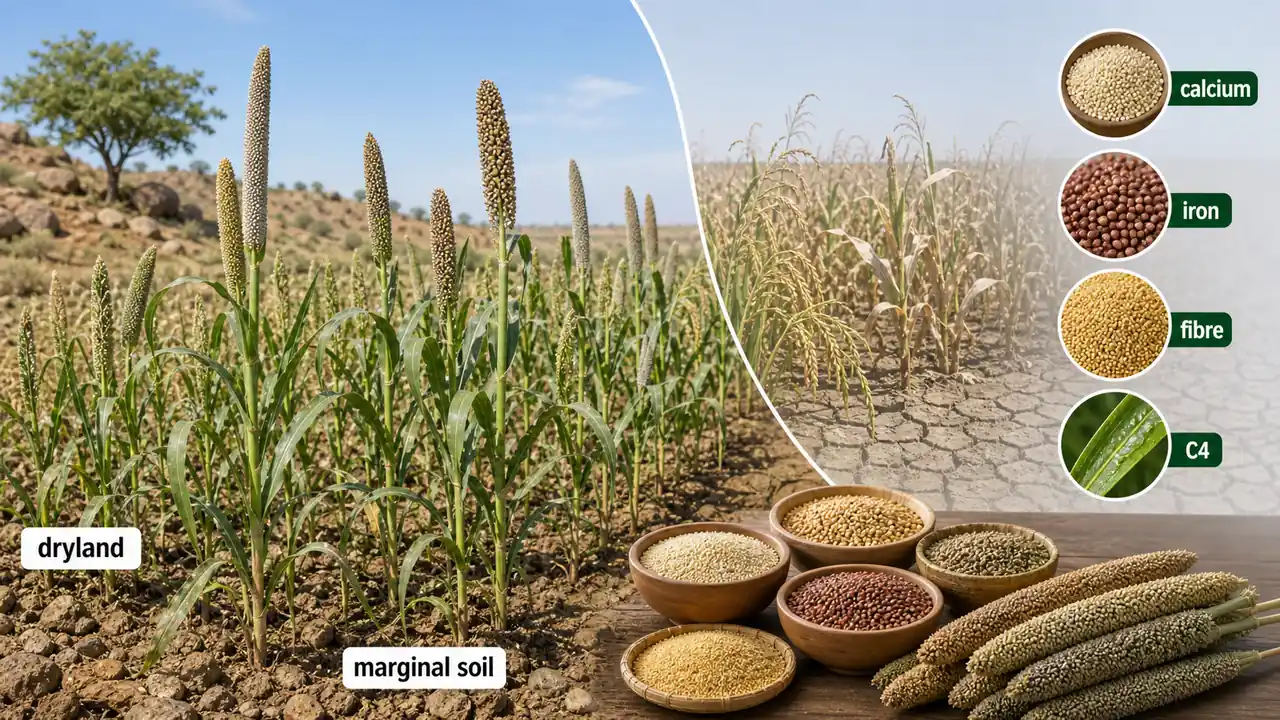
- Grown mainly in dryland areas on low-fertility soils with scanty rainfall and on marginal lands where major cereals fail.
- Called nutri-cereals for their superior content of dietary fibre, minerals (calcium, iron, zinc), and vitamins.
- Play a crucial role in food security for smallholder and tribal farmers across India.
- All minor millets are C4 plants, making them efficient in hot, dry conditions.
Minor Millets at a Glance -- Comparison Table
| Millet | Botanical Name | Key Distinction | Maturity |
|---|---|---|---|
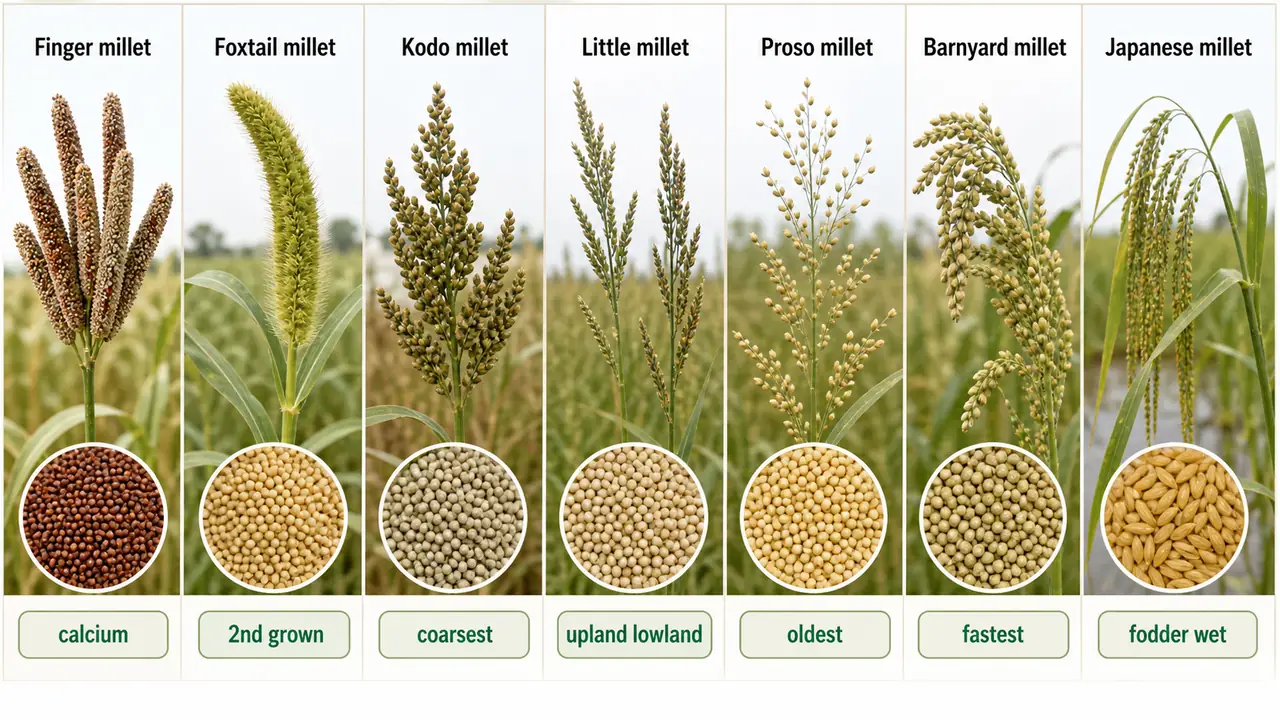
| Finger millet (Ragi) | Eleusine coracana | Richest cereal source of calcium (344 mg/100g) | 90-120 days |
| Foxtail millet (Kakun) | Setaria italica | 2nd most widely grown millet globally | 75-90 days |
| Kodo millet | Paspalum scrobiculatum | Coarsest millet (largest grain), low glycemic index | 90-120 days |
| Little millet | Panicum sumatrense | Hardy; grows in both upland and lowland | 60-80 days |
| Proso millet (Cheena) | Panicum miliacearum | One of the oldest cultivated millets | 60-90 days |
| Barnyard millet (Sawan) | Echinochloa frumentacea | Fastest growing millet (45-60 days) | 45-60 days |
| Japanese millet | Echinochloa esculenta | Primarily a fodder crop; thrives in wet/marshy areas | 45-60 days |
TIP
Exam quick-fire for minor millets: Ragi = highest calcium (344 mg). Kodo = coarsest. Barnyard = fastest (45-60 days). Foxtail = 2nd most grown globally. Proso = oldest cultivated. Learn the botanical names -- they appear frequently in one-liner questions.
Finger Millet (Madua / Ragi)

- Eleusine coracana -- the most important minor millet in terms of area and production.
- Exceptionally rich in calcium (344 mg per 100 g) -- the richest cereal source of calcium.
- Also a good source of iron, amino acids (especially methionine), and dietary fibre.
- The name "finger millet" comes from the finger-like branching of its ear head.
- A staple food in Karnataka, Tamil Nadu, and parts of Andhra Pradesh and Uttarakhand.
TIP
Ragi is the most asked minor millet in exams. Key facts to memorise: Eleusine coracana, richest cereal source of calcium (344 mg/100g), most important minor millet by area and production, staple in Karnataka and Tamil Nadu, rich in methionine.
Foxtail Millet (Italian / German Millet / Kakun)

- Setaria italica -- among the most ancient cultivated millets, with origins in China.
- Gets its name from the foxtail-shaped panicle (inflorescence).
- Rich in protein, dietary fibre, and iron.
- Used for both food (porridge, flour) and fodder.
Kodo Millet

- Paspalum scrobiculatum -- the coarsest millet, earning the name for its thick, rough husk that requires extra processing.
- Despite the tough husk, it is highly nutritious with good amounts of protein, fibre, and antioxidants.
- Particularly drought-resistant; widely grown in Madhya Pradesh, Tamil Nadu, and other semi-arid regions.
- Low glycemic index -- beneficial for diabetic patients.
- Occasionally causes "Kodo poisoning" if grains are contaminated with the fungus Aspergillus flavus -- proper drying and storage prevent this.
Little Millet

- Panicum sumatrense -- a hardy crop that thrives in both upland and lowland conditions.
- Matures in 60-80 days.
- Popular in the tribal belts of central and southern India.
- Rich in iron and fibre.
Proso Millet (Cheena / Common Millet)

- Panicum miliacearum -- one of the oldest cultivated millets in the world.
- A short-duration crop (60-90 days), making it ideal as a catch crop or contingency crop when other crops fail.
- Excellent drought tolerance and ability to grow on poor soils.
- Primarily grown in Madhya Pradesh, Uttar Pradesh, and parts of Tamil Nadu.
- Also used as bird feed globally -- commonly sold as "millet" in pet stores.
Barnyard Millet (Sawan)

- Echinochloa frumentacea -- the fastest-growing millet, harvestable in 45-60 days.
- Commonly grown as a Kharif crop in hilly regions.
- An excellent substitute for rice during fasting periods in many parts of India.
- Rich in fibre, low glycemic index -- suitable for diabetic patients.
Japanese Millet

- Echinochloa esculenta -- closely related to barnyard millet but primarily cultivated for fodder rather than grain.
- Grows rapidly in wet, marshy conditions -- suited for areas that are too wet for other crops.
- Also used as a green manure crop to improve soil fertility in some regions.
Important Finger Millet Varieties
Finger millet has the most extensive breeding programme among minor millets. Key varieties to know for exams:
| Variety | Key Feature |
|---|---|
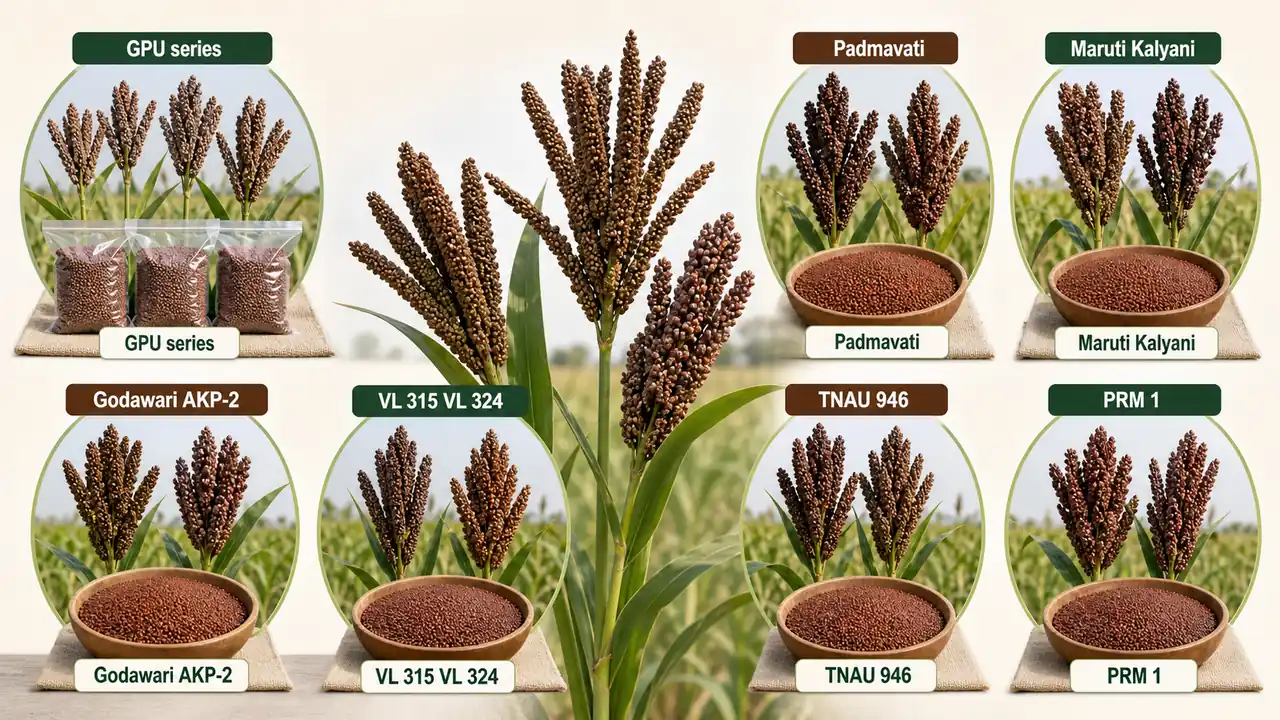
| GPU 26, 28, 45, 48, 67 | GPU series from UAS Bengaluru -- high-yielding, blast-resistant |
| Padmavati | Popular in Odisha |
| Maruti, Kalyani | Karnataka releases |
| Godawari, AKP-2 | Maharashtra releases |
| VL 315, VL 324 | Hill region varieties (Uttarakhand) |
| TNAU 946 | Tamil Nadu release |
| PRM 1 | Photo-insensitive variety suitable for multiple seasons |
Summary Table -- Minor Millets Quick Revision
| Millet | Botanical Name | Top Nutritional Feature | Where Mostly Grown |
|---|---|---|---|
| Finger millet (Ragi) | Eleusine coracana | Calcium (344 mg/100g) | Karnataka, Tamil Nadu |
| Foxtail millet | Setaria italica | Protein, fibre, iron | AP, Karnataka, Tamil Nadu |
| Kodo millet | Paspalum scrobiculatum | Fibre, antioxidants, low GI | MP, Tamil Nadu |
| Little millet | Panicum sumatrense | Iron, fibre | Tribal belts of central/south India |
| Proso millet | Panicum miliacearum | Drought tolerance, catch crop | Scattered across dryland India |
| Barnyard millet | Echinochloa frumentacea | Fibre, low GI, fasting food | Hilly regions (Uttarakhand, HP) |
| Japanese millet | Echinochloa esculenta | Rapid biomass for fodder | Wet/marshy areas |
Summary Cheat Sheet
| Concept / Topic | Key Details |
|---|---|
| Finger millet (Ragi) | Eleusine coracana; richest cereal source of calcium (344 mg/100g); rich in methionine; staple in Karnataka and Tamil Nadu |
| Foxtail millet (Kakun) | Setaria italica; 2nd most widely grown millet globally; origin China; rich in protein and iron |
| Kodo millet | Paspalum scrobiculatum; coarsest millet; low glycemic index -- good for diabetics; grown in Madhya Pradesh |
| Little millet | Panicum sumatrense; hardy; grows in both upland and lowland; 60-80 days maturity |
| Proso millet (Cheena) | Panicum miliacearum; oldest cultivated millet; 60-90 days; ideal as catch/contingency crop |
| Barnyard millet (Sawan) | Echinochloa frumentacea; fastest growing millet (45-60 days); fasting food; low GI |
| Japanese millet | Echinochloa esculenta; primarily fodder; thrives in wet/marshy conditions |
| All minor millets | C4 plants; dryland agriculture; called nutri-cereals |
| GPU series | Key finger millet varieties from UAS Bengaluru -- high-yielding, blast-resistant |
| 2023 -- International Year of Millets | UN declared 2023 as IYM on India's proposal -- boosted global awareness of millet nutrition |