🍲 Lentil and Field Pea -- Essential Rabi Pulses
Complete guide to lentil (masoor) and field pea cultivation covering Microsperma vs Macrosperma types, tenderometer, Aparna (1st dwarf pea), varieties, and exam-focused tables for IBPS AFO and NABARD.
In the previous lessons, we covered chickpea (King of Pulses, Rabi) and pigeonpea (mini fertiliser crop, Kharif). Now we turn to two more essential Rabi pulses: lentil (masoor) and field pea -- crops that frequently appear together in exam papers.
The optical "lens" was not named after a physics concept -- it was named after the lentil seed. The biconvex shape of the lentil (Lens esculentum) inspired the Latin name for the glass lens we use today. As one of the oldest cultivated crops (8,000-9,000 years of history), lentil has sustained human civilisations from the Fertile Crescent to the Indo-Gangetic plains. Today, it remains a vital Rabi pulse across India's dryland belts, often grown on residual moisture after rice or as an intercrop with wheat and barley.
This lesson covers:
- Lentil basics -- Microsperma vs Macrosperma types, origin, and the "lens" trivia
- Lentil cultivation -- climate, sowing, nutrient management, and intercropping
- Field pea basics -- botanical link to Mendel's genetics, field vs garden pea
- Field pea cultivation -- tenderometer, sowing, and varieties
- Key varieties -- Type 163 (1st pea), Rachna (1st powdery mildew resistant), Aparna (1st dwarf)
All sections are high-yield for exams, NABARD, and FCI exams.
Pro Content Locked
Upgrade to Pro to access this lesson and all other premium content.
Charged once for one year · ₹1188 total
Save ₹100/month vs ₹2388/year launch price
- All Agriculture & Banking Courses
- AI Lesson Questions (100/day)
- AI Doubt Solver (50/day)
- Glows & Grows Feedback (30/day)
- AI Section Quiz (20/day)
- 22-Language Translation (100/day)
- Recall Questions (20/day)
- AI Quiz (15/day)
- AI Quiz Paper Analysis (100/day)
- AI Step-by-Step Explanations (100/day)
- Spaced Repetition Recall (FSRS)
- AI Tutor
- Immersive Text Questions
- Audio Lessons — Hindi & English
- Mock Tests & Previous Year Papers
- Summary & Mind Maps
- XP, Levels, Leaderboard & Badges
- Generate New Classrooms
- Voice AI Teacher (AgriDots Live)
- AI Revision Assistant
- Knowledge Gap Analysis
- Interactive Revision (LangGraph)
🔒 Secure one-time yearly payment via Razorpay · No hidden fees
In the previous lessons, we covered chickpea (King of Pulses, Rabi) and pigeonpea (mini fertiliser crop, Kharif). Now we turn to two more essential Rabi pulses: lentil (masoor) and field pea -- crops that frequently appear together in exam papers.
The optical "lens" was not named after a physics concept -- it was named after the lentil seed. The biconvex shape of the lentil (Lens esculentum) inspired the Latin name for the glass lens we use today. As one of the oldest cultivated crops (8,000-9,000 years of history), lentil has sustained human civilisations from the Fertile Crescent to the Indo-Gangetic plains. Today, it remains a vital Rabi pulse across India's dryland belts, often grown on residual moisture after rice or as an intercrop with wheat and barley.
This lesson covers:
- Lentil basics -- Microsperma vs Macrosperma types, origin, and the "lens" trivia
- Lentil cultivation -- climate, sowing, nutrient management, and intercropping
- Field pea basics -- botanical link to Mendel's genetics, field vs garden pea
- Field pea cultivation -- tenderometer, sowing, and varieties
- Key varieties -- Type 163 (1st pea), Rachna (1st powdery mildew resistant), Aparna (1st dwarf)
All sections are high-yield for exams, NABARD, and FCI exams.
Lentil (Masoor) -- Basics

Lentil is among the simplest pulses to cultivate -- it requires minimal irrigation, thrives on residual moisture, and has a short crop duration. These characteristics make it ideal for the dryland Rabi belts of Uttar Pradesh, Madhya Pradesh, and Bihar.
| Parameter | Detail |
|---|---|
| Botanical name | Lens esculentum / Lens culinaris |
| Family | Papilionaceae (Leguminoceae) |
| Origin | Egypt, Asia Minor (Fertile Crescent region) |
| History | One of the oldest cultivated crops (8,000-9,000 years) |
| Other names | Cover crop (low, spreading canopy protects soil from erosion), Dryland crop (minimal irrigation) |
- As a legume, lentil fixes atmospheric nitrogen through Rhizobium bacteria, benefiting soil health.
NOTE
Lentil trivia for exams: The optical "lens" was named after lentil seeds (Lens esculentum) due to their similar biconvex shape. Lentil is among the oldest domesticated crops.
Microsperma vs Macrosperma
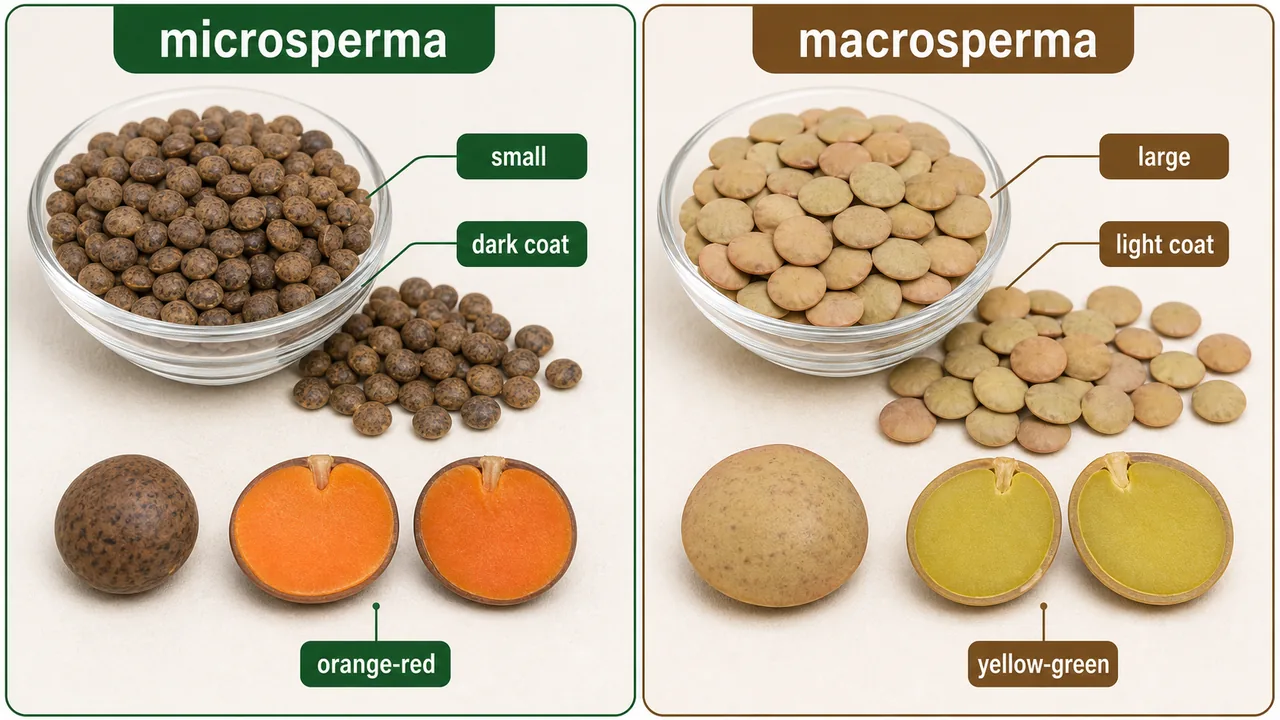
Lentil is classified into two distinct types based on seed size -- a distinction that exams test frequently. In India, the Microsperma type dominates cultivation, while Macrosperma is primarily grown for export markets.
| Feature | Microsperma (Masuri) | Macrosperma (Masur) |
|---|---|---|
| Seed size | Small (2-6 mm), convex | Large (6-9 mm), flat |
| Seed coat | Darker | Lighter |
| Cotyledon colour | Orange-red | Yellow to green |
| Predominance in India | Yes -- main type cultivated | Less common, mostly exported |
Climate and Cultivation
Lentil is strictly a cool-season Rabi crop that performs best under mild winter temperatures. Unlike chickpea which tolerates some drought stress, lentil is more sensitive to both excess moisture (causes root rot) and terminal heat stress (hastens maturity, reduces seed filling).
| Parameter | Value |
|---|---|
| Season | Rabi (cool-season crop) |
| Sowing time | Last week of October to 2nd week of November |
| Best soil | Light loam, alluvial (good drainage, adequate moisture retention) |
| Seed rate | 30-40 kg/ha (late sowing: 50-60 kg/ha for compensation) |
| Spacing | 30 x 5 cm |
| Sowing depth | 3-5 cm |
| Irrigations | 1-3 (low water requirement; sensitive to excess moisture) |
| Harvest | 100-120 days after sowing (pods turn brown, seeds rattle inside) |
| Yield | 15-20 q/ha |
Critical Irrigation Stages
| Stage | Timing | Impact of Stress |
|---|---|---|
| Flower initiation | 40-45 DAS | Reduces flower number and pod count |
| Pod formation | 70-80 DAS | Poor seed filling, lighter seeds |
Nutrient Management
Like all legumes, lentil fixes its own nitrogen and needs only a starter dose. The nutrient strategy prioritises phosphorus for nodulation and zinc for grain quality.
- NPK: 20 : 50 : 20 kg/ha at sowing in furrows.
- Foliar spray: ZnSO4 0.5% + Lime 0.25% in the standing crop.
- Low nitrogen (20 kg/ha) is a starter dose -- the crop meets most N needs through biological fixation.
- Zinc improves grain quality and enzyme function; lime corrects micronutrient availability.
Intercropping and Weed Management
Lentil's low, spreading canopy and slow initial growth make it both an excellent intercrop partner (adds nitrogen, covers soil) and vulnerable to weed competition in the early growth phase.
- Lentil is intercropped with wheat, barley, linseed, and safflower -- provides nitrogen enrichment to the companion crop and maximises land use efficiency.
- Weed management: Fluchloralin @ 1.0 kg a.i./ha (pre-plant incorporated) followed by one hand weeding at 30 DAS.

Important Lentil Varieties
Lentil varieties are classified by the Microsperma-Macrosperma distinction. Exam questions typically ask about the variety type rather than individual variety names.
| Type | Varieties |
|---|---|
| Microsperma | HUL 57, Pant L 6, 7, VL Masoor 125, 126, Pusa Vaibhav |
| Macrosperma | PL 5, IPL 406, DPL 62, WBL 58, K 75, Sapna, Priya, Garima, Subrata, Sheri, Jawahar Lentil 3 |
- Other common varieties: JL-3, Pant L-639, 209, 406, IPL-81, DL-62, Lens 4076.
Field Pea -- Basics

Field pea shares many characteristics with lentil -- both are cool-season Rabi pulses with hypogeal germination. However, field pea is historically significant as the organism Gregor Mendel used for his foundational genetics experiments, and it brings unique exam topics like the tenderometer and the Aparna (first dwarf) variety.
| Parameter | Detail |
|---|---|
| Botanical name | Pisum sativum var. arvense (field pea) / var. hortense (garden pea) |
| Family | Papilionaceae (Leguminoceae) |
| Chromosome | 2n = 14 (same chromosome number used by Gregor Mendel in his genetics experiments) |
| Origin | Mediterranean region of Southern Europe and Western Asia |
| Protein | 22% |
| Carbohydrate | 60% |
| Fat | 1.8% |
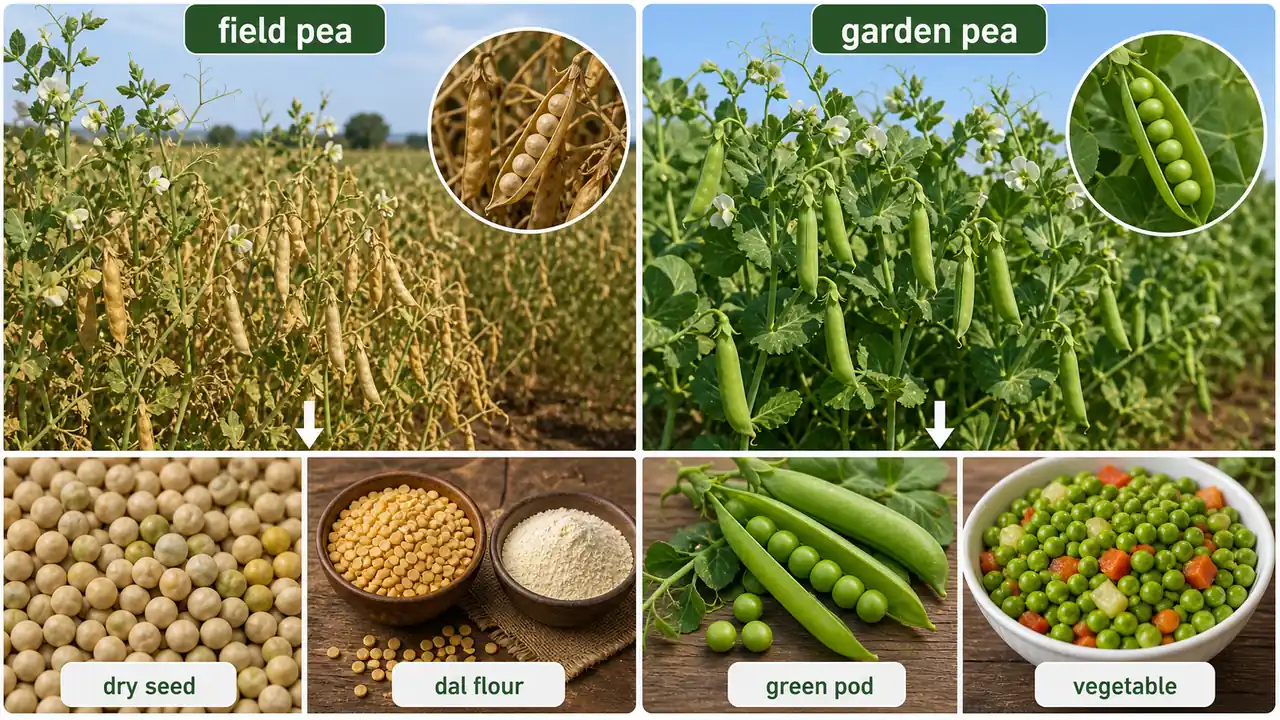
Field Pea vs Garden Pea
| Feature | Field Pea (var. arvense) | Garden Pea (var. hortense) |
|---|---|---|
| Use | Dry seeds for dal/flour | Green pods as vegetable, canning |
| Harvest stage | Mature dry pods | Green, tender pods |
| Seed rate | 75-80 kg/ha | 100-120 kg/ha |
| Yield | 20-25 q/ha | 80-100 q/ha (fresh green, high moisture) |
Climate (Field Pea)
Field pea requires cooler temperatures than most Kharif pulses and is highly sensitive to humidity (promotes fungal diseases). This climate profile explains why it is strictly a Rabi crop in India.
| Parameter | Requirement |
|---|---|
| Season | Rabi (cool growing season) |
| Germination temperature | ~22 C |
| Growth temperature | 13-18 C |
| Water requirement | 400-600 mm |
| Photoperiod | Short-day plant |
| Frost sensitivity | Damages flowers and young pods |
| Humidity | Harmful -- promotes powdery mildew, rust, and fungal diseases |
| Heavy rain at flowering | Causes flower drop and poor pollination |
NOTE
Late sowing warning: Sowing after October causes drastic yield reduction because higher temperatures during the reproductive phase reduce pod setting and seed filling.
Soil (Field Pea)
Soil requirements for field pea are more specific than for lentil -- pea is particularly intolerant of waterlogging and acidic conditions.
- Well-drained loam soil is best. Pea is highly sensitive to waterlogging -- even brief periods of standing water cause root rot and yellowing.
- Optimum pH: 6.5 (maximises nutrient availability and Rhizobium activity). Below pH 5.5, nodulation is severely inhibited.
Sowing and Seed Treatment
Timely sowing is critical for field pea because late planting exposes the reproductive phase to rising temperatures, causing drastic yield reduction through flower drop and poor seed filling.
| Parameter | Value |
|---|---|
| Sowing time | 2nd fortnight of October (Rabi) |
| Spacing | 30 x 10 cm |
| Seed treatment | Captan/Thiram @ 2.5 g + Rhizobium leguminosarum 10 g per kg seed |
| Irrigation | 1-2 irrigations |
| Germination | Hypogeal |
Tenderometer
- Maturity of pea is measured by Tenderometer -- it measures seed tenderness/firmness by the force required to crush a sample of peas. Lower readings = tender, immature (ideal for canning and freezing at 95-105 tenderometer units); higher readings = mature, starchy (for pulse/dal at 120+ units). This instrument is unique to pea among all pulses and is a frequently tested exam fact.

Critical Stages and Nutrient Management
Field pea responds well to irrigation at two critical stages. Missing irrigation at these windows causes significant yield losses that cannot be recovered later.
| Stage | Timing | Management |
|---|---|---|
| Flower initiation | 40-45 DAS | Irrigate for maximum flower production |
| Pod filling | 70-80 DAS | Irrigate for plump, well-filled seeds |
- Nutrient dose: 20 : 50 : 30 : 40 kg NPKS/ha. Sulphur (40 kg/ha) improves protein quality and enhances Rhizobium activity.
- Weed management: Two hand weedings at 30 and 45 DAS (pea is slow-growing initially, vulnerable to weed competition in first 40-50 days).
Varieties
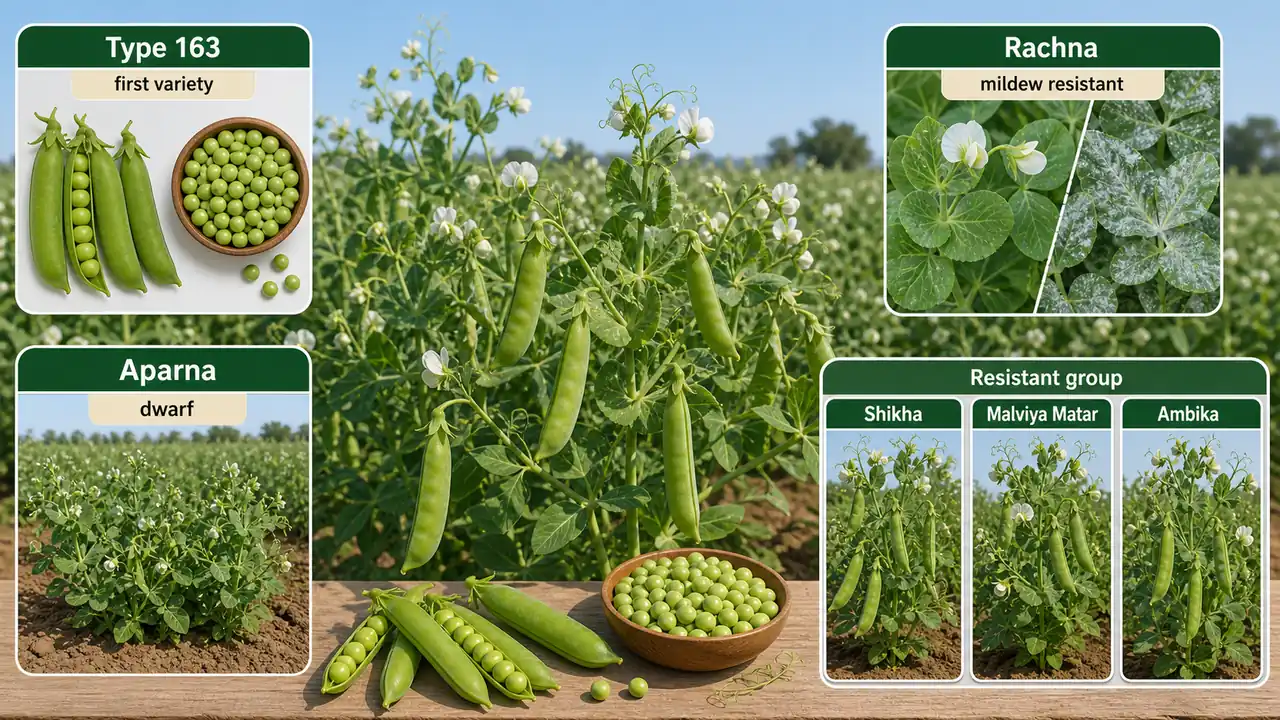
Field pea and garden pea have distinct variety lineups reflecting their different end-uses. Focus on the "firsts" -- Type 163 (first pea variety), Aparna (first dwarf), and Rachna (first powdery mildew resistant).
| Type | Key Varieties |
|---|---|
| Field pea | Aparna (1st dwarf variety -- less lodging), Ambika, Rachana, T-65, 163, Hans, KP-885, Pant C5 |
| Garden pea | Arkel (sickle-shaped pods, early maturity), Bonvilley, Sylvia (whole pod edible -- snap pea), Early Bajer, Early December, Pant Matar-1, 5, 6, 8, Aajad Matar-1, Pant Uphar |
Diseases
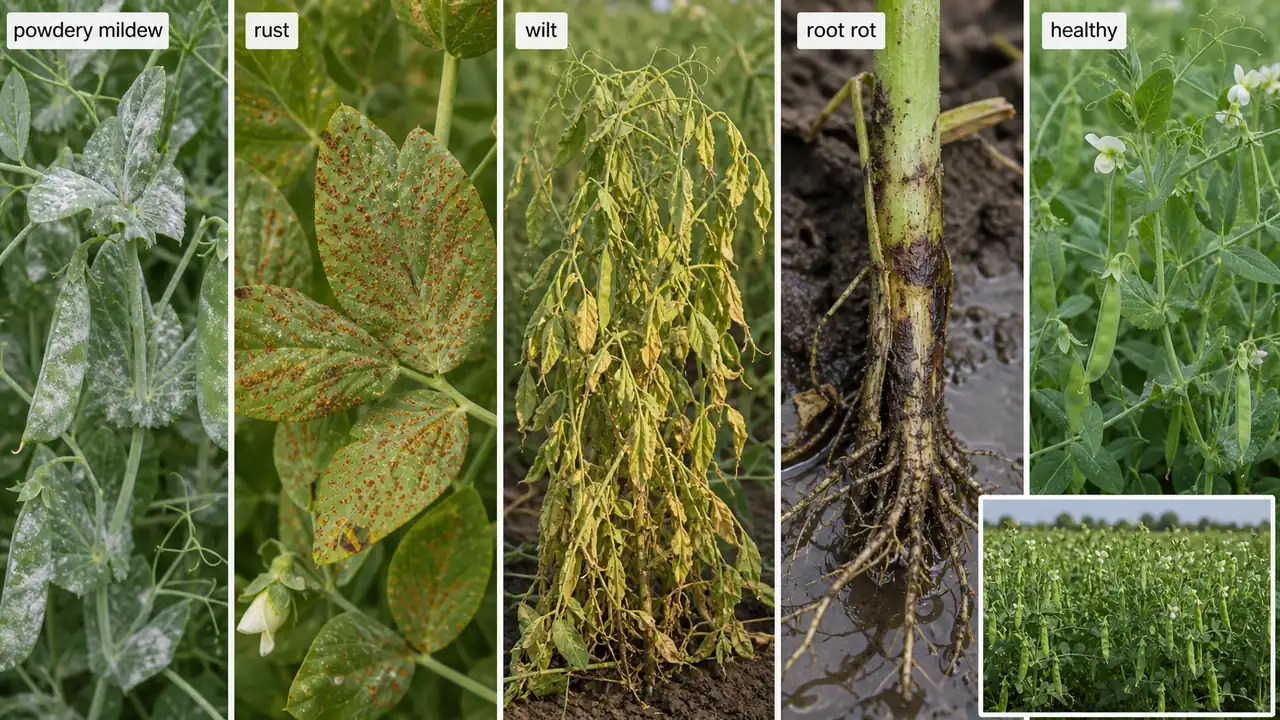
Field pea is susceptible to several fungal diseases, particularly under humid conditions. Powdery mildew is the most important disease and has driven significant variety development efforts.
| Disease | Causal Agent | Key Facts |
|---|---|---|
| Powdery Mildew | Erysiphe pisi | Most important disease; white powdery coating on leaves, stems, and pods. Resistant varieties: Rachna (1st resistant), Shikha, Malviya Matar, Ambika |
| Rust | Uromyces fabae | Brown pustules on leaves; favoured by humid, cool weather |
| Wilt | Fusarium oxysporum f. sp. pisi | Yellowing and wilting; managed by crop rotation and resistant varieties |
| Root Rot | Rhizoctonia solani | Caused by waterlogging; avoid poorly drained fields |
Yield and Harvest
Yield varies dramatically between field pea (harvested as dry grain) and garden pea (harvested as fresh green pods with high moisture content). The apparent higher yield of garden pea reflects water weight, not higher productivity.
| Type | Yield |
|---|---|
| Field pea (grain) | 20-25 q/ha |
| Garden pea (fresh green) | 80-100 q/ha |
- Harvest when stems and pods turn straw/light brown and seeds rattle within pods.
- Shelling percentage: 49% (about half the pod weight is grain).
Important Pea Varieties
These varieties are frequently asked in exams, NABARD, and IBPS SO papers. Focus on the "firsts" and disease-resistance categories.
| Variety | Special Characteristics |
|---|---|
| Type 163 | 1st pea variety |
| Rachna | 1st powdery mildew resistant variety of field pea |
| Aparna | 1st dwarf variety of field pea |
| Pusa Prabhat, Pusa Pana, Shubhra | Extra early variety |
| Uttara, Sapna | Dwarf varieties |
| Shikha, Malviya Matar, Ambika | Powdery mildew resistant |
| Harbajan | Early maturing variety |
Summary Table -- Lentil and Field Pea at a Glance
| Parameter | Lentil | Field Pea |
|---|---|---|
| Botanical name | Lens culinaris | Pisum sativum var. arvense |
| Family | Papilionaceae | Papilionaceae |
| Chromosome | 2n = 14 | 2n = 14 |
| Origin | Egypt, Asia Minor | Mediterranean |
| Protein | ~25% | 22% |
| Pollination | Self-pollinated | Often self-pollinated |
| Season | Rabi | Rabi |
| Photoperiod | Long-day | Short-day |
| Water requirement | Low (1-3 irrigations) | 400-600 mm |
| Seed rate | 30-40 kg/ha | 75-80 kg/ha |
| Sowing time | Oct-Nov | 2nd fortnight of October |
| Germination | Hypogeal | Hypogeal |
| Harvest days | 100-120 DAS | Varies by type |
| Yield | 15-20 q/ha | 20-25 q/ha (grain); 80-100 q/ha (green) |
| Shelling % | -- | 49% |
| 1st variety | -- | Type 163 |
| 1st dwarf variety | -- | Aparna |
| Maturity measurement | -- | Tenderometer |
| Lens trivia | Named the optical lens | Used by Mendel for genetics |
Summary Cheat Sheet
| Concept / Topic | Key Details |
|---|---|
| Lentil botanical name | Lens culinaris / Lens esculentum |
| Lentil origin | Egypt, Asia Minor — one of oldest crops (8,000-9,000 years) |
| Lens trivia | Optical lens named after lentil seed shape |
| Microsperma | Small (2-6 mm), dark, orange-red cotyledon — main Indian type |
| Macrosperma | Large (6-9 mm), flat, lighter — mostly exported |
| Lentil seed rate | 30-40 kg/ha (late: 50-60 kg/ha) |
| Lentil yield | 15-20 q/ha |
| Field Pea botanical name | Pisum sativum var. arvense |
| Field Pea chromosome | 2n = 14 (used by Mendel for genetics) |
| Field Pea protein | 22%; carbohydrate 60% |
| Field Pea pollination | Often self-pollinated |
| Field Pea photoperiod | Short-day plant |
| Tenderometer | Measures pea seed tenderness/firmness for harvest timing |
| Type 163 | 1st pea variety |
| Rachna | 1st powdery mildew resistant field pea variety |
| Aparna | 1st dwarf variety of field pea |
| Germination (both) | Hypogeal |
| Lentil critical stages | Flower initiation (40-45 DAS), Pod formation (70-80 DAS) |
| Lentil weed herbicide | Fluchloralin @ 1.0 kg a.i./ha (pre-plant) |
| Pea shelling % | 49% |
| Pea optimum pH | 6.5 |
TIP
Next: Lesson 4 covers the Vigna trio -- Mungbean, Urdbean, and Moth Bean -- short-duration pulse crops with the highest protein (mungbean at 24%) and the most drought-tolerant kharif pulse (moth bean).