🟡 Rapeseed and Mustard -- India's Premier Rabi Oilseed (Complete Guide)
Master rapeseed-mustard cultivation from the Triangle of U to Canola varieties -- Brassica species, climate, varieties, hybrid development, and exam-critical facts for exams, NABARD, and IBPS exams.
The previous lessons covered groundnut (King of Oilseeds) and soybean (the protein-dominant "Wonder Crop") -- both primarily Kharif crops. Now we shift to the most important Rabi oilseed in India.
As winter settles over the plains of Rajasthan and Haryana, a sea of bright yellow flowers transforms the countryside. This is mustard in full bloom -- India's most important Rabi oilseed crop and the source of the pungent cooking oil that defines cuisines from Punjab to Bengal. The Brassica family that includes mustard has a fascinating genetic story known as the Triangle of U, and it is one of the most examined topics in agricultural officer exams.
This lesson covers:
- Brassica species and Triangle of U -- the genetic relationships among six Brassica species
- Climate and soil -- why cool, dry weather suits mustard
- Agronomy -- sowing, irrigation, and sulphur-rich nutrient management
- Hybrid achievements -- Pusa Jai Kisan, NRC-HB-506, and Canola types
- Diseases and pests -- Alternaria blight, white rust, mustard aphid
- Varieties -- drought, heat, and salinity tolerant cultivars
All sections are high-yield for exams, NABARD, and FCI exams.
Pro Content Locked
Upgrade to Pro to access this lesson and all other premium content.
Pay once valid for one year · Effective ₹99/month
- All Agriculture & Banking Courses
- AI Lesson Questions (100/day)
- AI Doubt Solver (50/day)
- Glows & Grows Feedback (30/day)
- AI Section Quiz (20/day)
- 22-Language Translation (100/day)
- Recall Questions (20/day)
- AI Quiz (15/day)
- AI Quiz Paper Analysis (100/day)
- AI Step-by-Step Explanations (100/day)
- Spaced Repetition Recall (FSRS)
- AI Tutor
- Immersive Text Questions
- Audio Lessons — Hindi & English
- Mock Tests & Previous Year Papers
- Summary & Mind Maps
- XP, Levels, Leaderboard & Badges
- Generate New Classrooms
- Voice AI Teacher (AgriDots Live)
- AI Revision Assistant
- Knowledge Gap Analysis
- Interactive Revision (LangGraph)
🔒 Secure one-time yearly payment via Razorpay · No hidden fees
The previous lessons covered groundnut (King of Oilseeds) and soybean (the protein-dominant "Wonder Crop") -- both primarily Kharif crops. Now we shift to the most important Rabi oilseed in India.
As winter settles over the plains of Rajasthan and Haryana, a sea of bright yellow flowers transforms the countryside. This is mustard in full bloom -- India's most important Rabi oilseed crop and the source of the pungent cooking oil that defines cuisines from Punjab to Bengal. The Brassica family that includes mustard has a fascinating genetic story known as the Triangle of U, and it is one of the most examined topics in agricultural officer exams.
This lesson covers:
- Brassica species and Triangle of U -- the genetic relationships among six Brassica species
- Climate and soil -- why cool, dry weather suits mustard
- Agronomy -- sowing, irrigation, and sulphur-rich nutrient management
- Hybrid achievements -- Pusa Jai Kisan, NRC-HB-506, and Canola types
- Diseases and pests -- Alternaria blight, white rust, mustard aphid
- Varieties -- drought, heat, and salinity tolerant cultivars
All sections are high-yield for exams, NABARD, and FCI exams.
Basics

Rapeseed and mustard belong to the Cruciferae family, characterised by cross-shaped flowers and the distinctive siliqua fruit. Brassica juncea (Indian mustard) is commercially the most important species in India.
| Feature | Detail |
|---|---|
| Botanical Name | Brassica spp. |
| Family | Cruciferae (Brassicaceae) exams |
| Origin | China |
| Fruit (Pod) | Siliqua |
| Inflorescence | Raceme |
| Season | Primarily Rabi |
- AICRP on oilseed was started in 1967 to coordinate research for improving oilseed productivity across India.
- A siliqua is a dry, elongated, two-valved fruit characteristic of the Cruciferae family. When mature, the two valves split open from the base, releasing seeds.

The Triangle of U -- Brassica Species Relationships
The Triangle of U is one of the most frequently examined topics in agricultural genetics. It explains how three diploid Brassica species naturally crossed to produce three amphidiploid hybrids.
This is based on the Triangle of U (proposed by Woo Jang-choon in 1935), which explains the genetic relationships among six Brassica species. Three are diploid parents and three are amphidiploid (allotetraploid) hybrids formed by natural crossing.
| Amphidiploid (Hybrid) | Parent 1 | Parent 2 | Genome |
|---|---|---|---|
| B. carinata (Ethiopian mustard) | B. nigra (BB) | B. oleracea (CC) | BBCC |
| B. napus (Rapeseed) | B. oleracea (CC) | B. campestris (AA) | AACC |
| B. juncea (Indian mustard) | B. nigra (BB) | B. campestris (AA) | AABB |
TIP
Triangle of U is a high-frequency exam topic. Remember the 3 diploid parents: B. nigra (BB), B. oleracea (CC), B. campestris (AA). The 3 amphidiploids: B. juncea (AABB), B. napus (AACC), B. carinata (BBCC). Mnemonic: "JuNCA-NapAC-CarBC" -- Juncea = AB, Napus = AC, Carinata = BC.

Mustard Species at a Glance
Seven Brassica species are cultivated in India, each with distinct uses and characteristics. B. juncea dominates commercially, but exams test all species.
| Species | Common Name | Key Feature |
|---|---|---|
| Brassica campestris | Sarson | Oldest cultivated Brassica |
| Brassica napus | Rapeseed | Parent of Canola varieties |
| Brassica juncea | Brown mustard (Indian mustard/Rai) | Most important commercially in India |
| Brassica nigra | Black mustard | Used for condiment purpose |
| Brassica carinata | Ethiopian mustard | More tolerant to diseases |
| Brassica rapa | Toria | Most widely spread in world; early maturing |
| Eruca sativa | Taramira | Minor oilseed |
Rapeseed vs Mustard

The terms "rapeseed" and "mustard" are often used interchangeably but refer to different Brassica species with distinct morphological and quality characteristics.
Rapeseed generally refers to Brassica napus and Brassica rapa, while mustard typically refers to Brassica juncea and Brassica nigra. They differ in plant morphology, seed characteristics, and oil quality.
Climate
Mustard is a cool-season crop that requires clear, dry weather with bright sunshine for optimum oil accumulation. Unlike groundnut and soybean, it is strictly a Rabi crop in India.
| Parameter | Requirement |
|---|---|
| Temperature | 10-25°C |
| Weather | Cool, clear, dry with bright sunshine |
| Frost tolerance | Cannot tolerate frost (especially during flowering) |
| Waterlogging | Not tolerated |
| Season | Rabi (sown Oct-Nov, harvested Feb-Mar) |
- Cool temperature with clear dry weather and bright sunshine increases the oil percentage of the crop by promoting better photosynthate accumulation in seeds.
Soil
Mustard adapts to a wide range of soil types, but well-drained loamy soils with good organic matter give the best results.
- Can be grown on a wide range of soils from light to heavy loam.
- Best performance in well-drained loamy soils with good organic matter.
- Ideal pH: 6.0 to 7.5

Sowing, Seed Rate, and Spacing
Mustard has very small seeds and a high branching capacity, which explains the low seed rate compared to crops like groundnut or soybean.
| Parameter | Detail |
|---|---|
| Sowing time | October 3rd week to November 1st week |
| Seed rate (pure crop) | 4 to 6 kg/ha |
| Seed rate (mixed crop) | 2 to 3 kg/ha |
| Spacing (Mustard/Rai) | 45 cm x 15 cm |
| Spacing (Toria/Rapeseed) | 30 cm x 10 cm |
- The seed rate is kept low because mustard has very small seeds and a high capacity for branching and pod production even at lower plant densities.
- Toria is spaced more closely due to its shorter growth duration and smaller stature.
Irrigation
Mustard has a low water requirement (350-450 mm) and needs only two irrigations, making it well-suited for water-scarce Rabi conditions.
| Parameter | Detail |
|---|---|
| Number of irrigations | 2 |
| Water requirement | 350-450 mm |
Critical Stages
- Rosette stage (20-30 DAS) -- water stress severely affects subsequent vegetative growth.
- Siliqua formation stage -- moisture availability is essential for proper seed filling and oil accumulation.

Nutrient Management
Mustard is a sulphur-loving crop -- sulphur is essential for both oil synthesis and the formation of glucosinolates that give mustard its characteristic pungency.
- Dose: 60 : 30 : 30 : 20 : 10 kg NPK S Zn/ha
- Mustard is a sulphur-loving crop -- sulphur plays a key role in oil synthesis and the formation of glucosinolates (the compounds responsible for the pungent flavour).
- Zinc is important for enzyme functioning and seed development.
Varieties
Indian mustard breeding has produced landmark achievements including the world's first B. juncea hybrid and CMS-based hybrids. Canola-quality (double-zero) varieties are an emerging focus.
| Category | Varieties |
|---|---|
| Toria | Type-9, 36, Sangam, M-27 |
| Brown sarson | BS-70, Pusa Kalyani, Sufla, BSH-1 |
| Yellow sarson | Benoy, Type-42 |
| Mustard (Rai/Laha) | Kranti, Varuna, Krishna, Pusa Bold, Vardan, Rohni |
| Taramira | T-27 |
Landmark Hybrid Achievements
| Variety | Significance |
|---|---|
| Pusa Jai Kisan (Bio 902) | First Brassica juncea hybrid developed in the world |
| NRC-HB-506 | First mustard hybrid in India using CMS (Cytoplasmic Male Sterility) system, developed by Directorate of Rapeseed and Mustard Research, Bharatpur, Rajasthan |
| PGSH-51 | 00 or Canola type variety of Gobhi sarson -- low erucic acid (<2%) and low glucosinolate |
| CS-56 (Triveni) | New raya variety with higher oil content (37-40%), suited for late-sown conditions |
TIP
Canola = "00" type: Low erucic acid (<2%) + low glucosinolate = safe for human consumption and animal feed. Remember: "Double zero, Double safe" (safe oil + safe meal).
Disease
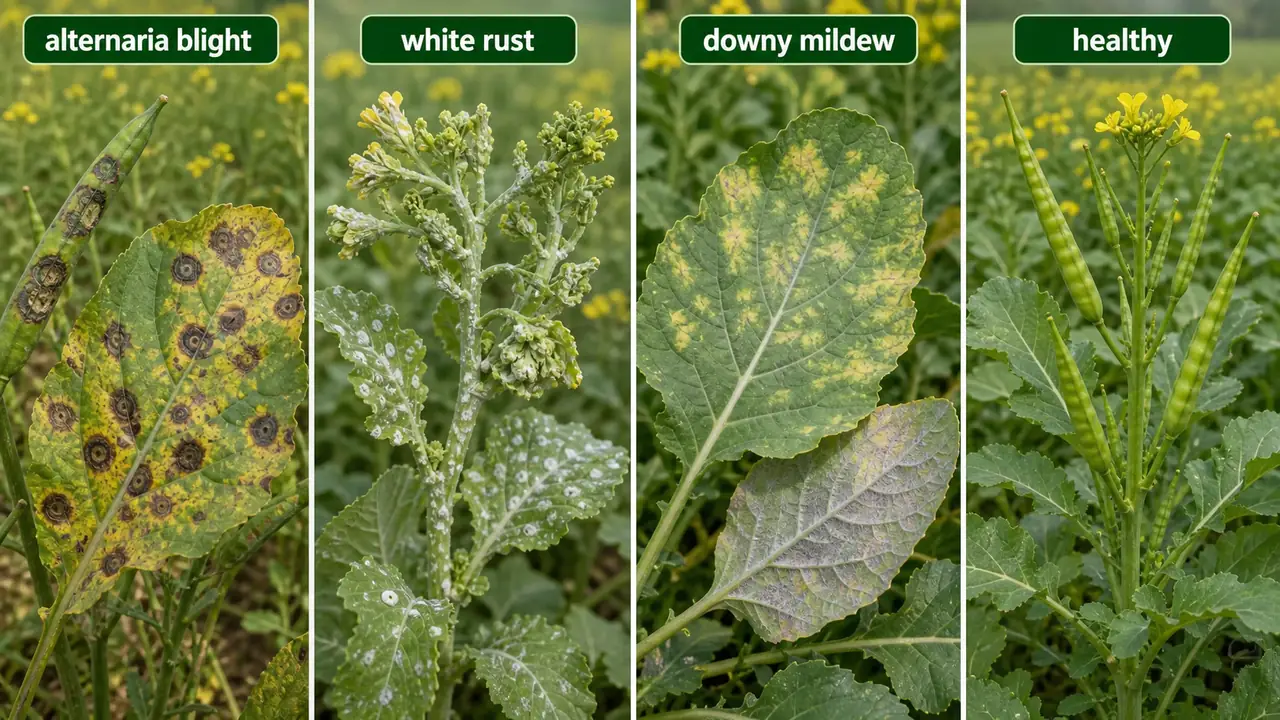
Mustard is affected by several fungal diseases, with Alternaria blight being the most widespread and economically damaging.
Major diseases include Alternaria blight (most widespread), White rust, Downy mildew, and Sclerotinia rot. Management involves seed treatment, crop rotation, and fungicides.

Insect-Pest
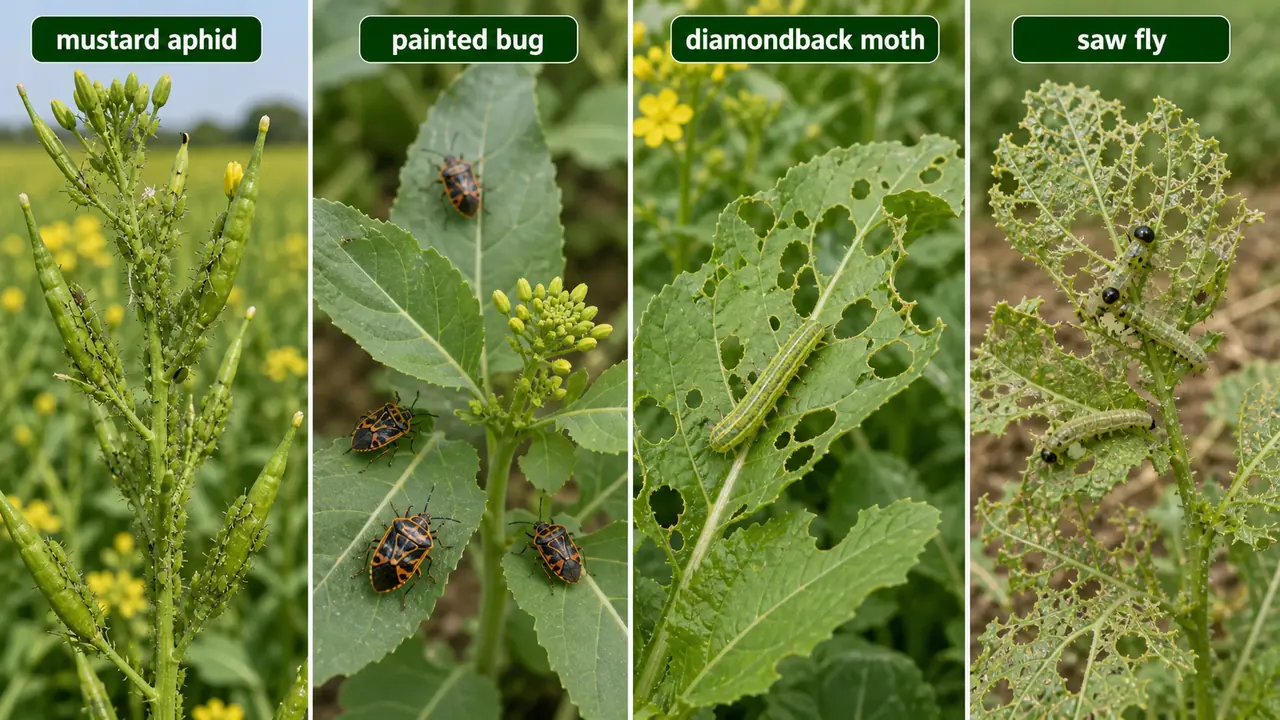
The mustard aphid is the single most destructive pest of mustard in India, capable of causing severe yield losses in epidemic years.
The mustard aphid (Lipaphis erysimi) is the most destructive pest, sucking cell sap from tender shoots and pods. The painted bug (Bagrada hilaris) is important in the early seedling stage.

Yield and Storage
Mustard yields vary between rapeseed and mustard types. Proper drying to safe moisture levels prevents seed deterioration in storage.
| Parameter | Detail |
|---|---|
| Rapeseed yield | 14-20 q/ha |
| Mustard yield | 20-25 q/ha |
| Safe storage moisture | 8 per cent |
Important Mustard Varieties
Variety classification by stress tolerance is a frequent exam topic. Note which varieties tolerate drought, heat, salinity, and specific diseases.
| Type | Varieties |
|---|---|
| Drought tolerant | Aravali, Pusa Bold, Pusa Bahar, Geeta, GM 1, Shivani, RB 50, RH 781, RH 819, RGN 48 |
| High temperature tolerant | Kranti, Pusa Agrani, Urvashi, NRCDR 02, Pusa Mustard 25, Pusa Mustard 27, RGN 13 |
| Salinity tolerant | CS 52, CS 54, Narendra Rai 1 |
| Alternaria blight tolerant | B. napus and B. carinata more tolerant. RC 781, PHR 2, EC 399301, JMM 915, Divya |
| White rust tolerant | B. napus and B. carinata more tolerant. JM 1, JM2, Basanti |
| NRC-HB-506 | 1st hybrid based on CMS system, suitable for late sowing |
| New varieties | Pusa Jai Kisan, Basanti, Ashirwad, Laxmi |
| Double zero "00" (Canola) | Contains less than 3% erucic acid |
Quick Revision Summary
| Parameter | Detail |
|---|---|
| Key species | B. juncea (Indian mustard) -- most commercially important |
| Family | Cruciferae |
| Origin | China |
| Fruit | Siliqua |
| Triangle of U | 3 diploid + 3 amphidiploid Brassica species |
| Season | Rabi (Oct-Nov sowing) |
| Seed rate | 4-6 kg/ha |
| NPK S Zn | 60:30:30:20:10 kg/ha |
| Critical stages | Rosette, Siliqua formation |
| 1st hybrid | Pusa Jai Kisan (Bio 902) |
| CMS hybrid | NRC-HB-506 |
| Canola type | PGSH-51 (00 type, low erucic acid) |
| Key pest | Mustard aphid (Lipaphis erysimi) |
| Key disease | Alternaria blight |
| Yield | 20-25 q/ha |
| Oil content | 38-42% in seed |
| Oil recovery | 33% (conversion factor: seed → oil) |
| Storage moisture | 8% |
TIP
Next: The next lesson covers Sunflower -- the day-neutral, sun-tracking oilseed with its unique capitulum inflorescence and chaffiness problem.
Mustard: Practical Cultivation Guide
Species confusion in exams — the Triangle of U (Nagaharu, 1935):
Brassica oilseed species are related through hybridization. Know these three cultivated species for India:
| Species | Common Name | Chromosome (2n) | Oil % | Where Dominant |
|---|---|---|---|---|
| B. juncea | Indian mustard / Rai | 36 (AABB) | 38-42% | Rajasthan, UP, Haryana, MP — most important |
| B. rapa (= campestris) | Yellow sarson / Toria | 20 (AA) | 42-44% | Eastern India (WB, Bihar, Assam) |
| B. napus | Gobhi sarson / Canola | 38 (AACC) | 40-44% | Limited — Punjab (winter); Canola = low erucic acid + low glucosinolates |
Key cultivation decisions:
| Decision | Recommendation | Why |
|---|---|---|
| Sowing time | Oct 15 - Nov 5 (North India) | Late sowing exposes flowering to frost + aphid peak |
| Aphid management | Spray at 10% inflorescence infested; use imidacloprid or dimethoate | Mustard aphid (Lipaphis erysimi) is the most destructive pest; can reduce yield to 1/4th-1/5th |
| Bee colonies for pollination | Place 5 Apis mellifera colonies/ha at 10% flowering | Mustard is a major honey source crop AND benefits from cross-pollination — 15-30% yield increase reported with bee pollination |
| Canola vs regular mustard | Canola (00 type) for export/health-conscious market | Low erucic acid (<2%) + low glucosinolates — but lower yield than B. juncea |
Why Rajasthan leads: Rajasthan produces ~45% of India's rapeseed-mustard. The semi-arid climate with cool winters and residual soil moisture after kharif crop suits mustard's low water requirement (250-400 mm).
Exam One-Liners: Mustard Meal and Test Weight
These small numerical facts are frequently asked in AFO/NABARD one-liner MCQs.
| Fact | Detail |
|---|---|
| Brassica juncea test weight | 4.4 g |
| Protein in rapeseed-mustard meal | 35-40% |
| Carbohydrate in meal | 14-15% |
| Fiber in meal | 10-12% |
| Ash in meal | 4-6% |
| Minerals and vitamins | 1.0-1.5% |
| Glucosinolate in meal | 2-3%; anti-nutritional factor and source of pungency |
Summary Cheat Sheet
| Concept / Topic | Key Details / Explanation |
|---|---|
| Botanical name | Brassica spp.; Family Cruciferae (Brassicaceae); Origin China |
| Most important species | Brassica juncea — Indian mustard (Rai); most commercially important in India |
| Fruit | Siliqua (dry, 2-valved pod splitting from base) |
| Inflorescence | Raceme |
| Season | Rabi (sown Oct-Nov; harvested Feb-Mar) |
| Triangle of U | 3 diploid parents: B. nigra (BB), B. oleracea (CC), B. campestris (AA) |
| Amphidiploids | B. juncea (AABB), B. napus (AACC), B. carinata (BBCC) |
| Toria | B. rapa — most widely spread in world; early maturing |
| Climate | Cool, clear, dry; temp 10-25°C; no frost during flowering |
| Water requirement | 350-450 mm; 2 irrigations |
| Critical stages | Rosette (20-30 DAS) and Siliqua formation |
| Seed rate (pure crop) | 4-6 kg/ha |
| NPK S Zn | 60 : 30 : 30 : 20 : 10 kg/ha |
| Sulphur importance | Key for oil synthesis and glucosinolate (pungency) formation |
| Glucosinolate in meal | 2-3%; anti-nutritional factor limiting high-level feed use |
| Mustard test weight | B. juncea = 4.4 g |
| Oil content | 38-42% in seed; oil recovery 33% |
| Yield | Mustard: 20-25 q/ha; Rapeseed: 14-20 q/ha |
| Safe storage moisture | 8% |
| 1st B. juncea hybrid | Pusa Jai Kisan (Bio 902) — first in the world |
| 1st CMS hybrid | NRC-HB-506 (Directorate of R&M Research, Bharatpur) |
| Canola (00 type) | PGSH-51 — low erucic acid (<2%) + low glucosinolate |
| Key pest | Mustard aphid (Lipaphis erysimi) — most destructive |
| Key disease | Alternaria blight — most widespread |
| Drought tolerant varieties | Pusa Bold, Aravali, Geeta |
| Salinity tolerant | CS 52, CS 54, Narendra Rai 1 |