🍲 Cowpea -- The Protein-Rich "Vegetable Meat" of Tropical Agriculture
Complete guide to cowpea (Vigna unguiculata) covering botany, nutritional significance, cultivation practices, and exam-important pulse nicknames for exams, NABARD, and IBPS exams.
In the previous lesson, we covered the Vigna trio -- mungbean, urdbean, and moth bean. Now we complete the pulse chapter with another Vigna member: cowpea (lobia), the "Vegetable Meat" of tropical agriculture.
In the semi-arid villages of Rajasthan and the drought-prone belts of Maharashtra, cowpea is often the first crop farmers sow when the monsoon arrives. Hardy, fast-growing, and packed with protein, it feeds both people and livestock while enriching the soil with nitrogen.
This lesson covers:
- Basics and the "Vegetable Meat" nickname -- botanical classification and nutritional significance
- Climate and cultivation -- season, sowing, and soil requirements
- Nitrogen fixation and soil health -- role in crop rotations and intercropping
- Varieties and diseases -- key cultivars and major biotic stresses
- Pulse nicknames -- consolidated exam-ready table covering all pulses
All sections are high-yield for exams, NABARD, and FCI exams.
Basics

Cowpea belongs to the same genus (Vigna) as mungbean, urdbean, and moth bean -- making it the fourth Vigna pulse covered in this chapter. Its versatility as a food (seeds, pods, leaves), fodder, and green manure crop makes it uniquely valuable in tropical farming systems.
Pro Content Locked
Upgrade to Pro to access this lesson and all other premium content.
Pay once valid for one year · Effective ₹99/month
- All Agriculture & Banking Courses
- AI Lesson Questions (100/day)
- AI Doubt Solver (50/day)
- Glows & Grows Feedback (30/day)
- AI Section Quiz (20/day)
- 22-Language Translation (100/day)
- Recall Questions (20/day)
- AI Quiz (15/day)
- AI Quiz Paper Analysis (100/day)
- AI Step-by-Step Explanations (100/day)
- Spaced Repetition Recall (FSRS)
- AI Tutor
- Immersive Text Questions
- Audio Lessons — Hindi & English
- Mock Tests & Previous Year Papers
- Summary & Mind Maps
- XP, Levels, Leaderboard & Badges
- Generate New Classrooms
- Voice AI Teacher (AgriDots Live)
- AI Revision Assistant
- Knowledge Gap Analysis
- Interactive Revision (LangGraph)
🔒 Secure one-time yearly payment via Razorpay · No hidden fees
In the previous lesson, we covered the Vigna trio -- mungbean, urdbean, and moth bean. Now we complete the pulse chapter with another Vigna member: cowpea (lobia), the "Vegetable Meat" of tropical agriculture.
In the semi-arid villages of Rajasthan and the drought-prone belts of Maharashtra, cowpea is often the first crop farmers sow when the monsoon arrives. Hardy, fast-growing, and packed with protein, it feeds both people and livestock while enriching the soil with nitrogen.
This lesson covers:
- Basics and the "Vegetable Meat" nickname -- botanical classification and nutritional significance
- Climate and cultivation -- season, sowing, and soil requirements
- Nitrogen fixation and soil health -- role in crop rotations and intercropping
- Varieties and diseases -- key cultivars and major biotic stresses
- Pulse nicknames -- consolidated exam-ready table covering all pulses
All sections are high-yield for exams, NABARD, and FCI exams.
Basics
Cowpea belongs to the same genus (Vigna) as mungbean, urdbean, and moth bean -- making it the fourth Vigna pulse covered in this chapter. Its versatility as a food (seeds, pods, leaves), fodder, and green manure crop makes it uniquely valuable in tropical farming systems.
| Feature | Detail |
|---|---|
| Botanical Name | Vigna unguiculata |
| Family | Leguminosae (Papilionaceae) |
| Common Names | Lobia, Black-eyed Pea, Southern Pea |
| Origin | Africa (domesticated in West Africa) |
| Chromosome | 2n = 22 |
| Protein Content | 20-25% |
| Nickname | Vegetable Meat |
| Photoperiod | Short-day plant (flowers when days shorten) |
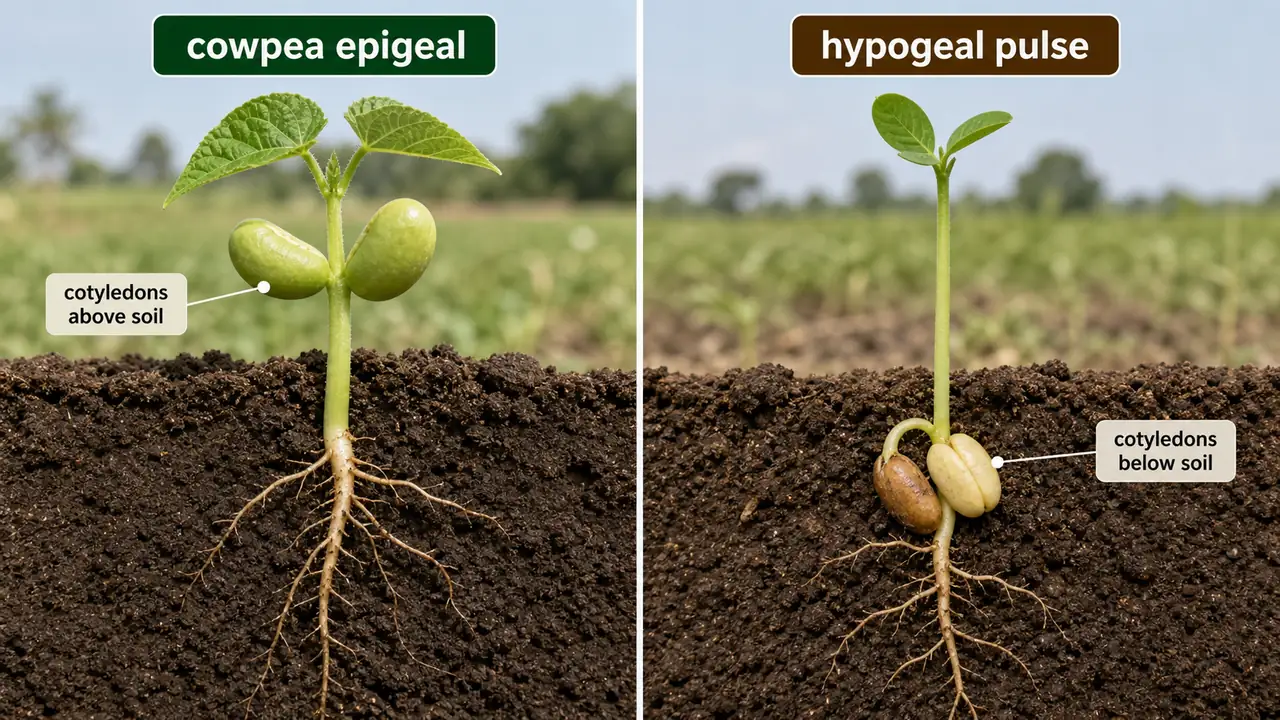
| Germination | Epigeal (cotyledons emerge above soil -- unlike most other pulses which are hypogeal) |
- The species name unguiculata refers to the claw-shaped attachment of the flower petals, a distinguishing morphological feature of cowpea.
- Cowpea is one of the few pulses where leaves are also consumed as a vegetable, particularly in Africa -- this multi-use nature contributes to the "Vegetable Meat" designation.
WARNING
Cowpea germination is epigeal, not hypogeal. Most other major pulses (chickpea, pigeonpea, lentil, pea, mungbean, urdbean) have hypogeal germination. This is a common MCQ trap.

Why "Vegetable Meat"?
Cowpea earns the name Vegetable Meat because of its high protein content (approximately 20-25%), which is comparable to meat in terms of amino acid profile. This makes it a vital source of dietary protein, especially for vegetarian populations and in regions where animal protein is expensive or scarce. Beyond protein, cowpea provides significant amounts of iron, zinc, and B-vitamins, making it nutritionally one of the most complete pulse crops.
Climate and Cultivation
Cowpea is primarily a Kharif crop but can also be grown in the Zaid (summer) season in many parts of India. Its drought tolerance and heat resistance allow cultivation in marginal lands where other pulses fail.
| Parameter | Value |
|---|---|
| Season | Kharif (also Zaid/summer in some regions) |
| Temperature | 25-35 C (warm and hot conditions) |
| Rainfall | 500-750 mm (moderate; drought-tolerant) |
| Best soil | Sandy loam to loam, well-drained; pH 6.0-7.0 |
| Seed rate | 20-25 kg/ha |
| Spacing | 45 x 15 cm |
| Sowing time | June-July (Kharif); March-April (Zaid) |
| Crop duration | 60-90 days (short duration, fits well in rotations) |
| Fertiliser | 20 : 40 : 20 NPK kg/ha (low N due to Rhizobium fixation) |
| Yield | 8-12 q/ha (grain); 150-200 q/ha (green fodder) |
- Cowpea is highly heat-tolerant -- it performs well at temperatures up to 35 C where most other pulses suffer heat stress.
- As a dual-purpose crop, cowpea is grown for both grain and fodder. The fodder yield is exceptionally high, making it valuable for livestock-dependent farming systems.
Nitrogen Fixation and Soil Health
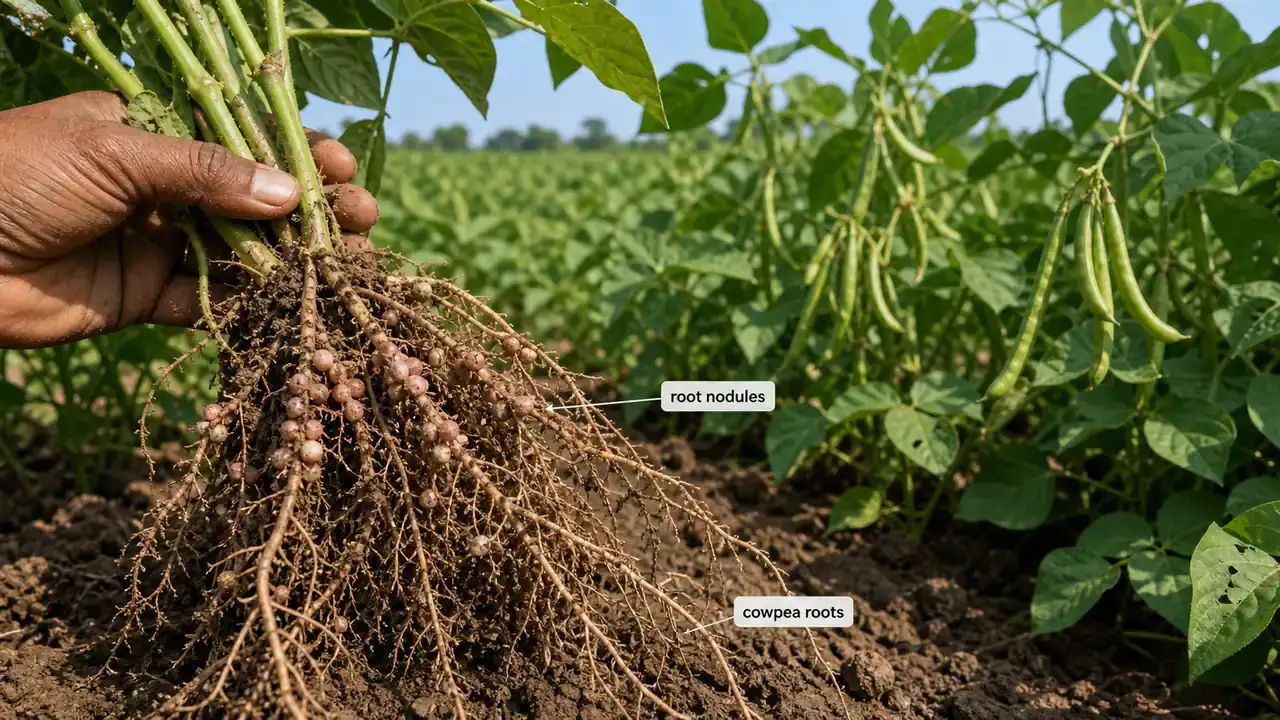
As a member of the legume family, cowpea forms root nodules with Rhizobium bacteria that fix atmospheric nitrogen into the soil, contributing approximately 30-40 kg N/ha. This nitrogen-fixing ability makes it an excellent crop for:
- Improving soil fertility in degraded and nutrient-poor soils -- particularly important in the sandy soils of Rajasthan where organic matter is low
- Crop rotations -- following cowpea with cereals like sorghum or pearl millet boosts their yield by 15-20% due to residual nitrogen
- Intercropping systems -- cowpea pairs well with maize, sorghum, and pearl millet in mixed farming, providing ground cover that reduces soil erosion
- Green manuring -- when ploughed under before flowering, cowpea adds both nitrogen and organic matter to the soil
- Triple-purpose crop -- cowpea is grown for grain, fodder, and green manure, making it highly useful in dryland mixed farming.
Important Varieties
Cowpea variety development has focused on early maturity, dual-purpose use (grain + fodder), and disease resistance.
| Category | Varieties |
|---|---|
| Grain type | Pusa Komal, Pusa Barsati, C-152, V-16, V-585, Pusa Phalguni |
| Fodder type | Russian Giant, EC 4216, UPC-287 |
| Dual purpose | Pusa Komal (grain + vegetable pods), C-152 |
| Early maturing | Pusa Barsati (55-60 days), Pusa Phalguni |
| Disease resistant | Pusa Komal (bacterial blight resistant) |
Diseases and Pests
Cowpea faces several biotic stresses, though generally fewer than chickpea or pigeonpea. The major constraints are viral diseases transmitted by insect vectors.
| Disease / Pest | Causal Agent | Key Facts |
|---|---|---|
| Cowpea Mosaic Virus | Transmitted by aphids | Causes mosaic patterns on leaves, stunted growth |
| Bacterial Blight | Xanthomonas vignicola | Water-soaked lesions on leaves; resistant variety: Pusa Komal |
| Root Rot | Rhizoctonia solani | Favoured by waterlogging and poor drainage |
| Pod Borer | Maruca vitrata | Major insect pest; larvae feed inside pods |
| Aphids | Aphis craccivora | Suck plant sap; also vector for mosaic virus |
Exam-Important Pulse Nicknames
This consolidated table covers all the pulse nicknames tested across the entire pulses chapter. Memorise these as a set -- they are asked repeatedly in exams, NABARD, and IBPS SO papers.
TIP
Mnemonic -- "Kings and Queens eat Meat and Lentils": Chickpea = King, Pea = Queen, Cowpea = Vegetable Meat, Lentil = Poor Man's Meat. This covers four of the most frequently tested pulse nicknames.
| Pulse | Nickname |
|---|---|
| Chickpea | King of Pulses |
| Pea | Queen of Pulses |
| Cowpea | Vegetable Meat |
| Mungbean | Highest protein among pulses (24g/100g) |
| Lentil | Poor Man's Meat |
| Pigeonpea | Mini Fertiliser Crop |

Summary Cheat Sheet
| Concept / Topic | Key Details |
|---|---|
| Botanical name | Vigna unguiculata; Family Leguminosae (Papilionaceae) |
| Origin | Africa (West Africa); Chromosome 2n = 22 |
| Common names | Lobia, Black-eyed Pea, Southern Pea |
| Nickname | Vegetable Meat (20-25% protein) |
| Season | Kharif (also Zaid/summer) |
| Photoperiod | Short-day plant |
| Germination | Epigeal (unlike most other pulses) |
| Seed rate | 20-25 kg/ha; spacing 45 x 15 cm |
| Crop duration | 60-90 days (short duration) |
| Yield | 8-12 q/ha (grain); 150-200 q/ha (green fodder) |
| N-fixation | 30-40 kg N/ha via Rhizobium |
| Dual purpose | Grain + fodder + green manure + vegetable (leaves and pods) |
| Key variety | Pusa Komal (bacterial blight resistant, dual purpose) |
| Major pest | Pod borer (Maruca vitrata) |
| Pulse nicknames | King = Chickpea, Queen = Pea, Vegetable Meat = Cowpea, Poor Man's Meat = Lentil |