🌻 Safflower -- The Thorny "Fencing Crop" with Highest PUFA (Complete Guide)
Master safflower cultivation from achene fruit to deep tap roots -- climate, topping for branching, varieties, and exam-critical facts about this drought-tolerant oilseed for exams, NABARD, and IBPS exams.
The previous lesson covered sunflower -- another Compositae family oilseed. Safflower shares the same family and fruit type (achene) but differs sharply in drought tolerance, photoperiod response, and management practices.
In the rain-shadow regions of Maharashtra and Karnataka, where black cotton soils crack under the winter sun and rainfall barely crosses 500 mm, safflower thrives where most oilseed crops would fail. Its deep tap root, reaching 2-3 metres into the soil, taps moisture that other crops simply cannot access. Farmers along field borders often plant safflower as a living fence -- its sharp spines on leaves and bracts deter stray cattle, earning it the name "Fencing Crop" or "Border Crop."
This lesson covers:
- Botany -- achene fruit, Compositae family, and deep tap root system
- Climate and soil -- why safflower thrives in rain-shadow black cotton soils
- Topping -- the key agronomic practice that breaks apical dominance
- Varieties and hybrids -- DSH-129 and state-specific cultivars
- Diseases and pests -- Alternaria, Fusarium wilt, aphids
- Safflower vs Sunflower -- a comparison table for exam clarity
All sections are high-yield for exams, NABARD, and FCI exams.
Pro Content Locked
Upgrade to Pro to access this lesson and all other premium content.
Pay once valid for one year · Effective ₹99/month
- All Agriculture & Banking Courses
- AI Lesson Questions (100/day)
- AI Doubt Solver (50/day)
- Glows & Grows Feedback (30/day)
- AI Section Quiz (20/day)
- 22-Language Translation (100/day)
- Recall Questions (20/day)
- AI Quiz (15/day)
- AI Quiz Paper Analysis (100/day)
- AI Step-by-Step Explanations (100/day)
- Spaced Repetition Recall (FSRS)
- AI Tutor
- Immersive Text Questions
- Audio Lessons — Hindi & English
- Mock Tests & Previous Year Papers
- Summary & Mind Maps
- XP, Levels, Leaderboard & Badges
- Generate New Classrooms
- Voice AI Teacher (AgriDots Live)
- AI Revision Assistant
- Knowledge Gap Analysis
- Interactive Revision (LangGraph)
🔒 Secure one-time yearly payment via Razorpay · No hidden fees
The previous lesson covered sunflower -- another Compositae family oilseed. Safflower shares the same family and fruit type (achene) but differs sharply in drought tolerance, photoperiod response, and management practices.
In the rain-shadow regions of Maharashtra and Karnataka, where black cotton soils crack under the winter sun and rainfall barely crosses 500 mm, safflower thrives where most oilseed crops would fail. Its deep tap root, reaching 2-3 metres into the soil, taps moisture that other crops simply cannot access. Farmers along field borders often plant safflower as a living fence -- its sharp spines on leaves and bracts deter stray cattle, earning it the name "Fencing Crop" or "Border Crop."
This lesson covers:
- Botany -- achene fruit, Compositae family, and deep tap root system
- Climate and soil -- why safflower thrives in rain-shadow black cotton soils
- Topping -- the key agronomic practice that breaks apical dominance
- Varieties and hybrids -- DSH-129 and state-specific cultivars
- Diseases and pests -- Alternaria, Fusarium wilt, aphids
- Safflower vs Sunflower -- a comparison table for exam clarity
All sections are high-yield for exams, NABARD, and FCI exams.
Basics

Safflower is a hardy, drought-tolerant oilseed from the Compositae family, distinguished by its thorny leaves, deep tap root, and the highest PUFA content among all oilseeds.
| Feature | Detail |
|---|---|
| Botanical Name | Carthamus tinctorius |
| Family | Compositae (Asteraceae) |
| Origin | Southern United States and Mexico |
| Nickname | Fencing Crop / Border Crop |
| Fruit type | Achene |
| Deep tap root | 2-3 metres |

- An achene is a small, dry, one-seeded fruit that does not open at maturity (indehiscent). Each floret in the flower head produces one achene with a hard outer shell enclosing the oil-rich kernel.
- Auxin activity is more in the apical portion of the flower, promoting cell elongation and proper flower development.
TIP
Safflower key facts (exam must-know): Fencing/Border crop (thorny leaves deter cattle). Fruit = Achene. Has highest PUFA content among oilseeds. Deep tap root (2-3 m) makes it drought tolerant and suitable for black cotton soils.

Climate
Safflower requires cool conditions for germination and warm weather for flowering and maturation. Its moderate frost tolerance during the rosette stage allows early Rabi sowing.
| Parameter | Requirement |
|---|---|
| Germination/seedling | Cool climate required |
| Frost tolerance | Moderate, up to 4-6 leaf (rosette) stage |
| Seedling to flowering | Warm weather required |
| Flowering to maturity | Warm and sunny days |
- During the rosette stage, the growing point remains close to the ground and is somewhat protected from frost. Beyond this stage, the plant becomes increasingly susceptible to cold damage.
Soil
Safflower's deep tap root system gives it an exceptional ability to extract moisture from lower soil layers, making it uniquely suited for black cotton soils in semi-arid regions.
- Safflower's deep tap root (2-3 metres) allows it to access moisture from deeper soil layers, making it tolerant of saline and alkaline conditions.
- Thrives best on deep loam soils with good drainage.
- pH range: 6.5 to 8.5 -- wider tolerance than most oilseeds, which is why safflower grows well in black cotton soils of central and southern India.
WARNING
Do not confuse Safflower with Sunflower -- both belong to the Compositae family and produce achene fruits, but safflower has much wider pH tolerance (6.5-8.5) and deeper roots (2-3 m vs moderate for sunflower).
Sowing, Seed Rate, and Spacing
Sowing time and spacing vary by season, with wider spacing during Kharif to accommodate more vigorous vegetative growth under warm, moist conditions.
| Parameter | Detail |
|---|---|
| Kharif sowing | July to 1st week of August |
| Rabi sowing | November 1st to 2nd week |
| Summer sowing | February 2nd week |
| Germination type | Epigeal |
| Seed rate | 8-10 kg/ha |
| Sowing depth | 3-4 cm |
| Kharif spacing | 60 x 20 cm |
| Rabi spacing | 45 x 20 cm |
- Wider spacing during Kharif accounts for more vigorous vegetative growth under warm, rainy conditions.
- Closer spacing in Rabi compensates for slower growth in cooler temperatures.
Irrigation
Safflower's deep root system makes it one of the least water-demanding oilseed crops, well-suited for rainfed conditions with only 2-3 supplementary irrigations.
| Parameter | Detail |
|---|---|
| Irrigations needed | 2-3 |
| Suitability | Low water-requirement crop; well-suited for rainfed farming |
Critical Stages
| Stage | DAS | Impact |
|---|---|---|
| Bud initiation | 35-40 | Reduces number of flower heads |
| Flower opening | 55-65 | Poor pollination and seed setting |
| Seed filling | 65-90 | Reduced oil content and yield |
Nutrient Management
Safflower nutrient management emphasises sulphur for oil biosynthesis, applied as a basal dose at sowing.
- Dose: 40 : 40 : 30 : 20 kg NPKS/ha at sowing time.
- Sulphur is particularly important for oil biosynthesis and formation of sulphur-containing amino acids.
Topping -- A Key Practice
Topping is done at 40 to 50 days after sowing to increase lateral branching. Removing the apical growing tip breaks apical dominance, redirecting growth hormones to lateral buds. More branches mean more flower heads per plant and ultimately higher seed yield.
TIP
Exam tip: Topping in safflower (40-50 DAS) breaks apical dominance to increase branching. This is different from topping in tobacco (which redirects energy from flowers to leaves for nicotine accumulation).

Varieties
The JSF and JSI series from JNKVV Jabalpur dominate Indian safflower cultivation, with hybrid varieties offering higher yield potential.
- Varieties: JSF-1, 2, 5, JSI-7, EB-7, JSH-129
- The JSF (Jawahar Safflower) and JSI (Jawahar Safflower Improved) series are developed by JNKVV, Jabalpur.
- JSH-129 is a hybrid variety with higher yield potential.

Disease
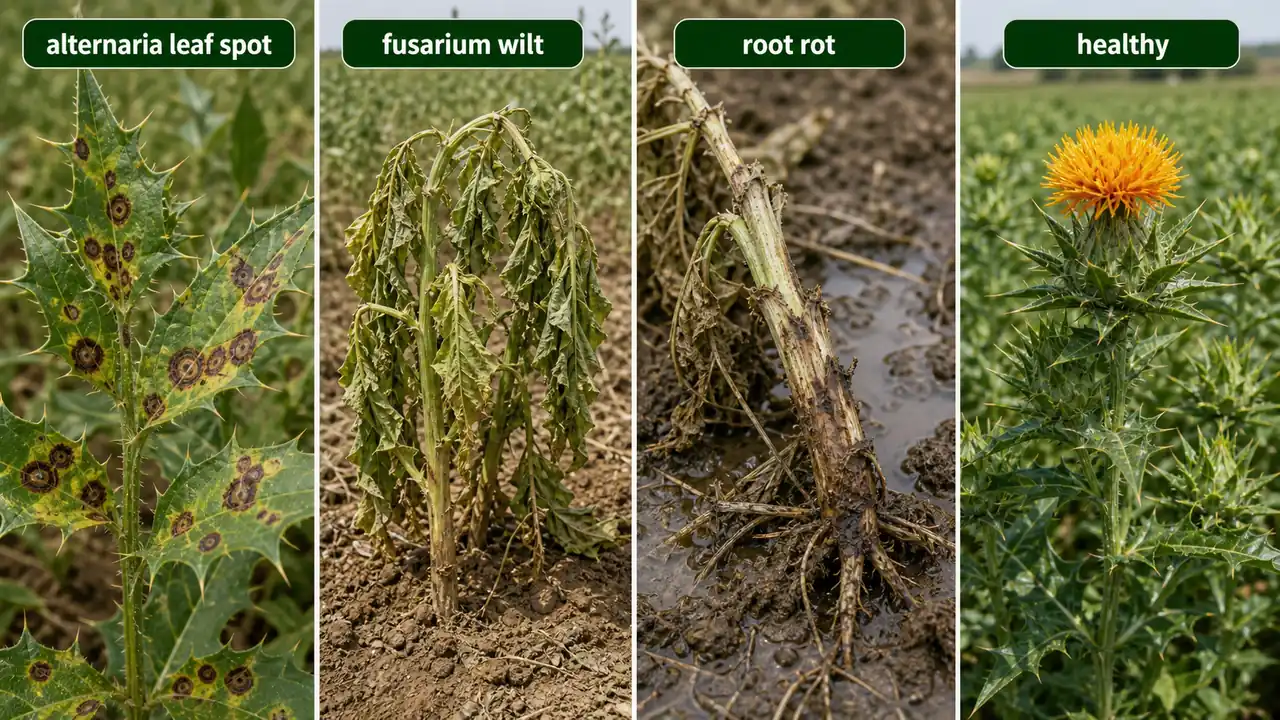
Safflower is susceptible to fungal diseases, particularly under waterlogged conditions. Alternaria and Fusarium are the most common pathogens.
Major diseases include Alternaria leaf spot (Alternaria carthami), Fusarium wilt (Fusarium oxysporum f.sp. carthami), and Root rot (Phytophthora, problematic in waterlogged conditions). Management includes resistant varieties, seed treatment, and crop rotation.
Insect-Pest
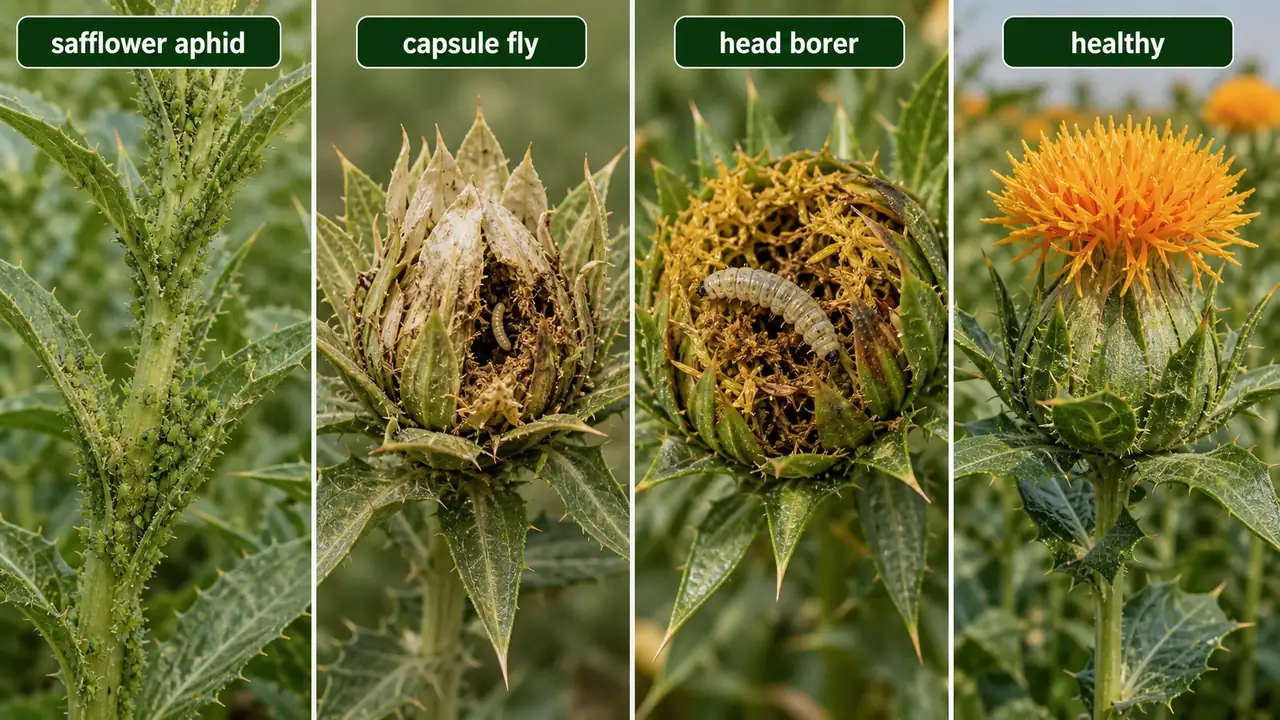
Aphids are the most economically important pest of safflower, while the capsule fly targets developing seed heads directly.
The safflower aphid (Uroleucon compositae) is the most important pest. The safflower capsule fly (Acanthiophilus helianthi) attacks developing seed heads.
Harvesting and Yield
Safflower is harvested when seed moisture reaches around 20%. Under irrigation, yields can reach 25-30 q/ha.
| Parameter | Detail |
|---|---|
| Harvest moisture | 20 per cent in seed |
| Yield | 18-20 q/ha (up to 25-30 q/ha under irrigation) |
Important Safflower Varieties
DSH-129 was the first safflower hybrid developed in India. Regional variety selection depends on the specific agro-climatic zone of Maharashtra, Karnataka, and other growing states.
| Type | Varieties |
|---|---|
| Hybrids | DSH-129 (1st safflower hybrid in India), MKH 11, NARI-NH 1, NARI-NH 15, MRSA 521, DSH-185 |
| Maharashtra & Karnataka region | S 144, A1, A2, A300, NARI 6, NARI 38, SSF 658, PBNS 40, Phule Kusuma, Prabhani Kusum, Bhima, Nira, Gima, Sharda |
| Other states | Annigeri 1, Manjira, JSF-1, Sagarmutyalu, JSI-7, JSI-73, JSI 97, JSI 99, SSF 68 |
Safflower vs Sunflower -- A Comparison
Both safflower and sunflower belong to the Compositae family and produce achene fruits, but they differ significantly in drought tolerance, photoperiod response, and key management practices. This comparison is a frequent exam question.
| Feature | Safflower | Sunflower |
|---|---|---|
| Family | Compositae | Compositae |
| Fruit | Achene | Achene (cypsela) |
| Photoperiod | Short-day | Day Neutral |
| Root depth | 2-3 m (deep) | Moderate |
| Drought tolerance | High | Moderate |
| PUFA content | Highest among oilseeds | Very high (78% unsaturated) |
| Key practice | Topping for branching | Beehives for pollination |
| Special trait | Fencing/Border crop (thorny) | Allelopathy |
| Major problem | Aphid | Chaffiness |
Quick Revision Summary
| Parameter | Detail |
|---|---|
| Botanical Name | Carthamus tinctorius |
| Family | Compositae |
| Origin | S. United States and Mexico |
| Nickname | Fencing/Border Crop |
| Fruit | Achene |
| PUFA | Highest among oilseeds |
| Tap root | 2-3 m deep |
| Topping | 40-50 DAS for branching |
| 1st hybrid | DSH-129 |
| NPK S | 40:40:30:20 kg/ha |
| Irrigations | 2-3 |
| Yield | 18-20 q/ha |
| Best soils | Black cotton soils |
| Inflorescence | Capitulum (Head) |
| pH tolerance | 6.5-8.5 |
TIP
Next: The next lesson covers Sesame -- the "Queen of Oilseeds" with 50% oil content, the highest among commonly cultivated oilseeds.
Summary Cheat Sheet
| Concept / Topic | Key Details / Explanation |
|---|---|
| Botanical name | Carthamus tinctorius; Family Compositae (Asteraceae) |
| Origin | Southern United States and Mexico |
| Nickname | Fencing Crop / Border Crop — thorny leaves deter cattle |
| Fruit type | Achene (small, dry, indehiscent, one-seeded) |
| Inflorescence | Capitulum (Head) — same as sunflower |
| PUFA content | Highest among all oilseeds |
| Deep tap root | 2-3 metres — enables drought tolerance and black cotton soil suitability |
| Photoperiod | Short-day plant (contrast: sunflower = day neutral) |
| Germination | Epigeal |
| Climate | Cool for germination; warm for flowering and maturity |
| Frost tolerance | Moderate up to 4-6 leaf (rosette) stage |
| Soil | Deep loam; pH 6.5-8.5; thrives on black cotton soils |
| Seed rate | 8-10 kg/ha; sowing depth 3-4 cm |
| NPK S | 40 : 40 : 30 : 20 kg/ha |
| Topping | Done at 40-50 DAS — removes apical tip to break apical dominance, increases lateral branching and flower heads |
| Irrigations | 2-3 (low water requirement) |
| Critical stages | Bud initiation (35-40 DAS), Flower opening (55-65 DAS), Seed filling (65-90 DAS) |
| Yield | 18-20 q/ha (up to 25-30 q/ha under irrigation) |
| Harvest moisture | 20% |
| 1st hybrid | DSH-129 |
| Key disease | Alternaria leaf spot (Alternaria carthami); Fusarium wilt |
| Key pest | Safflower aphid (Uroleucon compositae) |
| Safflower vs Sunflower | Both Compositae + Achene; Safflower = short-day, deep tap root, highest PUFA, topping; Sunflower = day-neutral, allelopathy, chaffiness |