🧵 Mesta -- India's Jute Substitute (Kenaf vs Roselle, Fiber & Cultivation)
Complete guide to mesta -- Kenaf (Hibiscus cannabinus) and Roselle (H. sabdariffa), second most important bast fiber crop after jute, Hibiscus tea, retting, and exam-important comparisons.
In the rain-shadow areas of Andhra Pradesh and Maharashtra, where rainfall is too low for jute cultivation, farmers turn to mesta -- a hardy fiber crop that thrives in drier conditions. Mesta is the second most important bast fiber crop in India after jute and serves as a reliable jute substitute. What makes mesta particularly interesting is that it comes in two species: Kenaf, which produces better fiber, and Roselle, whose fleshy red calyx is used to make the globally popular Hibiscus tea. This chapter covers both species and their exam-relevant distinctions.
Two Species of Mesta -- Kenaf vs Roselle
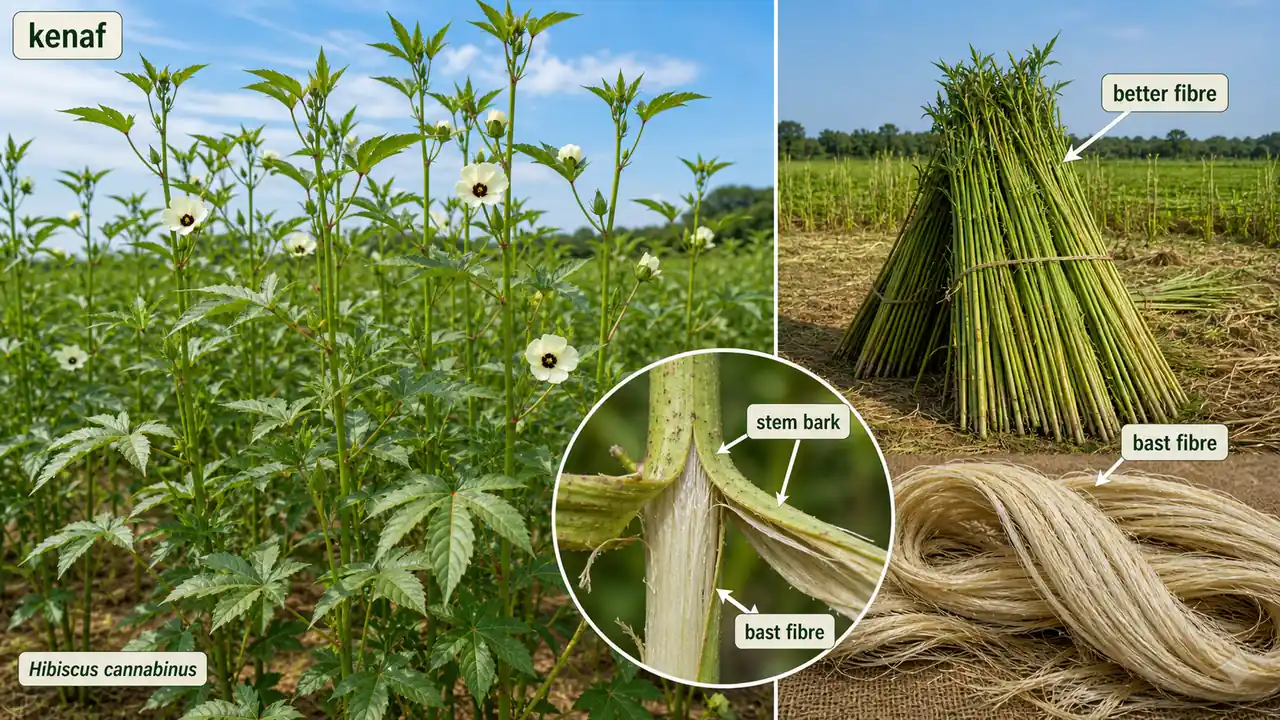
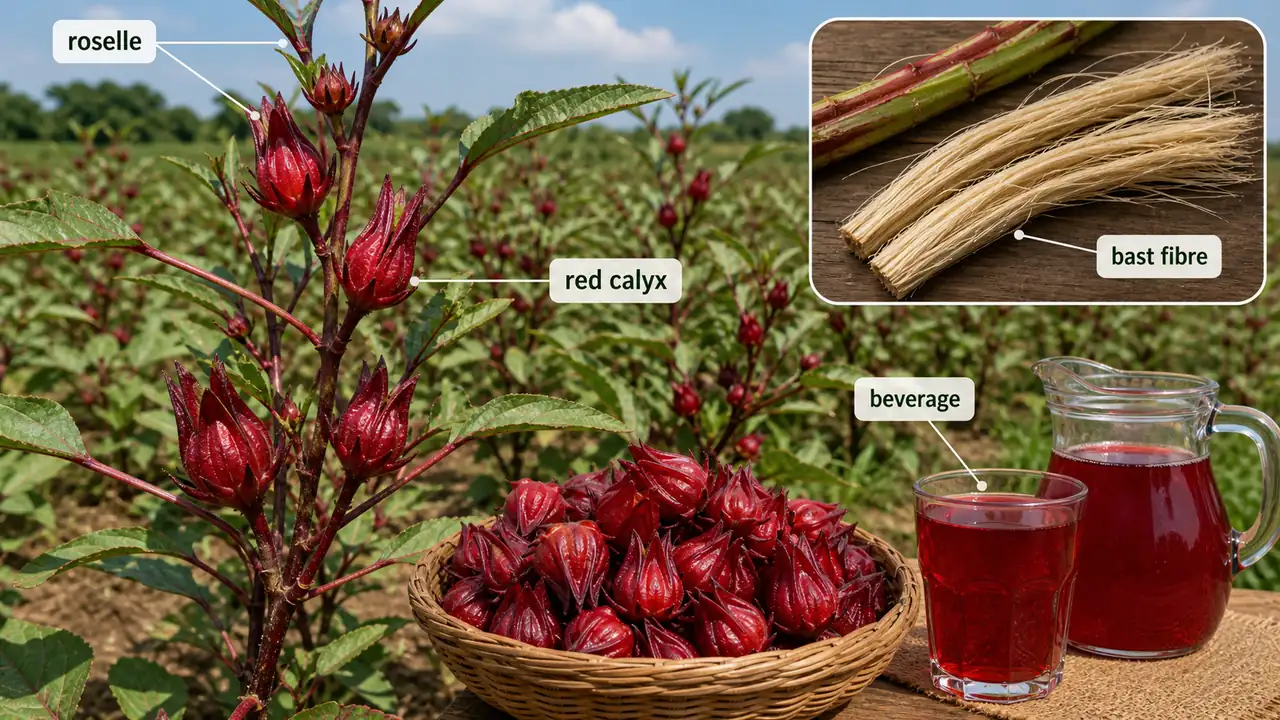
Mesta is the second most important bast fiber crop in India after jute. Unlike jute, which demands heavy rainfall (1500-2000 mm), mesta thrives in drier conditions with just 600-900 mm rainfall -- making it the go-to fiber crop in rain-shadow and semi-arid regions. The two species differ sharply in chromosome number, fiber quality, and food value.
Pro Content Locked
Upgrade to Pro to access this lesson and all other premium content.
Pay once valid for one year · Effective ₹99/month
- All Agriculture & Banking Courses
- AI Lesson Questions (100/day)
- AI Doubt Solver (50/day)
- Glows & Grows Feedback (30/day)
- AI Section Quiz (20/day)
- 22-Language Translation (100/day)
- Recall Questions (20/day)
- AI Quiz (15/day)
- AI Quiz Paper Analysis (100/day)
- AI Step-by-Step Explanations (100/day)
- Spaced Repetition Recall (FSRS)
- AI Tutor
- Immersive Text Questions
- Audio Lessons — Hindi & English
- Mock Tests & Previous Year Papers
- Summary & Mind Maps
- XP, Levels, Leaderboard & Badges
- Generate New Classrooms
- Voice AI Teacher (AgriDots Live)
- AI Revision Assistant
- Knowledge Gap Analysis
- Interactive Revision (LangGraph)
🔒 Secure one-time yearly payment via Razorpay · No hidden fees
In the rain-shadow areas of Andhra Pradesh and Maharashtra, where rainfall is too low for jute cultivation, farmers turn to mesta -- a hardy fiber crop that thrives in drier conditions. Mesta is the second most important bast fiber crop in India after jute and serves as a reliable jute substitute. What makes mesta particularly interesting is that it comes in two species: Kenaf, which produces better fiber, and Roselle, whose fleshy red calyx is used to make the globally popular Hibiscus tea. This chapter covers both species and their exam-relevant distinctions.
Two Species of Mesta -- Kenaf vs Roselle
Mesta is the second most important bast fiber crop in India after jute. Unlike jute, which demands heavy rainfall (1500-2000 mm), mesta thrives in drier conditions with just 600-900 mm rainfall -- making it the go-to fiber crop in rain-shadow and semi-arid regions. The two species differ sharply in chromosome number, fiber quality, and food value.
| Character | Kenaf | Roselle |
|---|---|---|
| Botanical name | Hibiscus cannabinus | Hibiscus sabdariffa |
| Family | Malvaceae | Malvaceae |
| Origin | Africa | India / West Africa |
| Chromosome (2n) | 36 | 72 |
| Pollination | Often cross-pollinated | Self-pollinated |
| Stem colour | Green | Red/Green |
| Calyx | Not fleshy | Fleshy, red -- used for jam, jelly, beverages |
| Fiber quality | Better quality | Slightly inferior |
| Growing period | 120-150 days | 150-180 days |
| Other names | Deccan hemp / Ambari | Patwa / Lal Ambari |
TIP
Remembering Kenaf vs Roselle: Kenaf = Kuality fiber (better fiber quality). Roselle = Red calyx (used for Hibiscus tea, jam, jelly). Roselle has double the chromosomes (72 vs 36) and a longer growing period.
Uses
Mesta serves dual purposes -- fiber production (both species) and food products (Roselle only). This dual-use nature makes Roselle economically more versatile than Kenaf despite its slightly inferior fiber quality.
Fiber Products
- Making ropes, sacks, canvas, carpet backing, paper pulp -- these are the same end-uses as jute, which is why mesta functions as a direct jute substitute in drier regions
Roselle Calyx Products
- Used for making jam, jelly, syrup, beverages (Hibiscus tea)
- The fleshy red calyx is rich in anthocyanins and vitamin C, making it a valued food product beyond just fiber
- Hibiscus tea from Roselle is consumed globally and is one of the most popular herbal teas worldwide
Climate and Soil Requirements
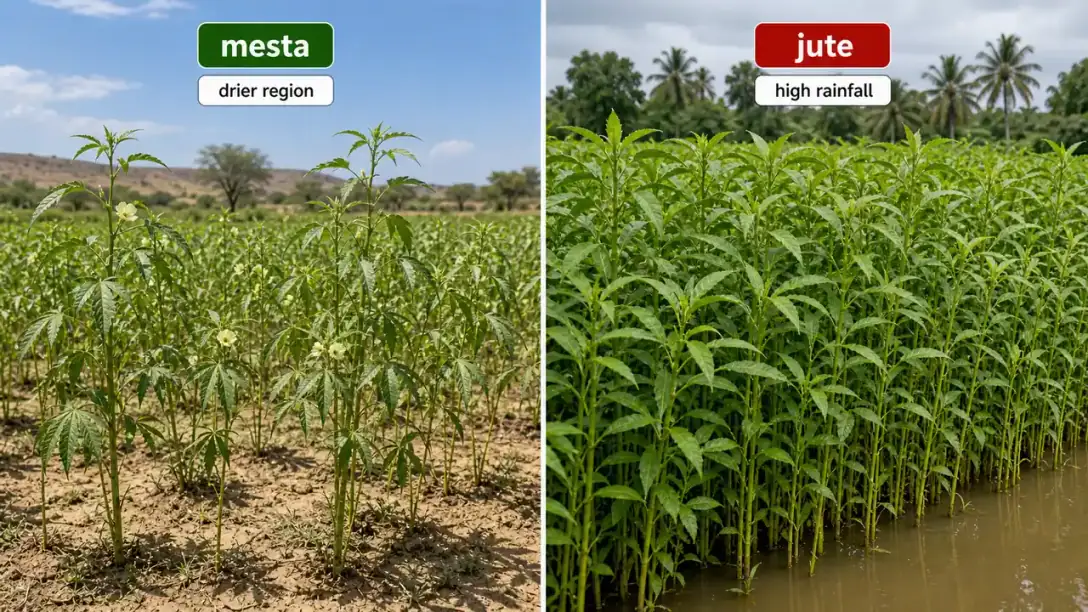
Mesta is a tropical crop suited to warm, humid conditions -- but critically, it needs far less rainfall than jute. This lower water requirement is the single most important reason mesta is cultivated as a jute substitute.
| Parameter | Details |
|---|---|
| Climate | Tropical crop requiring hot and humid conditions |
| Temperature | 25-35°C |
| Rainfall | 600-900 mm |
| Photoperiod | Short-day plant |
| Soil | Loam to clay loam, well-drained |
| pH | 6.0-7.0 (slightly acidic to neutral) |
Cultivation Practices
Mesta cultivation follows practices similar to jute, with adjustments for drier conditions. The crop is sown early (March-April) or during the normal season (May-June) and requires modest fertilizer inputs.
| Parameter | Details |
|---|---|
| Seed rate | 15-20 kg/ha (line sowing), 20-25 kg/ha (broadcast) |
| Spacing | 30 x 7-10 cm |
| Sowing time | March-April (early), May-June (normal) |
| Fertilizers (NPK) | 40:20:20 kg/ha |
| Fiber yield | 15-20 q/ha |

Retting and Harvesting
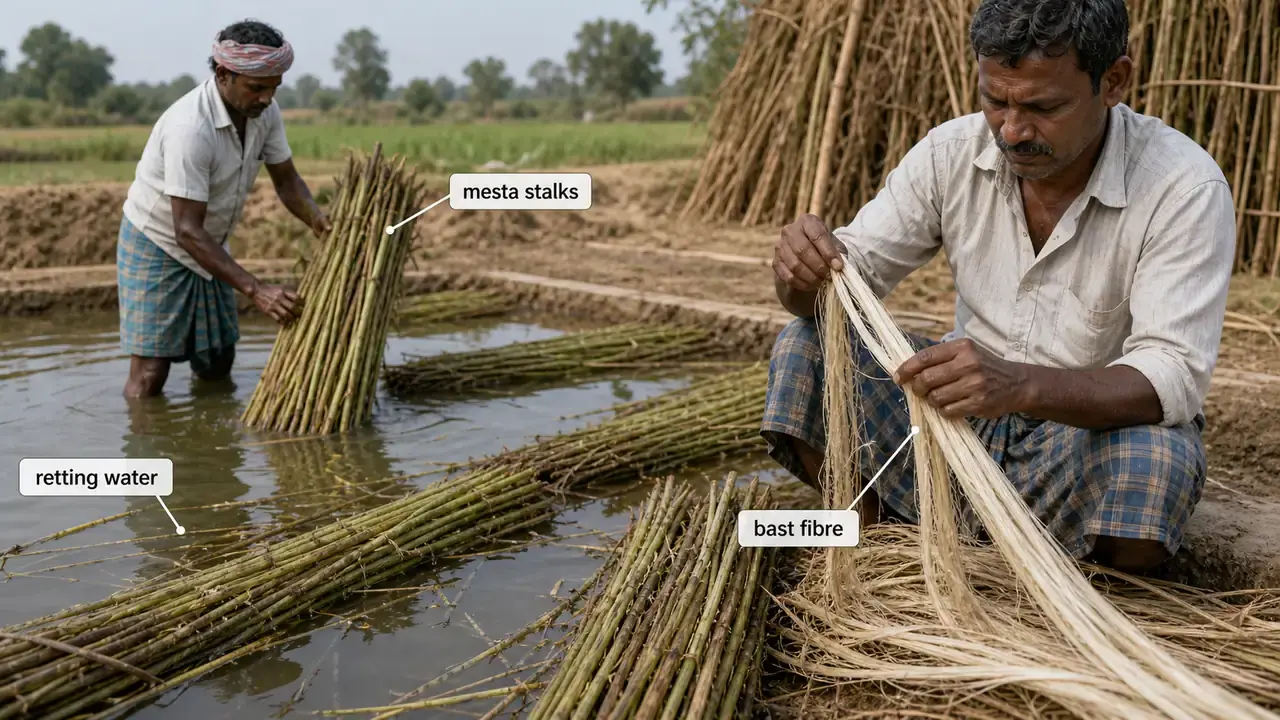
Like jute, mesta fiber is separated from the stem through retting -- a biological process where microbial action breaks down the pectin that binds fiber to the woody core. Timing of harvest and retting duration are critical for fiber quality.
- Harvested when 50% plants show flowers -- harvesting too late produces coarse, brittle fiber because lignin deposition increases with maturity
- Retting process is similar to jute -- immersion in water for 10-18 days
- Both ribbon retting (stripping bark before immersion) and stem retting (immersing whole stems) methods are used
- Microbial action breaks down pectin binding the fiber to the stem, releasing the bast fibers
Mesta vs Jute -- Comparison
This comparison is a favourite in exams. The key differentiator is drought tolerance and rainfall requirement -- mesta thrives where jute cannot.
| Character | Mesta | Jute |
|---|---|---|
| Fiber rank in India | 2nd | 1st |
| Drought tolerance | More drought tolerant | Less drought tolerant |
| Rainfall requirement | 600-900 mm | 1500-2000 mm |
| Family | Malvaceae | Malvaceae |
| Fiber quality | Slightly inferior (jute substitute) | Superior |
| Food product | Roselle calyx (jam, tea) | None |
Growing Regions in India
Mesta is mainly grown in Andhra Pradesh, Bihar, Maharashtra, Odisha, and West Bengal. These states have conditions where mesta performs better than jute due to lower rainfall and drier growing environments.
Summary Cheat Sheet
| Fact | Details |
|---|---|
| Family | Malvaceae |
| Rank among fiber crops | 2nd after jute |
| Two species | Kenaf (H. cannabinus, 2n=36) and Roselle (H. sabdariffa, 2n=72) |
| Better fiber | Kenaf |
| Edible calyx | Roselle (Hibiscus tea, jam) |
| Harvest stage | 50% flowering |
| Retting duration | 10-18 days |
| Fiber yield | 15-20 q/ha |
| Photoperiod | Short-day plant |
| Major states | Andhra Pradesh, Bihar, Maharashtra, Odisha, West Bengal |
NOTE
Mesta vs Jute (exam favourite): Mesta grows in drier conditions than jute, making it suitable for areas with lower rainfall. Mesta is more drought tolerant. When an exam question mentions "jute substitute" or "grows where jute cannot", the answer is always mesta.
Lesson Doubts
Ask questions, get expert answers