🧈 Sesame -- Queen of Oilseeds with 50% Oil (Complete Guide)
Master sesame cultivation from Sesamum indicum botany to phyllody disease -- oil content, antioxidants, capsule management, varieties, and exam-critical facts for exams, NABARD, and IBPS exams.
The previous lessons covered the Compositae family oilseeds -- sunflower and safflower. Now we move to an entirely different family, Pedaliaceae, and one of the oldest cultivated crops in the world.
Sesame may well be the oldest oilseed crop known to humankind. Archaeological evidence from the Indus Valley Civilisation, dating back to 3000 BC, shows that farmers in what is now India were already cultivating this tiny-seeded plant for its rich oil. Today, India remains both the centre of origin and the centre of diversity for sesame, and the phrase "Open Sesame" from the Arabian Nights hints at how prized its oil-rich seeds have been for millennia. With 50% oil content -- the highest among commonly grown oilseeds -- sesame earns the title "Queen of Oilseeds."
This lesson covers:
- Botany and composition -- 50% oil, sesamol and sesamin antioxidants
- Climate and soil -- tropical requirements and shallow root considerations
- Agronomy -- sowing, irrigation, and nutrient management
- Harvesting -- dehiscent capsules and shattering management
- Diseases and pests -- phyllody, charcoal rot, leaf webber
- Varieties -- state-wise cultivar classification
All sections are high-yield for exams, NABARD, and FCI exams.
Pro Content Locked
Upgrade to Pro to access this lesson and all other premium content.
Pay once valid for one year · Effective ₹99/month
- All Agriculture & Banking Courses
- AI Lesson Questions (100/day)
- AI Doubt Solver (50/day)
- Glows & Grows Feedback (30/day)
- AI Section Quiz (20/day)
- 22-Language Translation (100/day)
- Recall Questions (20/day)
- AI Quiz (15/day)
- AI Quiz Paper Analysis (100/day)
- AI Step-by-Step Explanations (100/day)
- Spaced Repetition Recall (FSRS)
- AI Tutor
- Immersive Text Questions
- Audio Lessons — Hindi & English
- Mock Tests & Previous Year Papers
- Summary & Mind Maps
- XP, Levels, Leaderboard & Badges
- Generate New Classrooms
- Voice AI Teacher (AgriDots Live)
- AI Revision Assistant
- Knowledge Gap Analysis
- Interactive Revision (LangGraph)
🔒 Secure one-time yearly payment via Razorpay · No hidden fees
The previous lessons covered the Compositae family oilseeds -- sunflower and safflower. Now we move to an entirely different family, Pedaliaceae, and one of the oldest cultivated crops in the world.
Sesame may well be the oldest oilseed crop known to humankind. Archaeological evidence from the Indus Valley Civilisation, dating back to 3000 BC, shows that farmers in what is now India were already cultivating this tiny-seeded plant for its rich oil. Today, India remains both the centre of origin and the centre of diversity for sesame, and the phrase "Open Sesame" from the Arabian Nights hints at how prized its oil-rich seeds have been for millennia. With 50% oil content -- the highest among commonly grown oilseeds -- sesame earns the title "Queen of Oilseeds."
This lesson covers:
- Botany and composition -- 50% oil, sesamol and sesamin antioxidants
- Climate and soil -- tropical requirements and shallow root considerations
- Agronomy -- sowing, irrigation, and nutrient management
- Harvesting -- dehiscent capsules and shattering management
- Diseases and pests -- phyllody, charcoal rot, leaf webber
- Varieties -- state-wise cultivar classification
All sections are high-yield for exams, NABARD, and FCI exams.
Basics

Sesame belongs to the Pedaliaceae family and is the only major oilseed crop of Indian origin. Its natural antioxidants give it exceptional resistance to rancidity.
| Feature | Detail |
|---|---|
| Botanical Name | Sesamum indicum |
| Family | Pedaliaceae |
| Origin | India (one of the oldest domesticated oilseeds) |
| Oil content | 50 per cent |
| Protein | 18-20 per cent |
| Nickname | Queen of Oilseeds |
| Natural antioxidants | Sesamol, Sesamin |
- The exceptionally high oil content and natural antioxidants like sesamol and sesamin give sesame oil remarkable resistance to rancidity and a long shelf life.
- The oil is rich in oleic acid and linoleic acid (polyunsaturated fatty acids).
NOTE
Oilseed royalty (exam favourite): Groundnut = King of Oilseeds (45% oil). Sesame = Queen of Oilseeds (50% oil). Despite having higher oil content, sesame is "Queen" because groundnut dominates India's oilseed economy by area and production.

Climate
Sesame is a warm-season crop that requires frost-free tropical to subtropical conditions. Temperature extremes during flowering directly reduce capsule formation.
| Parameter | Requirement |
|---|---|
| Climate type | Tropical and sub-tropical |
| Temperature | 25-27°C (ideal) |
| Growing period | Frost-free required |
- Temperatures below 20°C slow growth significantly.
- Temperatures above 40°C during flowering cause flower drop and poor capsule formation.
Soil
Sesame has a relatively shallow root system and requires well-drained soils that retain some moisture without waterlogging.
- Well-drained light loamy soil is best. Sesame has a relatively shallow root system, so it benefits from soils that retain some moisture but drain excess water quickly.
- Adding well-rotted FYM improves soil structure and provides slow-release nutrients.
- Sandy soils and saline soils are not suitable -- sandy soils drain too fast, saline conditions reduce germination.

Sowing, Seed Rate, and Spacing
Sesame has extremely small seeds, requiring very low seed rates and careful sowing techniques to ensure uniform plant stand.
| Parameter | Detail |
|---|---|
| Seed rate (line sowing) | 3-4 kg/ha |
| Seed rate (broadcasting) | 5-7 kg/ha |
| Spacing | 30 x 10 cm |
| Sowing depth | Not more than 3 cm |
- Sesame seeds are extremely small (about 3-4 mm long), which is why the seed rate is very low.
- Sowing seed with sand mixture ensures uniform distribution -- the sand acts as a carrier and prevents clumping.
- Seed treatment: 1.5 gm Thiram + 1.5 gm Bavistin per kg of seed (dual fungicide protection against Macrophomina and Fusarium).
Irrigation
Sesame is moderately drought-tolerant but responds well to irrigation at critical growth stages. Summer crops need 5-6 irrigations.
| Parameter | Detail |
|---|---|
| Water requirement | 500 mm |
| Summer irrigations | 5-6 |
Critical Stages
| Stage | DAS | Impact of Stress |
|---|---|---|
| 4-5 leaf stage | 25-30 | Reduces branching and capsule-bearing nodes |
| Flowering | -- | Poor pollination and capsule set |
| Capsule/Pod formation | -- | Reduced seed weight and oil content |

Nutrient and Weed Management
Sesame is a slow-establishing crop with poor competitive ability against weeds, making early weed control essential for good yields.
| Parameter | Detail |
|---|---|
| NPK dose | 30 : 60 : 30 kg/ha |
| Pre-emergence herbicide | Basalin @ 1 kg ai/ha or Alachlor @ 0.75 kg ai/ha |
- Note the relatively high phosphorus requirement (60 kg/ha) -- phosphorus is critical for root development, energy transfer, and capsule and seed formation.
- Weed management is very important because sesame is slow to establish and has poor competitive ability against weeds in the first 30-40 days.
Harvesting and Yield
Timely harvest is critical in sesame because its capsules are naturally dehiscent -- they split open when mature, causing seed shattering and significant yield loss.
| Parameter | Detail |
|---|---|
| Duration | 85-90 days |
| Maturity signs | Lower capsules turn yellow-brown and begin to split |
| Yield | 8-10 q/ha (up to 12-15 q/ha under irrigation) |
- Sesame capsules are naturally dehiscent (they split open to release seeds when mature), making timely harvest critical to avoid shattering losses.
TIP
Exam tip -- Dehiscence in sesame: Sesame is one of the few oilseed crops where seed shattering is a major harvest concern because capsules split open naturally. This is why plant breeders are working on non-shattering (indehiscent) varieties.
Disease
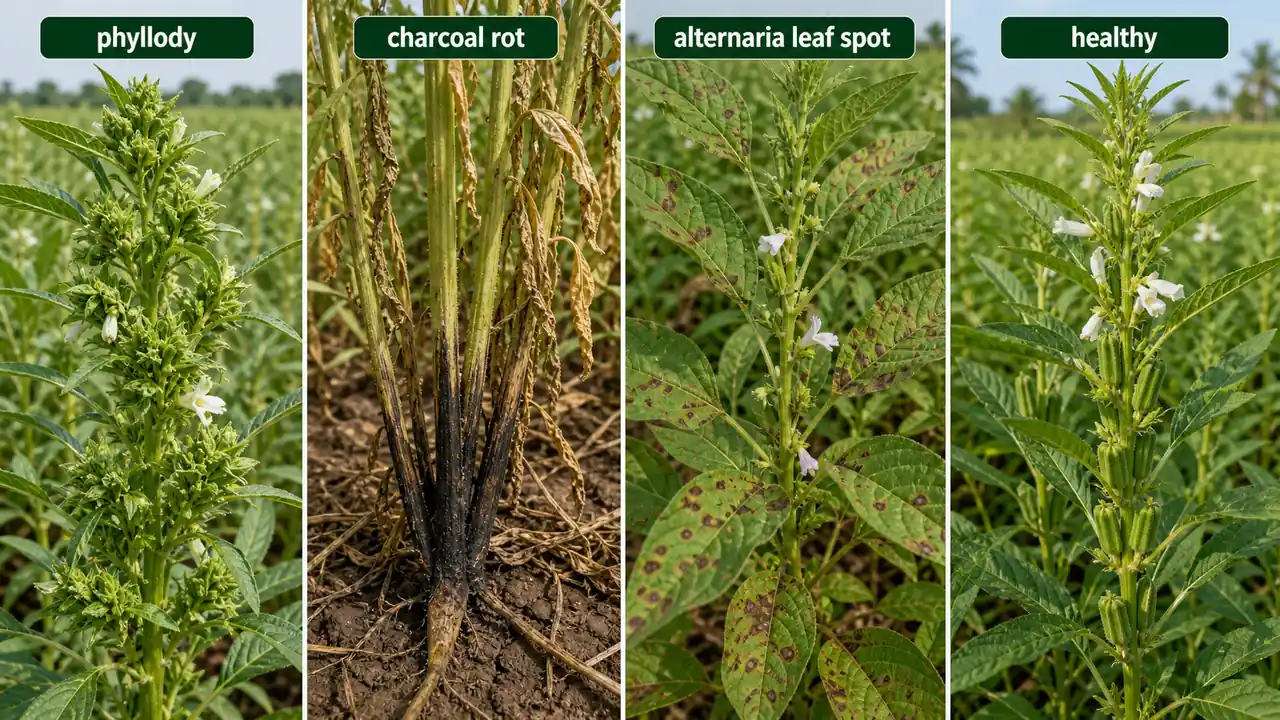
Sesame diseases range from phytoplasma-caused phyllody (the most distinctive) to fungal rots. Phyllody is the most exam-relevant disease.
| Disease | Pathogen | Key Feature |
|---|---|---|
| Phyllody | Phytoplasma (transmitted by leafhoppers) | Converts floral parts into green leafy structures, causing complete sterility |
| Charcoal rot | Macrophomina phaseolina | Blackening and drying of stem, especially under drought |
| Root rot | Various fungi | Common in waterlogged soils |
| Alternaria leaf spot | Alternaria spp. | Brown spots on leaves |
Insect-Pest
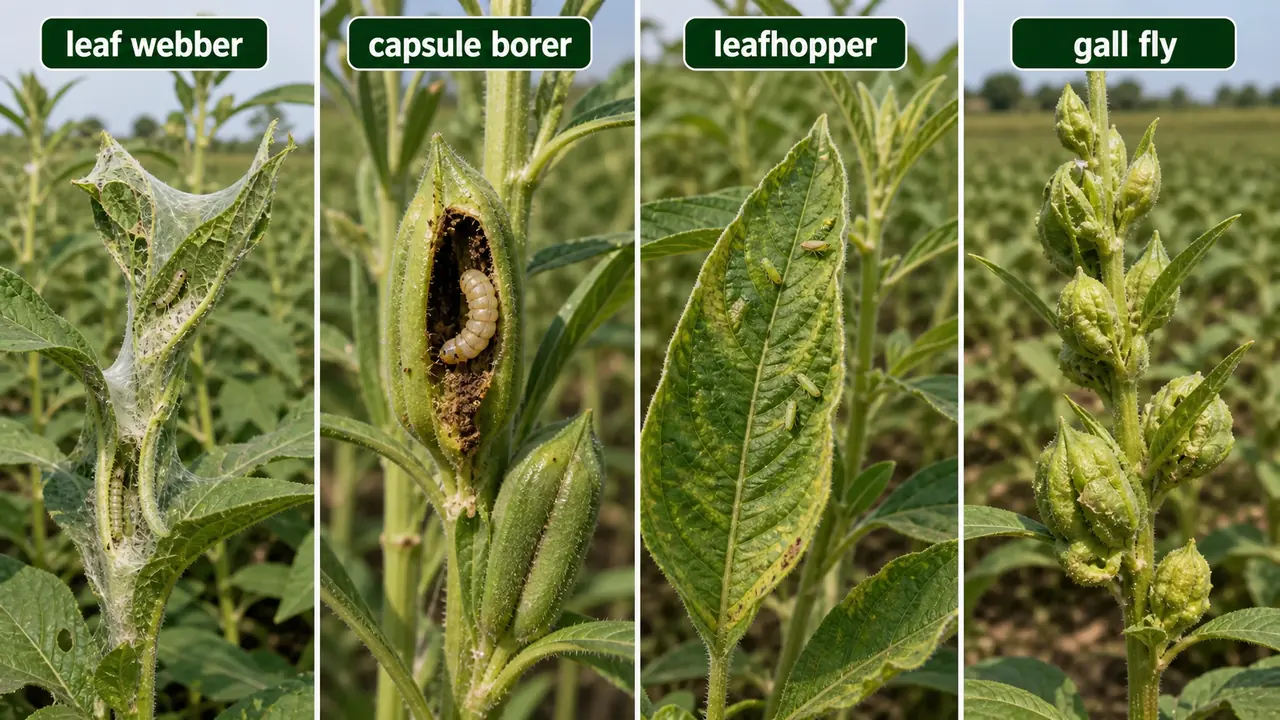
The leaf webber and capsule borer is the most economically important pest, while gall fly distorts capsules and leafhoppers serve double duty as pests and vectors of phyllody disease.
| Pest | Key Feature |
|---|---|
| Leaf webber and capsule borer (Antigastra catalaunalis) | Most important pest -- larvae web leaves and later bore into shoots, buds, and capsules |
| Gall fly (Asphondylia sesami) | Maggots feed inside buds and capsules, causing gall-like swellings and poor or absent seed set |
| Hornworm / hawk moth (Acherontia styx) | Voracious defoliator of sesame foliage; the adult is also remembered as the "honey robber" |
| Leafhoppers (Orosius albicinctus) | Vector of Phyllody disease |
TIP
Phyllody connection: The leafhopper Orosius albicinctus transmits phytoplasma that causes phyllody. If you see "leafhopper + sesame" in an exam question, the answer is usually phyllody disease.
Important Sesame Varieties (State-wise)
State-wise variety identification is a common exam topic. Rajasthan's RT series and Madhya Pradesh's TKG series are the most frequently tested.
| State | Varieties |
|---|---|
| Rajasthan | RT Series -- 46, 54, 103, 125, 346, 351 |
| Gujarat | Gujarat Til series -- 1, 2, 3, 10 |
| Maharashtra | Phule Til 1, Tapi, Padma, AKT 64, AKT 101, N8 |
| Madhya Pradesh & Chhattisgarh | Kanchan, Jawahar Til 11, 12, TKG 21, 22, 55, 306 |
| Uttar Pradesh | Sekhar, Tarun, Pragati, T 78 |
| Andhra Pradesh | Madhavi, Varaha, Charidana, Gauri, Gautama, Hima |
| Tamil Nadu | TMV 4, TMV 6, CO 1, TSS 1, Paiyur 1, VRI 1, 2 |
| Punjab | TC 25, TC 289, Punjab Til 1 |
Quick Revision Summary
| Parameter | Detail |
|---|---|
| Botanical Name | Sesamum indicum |
| Family | Pedaliaceae |
| Origin | India |
| Oil / Protein | 50% / 18-20% |
| Nickname | Queen of Oilseeds |
| Antioxidants | Sesamol, Sesamin |
| Seed rate | 3-4 kg/ha (line sowing) |
| NPK | 30:60:30 kg/ha |
| Duration | 85-90 days |
| Key disease | Phyllody (phytoplasma via leafhoppers) |
| Key pest | Leaf webber & capsule borer |
| Capsule type | Dehiscent (shattering risk) |
| Inflorescence | Cymose |
| Yield | 8-10 q/ha |
TIP
Next: The final oilseed lesson covers Linseed (Flax) -- the dual-purpose crop producing both fibre (linen) and oil, with 80% of its oil going to industrial use.
Summary Cheat Sheet
| Concept / Topic | Key Details / Explanation |
|---|---|
| Botanical name | Sesamum indicum; Family Pedaliaceae; Origin India |
| Title | Queen of Oilseeds (King = Groundnut) |
| Oil content | 50% — highest among commonly grown oilseeds |
| Protein | 18-20% |
| Natural antioxidants | Sesamol and Sesamin — give exceptional resistance to rancidity |
| Key fatty acids | Oleic acid and Linoleic acid (PUFA) |
| Inflorescence | Cymose |
| Climate | Tropical and sub-tropical; temp 25-27°C (frost-free required) |
| Soil | Well-drained light loamy soil; sandy and saline soils not suitable |
| Season | Primarily Kharif |
| Seed rate (line) | 3-4 kg/ha — extremely small seeds |
| Seed rate (broadcast) | 5-7 kg/ha |
| Spacing | 30 x 10 cm; sowing depth max 3 cm |
| Sowing technique | Mix seed with sand for uniform distribution |
| NPK | 30 : 60 : 30 kg/ha (high phosphorus for capsule/seed formation) |
| Water requirement | 500 mm; Summer: 5-6 irrigations |
| Critical stages | 4-5 leaf stage, Flowering, Capsule/Pod formation |
| Duration | 85-90 days |
| Yield | 8-10 q/ha (up to 12-15 q/ha under irrigation) |
| Capsule | Dehiscent — splits open at maturity causing shattering losses |
| Phyllody disease | Caused by phytoplasma (vector: leafhopper Orosius albicinctus); converts floral parts to leafy structures |
| Charcoal rot | Macrophomina phaseolina — under drought stress |
| Key pest | Leaf webber & capsule borer (Antigastra catalaunalis) |
| Leafhopper role | Vector of Phyllody disease (phytoplasma) |
| Rajasthan varieties | RT series — 46, 54, 103, 125, 346, 351 |
| MP varieties | TKG series — 21, 22, 55, 306 |