🪢 Ramie & Sisal -- Specialty Fiber Crops and Fiber Classification
Complete guide to Ramie (China grass, longest bast fiber) and Sisal (Agave leaf fiber), plus the full classification of natural fibers into bast, seed, and leaf types for competitive exams.
Beyond the well-known fiber crops -- cotton, jute, and mesta -- two specialty crops deserve attention for their unique properties. In the misty hills of Assam, farmers cultivate Ramie (China grass), a perennial plant whose fiber is eight times stronger than cotton and has a silky lustre prized for fine fabrics and even bank-note paper. Meanwhile, in the semi-arid fields of Karnataka and Rajasthan, Sisal (an Agave species) produces tough leaf fibers used in ropes, dartboards, and marine cordage. Together, these two crops illustrate the key distinction exam questions love: bast fiber vs leaf fiber. This chapter also provides the complete classification of natural fibers -- a frequently tested topic.
Ramie (Boehmeria nivea) -- Longest and Strongest Bast Fiber
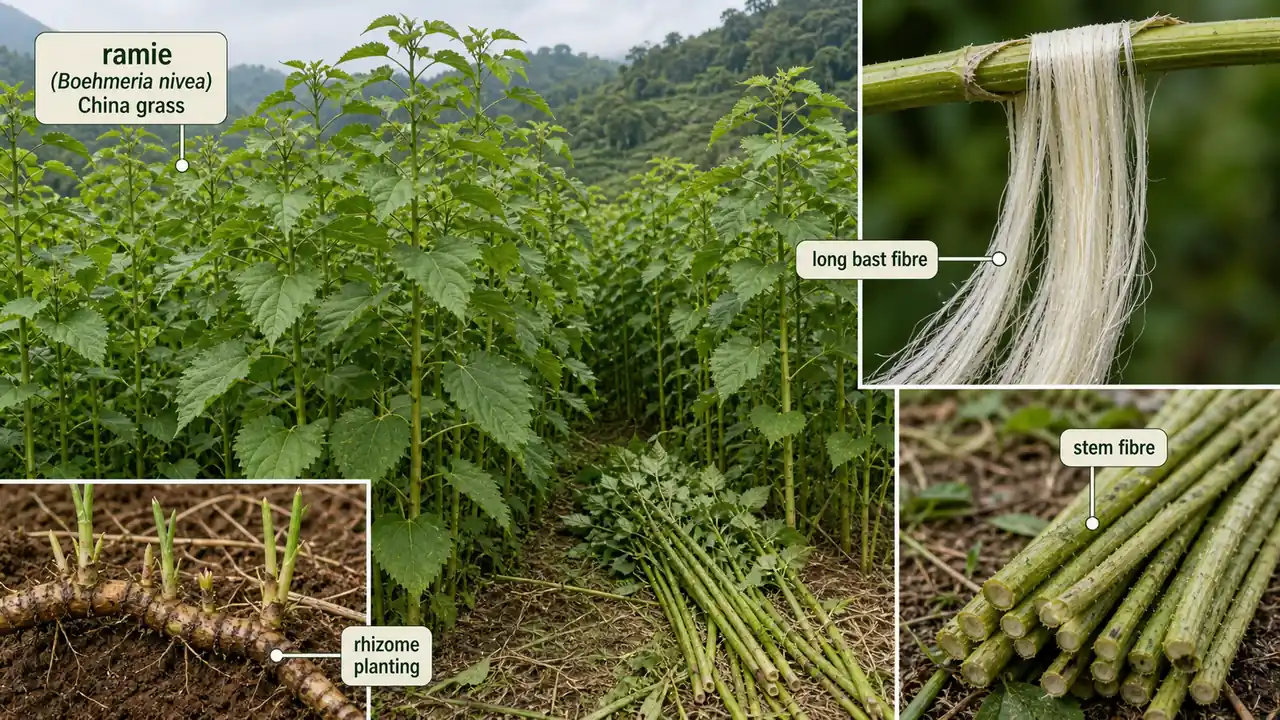
Ramie is a perennial bast fiber crop from the Nettle family that produces the longest and strongest natural bast fiber -- eight times stronger than cotton. Unlike annual fiber crops, a single ramie planting can be harvested repeatedly for up to 20 years.
Pro Content Locked
Upgrade to Pro to access this lesson and all other premium content.
Pay once valid for one year · Effective ₹99/month
- All Agriculture & Banking Courses
- AI Lesson Questions (100/day)
- AI Doubt Solver (50/day)
- Glows & Grows Feedback (30/day)
- AI Section Quiz (20/day)
- 22-Language Translation (100/day)
- Recall Questions (20/day)
- AI Quiz (15/day)
- AI Quiz Paper Analysis (100/day)
- AI Step-by-Step Explanations (100/day)
- Spaced Repetition Recall (FSRS)
- AI Tutor
- Immersive Text Questions
- Audio Lessons — Hindi & English
- Mock Tests & Previous Year Papers
- Summary & Mind Maps
- XP, Levels, Leaderboard & Badges
- Generate New Classrooms
- Voice AI Teacher (AgriDots Live)
- AI Revision Assistant
- Knowledge Gap Analysis
- Interactive Revision (LangGraph)
🔒 Secure one-time yearly payment via Razorpay · No hidden fees
Beyond the well-known fiber crops -- cotton, jute, and mesta -- two specialty crops deserve attention for their unique properties. In the misty hills of Assam, farmers cultivate Ramie (China grass), a perennial plant whose fiber is eight times stronger than cotton and has a silky lustre prized for fine fabrics and even bank-note paper. Meanwhile, in the semi-arid fields of Karnataka and Rajasthan, Sisal (an Agave species) produces tough leaf fibers used in ropes, dartboards, and marine cordage. Together, these two crops illustrate the key distinction exam questions love: bast fiber vs leaf fiber. This chapter also provides the complete classification of natural fibers -- a frequently tested topic.
Ramie (Boehmeria nivea) -- Longest and Strongest Bast Fiber
Ramie is a perennial bast fiber crop from the Nettle family that produces the longest and strongest natural bast fiber -- eight times stronger than cotton. Unlike annual fiber crops, a single ramie planting can be harvested repeatedly for up to 20 years.

| Parameter | Details |
|---|---|
| Family | Urticaceae (Nettle family) |
| Origin | China |
| Common names | China grass / Rhea |
| Life cycle | Perennial -- can be harvested for 6-20 years from a single planting |
| Propagation | Rhizome cuttings (vegetative propagation) |
| Fiber distinction | Produces the longest and strongest natural bast fiber among all fiber crops |
Fiber Characteristics
Ramie fiber stands out among all natural fibers for its exceptional mechanical properties:
- 8 times stronger than cotton with a silky lustre
- High tensile strength and low elasticity
- Resistant to bacteria, mildew, and insect attack
- Used for making fine fabrics, fishing nets, parachute cords, bank note paper, industrial sewing threads
Cultivation
| Parameter | Details |
|---|---|
| Climate | Tropical and sub-tropical, requires high humidity |
| Rainfall | 1500-2000 mm (or irrigation) |
| Temperature | 20-31°C |
| Soil | Deep, well-drained loamy soil rich in organic matter |
| Cutting interval | Every 45-60 days (4-6 cuttings per year) |
| Fiber yield | 25-35 q/ha per year |
| Growing regions in India | Assam, West Bengal, Meghalaya |
Sisal (Agave sisalana) -- Hard Fiber from Leaves
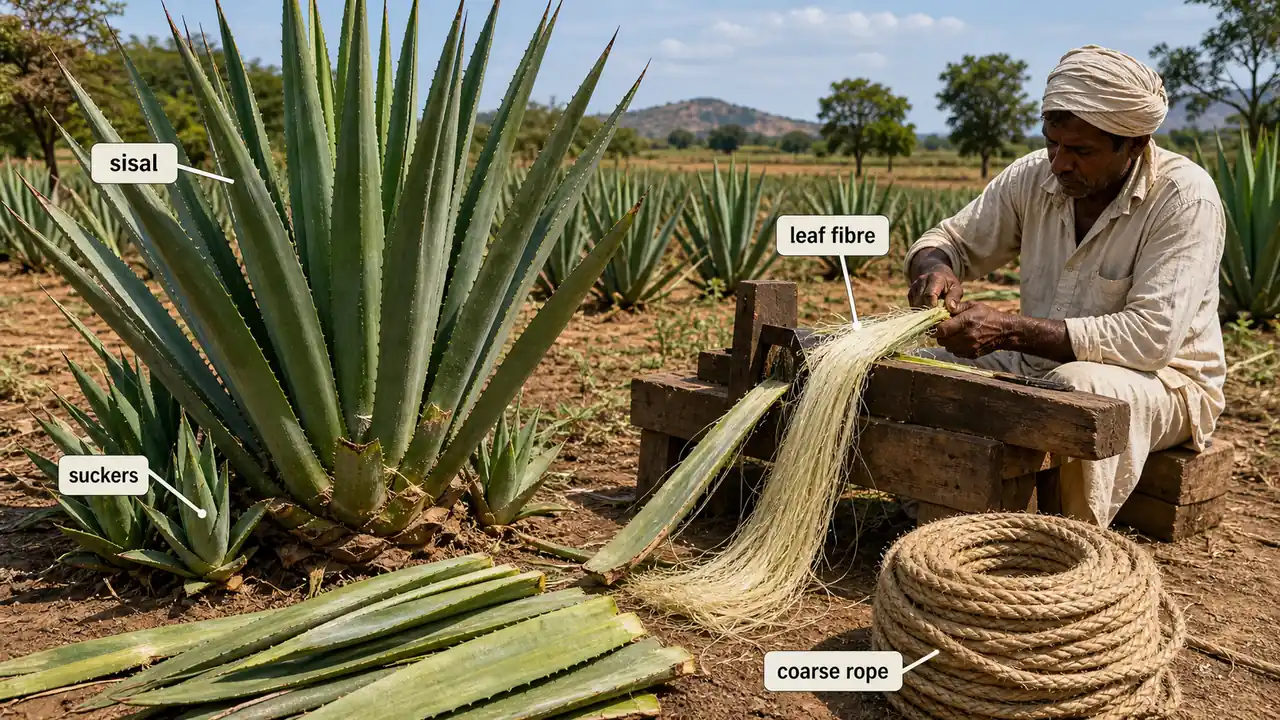
Unlike all the fiber crops covered so far (cotton, jute, mesta, ramie) which derive fiber from seeds or stems, sisal extracts its fiber from leaves -- classifying it as a hard/leaf fiber. This distinction is one of the most frequently tested fiber classification questions in exams.

| Parameter | Details |
|---|---|
| Family | Asparagaceae (Agavaceae) |
| Origin | Mexico (Central America) |
| Fiber type | Hard fiber -- extracted from leaves (NOT stem) |
| Life cycle | Perennial with a rosette of fleshy, sword-shaped leaves |
Fiber Characteristics
- Sisal is a leaf fiber (unlike jute, cotton, sunhemp which are stem/seed fibers)
- The fiber is hard, strong, and coarse
- Used for making ropes, twines, mattresses, dartboards, handicrafts, geotextiles
- Sisal rope is resistant to saltwater -- used extensively in the marine industry
Cultivation
| Parameter | Details |
|---|---|
| Climate | Tropical and semi-arid, highly drought tolerant |
| Rainfall | 600-1500 mm |
| Temperature | 25-30°C |
| Soil | Can grow on poor, marginal soils; well-drained |
| Propagation | Bulbils (aerial bulbs) or suckers |
| Spacing | 2 x 2 m or 3 x 1 m |
| Economic life | 7-10 years (leaves harvested after 2-3 years) |
| Leaf yield | 40-60 leaves/plant/year |
| Fiber yield | 10-15 q/ha |
| Growing regions in India | Karnataka, Tamil Nadu, Maharashtra, Rajasthan |
Ramie vs Sisal -- Comparison
These two specialty fiber crops differ fundamentally in fiber origin, climate preference, and end-use. This comparison table highlights the contrasts that exams frequently test.
| Character | Ramie | Sisal |
|---|---|---|
| Fiber type | Bast (stem) | Leaf (hard) |
| Family | Urticaceae | Asparagaceae |
| Origin | China | Mexico |
| Fiber strength | Longest and strongest bast fiber | Strong and coarse |
| Propagation | Rhizome cuttings | Bulbils/Suckers |
| Drought tolerance | Needs high rainfall (1500-2000 mm) | Highly drought tolerant (600 mm) |
| Economic life | 6-20 years | 7-10 years |
| Key use | Fine fabrics, bank note paper | Ropes, marine cordage |
Classification of Natural Fibers
Understanding fiber classification by plant source is essential -- exams regularly ask which crop produces bast fiber vs leaf fiber vs seed fiber. The three categories are based on which part of the plant the fiber is extracted from.

| Type | Source | Examples |
|---|---|---|
| Bast/Stem fiber | Stem (phloem) | Jute, Mesta, Sunhemp, Ramie, Flax |
| Seed/Surface fiber | Seed surface | Cotton |
| Hard/Leaf fiber | Leaves | Sisal, Manila hemp, Coir |
TIP
Fiber classification mnemonic -- "BSL": Bast (stem phloem) = Jute, Mesta, Sunhemp, Ramie, Flax. Seed (surface) = Cotton. Leaf (hard) = Sisal, Manila hemp, Coir. Remember: if a question says "leaf fiber", the answer is almost always Sisal.
Summary Cheat Sheet
| Fact | Ramie | Sisal |
|---|---|---|
| Family | Urticaceae | Asparagaceae |
| Origin | China | Mexico |
| Fiber type | Bast (stem) | Hard (leaf) |
| Common name | China grass / Rhea | -- |
| Fiber distinction | Longest + strongest bast fiber | Saltwater resistant |
| Propagation | Rhizome cuttings | Bulbils / suckers |
| Life span | 6-20 years | 7-10 years |
| Growing regions | Assam, West Bengal, Meghalaya | Karnataka, Tamil Nadu, Maharashtra, Rajasthan |
IMPORTANT
Fiber classification is frequently asked: Bast fibers = from stem phloem (Jute, Mesta, Sunhemp, Ramie, Flax). Leaf fibers = from leaves (Sisal). Seed fibers = from seed surface (Cotton). Ramie = longest and strongest bast fiber. Sisal = most important leaf/hard fiber.
Lesson Doubts
Ask questions, get expert answers