🥼 Linseed (Flax) -- The Dual-Purpose "Most Useful" Crop (Complete Guide)
Master linseed cultivation from fibre flax to oil flax -- linolenic acid, retting process, utera cropping, varieties, and exam-critical facts for exams, NABARD, and IBPS exams.
The previous lesson covered sesame -- the "Queen of Oilseeds" with 50% oil content. This final lesson in the oilseed series covers a crop that is entirely different in character -- a dual-purpose crop providing both fibre and oil.
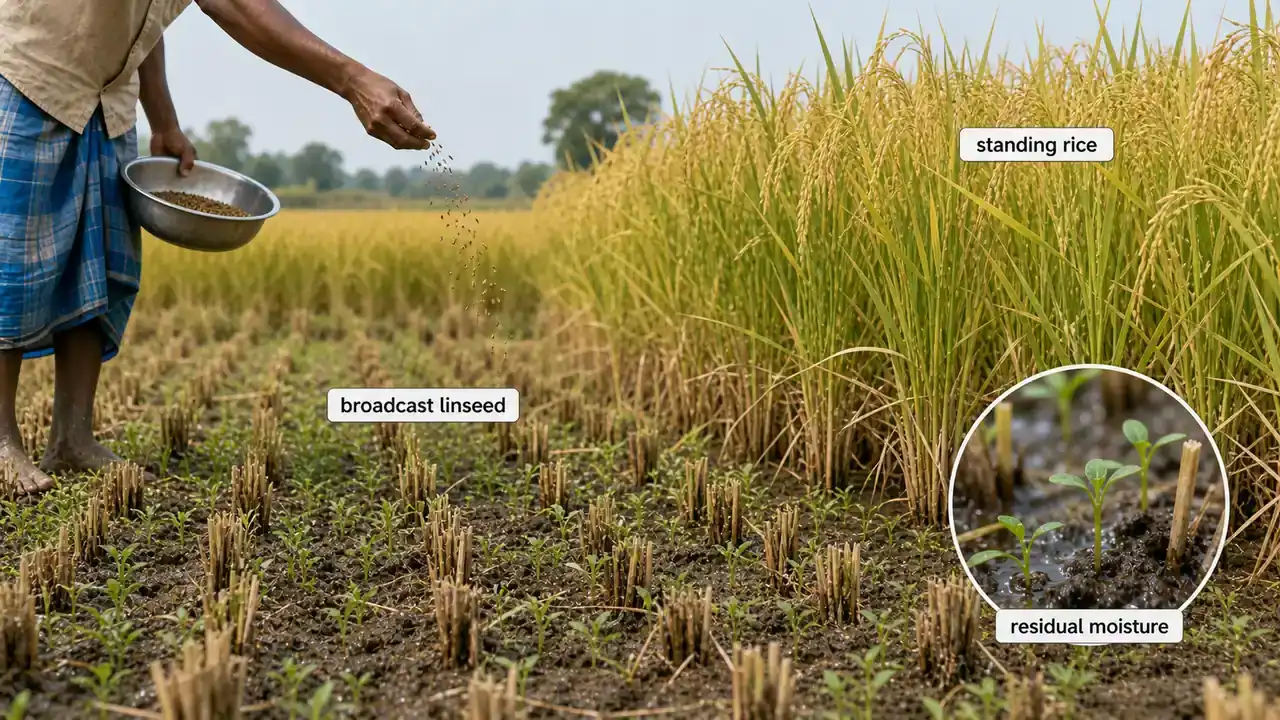
In the rice fallows of eastern India, farmers practice a unique technique called "utera" cropping -- broadcasting linseed seeds into standing rice about 10-15 days before harvest. As the rice is cut, the linseed seedlings emerge and grow using residual soil moisture, requiring almost no additional land preparation. This ancient practice reflects the remarkable versatility of linseed, a crop so useful that its botanical name literally means "most useful" (usitatissimum). Providing both fibre (linen) and oil from a single plant, linseed is a dual-purpose crop with 80% of its oil going to industrial use in paints and varnishes.
This lesson covers:
- Botany and composition -- linolenic acid (50-60%), fibre flax vs seed flax
- Oil uses -- 80% industrial (paints, varnishes), 20% edible
- Utera cropping -- relay cropping with rice
- Agronomy -- climate, soil, sowing, irrigation, and nutrients
- Retting -- the fibre extraction process
- Diseases -- rust (Melampsora lini), wilt, powdery mildew
All sections are high-yield for exams, NABARD, and FCI exams.
Pro Content Locked
Upgrade to Pro to access this lesson and all other premium content.
Pay once valid for one year · Effective ₹99/month
- All Agriculture & Banking Courses
- AI Lesson Questions (100/day)
- AI Doubt Solver (50/day)
- Glows & Grows Feedback (30/day)
- AI Section Quiz (20/day)
- 22-Language Translation (100/day)
- Recall Questions (20/day)
- AI Quiz (15/day)
- AI Quiz Paper Analysis (100/day)
- AI Step-by-Step Explanations (100/day)
- Spaced Repetition Recall (FSRS)
- AI Tutor
- Immersive Text Questions
- Audio Lessons — Hindi & English
- Mock Tests & Previous Year Papers
- Summary & Mind Maps
- XP, Levels, Leaderboard & Badges
- Generate New Classrooms
- Voice AI Teacher (AgriDots Live)
- AI Revision Assistant
- Knowledge Gap Analysis
- Interactive Revision (LangGraph)
🔒 Secure one-time yearly payment via Razorpay · No hidden fees
The previous lesson covered sesame -- the "Queen of Oilseeds" with 50% oil content. This final lesson in the oilseed series covers a crop that is entirely different in character -- a dual-purpose crop providing both fibre and oil.
In the rice fallows of eastern India, farmers practice a unique technique called "utera" cropping -- broadcasting linseed seeds into standing rice about 10-15 days before harvest. As the rice is cut, the linseed seedlings emerge and grow using residual soil moisture, requiring almost no additional land preparation. This ancient practice reflects the remarkable versatility of linseed, a crop so useful that its botanical name literally means "most useful" (usitatissimum). Providing both fibre (linen) and oil from a single plant, linseed is a dual-purpose crop with 80% of its oil going to industrial use in paints and varnishes.
This lesson covers:
- Botany and composition -- linolenic acid (50-60%), fibre flax vs seed flax
- Oil uses -- 80% industrial (paints, varnishes), 20% edible
- Utera cropping -- relay cropping with rice
- Agronomy -- climate, soil, sowing, irrigation, and nutrients
- Retting -- the fibre extraction process
- Diseases -- rust (Melampsora lini), wilt, powdery mildew
All sections are high-yield for exams, NABARD, and FCI exams.
Basics

Linseed belongs to the Linaceae family and is the only major oilseed crop that is also a significant fibre source. Its species name usitatissimum ("most useful") reflects this dual utility.
| Feature | Detail |
|---|---|
| Botanical Name | Linum usitatissimum (2n = 30) |
| Family | Linaceae |
| Origin | Afghanistan |
| Oil content | 40-42 per cent |
| Protein | 20 per cent |
| Linolenic acid | 50-60 per cent |
| Fibre content | 5-6% |
| Fibre name | Reflex (lustrous, blends well with wool, silk, cotton) |
| Fabric produced | Linen |
| Historical name | Old World Fibre |
- The species name usitatissimum literally means "most useful", reflecting the crop's remarkable versatility.
Fibre Flax vs Seed Flax (Oil Flax)
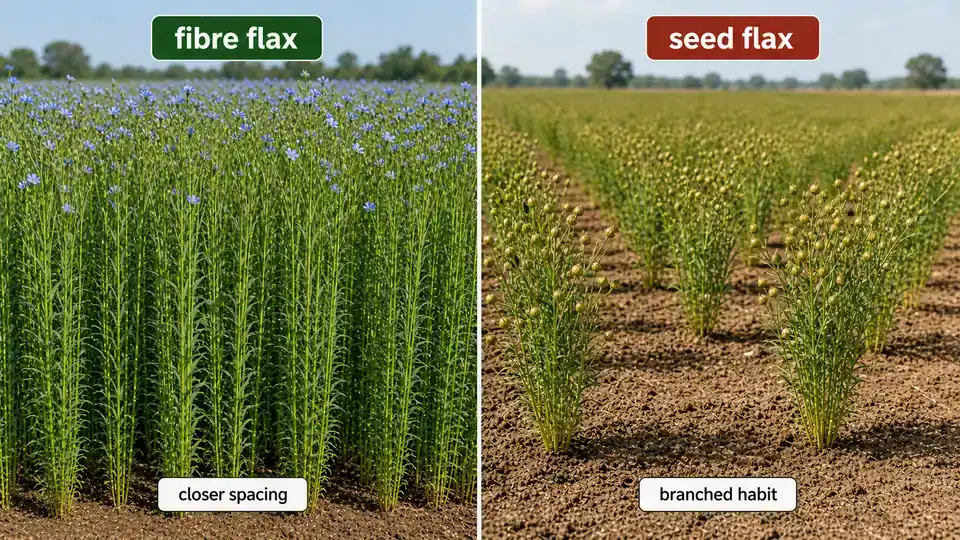
Linseed is grown for two distinct purposes -- fibre and oil -- and the agronomy differs significantly between the two. Understanding this distinction is critical for exam questions about spacing, plant habit, and end use.
| Feature | Fibre Flax | Seed Flax (Linseed) |
|---|---|---|
| Primary product | Fibre (linen) | Oil |
| Also called | Flax | Linseed, Linola (edible) |
| Spacing | Closer (tall, unbranched stems) | Wider (branching for seed production) |
| Plant habit | Tall, unbranched | Short, branched |
| Use | Textile (linen fabric) | Oil, industrial products |
- Flax fibre was one of humanity's earliest textile materials, used to make linen cloth as far back as ancient Egypt. In India, the focus has shifted primarily to oilseed production.
Oil Composition and Uses
Linseed oil is unique among vegetable oils due to its extremely high linolenic acid content, which makes it a drying oil -- it polymerises and hardens when exposed to air, making it invaluable for industrial applications.
IMPORTANT
Linseed is a dual-purpose crop: fibre (linen) + oil. 80% of its oil goes to industrial use (paints, varnishes, printing inks) due to high linolenic acid (50-60%), which is a drying oil that polymerises when exposed to air. Only 20% is edible.
| Component | Content/Use |
|---|---|
| Oil | 40-42% |
| Linolenic acid | 50-60% (omega-3 fatty acid, drying oil) |
| Industrial use | 80% (paints, varnishes, printing inks) |
| Edible use | 20% |
| Oil cake | Excellent feed for milch animals and organic manure |
Climate and Soil
Linseed is a cool-season Rabi crop that thrives in moderate temperatures during growth and warmer conditions at seed maturation. Its soil adaptability is broad, excluding only sandy and poorly drained soils.
Climate
- Requires moderate to cool temperature during the vegetative phase.
- Rabi season crop -- grows best in cool winter months.
- Ideal temperatures: 15-20°C (vegetative), 25-30°C (seed maturation).
Soil
- Grows on a variety of soils except sandy and poorly drained soils.
- Best in well-drained fertile medium heavy soils, silty loam, clay loam, and silty clay.
- pH: 5.0 to 7.0
Sowing, Seed Rate, and Spacing
Linseed sowing includes the unique "utera" (relay) cropping system where seeds are broadcast into standing rice before harvest -- a technique that uses residual moisture without additional land preparation.
| Parameter | Detail |
|---|---|
| Sowing time | October to November |
| Seed rate (normal) | 25-30 kg/ha |
| Seed rate (utera crop) | 35-40 kg/ha |
| Spacing | 30 x 5 cm |
| Depth | 2-3 cm (shallow seeding) |
- Utera cropping (relay cropping) -- linseed seeds are broadcast into standing rice about 10-15 days before rice harvest. Higher seed rate compensates for poor seed-soil contact and competition.
- Linseed has small seeds with limited energy reserves, so shallow placement ensures quick emergence.
Irrigation
Linseed needs 4-5 irrigations, with critical stages spanning from seedling establishment through pod filling.
| Parameter | Detail |
|---|---|
| Number of irrigations | 4-5 |
Critical Stages
| Stage | Purpose |
|---|---|
| 4-5 leaf stage | Strong seedling establishment and root development |
| Tillering stage | More branches = more flower-bearing shoots |
| Flower stage | Proper pollination and seed set |
| Pod filling stage | Seed development and oil accumulation |
Nutrient Management and Cropping Systems
As a non-leguminous oilseed, linseed requires a higher nitrogen dose than pulse crops. It works well in intercropping with wheat and gram.
| Parameter | Detail |
|---|---|
| NPK dose | 60 : 40 : 20 kg/ha |
| Intercropping | Wheat + Linseed (4:1), Gram + Linseed (1:1) |
| Weed control | Fluchloralin @ 1.0 kg ai/ha or Pendimethalin 1.0 kg ai/ha (pre-emergence) |
- Linseed is a non-leguminous oilseed, so it requires a higher nitrogen dose (60 kg/ha) compared to pulses.
Varieties
Variety selection in linseed depends on the cropping system (utera vs normal sowing) and water availability (rainfed vs irrigated).
| Category | Varieties |
|---|---|
| For rice fallow (utera) | R-552 |
| For rainfed | Kiran, Sheetal |
| For rainfed & irrigated (Assam, Bihar, West Bengal, Punjab) | Shubra, Himalini |
Disease
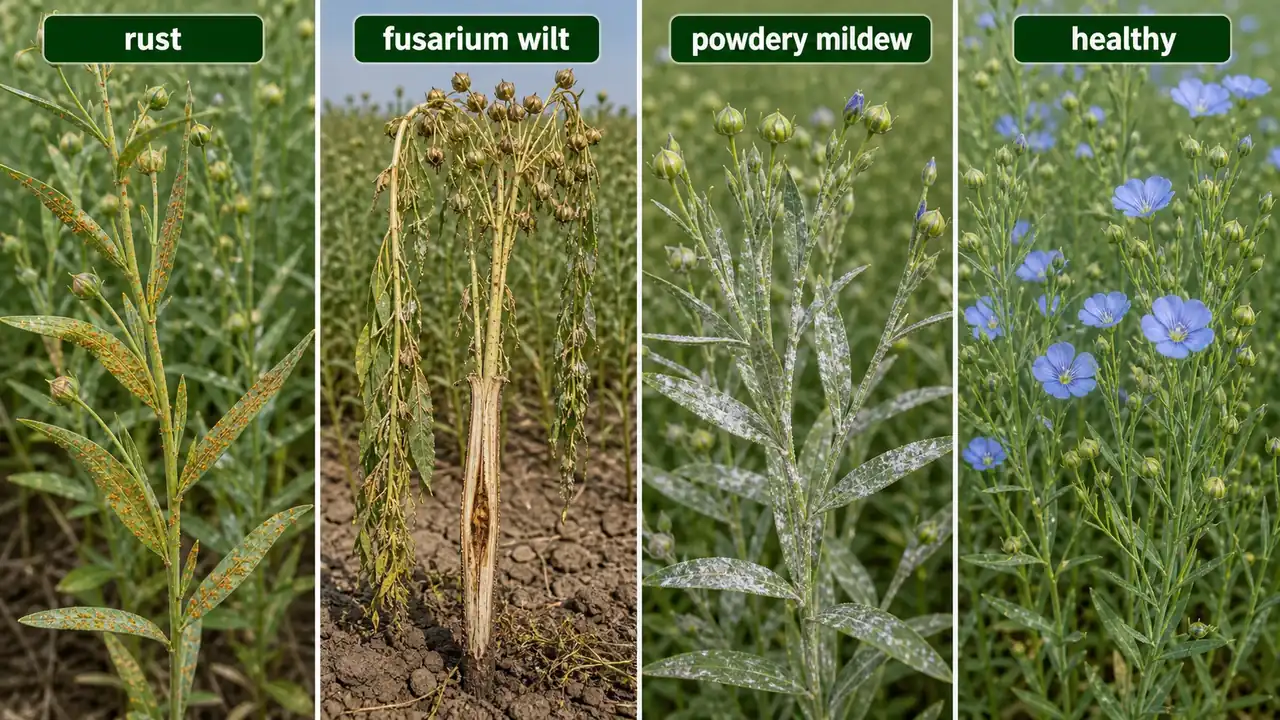
Linseed is affected by rust, wilt, and powdery mildew. Rust caused by Melampsora lini is the most destructive and most frequently tested disease.
| Disease | Pathogen | Key Feature |
|---|---|---|
| Rust | Melampsora lini | Most destructive disease; orange-brown pustules on leaves and stems |
| Fusarium Wilt | Fusarium oxysporum f.sp. lini | Soil-borne; blocks xylem vessels causing wilting |
| Powdery Mildew | Oidium lini | White powdery coating on leaves and stems |
TIP
Exam tip -- Linseed rust: Melampsora lini is the most frequently tested linseed pathogen. Remember: "Mela-Lini" (Melampsora on Linum).
Retting -- The Fibre Extraction Process
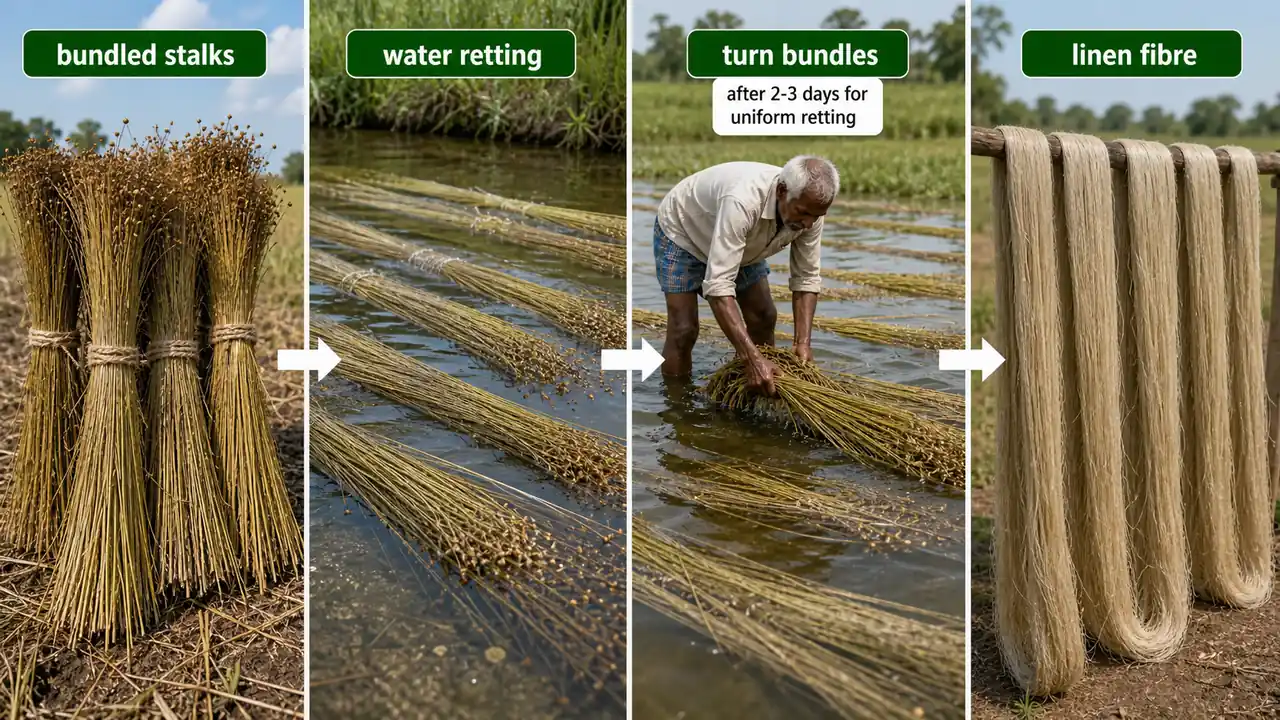
Retting is the traditional process of extracting fibre from plant stems using microbial decomposition. It is a key exam topic for linseed/flax.
Retting is a process of treating stalks for final fibre extraction. Bundled stalks are submerged in water so that microbial decomposition breaks down the pectin and other cementing substances that bind the fibres to the woody core of the stem.

Process
- Linseed stalks are chopped at the top end and tied in small bundles.
- Bundles are shifted to an available water source and immersed until retting is completed.
- For uniform retting, bundles should be turned (upper layer to lower layer) after 2-3 days.
- Turning ensures equal microbial action, preventing over-retting (which weakens fibre) and under-retting (which makes extraction difficult).
Yield
Linseed yields are moderate compared to other oilseeds, reflecting its dual-purpose nature and lower harvest index.
| Parameter | Detail |
|---|---|
| Yield | 12-18 q/ha |
TIP
Series complete: This concludes the seven-lesson oilseed series covering Groundnut, Soybean, Mustard, Sunflower, Safflower, Sesame, and Linseed. Review the cheat sheets across all lessons -- exam questions frequently compare oilseeds on oil content, family, fruit type, and key management practices.
Quick Revision Summary
| Parameter | Detail |
|---|---|
| Botanical Name | Linum usitatissimum (= "most useful") |
| Family | Linaceae |
| Origin | Afghanistan |
| 2n | 30 |
| Oil / Protein | 40-42% / 20% |
| Linolenic acid | 50-60% (drying oil) |
| Industrial use | 80% of oil (paints, varnishes) |
| Fibre | Reflex (produces linen fabric) |
| Dual purpose | Fibre flax + Oil flax |
| Utera cropping | Broadcast into standing rice |
| Key disease | Rust (Melampsora lini) |
| Retting | Microbial breakdown of pectin in water |
| NPK | 60:40:20 kg/ha |
| Inflorescence | Cymose |
| Yield | 12-18 q/ha |
Summary Cheat Sheet
| Concept / Topic | Key Details / Explanation |
|---|---|
| Botanical name | Linum usitatissimum (= "most useful"); Family Linaceae; 2n = 30 |
| Origin | Afghanistan |
| Title | Most Useful Crop (usitatissimum = most useful) |
| Dual purpose | Fibre (linen) + Oil from same plant |
| Oil content | 40-42% |
| Protein | 20% |
| Linolenic acid | 50-60% (omega-3 fatty acid; makes linseed a drying oil) |
| Industrial use of oil | 80% (paints, varnishes, printing inks) |
| Edible use | 20% only |
| Fibre name | Reflex — blends with wool, silk, cotton; produces linen fabric |
| Historical name | Old World Fibre |
| Fibre flax vs seed flax | Fibre flax = tall, unbranched, closer spacing; Seed flax = short, branched, wider spacing |
| Season | Rabi — sown October to November |
| Climate | Moderate to cool (vegetative), 15-20°C; warm 25-30°C at maturity |
| Soil | Well-drained medium heavy soils (silty loam, clay loam); pH 5.0-7.0 |
| Seed rate (normal) | 25-30 kg/ha |
| Seed rate (utera) | 35-40 kg/ha |
| Spacing | 30 x 5 cm; depth 2-3 cm |
| Utera cropping | Broadcast seeds into standing rice 10-15 days before harvest — uses residual moisture |
| NPK | 60 : 40 : 20 kg/ha |
| Intercropping | Wheat + Linseed (4:1); Gram + Linseed (1:1) |
| Irrigations | 4-5 (critical: 4-5 leaf, tillering, flower, pod filling stages) |
| Retting | Bundles submerged in water; microbial action breaks down pectin; turn bundles after 2-3 days for uniform retting |
| Key disease | Rust — Melampsora lini (most destructive) |
| Fusarium wilt | Fusarium oxysporum f.sp. lini — soil-borne, blocks xylem |
| Variety for utera | R-552 |
| Rainfed varieties | Kiran, Sheetal |
| Yield | 12-18 q/ha |