🍄 Button Mushroom Casing, Harvest, IPM and Quality
Advanced button mushroom management -- casing materials, pinning triggers, harvest hygiene, grading, post-harvest quality, pests, diseases, bacterial blotch, dry bubble, wet bubble, green mould and poisoning safety.
Why This Lesson Is Advanced
Most button mushroom losses happen after the basic crop is already established: casing dries out, CO2 remains high, bacterial blotch develops, flies enter the room, or harvest handling bruises caps. This lesson focuses on those management details.
Casing Quality
ICAR mushroom research highlights casing as a prerequisite for button mushroom because it supports primordia formation, acts as a water reservoir, protects mycelium, and physically supports fruit bodies.
| Desired casing property | Why it matters |
|---|---|
| High water-holding capacity | Prevents drying of pins. |
| Porosity | Maintains gas exchange. |
| pH 7.0-7.5 | Favours button mushroom pinning. |
| Low soluble salts | Prevents mycelial stress. |
| Pasteurised material | Reduces moulds, nematodes, and flies. |
Coir pith, loam, FYM, spent mushroom substrate, lime, and sand can be combined to mimic peat-like casing properties where peat moss is unavailable.
Pinning Troubleshooting
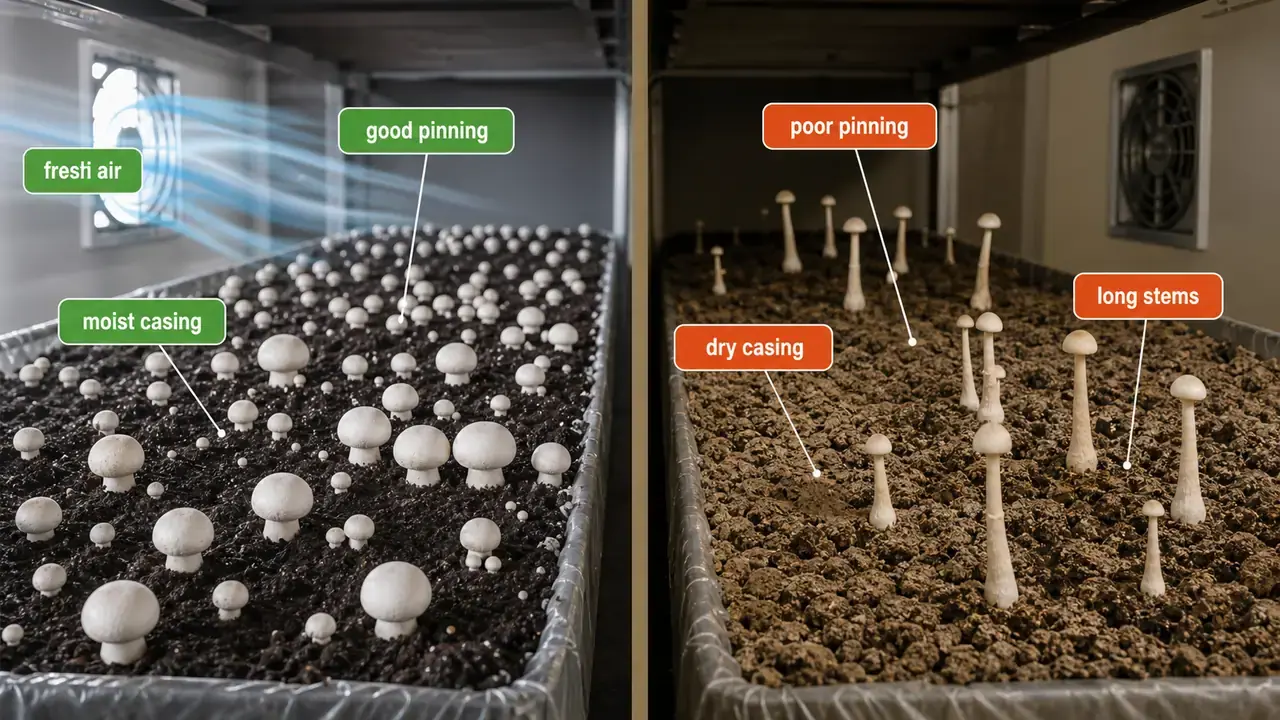
| Symptom | Likely cause | Correction |
|---|---|---|
| No pins after casing | High CO2, high temperature, dry casing, poor casing microbes | Increase ventilation, lower temperature, maintain casing moisture. |
| Long stems, small caps | Excess CO2 | Improve fresh air exchange. |
| Brown blotches on caps | Free water on cap surface; bacterial blotch risk | Water earlier, ventilate, avoid wet caps overnight. |
| Uneven crop | Uneven spawn mixing or uneven casing moisture | Improve mixing and misting uniformity. |
| Mould patches | Poor pasteurisation or hygiene | Remove infected area, improve sanitation. |
Pests
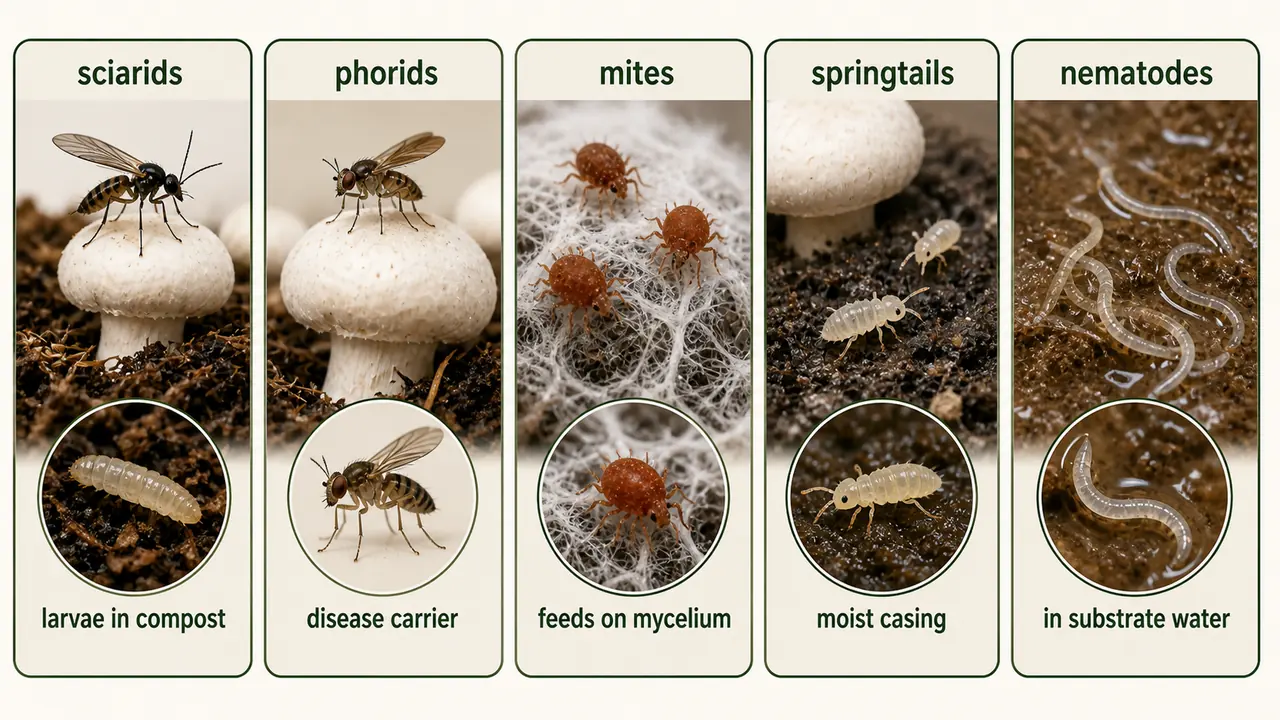
| Pest | Exam clue |
|---|---|
| Sciarids | Fungus gnats; larvae damage mycelium and spread diseases. |
| Phorids | Scuttle flies; rapid runners, disease carriers. |
| Mites | Feed on mycelium and fruit bodies. |
| Springtails | Small jumping insects in moist substrate. |
| Nematodes | Damage mycelium and reduce yield. |
Sanitation, fly-proof netting, clean spent-compost disposal, and pasteurisation are more important than late chemical control.
Major Diseases
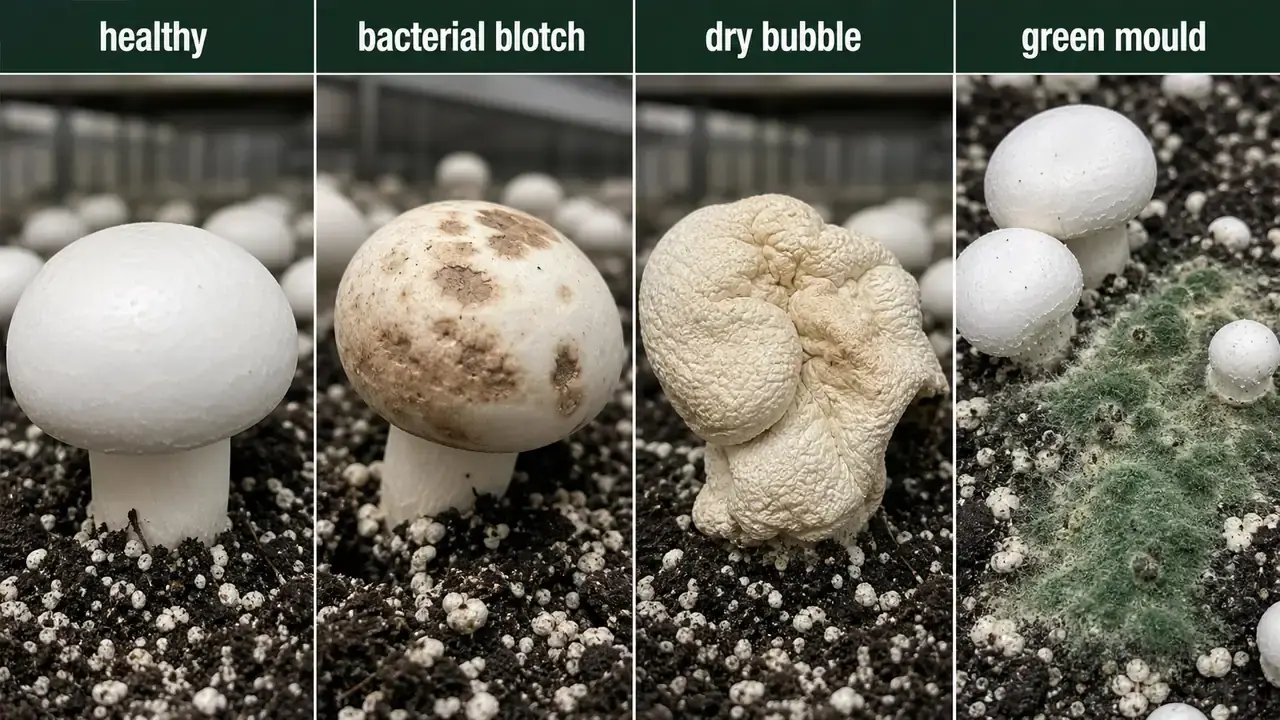
| Disease | Common clue | Key idea |
|---|---|---|
| Dry bubble | Brown spot, deformed dry caps | Caused by Lecanicillium fungicola (formerly Verticillium fungicola). |
| Wet bubble | White mould, soft distorted masses | Caused by Mycogone perniciosa. |
| Cobweb disease | Grey-white web over casing/mushrooms | Spreads fast in high humidity. |
| Green mould | Green competitor patches | Commonly associated with Trichoderma. |
| Bacterial blotch | Brown sunken blotches on caps | Favoured by wet caps and poor ventilation. |
| False truffle | Truffle disease | Competitor fungus in compost/casing. |
TIP
Disease order mnemonic: Dry, Wet, Cobweb, Green, Bacterial. These five cover most exam options.
Harvest and Post-Harvest Quality
Button mushrooms are harvested when caps are still closed. After harvest they respire rapidly, lose water, bruise easily, and brown quickly.
| Practice | Why it matters |
|---|---|
| Twist, do not pull roughly | Protects casing and neighbouring pins. |
| Trim dirty stem base | Improves market grade. |
| Avoid washing before storage | Extra surface water increases bacterial blotch and spoilage. |
| Cool quickly | Slows respiration and browning. |
| Grade by size and colour | Higher market price for clean white buttons. |
| Process surplus | Canning, drying, pickling, powder, soup mix. |
Mushroom Poisoning Safety
Poisonous mushrooms can cause:
- Gastric disorder
- Nervous disorder
- Muscular disorder
- Haemolytic disorder
For public education, teach this plainly: cultivated mushroom supply is safer than wild collection because visual identification by non-experts is unreliable.
Summary Points
| Concept | Key detail |
|---|---|
| Casing role | Water reservoir, gas buffer, microbial pinning trigger, physical support. |
| Long stems | Excess CO2. |
| Bacterial blotch | Wet cap surface + poor ventilation. |
| Dry bubble | Brown spot / distorted dry caps. |
| Wet bubble | White mould / soft masses. |
| Green mould | Competitor mould, commonly Trichoderma. |
| Harvest stage | Closed button stage. |
| Poisoning types | Gastric, nervous, muscular, haemolytic. |
Lesson Doubts
Ask questions, get expert answers