Mushroom Cultivation 🍄
Pedagogically arranged mushroom cultivation course from fungal basics to spawn, substrate science, button mushroom production, tropical mushrooms, IPM, post-harvest and enterprise.
Frequently Asked Questions
What are the main edible mushroom species and their scientific names?
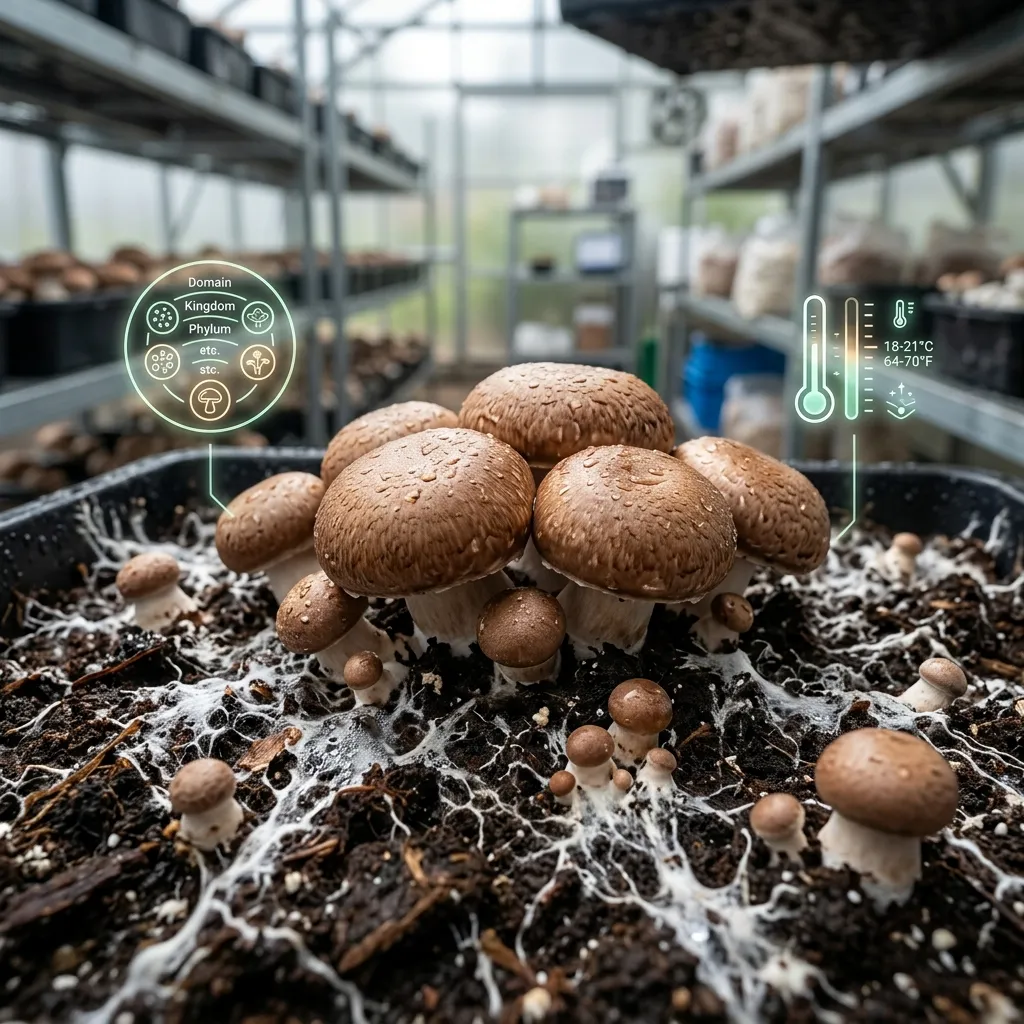
The four commercially important edible mushrooms in India: (1) Button mushroom — Agaricus bisporus (temperate, grown in winter 15–22°C); (2) Oyster mushroom — Pleurotus ostreatus / P. florida (subtropical, 20–30°C); (3) Paddy straw mushroom — Volvariella volvacea (tropical, 30–38°C, short shelf life); (4) Shiitake — Lentinula edodes (temperate, grown on hardwood logs). Milky mushroom (Calocybe indica) is suited to plains of India at 30–35°C.
What is the spawn rate for button mushroom and what is spawn run?
The standard spawn rate for button mushroom cultivation is 500–750 g of grain spawn per 100 kg of compost (0.5–0.75%). Spawn run is the vegetative growth phase after spawning where mycelium colonises the compost — it takes 12–15 days at 22–25°C in a dark, CO₂-rich environment. After spawn run, temperature is reduced and casing soil is applied to stimulate fruiting.
What is the composting temperature in Phase I and Phase II for button mushroom?
Phase I composting (outdoor fermentation): compost heap reaches 70–80°C through microbial thermogenesis. This kills pathogens, weed seeds, and fly larvae. Duration: 18–21 days with regular turning. Phase II composting (peak heating in tunnels): 58–60°C for 6–8 hours (pasteurisation) followed by conditioning at 48–52°C. The 70°C peak in Phase I is a commonly tested figure.
What is the purpose of casing soil in mushroom cultivation?
Casing soil is a layer of non-nutritive material (peat moss, spent compost, or loamy soil mixed with lime) applied 3–4 cm thick over the spawned compost after spawn run. It serves three purposes: (1) maintains humidity and provides a humid microclimate for pin initiation; (2) creates a physical support for developing mushrooms; (3) provides Pseudomonas bacteria whose metabolites trigger primordia (pin) formation. Without casing, button mushrooms will not fruit.
What are the major diseases of button mushroom?
Major diseases of button mushroom: (1) Wet bubble — caused by Mycogone perniciosa; produces distorted, wet, soft fruit bodies. (2) Dry bubble — caused by Lecanicillium fungicola (formerly Verticillium fungicola); produces dry, cracked or deformed caps. (3) Green mold — commonly associated with Trichoderma spp.; a competitor that colonises compost and suppresses Agaricus mycelium. (4) Bacterial blotch — Pseudomonas tolaasii; causes brown blotches on caps, favoured by wet cap surfaces and poor ventilation.
Which exams test Mushroom Cultivation?
Mushroom Cultivation is directly tested in IBPS AFO (Professional Knowledge), NABARD Grade A/B, ICAR JRF (Horticulture/Agronomy), state PSC Agriculture Officer exams, and Pre-PG entrance exams at IARI, BHU, TNAU, and ANGRAU. Species names with scientific names, composting temperature, spawn rate, and disease names are the most commonly tested items.