🍄 Button Mushroom Production Cycle
Step-by-step button mushroom cultivation from compost preparation and spawning to spawn run, casing, pinning, fruiting, harvest, yield and environment control.
Why Button Mushroom Is the Main Exam Species
Button mushroom (Agaricus bisporus) is the best-known cultivated mushroom and the most technical one in the exam syllabus. It is associated with cool climates, compost, casing, and strict temperature/CO2 control.
| Parameter | Detail |
|---|---|
| Scientific name | Agaricus bisporus |
| Family | Agaricaceae |
| Class | Basidiomycetes |
| Season in low-tech North India | Winter |
| Commercial production | Possible year-round only under controlled conditions |
| Dominant production zone | North India and cool hill states |
Six-Step Technology
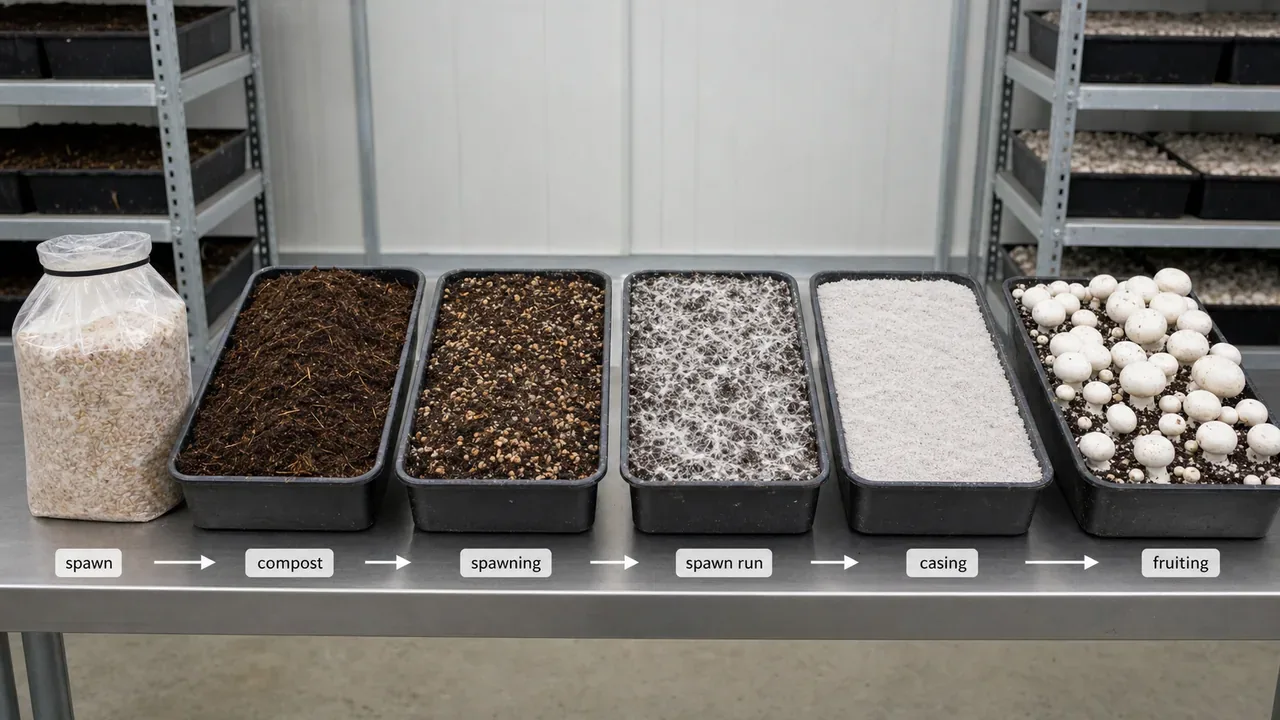
Button mushroom cultivation follows this sequence:
Compost preparation -> Spawning -> Spawn run -> Casing -> Pinning/Fruiting -> Harvesting
Step 1: Compost Preparation
Button mushroom does not grow well on raw straw. The straw and manures must first be composted into a selective medium.
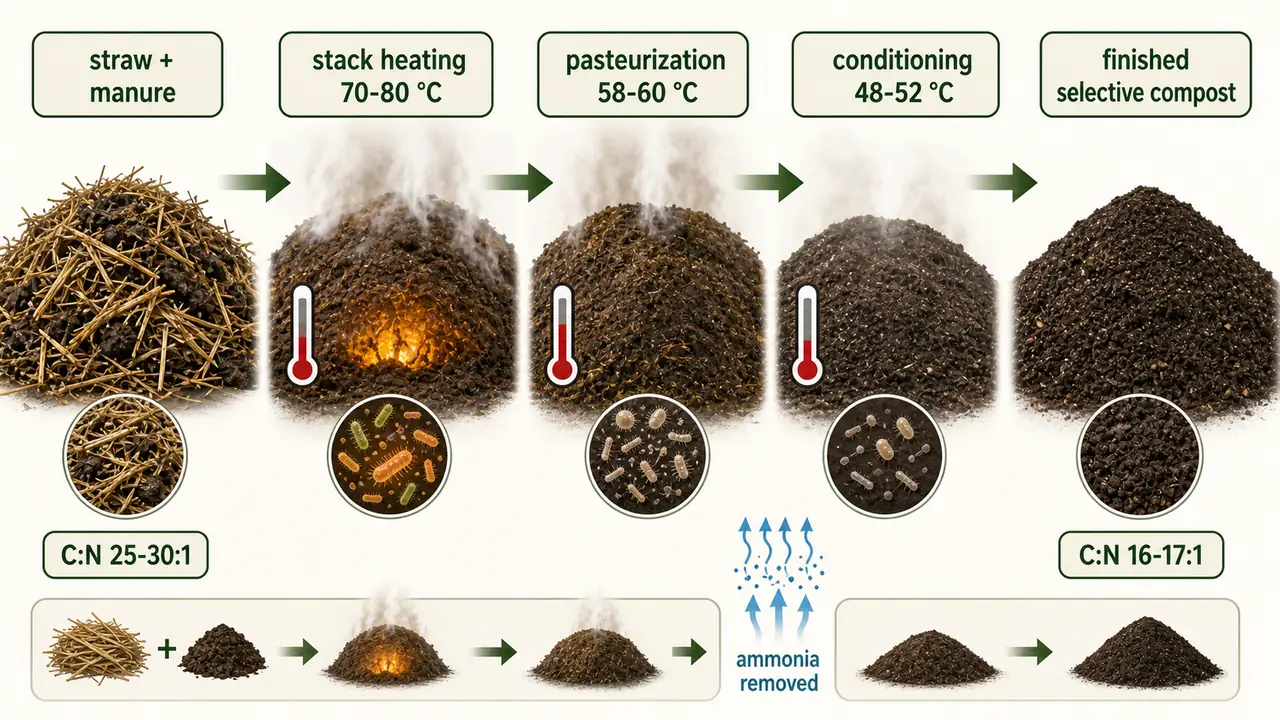
| Compost input | Role |
|---|---|
| Wheat straw / paddy straw | Carbon skeleton and bulk. |
| Poultry manure / organic manure | Nitrogen source. |
| Urea and supplements | Adjust nitrogen and microbial activity. |
| Gypsum | Improves compost structure and prevents greasiness. |
| Water | Maintains microbial fermentation. |
Exam logic: compost should be brown, selective, free of ammonia smell, and not greasy or waterlogged.
Step 2: Spawning
Spawning is the mixing of mushroom spawn with prepared compost.
| Practice | Exam point |
|---|---|
| Spawn rate | Commonly 500-750 g grain spawn per 100 kg compost. |
| Mixing | Uniform mixing gives uniform mycelial colonisation. |
| Hygiene | Dirty trays or old compost introduce competitor moulds. |
Step 3: Spawn Run
Spawn run is the vegetative phase when mycelium colonises compost.
| Parameter | Requirement |
|---|---|
| Temperature | 22-25°C or about 23 +/- 2°C |
| Relative humidity | About 90% |
| CO2 | High CO2 is favourable |
| Duration | 12-15 days |
| Light | Not important |
TIP
Spawn run = warm + high CO2. This is opposite to fruiting.
Step 4: Casing
After complete spawn run, cover the compost with 3-4 cm casing soil. Casing should be moist, porous, neutral to slightly alkaline, and pasteurised.
| Casing parameter | Value |
|---|---|
| Thickness | 3-4 cm |
| pH | 7.0-7.5 |
| Ideal material | Peat moss where available |
| Indian alternatives | Loam + FYM, loam + sand, spent compost + sand + lime, coir-based mixtures |
| Treatment | Steam/pasteurisation or approved chemical treatment before use |
Step 5: Pinning and Fruiting
Fruiting begins only when the environment is shifted.
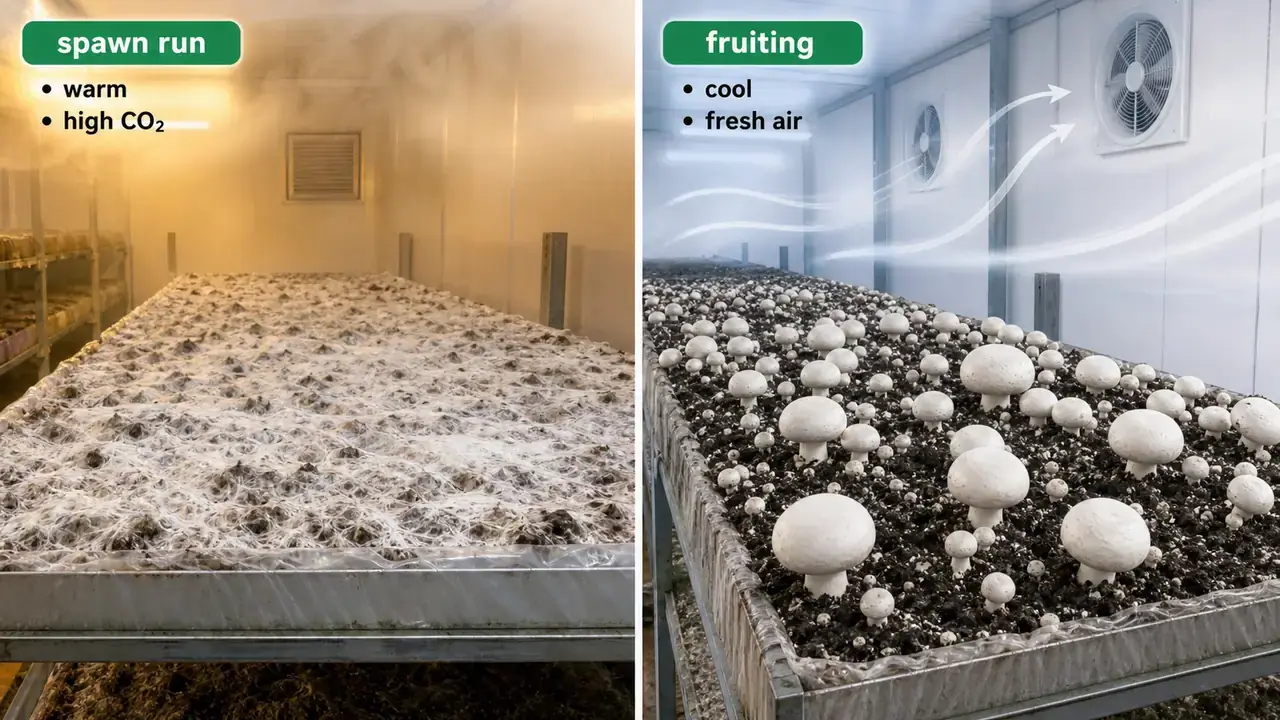
| Parameter | Spawn run | Fruiting |
|---|---|---|
| Temperature | 22-25°C | 15-18°C |
| CO2 | High | Low |
| Ventilation | Limited | Increased |
| Main growth | Mycelium | Pins and buttons |
Pins usually appear after casing when temperature and ventilation are managed correctly.
Step 6: Harvesting and Yield
Harvest at the button stage, before the cap opens and gills are exposed.
| Parameter | Detail |
|---|---|
| Harvest stage | Closed button, cap about 2.5-4 cm |
| Harvest method | Twist gently; avoid damaging casing |
| First flush | Usually about 3 weeks after casing |
| Normal yield | 10-14 kg fresh mushroom per 100 kg fresh compost |
| Better managed short method | 15-20 kg per 100 kg compost |
| Preservation | Canning is the classic long-duration method |
Summary Points
| Concept | Key detail |
|---|---|
| Button mushroom | Agaricus bisporus. |
| Production sequence | Compost -> spawning -> spawn run -> casing -> fruiting -> harvest. |
| Spawn rate | 500-750 g per 100 kg compost. |
| Spawn run | 12-15 days at 22-25°C, high CO2. |
| Fruiting | 15-18°C, low CO2, ventilation. |
| Casing | 3-4 cm, pH 7.0-7.5. |
| Harvest | Button stage, cap closed. |
Lesson Doubts
Ask questions, get expert answers