🚰 Irrigation: Principles, Soil-Water Concepts, and Scientific Management
Complete guide to irrigation in Indian agriculture -- purpose, importance, soil-water relationships (field capacity, wilting point, infiltration), soil water potential, moisture constants, mulching, and key irrigation terminologies for competitive exams.
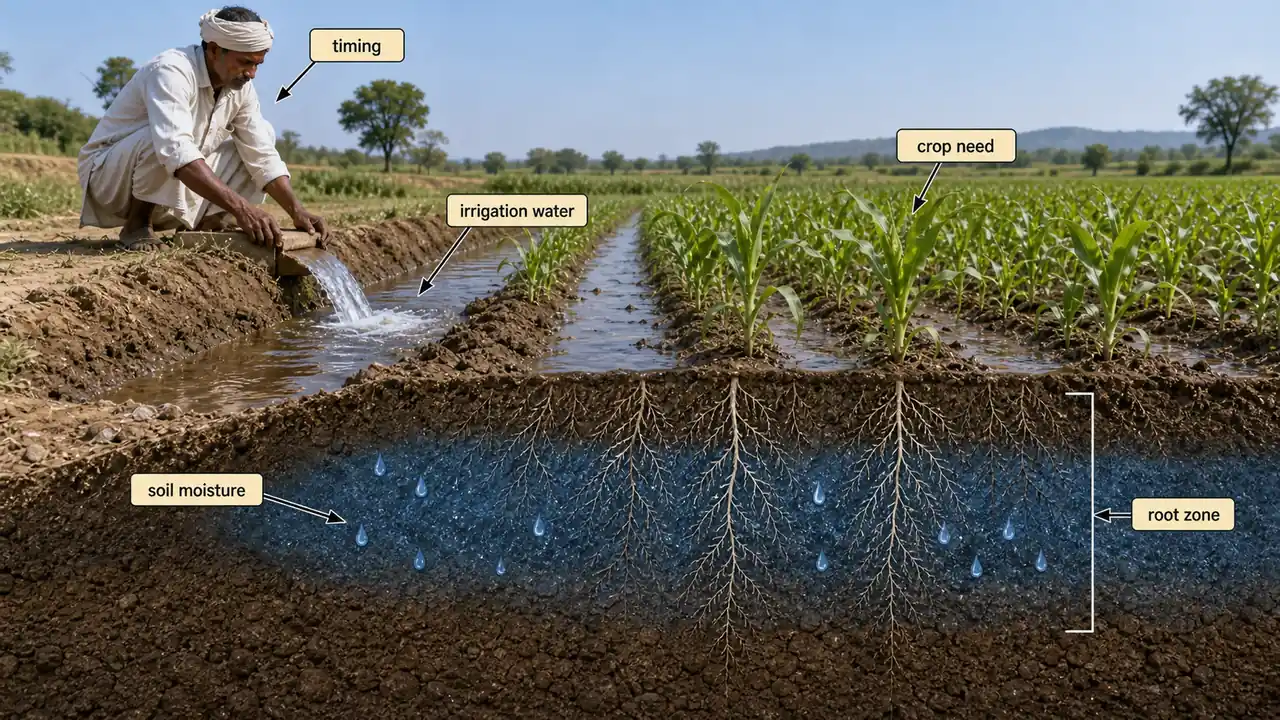
From Rainfall Uncertainty to Reliable Harvests
In the previous lesson, we established how water is distributed on Earth -- the hydrologic cycle, aquifer types, and India's water budget. Now we move from understanding where water is to understanding how to apply it to crops -- the science of irrigation.
A wheat farmer in Uttar Pradesh depends on timely winter rains for his crop. In a good year, the rains arrive perfectly during crown root initiation and tillering. But in a bad year, a three-week dry spell at the critical CRI stage destroys the entire harvest -- months of labour and investment lost to a single rainless fortnight. Irrigation solves this problem by giving the farmer control over water supply, transforming uncertain rainfed farming into reliable, high-yielding agriculture. This chapter covers what irrigation is, why India needs it, and the scientific concepts behind managing it effectively.
Pro Content Locked
Upgrade to Pro to access this lesson and all other premium content.
Charged once for one year · ₹1188 total
Save ₹100/month vs ₹2388/year launch price
- All Agriculture & Banking Courses
- AI Lesson Questions (100/day)
- AI Doubt Solver (50/day)
- Glows & Grows Feedback (30/day)
- AI Section Quiz (20/day)
- 22-Language Translation (100/day)
- Recall Questions (20/day)
- AI Quiz (15/day)
- AI Quiz Paper Analysis (100/day)
- AI Step-by-Step Explanations (100/day)
- Spaced Repetition Recall (FSRS)
- AI Tutor
- Immersive Text Questions
- Audio Lessons — Hindi & English
- Mock Tests & Previous Year Papers
- Summary & Mind Maps
- XP, Levels, Leaderboard & Badges
- Generate New Classrooms
- Voice AI Teacher (AgriDots Live)
- AI Revision Assistant
- Knowledge Gap Analysis
- Interactive Revision (LangGraph)
🔒 Secure one-time yearly payment via Razorpay · No hidden fees
From Rainfall Uncertainty to Reliable Harvests
In the previous lesson, we established how water is distributed on Earth -- the hydrologic cycle, aquifer types, and India's water budget. Now we move from understanding where water is to understanding how to apply it to crops -- the science of irrigation.
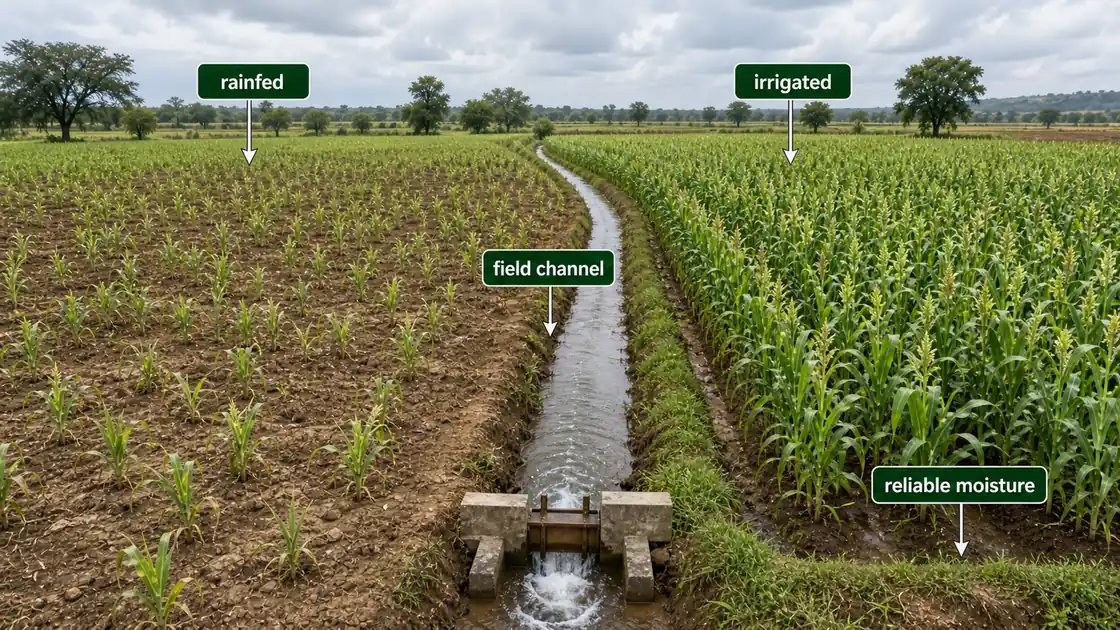
A wheat farmer in Uttar Pradesh depends on timely winter rains for his crop. In a good year, the rains arrive perfectly during crown root initiation and tillering. But in a bad year, a three-week dry spell at the critical CRI stage destroys the entire harvest -- months of labour and investment lost to a single rainless fortnight. Irrigation solves this problem by giving the farmer control over water supply, transforming uncertain rainfed farming into reliable, high-yielding agriculture. This chapter covers what irrigation is, why India needs it, and the scientific concepts behind managing it effectively.
What is Irrigation?
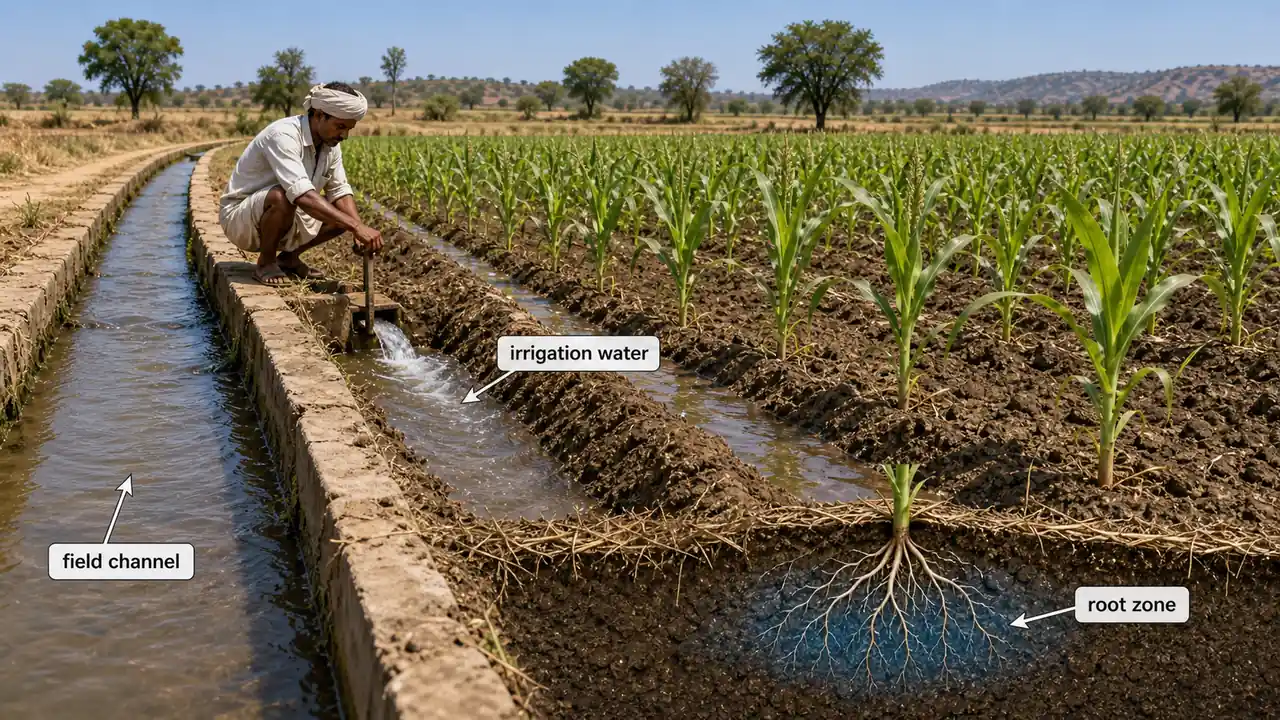
Irrigation is the artificial application of water to the soil for crop growth and crop production, supplementing rainfall and groundwater contribution. It is one of the most critical inputs in modern agriculture.
Purpose of Irrigation
| Purpose | Agricultural Example |
|---|---|
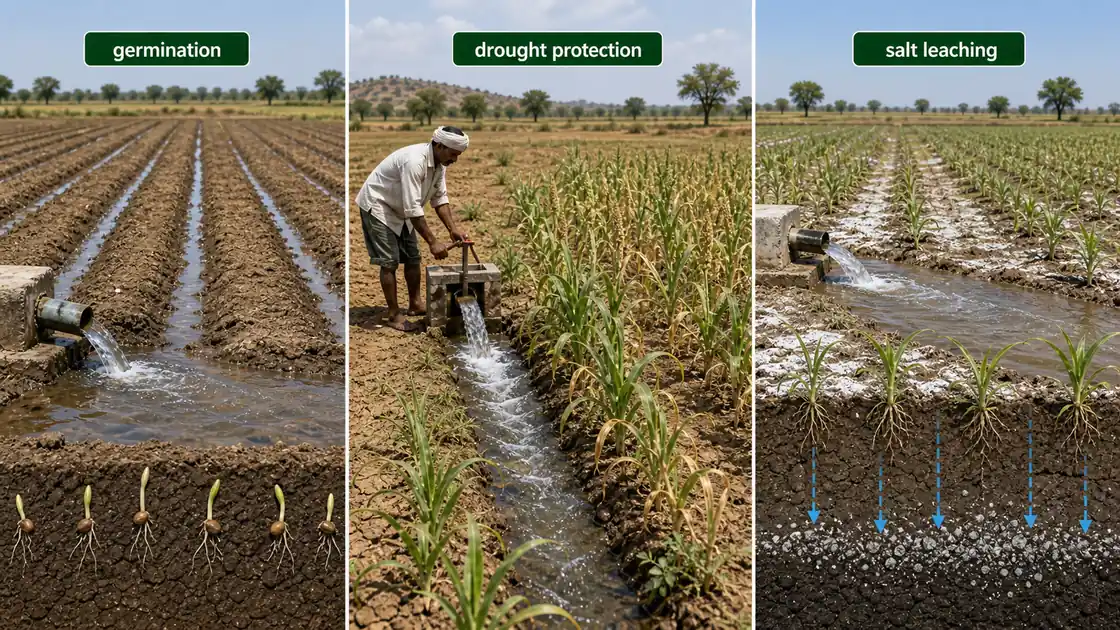
| Add water for plant growth | Pre-sowing irrigation (palco) ensures seed germination in wheat |
| Crop insurance against short drought | Life-saving irrigation during dry spells in pearl millet |
| Cool the soil and atmosphere | Sprinkler irrigation to protect potato from frost damage |
| Wash out or dilute soil salts | Leaching irrigation in saline soils of Gujarat |
| Reduce soil piping hazards | Controlled irrigation in canal-command areas |
| Soften tillage pans | Pre-monsoon irrigation to break hard pans in black cotton soils |
Importance of Irrigation in India
India's agriculture is deeply dependent on water -- yet water availability is highly uneven across regions and seasons.
- Agriculture is the biggest user of water -- 78% of India's freshwater consumption (CWC, 2014).
- Only about 49% of cultivated area has irrigation access; more than half still depends on rainfall.
- About 86% of irrigated agriculture comes from two sources:
- Groundwater (62%)
- Canals (24%)
| Fact | Detail |
|---|---|
| Highest irrigated area globally | India (1st) |
| Most irrigated state (% of total area) | Punjab |
| Largest total irrigated area | Uttar Pradesh (mainly canal irrigation) |
| Main source of irrigation | Tube-wells (46%) |
| Other sources | Canals (24%), Other wells (16%), Tanks (3%), Others (11%) |

TIP
Exam mnemonic -- TCWTO (Tube-wells, Canals, Wells, Tanks, Others): Remember the irrigation sources in descending order of area covered: 46, 24, 16, 3, 11%.
Advantages of Irrigation
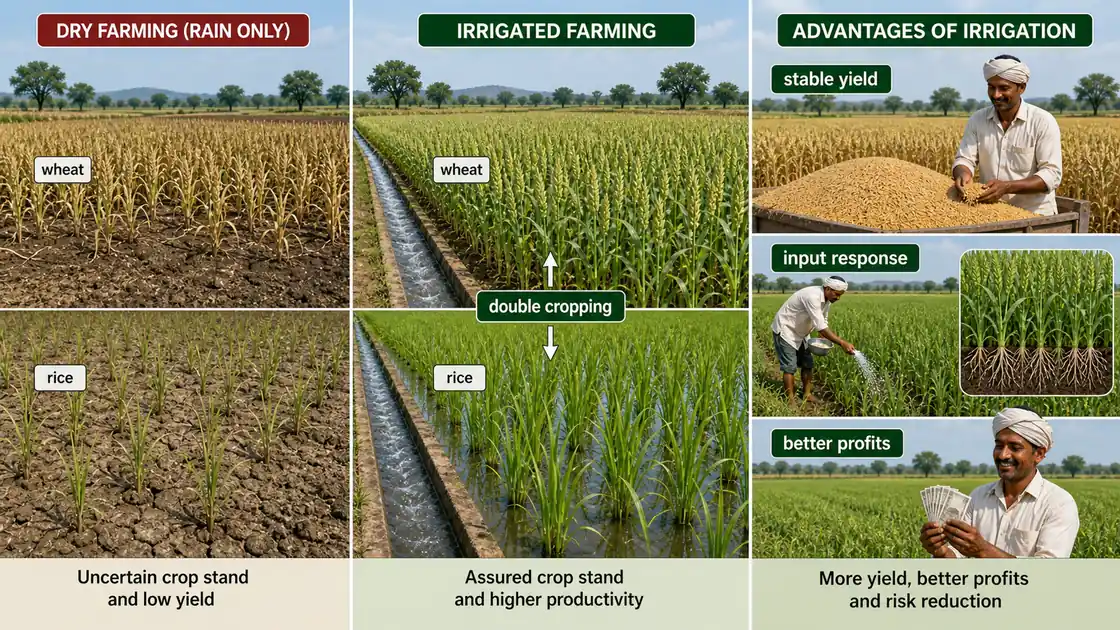
- Increases food production to feed the expanding population.
- Ensures stable production in traditional dryland farming systems.
- Prolongs the growing period, enabling multiple cropping and employment generation.
- Makes additional inputs (fertilizers, tillage, plant protection) economically feasible.
- Reduces the risk of expensive inputs being wasted by drought.
Agricultural example: In Haryana, the introduction of canal irrigation in the 1960s transformed semi-arid land into one of India's most productive wheat-rice belts, enabling two reliable harvests per year instead of one uncertain monsoon crop.
Adverse Effects of Excess Irrigation
While irrigation is essential, over-irrigation causes serious problems:
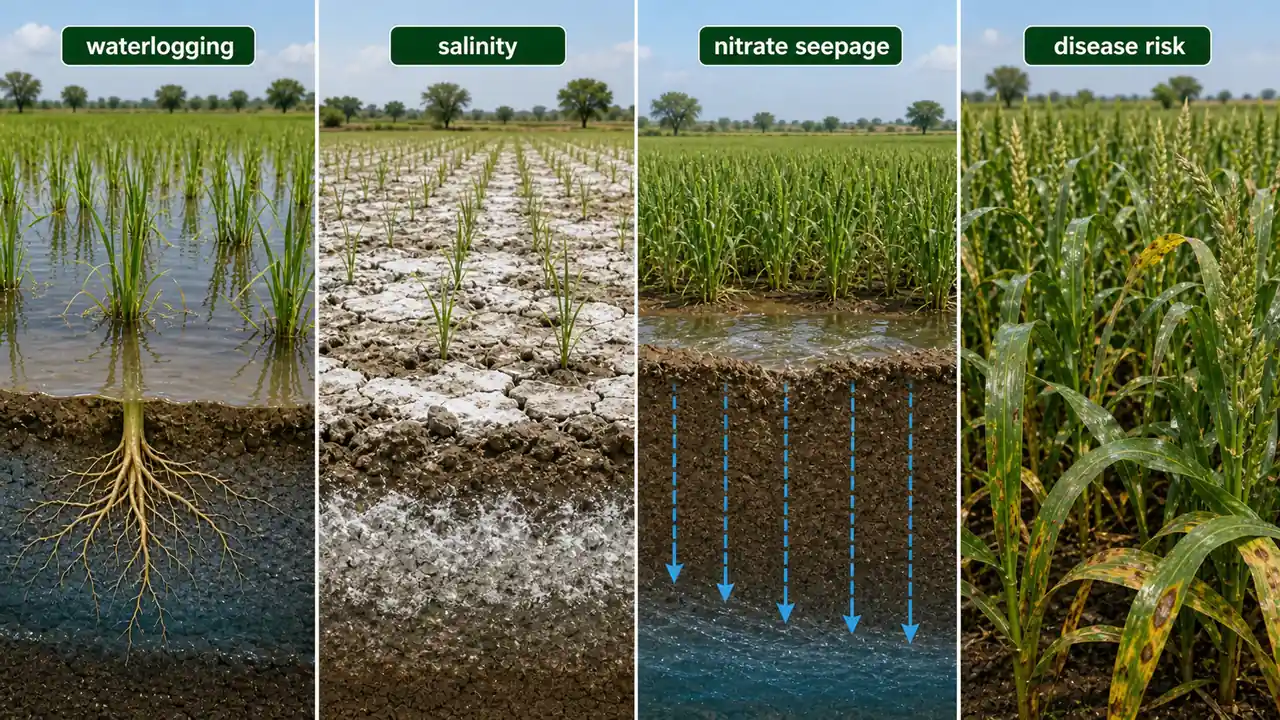
| Problem | Consequence | Example |
|---|---|---|
| Waterlogging | Root suffocation, reduced productivity | Over-irrigated rice-wheat areas in Haryana |
| Soil salinization | Salt buildup rendering land unfit | Canal-command areas in Rajasthan |
| Groundwater pollution | Nitrate contamination from fertilizer seepage | Intensive vegetable belts |
| Pest/disease outbreaks | Colder, damper climate favours pathogens | Fungal diseases in over-irrigated wheat |
TIP
Exam tip: Remember "WSGP" for adverse effects of excess irrigation: Waterlogging, Salinization, Groundwater pollution, Pest outbreaks. Exams often ask "what are the ill effects of over-irrigation?"
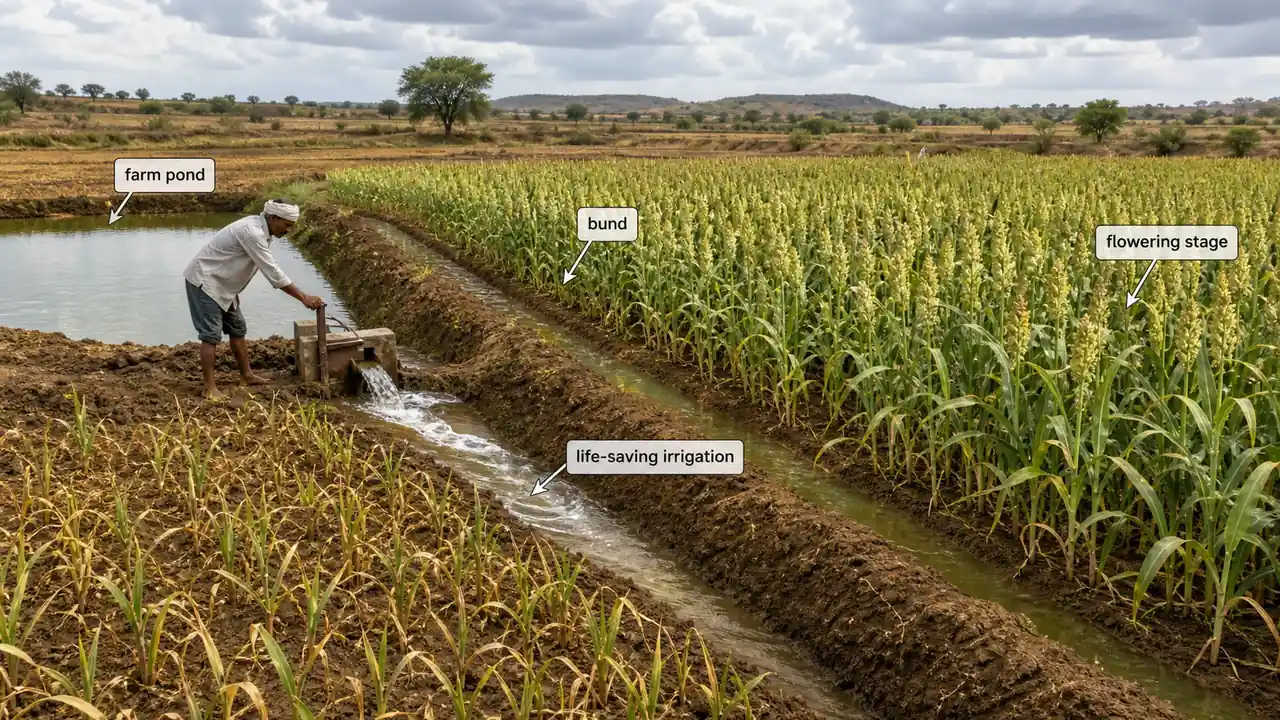
Life-Saving Irrigation
- Also called contingency irrigation -- an emergency measure for severe moisture stress.
- Supplemental irrigation applied to dryland crops.
- Land is not prepared for irrigation.
- Fields divided into plots of 20--25 m width with small bunds to guide water.
Agricultural example: During a mid-season drought in sorghum, a single life-saving irrigation of 5 cm at the flowering stage can prevent 40--60% yield loss. Farmers in dryland Maharashtra keep a farm pond specifically for such emergencies.
Irrigation Management
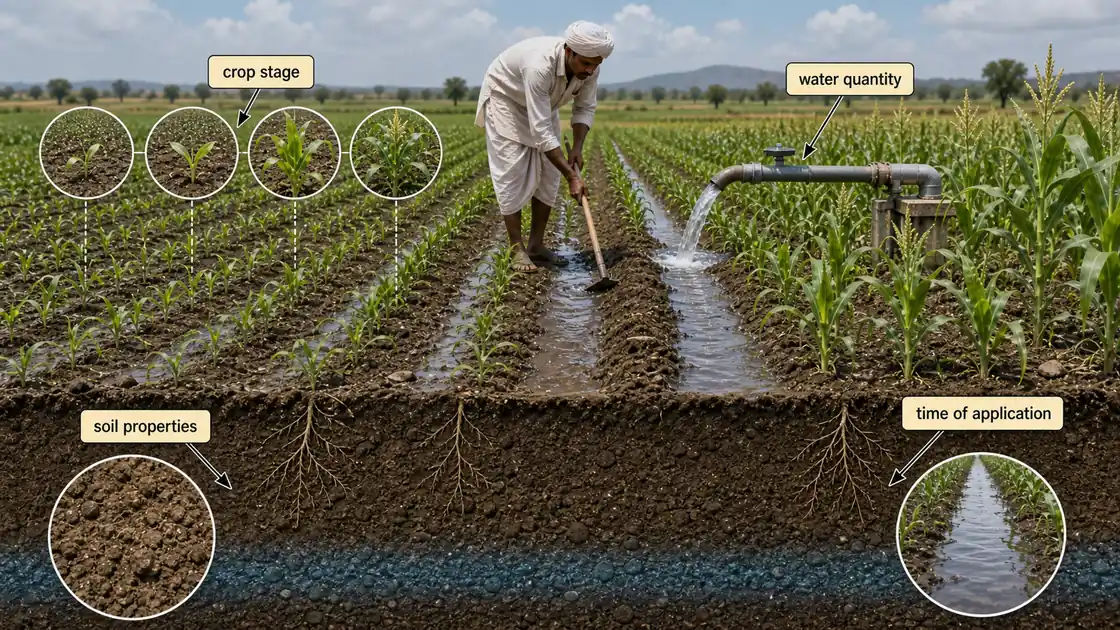
Irrigation water management is the act of timing and regulating water applications to satisfy crop water requirement without wasting water, soil, plant nutrients, or energy.
It requires understanding four key factors:
| Factor | What to Know | Why It Matters |
|---|---|---|
| Soil properties | Physical and chemical characteristics | Determines water-holding capacity |
| Crop biology | Growth stages and water sensitivity | Identifies when water is most critical |
| Water quantity | Available from all sources | Sets the upper limit of irrigation |
| Time of application | When to irrigate | Ensures water reaches the crop when needed |
The scientific management of all these factors is called Irrigation Agronomy.
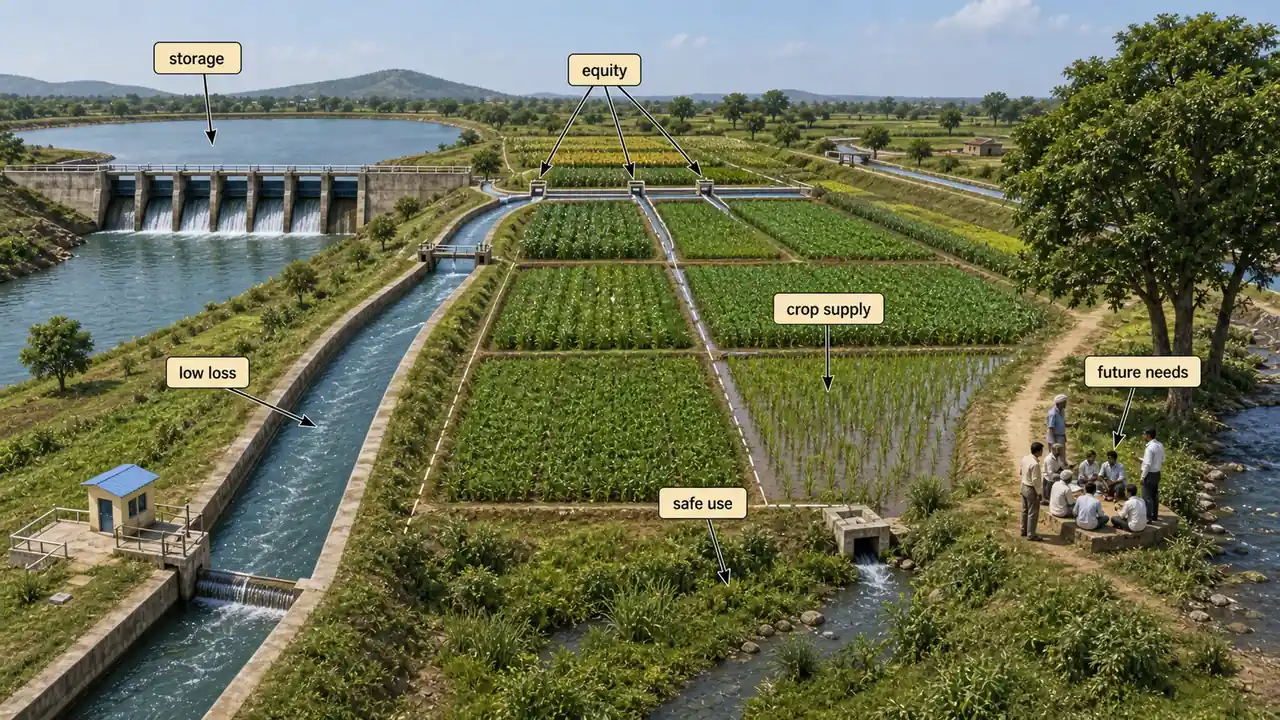
Importance of Irrigation Management
| Objective | Principle |
|---|---|
| Store and regulate water | Resource conservation |
| Allocate water proportionally by area and crop | Balanced equity in distribution |
| Convey water with minimum loss | Efficiency in use |
| Apply sufficient quantity to crops | Optimization of use |
| Consider cost-benefit | Economically viable management |
| Distribute without social conflict | Judicial distribution |
| Meet future domestic and famine needs | Resource conservation |
| Protect environment from misuse | Environmentally safe use |
Why India Needs Irrigation
- India receives most rainfall in the monsoon season (June--September).
- There is huge spatial and temporal variation in rainfall patterns -- Cherrapunji receives over 11,000 mm while Jaisalmer gets less than 200 mm.
- Climate change has increased this unpredictability.
- Irrigation provides a reliable, controlled water supply regardless of rainfall.

India's rainfall follows a distinct seasonal pattern: the southwest monsoon (June--September) delivers about 75% of annual rainfall, followed by the northeast monsoon (October--December) in peninsular India, a dry winter (January--February), and the pre-monsoon hot weather period (March--May). This uneven distribution makes irrigation essential for year-round cropping.
Important Irrigation Concepts
These concepts form the scientific foundation of irrigation management. They progress logically from how water is held in soil, to how it moves, and finally to how we measure its energy state.
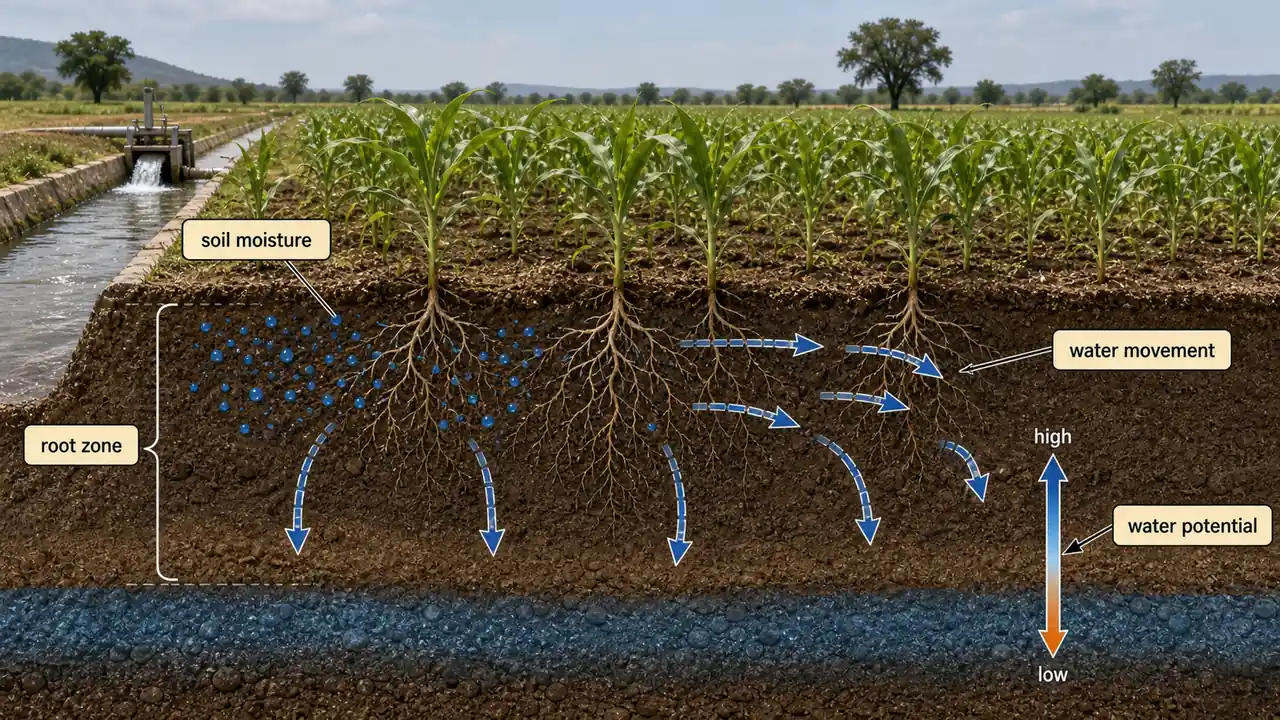
Soil Water Relationships -- From Saturation to Wilting
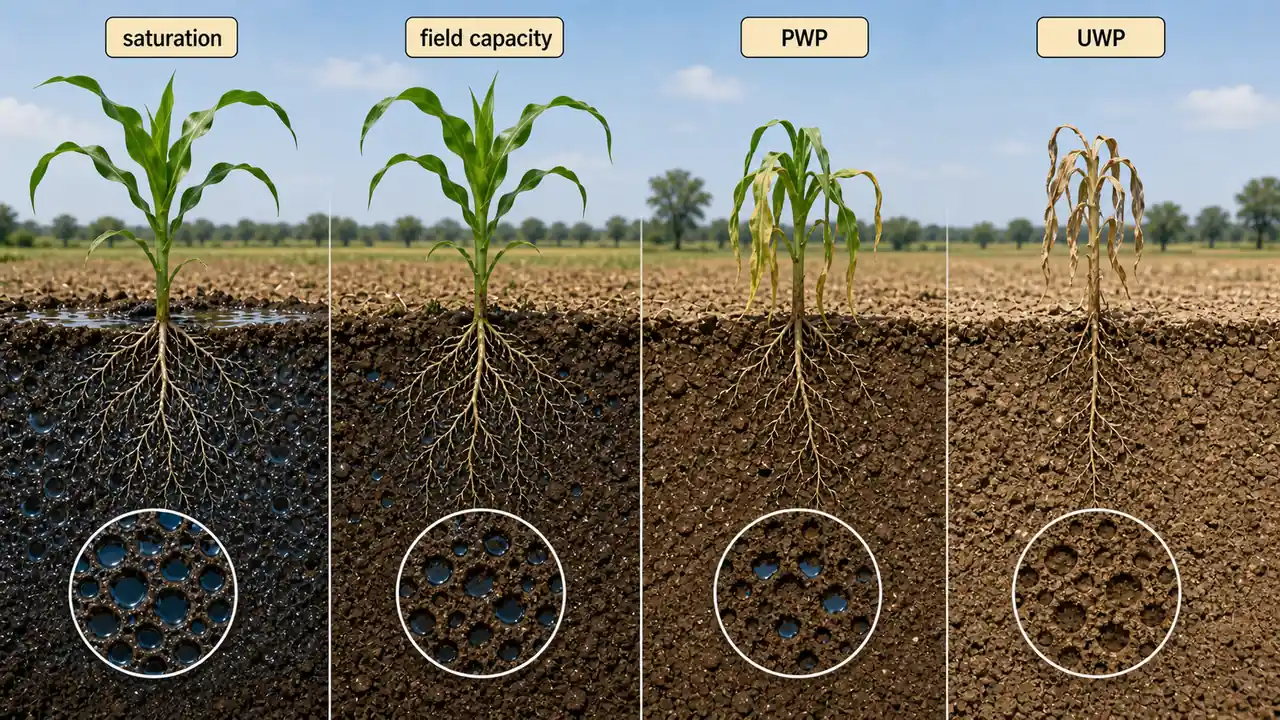
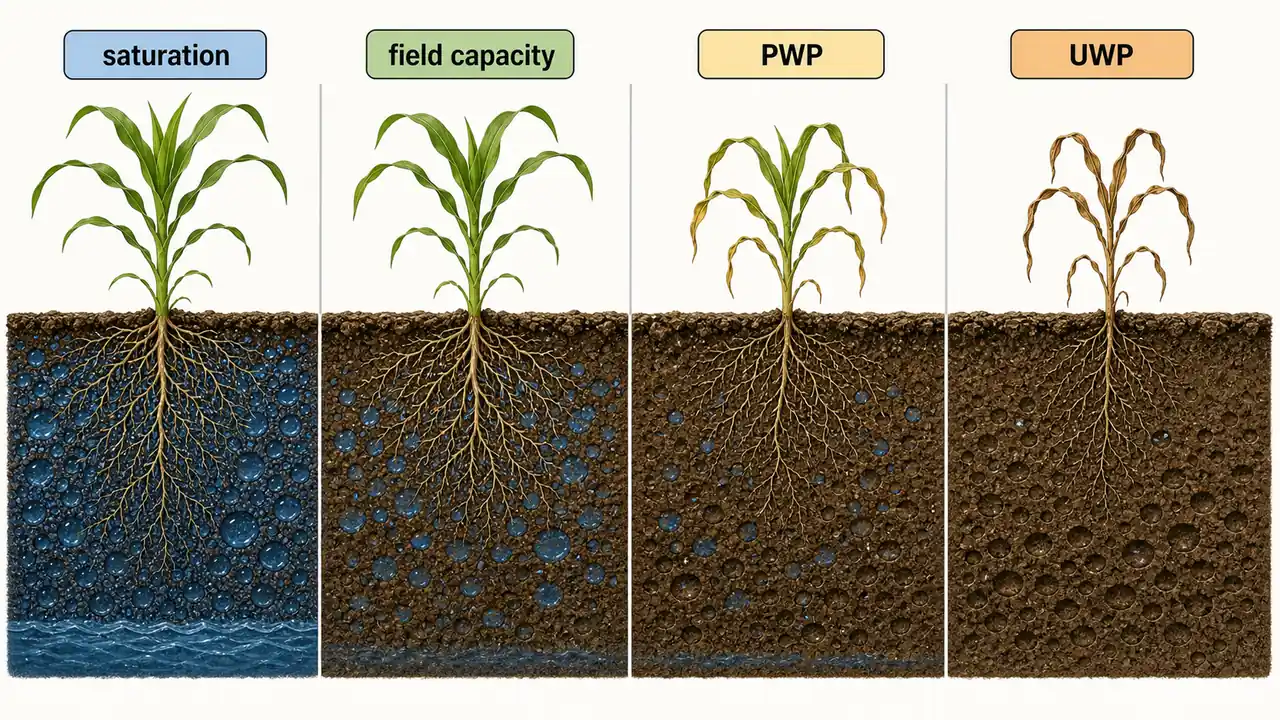
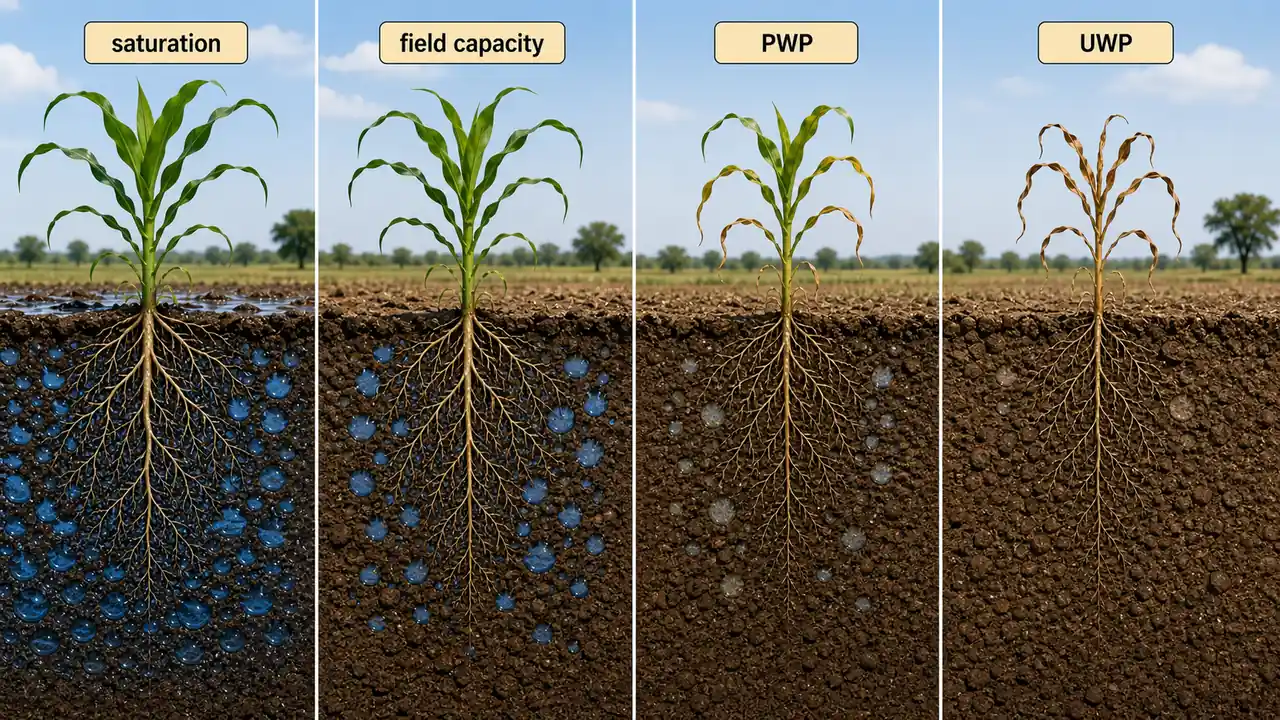
Understanding how soil holds and releases water is critical for deciding when and how much to irrigate. The following concepts describe a continuum -- from soil completely full of water (saturation) to soil so dry that plants die (ultimate wilting point).
Saturation Capacity
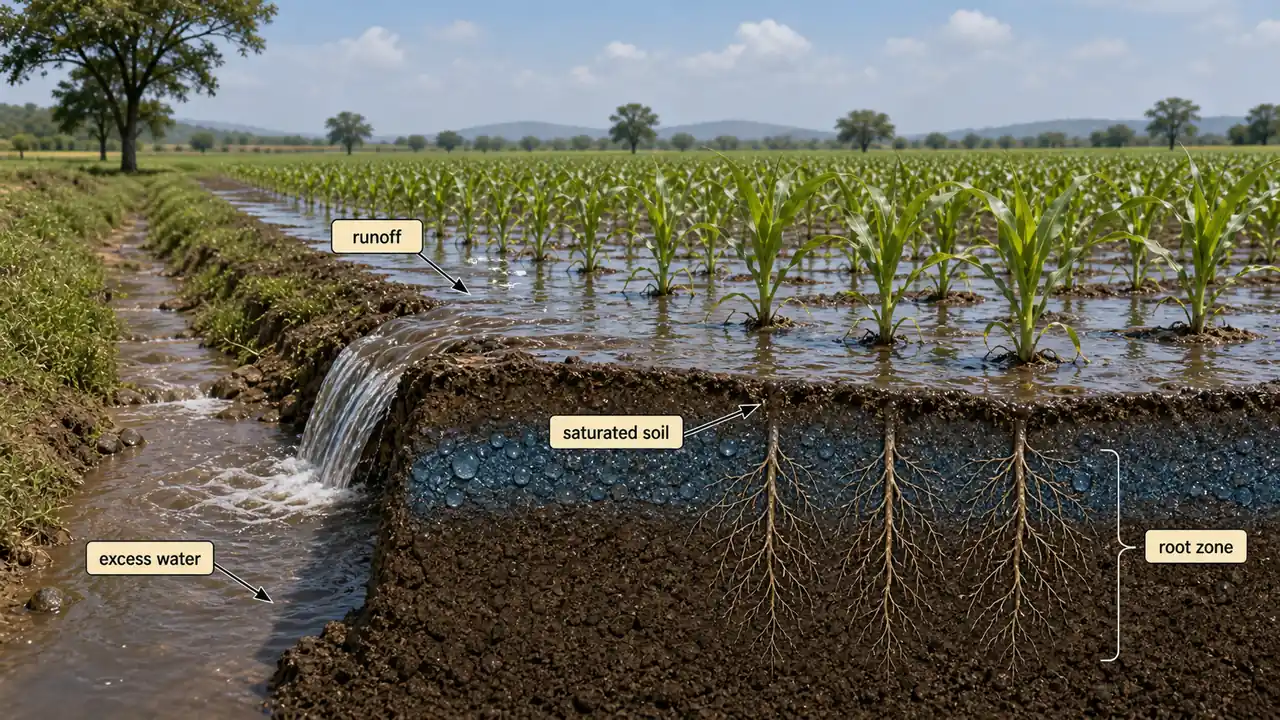
The maximum water holding capacity of soil where all pores (macropores and micropores) are completely filled with water. No more water can be absorbed; additional water ponds on surface or runs off.
Agricultural example: Immediately after heavy monsoon rain, paddy fields reach saturation -- ideal for rice (which tolerates standing water) but harmful for wheat (whose roots suffocate without air in the pore spaces).
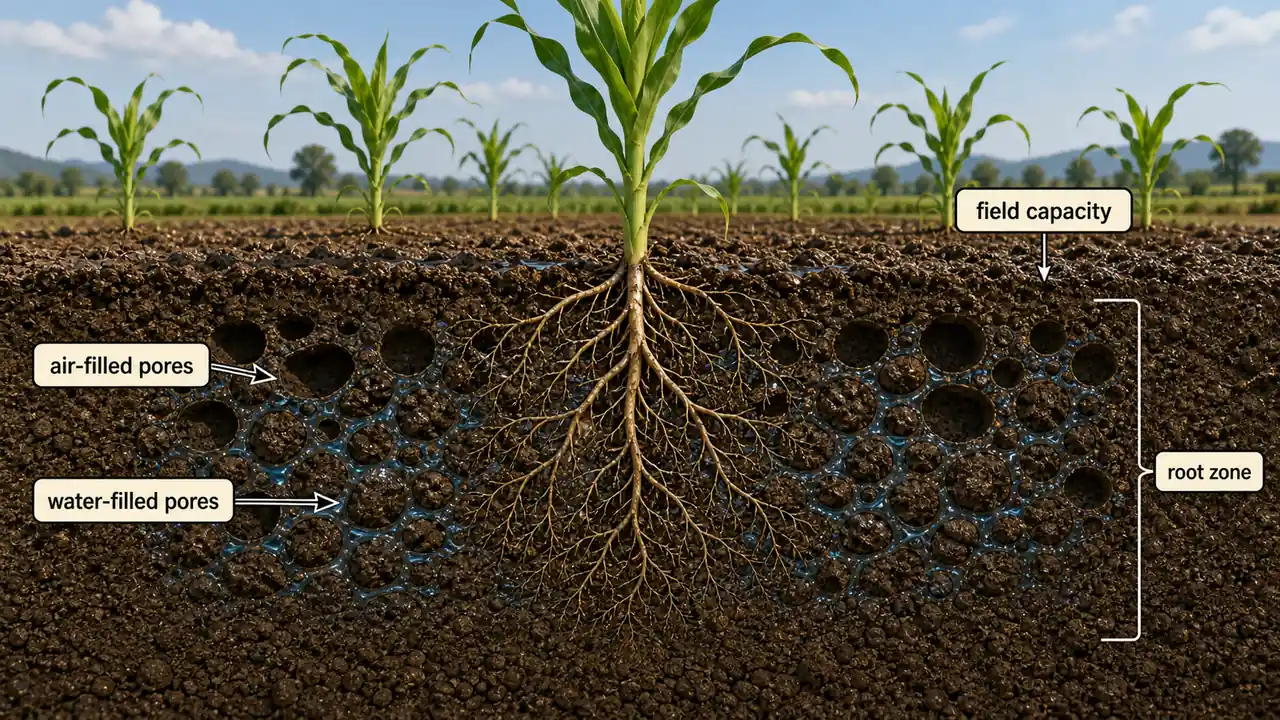
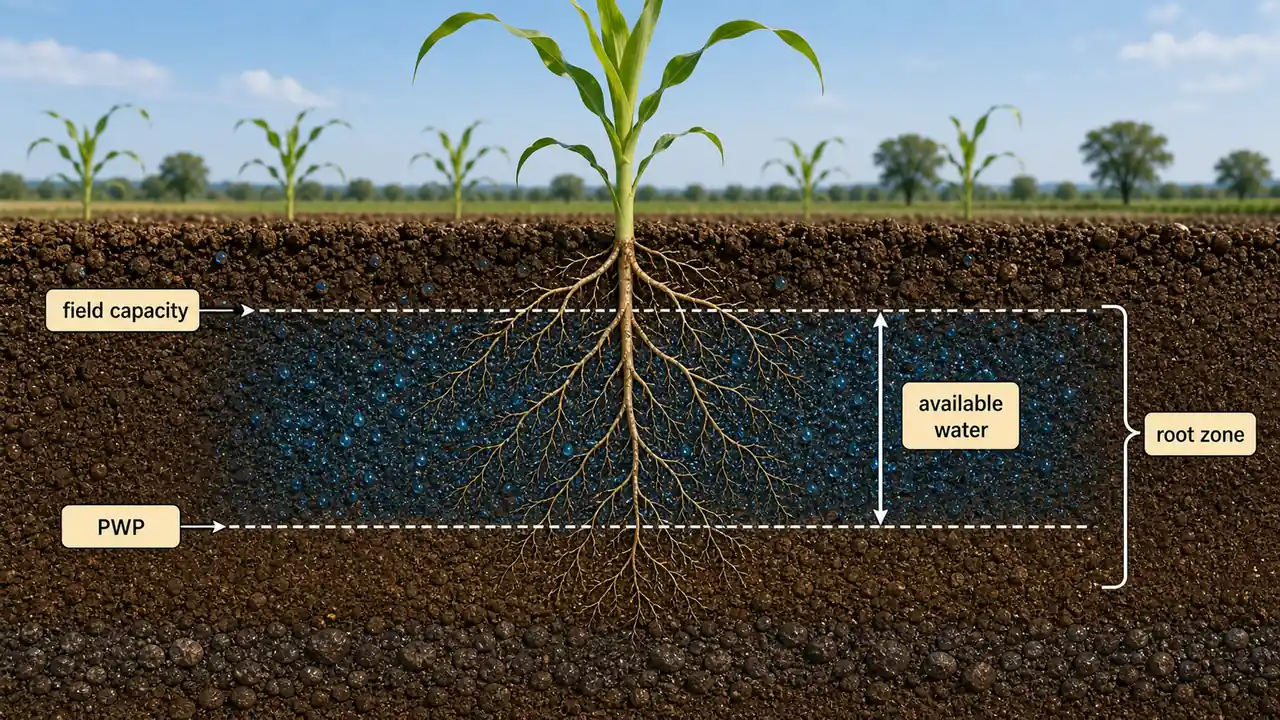
Field Capacity (FC)
- Soil moisture content 2--3 days after irrigation, after gravitational water has drained and moisture is relatively stable.
- Large pores filled with air; micropores filled with water.
- The upper limit of water availability to plants.
Agricultural example: When a well-drained loamy soil in a mango orchard reaches field capacity, both water and air are available in the root zone -- ideal conditions for root growth and nutrient uptake.
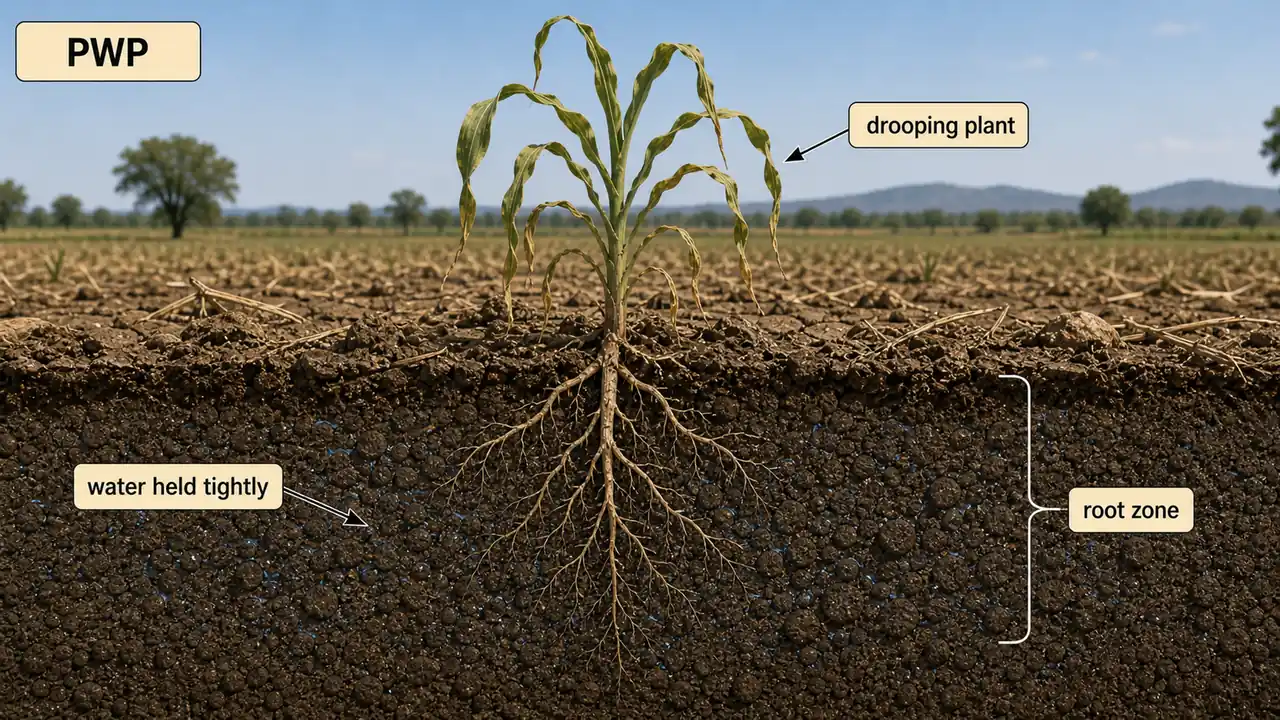
Permanent Wilting Point (PWP)
- Concept proposed by Briggs and Shantz in 1912 using dwarf sunflower as indicator plant.
- Soil moisture at which plants can no longer obtain enough water and remain permanently wilted unless water is added.
- The lower limit of available water to plants.
- Plants are not dead but are in a permanently wilted condition.
Agricultural example: A cotton crop in Vidarbha reaching PWP shows drooping leaves that do not recover even in the evening. If irrigation is provided within 1--2 days, the crop can still recover.
Available Water
- Concept given by Veihmayer and Hendrickson (1981).
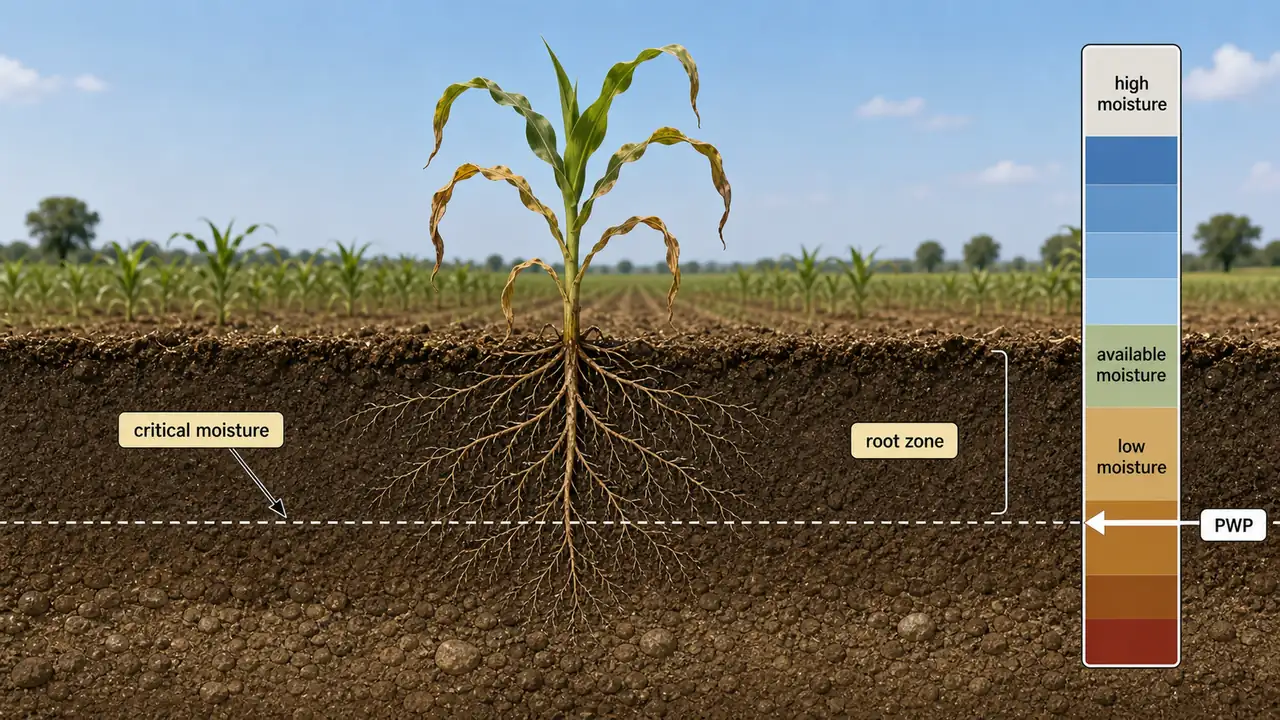
- Available Water = Field Capacity - Permanent Wilting Point
- This is the range of soil moisture actually useful for crop growth.
TIP
Exam shortcut: Available Water = FC - PWP. This is the "usable reservoir" of soil water. The goal of irrigation is to refill this reservoir before it empties completely.
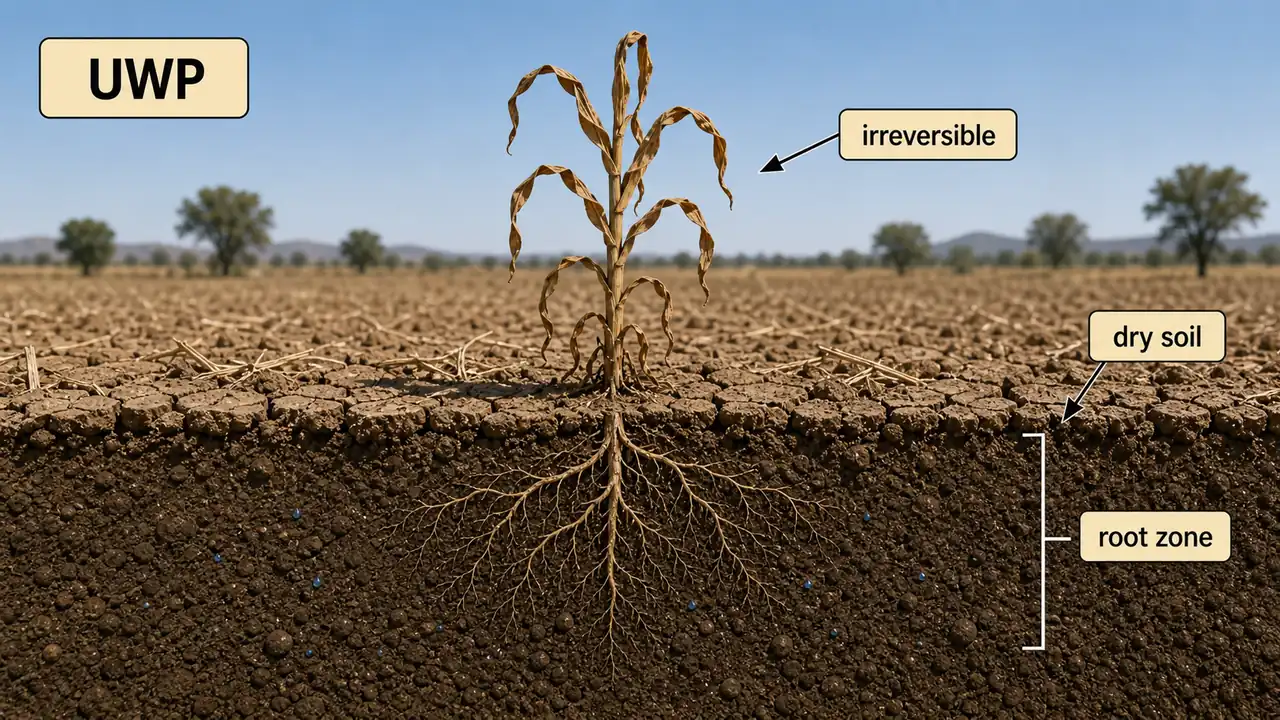
Ultimate Wilting Point (UWP)
- Moisture content at which wilting is complete and plants die (irreversible).
- Soil moisture tension reaches -60 bars.
Wilting Coefficient
The percentage of moisture in the root zone at permanent wilting -- numerically equivalent to PWP expressed as a percentage. Also called critical moisture point.
Comparison of Soil Moisture Constants
| Constant | Definition | Plant Status | Soil Pore Status |
|---|---|---|---|
| Saturation | All pores filled with water | Roots may suffocate | All pores full |
| Field Capacity | After gravitational drainage (2-3 days) | Ideal for most crops | Macropores: air, Micropores: water |
| PWP | Plants permanently wilt | Stressed, recoverable if watered | Water held too tightly |
| UWP | Plants die (-60 bars) | Dead, irreversible | Almost no extractable water |
TIP
Exam mnemonic -- "SF-PU": The soil moisture constants in order from wettest to driest: Saturation, Field capacity, PWP, UWP. Water available to crops lies between F and P.
How Water Enters and Moves Through Soil
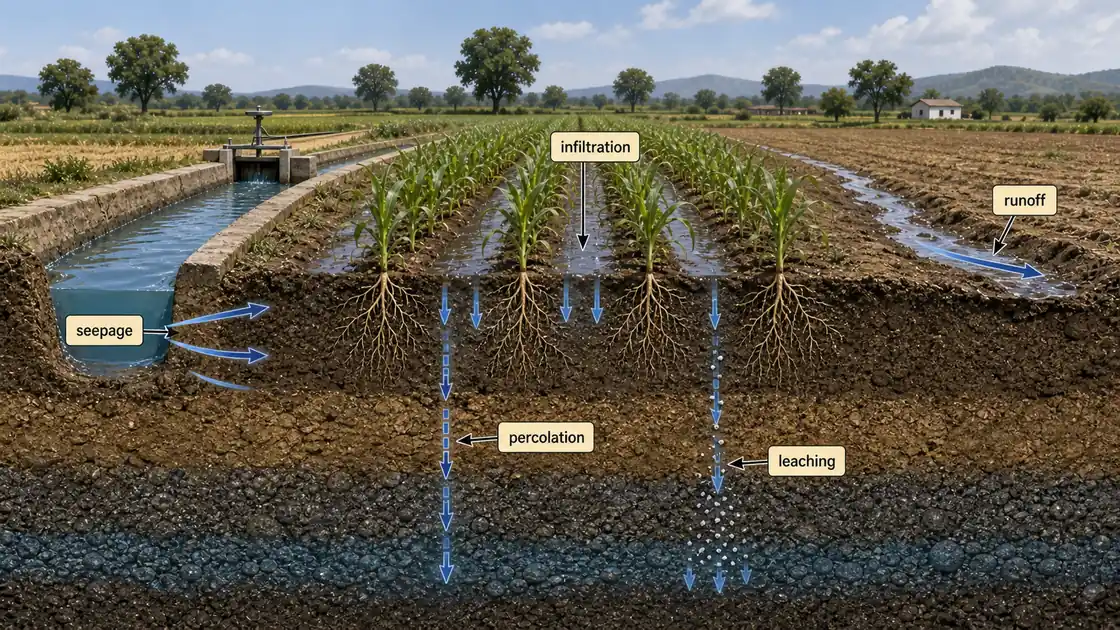
Water movement in soil follows a logical sequence: it first enters the surface (infiltration), then moves downward through the profile (percolation), may move sideways (seepage), carries substances out of the root zone (leaching), or flows off the surface entirely (runoff).
Infiltration
- Entry of water from the surface into the upper soil layers.
- Occurs in unsaturated soil.
- Infiltration rate is highest when soil is dry and shows exponential decay as soil wets.
- The nearly constant rate after prolonged irrigation is the basic infiltration rate.
- Infiltration rate = maximum rate water can enter soil; Infiltration velocity = actual rate at any time.
Key factors affecting infiltration:
| Factor | Effect on Infiltration Rate | Agricultural Example |
|---|---|---|
| Sandy soil (light texture) | Higher | Sandy soils in Rajasthan need frequent, light irrigation |
| Clay soil (heavy texture) | Lower | Black cotton soils in Maharashtra are prone to surface ponding |
| Grassland cover | Higher than bare land | Grass strips between orchards improve water absorption |
| Cultivation | Increases (breaks surface seals) | Pre-sowing tillage improves infiltration for kharif crops |
| Organic matter addition | Increases substantially | FYM application in vegetable beds |
| Warm water (tropics) | Higher (low viscosity) | Tropical regions naturally have better infiltration |
Agricultural example: A farmer adding farmyard manure to clay soil before sowing groundnut improves infiltration, reducing waterlogging risk during monsoon showers.
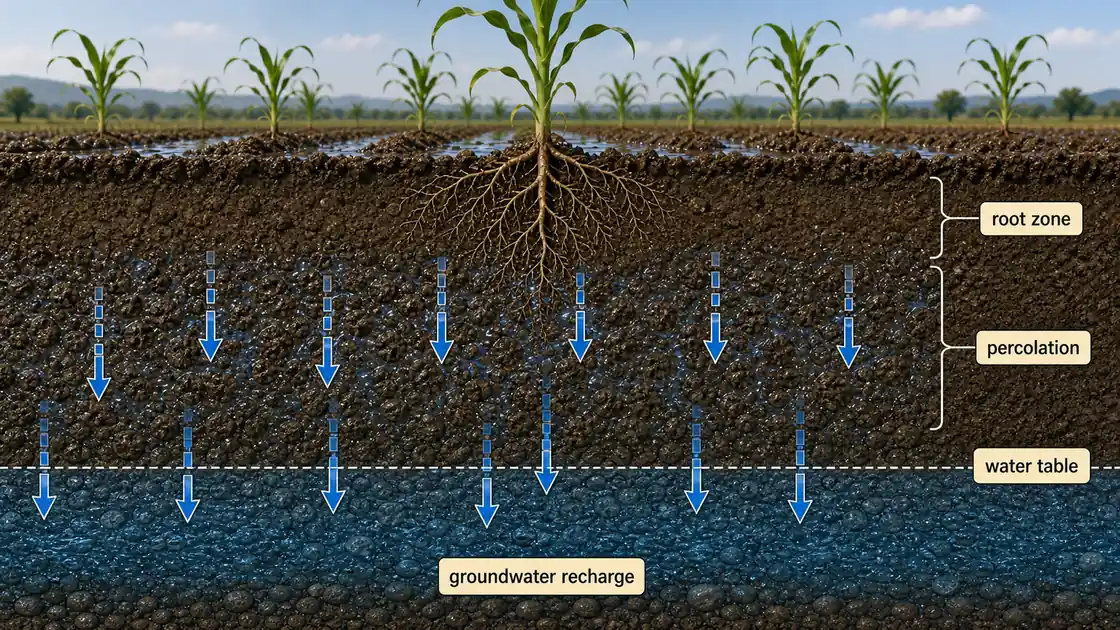
Percolation
- Downward movement of water through saturated or nearly saturated soil due to gravity. Exams
- Water moves from the unsaturated zone to the saturated zone, eventually reaching the water table and replenishing groundwater.
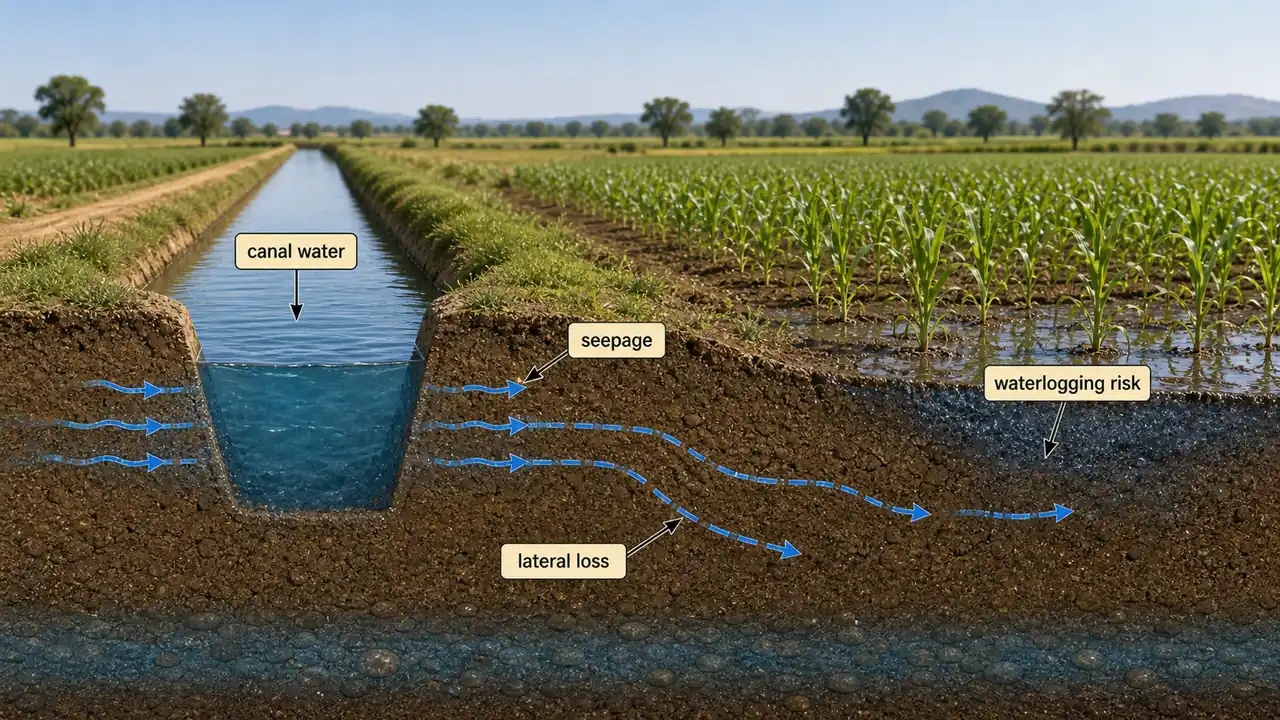
Infiltration vs Percolation
| Feature | Infiltration | Percolation |
|---|---|---|
| Location | Near soil surface | Deeper in soil profile |
| Function | Delivers water to plant rooting zone | Replenishes groundwater |
| Soil condition | Unsaturated | Saturated or nearly saturated |
| Farmer's concern | How fast can soil absorb irrigation water? | How much water is lost below the root zone? |
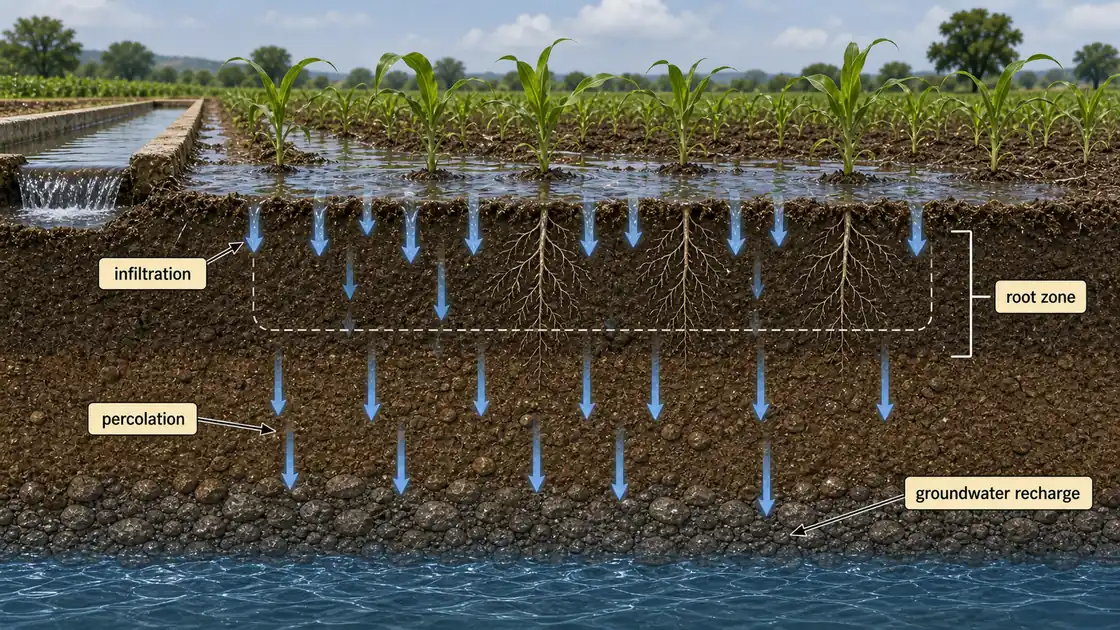
Seepage
- Horizontal flow of water from irrigation channels or canals.
- Main cause of water loss from irrigation conveyance systems.
- Affected by: soil texture, water temperature, siltation, bank storage, water velocity, and water table fluctuations.
- Can cause waterlogging and salinization of adjacent land.
- Solution: Lining canals with concrete or impervious materials.
Agricultural example: In the Indira Gandhi Nahar Project (Rajasthan), unlined canal sections lose up to 40% of water through seepage, causing waterlogging in nearby fields. Lined sections reduce losses to under 10%.
Leaching
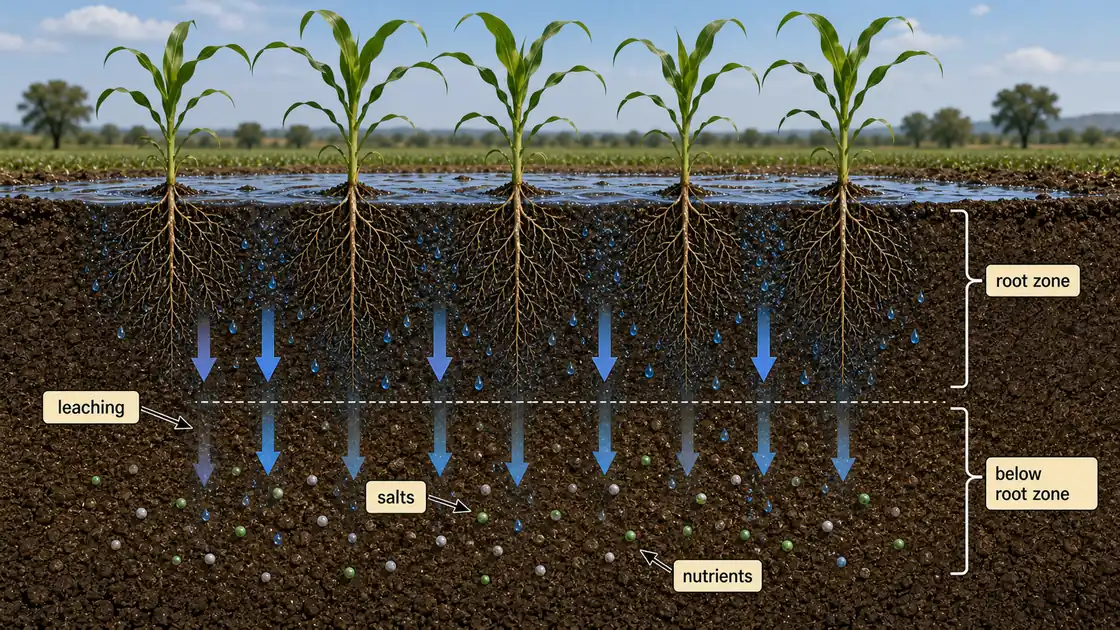
Downward movement of nutrients and salts from the root zone with water. While it causes loss of valuable nutrients (especially nitrogen), it is also used intentionally in reclamation leaching to remove excess salts from saline soils.
Runoff
Flow of excess water from the field after soil saturation. Represents water not utilized by crops -- minimizing runoff improves water use efficiency.
Water Movement Summary
| Process | Direction | What It Does | Agricultural Impact |
|---|---|---|---|
| Infiltration | Downward (surface to root zone) | Delivers water to crops | Essential for irrigation success |
| Percolation | Downward (root zone to water table) | Recharges groundwater | Water lost from crop use |
| Seepage | Horizontal (from canals) | Causes canal water loss | Wastes irrigation water |
| Leaching | Downward (with dissolved salts) | Removes salts and nutrients | Good for reclamation, bad for nutrient loss |
| Runoff | Lateral (across surface) | Removes excess water | Causes erosion and water loss |
Soil Water Energy Concepts
Water in soil is not only held in different amounts but also with different amounts of energy. Understanding these energy concepts explains why water moves from one place to another in the soil.
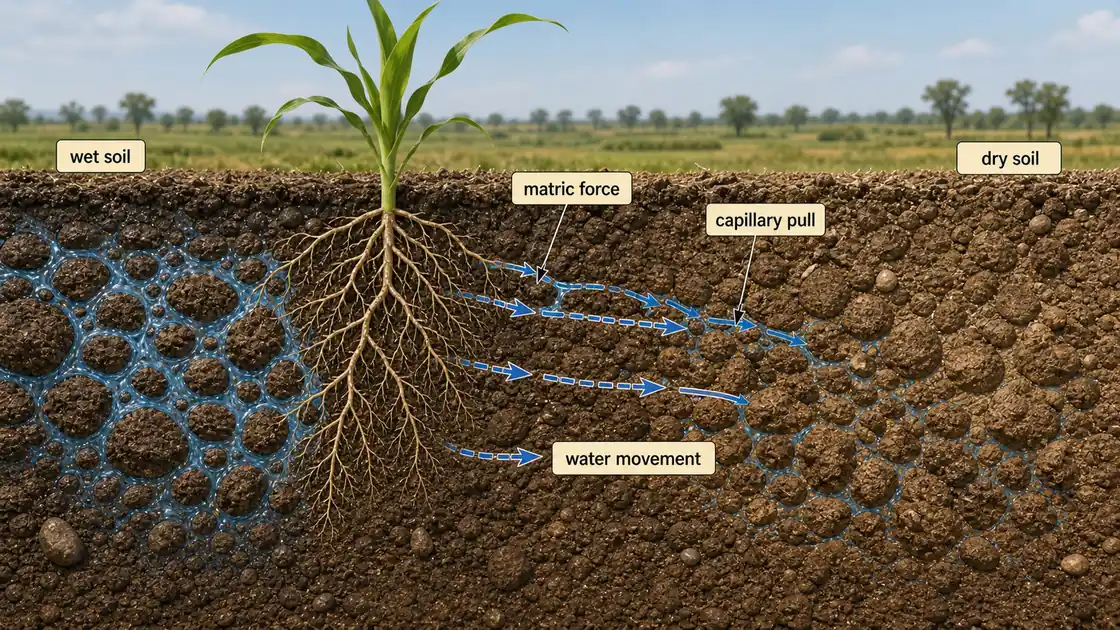
Matric Potential
The water potential attributed to the solid colloidal matrix of the soil system -- measures how tightly water is held by adsorption and capillarity. The drier the soil, the more negative the matric potential.
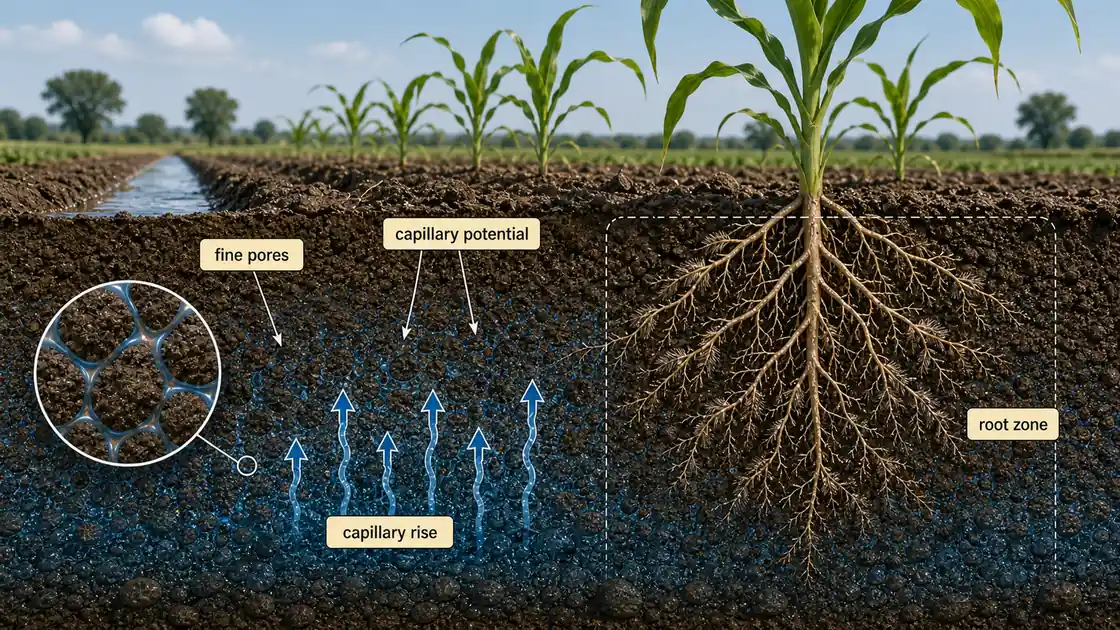
Capillary Potential
The energy with which water is held by soil through surface tension in tiny pore spaces. Capillary forces pull and hold water against gravity.
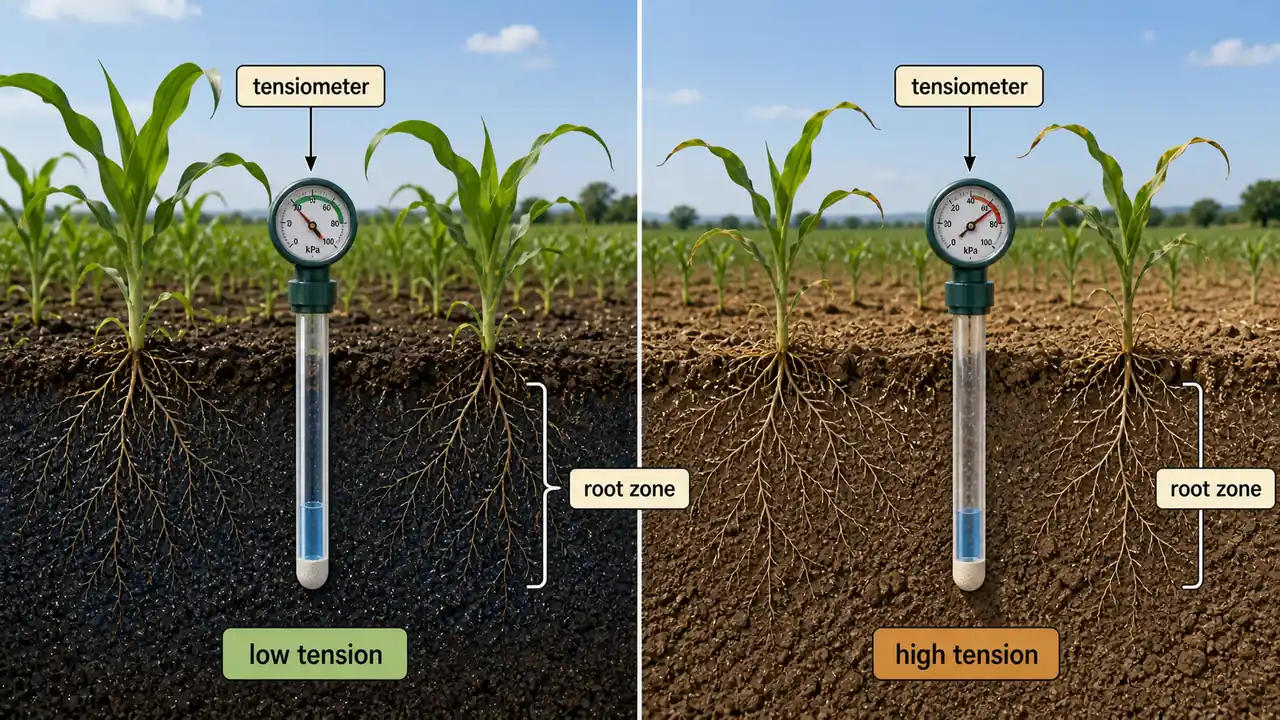
Soil Moisture Tension
A measure of how tenaciously water is retained in soil -- the force per unit area needed to remove water. Higher tension = drier soil = harder for plants to absorb water. Critical parameter for irrigation scheduling.
Agricultural example: Tensiometers installed in a drip-irrigated tomato field measure soil moisture tension. When tension exceeds 30 centibars, the farmer knows it is time to irrigate -- this prevents both under- and over-watering.
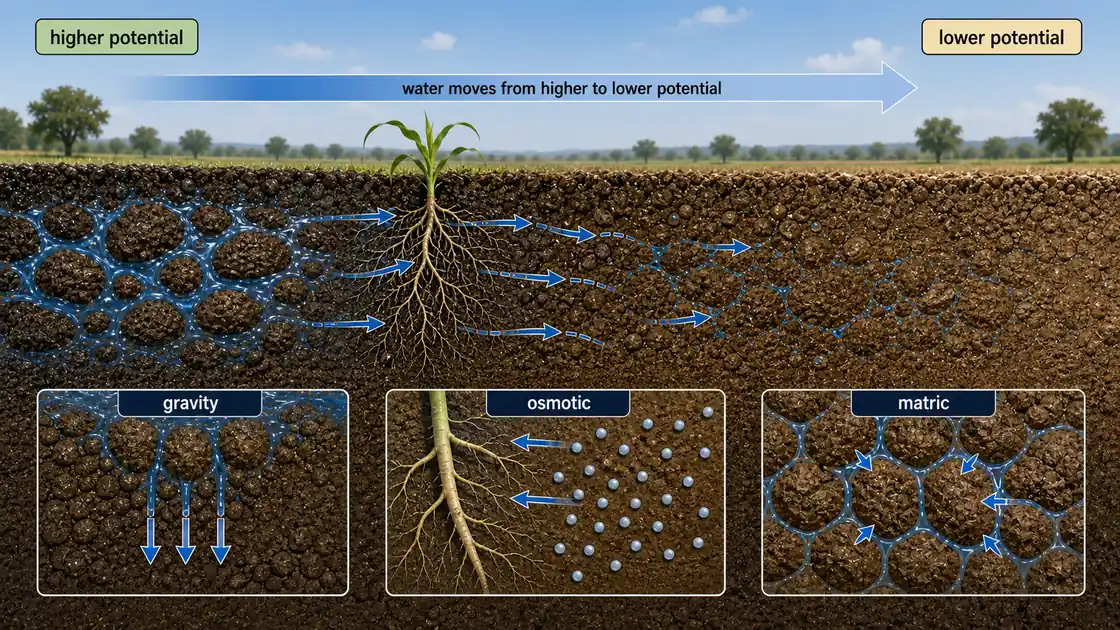
Soil Water Potential (Psi)
- Water in soil does not move rapidly, so kinetic energy is negligible.
- Water moves from higher potential to lower potential (wet to dry soil).
- Soil Water Potential (Psi) = work water can do moving from its present state to a reference state (pool of pure water at zero elevation).
- At saturation, Psi = 0 (zero).
- As soil dries, Psi becomes more negative.
- When Psi is high (close to 0), water is held loosely, highly available, and ready to move.
Three Components of Total Soil Water Potential
| Component | Symbol | Due To | Sign |
|---|---|---|---|
| Gravitational | Psi-g | Force of gravity on water | Always positive |
| Osmotic | Psi-o | Dissolved salts and solutes | Negative |
| Matric | Psi-m | Attraction between water and soil particles | Negative |
Total Soil Water Potential: Psi-t = Psi-g + Psi-o + Psi-m
NOTE
Matric and Osmotic potentials are negative (reduce free energy; called suction or tension). Gravity is always positive.
- Gravitational potential causes downward flow after heavy rain or irrigation.
- Osmotic potential -- high soluble salts reduce water availability, causing physiological drought (plants wilt in saline soils even when water is present).
- Matric potential -- in saturated soil, Psi-m = 0 (not a factor); in dry soil, matric forces dominate.
TIP
Exam tip: Remember "GOM" for the three potentials: Gravitational (positive), Osmotic (negative), Matric (negative). Only gravity adds energy; osmotic and matric take it away.
Methods of Expressing Suctions
Atmospheric Pressure or Bars
- Common unit for expressing suction.
- Wet soil at maximum water content: suction ~ 0.01 atmospheres or 1 pF (10 cm water column).
pF Scale
- Introduced by Schofield.
- pF = logarithm of the height of water column (cm) needed to produce the necessary suction.
- The log scale conveniently expresses the wide range of soil moisture tensions.

Key pF values: wet soil at maximum water content has suction of about 0.01 atmospheres or 1 pF (10 cm water column). At field capacity, pF is approximately 2.5 (about 1/3 atmosphere). At permanent wilting point, pF reaches 4.2 (about 15 atmospheres). At the ultimate wilting point, pF is approximately 4.8 (-60 bars).
Other Important Concepts
| Term | Definition | Agricultural Relevance |
|---|---|---|
| Moisture Regime (MR) | % moisture in soil at atmospheric pressure | Snapshot of current soil moisture status |
| Moisture Equivalent (ME) | Water retained after centrifugal force of 1000x gravity for 30 minutes | Approximate measure of field capacity |
| Puddling | Pre-sowing irrigation to reduce percolation | Essential in rice to create impermeable layer |
| Base Period | Duration (days) from first to last irrigation | Used for canal water allocation planning |
| Delta | Total depth of water (cm) required by crop during its field duration | Varies by crop and climate |
| Duty of Water | Volume of water to bring a crop to maturity | Relates water volume to irrigable area |
| Gross Duty | Area commanded at source (includes conveyance wastage) | Total water needed including losses |
| Net Duty | Area commanded at field (includes field losses) | Gross - Net = conveyance efficiency |
| Palco | First irrigation before sowing for germination | Ensures adequate moisture for seed germination |
| Kor Watering | First watering during crop growth | Most critical irrigation for establishment |
| Rostering | Scheduled distribution/rotation of irrigation water | Ensures equitable distribution among users |
| Water Stress | Both shortage and excess (waterlogging) | Both extremes damage crops |

TIP
Exam tip: Palco = pre-sowing irrigation (before the crop). Kor = first irrigation during crop growth (after germination). Exams often test the difference between these two.
Classification of Irrigation Projects

Irrigation projects in India are classified by the culturable command area (CCA) they serve: Major projects irrigate more than 10,000 hectares, medium projects irrigate 2,000--10,000 hectares, and minor projects irrigate less than 2,000 hectares. Minor irrigation includes individual wells, tube-wells, and small tanks -- covering the majority of India's irrigated area.
The Water Man of India

- Rajendra Singh is known as Water Man of India.
- Acclaimed water conservationist from Alwar, Rajasthan.
- Uses traditional johads (earthen dams) to restore groundwater and revive rivers.
- Rejuvenated five rivers: Arvari, Ruparel, Sarsa, Bhagani, and Jahajwali.
- Awards: Ramon Magsaysay Award (2001) and Stockholm Water Prize (2015).
- Emphasizes community involvement in sustainable water management.
TIP
Exam fact: Rajendra Singh -- Water Man of India -- Alwar, Rajasthan -- johads -- Magsaysay 2001 -- Stockholm Water Prize 2015. This is a frequently asked personality question.
Water Content in Different Plant Parts
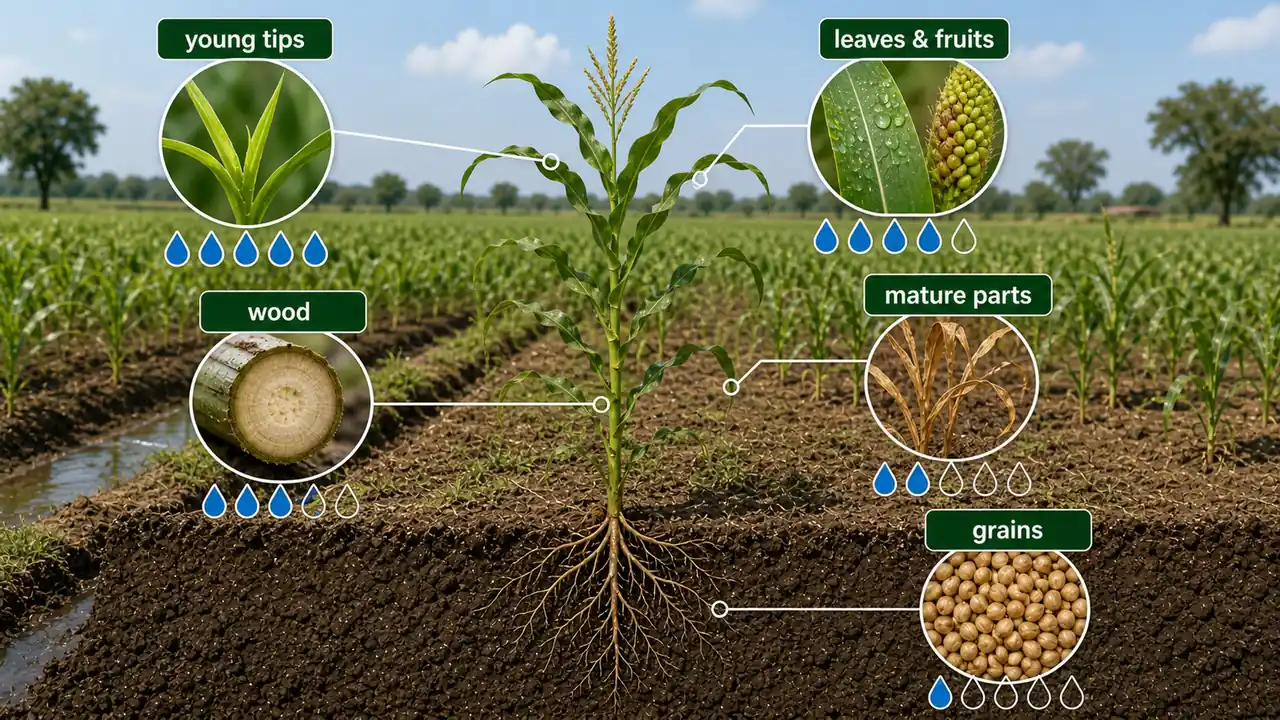
| Plant Part | Water Content (%) |
|---|---|
| Apical portion of root and shoot | > 90% |
| Stem, leaves and fruits | 70--90% |
| Woods | 50--60% |
| Matured parts | 15--20% |
| Freshly harvested grains | 15--20% |
TIP
Exam tip: Growing tips have the most water (>90%); grains have the least (15-20%). Water content decreases as plant parts mature and lignify. Remember: young = wet, old = dry.
Soil Moisture Constants by Soil Type
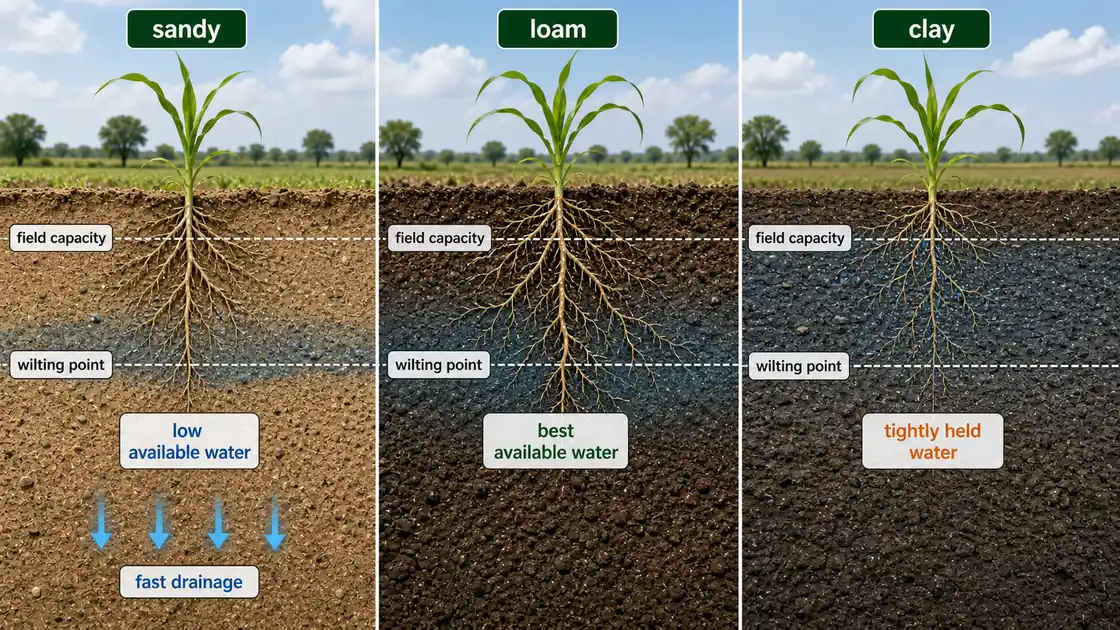
| Soil Type | Field Capacity (%) | PWP (%) | Available Water (cm/m depth) |
|---|---|---|---|
| Fine Sand | 3--5 | 1--3 | 2--4 |
| Sandy Loam | 5--15 | 3--8 | 4--11 |
| Silt Loam | 12--18 | 6--10 | 6--13 |
| Clay Loam | 15--30 | 7--16 | 10--18 |
| Clay | 25--40 | 12--20 | 16--30 |
NOTE
As soil texture becomes finer (sand to clay), both FC and PWP increase. Clay holds the most water but also retains more at wilting point. Available water (FC - PWP) is generally highest in loam soils -- which is why loamy soils are considered ideal for most crops.
Agricultural example: A groundnut farmer on sandy loam soil in Gujarat needs to irrigate every 7--10 days because the soil holds only 4--11 cm of available water per metre. A wheat farmer on clay loam in Punjab can wait 15--20 days between irrigations because the soil holds 10--18 cm.
Reference Evapotranspiration (ET0) by Climatic Zone
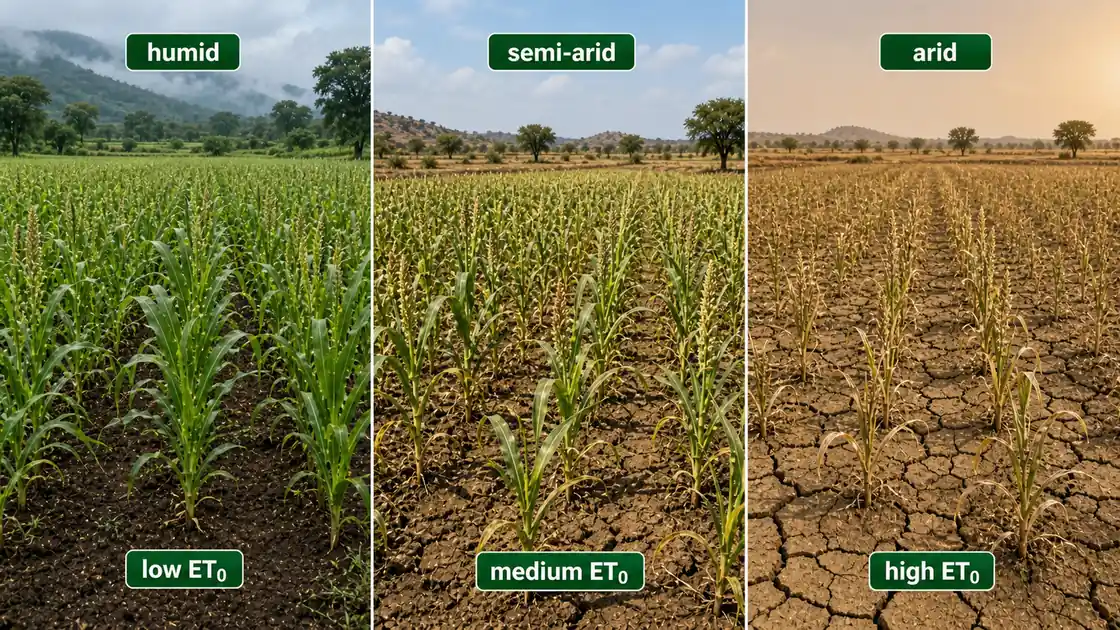
Reference ET (mm/day) varies with climate and temperature:
| Climatic Zone | Low Temp | Medium Temp | High Temp |
|---|---|---|---|
| Humid | 1--2 | 3--4 | 5--6 |
| Sub-humid | 3--4 | 5--6 | 7--8 |
| Semi-arid | 4--5 | 6--7 | 8--9 |
| Desert / Arid | 4--6 | 7--8 | 9--10 |
ET0 classification: 4--5 mm/day = Low, 6--7 mm/day = Medium, 8--9 mm/day = High.
Agricultural example: In desert regions of Rajasthan (ET0 = 9--10 mm/day during summer), crops lose water very rapidly. Drip irrigation with mulching is essential to keep up with this high evaporative demand.
Water Sensitivity of Crops
Crops grown for fresh leaves or fruits are more sensitive to water shortage than those grown for dry seeds or fruits.
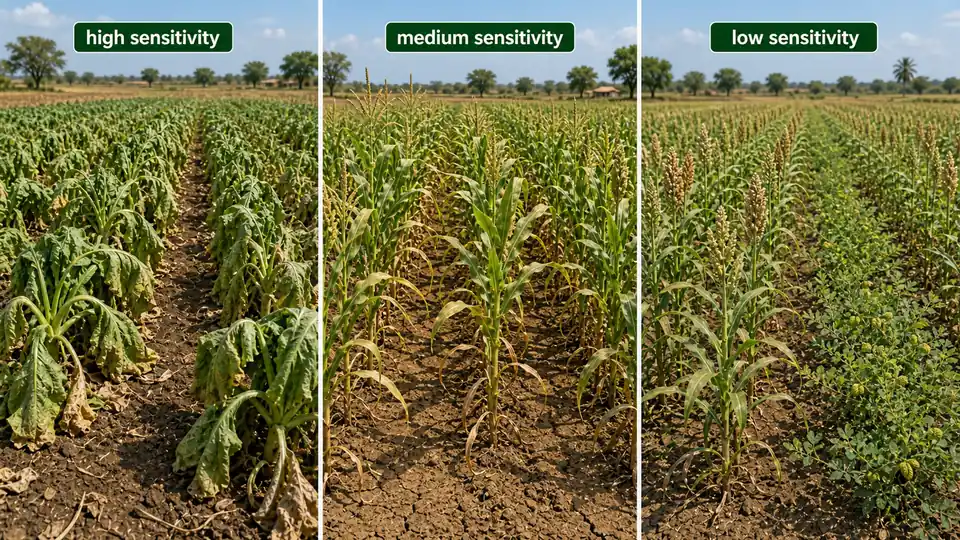
| Sensitivity | Crops |
|---|---|
| Low | Cassava, Millets, Redgram |
| Low to Medium | Alfalfa, Cotton, Maize, Groundnut |
| Medium to High | Beans, Citrus, Soybean, Wheat |
| High | Banana, Cabbage, Fresh Green Vegetables, Rice, Sugarcane, Tomato |
TIP
Exam mnemonic -- "BCFRST": The highly water-sensitive crops start with B-C-F-R-S-T: Banana, Cabbage, Fresh veggies, Rice, Sugarcane, Tomato.
Net Irrigation Rooting Depth (mm)
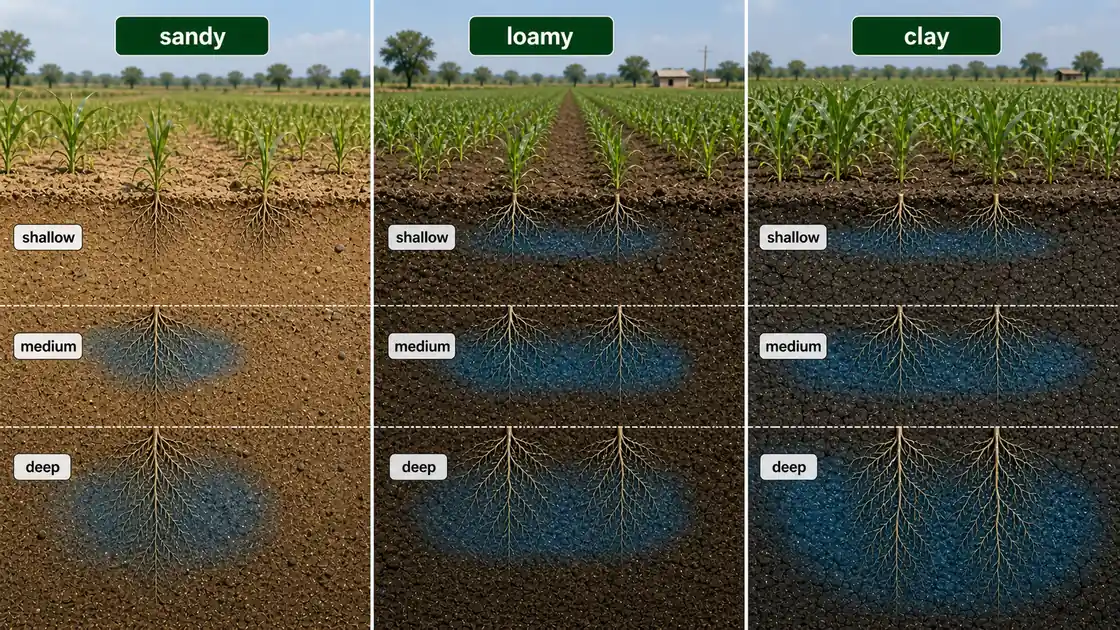
| Rooting Depth | Sandy | Loamy | Clay |
|---|---|---|---|
| Shallow | 15 | 20 | 30 |
| Medium | 30 | 40 | 50 |
| Deep | 40 | 60 | 70 |
TIP
Exam shortcut: Clay soil holds more water per unit depth than sandy soil. Deep-rooted crops in clay soil need the largest net irrigation depth (70 mm).
Root Depth Classification of Crops
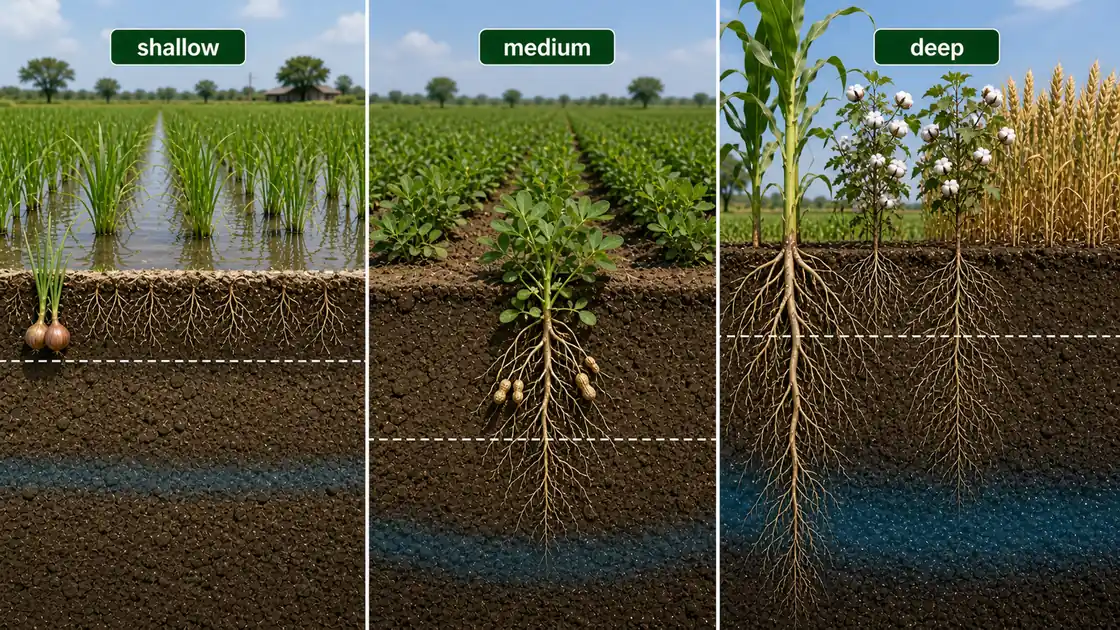
| Category | Depth | Crops |
|---|---|---|
| Shallow rooted | 30--60 cm | Rice, Onion, Potato, Pineapple, Cabbage |
| Medium rooted | 50--100 cm | Banana, Bean, Coconut, Groundnut, Peas, Soybean, Sunflower, Tobacco, Tomato, Pearl millet, Pulses |
| Deep rooted | 90--150 cm | Citrus, Grapes, Wheat, Cotton, Maize, Sorghum |
Agricultural example: Shallow-rooted rice (30--60 cm) needs frequent light irrigation because its roots cannot access deeper moisture. Deep-rooted cotton (90--150 cm) can survive longer between irrigations by drawing water from deeper soil layers.
Irrigation Efficiency by Method
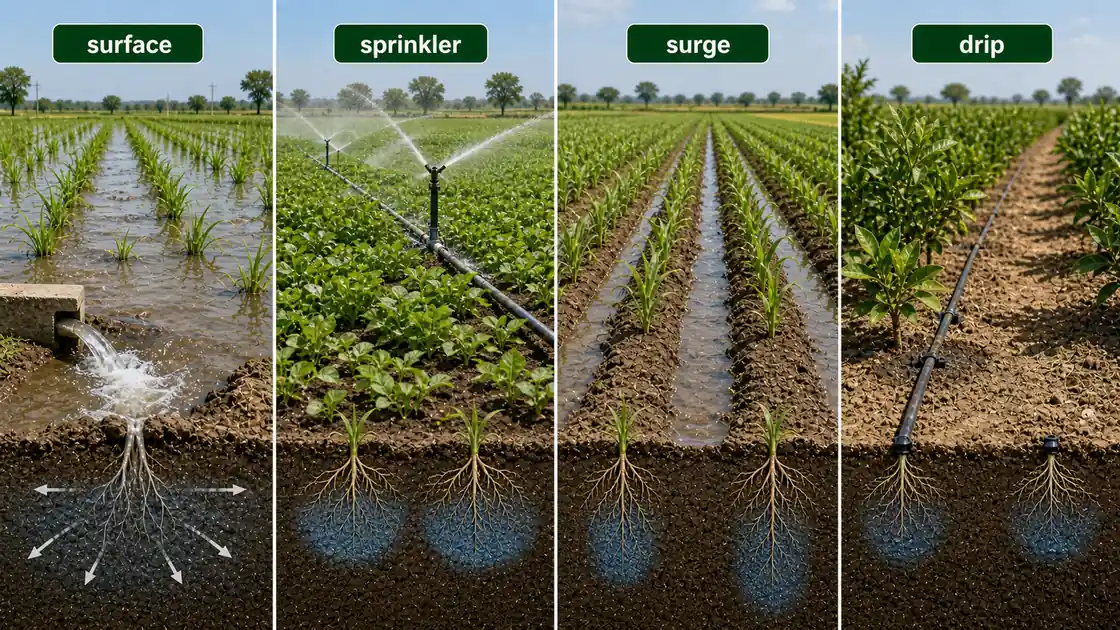
| Method | Efficiency | Best Suited For |
|---|---|---|
| Surface (flood/furrow) | ~60% | Rice, wheat (large fields, flat terrain) |
| Sprinkler | ~75% | Groundnut, pulses, vegetables (undulating land) |
| Surge | 85--90% | Row crops on sloping land |
| Drip | 90--95% | Sugarcane, banana, vegetables, orchards |
IMPORTANT
Most asked: Drip irrigation = highest efficiency (90-95%), introduced from Israel. Surface irrigation = oldest (4000 years) and least efficient (60%). Sprinkler saves 25-30% water over surface.
Effect of Waterlogging on Soil Elements
Waterlogging creates anaerobic (reduced) conditions:
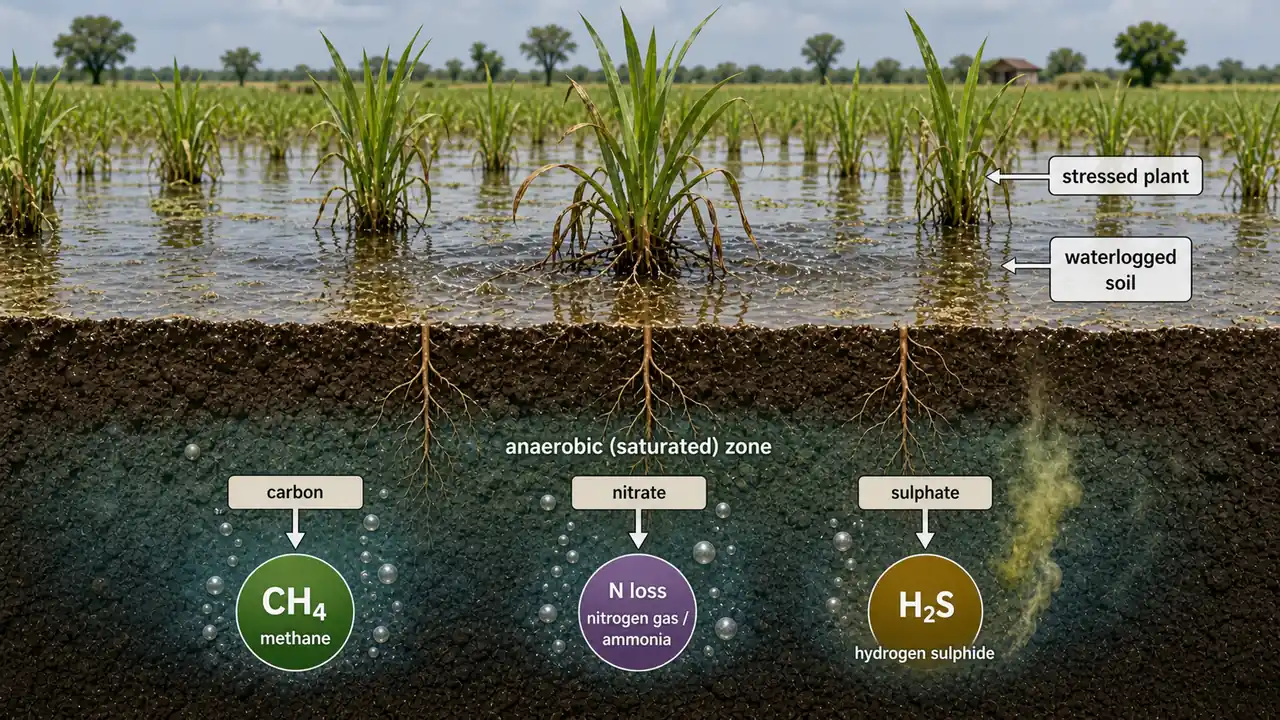
| Element | Normal (Aerobic) Form | Reduced (Waterlogged) Form |
|---|---|---|
| Carbon | CO2 (Carbon dioxide) | CH4 (Methane), Complex aldehydes |
| Nitrogen | NO3- (Nitrate) | N2 (Nitrogen gas), NH2 (Amides), NH3 (Ammonia) |
| Sulphur | SO4 2- (Sulphate) | H2S (Hydrogen sulphide) |
- Waterlogging reduces availability of N, Mn, Fe, Cu, Zn.
- Surface drainage is suitable for land with < 1.5% slope.
Agricultural example: In waterlogged rice paddies, nitrogen applied as urea is rapidly lost through denitrification (NO3 to N2 gas). This is why neem-coated urea and deep placement of urea super granules (USG) are recommended for rice -- they slow down nitrification and reduce losses.
Plastic Mulching -- Selection Guide
Mulching covers the soil surface to conserve moisture, regulate temperature, and suppress weeds. Most plastic mulch is based on LLDPE (Linear Low Density Polyethylene).
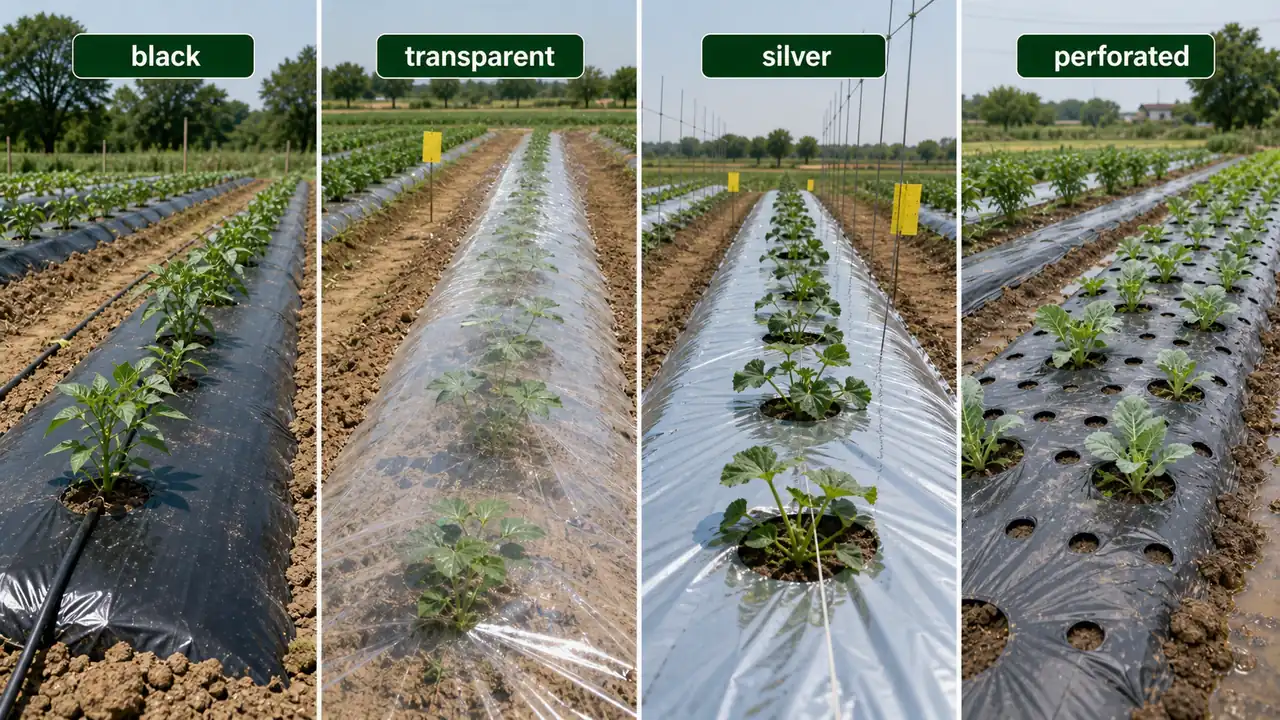
| S.No. | Purpose | Mulch Type |
|---|---|---|
| 1 | Rainy season | Perforated mulch |
| 2 | Orchard and plantation | Thicker mulch |
| 3 | Soil solarisation | Thin transparent film |
| 4 | Weed control through solarisation | Transparent film |
| 5 | Weed control in cropped land | Black film |
| 6 | Sandy soil | Black film |
| 7 | Saline water use | Black film |
| 8 | Summer cropped land | White film |
| 9 | Insect repellent | Silver colour film |
| 10 | Early germination | Thinner film |
TIP
Exam tip: Black film = most versatile (weeds, sandy soil, saline water). Silver film = insects. Transparent film = solarisation. Perforated = rainy season. Remember: "BST-P" -- Black (weeds), Silver (insects), Transparent (solarisation), Perforated (rain).
Soil Moisture Characteristic Curve
Shows the relationship between soil water tension and moisture content:
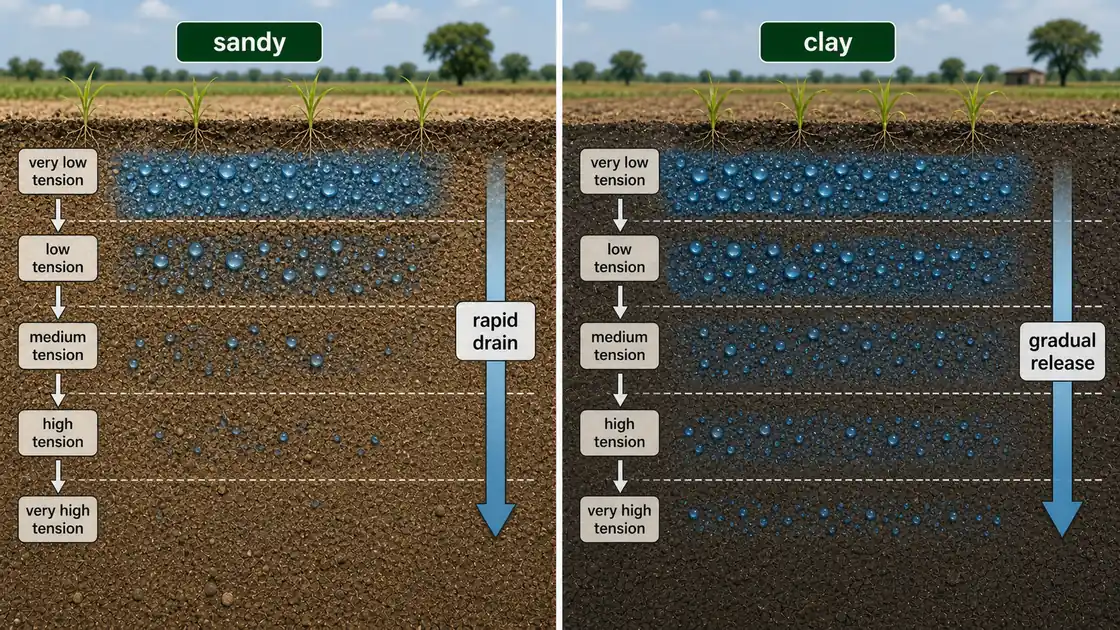
| Soil Type | Curve Shape | Explanation |
|---|---|---|
| Sandy soils | L-shaped | Water drains rapidly at low tension, then levels off |
| Clay soils | I-shaped | Water released gradually over wide tension range |
Agricultural relevance: Sandy soil loses most of its water at low tension (drains fast), so irrigation must be frequent and in small amounts. Clay soil releases water slowly across a wide range, allowing longer intervals between irrigations.
Summary Table
| Topic | Key Point |
|---|---|
| Irrigation | Artificial water application to supplement rainfall for crop production |
| India's irrigation | 49% area irrigated; tube-wells are main source (46%); India ranks 1st globally |
| Most irrigated state (%) | Punjab; Largest total area: Uttar Pradesh |
| Field Capacity | Upper limit of plant-available water; macropores have air, micropores have water |
| PWP | Lower limit; proposed by Briggs & Shantz (1912); dwarf sunflower indicator |
| Available Water | FC minus PWP; concept by Veihmayer & Hendrickson |
| Infiltration vs Percolation | Infiltration = surface entry; Percolation = downward to groundwater |
| Soil Water Potential | Psi-t = Psi-g + Psi-o + Psi-m; gravity positive, osmotic and matric negative |
| pF Scale | Introduced by Schofield; log of water column height (cm) |
| Moisture curve | Sandy = L-shaped; Clay = I-shaped |
| Mulching | LLDPE; black film most versatile; silver for insects |
| Waterlogging | Reduces N, Mn, Fe, Cu, Zn; creates anaerobic conditions |
| Drip irrigation | Highest efficiency (90-95%); from Israel; best for orchards/vegetables |
| Rajendra Singh | Water Man of India; Alwar, Rajasthan; johads; Magsaysay 2001 |
| Palco vs Kor | Palco = pre-sowing; Kor = first irrigation during growth |
Summary Cheat Sheet
| Concept / Topic | Key Details |
|---|---|
| Irrigation | Artificial water application to supplement rainfall |
| India's irrigated area | 49%; tube-wells main source (46%); India ranks 1st globally |
| Most irrigated state (%) | Punjab; Largest total area: Uttar Pradesh |
| Field Capacity | Upper limit of plant-available water |
| PWP | Lower limit; proposed by Briggs & Shantz (1912); sunflower indicator |
| Available Water | FC minus PWP; concept by Veihmayer & Hendrickson |
| Infiltration | Surface entry of water into soil |
| Percolation | Downward movement to groundwater |
| Soil Water Potential | Ψt = Ψg + Ψo + Ψm |
| pF Scale | Introduced by Schofield; log of water column height (cm) |
| Moisture curve | Sandy = L-shaped; Clay = I-shaped |
| Mulching | LLDPE; black film most versatile; silver for insects |
| Drip irrigation | Highest efficiency (90-95%); from Israel |
| Rajendra Singh | Water Man of India; Alwar, Rajasthan; johads; Magsaysay 2001 |
| Palco vs Kor | Palco = pre-sowing; Kor = first irrigation during growth |
| Waterlogging | Reduces N, Mn, Fe, Cu, Zn; creates anaerobic conditions |
TIP
Next: Lesson 03 covers Irrigation Scheduling -- the scientific methods (IW/CPE ratio, tensiometer, plant-based approaches) for deciding when and how much to irrigate.