🌵 Dryland Agriculture -- Farming Without Irrigation in India
Complete guide to dryland agriculture covering dry farming, dryland farming, and rainfed farming categories, CRIDA, ICRISAT, AICRPDA, contingency crop plans, drought types, anti-transpirants, NICRA, and dryland implements for competitive exams.
When the Sky is Your Only Source of Water
The previous chapter covered irrigated agriculture -- water distribution, irrigation principles, scheduling, methods, quality, measurement, and drainage. But more than half of India's farmland has no access to irrigation at all. This chapter shifts focus to the science of farming with rainfall alone.
A pearl millet farmer in Jodhpur, Rajasthan receives barely 350 mm of rainfall in a year -- less than what Mumbai gets in a single week. Yet he grows a successful crop every kharif by choosing short-duration varieties, practising in-situ moisture harvesting, and using a CRIDA seed-cum-fertilizer drill for precise placement. His entire farming system depends on capturing, conserving, and efficiently using every drop of rain. This is the essence of dryland agriculture -- the science of farming without irrigation, practised on over half of India's cultivated land.
What is Dryland Agriculture?
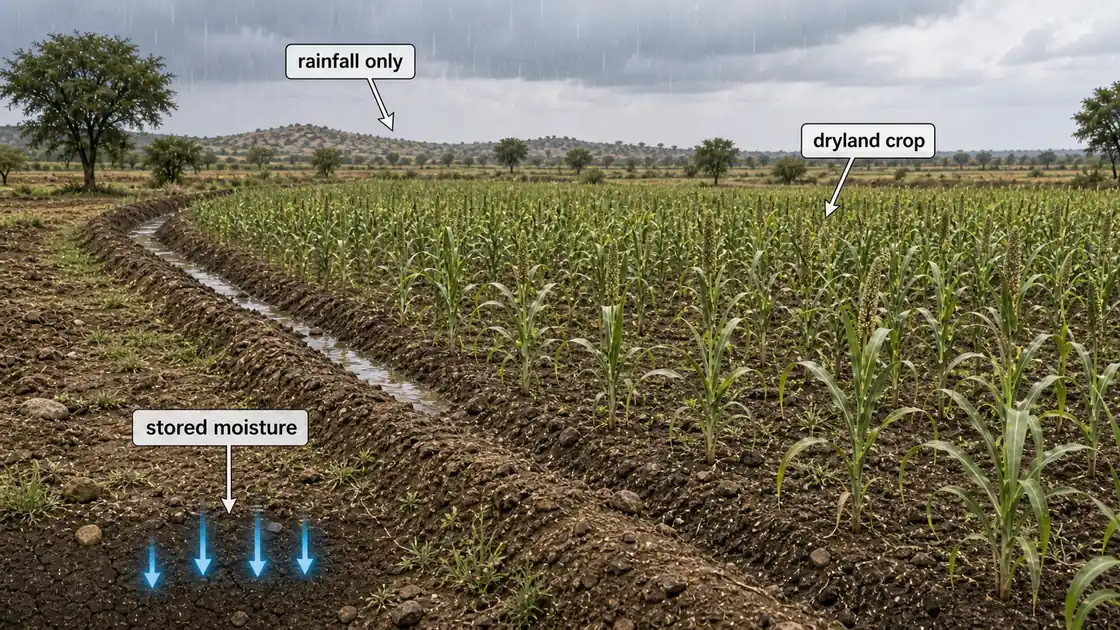
Dryland agriculture refers to growing crops entirely under rainfed conditions. Unlike irrigated agriculture where water supply can be controlled, dryland farmers are completely dependent on the timing, amount, and distribution of rainfall.
Pro Content Locked
Upgrade to Pro to access this lesson and all other premium content.
Charged once for one year · ₹1188 total
Save ₹100/month vs ₹2388/year launch price
- All Agriculture & Banking Courses
- AI Lesson Questions (100/day)
- AI Doubt Solver (50/day)
- Glows & Grows Feedback (30/day)
- AI Section Quiz (20/day)
- 22-Language Translation (100/day)
- Recall Questions (20/day)
- AI Quiz (15/day)
- AI Quiz Paper Analysis (100/day)
- AI Step-by-Step Explanations (100/day)
- Spaced Repetition Recall (FSRS)
- AI Tutor
- Immersive Text Questions
- Audio Lessons — Hindi & English
- Mock Tests & Previous Year Papers
- Summary & Mind Maps
- XP, Levels, Leaderboard & Badges
- Generate New Classrooms
- Voice AI Teacher (AgriDots Live)
- AI Revision Assistant
- Knowledge Gap Analysis
- Interactive Revision (LangGraph)
🔒 Secure one-time yearly payment via Razorpay · No hidden fees
When the Sky is Your Only Source of Water
The previous chapter covered irrigated agriculture -- water distribution, irrigation principles, scheduling, methods, quality, measurement, and drainage. But more than half of India's farmland has no access to irrigation at all. This chapter shifts focus to the science of farming with rainfall alone.
A pearl millet farmer in Jodhpur, Rajasthan receives barely 350 mm of rainfall in a year -- less than what Mumbai gets in a single week. Yet he grows a successful crop every kharif by choosing short-duration varieties, practising in-situ moisture harvesting, and using a CRIDA seed-cum-fertilizer drill for precise placement. His entire farming system depends on capturing, conserving, and efficiently using every drop of rain. This is the essence of dryland agriculture -- the science of farming without irrigation, practised on over half of India's cultivated land.
What is Dryland Agriculture?
Dryland agriculture refers to growing crops entirely under rainfed conditions. Unlike irrigated agriculture where water supply can be controlled, dryland farmers are completely dependent on the timing, amount, and distribution of rainfall.
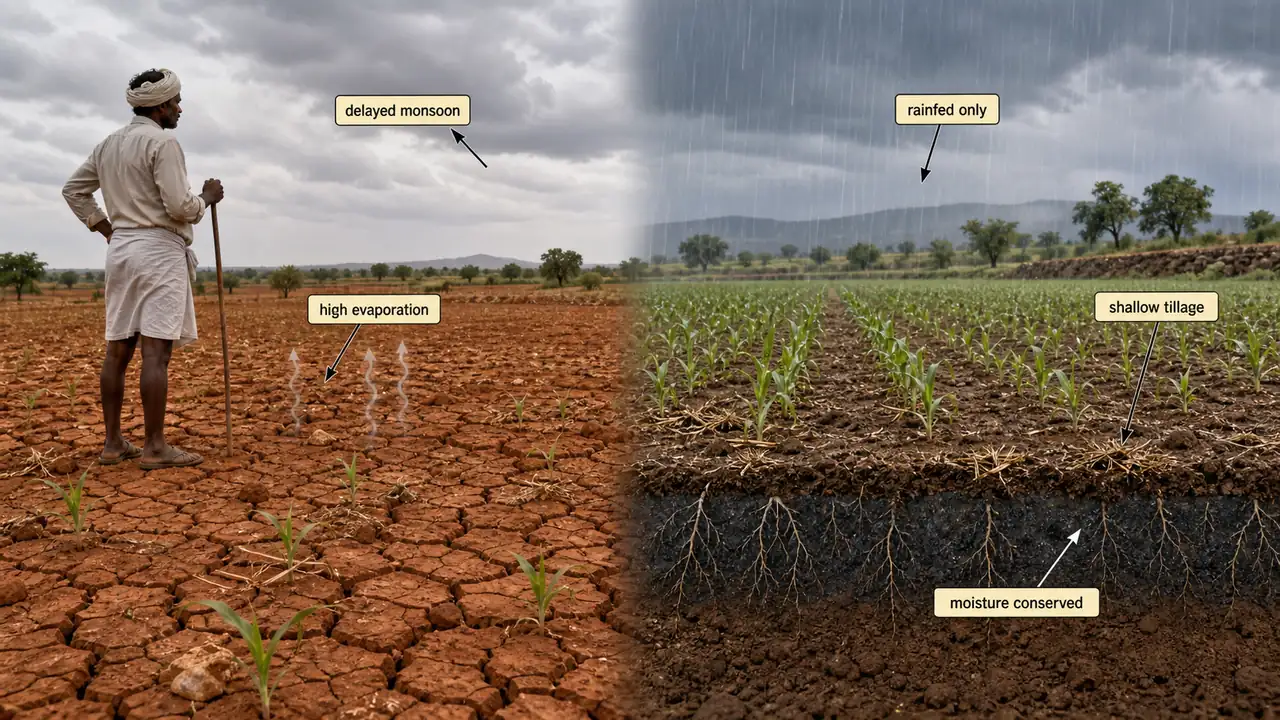
- Rainfall is the main factor deciding the time of sowing in dryland conditions
- Area under dryland agriculture in India: about 52 per cent of total cultivated area -- more than half of India has no access to irrigation
- About 75-90 per cent of water is lost through evaporation under dryland conditions -- this staggering loss underscores why moisture conservation is the central challenge
- Shallow tillage in red soils in drylands improves moisture conservation
Agricultural example: In the Deccan Plateau of Karnataka, sorghum (jowar) farmers depend entirely on the southwest monsoon. A 10-day delay in monsoon onset can force them to switch from sorghum to a shorter-duration crop like green gram -- a decision that dryland agriculture science helps them make systematically.
TIP
Exam tip: Remember "52-75-90" -- 52% of India's cultivated area is dryland, 75-90% water is lost to evaporation in drylands. These are frequently tested numbers.
Categories of Dryland Agriculture
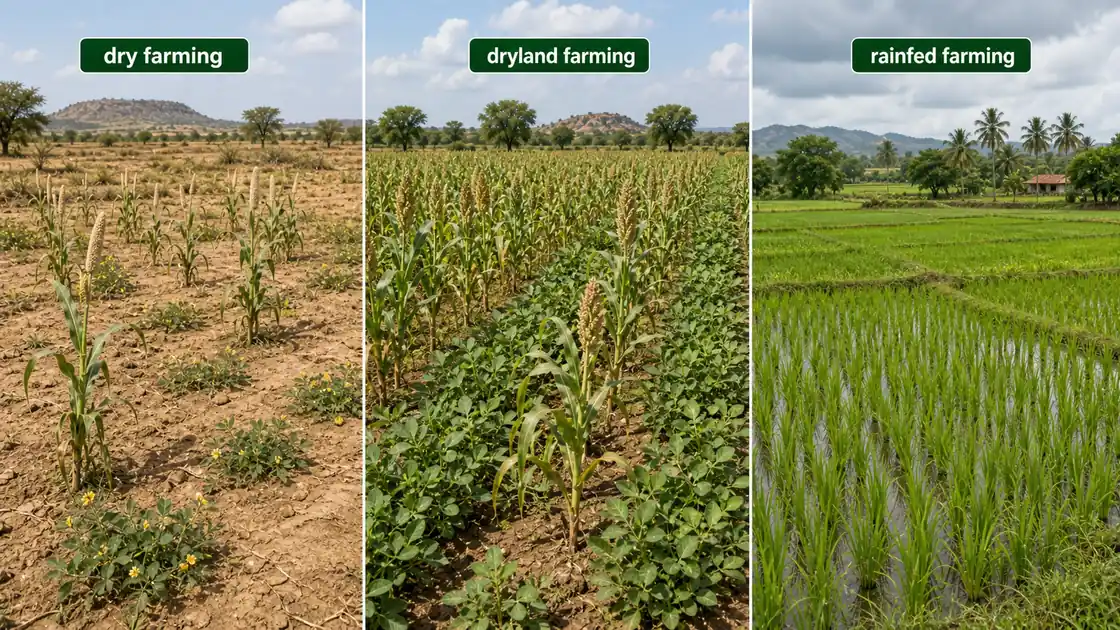
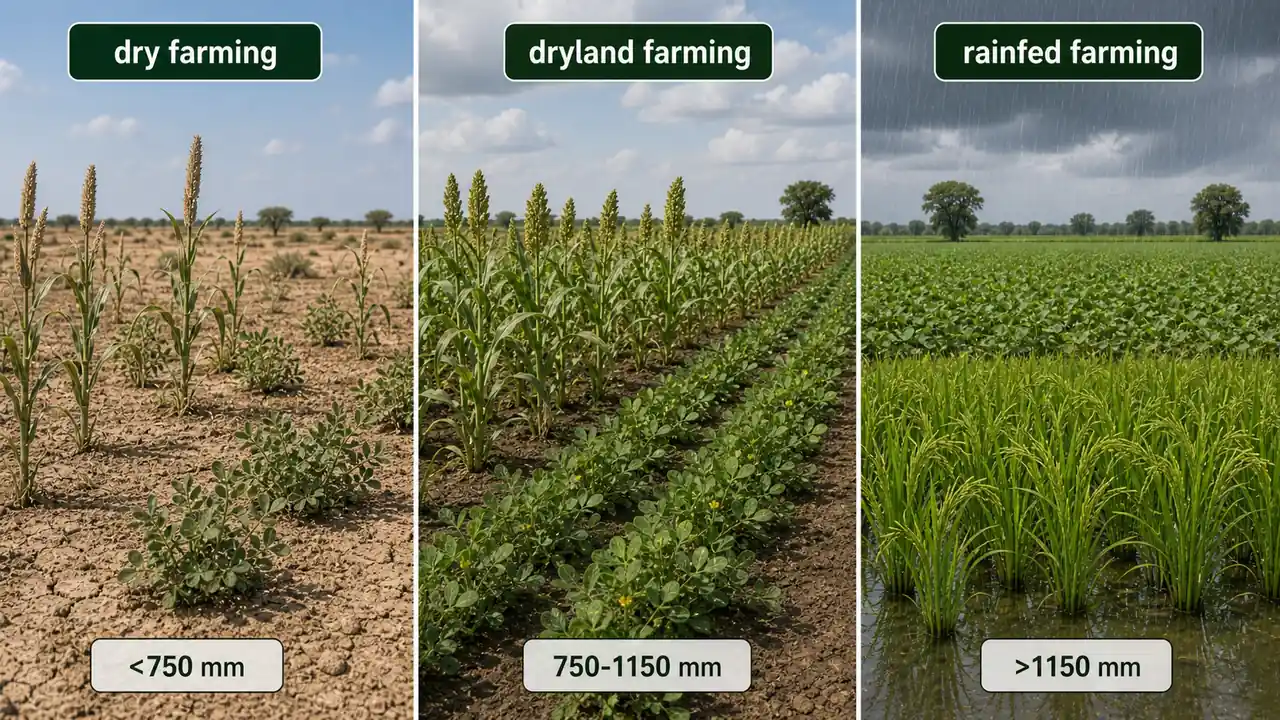
Based on amount of rainfall received, dryland agriculture is grouped into three categories:
| Category | Annual Rainfall | Characteristics | Agricultural Example |
|---|---|---|---|
| Dry Farming | Less than 750 mm Exams | Most moisture-stressed; only the hardiest drought-tolerant crops survive | Pearl millet and cluster bean in western Rajasthan (< 400 mm rainfall) |
| Dryland Farming | 750 to 1150 mm | Moderate rainfall; more crop options but significant moisture uncertainty | Sorghum and groundnut in Marathwada, Maharashtra |
| Rainfed Farming | More than 1150 mm | Adequate total rainfall but challenges from uneven distribution and prolonged dry spells | Rice in Chhattisgarh receives > 1200 mm but suffers from mid-season drought |
TIP
Exam mnemonic -- "DRR = Dry (< 750), dRyland (750-1150), Rainfed (> 1150)." The rainfall limits increase in steps of approximately 400 mm.
Crops Grown in Dryland Areas
Pulses, oilseeds, important commercial crops like cotton, castor, groundnut, and all coarse grains like jowar (sorghum) and bajra (pearl millet). These crops have evolved natural drought avoidance and tolerance mechanisms such as deep root systems, waxy leaf coatings, osmotic adjustment, and the ability to become dormant during dry spells.

Key Institutions for Dryland Agriculture
AICRPDA -- All India Coordinated Research Project for Dryland Agriculture
| Feature | Detail |
|---|---|
| Established | 1970 |
| Assistance from | Government of Canada |
| Under | Indian Council of Agricultural Research (ICAR) |
| Current centres | 25 cooperative centres |
| Purpose | Network of research centres developing location-specific technologies for different dryland regions |
Mandate of AICRPDA:
- Optimize use of natural resources (rainfall, land, water) and minimize soil and water loss
- Evolve simple technologies to substantially increase crop productivity and profitability
- Increase stability of crop production by matching technologies with weather aberrations
- Develop alternate and sustainable land use systems
- Evaluate transferability of improved dryland technologies to farmers' fields
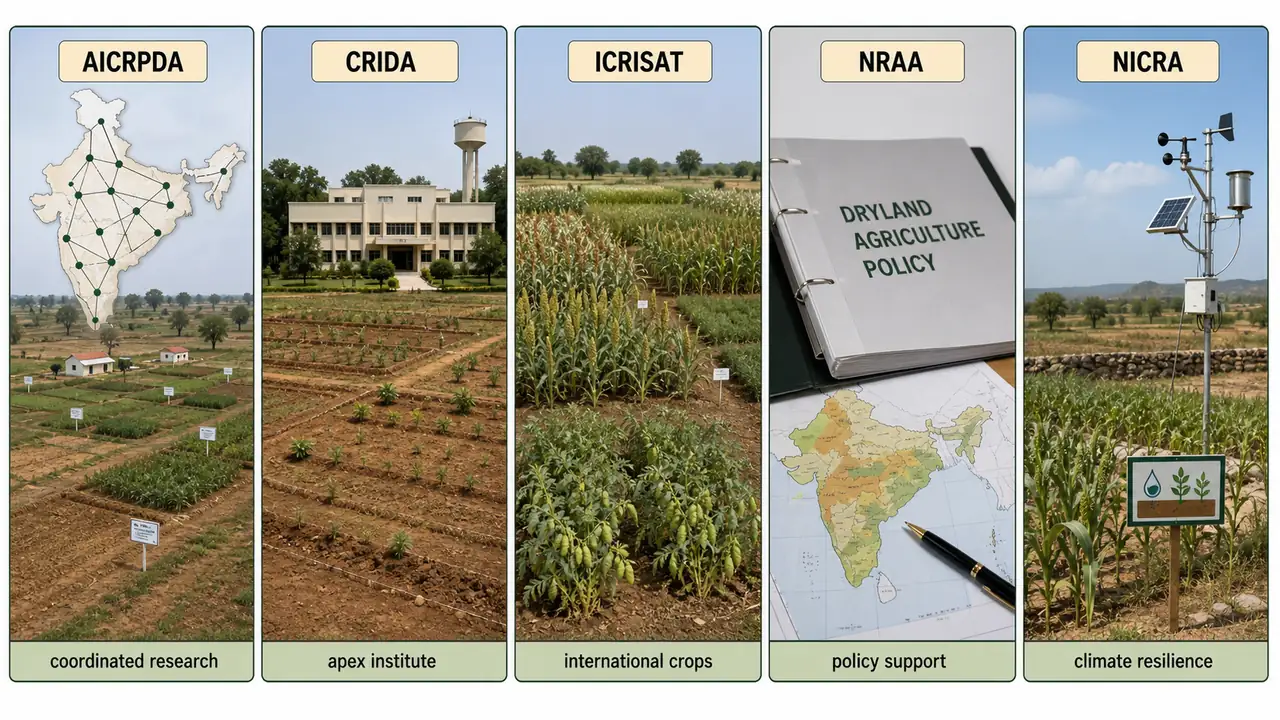
CRIDA -- Central Research Institute for Dryland Agriculture

| Feature | Detail |
|---|---|
| Established | 1985 |
| Location | Hyderabad |
| Under | ICAR |
| Role | Apex research institution for dryland agriculture in India |
| AICRPs housed | Dryland Agriculture + Agrometeorology (25 partners each) |
| Key programme | Lead institute and Nodal point for NICRA |
CRIDA also undertakes National/International collaborations and consultancy projects.
Agricultural example: CRIDA developed the Broad Bed and Furrow (BBF) system for vertisols and the contingency crop planning framework used across 614 districts of India.
ICRISAT -- International Crops Research Institute for the Semi-Arid Tropics
| Feature | Detail |
|---|---|
| Type | Non-profit, non-political international organization |
| Headquarters | Hyderabad, Telangana |
| Regional hubs | Nairobi (Kenya) and Bamako (Mali) |
| Country offices | Niger, Nigeria, Zimbabwe, Malawi, Ethiopia, Mozambique |
| Mandate crops | Sorghum, Pearl millet, Groundnut, Chickpea, Pigeonpea |
| Focus | Agricultural research for development in drylands of Asia and sub-Saharan Africa |
TIP
Exam mnemonic -- "ICRISAT's 5 crops = SoPeGroChiPi" (Sorghum, Pearl millet, Groundnut, Chickpea, Pigeonpea). Both CRIDA and ICRISAT are headquartered in Hyderabad.
NRAA -- National Rainfed Area Authority
- Established on 3rd November 2006
- Expert body of Ministry of Agriculture
- Provides knowledge inputs for systematic management of India's dryland and rainfed agriculture
- Coordinates and facilitates policy-level interventions for holistic development of rainfed areas
Agriculture Contingency Plans
CRIDA (ICAR) has prepared district-level agriculture contingency plans in collaboration with state agricultural universities to tackle:
- Aberrant monsoon situations (drought and floods)
- Extreme events (heat waves, cold waves, frost, hailstorms, cyclones)
- Adverse impacts on crops, livestock, and fisheries (including horticulture)
These plans provide ready-made, location-specific action plans that can be immediately activated when weather abnormalities occur.
- Total: 614 district agriculture contingency plans
- Available on the "Farmer Portal" of the Ministry of Agriculture and CRIDA website
Improved Dryland Technologies
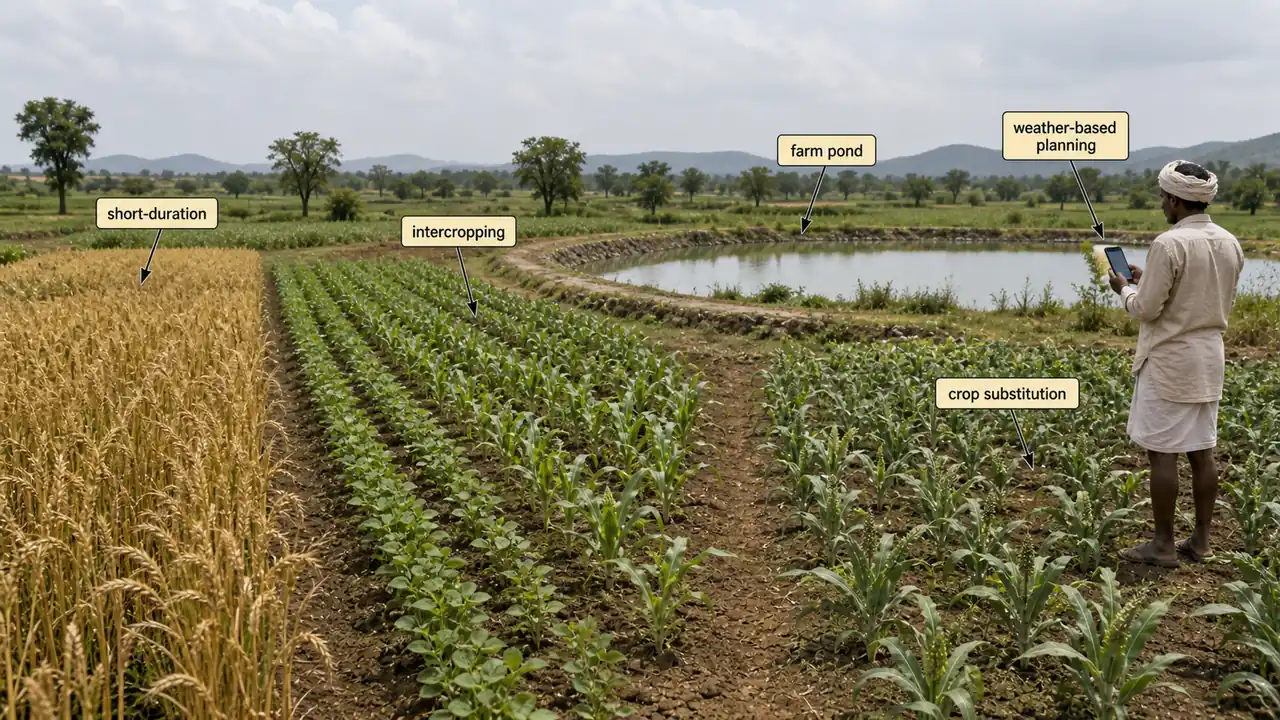
| Technology | Description | Agricultural Example |
|---|---|---|
| Crop planning | Choose short-duration, drought-tolerant, high-yielding varieties that can be harvested within rainfall period | CSH-14 sorghum (110 days) replaces traditional 140-day varieties in Marathwada |
| Planning for weather | Use weather forecasts and advisories to adjust farming operations | ICAR Agromet advisories guide sowing dates |
| Crop substitution | Replace moisture-inefficient traditional crops with more efficient ones | Sunflower replacing sorghum in late-sown conditions |
| Cropping systems | Increase cropping intensity through inter-cropping and multiple cropping | Sorghum + pigeonpea intercropping in Solapur |
| Other technologies | Watershed management, rainwater management, alternate land use | Farm ponds in Bundelkhand region |
Aberrant Weather Conditions in Dryland Areas
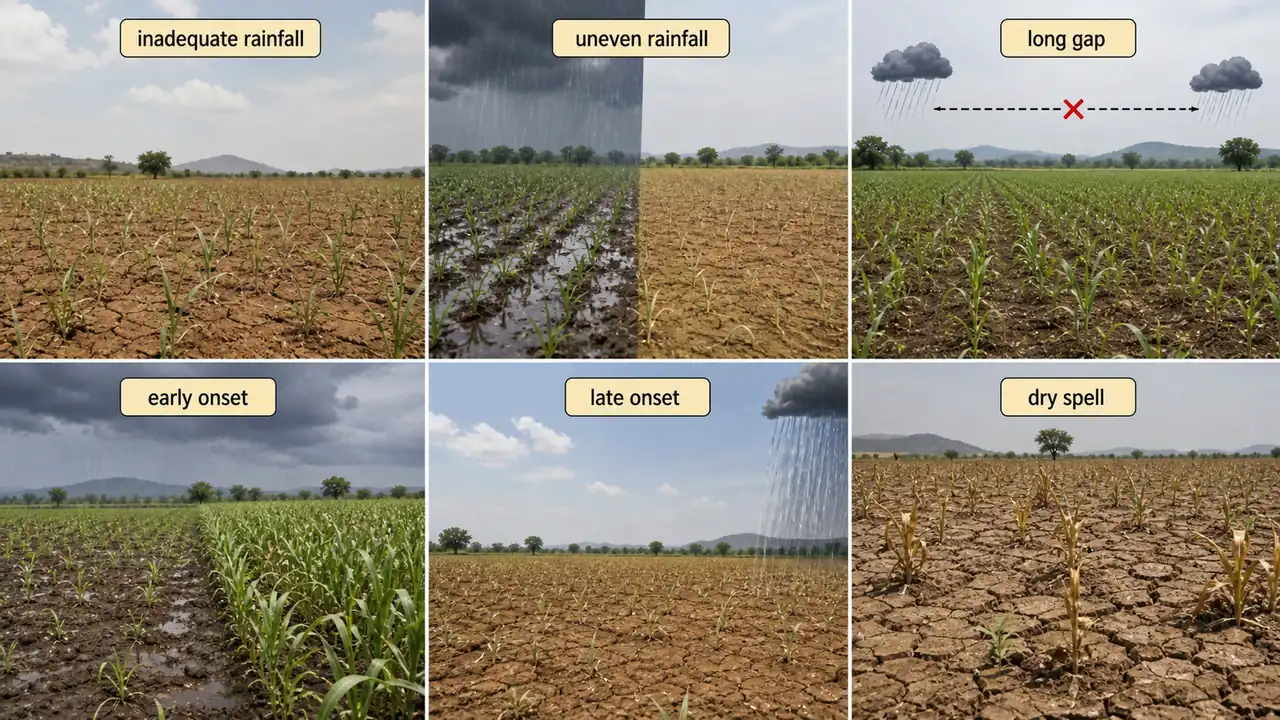
The following weather conditions commonly disrupt farming in dryland areas:
- Inadequate and uneven distribution of rainfall
- Long gap in rainfall
- Early onset of monsoon
- Late onset of monsoon
- Early cessation of rains
- Prolonged dry spells / mid-term drought during crop period
Contingent Crop Plans
Contingent crop plans are pre-planned alternative strategies for when normal crop planning is disrupted by weather abnormalities. They ensure farmers have ready-made solutions for each type of weather deviation.
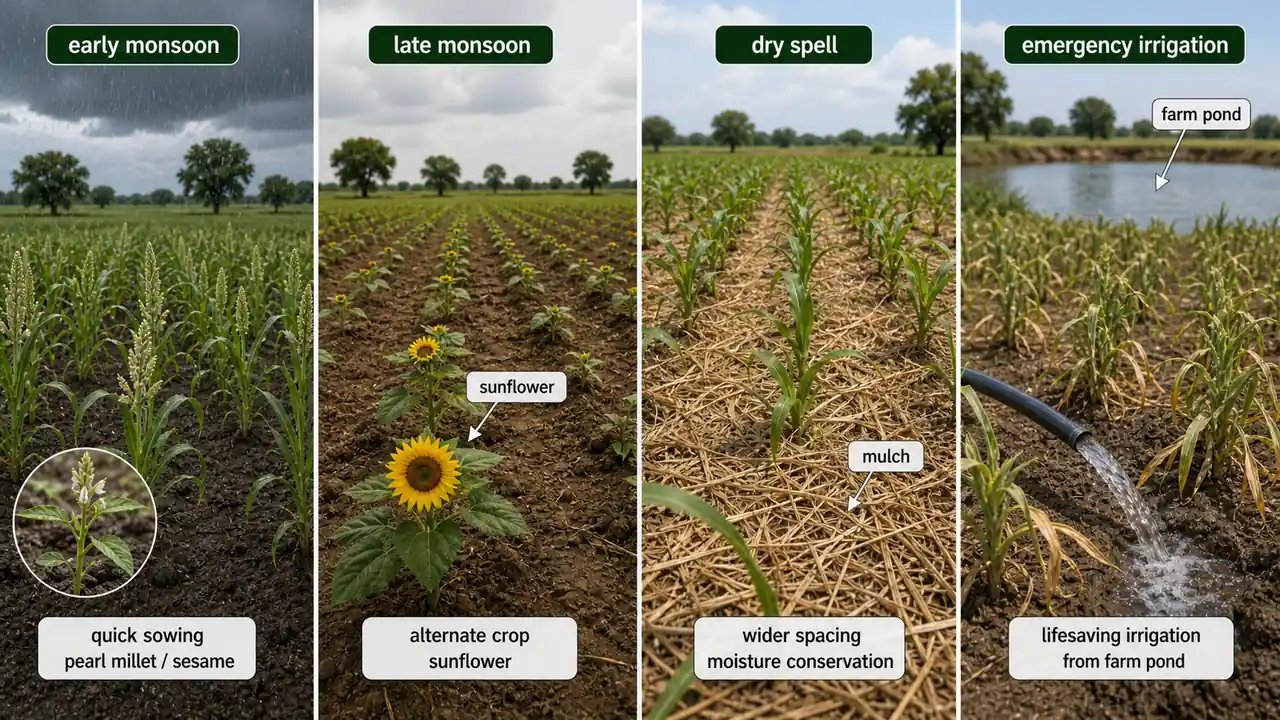
1) Inadequate and Uneven Distribution of Rainfall
Low and highly variable rainfall results in uncertain crop yields -- high rain when not needed, lack of it when crop needs it most.
- Cultivation of low water-requiring crops
- Grow short-duration crops
- Provide lifesaving irrigation
Agricultural example: In Anantapur (AP), groundnut farmers switch to castor or horsegram when rainfall is inadequate, as these crops need less moisture.
2) Long Gap in Rainfall
- Increase seed rate to obtain higher population (compensate for expected mortality)
- Spraying of urea solution (foliar nutrition)
- Provide lifesaving irrigation at critical growth stages
- Weeding and intercultural operations to conserve moisture
3) Early Onset of Monsoon
- Cultivate pearl millet, sesamum and similar quick-response crops
Agricultural example: When monsoon arrives 2-3 weeks early in parts of Gujarat, farmers quickly sow pearl millet (bajra) which germinates rapidly and takes advantage of the early moisture.
4) Late Onset of Monsoon
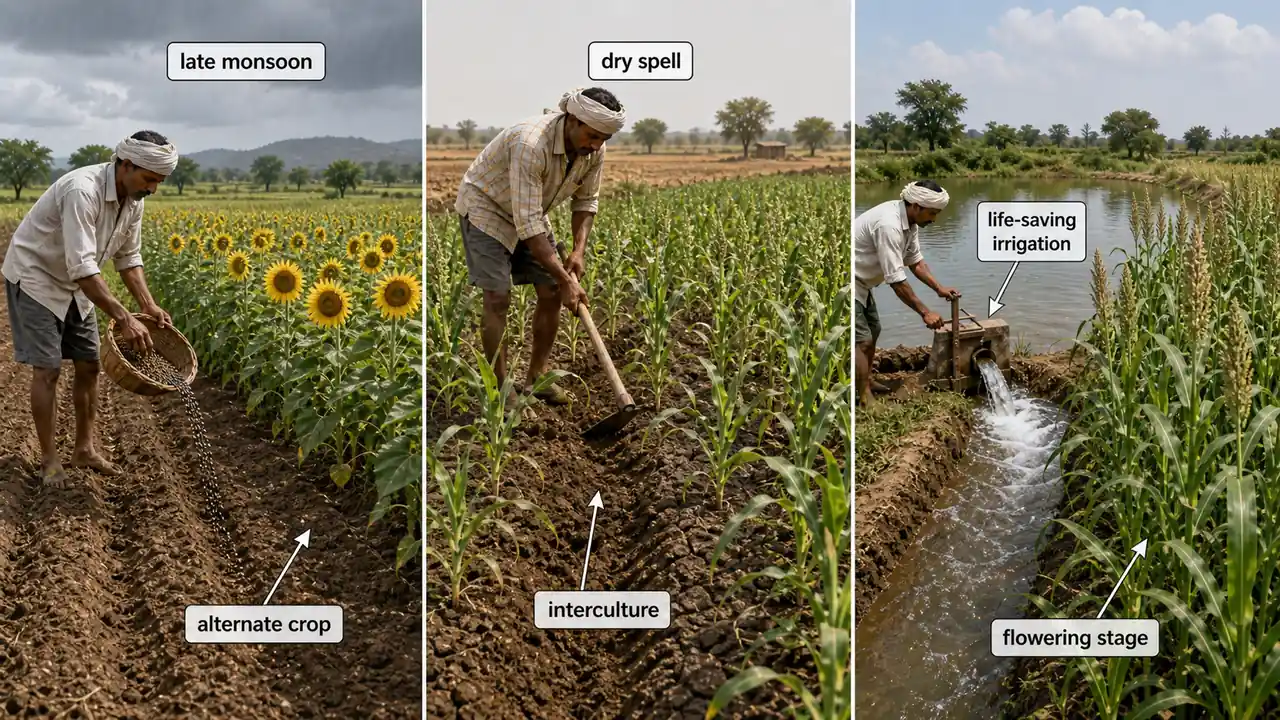
Late monsoon delays sowing, resulting in poor yields. Strategies include:
| Strategy | Detail |
|---|---|
| Alternate crops and varieties | Castor (Aruna), greengram, cowpea, sunflower |
| Dry sowing / Kurra sowing | Sow seeds in dry soil before rains arrive |
| Pre-sowing | Prepare field and seed for immediate sowing when rain comes |
| Seed soaking / treatment | Improves germination speed once rains arrive |
| Transplanting | One-month-old bajra seedlings (saves field time) |
| Complete weed control | Every weed removed = moisture saved for the crop |
| Substitute legumes/oilseeds for cereals | More efficient moisture use |
| Most suitable crop | Sunflower -- short growing period, tolerates wide range of soil and moisture conditions |
TIP
Exam tip: For late onset of monsoon, Sunflower is the most suitable crop. Remember "Late = Sun(flower) still shines."
5) Early Cessation of Rains
Rain may cease early, exposing crops to drought during flowering and maturity stages.
- Select short-duration varieties
- Use mulching (reduces soil evaporation, conserves remaining moisture for grain-filling)
- Apply lifesaving irrigation
- Decrease plant population (fewer plants competing for limited moisture)
6) Prolonged Dry Spells
Long breaks in the rainy season are a key feature of the Indian monsoon. Strategies depend on timing:
| Timing of Stress | Action | Reasoning |
|---|---|---|
| Dry spell within 10 days of sowing | Resowing | Stand establishment has failed |
| Mild moisture stress at 30-35 days | Thinning alternate rows of sorghum/pearl millet | Reduces competition for limited moisture |
| Severe moisture stress at 30-35 days | Cutting sorghum/pearl millet and ratooning | Salvages the crop by allowing regrowth |
| Moisture stress at blooming stage | Cutting and ratooning | Allows new flush from stored root reserves |
| Short monsoon break | Shallow intercultivation for soil mulch and weed control | Breaks capillary pores, reduces evaporation |
| General strategy | Wider spacing for moisture conservation | Each plant gets larger moisture access zone |
| After drought period | Spray 2 per cent urea on indeterminate crops (castor, pigeonpea, groundnut) | Foliar nitrogen helps quick recovery through leaves |
| General strategy | Soil mulching to reduce evaporation | Conserves remaining soil moisture |
| General strategy | In-situ water harvesting | Captures whatever rain falls |
| General strategy | Lifesaving irrigation | Critical intervention at reproductive stage |
| General strategy | Weed control | Removes moisture competitors |
Dryland Implements
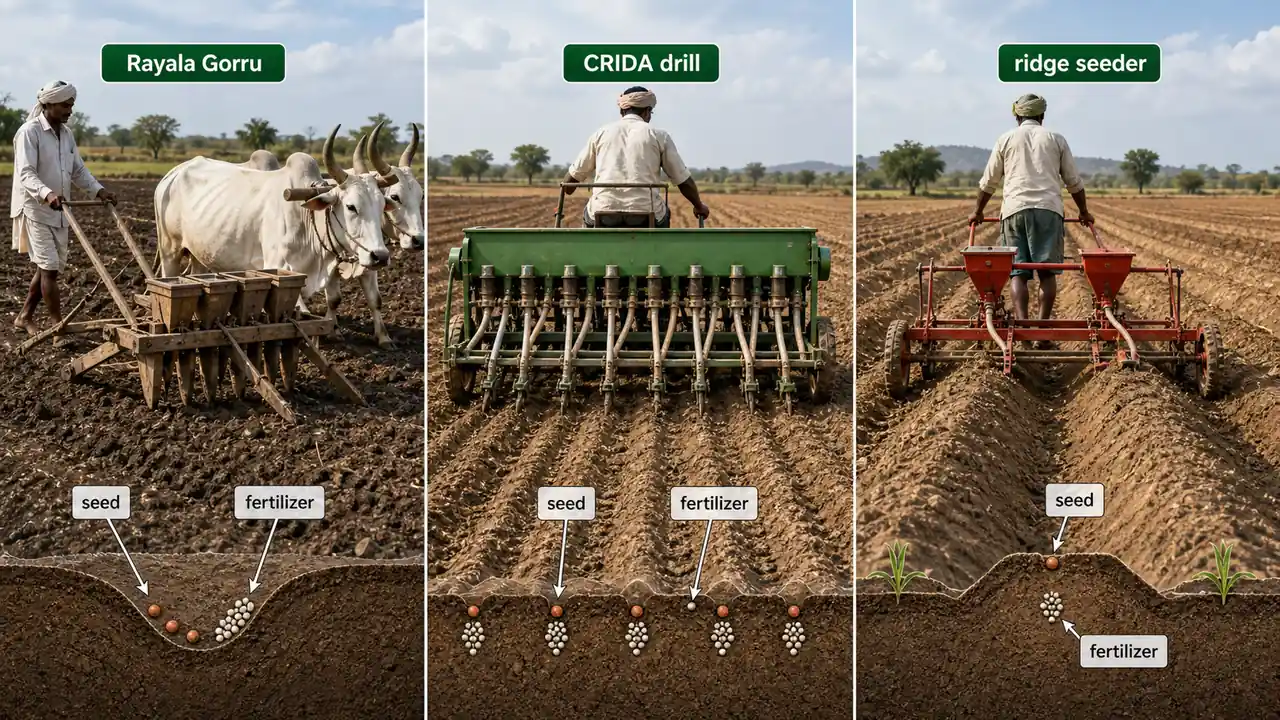
Specialized implements for efficient sowing and fertilizer placement under moisture-limited conditions:
| Implement | Description | Developed By |
|---|---|---|
| CRIDA Drill-plough | Seed cum fertilizer device attached to country plough | CRIDA |
| Ridge seeder | Two-row bullock-drawn seeder | AICRPDA, Hisar |
| CRIDA seed cum fertilizer drill | Three-row drill; no covering of seed and fertilizer | CRIDA |
| Fepso plough | Bullock-drawn implement for seeding and band placement of fertilizer | CRIDA, Hyderabad |
| Rayala Gorru | Seed cum fertilizer device; covers seed and fertilizer simultaneously | AICRPDA, Anantapur |
Agricultural example: The Rayala Gorru, developed for the dryland conditions of Anantapur (AP), allows groundnut farmers to place seed and fertilizer in one pass using bullock power, saving time and ensuring precise placement in moisture-limited soils.
Length of Growing Period (LGP)
LGP is defined as the period during which available soil moisture is enough to meet the evapotranspiration requirement of dryland crops, assuring productivity. LGP is the most important criterion for crop planning in dryland areas -- it determines which crops can be successfully grown and when they should be sown and harvested.

Agricultural example: In Sholapur (Maharashtra), the LGP is only 90-120 days. Farmers must choose crops like short-duration sorghum (CSH-14, 100 days) or safflower that complete their lifecycle within this window.
Characteristics of Dry Farming Eco Zones

India's dry farming areas span several agro-ecological zones -- from the hot arid deserts of western Rajasthan (LGP < 60 days) to semi-arid regions of Deccan Plateau (LGP 90--150 days) to dry sub-humid zones of eastern India (LGP 150--180 days). Each zone has distinct soil types, rainfall patterns, and suitable crop combinations. The arid zones rely on pearl millet and cluster bean, semi-arid zones grow sorghum and groundnut, while dry sub-humid zones support rainfed rice and pulses.
Drought
Drought is the moisture deficit that results when the amount of water available in the soil is insufficient to meet the demand of potential evapotranspiration. In agricultural terms, drought is fundamentally about the mismatch between water supply (rainfall + stored soil moisture) and water demand (crop evapotranspiration).
Types of Drought Response in Plants
| Type | Definition | Mechanism | Agricultural Example |
|---|---|---|---|
| Drought Avoidance | Ability to maintain favourable internal water balance under stress | Deep rooting, reduced leaf area, stomatal closure | Pearl millet has deep roots (up to 2 m) to access deeper water |
| Drought Tolerance | Ability to withstand low tissue water content | Osmotic adjustment, cell wall elasticity, protoplasm tolerance | Sorghum can resume growth after severe wilting |
| Drought Resistance | Ability to grow and reproduce normally under moisture deficit (= avoidance + tolerance) | Combines both strategies | Chickpea completes lifecycle on residual soil moisture after monsoon |
| Drought Hardening | Improvement in tolerance through seed and seedling treatments | Pre-sowing alternate wetting and drying of seeds | Seed hardening in pearl millet before sowing in Rajasthan |
TIP
Exam mnemonic -- "RATH" = Resistance = Avoidance + Tolerance; Hardening is induced artificially. Resistance is the broadest term (sum of avoidance + tolerance).
What Drought Initiates in Plants
- Accumulation of amino acid proline -- acts as an osmoprotectant, maintaining cell turgor and protecting enzymes
- Synthesis of ABA (Abscisic acid) -- the stress hormone that triggers stomatal closure and activates drought-response genes
- K and Mg deficiency occurs -- reduced soil moisture limits mass flow and diffusion of nutrients to roots. Example: Mg deficiency in cotton leaves during drought

Remedies of Drought
| Remedy | Purpose |
|---|---|
| Spraying 2 per cent Urea/DAP | Foliar nitrogen/phosphorus nutrition |
| Foliar spray of 0.5-1 per cent KCl | Potassium improves stomatal regulation and drought tolerance |
| Use of anti-transpirants | Reduces water loss from leaves |
| Foliar spray of 500 ppm Cycocel (CCC) | Growth retardant that reduces height, thickens stems, promotes deeper rooting |
Anti-Transpirants
Any material applied to transpiring plant surfaces for reducing water loss. Anti-transpirants work by:
| Type | Mechanism | Example |
|---|---|---|
| Stomatal closing type | Closes stomata chemically | ABA, PMA (phenyl mercuric acetate) |
| Film-forming type | Creates a thin film over leaf surface | Mobileaf, hexadeconol |
| Reflecting type | Increases leaf reflectance, reduces heat load | Kaolin (china clay), lime water |
| Growth retardant type | Reduces transpiration by altering growth | Cycocel (CCC) |
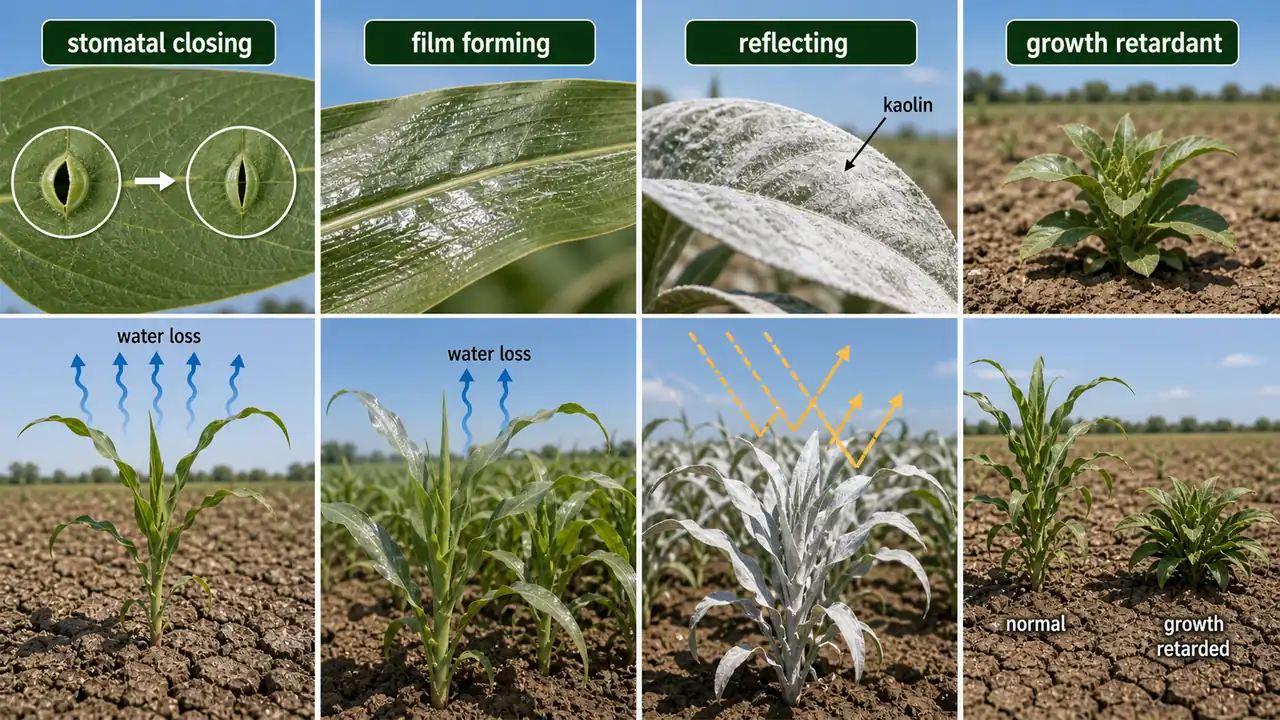
Agricultural example: In drought-prone Bundelkhand, spraying 6% kaolin suspension on chickpea leaves reflects excess radiation, reduces leaf temperature by 3-4 degrees C, and conserves soil moisture by reducing transpiration.
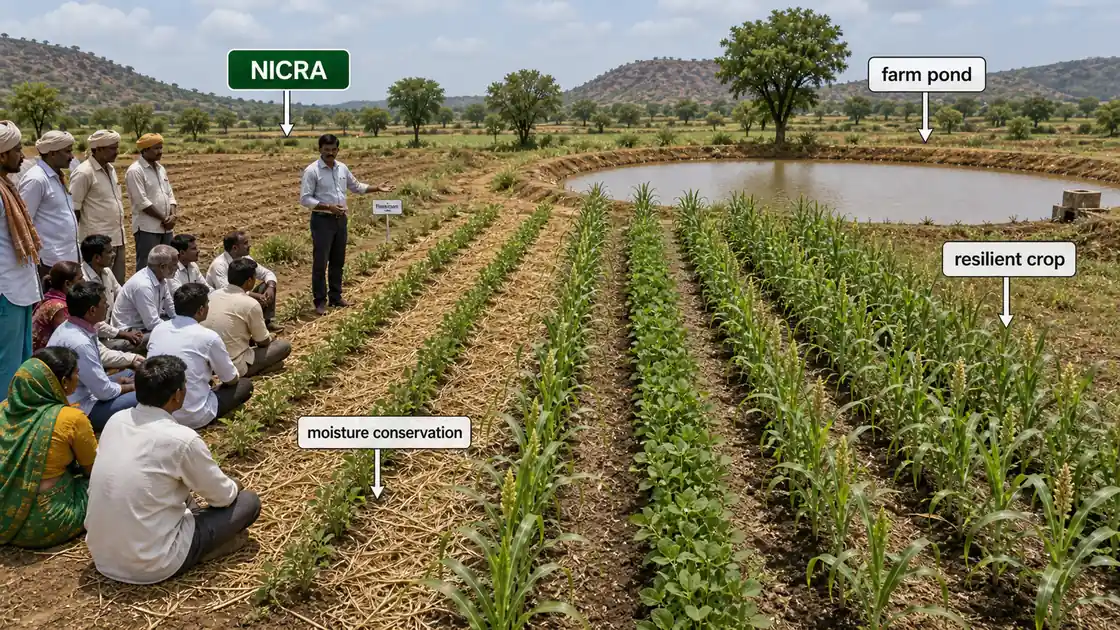
NICRA -- National Innovations on Climate Resilient Agriculture
| Feature | Detail |
|---|---|
| Launched | February 2011 |
| By | ICAR with funding from Ministry of Agriculture, Government of India |
| Three objectives | Strategic research, Technology demonstrations, Capacity building |
| Implementation | Through ICAR institutes, State Agricultural Universities, and 100 KVKs |
| Purpose | Address climate change impacts on agriculture through climate-resilient technologies |
Comparison of Key Dryland Institutions
| Institution | Year | Location | Key Focus |
|---|---|---|---|
| AICRPDA | 1970 | 25 centres across India | Coordinated research; location-specific technologies |
| CRIDA | 1985 | Hyderabad | Apex research institute; NICRA nodal point; 614 contingency plans |
| ICRISAT | -- | Hyderabad | International; 5 mandate crops (sorghum, pearl millet, groundnut, chickpea, pigeonpea) |
| NRAA | 2006 | New Delhi | Policy-level; Ministry of Agriculture expert body |
| NICRA | 2011 | Through ICAR/KVKs | Climate resilience; strategic research + demonstrations |
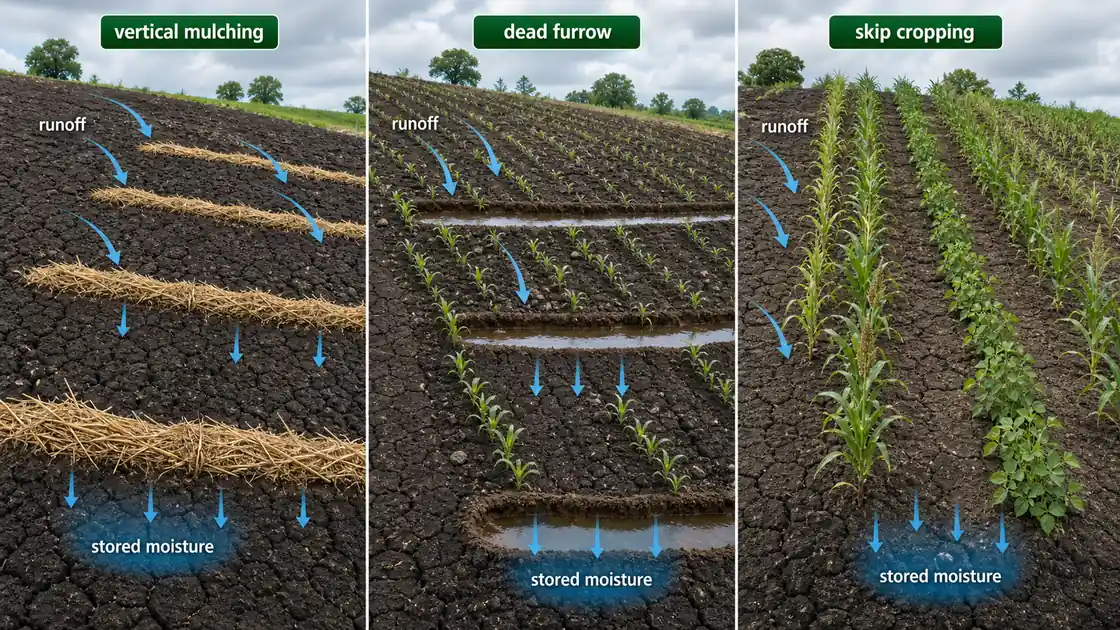
Moisture Conservation Techniques in Dryland
| Technique | Definition | Agricultural Detail |
|---|---|---|
| Vertical mulching | Trenches cut across the slope and filled with straw or crop residues to increase water infiltration | Most effective in vertisols (black cotton soils) where surface cracking allows lateral water movement |
| Skip Cropping | Leaving alternate rows unsown to conserve moisture for the remaining crop rows | Used in deficit rainfall years; sorghum + pigeon pea skip-row intercropping is common in dryland |
| Dead furrows | Plough furrows at 3-4 m intervals running across the slope to intercept and store runoff | Simple, low-cost moisture conservation for dryland |
TIP
Exam fact: Vertical mulching is specifically recommended for vertisols (black soils) because deep cracks in these soils allow trenched straw to channel water deep into the profile. Skip cropping is a dryland risk management strategy — fewer plants share the limited moisture.
Summary Table
| Topic | Key Point |
|---|---|
| Dryland agriculture | Growing crops entirely under rainfed conditions |
| Area in India | 52% of cultivated area is dryland |
| Water loss (evaporation) | 75-90% in dryland conditions |
| Dry farming | Rainfall < 750 mm/year |
| Dryland farming | Rainfall 750-1150 mm/year |
| Rainfed farming | Rainfall > 1150 mm/year |
| AICRPDA | Established 1970 with Canadian assistance; 25 centres |
| CRIDA | Established 1985 at Hyderabad; apex dryland research institute |
| ICRISAT | HQ Hyderabad; 5 crops -- sorghum, pearl millet, groundnut, chickpea, pigeonpea |
| NRAA | Established 2006; Ministry of Agriculture expert body |
| NICRA | Launched 2011 by ICAR; climate-resilient agriculture |
| Contingency plans | 614 district-level plans prepared by CRIDA |
| Late monsoon crop | Sunflower is most suitable |
| Prolonged dry spell (10 days) | Resow the crop |
| Prolonged dry spell (30-35 days) | Thin alternate rows or cut and ratoon |
| Foliar spray after drought | 2% urea for indeterminate crops |
| LGP | Length of growing period; most important criterion for crop planning |
| Drought resistance | = Drought avoidance + Drought tolerance |
| Drought initiates | Proline accumulation, ABA synthesis, K and Mg deficiency |
| Anti-transpirants | Stomatal closing, film-forming, reflecting, growth retardant types |
| Cycocel (CCC) | Growth retardant; 500 ppm foliar spray; promotes deeper rooting |
| Seed hardening | Alternate wetting-drying before sowing; induces drought tolerance |
| Dryland implements | CRIDA drill-plough, Ridge seeder, Fepso plough, Rayala Gorru |
Summary Cheat Sheet
| Concept / Topic | Key Details |
|---|---|
| Dryland area in India | 52% of cultivated area |
| Water loss (evaporation) | 75-90% in dryland conditions |
| Dry farming | Rainfall < 750 mm/year |
| Dryland farming | Rainfall 750-1150 mm/year |
| Rainfed farming | Rainfall > 1150 mm/year |
| AICRPDA | Established 1970 with Canadian assistance; 25 centres |
| CRIDA | Established 1985 at Hyderabad; apex dryland research |
| ICRISAT | HQ Hyderabad; 5 crops — sorghum, pearl millet, groundnut, chickpea, pigeonpea |
| NRAA | Established 2006; Ministry of Agriculture |
| NICRA | Launched 2011 by ICAR; climate-resilient agriculture |
| Contingency plans | 614 district-level plans by CRIDA |
| Late monsoon crop | Sunflower is most suitable |
| Dry spell 10 days | Resow the crop |
| Dry spell 30-35 days | Thin alternate rows or cut and ratoon |
| Anti-transpirants | Stomatal closing, film-forming, reflecting, growth retardant types |
| Cycocel (CCC) | 500 ppm foliar spray; promotes deeper rooting |
| Seed hardening | Alternate wetting-drying before sowing; drought tolerance |
| Drought resistance | = Drought avoidance + Drought tolerance |
| Foliar spray after drought | 2% urea for indeterminate crops |
| LGP | Length of growing period — most important dryland criterion |
| Vertical mulching | Trenches filled with straw — best for vertisols (black soils) |
| Skip Cropping | Alternate rows unsown — moisture conservation in deficit rainfall |
| Dead furrows | Furrows at 3-4 m intervals — intercept runoff for moisture conservation |
TIP
Next: Lesson 02 covers Watershed Management -- the holistic approach to managing an entire drainage area as one unit, with programmes (DPAP, DDP, NWDPRA, WDC-PMKSY, Neeranchal), practices, and rainwater harvesting techniques.