📋 12 Classification Systems of Weeds
Master all 12 ways weeds are classified -- by life span, ecology, soil type, origin, morphology, pH, stem nature, cotyledons, specificity, association and more -- with comparison tables and exam mnemonics.
Why Classification Matters in the Field
In the previous lesson, we established what weeds are, why they cause more crop losses than insects and diseases combined, and the survival traits that make them so persistent. Now we move to the next logical question: how do we organise and classify this enormous diversity of weeds?
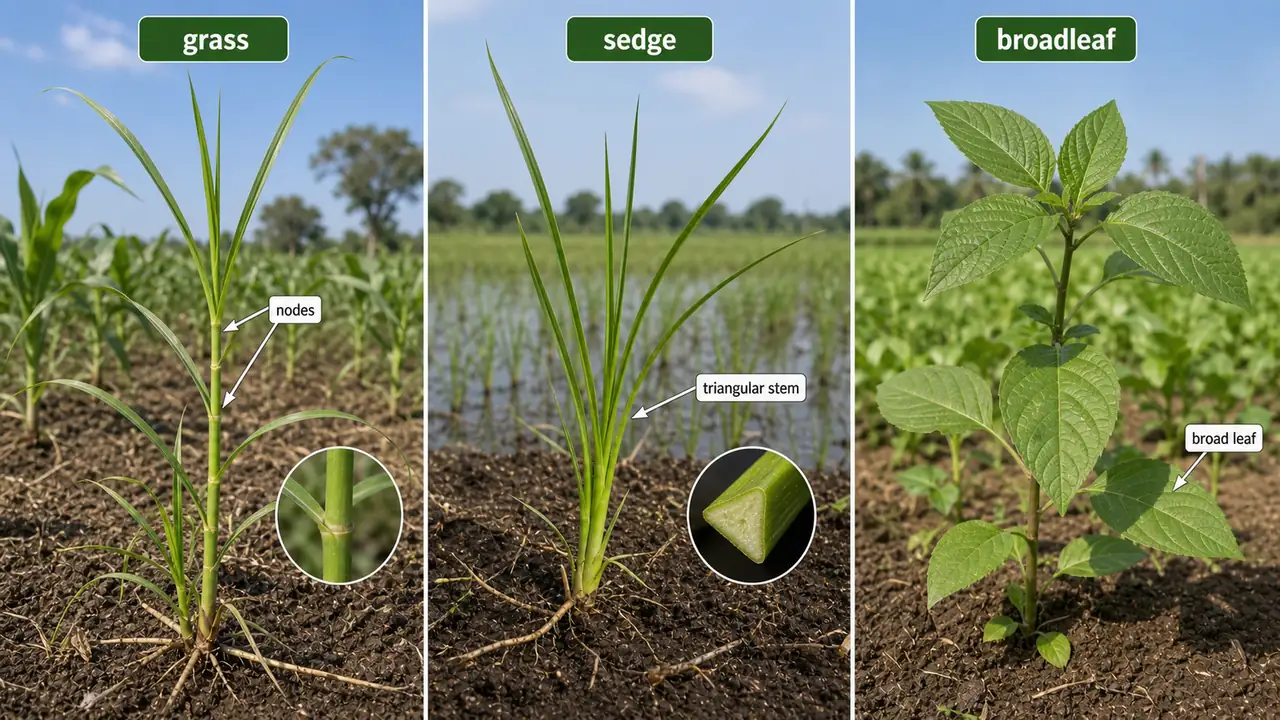
Walk into any wheat field in Rajasthan during Rabi season and you will see a mix of broad-leaved weeds like Chenopodium album (Bathua) alongside grassy weeds like Phalaris minor. A farmer who can classify these weeds correctly will choose the right herbicide -- 2,4-D for the broadleaves, clodinafop for the grasses. Wrong classification leads to wrong herbicide selection, wasted money, and surviving weeds.
Weeds are classified using 12 different systems based on various characteristics. Exam questions may come from any system, so understanding all twelve is essential.
Pro Content Locked
Upgrade to Pro to access this lesson and all other premium content.
Charged once for one year · ₹1188 total
Save ₹100/month vs ₹2388/year launch price
- All Agriculture & Banking Courses
- AI Lesson Questions (100/day)
- AI Doubt Solver (50/day)
- Glows & Grows Feedback (30/day)
- AI Section Quiz (20/day)
- 22-Language Translation (100/day)
- Recall Questions (20/day)
- AI Quiz (15/day)
- AI Quiz Paper Analysis (100/day)
- AI Step-by-Step Explanations (100/day)
- Spaced Repetition Recall (FSRS)
- AI Tutor
- Immersive Text Questions
- Audio Lessons — Hindi & English
- Mock Tests & Previous Year Papers
- Summary & Mind Maps
- XP, Levels, Leaderboard & Badges
- Generate New Classrooms
- Voice AI Teacher (AgriDots Live)
- AI Revision Assistant
- Knowledge Gap Analysis
- Interactive Revision (LangGraph)
🔒 Secure one-time yearly payment via Razorpay · No hidden fees
Why Classification Matters in the Field
In the previous lesson, we established what weeds are, why they cause more crop losses than insects and diseases combined, and the survival traits that make them so persistent. Now we move to the next logical question: how do we organise and classify this enormous diversity of weeds?
Walk into any wheat field in Rajasthan during Rabi season and you will see a mix of broad-leaved weeds like Chenopodium album (Bathua) alongside grassy weeds like Phalaris minor. A farmer who can classify these weeds correctly will choose the right herbicide -- 2,4-D for the broadleaves, clodinafop for the grasses. Wrong classification leads to wrong herbicide selection, wasted money, and surviving weeds.
Weeds are classified using 12 different systems based on various characteristics. Exam questions may come from any system, so understanding all twelve is essential.
This lesson covers:
- Life span (Ontogeny) -- annual, biennial, perennial weeds
- Ecological affinities -- wetland, garden land, dryland
- Soil type, place, origin -- edaphic indicators, native vs exotic
- Morphology -- the most widely used system (grasses, sedges, broadleaved)
- pH, stem nature, cotyledons -- practical identification traits
- Specificity, position, association -- noxious, mimicry, obligate, facultative
1. Based on Life Span (Ontogeny)
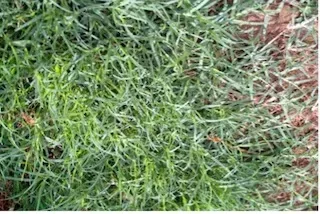
Ontogeny refers to the developmental life history of the weed. This is the most fundamental classification.
A. Annual Weeds
Complete their life cycle in one season or year. Most common field weeds are annuals, subdivided by growing season:
| Season | Period | Examples |
|---|---|---|
| Kharif (Monsoon) annuals | Warm, rainy season | Commelina benghalensis, Boerhavia erecta, Amaranthus viridis, Euphorbia thymifolia, Digera arvensis, Datura festuosa, Cassia occidentalis |
| Rabi (Winter) annuals | Cool season | Chenopodium album (Bathua) UPPSC 2021, Argemone mexicana, Anagallis arvensis, Convolvulus arvensis, Parthenium hysterophorus, Cuscuta reflexa, Asphodelus tenuifolius |
Short-lived annuals completing their seed-to-seed cycle in just 2-4 weeks are called Ephemerals (e.g. Phyllanthus fraternus). They can produce multiple generations within a single crop season.
B. Biennial Weeds
Complete vegetative growth in the 1st season, then flower and set seed in the 2nd season, and then die. Found mainly in non-cropped areas because regular tillage disrupts their two-year cycle.
- Examples: Alternanthera echinata, Daucus carota, Cirsium vulgare, Cichorium intybus
C. Perennial Weeds
Live for more than two years and are the most difficult to control because they regenerate from underground parts even after surface vegetation is removed.
| Perennial Type | Description | Example |
|---|---|---|
| Simple perennials | Propagated only by seeds -- no vegetative reproduction | Sonchus arvensis |
| Bulbous perennials | Reproduce from modified stem with scales (bulbs) | Allium sp. |
| Corm perennials | Reproduce through corms (modified underground stem) | Phleum pratense (Timothy) |
| Creeping perennials | Reproduce by seeds + vegetative parts -- the hardest to manage | See sub-types below |
Creeping perennial sub-types:
| Vegetative Structure | How It Works | Example |
|---|---|---|
| Rhizome | Horizontal underground stem | Sorghum halepense |
| Stolon | Creeping runner along the ground surface | Cynodon dactylon |
| Roots | Enlarged root system with adventitious buds | Convolvulus arvensis |
| Tubers | Modified rhizome storing food reserves | Cyperus rotundus |
Other important perennial weeds include Saccharum spontaneum (Kans grass -- spreads by rhizomes, used in roof making and sugarcane breeding) and Ageratum conyzoides (billy goat weed).
IMPORTANT
Creeping perennials are the hardest to manage. Tillage can actually worsen infestations by fragmenting rhizomes and tubers -- each fragment regenerates into a new plant.
TIP
Mnemonic for perennial types -- "SiBCoCr": Simple, Bulbous, Corm, Creeping. Creeping is the toughest -- remember it last, because it is the last one you can get rid of!
2. Based on Ecological Affinities (Moisture Regime)
This system classifies weeds by the moisture conditions they prefer, directly correlating with farming systems.
| Type | Description | Example |
|---|---|---|
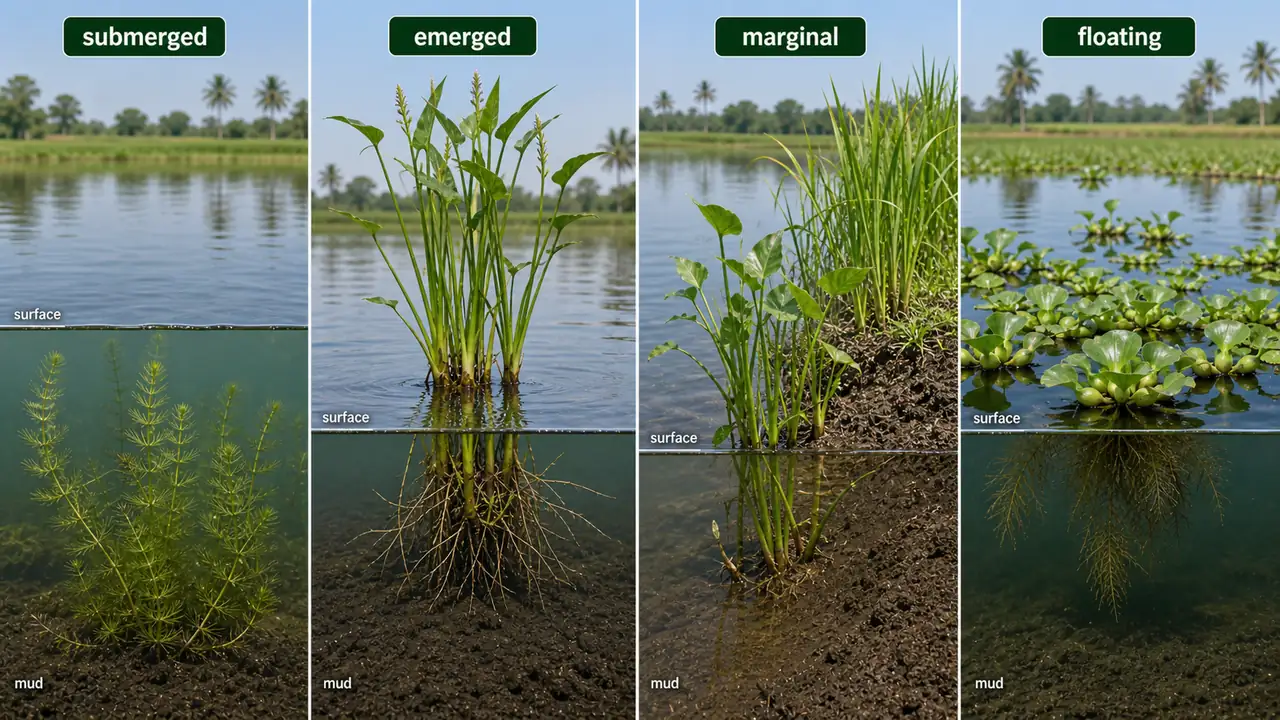
| Wetland weeds | Tender annuals with semi-aquatic habit; thrive in waterlogged conditions | Ammania baccifera |
| Garden land (irrigated) weeds | Moderate moisture; neither waterlogged nor extremely dry | Trianthema portulacastrum, Digera arvensis |
| Dryland weeds | Hardy plants with deep roots, mucilaginous or hairy stems to conserve water | Tribulus terrestris, Argemone mexicana |
TIP
Field application: If you see Tribulus terrestris (puncture vine) dominating a field, it strongly suggests dryland/rainfed conditions with low moisture.
3. Based on Soil Type (Edaphic Classification)
Certain weed species indicate specific soil types -- they serve as natural bio-indicators.
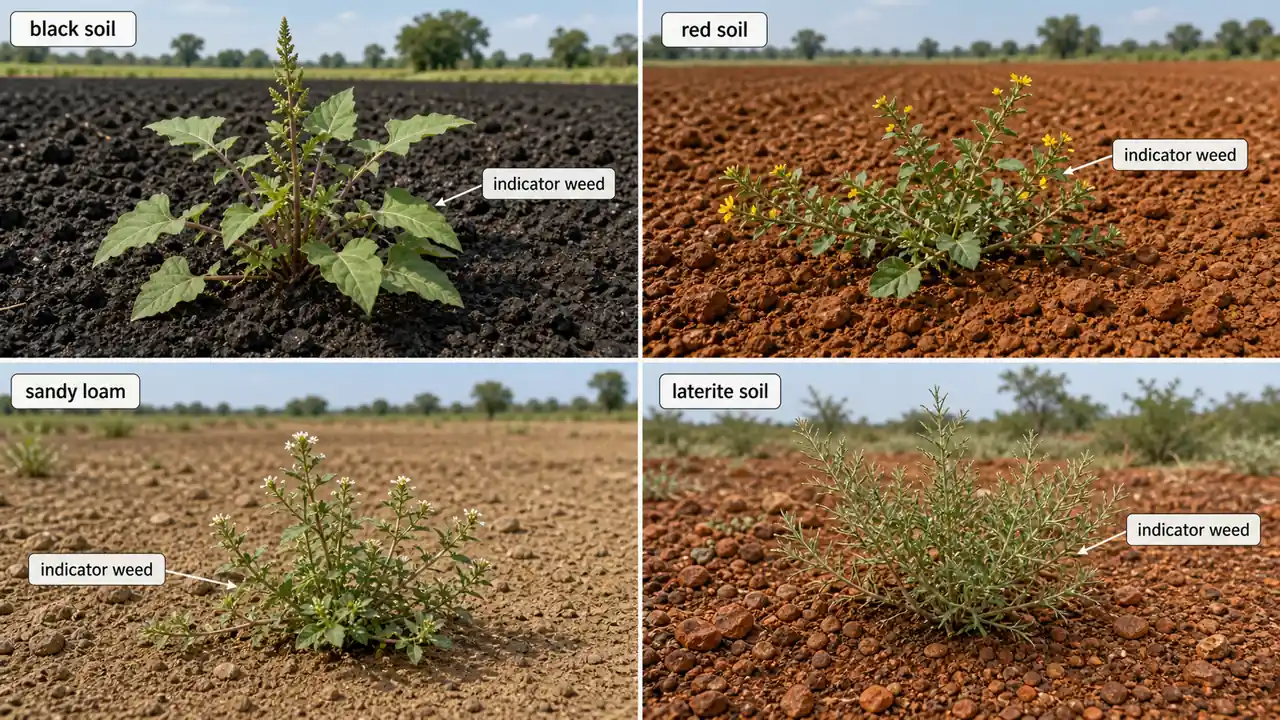
| Soil Type | Indicator Weed |
|---|---|
| Black cotton soil | Aristolochia bracteata |
| Red soils | Commelina benghalensis |
| Light sandy/loamy soils | Leucas aspera |
| Laterite soils | Lantana camara, Spergula arvensis |
TIP
Seeing Lantana camara dominating an area? It suggests laterite soil conditions. This weed-as-indicator concept is useful for quick field diagnosis.
4. Based on Place of Occurrence
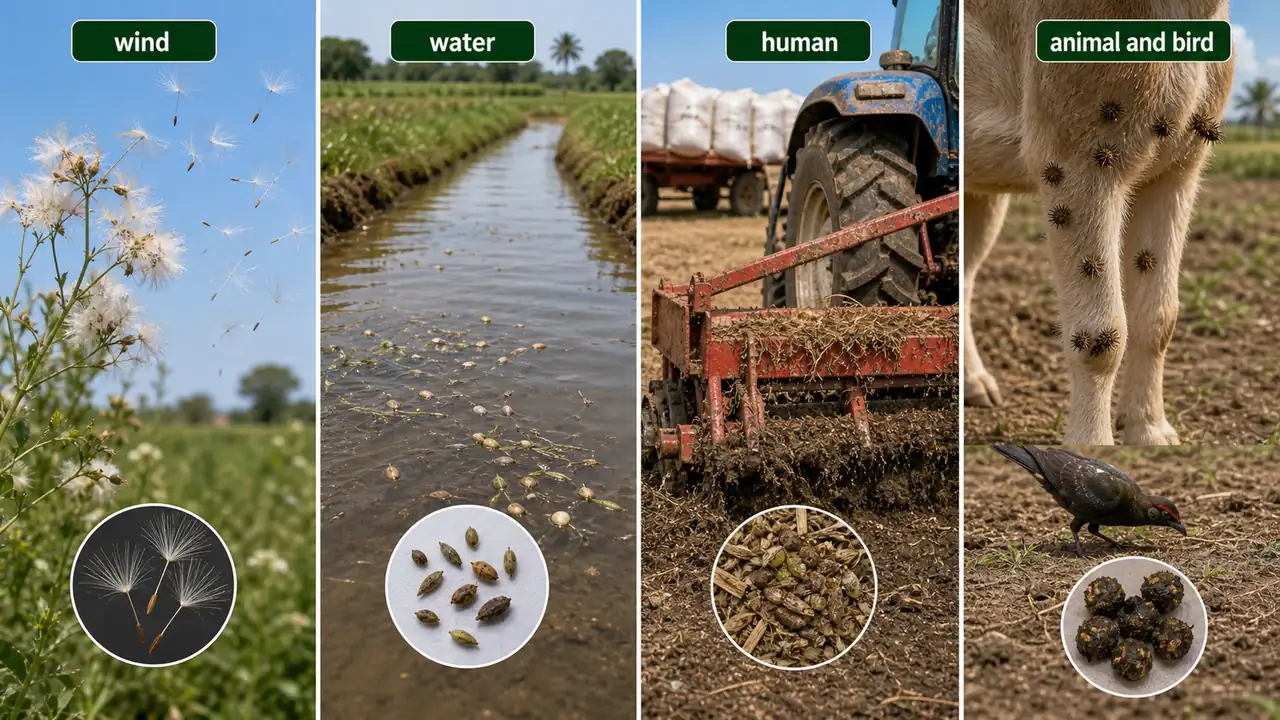
| Place | Example |
|---|---|
| Crop lands | Phalaris minor in wheat |
| Pasture lands | Indigofera enneaphylla |
| Waste places | Gynandropsis pentaphylla, Calotropis gigantea |
| Playgrounds, roadsides | Alternanthera echinata, Tribulus terrestris |
5. Based on Origin
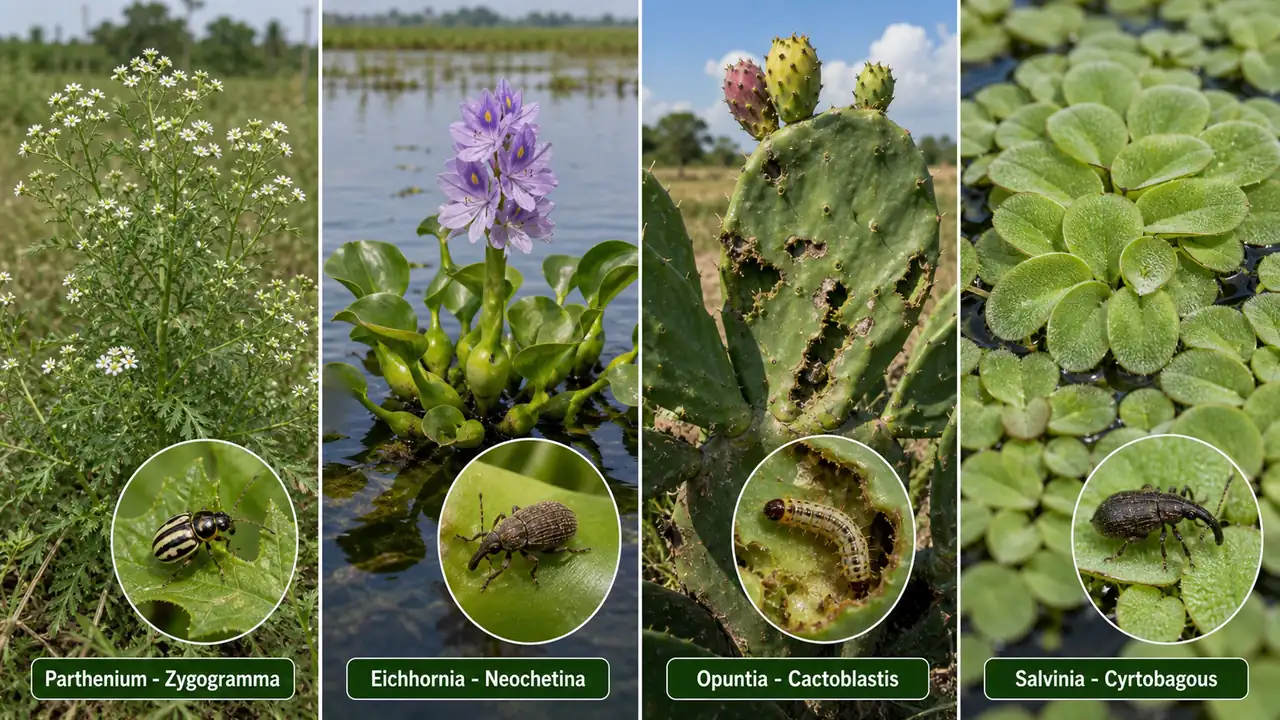
A. Indigenous (Native) Weeds
Species that evolved locally and are naturally present in the country.
- Examples: Acalypha indica, Abutilon indicum
B. Introduced / Exotic Weeds (Anthropytes / Alien Weeds)
Introduced from other countries, often accidentally. These are frequently the most troublesome because they arrive without their natural enemies.
| Weed | Introduced From | Purpose / Route |
|---|---|---|
| Sorghum halepense | USA | As forage crop |
| Lantana camara | -- | As ornamental |
| Opuntia stricta | Australia | As fence crop |
| Parthenium hysterophorus | America | With cereal import (PL-480 scheme) |
| Eichhornia crassipes | South America | -- |
| Tribulus terrestris | Mediterranean | -- |
| Phalaris minor | -- | Came to India in 1960 |
Many of India's worst weeds -- Parthenium, Lantana, Eichhornia -- are exotic introductions. Weeds introduced with human aid are called Anthropytes.
TIP
Exam alert: Parthenium arrived in India through the PL-480 food grain import scheme from America -- a frequently asked question.
6. Based on Cotyledon Number
This division determines leaf shape, root system, and critically, herbicide susceptibility.
| Type | Features | Key Family | Example |
|---|---|---|---|
| Monocots (grassy/narrow-leaf) | 1 cotyledon, fibrous root, parallel venation | Poaceae | Panicum maximum, Echinochloa crusgalli |
| Dicots (broadleaved) | 2 cotyledons, tap root, reticulate venation | Asteraceae | Parthenium, Chenopodium |
NOTE
This distinction is critical for herbicide selection: 2,4-D kills broadleaf (dicot) weeds while sparing grassy (monocot) crops like wheat and rice.
7. Based on Soil pH
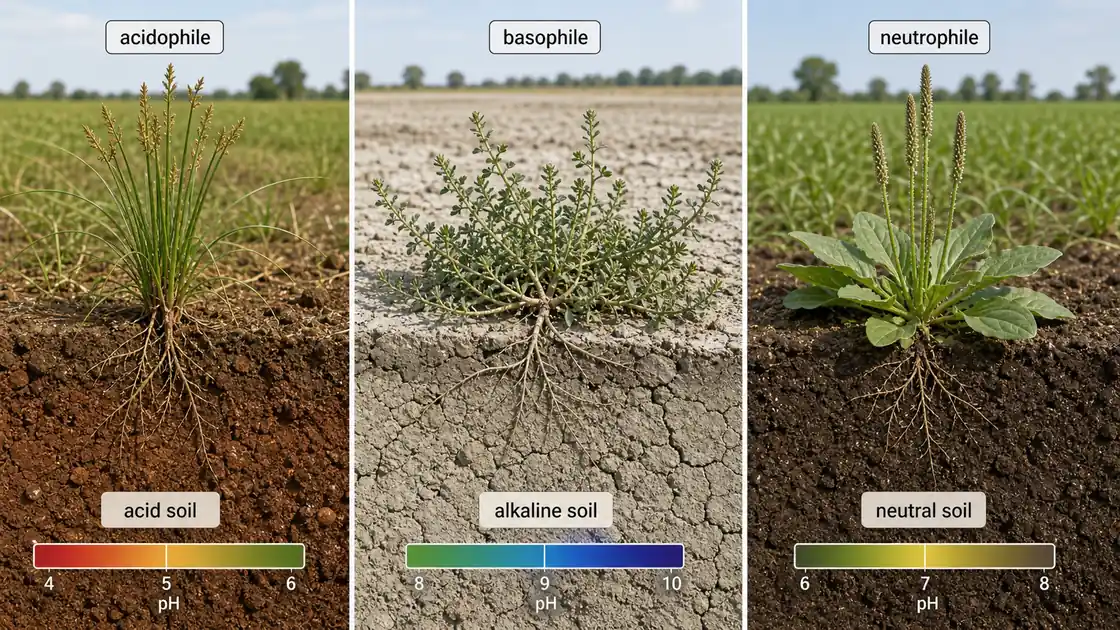
| Type | Soil Preference | Example |
|---|---|---|
| Acidophiles | Acid soils (low pH) | Rumex acetosella |
| Basophiles | Alkaline soils (high pH) | Prosopis sp. |
| Neutrophiles | Neutral soils (pH ~7) | Acalypha indica |
TIP
Mnemonic -- "ABN": Acidophiles (acid), Basophiles (basic/alkaline), Neutrophiles (neutral).
8. Based on Morphology -- The Most Widely Used System
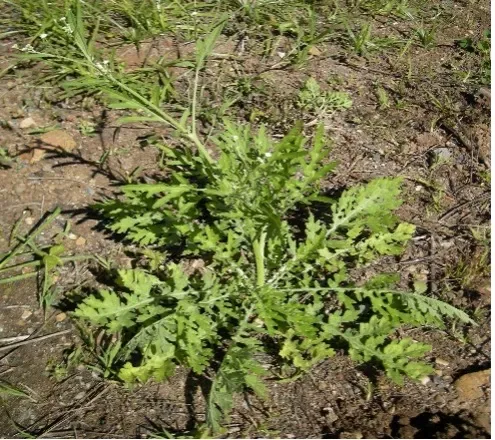
This is the most widely used classification because it is practical for field identification and herbicide selection.
| Type | Family | Key Identification Feature | Example |
|---|---|---|---|
| Grasses | Poaceae | Long narrow leaves, cylindrical hollow stem | Echinochloa colonum, Cynodon dactylon |
| Sedges | Cyperaceae | Triangular stem, leaves from base | Cyperus rotundus, Fimbristylis miliacea |
| Broadleaved | All other families | Wide, flat leaves (all dicots) | Flaveria australasica, Digera arvensis |
TIP
Field rule: "Sedges have edges, rushes are round, grasses have nodes from the top to the ground." The triangular stem cross-section is the fastest way to distinguish sedges from grasses.
9. Based on Nature of Stem
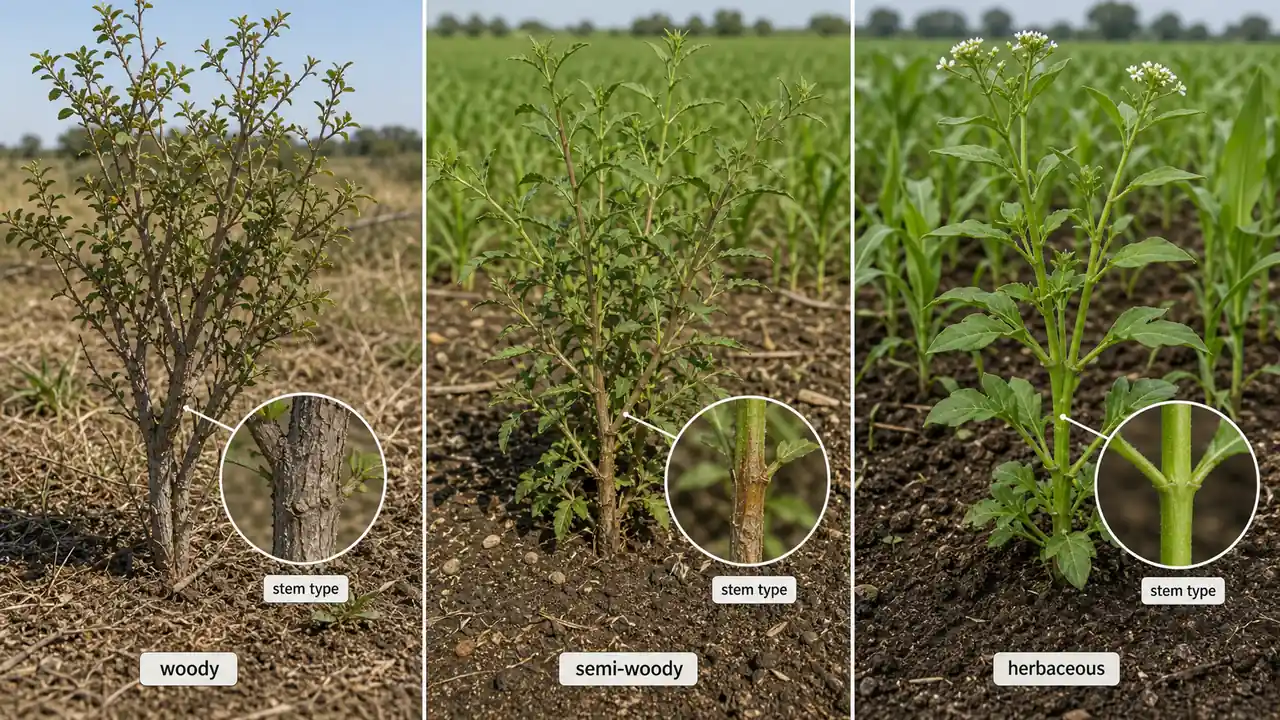
| Type | Description | Example |
|---|---|---|
| Woody (brush weeds) | Shrubs with bark; difficult to uproot | Lantana camara, Prosopis juliflora |
| Semi-woody | Intermediate bark development | Croton sparciflorus |
| Herbaceous | Succulent stems without bark; most common in crop fields | Amaranthus viridis |
10. Based on Specificity (Special Harmful Properties)
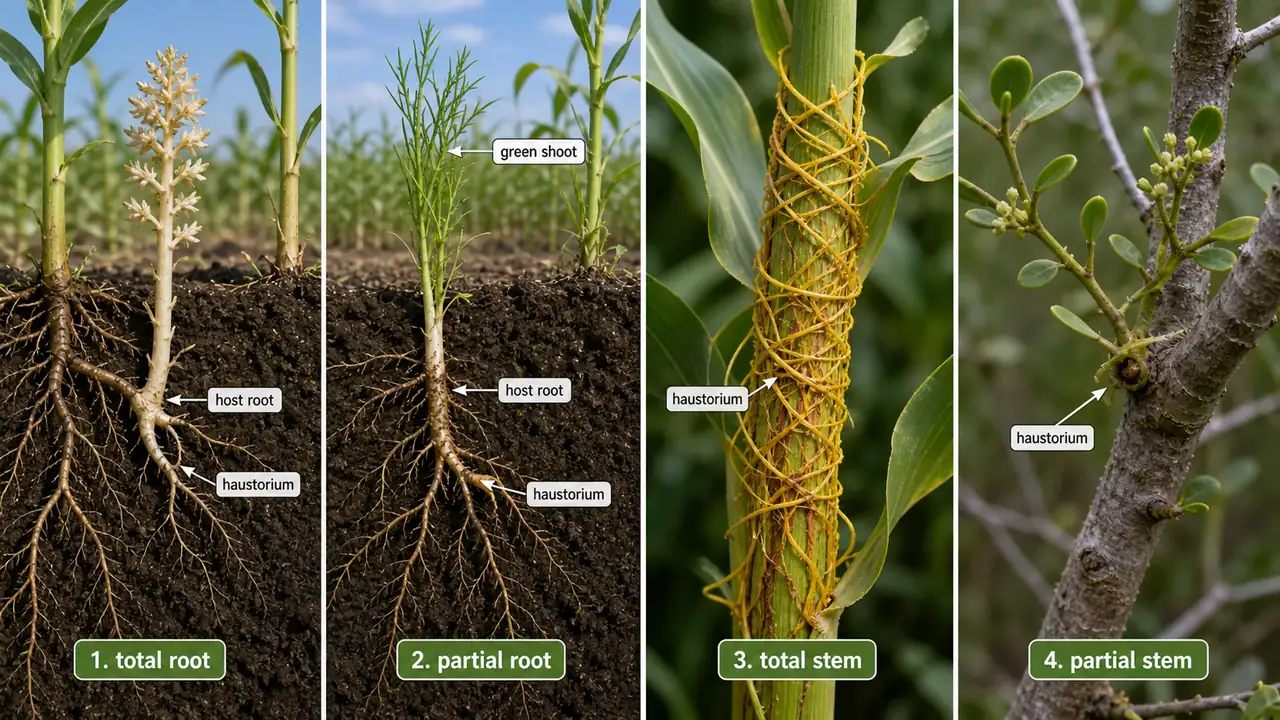
A. Poisonous Weeds
Contain toxins dangerous to humans and animals:
- Datura stramonium, D. innoxia -- poisonous due to tropane alkaloids
- Berries of Withania somnifera and seeds of Abrus precatorius are poisonous
B. Parasitic Weeds
(Covered in detail in the next lesson)
C. Aquatic Weeds
(Covered in detail in the next lesson)
11. Based on Relative Position / Presence
This is a very important classification for exams. Each term describes a specific relationship between the weed and the crop system.
| Type | Definition | Example |
|---|---|---|
| Absolute weeds | Always weeds; have no crop value whatsoever | Phalaris minor, Rumex spp. |
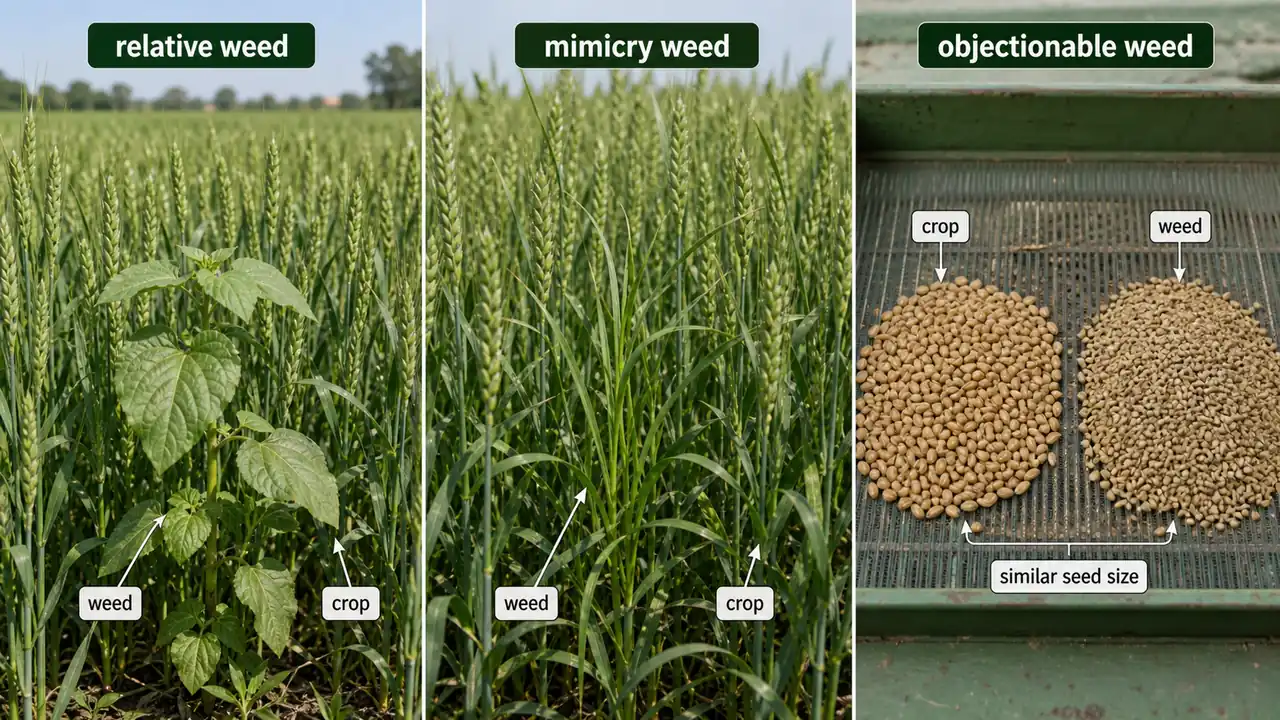
| Relative weeds | A crop plant out of place in another crop | Mustard growing in a wheat field |
| Rogue | An off-type variety within a crop field (genetically different from the cultivated variety) | HD 1329 plants in an HD 2285 wheat field |
| Volunteer weeds | Arise from fallen seeds of the previous crop | Wheat plants in a subsequent rice crop |
| Mimicry weeds | Similar morphology to the crop, making identification difficult | Phalaris in wheat, wild rice in rice |
| Noxious weeds | Especially troublesome; often legally designated | Parthenium, Cyperus rotundus |
| Objectionable weeds | Seeds difficult to separate from crop seeds due to similar size/shape | Convolvulus in wheat, Argemone in mustard |
| Satellite weeds | Consistently associated with specific crops as integral part of the ecosystem | Associated with particular crops |
IMPORTANT
Distinguish carefully: Mimicry weeds look like the crop (hard to identify in the field), while Objectionable weeds have seeds similar to the crop (hard to separate at harvest). Both are exam favourites.
12. Based on Association
This system classifies weeds by their relationship to seasons, crops, and habitats.
| Association Type | Description | Example |
|---|---|---|
| Season-bound | Grow in a specific season regardless of crop | Sorghum halepense (summer), Cirsium arvense (winter) |
| Crop-bound | Specifically associated with certain crops; often parasitic | Cuscuta, Orobanche, Striga |
| Obligate (Anthropytes) | Found only in cultivated land, never in the wild | Convolvulus, Chenopodium album |
| Facultative (Apophytes) | Grow both in wild and cultivated habitats | Argemone mexicana, Euphorbia hirta, Opuntia |
TIP
Memory hook: Anthropytes = "Anthro" (human) = only in human-cultivated land. Apophytes = "Apo" (away/independent) = found in the wild too.
All 12 Systems at a Glance -- Quick-Revision Summary Table
| # | Classification Basis | Key Categories |
|---|---|---|
| 1 | Life span (Ontogeny) | Annual, Biennial, Perennial |
| 2 | Ecological affinity | Wetland, Garden land, Dryland |
| 3 | Soil type (Edaphic) | Black cotton, Red, Sandy, Laterite |
| 4 | Place of occurrence | Cropland, Pasture, Waste, Roadside |
| 5 | Origin | Indigenous vs Exotic (Anthropytes) |
| 6 | Cotyledon number | Monocot (grassy) vs Dicot (broadleaved) |
| 7 | Soil pH | Acidophile, Basophile, Neutrophile |
| 8 | Morphology (most used) | Grasses, Sedges, Broadleaved |
| 9 | Nature of stem | Woody, Semi-woody, Herbaceous |
| 10 | Specificity | Poisonous, Parasitic, Aquatic |
| 11 | Relative position | Absolute, Relative, Rogue, Volunteer, Mimicry, Noxious, Objectionable, Satellite |
| 12 | Association | Season-bound, Crop-bound, Obligate, Facultative |
TIP
Master mnemonic for all 12 systems -- "LESS POMP N' RAP": Life span, Ecology, Soil type, Specificity, Place, Origin, Morphology, PH, Nature of stem, Relative position, Association, coPtyledon number.
Summary Cheat Sheet
| Concept / Topic | Key Details |
|---|---|
| 12 classification systems | 12 systems: Life span, Ecology, Soil type, Specificity, Place, Origin, Morphology, pH, Stem, Position, Association, Cotyledon |
| Ontogeny | Annual (1 year), Biennial (2 years), Perennial (3+ years) |
| Ephemerals | Annuals completing cycle in 2-4 weeks (Phyllanthus fraternus) |
| Morphology (most used) | Most widely used — Grasses (parallel veins), Sedges (triangular stem), Broadleaved (net veins) |
| Obligate weeds (Anthropytes) | Only in cultivated land, never wild — Convolvulus, Chenopodium |
| Facultative weeds (Apophytes) | Both wild and cultivated — Argemone, Euphorbia, Opuntia |
| Acidophile | Grows in acidic soil — Rumex acetosella |
| Basophile | Grows in alkaline soil — Prosopis sp. |
| Mimicry weed | Resembles the crop — hard to identify in the field |
| Noxious weed | Legally declared harmful — Parthenium, Cyperus rotundus |
| Absolute weed | Always a weed; no crop value — Phalaris minor |
| Rogue | Off-type plant within a crop |
| Volunteer weed | Previous crop plant in current crop |
| Season-bound | Grows in specific season regardless of crop |
| Crop-bound | Associated with specific crops; often parasitic |
| Phalaris minor in India | Arrived in 1960 |
| Parthenium route | Arrived via PL-480 food grain import from America |
| Mnemonic | LESS POMP N' RAP for all 12 systems |