🪱 Parasitic and Aquatic Weeds: Types, Examples, Hosts and Control
Answer-first notes on parasitic weeds like Orobanche, Striga, Cuscuta and Loranthus, plus aquatic weeds like Eichhornia, Salvinia and Hydrilla for agriculture exams.
When Weeds Feed on Crops
Quick answer: Parasitic weeds attach to a host through haustoria and steal food, water or minerals; the four exam types are Orobanche (total root), Striga (partial root), Cuscuta (total stem) and Loranthus (partial stem). Aquatic weeds grow in water bodies; the most asked examples are Eichhornia crassipes (water hyacinth), Salvinia molesta, Hydrilla, Typha and lotus.
| Search Query / Exam Prompt | Direct Answer |
|---|---|
| Parasitic weed of tobacco | Orobanche (broomrape), a total root parasite |
| Parasitic weed of sorghum / maize | Striga (witch weed), a partial root parasite |
| Parasitic weed of lucerne | Cuscuta (dodder), a total stem parasite |
| Parasitic weed of mango | Loranthus, a partial stem parasite |
| Worst floating aquatic weed in India | Eichhornia crassipes (water hyacinth) |
| World's worst aquatic weed | Salvinia molesta |
| Submerged aquatic weed example | Hydrilla |
In the previous lesson, we explored the 12 classification systems of weeds, including a brief mention of parasitic and aquatic weeds under "specificity." Now we dive deep into these two special categories that behave very differently from ordinary weeds -- they do not merely compete, they directly parasitise host plants or infest water bodies.
In the tobacco fields of Andhra Pradesh, farmers sometimes notice stunted, yellowing plants long before any above-ground intruder is visible. Underground, Orobanche (broomrape) has already latched onto the tobacco roots, silently draining water and nutrients. By the time its fleshy purple flower stalk breaks through the soil, the damage is done.
This lesson covers:
- Four types of parasitic weeds -- total/partial, root/stem combinations
- Aquatic weed categories -- submerged, emerged, marginal, floating
- Control methods for parasitic and aquatic weeds
- Taxonomic families of important weeds
Parasitic Weeds -- Overview
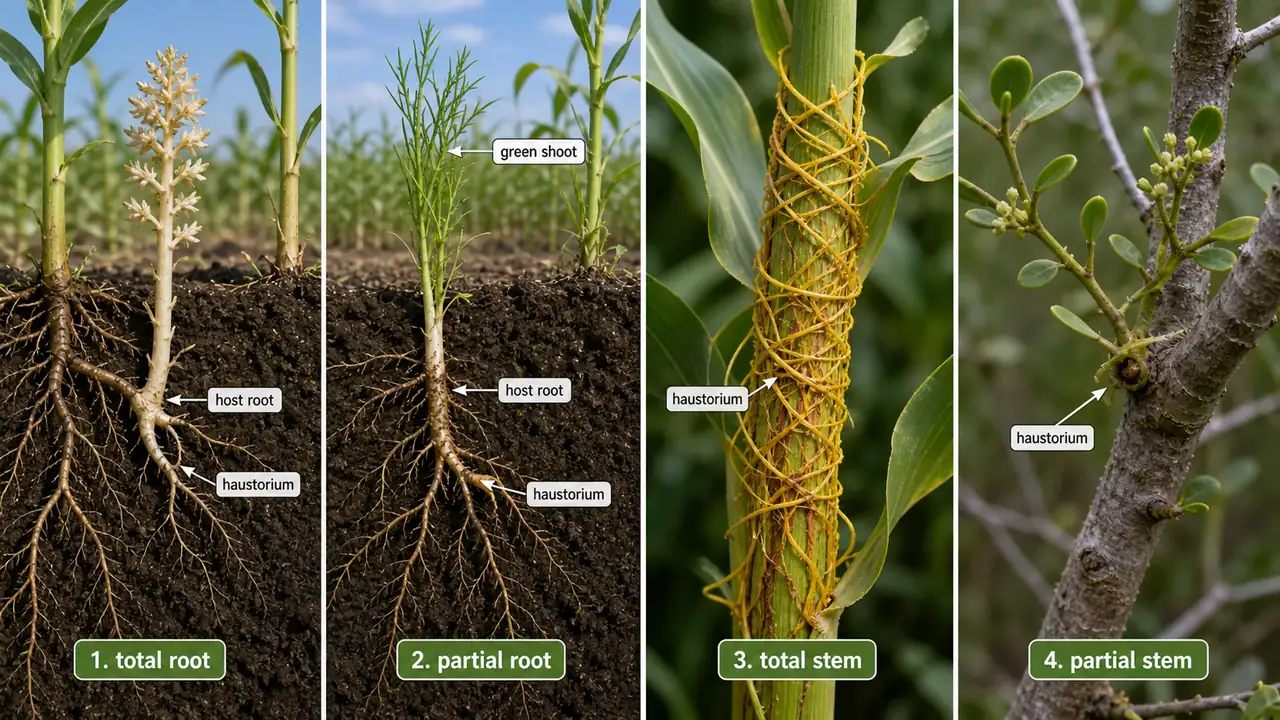
Parasitic weeds are classified on two axes:
- Degree of dependence: Total (holoparasite -- no chlorophyll) vs Partial (hemiparasite -- develops chlorophyll later)
- Site of attachment: Root parasite vs Stem parasite
This creates four distinct types:
Parasitic Weeds Exam Table
| Type | Example | Common Name | Main Host / Crop | One-Line Identification | Control Pointer |
|---|---|---|---|---|---|
| Total root parasite | Orobanche | Broomrape | Tobacco, tomato, mustard, solanaceous crops | Fleshy, non-green shoot emerges near host | Long rotation; trap crop such as chilli |
| Partial root parasite | Striga | Witch weed | Sorghum, maize, sugarcane | Damage starts before emergence | Resistant varieties, rotation, sanitation |
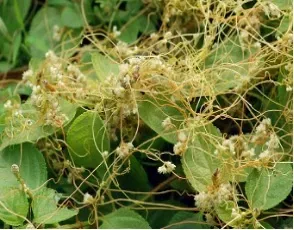
| Total stem parasite | Cuscuta | Dodder | Lucerne, niger, linseed | Yellow/orange thread-like vine | Clean seed; 20% salt solution seed separation |
| Partial stem parasite | Loranthus | Birdvine | Mango and fruit trees | Green parasite on branches | Pruning / directed herbicide on infected branch |
Type 1: Total Root Parasite (Holoparasite)
Takes all nutrition from host roots. Completely lacks chlorophyll -- appears as non-green, fleshy structures emerging from soil near the host.
- Orobanche sp. (Broomrape) parasitises tobacco, tomato, fababean, chickpea, mustard, chilli, brinjal, potato -- mostly Solanaceous crops
- Attaches to host roots underground; difficult to detect until it emerges to flower
- Control: Long crop rotation with tobacco once in 3 years, preceded by chilli as a trap crop (stimulates Orobanche germination but chilli is a poor host, so the parasite dies without reproducing)
Type 2: Partial Root Parasite (Hemiparasite)
Depends on host roots during the underground stage, but after emergence becomes green and photosynthetic -- a "semi-independent" parasite.
- Striga hermonthica / asiatica (= lutea) (Witch weed) attacks sorghum, maize, sugarcane, sunflower
- Called "witch weed" because it causes severe crop damage before it even emerges -- the crop appears bewitched
- Striga gesnerioides specifically parasitises cowpea
Type 3: Total Stem Parasite (Holoparasite)
Takes all nutrition from the host stem through specialised haustoria. No chlorophyll -- appears as yellow or orange thread-like vines wrapping around the host.
- Cuscuta campestris / chinensis / epilinum (Dodder) parasitises alfalfa (lucerne), niger, linseed respectively
- Earlier placed in family Convolvulaceae; now in separate family Cuscutaceae
- Control: Float fenugreek and lucerne seeds in 20% salt solution before sowing -- lighter Cuscuta seeds float to the surface for easy removal
Type 4: Partial Stem Parasite (Hemiparasite)
Initially depends on host stem, but later becomes green and can photosynthesise. Typically attacks perennial woody plants.
- Loranthus longiflorus (Birdvine) -- found on mango and other fruit trees; birds disperse its sticky seeds
- Cassytha filiformis on orange, eucalyptus -- twines anti-clockwise like Cuscuta but is greener (partial photosynthesis)
- Control: Spray of Glyphosate + 0.2% on infected branches
Comparison Table: Four Types of Parasitic Weeds
| Feature | Total Root | Partial Root | Total Stem | Partial Stem |
|---|---|---|---|---|
| Example | Orobanche | Striga | Cuscuta | Loranthus |
| Common Name | Broomrape | Witch weed | Dodder | Birdvine |
| Chlorophyll | Absent | Develops after emergence | Absent | Develops later |
| Attachment | Host roots (underground) | Host roots (underground) | Host stem (above ground) | Host stem (above ground) |
| Host Crops | Tobacco, mustard, Solanaceae | Sorghum, maize, sugarcane | Lucerne, niger, linseed | Mango, fruit trees |
| Dependence | 100% on host | Partial (semi-independent) | 100% on host | Partial (semi-independent) |
TIP
Mnemonic -- "CLOS": Cuscuta (Total Stem), Loranthus (Partial Stem), Orobanche (Total Root), Striga (Partial Root). This order covers all four types.
NOTE
The key distinction: Total parasites have NO chlorophyll (completely dependent), while Partial parasites develop chlorophyll after emergence (semi-independent).
Aquatic Weeds
While parasitic weeds attack crops directly by feeding on them, aquatic weeds create a different set of problems entirely. They grow in water and complete at least part of their life cycle in water, choking waterways, impeding irrigation, reducing dissolved oxygen, and lowering fish production. Unlike terrestrial weeds that compete in fields, aquatic weeds disrupt water infrastructure critical for agriculture. They are classified by their position relative to the water surface.
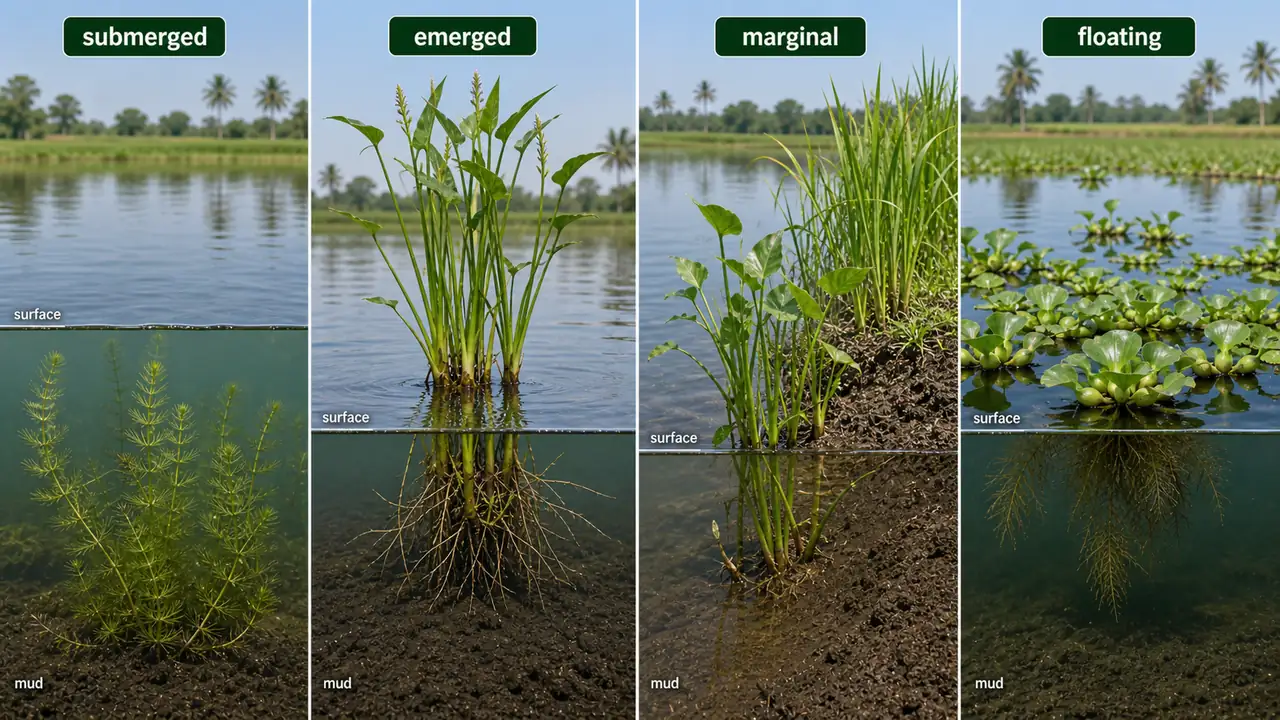
ICAR's Indian Farming review lists water hyacinth, water fern, alligator weed and water lettuce among important floating aquatic weeds in India; lotus, cattail and water lily among emergent weeds; and Hydrilla, bladderwort and Eurasian water milfoil among submerged problem weeds. This is why exam questions usually ask both growth position and common example.
1. Submerged Weeds
Produce most vegetative growth beneath the water surface. Leaves are thin and finely divided to maximise surface area for absorbing dissolved gases.
- Examples: Utricularia stellaris, Ceratophyllum demersum, Hydrilla
2. Emerged (Emersed) Weeds
Rooted in bottom mud, with aerial stems and leaves at or above the water surface. They do not rise or fall with changing water levels -- rigid stems hold them in place.
- Examples: Nelumbium speciosum (Lotus), Jussiaea repens
3. Marginal Weeds
Emergent rooted weeds found in moist shoreline areas with water depth up to 0.5 metres (60-90 cm). They form dense stands along pond, lake and canal edges.
- Examples: Typha sp. (Cattail), Polygonum sp., Cephalanthus, Scirpus
4. Floating Weeds
Leaves float on the water surface. Some are free-floating (not attached to the bottom), others are rooted with floating leaves. Free-floating types spread most rapidly.
| Weed | Common Name | Key Fact |
|---|---|---|
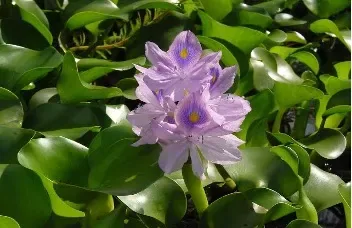
| Eichhornia crassipes | Water Hyacinth | Known as "weed of fishermen"; provides fish breeding ground but clogs water bodies |
| Salvinia molesta | -- | Considered the world's worst aquatic weed; can double biomass in days |
| Pistia stratiotes | Water cabbage | Free-floating rosette |
| Nymphaea sp. | Water lily | Rooted with floating leaves |
Comparison of Aquatic Weed Types
| Type | Position | Rooted? | Example |
|---|---|---|---|
| Submerged | Below water surface | Yes | Hydrilla, Ceratophyllum |
| Emerged | Stems above water, rooted in mud | Yes | Lotus, Jussiaea |
| Marginal | Shoreline, up to 0.5 m depth | Yes | Typha (Cattail) |
| Floating | On water surface | Some yes, some no | Eichhornia, Salvinia |
IMPORTANT
For control of aquatic weeds, the two most commonly used chemicals are 2,4-D and Copper Sulphate (CuSO4).
Obsolete Mechanical Controls for Aquatic Weeds
| Method | How It Works |
|---|---|
| Chaining | Heavy chain pulled through ditch bottom by two tractors on either bank, uprooting submerged weeds |
| Dredging | Mechanical pulling of weeds along with roots and rhizomes embedded in bottom mud |
Both methods are rarely used today due to high cost and environmental disturbance.
Families of Important Weeds
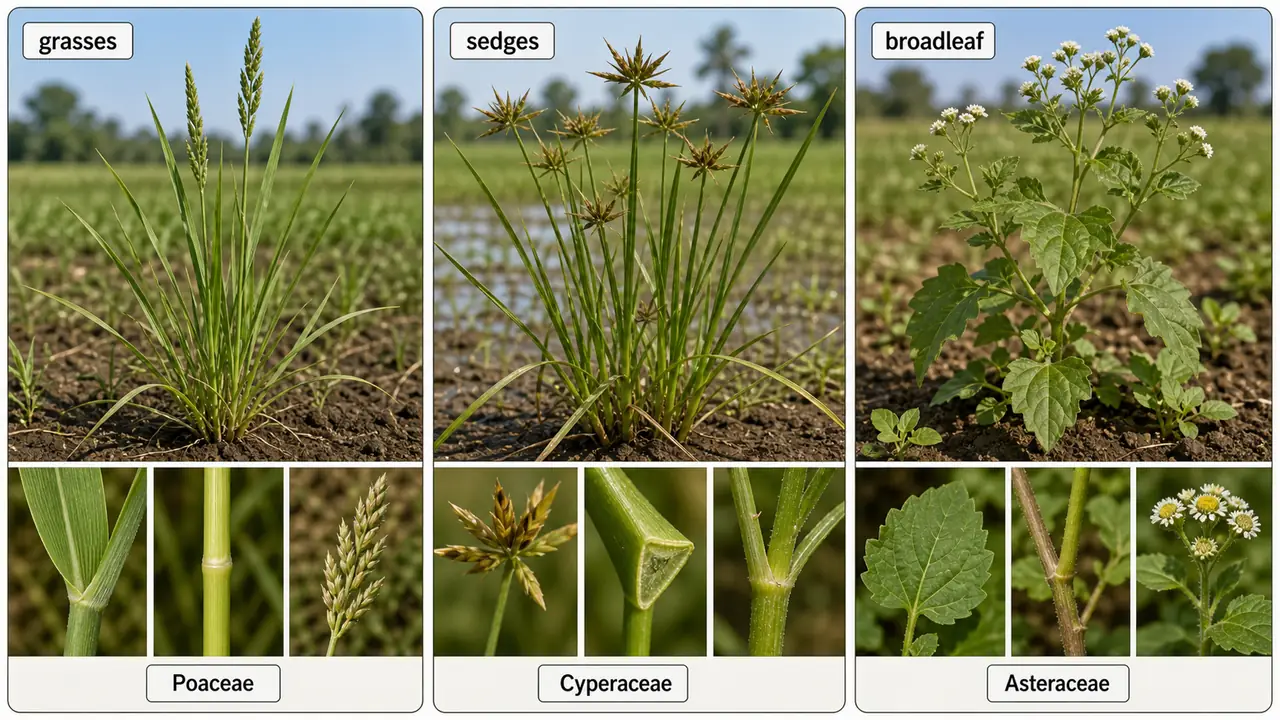
Beyond the parasitic/aquatic distinction, knowing the taxonomic family of a weed is essential because herbicide selectivity often works at the family level. A herbicide effective against Poaceae (grasses) may be useless against Cyperaceae (sedges) or Asteraceae (composites).
| Weed | Family |
|---|---|
| Lantana camara | Verbenaceae |
| Striga spp. | Scrophulariaceae |
| Argemone mexicana | Papaveraceae |
| Echinochloa spp. | Gramineae (Poaceae) |
| Cyperus rotundus | Cyperaceae |
| Parthenium hysterophorus | Asteraceae |
| Cuscuta spp. | Cuscutaceae (earlier Convolvulaceae) |
TIP
The two most important weed families are Poaceae (grasses -- monocot weeds) and Asteraceae (composites -- dicot weeds like Parthenium).
Summary Cheat Sheet
| Concept / Topic | Key Details |
|---|---|
| Total root parasite | Orobanche (Broomrape) — no chlorophyll; attacks Solanaceae |
| Partial root parasite | Striga (Witch weed) — develops chlorophyll; attacks sorghum/maize |
| Total stem parasite | Cuscuta (Dodder) — no chlorophyll; attacks lucerne/niger |
| Partial stem parasite | Loranthus (Birdvine) — develops chlorophyll; attacks mango |
| Parasitic mnemonic | CLOS: Cuscuta, Loranthus, Orobanche, Striga |
| Cuscuta seed separation | Float in 20% salt solution |
| Cuscuta family | Cuscutaceae (not Convolvulaceae) |
| World's worst aquatic weed | Salvinia molesta |
| Weed of fishermen | Eichhornia crassipes (Water Hyacinth) |
| Aquatic weed chemicals | 2,4-D and Copper Sulphate |
| Most important weed families | Poaceae (grasses) and Asteraceae (Parthenium) |
| Parthenium family | Asteraceae |
| Cyperus rotundus family | Cyperaceae |
| Lantana camara family | Verbenaceae |
| Marginal weeds depth | Up to 0.5 metres |
| Orobanche control | Crop rotation; chilli as trap crop |
| Loranthus control | Spray Glyphosate + 0.2% on infected branches |
| Striga on cowpea | Striga gesnerioides specifically parasitises cowpea |