🔗Weed-Crop Associations and Their Impact
Explore mimicry weeds, objectionable weeds under the Seed Act 1966, how weeds serve as alternate hosts for pests and diseases, toxic effects on livestock, and erosion of crop quality.
The Weed That Wears a Disguise
The previous lesson covered parasitic and aquatic weeds — special categories defined by how they feed and where they grow. This lesson shifts focus to the relationships between weeds and crops: how weeds mimic crops, contaminate seeds, harbour pests, poison livestock, and degrade produce quality. Understanding these associations explains why weeds cause damage far beyond simple competition for resources.
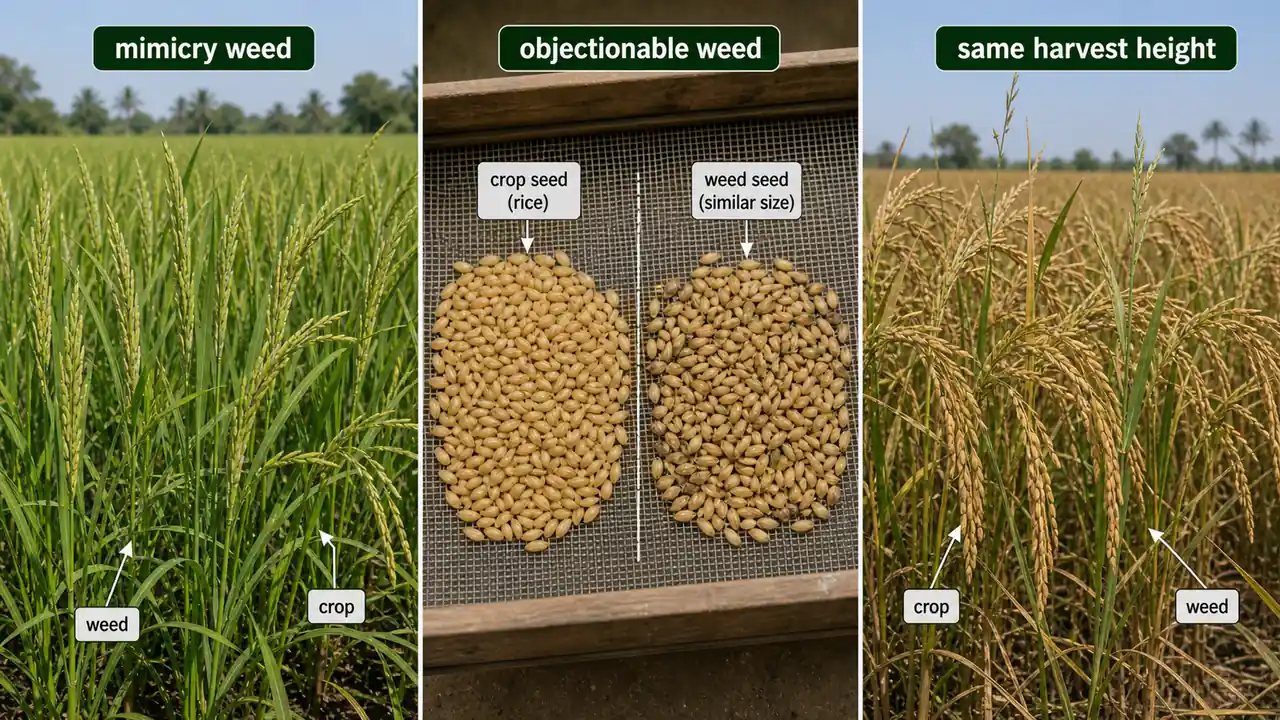
In the rice paddies of eastern India, wild rice (Oryza sativa var. fatua) grows among cultivated rice looking almost identical — same leaf shape, same height, same growth habit. Farmers cannot tell them apart until harvest, when the wild rice shatters and drops its inferior-quality grains back into the soil. This “mimicry” is not accidental — it is an evolutionary survival strategy. The closer a weed resembles the crop, the more likely it is to escape weeding and survive to reproduce.
This lesson covers:
- Mimicry and crop-specific weeds — weeds that resemble crops
- Objectionable weeds — seed contamination and the Seeds Act 1966
- Alternate hosts — weeds harbouring crop pests and diseases
- Livestock toxicity — HCN poisoning, lantanism, oxalate poisoning
- Crop-weed competition — nutrients, water, light, CO2
- Weed ecology — persistence, hardiness, succession, chemotypes
Crop-Specific and Mimicry Weeds
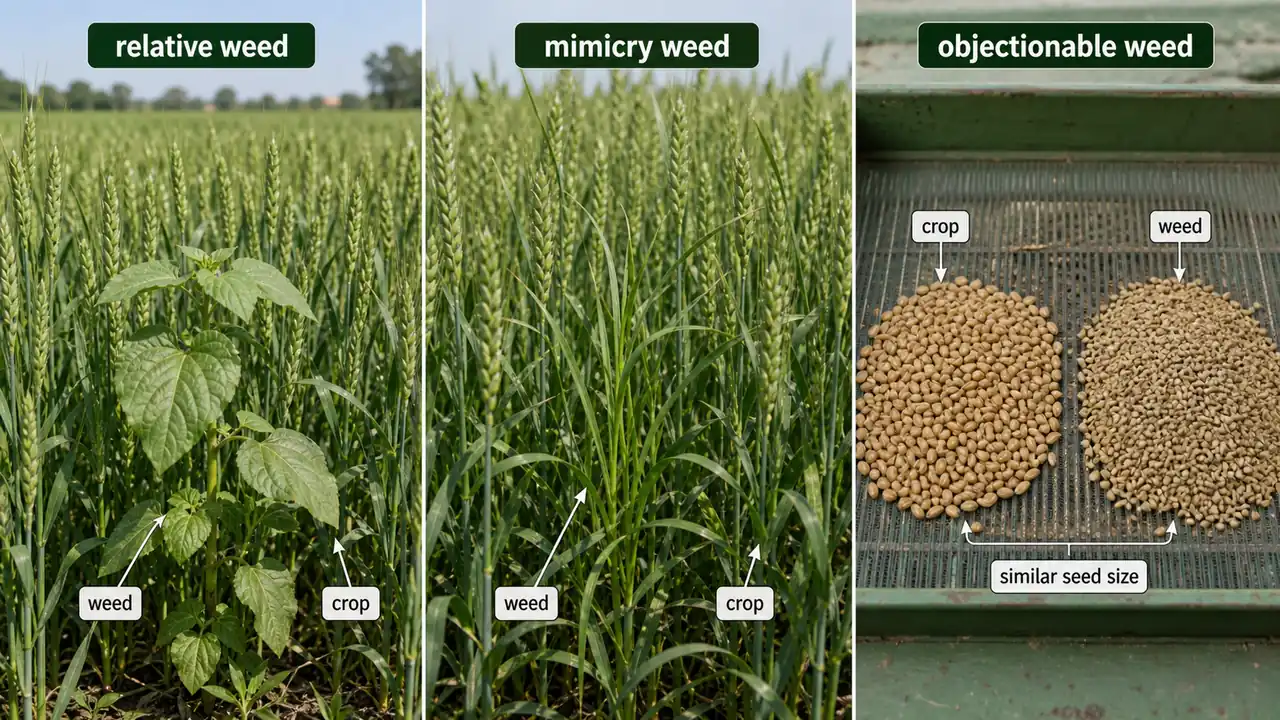
Mimicry weeds have similar external morphology to the crop, making them extremely difficult to identify and remove during weeding. This is an evolutionary adaptation that helps them survive manual and mechanical weeding.
| Crop | Common Weed Name | Scientific Name |
|---|---|---|
| Paddy | Wild rice / Red rice | Oryza sativa var. fatua |
| Wheat | Bindweed (Hirankhuri) | Convolvulus arvensis |
| Wheat | Wild oat | Avena fatua |
| Wheat | Canary grass | Phalaris minor |
| Okra | Wild okra | Abelmoschus spp. |
| Mustard | Mexican poppy (Satyanashi) | Argemone mexicana |
| Lucerne | Dodder | Cuscuta sp. |
| Berseem | Chicory (Kasni) | Cichorium intybus |
| Lettuce | Wild lettuce | Lactuca seriola |
| Cucurbits | Wild cucurbits | Cucurbita spp. |
| Methi | Sanji | Melilotus spp. |
Crop-specific weeds need a microenvironment matching the crop’s growing conditions. For example, Chicory thrives in the cool moist climate of berseem fields.
TIP
Exam favourite — the “wheat-weed trio”: Convolvulus arvensis (Bindweed), Avena fatua (Wild oat), and Phalaris minor (Canary grass). These three are the most frequently tested crop-weed associations.
Ready Contamination of Crop Seeds
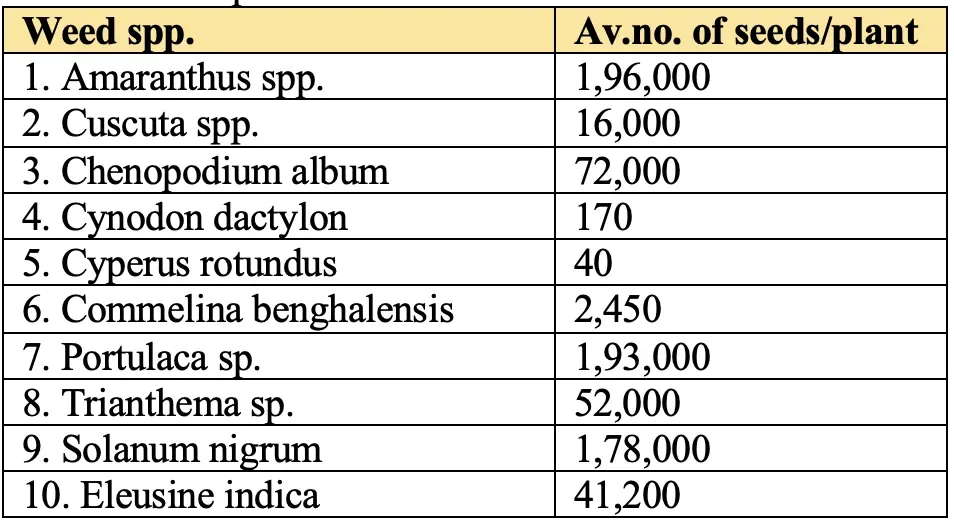
Some weeds mature their seeds at the same height and time as the crop, so their seeds get harvested along with the grain:
| Weed | Crop | Why It Contaminates |
|---|---|---|
| Allium sp. (wild alura) | Garlic | Both produce bulbils at similar heights |
| Phalaris minor | Wheat | Seeds ripen simultaneously and are of similar size |
This is a major reason why certified seed production requires stringent field inspections.
Objectionable Weeds
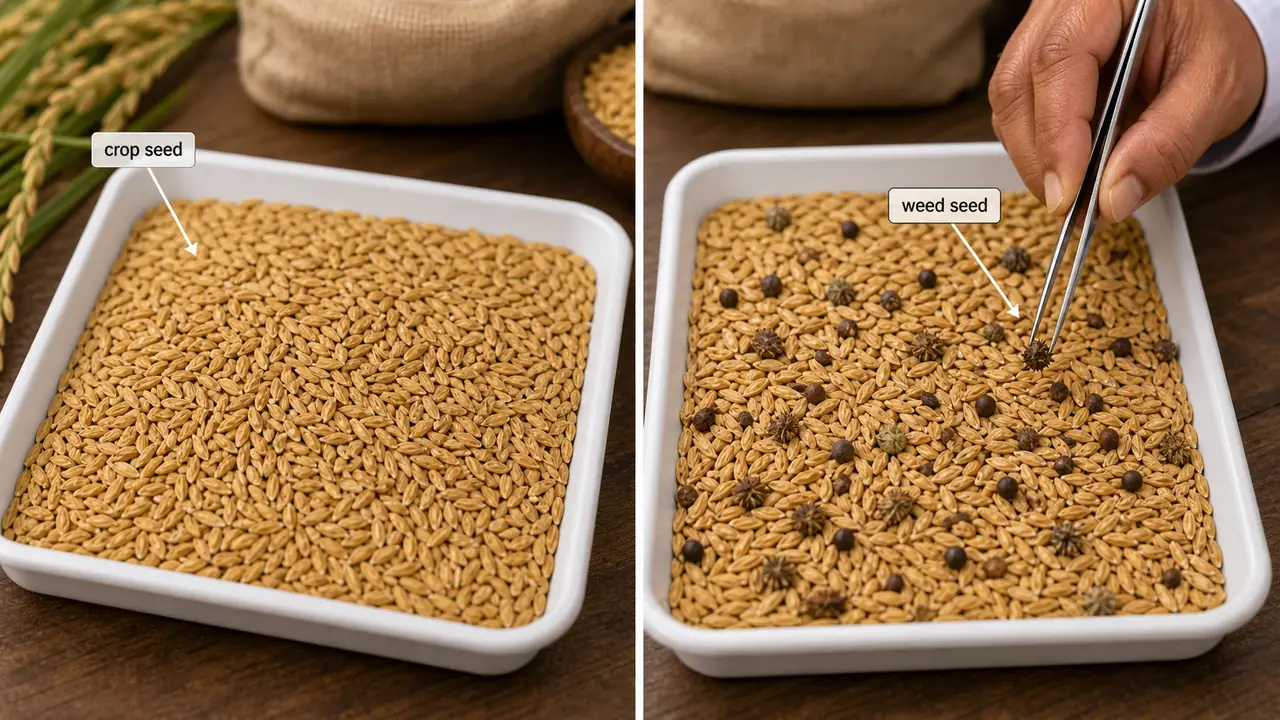
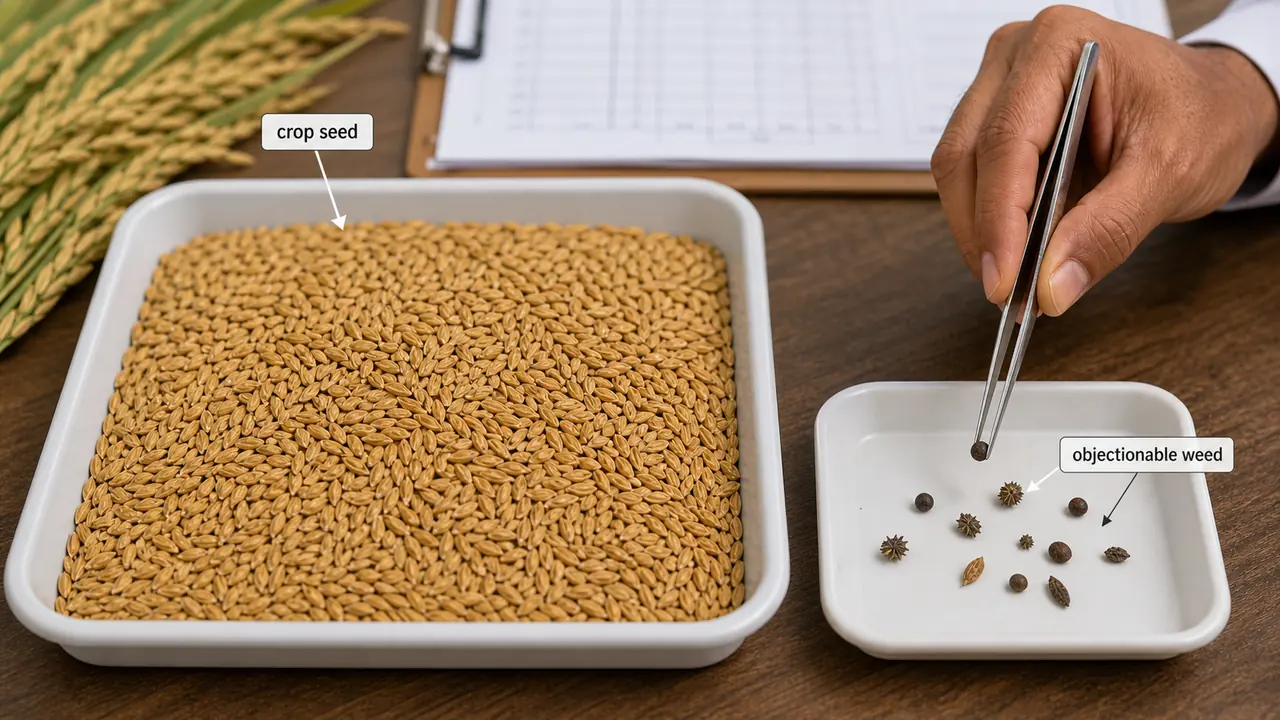
Objectionable weeds are those whose seeds are difficult to separate once mixed with crop seeds, due to similarity in size, shape or weight.
| Objectionable Weed | Associated Crop |
|---|---|
| Argemone mexicana | Mustard |
| Melilotus alba | Methi |
| Cuscuta (Dodder) | Lucerne |
| Cichorium intybus (Chicory) | Berseem |
| Wild rice | Rice |
| Convolvulus arvensis (Bindweed) | Wheat |
| Abelmoschus spp. | Okra |
Objectionable Weeds under the Indian Seeds Act, 1966
The Indian Seeds Act, 1966 sets legal limits on the maximum permissible percentage of objectionable weed seeds in certified seed lots. Exceeding these limits makes the seed lot unfit for sale.
| Crop | Objectionable Weed | Max Objectionable Limit | Max Total Weed Limit |
|---|---|---|---|
| Paddy | Wild rice / red rice | 0.01% | 0.1% |
| Wheat | Bindweed (Convolvulus) | 0.01% | 0.1% |
| Rape & Mustard | Mexican poppy (Argemone) | 0.1% | 0.5% |
| Egyptian clover | Chicory | 0.05% | 0.5% |
| Lucerne | Dodder | 0.5% | 0.5% |
| Okra | Wild okra | 0.0% | 0.0% |
IMPORTANT
Okra has ZERO tolerance — absolutely no wild okra seeds are permitted. This is the strictest standard among all crops under the Seed Act. Remember this for exams.
Mimicry vs Objectionable Weeds — A Key Comparison
| Feature | Mimicry Weeds | Objectionable Weeds |
|---|---|---|
| Problem | Look like the crop | Seeds look like crop seeds |
| Difficulty | Hard to identify in the field | Hard to separate at harvest |
| Example | Wild rice in paddy | Argemone in mustard |
| Impact | Escape weeding operations | Contaminate certified seed |
TIP
Mnemonic: Mimicry = Morphology match (plant looks similar). Objectionable = Output match (seed looks similar).
Weeds as Alternate Hosts for Insects and Diseases
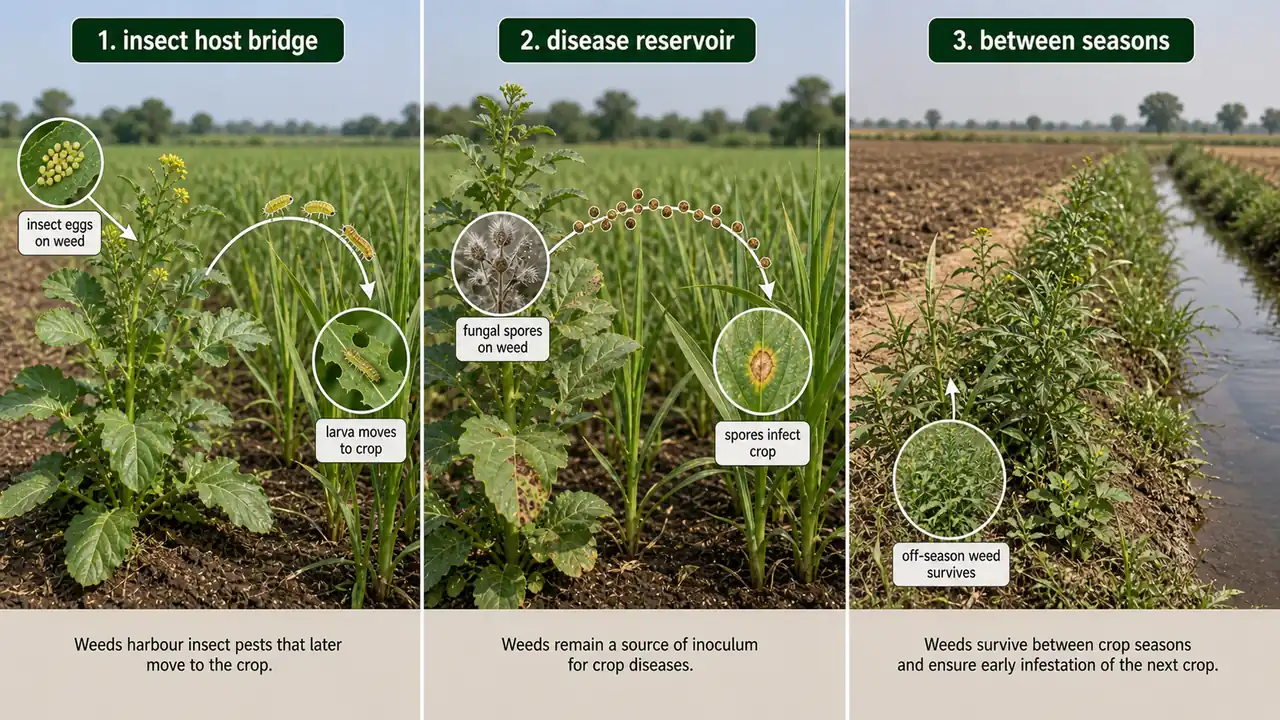
Weeds harbour pest and pathogen populations between crop seasons, ensuring pests are ready to attack the next crop. This is a major indirect loss caused by weeds.
| Weed | Pest / Disease Hosted | Crop Affected |
|---|---|---|
| Echinochloa colonum | Stem borer | Rice |
| Chenopodium album | Gram caterpillar | Cotton, Pea, Tomato |
| Chenopodium album | Stem borer | Maize |
| Agropyron portulaca | Wilt | Tomato |
| Cenchrus ciliaris | Ergot disease | Pearl millet (Bajra) |
| Leersia oryzoides | Bacterial leaf blight | Rice |
| Saccharum spontaneum | Downy mildew | Maize |
| Agropyron repens | Rust | Wheat |
| Lantana camara | American bollworm | Cotton |
| Avena fatua | Stem rust, Powdery mildew | Wheat, Barley |
| Parthenium hysterophorus | Tobacco streak virus | Tobacco |
| Amaranthus spp. | Gram caterpillar | Pigeonpea |
| Abutilon spp. | Spotted & pink bollworm | Cotton |
| Plantago ovata | TMV | Tobacco |
NOTE
Chenopodium album (Bathua) hosts pests for multiple crops — it is one of the most versatile alternate hosts. Lantana camara harbours the American bollworm that devastates cotton.
Effects of Weeds on Livestock
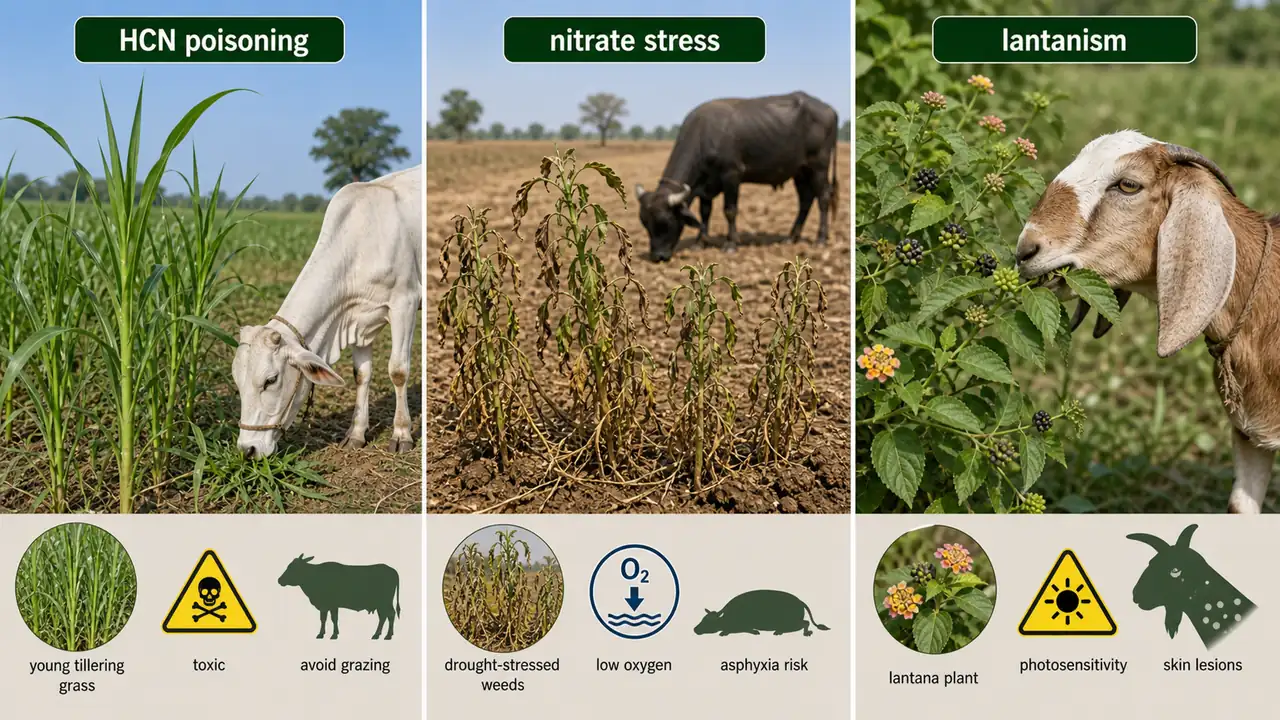
Several weeds produce toxic compounds that poison livestock through grazing or contaminated fodder.
| Weed | Toxic Effect | Toxin / Mechanism |
|---|---|---|
| Ageratum conyzoides (Goat weed) | Death of sheep/horses | High oxalate content |
| Sorghum halepense (Johnson grass) at tillering | Poisonous to cattle | Prussic acid (HCN) |
| Xanthium strumarium at tillering | Poisonous | Prussic acid |
| Chloropepium, Amaranthus, Crotalum, Polygonum (drought-stressed) | Asphyxia (oxygen starvation) in livestock | Nitrate >1000 ppm |
| Lantana camara | Photosensitivity and jaundice | Condition called Lantanism |
| Tribulus terrestris (Puncture vine) | Photosensitisation in sheep | Steroidal saponins |
WARNING
Weeds are most toxic at the tillering stage (young growth). Under drought stress, many otherwise harmless weeds accumulate dangerous nitrate levels. Always inspect fodder from weed-infested areas.
TIP
Exam terms: HCN poisoning = Johnson grass at tillering. Lantanism = Lantana-induced jaundice in animals. Oxalate poisoning = Ageratum/Amaranthus.
Erosion of Crop Quality by Weeds
Beyond reducing yield, weeds can degrade the quality of harvested produce:
| Crop | Weed | Quality Impact |
|---|---|---|
| Tea | Loranthus (Dendrophthoe falcata) — partial stem parasite | Diverts nutrients, impairs tea leaf quality |
| Rapeseed (Mustard) | Cirsium arvense (Canada thistle) | Contaminates seed, causes off-flavours in extracted oil |
Crop-Weed Competition for Resources
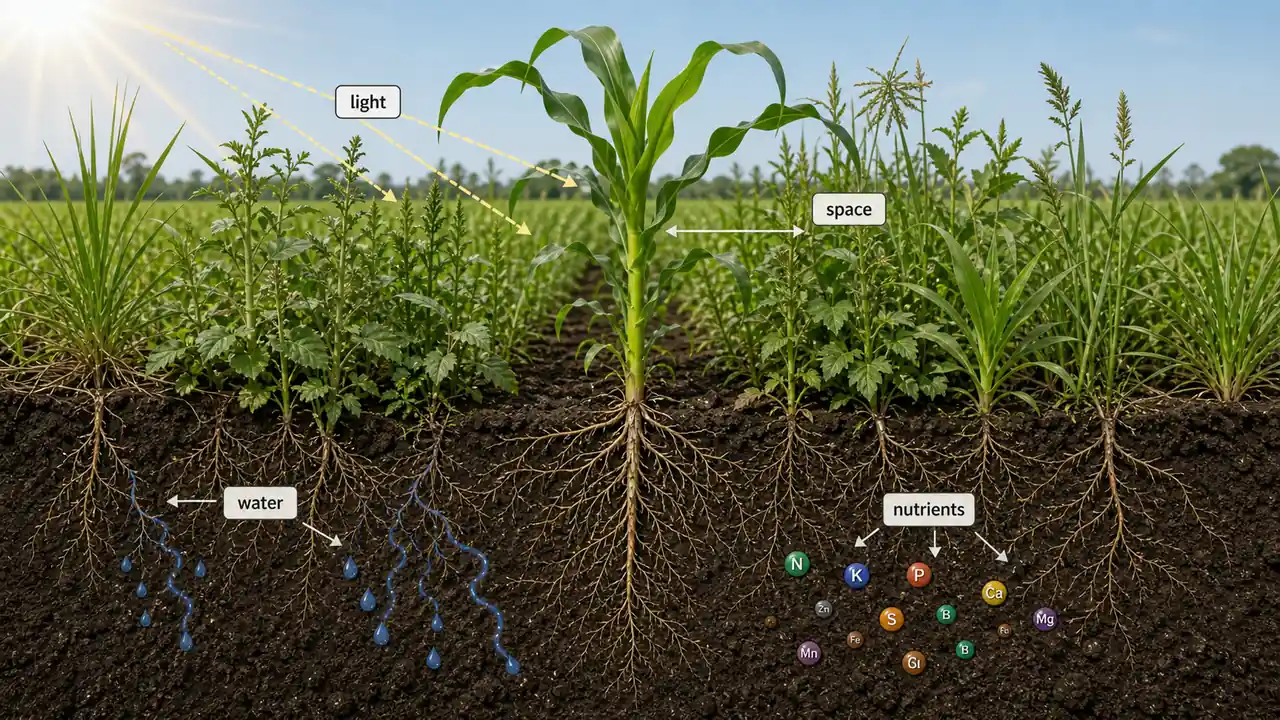
Beyond serving as alternate hosts and producing toxins, weeds cause their primary damage through direct competition for limited resources. This competition is the fundamental mechanism behind the yield losses discussed in the introduction lesson. Weeds and crops compete for nutrients, water, light, and CO2. When weed population crosses the threshold level, crop production declines. Competition is always negative for the crop and may be interspecific (between species) or intraspecific (within species).
Highest yield reduction through weeds: sugarbeet (slow early growth gives weeds time to establish).
| Resource | Key Facts | Example |
|---|---|---|
| Nutrients | Weeds absorb minerals faster than crops; remove twice the nutrients | Amaranthus accumulates > 3% N (nitrophyll) |
| Water | Weeds transpire more water for same dry matter; extract moisture from up to 90 cm depth | Chenopodium uses 550 mm vs wheat’s 479 mm (15% more) |
| Light | Plant height and vertical leaf area are key; shading damage is irreversible | Cotton, potato, sugarcane suffer heavy early-stage shading |
| CO2 (Space) | C4 weeds use CO2 more efficiently than C3 crops | Tropical C4 weeds outgrow C3 rice and wheat |
IMPORTANT
Nutrient competition is the most critical factor. Weeds like Amaranthus that accumulate > 3% nitrogen in their tissues are called nitrophyll plants — they literally starve the crop of nitrogen. Shading damage from weeds is irreversible — once the crop loses the light race, it cannot recover even if weeds are removed later.
Important Weeds of Major Crops
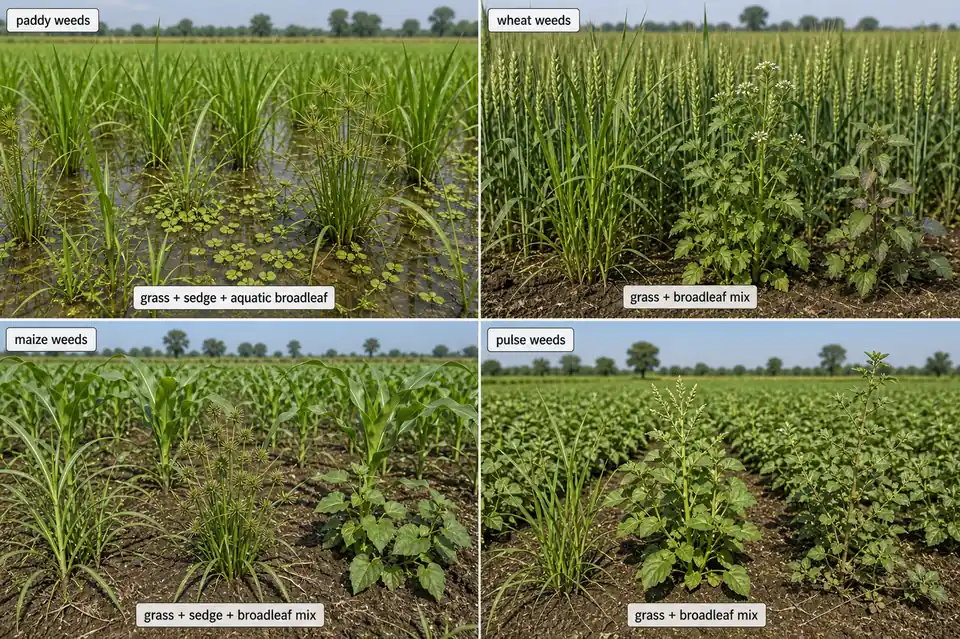
Kharif Crops
| Crop | Major Weeds |
|---|---|
| Paddy | Echinochloa spp., Cyperus spp., Wild rice, Celosia, Eclipta, Cynodon |
| Maize, Sorghum, Bajra | Phyllanthus, Amaranthus, Johnson grass, Cynodon, Cyperus, Partulaca |
| Soybean, Moong, Urd, Arhar, Groundnut, Cotton | Phyllanthus, Solanum nigrum, Amaranthus, Johnson grass, Celosia, Cynodon, Cyperus |
Rabi Crops
| Crop | Major Weeds |
|---|---|
| Wheat, Barley | Chenopodium, Anagallis, Phalaris minor, Wild oat, Melilotus, Cynodon, Cyperus, Convolvulus |
| Gram, Pea, Lentil, Potato, Mustard, Linseed | Fumaria, Anagallis, Chenopodium, Melilotus, Asphodelus, Argemone mexicana |
| Berseem | Chicorium intybus, Cynodon, Anagallis, Cyperus |
| Tobacco | Orobanche, Melilotus, Convolvulus, Cynodon, Cyperus |
| Sugarcane | Most kharif and rabi weeds (widest diversity — crop spans both seasons) |
TIP
Exam favourites: Paddy = Echinochloa; Wheat = Phalaris minor; Mustard = Argemone mexicana; Tobacco = Orobanche (a root parasite). Sugarcane hosts the widest diversity of weeds because it spans both kharif and rabi seasons.
Weed Ecology
The sections above focused on specific weed-crop interactions — mimicry, contamination, pest hosting, toxicity. Now we step back to look at the bigger picture: weed ecology, which studies the inter-relationship between weeds and their environment. These ecological principles explain why certain weeds dominate certain systems and why weed communities change over time.
Persistence
Persistence = the ability to repeatedly invade an environment even after apparent removal. This differs from hardiness (ability to withstand natural stresses). Weeds are both persistent and hardy, making them exceptionally difficult to eliminate.
| # | Persistence Mechanism | How It Helps the Weed |
|---|---|---|
| 1 | Prolific seed production | Massive seed output ensures population survival |
| 2 | Viable seed production | Seeds remain germinable for years/decades |
| 3 | Dormancy | Protects seeds from premature germination |
| 4 | Vegetative propagation | Regeneration from fragments |
| 5 | Rapid dispersal | Colonises new areas quickly |
| 6 | Inherent hardiness | Survives extreme weather, poor soils |
| 7 | Evasiveness | Escapes destruction by animals/humans |
| 8 | Self-regeneration | No artificial seedbed needed |
| 9 | Selective invasion | Adapts to changing cropping environment |
| 10 | Weed succession | New species replace controlled ones |
Persistence is influenced by climatic factors (light, temperature, rainfall, wind, humidity), edaphic factors (soil-related), and biotic factors (other organisms).
Inherent Hardiness
- Many tropical weeds (Cyperus, Amaranthus) use the C4 pathway — devoid of photorespiration, giving photosynthetic advantage over C3 crops in hot conditions.
- High transpiration efficiency, low nutrient requirements, slow translocation, high initial elongation rate.
Evasiveness
Weeds evade destruction through bitter taste, disagreeable odour, spiny nature, and mimicry. Animals refuse to eat them, and farmers struggle to distinguish them from crops.
Selective Invasion
Weed species composition changes with the cropping environment:
| Condition | Dominant Weeds |
|---|---|
| Dryland | Tribulus terrestris, Argemone mexicana, Euphorbia hirta |
| Irrigated | Trianthema monogyna, Phalaris minor, Commelina bengalensis |
| Paddy (wetland) | Echinochloa, Eclipta, Caesulia auxillaris |
NOTE
Changing the cropping environment changes the weed community. Shifting from dryland to irrigated agriculture will replace drought-tolerant weeds with moisture-loving species.
Weed Succession
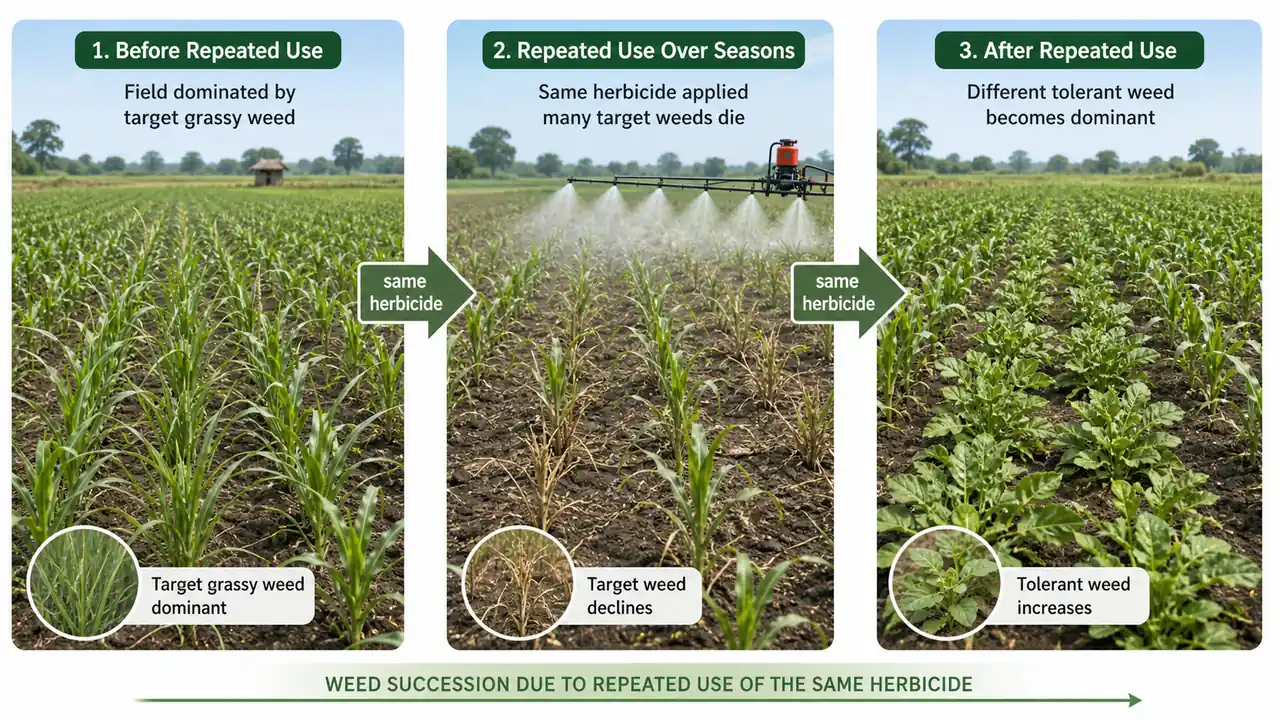
Weed succession = one dominant species replaced by another due to long-term herbicide use or management practice. Continuous use of the same herbicide selects for tolerant species.
| Region | Herbicide Used | Weed Controlled | Weed That Increased |
|---|---|---|---|
| Punjab | Isoproturon | Phalaris minor | Avena fatua |
| Tamil Nadu | Butachlor | Echinochloa | Cyperus spp. |
Solution: Rotate herbicides with different modes of action to prevent weed shift.
Chemotypes and Agricultural Ecotypes
- Weeds can cross-breed to form new races called Agricultural Ecotypes.
- Continuous herbicide use creates tolerant ecotypes called Chemotypes — a form of herbicide resistance through natural selection.
”Horrible Weeds”
Sorghum halepense (Johnson grass) and Saccharum spontaneum (wild sugarcane) are classified as horrible weeds because they possess most persistence factors — prolific seed production, deep rhizomes, extreme hardiness, and rapid vegetative spread.
Summary Cheat Sheet
| Concept / Topic | Key Details |
|---|---|
| Mimicry weeds | Look like the crop — hard to identify (wild rice in paddy) |
| Objectionable weeds | Seeds resemble crop seeds — hard to separate (Argemone in mustard) |
| Seed Act 1966 | Legal limits on weed seed contamination; okra = zero tolerance |
| Wheat-weed trio | Convolvulus, Avena fatua, Phalaris minor |
| Versatile alternate host | Chenopodium album — hosts pests for multiple crops |
| HCN poisoning | Sorghum halepense at tillering stage |
| Lantanism | Jaundice in animals caused by Lantana camara |
| Oxalate poisoning | From Ageratum and Amaranthus |
| Crop quality erosion | Loranthus in tea, Canada thistle in mustard |
| Weeds most toxic at | Tillering stage (young growth) |
| Drought stress + weeds | Accumulate dangerous nitrate levels |
| Nitrophyll | Amaranthus accumulates > 3% N — starves crops of nitrogen |
| Sugarbeet | Highest yield reduction by weeds (slow early growth) |
| Persistence mechanisms | 10 factors: seed production, viability, dormancy, vegetative propagation, dispersal, hardiness, evasiveness, self-regeneration, selective invasion, succession |
| C4 pathway advantage | Cyperus, Amaranthus — no photorespiration, outperform C3 crops |
| Selective invasion | Dryland (Tribulus), Irrigated (Phalaris), Paddy (Echinochloa) |
| Weed succession | Punjab: Isoproturon → Phalaris controlled → Avena increased |
| Chemotypes | Herbicide-tolerant ecotypes from repeated same-herbicide use |
| Horrible weeds | Sorghum halepense + Saccharum spontaneum (most persistence factors) |
| Orobanche | Root parasite — major weed of tobacco |
Pro Content Locked
Upgrade to Pro to access this lesson and all other premium content.
₹2388 billed yearly
- All Agriculture & Banking Courses
- AI Lesson Questions (100/day)
- AI Doubt Solver (50/day)
- Glows & Grows Feedback (30/day)
- AI Section Quiz (20/day)
- 22-Language Translation (30/day)
- Recall Questions (20/day)
- AI Quiz (15/day)
- AI Quiz Paper Analysis
- AI Step-by-Step Explanations
- Spaced Repetition Recall (FSRS)
- AI Tutor
- Immersive Text Questions
- Audio Lessons — Hindi & English
- Mock Tests & Previous Year Papers
- Summary & Mind Maps
- XP, Levels, Leaderboard & Badges
- Generate New Classrooms
- Voice AI Teacher (AgriDots Live)
- AI Revision Assistant
- Knowledge Gap Analysis
- Interactive Revision (LangGraph)
🔒 Secure via Razorpay · Cancel anytime · No hidden fees
The Weed That Wears a Disguise
The previous lesson covered parasitic and aquatic weeds — special categories defined by how they feed and where they grow. This lesson shifts focus to the relationships between weeds and crops: how weeds mimic crops, contaminate seeds, harbour pests, poison livestock, and degrade produce quality. Understanding these associations explains why weeds cause damage far beyond simple competition for resources.
In the rice paddies of eastern India, wild rice (Oryza sativa var. fatua) grows among cultivated rice looking almost identical — same leaf shape, same height, same growth habit. Farmers cannot tell them apart until harvest, when the wild rice shatters and drops its inferior-quality grains back into the soil. This “mimicry” is not accidental — it is an evolutionary survival strategy. The closer a weed resembles the crop, the more likely it is to escape weeding and survive to reproduce.
This lesson covers:
- Mimicry and crop-specific weeds — weeds that resemble crops
- Objectionable weeds — seed contamination and the Seeds Act 1966
- Alternate hosts — weeds harbouring crop pests and diseases
- Livestock toxicity — HCN poisoning, lantanism, oxalate poisoning
- Crop-weed competition — nutrients, water, light, CO2
- Weed ecology — persistence, hardiness, succession, chemotypes
Crop-Specific and Mimicry Weeds
Mimicry weeds have similar external morphology to the crop, making them extremely difficult to identify and remove during weeding. This is an evolutionary adaptation that helps them survive manual and mechanical weeding.
| Crop | Common Weed Name | Scientific Name |
|---|---|---|
| Paddy | Wild rice / Red rice | Oryza sativa var. fatua |
| Wheat | Bindweed (Hirankhuri) | Convolvulus arvensis |
| Wheat | Wild oat | Avena fatua |
| Wheat | Canary grass | Phalaris minor |
| Okra | Wild okra | Abelmoschus spp. |
| Mustard | Mexican poppy (Satyanashi) | Argemone mexicana |
| Lucerne | Dodder | Cuscuta sp. |
| Berseem | Chicory (Kasni) | Cichorium intybus |
| Lettuce | Wild lettuce | Lactuca seriola |
| Cucurbits | Wild cucurbits | Cucurbita spp. |
| Methi | Sanji | Melilotus spp. |
Crop-specific weeds need a microenvironment matching the crop’s growing conditions. For example, Chicory thrives in the cool moist climate of berseem fields.
TIP
Exam favourite — the “wheat-weed trio”: Convolvulus arvensis (Bindweed), Avena fatua (Wild oat), and Phalaris minor (Canary grass). These three are the most frequently tested crop-weed associations.
Ready Contamination of Crop Seeds
Some weeds mature their seeds at the same height and time as the crop, so their seeds get harvested along with the grain:
| Weed | Crop | Why It Contaminates |
|---|---|---|
| Allium sp. (wild alura) | Garlic | Both produce bulbils at similar heights |
| Phalaris minor | Wheat | Seeds ripen simultaneously and are of similar size |
This is a major reason why certified seed production requires stringent field inspections.
Objectionable Weeds
Objectionable weeds are those whose seeds are difficult to separate once mixed with crop seeds, due to similarity in size, shape or weight.
| Objectionable Weed | Associated Crop |
|---|---|
| Argemone mexicana | Mustard |
| Melilotus alba | Methi |
| Cuscuta (Dodder) | Lucerne |
| Cichorium intybus (Chicory) | Berseem |
| Wild rice | Rice |
| Convolvulus arvensis (Bindweed) | Wheat |
| Abelmoschus spp. | Okra |
Objectionable Weeds under the Indian Seeds Act, 1966
The Indian Seeds Act, 1966 sets legal limits on the maximum permissible percentage of objectionable weed seeds in certified seed lots. Exceeding these limits makes the seed lot unfit for sale.
| Crop | Objectionable Weed | Max Objectionable Limit | Max Total Weed Limit |
|---|---|---|---|
| Paddy | Wild rice / red rice | 0.01% | 0.1% |
| Wheat | Bindweed (Convolvulus) | 0.01% | 0.1% |
| Rape & Mustard | Mexican poppy (Argemone) | 0.1% | 0.5% |
| Egyptian clover | Chicory | 0.05% | 0.5% |
| Lucerne | Dodder | 0.5% | 0.5% |
| Okra | Wild okra | 0.0% | 0.0% |
IMPORTANT
Okra has ZERO tolerance — absolutely no wild okra seeds are permitted. This is the strictest standard among all crops under the Seed Act. Remember this for exams.
Mimicry vs Objectionable Weeds — A Key Comparison
| Feature | Mimicry Weeds | Objectionable Weeds |
|---|---|---|
| Problem | Look like the crop | Seeds look like crop seeds |
| Difficulty | Hard to identify in the field | Hard to separate at harvest |
| Example | Wild rice in paddy | Argemone in mustard |
| Impact | Escape weeding operations | Contaminate certified seed |
TIP
Mnemonic: Mimicry = Morphology match (plant looks similar). Objectionable = Output match (seed looks similar).
Weeds as Alternate Hosts for Insects and Diseases
Weeds harbour pest and pathogen populations between crop seasons, ensuring pests are ready to attack the next crop. This is a major indirect loss caused by weeds.
| Weed | Pest / Disease Hosted | Crop Affected |
|---|---|---|
| Echinochloa colonum | Stem borer | Rice |
| Chenopodium album | Gram caterpillar | Cotton, Pea, Tomato |
| Chenopodium album | Stem borer | Maize |
| Agropyron portulaca | Wilt | Tomato |
| Cenchrus ciliaris | Ergot disease | Pearl millet (Bajra) |
| Leersia oryzoides | Bacterial leaf blight | Rice |
| Saccharum spontaneum | Downy mildew | Maize |
| Agropyron repens | Rust | Wheat |
| Lantana camara | American bollworm | Cotton |
| Avena fatua | Stem rust, Powdery mildew | Wheat, Barley |
| Parthenium hysterophorus | Tobacco streak virus | Tobacco |
| Amaranthus spp. | Gram caterpillar | Pigeonpea |
| Abutilon spp. | Spotted & pink bollworm | Cotton |
| Plantago ovata | TMV | Tobacco |
NOTE
Chenopodium album (Bathua) hosts pests for multiple crops — it is one of the most versatile alternate hosts. Lantana camara harbours the American bollworm that devastates cotton.
Effects of Weeds on Livestock
Several weeds produce toxic compounds that poison livestock through grazing or contaminated fodder.
| Weed | Toxic Effect | Toxin / Mechanism |
|---|---|---|
| Ageratum conyzoides (Goat weed) | Death of sheep/horses | High oxalate content |
| Sorghum halepense (Johnson grass) at tillering | Poisonous to cattle | Prussic acid (HCN) |
| Xanthium strumarium at tillering | Poisonous | Prussic acid |
| Chloropepium, Amaranthus, Crotalum, Polygonum (drought-stressed) | Asphyxia (oxygen starvation) in livestock | Nitrate >1000 ppm |
| Lantana camara | Photosensitivity and jaundice | Condition called Lantanism |
| Tribulus terrestris (Puncture vine) | Photosensitisation in sheep | Steroidal saponins |
WARNING
Weeds are most toxic at the tillering stage (young growth). Under drought stress, many otherwise harmless weeds accumulate dangerous nitrate levels. Always inspect fodder from weed-infested areas.
TIP
Exam terms: HCN poisoning = Johnson grass at tillering. Lantanism = Lantana-induced jaundice in animals. Oxalate poisoning = Ageratum/Amaranthus.
Erosion of Crop Quality by Weeds
Beyond reducing yield, weeds can degrade the quality of harvested produce:
| Crop | Weed | Quality Impact |
|---|---|---|
| Tea | Loranthus (Dendrophthoe falcata) — partial stem parasite | Diverts nutrients, impairs tea leaf quality |
| Rapeseed (Mustard) | Cirsium arvense (Canada thistle) | Contaminates seed, causes off-flavours in extracted oil |
Crop-Weed Competition for Resources
Beyond serving as alternate hosts and producing toxins, weeds cause their primary damage through direct competition for limited resources. This competition is the fundamental mechanism behind the yield losses discussed in the introduction lesson. Weeds and crops compete for nutrients, water, light, and CO2. When weed population crosses the threshold level, crop production declines. Competition is always negative for the crop and may be interspecific (between species) or intraspecific (within species).
Highest yield reduction through weeds: sugarbeet (slow early growth gives weeds time to establish).
| Resource | Key Facts | Example |
|---|---|---|
| Nutrients | Weeds absorb minerals faster than crops; remove twice the nutrients | Amaranthus accumulates > 3% N (nitrophyll) |
| Water | Weeds transpire more water for same dry matter; extract moisture from up to 90 cm depth | Chenopodium uses 550 mm vs wheat’s 479 mm (15% more) |
| Light | Plant height and vertical leaf area are key; shading damage is irreversible | Cotton, potato, sugarcane suffer heavy early-stage shading |
| CO2 (Space) | C4 weeds use CO2 more efficiently than C3 crops | Tropical C4 weeds outgrow C3 rice and wheat |
IMPORTANT
Nutrient competition is the most critical factor. Weeds like Amaranthus that accumulate > 3% nitrogen in their tissues are called nitrophyll plants — they literally starve the crop of nitrogen. Shading damage from weeds is irreversible — once the crop loses the light race, it cannot recover even if weeds are removed later.
Important Weeds of Major Crops
Kharif Crops
| Crop | Major Weeds |
|---|---|
| Paddy | Echinochloa spp., Cyperus spp., Wild rice, Celosia, Eclipta, Cynodon |
| Maize, Sorghum, Bajra | Phyllanthus, Amaranthus, Johnson grass, Cynodon, Cyperus, Partulaca |
| Soybean, Moong, Urd, Arhar, Groundnut, Cotton | Phyllanthus, Solanum nigrum, Amaranthus, Johnson grass, Celosia, Cynodon, Cyperus |
Rabi Crops
| Crop | Major Weeds |
|---|---|
| Wheat, Barley | Chenopodium, Anagallis, Phalaris minor, Wild oat, Melilotus, Cynodon, Cyperus, Convolvulus |
| Gram, Pea, Lentil, Potato, Mustard, Linseed | Fumaria, Anagallis, Chenopodium, Melilotus, Asphodelus, Argemone mexicana |
| Berseem | Chicorium intybus, Cynodon, Anagallis, Cyperus |
| Tobacco | Orobanche, Melilotus, Convolvulus, Cynodon, Cyperus |
| Sugarcane | Most kharif and rabi weeds (widest diversity — crop spans both seasons) |
TIP
Exam favourites: Paddy = Echinochloa; Wheat = Phalaris minor; Mustard = Argemone mexicana; Tobacco = Orobanche (a root parasite). Sugarcane hosts the widest diversity of weeds because it spans both kharif and rabi seasons.
Weed Ecology
The sections above focused on specific weed-crop interactions — mimicry, contamination, pest hosting, toxicity. Now we step back to look at the bigger picture: weed ecology, which studies the inter-relationship between weeds and their environment. These ecological principles explain why certain weeds dominate certain systems and why weed communities change over time.
Persistence
Persistence = the ability to repeatedly invade an environment even after apparent removal. This differs from hardiness (ability to withstand natural stresses). Weeds are both persistent and hardy, making them exceptionally difficult to eliminate.
| # | Persistence Mechanism | How It Helps the Weed |
|---|---|---|
| 1 | Prolific seed production | Massive seed output ensures population survival |
| 2 | Viable seed production | Seeds remain germinable for years/decades |
| 3 | Dormancy | Protects seeds from premature germination |
| 4 | Vegetative propagation | Regeneration from fragments |
| 5 | Rapid dispersal | Colonises new areas quickly |
| 6 | Inherent hardiness | Survives extreme weather, poor soils |
| 7 | Evasiveness | Escapes destruction by animals/humans |
| 8 | Self-regeneration | No artificial seedbed needed |
| 9 | Selective invasion | Adapts to changing cropping environment |
| 10 | Weed succession | New species replace controlled ones |
Persistence is influenced by climatic factors (light, temperature, rainfall, wind, humidity), edaphic factors (soil-related), and biotic factors (other organisms).
Inherent Hardiness
- Many tropical weeds (Cyperus, Amaranthus) use the C4 pathway — devoid of photorespiration, giving photosynthetic advantage over C3 crops in hot conditions.
- High transpiration efficiency, low nutrient requirements, slow translocation, high initial elongation rate.
Evasiveness
Weeds evade destruction through bitter taste, disagreeable odour, spiny nature, and mimicry. Animals refuse to eat them, and farmers struggle to distinguish them from crops.
Selective Invasion
Weed species composition changes with the cropping environment:
| Condition | Dominant Weeds |
|---|---|
| Dryland | Tribulus terrestris, Argemone mexicana, Euphorbia hirta |
| Irrigated | Trianthema monogyna, Phalaris minor, Commelina bengalensis |
| Paddy (wetland) | Echinochloa, Eclipta, Caesulia auxillaris |
NOTE
Changing the cropping environment changes the weed community. Shifting from dryland to irrigated agriculture will replace drought-tolerant weeds with moisture-loving species.
Weed Succession
Weed succession = one dominant species replaced by another due to long-term herbicide use or management practice. Continuous use of the same herbicide selects for tolerant species.
| Region | Herbicide Used | Weed Controlled | Weed That Increased |
|---|---|---|---|
| Punjab | Isoproturon | Phalaris minor | Avena fatua |
| Tamil Nadu | Butachlor | Echinochloa | Cyperus spp. |
Solution: Rotate herbicides with different modes of action to prevent weed shift.
Chemotypes and Agricultural Ecotypes
- Weeds can cross-breed to form new races called Agricultural Ecotypes.
- Continuous herbicide use creates tolerant ecotypes called Chemotypes — a form of herbicide resistance through natural selection.
”Horrible Weeds”
Sorghum halepense (Johnson grass) and Saccharum spontaneum (wild sugarcane) are classified as horrible weeds because they possess most persistence factors — prolific seed production, deep rhizomes, extreme hardiness, and rapid vegetative spread.
Summary Cheat Sheet
| Concept / Topic | Key Details |
|---|---|
| Mimicry weeds | Look like the crop — hard to identify (wild rice in paddy) |
| Objectionable weeds | Seeds resemble crop seeds — hard to separate (Argemone in mustard) |
| Seed Act 1966 | Legal limits on weed seed contamination; okra = zero tolerance |
| Wheat-weed trio | Convolvulus, Avena fatua, Phalaris minor |
| Versatile alternate host | Chenopodium album — hosts pests for multiple crops |
| HCN poisoning | Sorghum halepense at tillering stage |
| Lantanism | Jaundice in animals caused by Lantana camara |
| Oxalate poisoning | From Ageratum and Amaranthus |
| Crop quality erosion | Loranthus in tea, Canada thistle in mustard |
| Weeds most toxic at | Tillering stage (young growth) |
| Drought stress + weeds | Accumulate dangerous nitrate levels |
| Nitrophyll | Amaranthus accumulates > 3% N — starves crops of nitrogen |
| Sugarbeet | Highest yield reduction by weeds (slow early growth) |
| Persistence mechanisms | 10 factors: seed production, viability, dormancy, vegetative propagation, dispersal, hardiness, evasiveness, self-regeneration, selective invasion, succession |
| C4 pathway advantage | Cyperus, Amaranthus — no photorespiration, outperform C3 crops |
| Selective invasion | Dryland (Tribulus), Irrigated (Phalaris), Paddy (Echinochloa) |
| Weed succession | Punjab: Isoproturon → Phalaris controlled → Avena increased |
| Chemotypes | Herbicide-tolerant ecotypes from repeated same-herbicide use |
| Horrible weeds | Sorghum halepense + Saccharum spontaneum (most persistence factors) |
| Orobanche | Root parasite — major weed of tobacco |
Knowledge Check
Take a dynamically generated quiz based on the material you just read to test your understanding and get personalized feedback.
Lesson Doubts
Ask questions, get expert answers