👶 Animal Husbandry — Definition, Classification, Livestock Population and Economic Significance
Learn what animal husbandry means, the six major livestock species studied (cattle, buffalo, sheep, goat, swine, chicken), their classification as ruminants and monogastrics, India's livestock population and world rankings, species nomenclature, body temperatures, gestation periods, manure nutrient value, and the key problems and solutions in the Indian livestock sector.
What is Animal Husbandry?
NOTE
The branch of science, which deals with the study of various breeds of domesticated animals and their management for obtaining better products and services from them, is known as Animal Husbandry.
- The term husbandry derives from the word "husband" which means 'one who takes care'. This concept highlights the responsibility humans have in nurturing and managing livestock for productive purposes. When it incorporates the study of proper utilisation of economically important domestic animals, it is called Livestock Management.
- Domesticated: Those that are of use at home and are easily bred and looked after by humans. Over thousands of years, humans have selectively bred animals for desirable traits such as milk yield, meat quality, and temperament. Common domesticated animals are dog, horse, cow, sheep, buffalo, fowl etc.
Animals We Will Study in This Lesson
This lesson focuses on the six most economically important domesticated species in India — the ones that dominate livestock censuses, competitive exam questions, and farm income data:
Pro Content Locked
Upgrade to Pro to access this lesson and all other premium content.
₹99 charged monthly · Cancel anytime
- All Agriculture & Banking Courses
- AI Lesson Questions (100/day)
- AI Doubt Solver (50/day)
- Glows & Grows Feedback (30/day)
- AI Section Quiz (20/day)
- 22-Language Translation (100/day)
- Recall Questions (20/day)
- AI Quiz (15/day)
- AI Quiz Paper Analysis (100/day)
- AI Step-by-Step Explanations (100/day)
- Spaced Repetition Recall (FSRS)
- AI Tutor
- Immersive Text Questions
- Audio Lessons — Hindi & English
- Mock Tests & Previous Year Papers
- Summary & Mind Maps
- XP, Levels, Leaderboard & Badges
- Generate New Classrooms
- Voice AI Teacher (AgriDots Live)
- AI Revision Assistant
- Knowledge Gap Analysis
- Interactive Revision (LangGraph)
🔒 Secure via Razorpay · Cancel anytime · No hidden fees
What is Animal Husbandry?
NOTE
The branch of science, which deals with the study of various breeds of domesticated animals and their management for obtaining better products and services from them, is known as Animal Husbandry.
- The term husbandry derives from the word "husband" which means 'one who takes care'. This concept highlights the responsibility humans have in nurturing and managing livestock for productive purposes. When it incorporates the study of proper utilisation of economically important domestic animals, it is called Livestock Management.
- Domesticated: Those that are of use at home and are easily bred and looked after by humans. Over thousands of years, humans have selectively bred animals for desirable traits such as milk yield, meat quality, and temperament. Common domesticated animals are dog, horse, cow, sheep, buffalo, fowl etc.
Animals We Will Study in This Lesson
This lesson focuses on the six most economically important domesticated species in India — the ones that dominate livestock censuses, competitive exam questions, and farm income data:
Cattle · Buffalo · Sheep · Goat · Swine · Chicken
These six were chosen because they collectively account for the vast majority of India's livestock population (535 million), contribute to GVA, exports, and rural livelihoods, and are the primary subjects of IBPS AFO, NABARD Grade A, and FCI exam questions.
Classification of These Animals
| Category | Animals | Basis |
|---|---|---|
| Livestock | Cattle, Buffalo, Sheep, Goat, Swine | Land animals reared for products/services |
| Poultry | Chicken | Domesticated birds reared for eggs and meat |
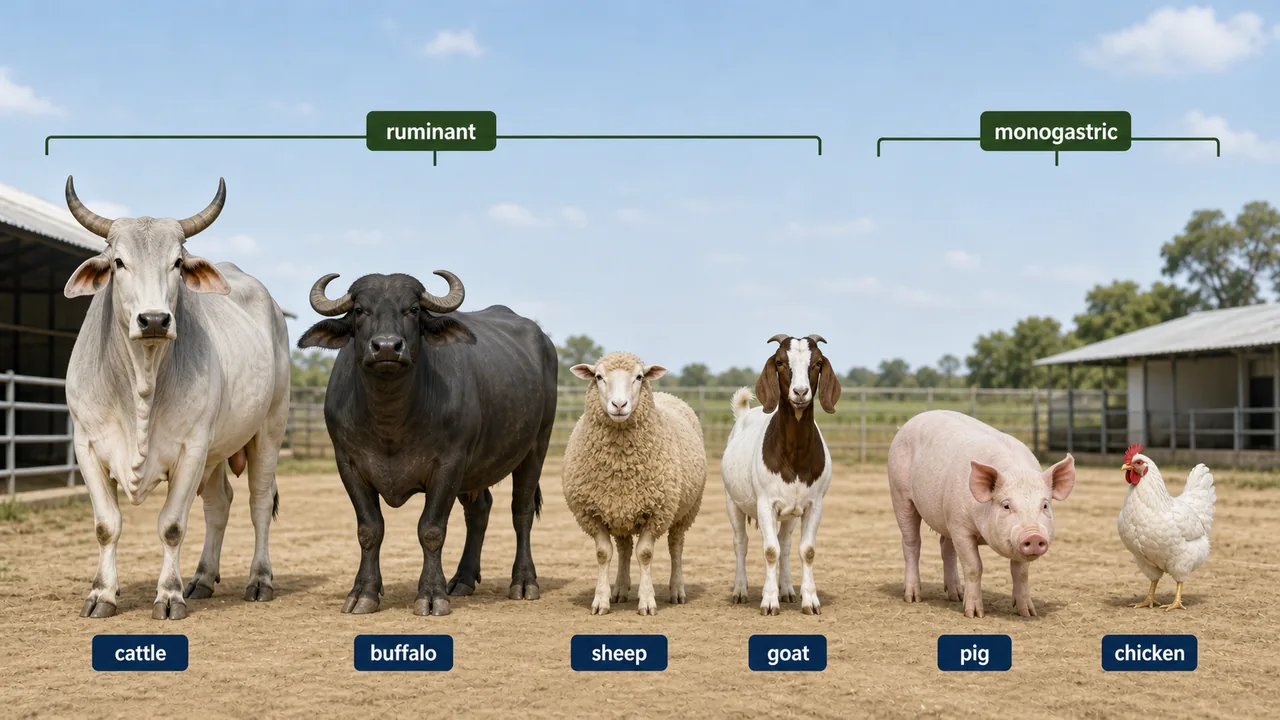
They can also be classified by digestive system:
| Type | Animals | Why it Matters |
|---|---|---|
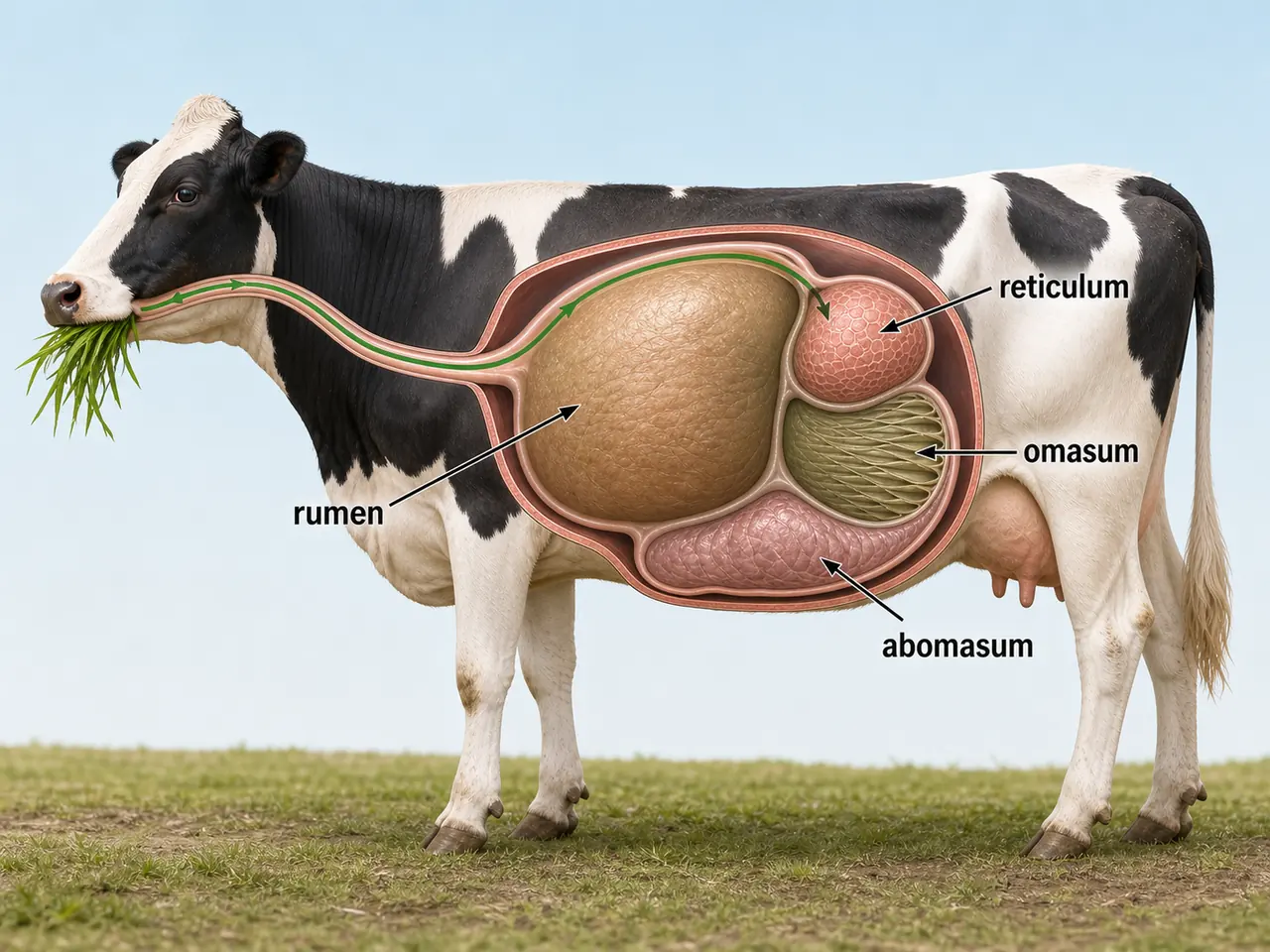
| Ruminants (4-chambered stomach) | Cattle, Buffalo, Sheep, Goat | Can digest roughage/cellulose; higher manure quality |
| Monogastric (simple stomach) | Swine, Chicken | Require concentrated feed; faster growth cycles |
And by primary product:
| Primary Product | Species |
|---|---|
| Milk (Dairy) | Cattle, Buffalo |
| Meat | Cattle, Buffalo, Sheep, Goat, Swine, Chicken |
| Fibre / Wool | Sheep |
| Eggs | Chicken |
| Draught Power | Cattle, Buffalo |
| Skin / Hide | Cattle, Buffalo, Goat |
Significance of Livestock and Poultry in Indian Economy
- Agricultural is the back bone of Indian Economy and within agriculture, livestock plays an importance role in providing sustainable income to farmers throughout the year. Unlike crop farming, which is seasonal, livestock generates income year-round through milk, eggs, meat, and other products.
- Livestock farming is an integral part of crop farming and contributes substantially to household nutritional security and poverty alleviation through increased household income. For millions of rural households, livestock serves as a supplementary income source that cushions against the risks of crop failure.
- Dairy animals produce milk by converting the crop residues and by products from crops which otherwise would be wasted. Dairy sector contributes by way of cash income, draught power and manure. Livestock provides for human needs by way of
- Food
- Fibre
- Fuel
- Fertilizer
- Skin
- Traction
- It is a living bank providing flexible finance in time of emergencies and also serves as insurance against crop failure for survival. Farmers can sell animals when they face financial distress, making livestock a liquid asset in rural economies. If Agriculture is the foundation of our national economy, Animal husbandry constitutes the sheet anchor of agriculture. Family income from livestock and poultry acts as Bankers cheque.
- Effective utilization of labour -- family labour is effectively utilized in animal husbandry. Women and children often contribute significantly to livestock rearing, making it an inclusive livelihood option.
- Soil fertility: organic manure -- promotes and maintains soil fertility. Animal dung and urine are excellent sources of organic manure that improve soil structure, water-holding capacity, and nutrient content.
Nutrient content of manure (mg/g dry weight):
| Nutrient | Cattle | Sheep | Pig | Horse | Poultry |
|---|---|---|---|---|---|
| Nitrogen | 25-40 | 20-45 | 20-45 | 17-30 | 28-62 |
| Phosphorus | 4-10 | 4-11 | 6-12 | 3-7 | 9-29 |
| Potassium | 7-25 | 20-29 | 15-48 | 15-18 | 8-29 |
| Calcium | 5-8 | 8-19 | 3-20 | 7-29 | 17-69 |
| Magnesium | 5-8 | 3-6 | 2-3 | 3-5 | 3-8 |
| Sulphur | 3-4 | 2-3 | 3-5 | 1-3 | 4-7 |
-
Apart from manurial value biogas can be produced from livestock dung and poultry droppings. Biogas is a renewable energy source that can be used for cooking and lighting in rural areas, reducing dependence on firewood and fossil fuels.
-
Cow produces 8 tonnes of farm yard manure per year and farm biomass and farm products which includes fodder, feed, edible weed, tree fodder, bund grass are better utilized -- and converted to Edible products like -- Milk, Meat and Egg.
-
Inter relationship
- Man-animal-plant interrelation is interdependent (one cannot survive without the help of other). Man not only depends on plants and animals for food but also for income and other needs. This symbiotic relationship forms the backbone of sustainable agriculture.
- He co-ordinates activities of the crop and other husbandry by proper planning.
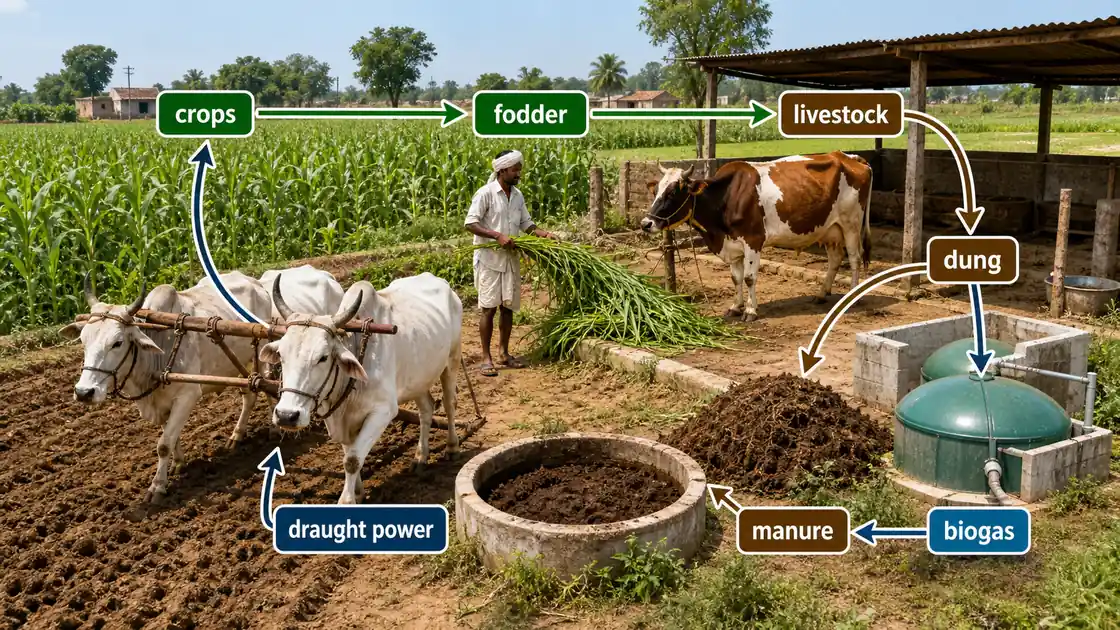
The crop-livestock cycle shows how crops and fodder support livestock, while dung returns as manure and biogas and animals provide draught power back to the farm. -
The usage of draught animal power for ploughing of land. In many parts of India, especially among small and marginal farmers, bullocks remain the primary source of farm power.
India's Livestock Position in the World
NOTE
Livestock population data (below) is from the 20th Livestock Census 2019 — the most recent completed census. The 21st Livestock Census is currently underway. Production data (milk, egg, meat, wool) is updated annually — see the next lesson for 2024-25 figures.
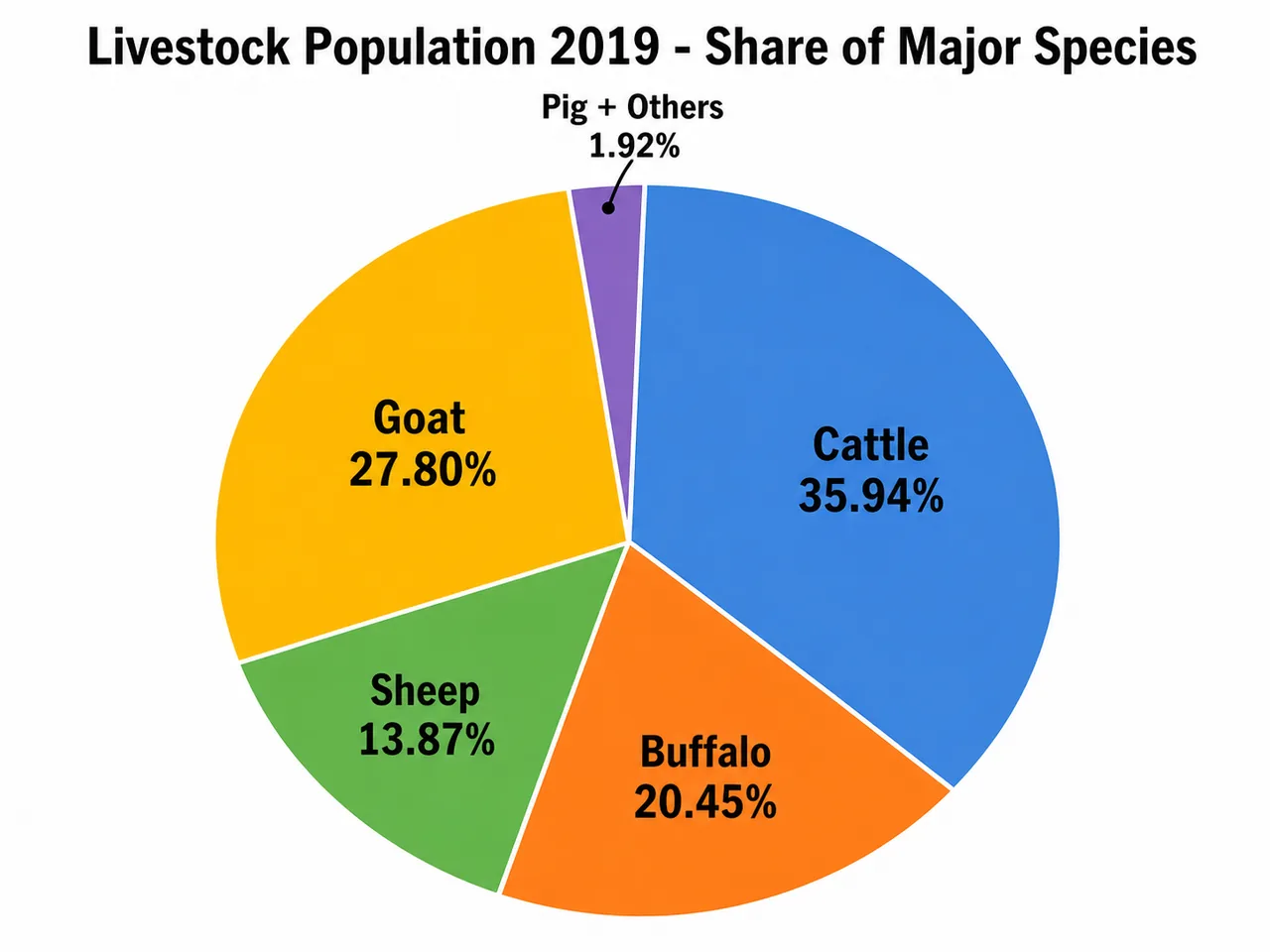
- India owns nearly 15% of the world livestock population, which is highest in the world with population of 535 million. This massive livestock population is both a strength and a challenge -- it requires efficient management to maximize productivity.
- 70% of the livestock are owned by 67% of small and marginal farmers. This underscores the democratic nature of livestock ownership in India and its role in poverty alleviation.
- 76% of the milk is produced by weaker sections of society.
- India has nearly 57% of the world's buffalo population (first rank), 16% of the cattle population (second rank), 20% of goat population (second rank) and 5% of sheep population (third rank) although India constitutes 2.4% of the world's total land area. These figures highlight India's extraordinary livestock density and the importance of efficient management practices.
IMPORTANT
India ranks 1st in buffalo, 2nd in cattle and goat, and 3rd in sheep population globally, all while occupying only 2.4% of the world's land area.
Livestock Contribution to the Indian Economy
- The contribution of livestock sector to the total Gross value added (GVA) is 5.5% of national GVA at current prices in 2023-24, accounting for 31% of total GVA of Agricultural and Allied Sector. This means nearly one-third of all agricultural economic output comes from livestock. (Agriculture, Forestry & Fishing together contribute 17.8% of national GVA.)
- Livestock GVA surged by 195% from 2014-15 to 2023-24, significantly outpacing the crop sector — reflecting the sector's rapid transformation into a dominant pillar of agricultural income.
- It is estimated that about 18 million people are employed in the livestock sector in principal or subsidiary status. Total value of livestock product exports reached ₹66,249 crore in 2024-25, driven largely by bovine meat and edible offal.
Species Overview — Nomenclature and Basic Facts
Mature Body Weight and Ages of Different Species
Understanding the mature body weight and age milestones of different species is essential for planning feed requirements, breeding schedules, and marketing strategies.
| Animal | Species Name | Term Used | Mature Body Weight (kg) | Mature Age | Maximum Recorded Lifespan (yr.) |
|---|---|---|---|---|---|
| Cattle | Bos indicus | Bovine | 464 - 653 | 5 years | 30 years |
| Goat | Capra hircus | Caprine | 26 - 102 | 2 years | 18 years |
| Sheep | Ovis aries | Ovine | 34 - 80 | 2 years | 20 years |
| Swine | Sus scrofa | Porcine | 70 - 128 | 5 – 6 months | 27 years |
| Chicken | Gallus domesticus | Poultry | 1.5 - 3.3 | 20 - 30 weeks | 3 years |
Common Names in Livestock Population
Knowing the correct nomenclature — group names, gender-specific terms, birthing terms, and meat names — is fundamental for any student of animal husbandry and is frequently tested in competitive examinations.
| Details | Cattle | Buffalo | Sheep | Goat | Swine | Chicken |
|---|---|---|---|---|---|---|
| Group | Herd | Herd | Flock | Flock | Drove/Herd | Flock |
| Adult Male | Bull | Buffalo Bull | Ram | Buck | Boar | Cock |
| Adult Female | Cow | Buffalo | Ewe | Doe | Sow/Gilt | Hen |
| Young Male | Bull Calf | Buffalo Calf | Male Lamb | Male Kid | Boarling | Cockrel |
| Young Female | Heifer Calf | Heifer Calf | Female Lamb | Female Kid | Female Piglet | Pullet |
| New Born | Calf | Buffalo Calf | Lamb | Kid | Piglet | Chick |
| Meat | Beef, Calf - Veal | Buffin | Mutton | Chevon | Pork | Chicken |
| Casted Male | Bullock/Steer | Bullock | Weeder | Buck | Hog, Stage | Capon |
| Castrated/Sterilised Female | Spayed | Spayed | Spayed | Spayed | Spayed | Spayed |
| Mating | Serving | Serving | Tupping | Serving | Coupling | Serving |
| Parturition | Calving | Calving | Lambing | Kidding | Farrowing | Hatching |
Each species also has a unique scientific name and a fixed chromosome number (2n) — a key identifier in genetics and breeding science.
Scientific Names and Chromosome Numbers
| Common Name | Scientific Name | Family | Chromosome (2n) |
|---|---|---|---|
| Cow | Bos taurus/indicus | Bovine | 60 |
| Water Buffalo / Asian Water Buffalo | Bubalus bubalis | Bovine | 50 |
| Swamp Buffalo | Bubalus carabanensis | Bovine | 48 |
| Goat | Capra aegagrus hircus | Caprine | 60 |
| Sheep | Ovis aries | Ovine | 54 |
| Domestic Pig | Sus scrofa domesticus | Swine or Sus | 38 |
| Chicken | Gallus domesticus | Phasianidae | 78 |
| Camel | Camelus sp. | Camelidae | 74 |
| Horse | Equus ferus caballus | Equine | 64 |
| Donkey | Equus africanus asinus | Equine | 62–64 |
| Rabbit | Lepus nigricollis | Leporidae | 48 |
Body Temperature & Gestation Period of Domesticated Animals
Body temperature and gestation period are two clinically important parameters every livestock manager must know. Body temperature is a key health indicator — a fever is often the first sign of infection. Gestation period determines the breeding calendar and helps plan farm operations.
| Animal | Body temperature (°C) | Body temperature (°F) = *9/5 + 32 | Gestation Period (days) | Food Habit |
|---|---|---|---|---|
| Buffalo | 37.5 | 100 | 310 | Herbivores |
| Cow | 38.5 | 101.5 | 282 | Herbivores |
| Sheep | 38.9 | 102 | 150 | Herbivores |
| Goat | 39.1 | 102.5 | 148 | Herbivores |
| Pig | 39.2 | 102.6 | 114 | Omnivorous |
| Hen | 41.7 | 107 | ----- | Omnivorous |
- Smaller the animal more is heat required to maintain the body metabolism. This is because smaller animals have a higher surface-area-to-body-weight ratio, causing them to lose heat more rapidly than larger animals.
- Body temperature may vary +1/-1 °C.
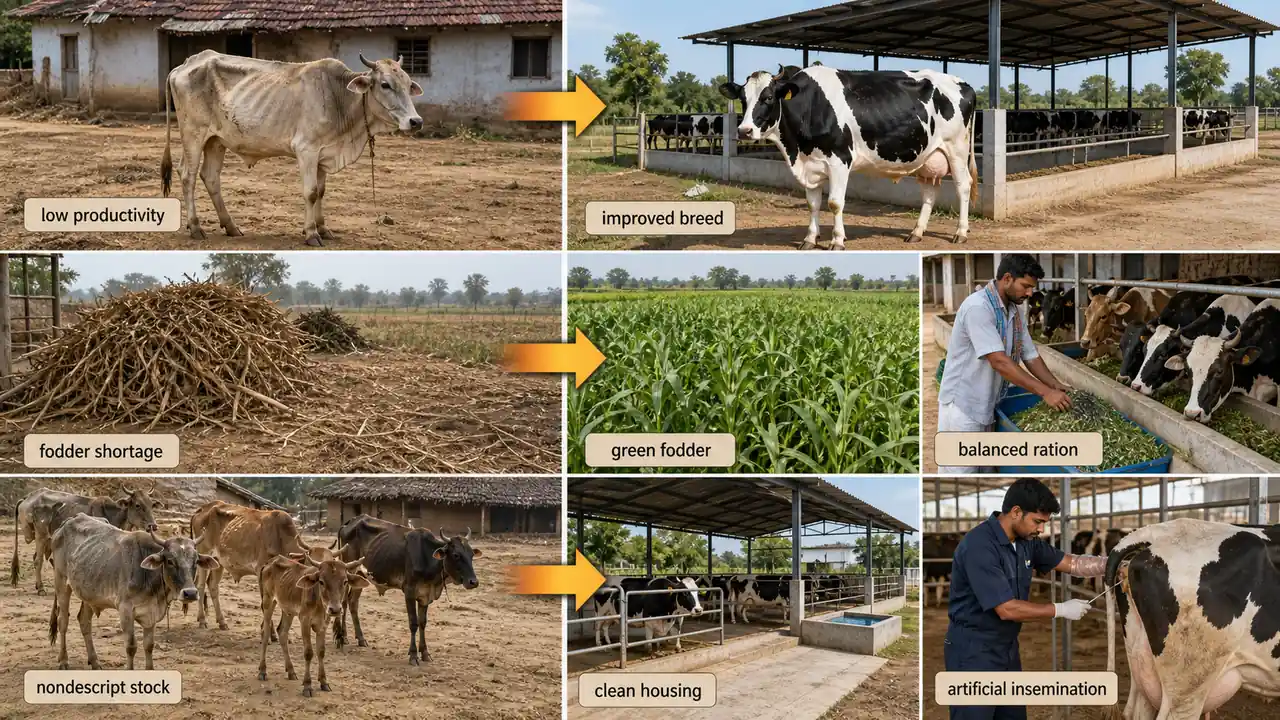
Problems in Indian Livestock Sector
Solutions
- To satisfy the nutrient requirement for the huge population of livestock the options are:
- To reduce the unproductive/ low productive animals. Culling of uneconomic animals and replacing them with improved breeds can significantly raise overall productivity.
- Feeding of non-conventional feed stuffs -- among these are the horticultural by products like agriculture by products, vegetable wastes and horticulture industrial wastes. Exploring alternative feed resources helps reduce competition with human food needs while lowering feed costs for farmers.
References
6 sources • [1] [2] [3] [4] [5] [6]
References
Summary Cheat Sheet
Definition & Classification
| Concept | Key Details |
|---|---|
| Animal Husbandry | Branch of science: management of domesticated animals for better products & services |
| Term origin | "Husband" = one who takes care |
| Livestock Management | Animal Husbandry + proper utilisation of economically important domestic animals |
| Livestock (6 species) | Cattle, Buffalo, Sheep, Goat, Swine → land animals; Chicken → poultry (birds) |
| Ruminants | Cattle, Buffalo, Sheep, Goat — 4-chambered stomach; digest roughage/cellulose |
| Monogastric | Swine, Chicken — simple stomach; need concentrated feed |
India's World Rankings (20th Livestock Census 2019)
| Parameter | Figure |
|---|---|
| Total livestock population | 535 million (~15% of world) |
| India's land area share | Only 2.4% of world total |
| Buffalo rank | 1st — 57% of world's buffalo |
| Cattle rank | 2nd — 16% of world's cattle |
| Goat rank | 2nd — 20% of world's goat |
| Sheep rank | 3rd — 5% of world's sheep |
| Livestock ownership | 70% livestock owned by 67% small & marginal farmers |
| Milk by weaker sections | 76% of milk produced by weaker sections |
Economic Significance
| Parameter | Figure |
|---|---|
| GVA contribution (2023-24) | 5.5% of national GVA |
| Share in Agri & Allied Sector GVA | 31% |
| GVA growth (2014-15 → 2023-24) | 195% |
| Livestock exports (2024-25) | ₹66,249 crore (bovine meat & offal) |
| Employment | ~18 million people |
| Livestock provides | Food, Fibre, Fuel, Fertilizer, Skin, Traction |
| Financial role | Living bank + insurance against crop failure |
| Cow FYM output | 8 tonnes per year |
| Poultry manure | Highest nutrient content but fast-release (less sustained) |
Nomenclature Quick Reference
| Term | Cattle | Buffalo | Sheep | Goat | Swine | Chicken |
|---|---|---|---|---|---|---|
| Adult Male | Bull | Buffalo Bull | Ram | Buck | Boar | Cock |
| Adult Female | Cow | Buffalo | Ewe | Doe | Sow/Gilt | Hen |
| New Born | Calf | Buffalo Calf | Lamb | Kid | Piglet | Chick |
| Young Female | Heifer Calf | Heifer Calf | Female Lamb | Female Kid | Female Piglet | Pullet |
| Castrated Male | Bullock/Steer | Bullock | Weeder | Buck | Hog/Stage | Capon |
| Birth event | Calving | Calving | Lambing | Kidding | Farrowing | Hatching |
| Meat name | Beef/Veal | Buffin | Mutton | Chevon | Pork | Chicken |
| Group name | Herd | Herd | Flock | Flock | Drove/Herd | Flock |
Scientific Names & Chromosomes
| Animal | Scientific Name | Chromosome (2n) |
|---|---|---|
| Cow | Bos taurus / indicus | 60 |
| Water Buffalo | Bubalus bubalis | 50 |
| Swamp Buffalo | Bubalus carabanensis | 48 |
| Goat | Capra aegagrus hircus | 60 |
| Sheep | Ovis aries | 54 |
| Pig | Sus scrofa domesticus | 38 |
| Chicken | Gallus domesticus | 78 |
| Horse | Equus ferus caballus | 64 |
| Donkey | Equus africanus asinus | 62–64 |
| Camel | Camelus sp. | 74 |
| Rabbit | Lepus nigricollis | 48 |
Body Temperature & Gestation Period
| Animal | Temp (°C) | Temp (°F) | Gestation (days) | Food Habit |
|---|---|---|---|---|
| Buffalo | 37.5 | 100 | 310 | Herbivore |
| Cow | 38.5 | 101.5 | 282 | Herbivore |
| Sheep | 38.9 | 102 | 150 | Herbivore |
| Goat | 39.1 | 102.5 | 148 | Herbivore |
| Pig | 39.2 | 102.6 | 114 | Omnivore |
| Hen | 41.7 | 107 | — (lays eggs) | Omnivore |
Rule: Smaller the animal → higher body temperature (greater surface-area-to-weight ratio → faster heat loss)
Problems & Solutions
| Problems | Solutions |
|---|---|
| India avg: 987 kg/lactation vs world avg 2038 kg | Cull unproductive/low-yield animals |
| Abundant nondescript (low-yield) cattle | Breed improvement programmes |
| Chronic feed & fodder shortage | Use non-conventional feed (agri by-products, vegetable & horticultural wastes) |
| Low fertility rates | Scientific reproductive management |
| Destruction of grazing land | Fodder development & land management |
Lesson Doubts
Ask questions, get expert answers