📊 20th Livestock Census 2026 & 21st Livestock Census — Free Notes for exams, NABARD & Agriculture Exams
Free notes on the latest Livestock Census for exams, NABARD, exams & all agriculture competitive exams. 20th Livestock Census 2026 — total population 536.76 million, state-wise rankings, species trends, poultry data. Also covers 21st Livestock Census 2026–25 key updates, new data points, and exam-relevant highlights.
Livestock Census Basics
- The first livestock census was done in 1919, 47 years after human counting was started in 1872. This means India has a long history of systematically documenting its animal wealth, recognizing its economic significance even during the colonial era.
- First livestock census, after independence was conducted in the year 1951. Post-independence, the census became a critical tool for planning livestock development programmes under the Five Year Plans.
- It is held by Department of Animal Husbandry & Dairying under Ministry of Fisheries, Animal Husbandry & Dairying. (Made recently in 2019)
- It is conducted quinuennially (every five years). The five-year interval allows the government to track long-term trends in livestock population, breed composition, and species distribution across the country.
- The Livestock Census covers all domesticated animals and its headcounts. So far 19 such censuses have been conducted in participation with State Governments and UT Administrations.
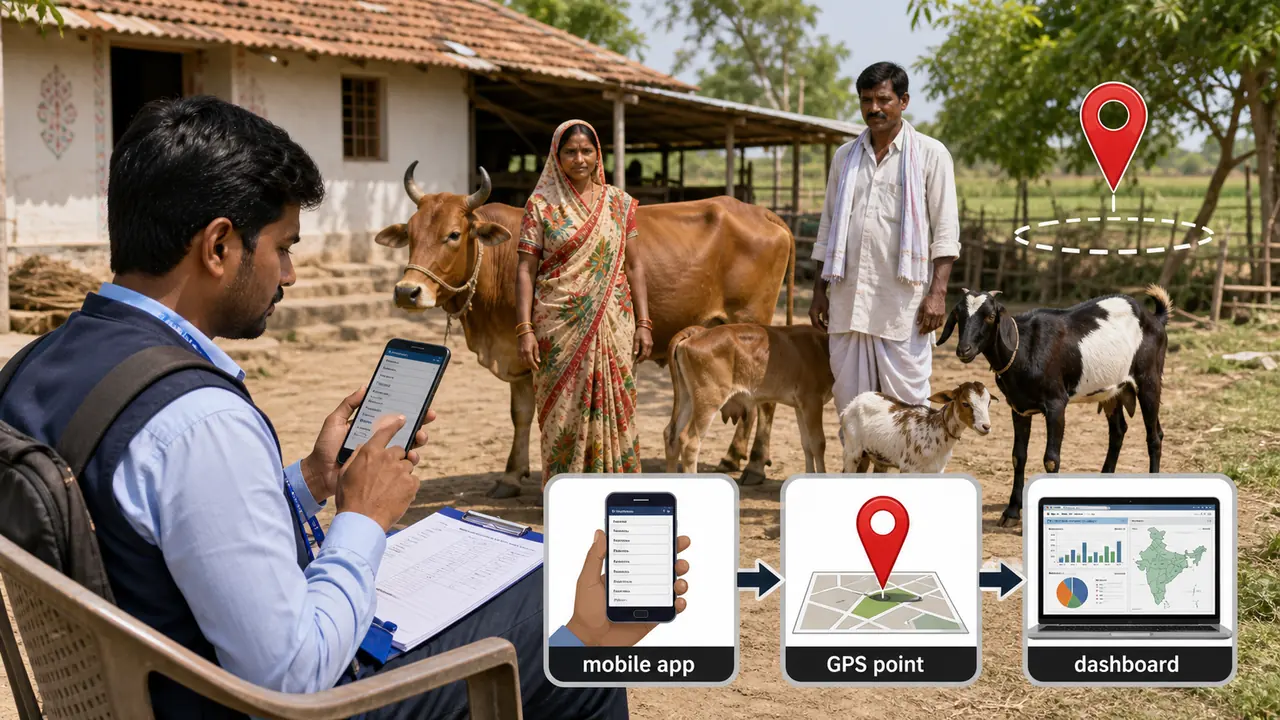
- The 20th Livestock Census was conducted in participation with all States and Union Territories. This was a landmark census as it employed digital technology for data collection for the first time.
- The enumeration was done both in rural and urban areas. Various species of
- Animals: Cattle, Buffalo, Mithun, Yak, Sheep, Goat, Pig, Horse, Pony, Mule, Donkey, Camel, Dog, Rabbit and Elephant
- Poultry birds: Fowl, Duck, Emu, Turkeys, Quail and other poultry birds
- possessed by the households, household enterprises/non-household enterprises and institutions have been counted at their site.
Main objectives
- To assess the growth rate of the livestock
- It helps to assess/improve the quality/production performance
- It helps to reduce the uneconomical livestock by culling
These objectives collectively enable the government to formulate evidence-based policies for breed improvement, disease control, and feed management across the nation.
Important Highlights of 20th Livestock Census 2019
- The total livestock population consisting of Cattle, Buffalo, Sheep, Goat, Pig, Horses & Ponies, Mules, Donkeys, Camels, Mithun and Yak in the country is 536.76 million in 2019. The total livestock population has increased by about 4.8% over the previous 2012 census. Rural livestock: 514.11 million (95.78%); Urban: 22.65 million (4.22%).
- Total bovine population (Cattle, Buffalo, Mithun and Yak) is 303.76 million in 2019 which shows an increase of about 1.3% over the previous census. Bovines form the backbone of India's dairy sector and contribute the most to milk production.
- The Total Number of Cattle in the country in 2019 is 193.46 million showing an increase of 1.3% over previous Census.
- The Female Cattle (Cows population) is 145.12 million, increased by 18.0% over the previous census (2012). This significant rise in female cattle reflects the growing focus on dairy development and the preference for milch animals.
- The Exotic/Crossbred and Indigenous/Non-descript Cattle population in the country is 51.36 million and 142.11 million respectively.
- The Indigenous/Non-descript female cattle population has increased by 10% in 2019 as compared to previous census. This is an encouraging trend, showing improved conservation efforts for indigenous breeds.
- The population of the total Exotic/Crossbred Cattle has increased by 29.3% in 2019 as compared to previous census. This sharp increase reflects the success of crossbreeding programmes aimed at enhancing milk productivity.
- There is a decline of 6% in the total Indigenous/Non-descript cattle population over the previous census. However, the pace of decline during 2012–2019 is much lesser than 2007–12 which was about 9%. This slowing decline suggests that breed conservation programmes like the Rashtriya Gokul Mission are having a positive effect.
- The total buffaloes in the country is 109.85 million showing an increase of about 1.1% over previous Census. India holds the largest buffalo population in the world, and buffaloes are major contributors to India's milk production.
- The total milch animals (in-milk and dry) in cows and buffaloes is 125.75 million, an increase of 6.0% over the previous census. More milch animals directly translate to higher milk production capacity.
- The total sheep in the country is 74.26 million in 2019, increased by 14.1% over previous Census.
- The goat population in the country in 2019 is 148.89 million showing an increase of 10.1% over the previous census. Goats remain the "poor man's cow" and are vital for the livelihood of landless labourers and marginal farmers.
- The total Pigs in the country is 9.06 million in the current Census, declined by 12.03% over the previous Census.
- The total Mithun in the country is 3.9 lakh (↑ 29.5%) and Yak is 58 thousand (↑ 24.9%) over previous Census.
- The total Horses and Ponies in the country is 3.4 lakhs in 2019, decreased by 45.2% over previous Census.
- The total Mules is 84 thousand (↓ 57.1%) and Donkeys is 1.2 lakhs (↓ 61.2%) in 2019.
- The total Camel population is 2.5 lakhs (0.25 million), decreased by 37.1% over previous Census. Only Camel and Donkey have shown continuous decline over the last four censuses (17th–20th).
- Stray Cattle: 50 lakhs | Stray Dogs: 153 lakhs in 2019.
Species-Wise Livestock Snapshot
| Category | Population | Growth 2012–2019 |
|---|---|---|
| Cattle | 193.46 Million | ↑ 1.3% |
| Exotic/Crossbred | 51.36 Million | ↑ 29.3% |
| Indigenous/Non-descript | 142.11 Million | ↓ 6% |
| Buffaloes | 109.85 Million | ↑ 1.1% |
| Mithun | 3.9 Lakh | ↑ 29.5% |
| Yak | 58 Thousand | ↑ 24.9% |
| Total Bovines (Cattle + Buffalo + Mithun + Yak) | 303.76 Million | ↑ 1.3% |
| Goat | 148.89 Million | ↑ 10.1% |
| Sheep | 74.26 Million | ↑ 14.1% |
| Pig | 9.06 Million | ↓ 12.03% |
| Horses & Ponies | 3.4 Lakh | ↓ 45.2% |
| Mules | 84 Thousand | ↓ 57.1% |
| Donkeys | 1.2 Lakh | ↓ 61.2% |
| Camel | 2.5 Lakh | ↓ 37.1% |
| Total Livestock | 536.76 Million | ↑ 4.8% |
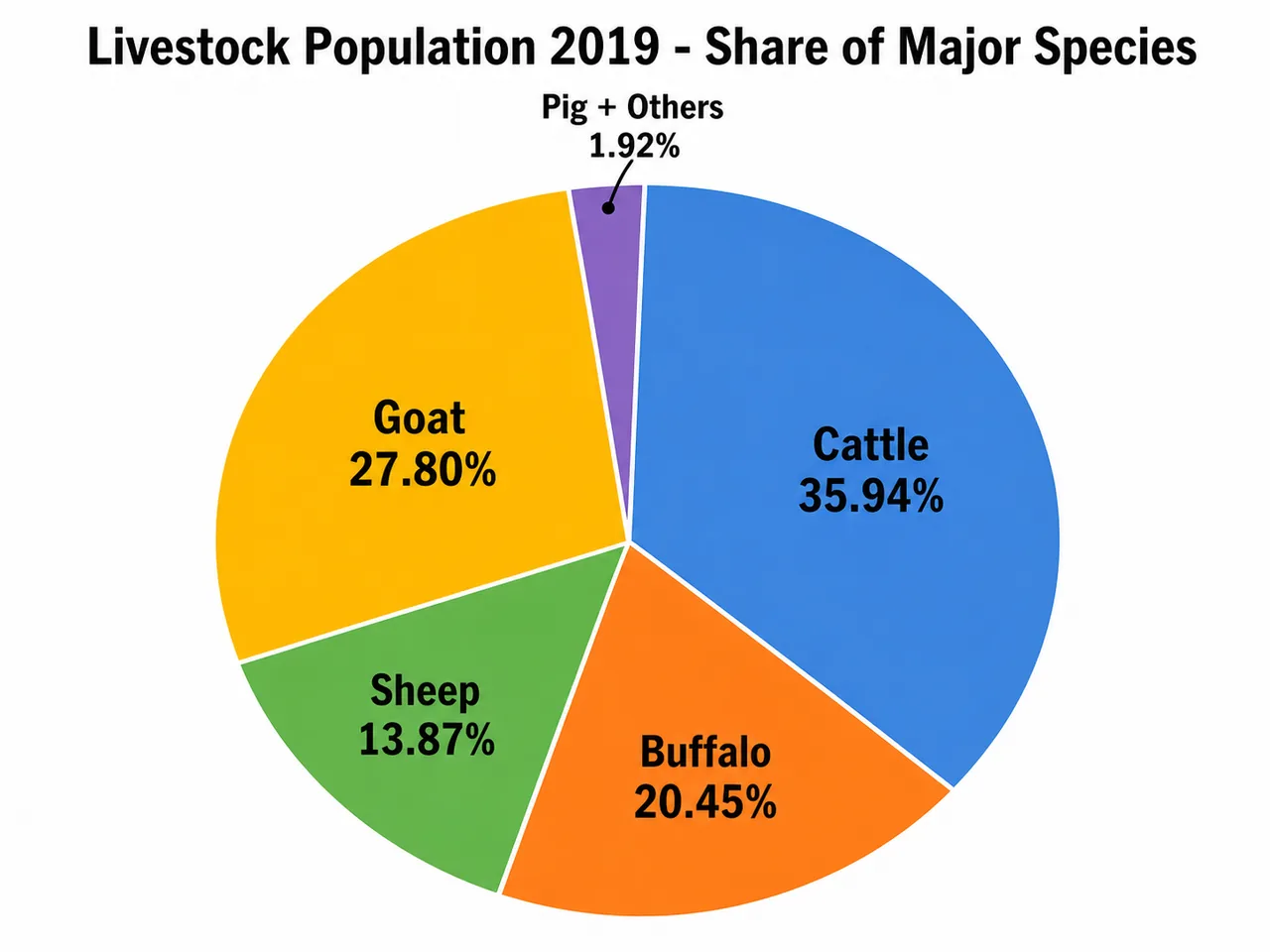
Species Share (2019): Cattle (36%) > Goat (28%) > Buffalo (20.5%) > Sheep (13.87%)
This ranking is important to remember for competitive exams. Cattle constitute the largest share of India's livestock, followed by goats, buffaloes, and sheep.
Poultry
| Category | Population (Million) | Growth over 2012 |
|---|---|---|
| Total Poultry | 851.81 | ↑ 16.8% |
| Backyard Poultry | 317.07 | ↑ 46% |
| Commercial Poultry | 534.74 | ↑ 4.5% |
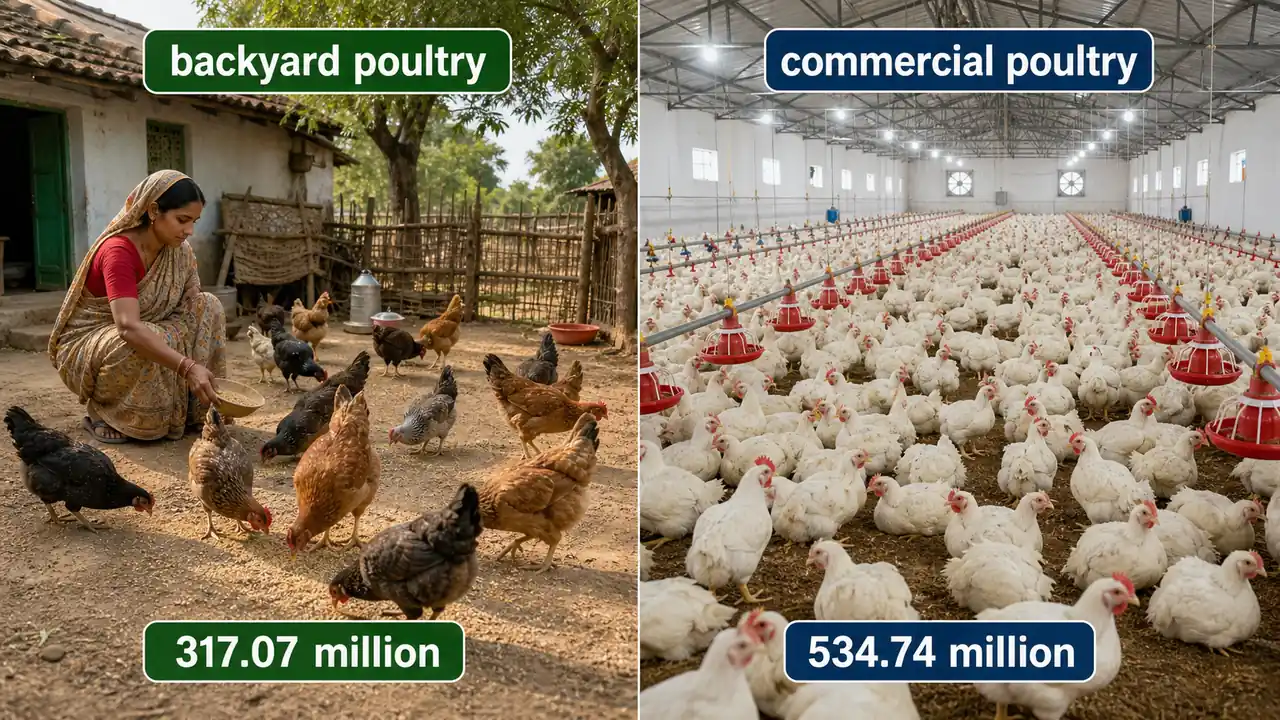
- The Total Poultry in the country is 851.81 million in 2019, registered an increase of 16.8% in the total poultry. This impressive growth highlights the rapid expansion of India's poultry industry, driven by rising demand for eggs and chicken meat.
- The total birds in the Backyard Poultry in the country is 317.07 million. The backyard poultry has increased by around 45.8% as compared to previous Census. Backyard poultry is gaining popularity because it provides nutrition and supplementary income to rural households with minimal investment.
- The total Commercial Poultry in the country is 534.74 million in 2019, increased by 4.5 % over previous Census. Commercial poultry operations are concentrated in states like Andhra Pradesh, Tamil Nadu, and Telangana.
Top Poultry States: Tamil Nadu > Andhra Pradesh > Telangana
Camel

Rajasthan alone accounts for the majority of India's camel population, as the state's arid terrain is ideal for camel rearing. The Border Security Force (BSF) also maintains camels for patrolling desert borders.
Note: Only Camel and Donkey have shown a continuous declining trend across the last four Livestock Censuses — 17th (2003), 18th (2007), 19th (2012), and 20th (2019).
Stray Animals (20th Census 2019)
| Category | Count |
|---|---|
| Stray Cattle | 50 Lakh (5 Million) |
| Stray Dogs | 153 Lakh (15.3 Million) |
Maximum Population (State Wise)
| Category | Maximum Population (State Wise) |
|---|---|
| Total Livestock | UP (67.8 Million) > Raj > MP |
| Cattle | W.B. > U.P |
| Buffalo | UP |
| Horse & Ponies | U.P. |
| Sheep | Telengana > AP |
| Goat | Raj |
| Donkey | Raj |
| Camel | Raj |
| Pig | Assam |
| Mules (Male Donkey x Female Horse) | U.K. |
| Mithun | Arunachal Pradesh |
| Yak | J&K |
| Poultry | T.N. > A.P. > Telengana |
Total Livestock Population by State
| S.No. | State | Population 2012 (Million) | Population 2019 (Million) | % Change |
|---|---|---|---|---|
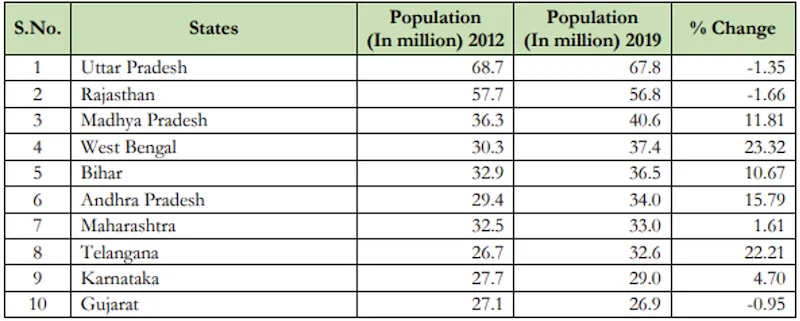
| 1 | Uttar Pradesh | 68.7 | 67.8 | -1.35 |
| 2 | Rajasthan | 57.7 | 56.8 | -1.66 |
| 3 | Madhya Pradesh | 36.3 | 40.6 | 11.81 |
| 4 | West Bengal | 30.3 | 37.4 | 23.32 |
| 5 | Bihar | 32.9 | 36.5 | 10.67 |
| 6 | Andhra Pradesh | 29.4 | 34.0 | 15.79 |
| 7 | Maharashtra | 32.5 | 33.0 | 1.61 |
| 8 | Telangana | 26.7 | 32.6 | 22.21 |
| 9 | Karnataka | 27.7 | 29.0 | 4.70 |
| 10 | Gujarat | 27.1 | 26.9 | -0.95 |
Major State increase in Livestock population
West Bengal > Telangana > Andhra Pradesh
References
1 source • [8]
References
21st Livestock Census (2024–25) — What's New?
The 21st Livestock Census is the next in the series, following the 20th Census of 2019. Enumeration was carried out between October 2024 and February 2025 across all States and Union Territories.
Key Facts for Exams
| Parameter | Details |
|---|---|
| Census Number | 21st Livestock Census |
| Enumeration Period | October 2024 — February 2025 |
| Conducted By | Dept. of Animal Husbandry & Dairying (DAHD) |
| Species Covered | 16 animal species |
| Indigenous Breeds Covered | 219 breeds recognised by ICAR-NBAGR |
| Data Collection Mode | Fully digitised — mobile app + digital dashboard |
| GPS Recording | Latitude & longitude of each data collection point |
16 Animal Species Covered
Cattle, Buffalo, Mithun, Yak, Sheep, Goat, Pig, Camel, Horse, Ponies, Mule, Donkey, Dog, Rabbit, Elephant — plus poultry birds (fowl, chicken, duck, turkey, geese, quail, ostrich, emu).
What's New in 21st Census (Not in Earlier Censuses)
- Pastoralist Data — For the first time, the census will collect information on the contribution of pastoralists to the livestock sector, their socio-economic status, and their livestock holdings.
- Household Income Dependency — Data will be collected on the proportion of households whose primary income comes from the livestock sector.
- Gender of Stray Cattle — The census will record the sex-wise count of stray cattle, a new addition to the dataset.
- 219 Indigenous Breeds — More granular breed-level data, covering all ICAR-NBAGR recognised breeds.
Exam Tip: The 21st Livestock Census will be fully digitised with mobile-app-based data collection, GPS coordinates, and real-time monitoring via a digital dashboard — same as the 20th census but with additional new data points.
ICAR-NBAGR — Quick Reference
ICAR-National Bureau of Animal Genetic Resources (NBAGR), Karnal, is the body responsible for identifying, registering, and conserving indigenous animal breeds in India. All 219 breeds covered in the 21st census are registered with NBAGR.
Summary Cheat Sheet
Census Framework
| Concept / Topic | Key Details |
|---|---|
| First livestock census | 1919 (47 years after human census in 1872) |
| First census after independence | 1951 |
| Census frequency | Quinquennial (every 5 years) |
| Conducted by | Dept. of Animal Husbandry & Dairying (DAHD), Ministry of Fisheries, AH & Dairying |
| Latest (completed) census | 20th Livestock Census (2019) — first to use digital technology for data collection |
| Objectives | Assess growth rate; improve production quality; reduce uneconomical livestock by culling |
20th Livestock Census 2019 — Population Data
| Species / Category | Population | Growth over 2012 |
|---|---|---|
| Total Livestock | 536.76 million | ↑ 4.8% |
| Rural livestock | 514.11 million (95.78%) | — |
| Urban livestock | 22.65 million (4.22%) | — |
| Total Bovines (Cattle + Buffalo + Mithun + Yak) | 303.76 million | ↑ 1.3% |
| Cattle | 193.46 million | ↑ 1.3% |
| Exotic/Crossbred cattle | 51.36 million | ↑ 29.3% |
| Indigenous/Non-descript cattle | 142.11 million | ↓ 6% |
| Female cattle (Cows) | 145.12 million | ↑ 18% |
| Buffaloes | 109.85 million | ↑ 1.1% |
| Mithun | 3.9 lakh | ↑ 29.5% |
| Yak | 58 thousand | ↑ 24.9% |
| Milch animals (cows + buffaloes) | 125.75 million | ↑ 6% |
| Goat | 148.89 million | ↑ 10.1% |
| Sheep | 74.26 million | ↑ 14.1% |
| Pig | 9.06 million | ↓ 12.03% |
| Horses & Ponies | 3.4 lakh | ↓ 45.2% |
| Mules | 84 thousand | ↓ 57.1% |
| Donkeys | 1.2 lakh | ↓ 61.2% |
| Camel | 2.5 lakh (0.25 million) | ↓ 37.1% |
| Total Poultry | 851.81 million | ↑ 16.8% |
| Backyard Poultry | 317.07 million | ↑ 45.8% |
| Commercial Poultry | 534.74 million | ↑ 4.5% |
| Stray Cattle | 50 lakh | — |
| Stray Dogs | 153 lakh | — |
Key Rankings & Trends
| Concept / Topic | Key Details |
|---|---|
| Species share order | Cattle 36% > Goat 28% > Buffalo 20.5% > Sheep 13.87% |
| Continuously declining | Camel & Donkey — only species with decline in all last 4 censuses (17th–20th) |
| Most cattle (state) | West Bengal > UP |
| Most buffalo (state) | Uttar Pradesh |
| Most goat (state) | Rajasthan |
| Most sheep (state) | Telangana > AP |
| Most pig (state) | Assam |
| Most camel (state) | Rajasthan > Gujarat > Haryana |
| Most mithun (state) | Arunachal Pradesh |
| Most yak (state) | J&K |
| Most poultry (state) | Tamil Nadu > AP > Telangana |
| Total livestock leader | Uttar Pradesh (67.8 M) > Rajasthan > MP |
| Highest livestock increase | West Bengal > Telangana > Andhra Pradesh |
21st Livestock Census (2024–25)
| Parameter | Details |
|---|---|
| Enumeration period | October 2024 — February 2025 |
| Conducted by | DAHD |
| Technology | Fully digitised — mobile app + GPS coordinates + digital dashboard |
| Species covered | 16 animal species |
| Indigenous breeds | 219 breeds recognised by ICAR-NBAGR, Karnal |
| New: Pastoralist data | First time — socio-economic status & livestock holdings of pastoralists |
| New: Income dependency | % of households whose primary income is from livestock |
| New: Stray cattle sex-wise | Sex-wise count of stray cattle (new addition) |
Lesson Doubts
Ask questions, get expert answers