🍱 Animal Nutrition - Balanced Ration, Feed Types, Rumen Health and Teeth
Complete guide to animal nutrition covering balanced ration, concentrates vs roughages, TDN, hay vs silage, types of ration (maintenance, production, flushing, steaming up), bypass protein, rumen health disorders, ketosis, acidosis, cattle dentition, and stomach chambers for exams.

- Nutrition involves various chemical reaction and physiological process which transforms Food into body tissue ( milk, meat, egg, wool )and activities (Work power). In other words, nutrition is the science of how an animal's body converts feed into useful products and energy.
- Nutrition involves ingestion, digestion, and absorption of the various Nutrients and their transport to all the body cell and the removal of unusable elements and waste products of Metabolism. This entire chain -- from eating to excreting -- must function efficiently for an animal to remain healthy and productive.
- There are two aspects in Animal Nutrition
- Science of Nutrition -- It is the work of Animal Nutritionist.
- Art of feeding of animals.- Good stockman ship. A good stockman knows when, what, and how much to feed each animal based on its age, breed, and productive status.
Balance Ration
- A balance ration is a ration which provides **all** the essential nutrients to the animal in such proportion and amounts that are required for the proper nourishment of the particular animal in 24 hours (One Day). The key concept here is that a **balanced ration** meets the animal's complete nutritional needs for an entire day -- not a single meal.
- Also known as **daily ration** or simply as **ration**.
- The ration is fed at the rate of 2 to 2.5% of body weight each day. For example, a cow weighing 400 kg would require approximately 8 to 10 kg of feed daily.
Ration Constituents

| Nutrient | Plant Sources |
|---|---|
| Carbohydrate | Maize, Sorghum, Wheat, Oats, Rice, Grasses |
| Protein | Lucerne (Alfalfa), Clovers, Beans, Grasses |
| Fats | Cotton seed, Sunflower, Groundnuts, Grasses |
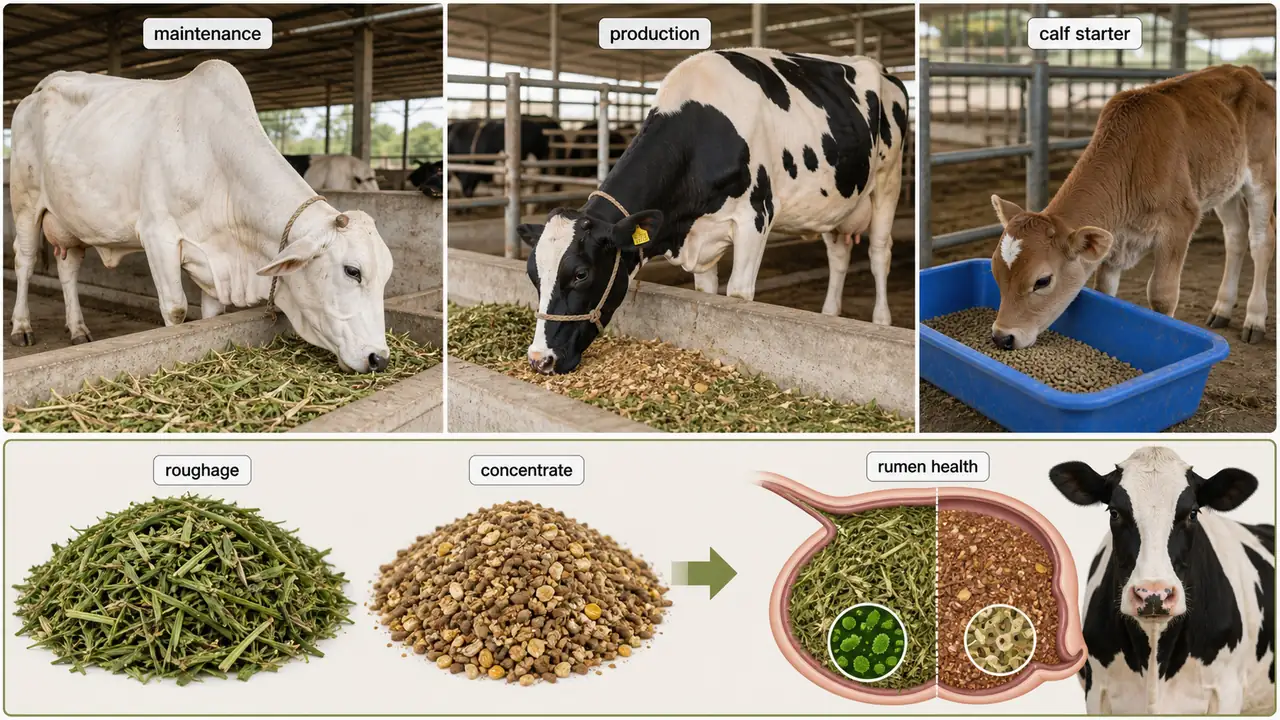
- Concentrates: Feeds that contain less than 18% crude fiber are called concentrates such as grains, oilcakes, grain by products etc. Concentrates are nutrient-dense feeds that provide high levels of energy and protein in a small volume.
- Roughage: Feeds that contain more than 18% crude fiber are called roughage such as hay, silage, fodder etc. Roughages are essential for rumen health as they stimulate chewing, saliva production, and proper rumen function.
TIP
Pro Content Locked
Upgrade to Pro to access this lesson and all other premium content.
₹99 charged monthly · Cancel anytime
- All Agriculture & Banking Courses
- AI Lesson Questions (100/day)
- AI Doubt Solver (50/day)
- Glows & Grows Feedback (30/day)
- AI Section Quiz (20/day)
- 22-Language Translation (100/day)
- Recall Questions (20/day)
- AI Quiz (15/day)
- AI Quiz Paper Analysis (100/day)
- AI Step-by-Step Explanations (100/day)
- Spaced Repetition Recall (FSRS)
- AI Tutor
- Immersive Text Questions
- Audio Lessons — Hindi & English
- Mock Tests & Previous Year Papers
- Summary & Mind Maps
- XP, Levels, Leaderboard & Badges
- Generate New Classrooms
- Voice AI Teacher (AgriDots Live)
- AI Revision Assistant
- Knowledge Gap Analysis
- Interactive Revision (LangGraph)
🔒 Secure via Razorpay · Cancel anytime · No hidden fees
- Nutrition involves various chemical reaction and physiological process which transforms Food into body tissue ( milk, meat, egg, wool )and activities (Work power). In other words, nutrition is the science of how an animal's body converts feed into useful products and energy.
- Nutrition involves ingestion, digestion, and absorption of the various Nutrients and their transport to all the body cell and the removal of unusable elements and waste products of Metabolism. This entire chain -- from eating to excreting -- must function efficiently for an animal to remain healthy and productive.
- There are two aspects in Animal Nutrition
- Science of Nutrition -- It is the work of Animal Nutritionist.
- Art of feeding of animals.- Good stockman ship. A good stockman knows when, what, and how much to feed each animal based on its age, breed, and productive status.
Balance Ration
- A balance ration is a ration which provides **all** the essential nutrients to the animal in such proportion and amounts that are required for the proper nourishment of the particular animal in 24 hours (One Day). The key concept here is that a **balanced ration** meets the animal's complete nutritional needs for an entire day -- not a single meal.
- Also known as **daily ration** or simply as **ration**.
- The ration is fed at the rate of 2 to 2.5% of body weight each day. For example, a cow weighing 400 kg would require approximately 8 to 10 kg of feed daily.
Ration Constituents
| Nutrient | Plant Sources |
|---|---|
| Carbohydrate | Maize, Sorghum, Wheat, Oats, Rice, Grasses |
| Protein | Lucerne (Alfalfa), Clovers, Beans, Grasses |
| Fats | Cotton seed, Sunflower, Groundnuts, Grasses |
- Concentrates: Feeds that contain less than 18% crude fiber are called concentrates such as grains, oilcakes, grain by products etc. Concentrates are nutrient-dense feeds that provide high levels of energy and protein in a small volume.
- Roughage: Feeds that contain more than 18% crude fiber are called roughage such as hay, silage, fodder etc. Roughages are essential for rumen health as they stimulate chewing, saliva production, and proper rumen function.
TIP
The 18% crude fibre threshold is the dividing line: below 18% = concentrate, above 18% = roughage. This is a frequently asked exam question.
| S.No. | Concentrate | Roughages |
|---|---|---|
| 1. | 10% Moisture and 90% Dry matter | Dry fodder: 10% Moisture and 90% Dry matter. Green Fodder: 80-90% Moisture and 10% Dry Matter |
| 2. | Highly Digestible | Comparatively less digestible |
| 3. | Crude fibre less than 18% | More than 18% |
| 4. | Nutritive Value/unit mass is high | Low |
| 5. | Compact in Nature | Bulky |
| 6. | Keeping quality - High | Variable: Dry Fodder – High, Green fodder – Less/low |
- Pasture: Fodder crops grown on the land for grazing animals. Pastures provide fresh, green feed that is rich in vitamins and minerals at low cost.
- Hay: Hay is grass that is cut, dried and stored by humans to be used in future. It is characterized by having low moisture content (not more than 15%). The low moisture ensures that hay can be stored for long periods without spoilage — if moisture exceeds 15%, mould and heating occur during storage.
- Silage: Green grass is a good source of vitamin A which is present in the form of Carotene. Green fodder can be preserved as silage stored for long period (up to months). Silage is a type of fodder made from green foliage crops which have been preserved by fermentation to the point of acidification. Moisture content varies by crop: maize/sorghum silage: 60–70% moisture; grass/legume silage: 70–80% moisture. The fermentation process produces organic acids (mainly lactic acid) that act as natural preservatives, keeping the fodder nutritious for months.
- Ensiling: Process of making silage. In the ensiling process, the absence of oxygen leads to the fermentation of water-soluble carbohydrates to produce organic acids which increase acidity of the material (pH about 4.0). This anaerobic fermentation is the core principle behind silage-making -- without oxygen, beneficial bacteria thrive and harmful ones are suppressed.
- Energy feeds: Feeds containing less than 20% crude protein are called energy feeds. Examples include maize, barley, wheat bran, and molasses.
- Protein supplements: Feeds that contain 20% or more protein are called protein supplements. Examples include groundnut cake, soybean meal, cottonseed cake, and fish meal.
Major Indian Fodder Crops
India's livestock sector depends heavily on cultivated fodder crops. Key crops to know for exams:
| Fodder Crop | Season | Key Feature |
|---|---|---|
| Berseem (Trifolium alexandrinum) | Rabi (winter) | Highest-quality legume roughage; rich in protein and calcium; widely used in Punjab, Haryana |
| Lucerne / Alfalfa (Medicago sativa) | Perennial / Rabi | Very high protein (18–22%); can cause frothy bloat if fed alone; best mixed with grasses |
| Napier / Elephant grass (Pennisetum purpureum) | Kharif / Year-round | High biomass; ideal for cut-and-carry systems; used in silage making |
| Jowar / Sorghum (Sorghum bicolor) | Kharif | Dual-purpose grain + fodder; excellent for silage; caution: HCN (prussic acid) in young plants |
| Maize (Zea mays) | Kharif | Best crop for silage making; high energy, highly digestible |
| Oats (Avena sativa) | Rabi | Good winter fodder; easily digestible; suitable for milch animals |
TIP
Berseem is called the "King of Fodder Crops" in India. Lucerne is the most protein-rich legume fodder. Both can cause frothy bloat if fed in excess on an empty stomach.
TDN — Total Digestible Nutrients
- TDN is a measure of the overall energy value of a feed. It is the sum of all digestible organic nutrients — digestible crude protein + digestible crude fibre + digestible nitrogen-free extract + (digestible ether extract × 2.25).
- TDN is expressed as a percentage of dry matter or as kg per kg of feed.
- A dairy cow producing 10 litres of milk per day requires approximately 5–6 kg TDN per day.
- TDN is the most commonly used energy system in Indian livestock feeding standards (ICAR) and in IBPS AFO/NABARD exam questions.
- High TDN feeds: Maize (80%), Groundnut cake (77%), Molasses (60–65%)
- Low TDN feeds: Wheat straw (40–42%), Paddy straw (38–40%)
IMPORTANT
TDN formula to remember: TDN = Digestible CP + Digestible CF + Digestible NFE + (Digestible EE × 2.25). Ether extract is multiplied by 2.25 because fat has 2.25× more energy than carbohydrates.
Bypass Protein (Rumen Undegradable Protein — RUP / UDP)
- Ruminants have a unique problem: the rumen microbes degrade a large portion of dietary protein before it reaches the small intestine. This degraded protein is called Rumen Degradable Protein (RDP).
- Bypass protein (also called Undegradable Dietary Protein — UDP or Rumen Undegradable Protein — RUP) is the fraction of dietary protein that escapes rumen fermentation and is directly digested and absorbed in the abomasum and small intestine.
- Bypass protein is critical for high-yielding dairy cows whose protein demand for milk production exceeds what rumen microbes can supply.
- High bypass protein feeds: Fish meal (~70% RUP), Blood meal (~80% RUP), Formaldehyde-treated groundnut cake, Heat-treated oilcakes.
- Formula: Total dietary protein = RDP (degraded in rumen) + RUP (bypass protein)
Importance of drinking water for dairy animals
- Ad libitum basis (as and when required on free choice basis). This means animals should have unrestricted access to clean drinking water at all times.
- Normally, an adult healthy animal require 75 to 80 litres of water daily. Since milk contains about 87–88% water, for every litre of milk produced, additional two and half litres water is required above maintenance. This makes water the single most important nutrient for dairy animals, as insufficient water intake directly reduces milk production.
- During summer, crossbred cows and buffaloes should be given bath twice daily and at least 100 litres of water per day to manage heat. Bathing helps in thermoregulation and reduces heat stress, which can otherwise cause a significant drop in milk yield.
- Salinity of water is seldom a problem in dairy buffalo feeding. A salt content of up to 5 g/litre of water can be used for buffaloes.
Ration Strategies for Different Production Goals
Types of Ration
| Category | Amount per Day |
|---|---|
| A. Concentrate Feed | |
| 3 months to 1 year | 1 kg |
| Above 1 year | 2 kg |
| Pregnant Heifers | 3–3.5 kg |
| B. Green Fodder | |
| Leguminous fodder | 10 kg |
| Non-Leguminous fodder | 25 kg |
| C. Dry Fodder | 3 kg |
Production Ration
- A portion of the ration given daily is more than maintenance requirement for purpose of growth, production, and work. The production ration is the extra feed above maintenance that fuels activities like milk production, weight gain, or draught work. The higher the production level, the more production ration is needed.
Flushing
- This is a temporary but purposeful increase in nutrition/ feed around breeding time — typically starting 2–3 weeks before mating and continuing through the first 3 weeks of the mating period.
- Its objective is to boost ovulation, conception, and embryo implantation rates. Flushing may also increase the proportion of females that exhibit estrus. By providing extra energy and protein just before breeding, the farmer can significantly improve reproductive success.
- Flushing is most effective in animals that are in average to thin body condition at the time of mating. Animals already in good condition show less response to flushing.
Steaming up
- Steaming up refers to providing extra concentrate to a pregnant animal in the last 4–6 weeks of pregnancy (G.C. Banerjee). This practice is crucial for preparing the animal for the demanding lactation period that follows calving.
- It provides extra nutrients for the animal and the growing foetus.
- Steaming up also allows the animal to put on extra weight (reserve energy) to promote maximum milk production from the very beginning of the lactation. Animals that are well-nourished before calving typically have a higher peak yield and a longer lactation than those that are underfed.
- Inadequate steaming up increases the risk of ketosis (acetonaemia) in early lactation, as the animal cannot mobilise enough energy from body reserves.
Calf starter
- Concentrate feed that can be offered as early as day 3–7 of age; meaningful voluntary intake begins at 2–3 weeks of age. Calf starter is high in protein and designed to encourage early rumen development in young calves, helping them transition from a liquid (milk) diet to solid feed.
- Early access to calf starter accelerates rumen papillae development, which is essential for efficient nutrient absorption later in life.
Challenge feeding
- The practice of feeding higher levels of concentrate to challenge the cow to reach her maximum milk production. This technique is used with high-yielding cows in early lactation to ensure they express their full genetic potential for milk production.
Creep feeding
- The place of feeding lamb, calves and piglet means only young animals but not adults. A creep feeder is designed with small openings that only young animals can access, ensuring the feed is reserved exclusively for them.
- Creep feeding is a method of supplementing the diet of young livestock, primarily in beef calves, by offering feed to animals who are still nursing.
- Creep feed is sometimes offered to swine, and it is possible with companion grazing animals such as sheep and goats.
- 'Creep Feeding', the practice of offering grain to lambs/kids that have not yet been weaned, can help the eventual transition off of milk to a post-weaning diet and can reduce stress at weaning time. Early exposure to solid feed ensures that the young animal's digestive system matures smoothly before weaning.
When Nutrition Goes Wrong
Rumen Health
IMPORTANT
Remember the deficiency-disease links: Ca → Milk Fever, Fe → Anaemia, P → Pica, Na → Dehydration.
Ketosis (Acetonaemia)
- Ketosis is a metabolic disorder of high-producing dairy cows that occurs in early lactation (first 4–6 weeks after calving), when energy demand for milk production exceeds dietary energy intake.
- The cow mobilises body fat to compensate, producing ketone bodies (acetone, acetoacetate, beta-hydroxybutyrate) in excess. These accumulate in blood, milk, and urine.
- Signs: Drop in milk yield, sweet/fruity smell of breath and milk (acetone odour), nervous signs in severe cases, rapid weight loss.
- Predisposing factors: Over-conditioned cows at calving (BCS > 3.5), inadequate steaming up, sudden diet change, low energy intake.
- Prevention: Proper steaming up, avoid over-conditioning before calving, propylene glycol supplementation.
Ruminal Acidosis (Grain Overload)
- Acidosis is the opposite of bloat — it occurs when excess concentrate (starch/grain) is fed, causing rapid fermentation of starch in the rumen, producing large amounts of lactic acid.
- Rumen pH drops below 5.5 (normal rumen pH: 6.0–6.8), damaging rumen lining (rumenitis) and ultimately the liver (liver abscesses).
- Signs: Diarrhoea, dullness, reluctance to move, rumen stasis, laminitis (founder) in chronic cases.
- Prevention: Gradual introduction of concentrates, adequate roughage in diet (minimum 40% of dry matter), use of buffers like sodium bicarbonate (baking soda).
TIP
Acidosis vs Bloat: Bloat = too much green legume fodder (gas accumulation, high pH). Acidosis = too much grain (lactic acid, low pH). Both are rumen disorders but opposite in cause.
Body Condition Scoring (BCS)
- BCS is a practical tool to visually and manually assess the fat reserves (energy status) of an animal, independent of body weight.
- Scored on a scale of 1 to 5 in cattle (1 = emaciated, 5 = obese). Ideal BCS at calving: 3.0–3.5.
- BCS guides feeding decisions: animals below target need more energy; over-conditioned animals (BCS > 3.5) are at risk of ketosis.
- Key BCS targets for dairy cows:
- At calving: 3.0–3.5
- At peak lactation (6–8 weeks): not below 2.5
- At dry-off: 3.0–3.5
Anatomical Anchors for Nutrition
Teeth in Cattles
- Cattle first develop 20 temporary teeth, known also as deciduous, milk, or baby teeth. These temporary teeth eventually fall out and are replaced with 32 permanent or adult teeth as an animal matures. The age of cattle can be estimated by examining the pattern of tooth replacement, which is a useful skill in livestock management.
TIP
Why the difference between 20 and 32? Temporary dentition has no molars at all (0/0 in the molar column). The 12 extra teeth in permanent dentition are the 12 molars (3 upper + 3 lower on each side = 12). Molars are never temporary — they erupt only as permanent teeth. So: 20 temporary = incisors + premolars only; 32 permanent = incisors + premolars + molars added. Also note: no upper incisors or canines in cattle — a tough dental pad replaces them.
- Dentition Formula (ICPM: Incisor, Canaion, Premolars, Molars - pairs)
- Temporary dentition (20): 0/4 0/0 3/3 0/0
- Permanent dentition (32): 0/4 0/0 3/3 3/3
- Number of permanent cheek teeth in cow (molar + premolar) = 24.
- Molar teeth do not emerge temporarily in cows and buffaloes. They come straight out permanent. This is an important exam fact -- molars appear only as permanent teeth, never as temporary ones.
- Canine teeth are not found in ruminant animals. Instead, ruminants have a tough dental pad on the upper jaw that works against the lower incisors to tear grass.

Parts of Stomach in Ruminants
 - The stomach of a ruminant has four chambers. This multi-chambered stomach is what makes ruminants unique -- it allows them to **digest cellulose** (plant fibre) that non-ruminants cannot.
- The first chamber is the largest and is called the rumen. The rumen acts as a giant **fermentation vat** where billions of microorganisms break down cellulose into usable nutrients.
- The second chamber is the **reticulum** (**honeycomb**). It is named for its **honeycomb-like inner lining** and works closely with the rumen to move partially digested food.
- The third is the **Omasum** (**book**) and the fourth is the abomasum (the true stomach). The omasum absorbs water and minerals, while the **abomasum** functions like a human stomach, secreting **digestive acids and enzymes**.
- The stomach of a ruminant has four chambers. This multi-chambered stomach is what makes ruminants unique -- it allows them to **digest cellulose** (plant fibre) that non-ruminants cannot.
- The first chamber is the largest and is called the rumen. The rumen acts as a giant **fermentation vat** where billions of microorganisms break down cellulose into usable nutrients.
- The second chamber is the **reticulum** (**honeycomb**). It is named for its **honeycomb-like inner lining** and works closely with the rumen to move partially digested food.
- The third is the **Omasum** (**book**) and the fourth is the abomasum (the true stomach). The omasum absorbs water and minerals, while the **abomasum** functions like a human stomach, secreting **digestive acids and enzymes**.
TIP
Mnemonic for the four rumen chambers (in order): "Rumen Really Offers All" — Rumen → Reticulum → Omasum → Abomasum. Alternatively remember by size/function: Rumen = largest (fermentation), Reticulum = honeycomb (hardware disease), Omasum = book/manyplies (water absorption), Abomasum = true stomach (acid digestion). Only the abomasum has a function equivalent to the human stomach.
- The ruminant chews grass and shallows and it goes into the rumen.
- When the ruminant has finished eating, the food is brought back up and rechewed. This is called chewing the cud or rumination. If the animal stops ruminating this is a sign of ill health. A healthy cow typically ruminates for 6 to 8 hours per day, and cessation of rumination is one of the earliest indicators of disease.
- Cattle, Goats, Sheep, Buffalo and Camel chew the cud. They are ruminants. They chew the cud (ruminate) for 6 to 8 hours each day.
- The horse, donkey and mule are herbivores but do not chew the cud. They are non-ruminants. These animals have a simple stomach (monogastric) and rely on hindgut fermentation in the caecum to digest fibre.

Explore More 🔭
🟢 https://www.youtube.com/watch?v=CJomFwt3eMs
References
5 sources • [1] [2] [3] [4] [5]
References
Summary Cheat Sheet
| Concept / Topic | Key Details |
|---|---|
| Nutrition | Chemical reactions & physiological processes converting food into body tissue (milk, meat, egg, wool) |
| Two aspects of nutrition | Science of Nutrition (nutritionist) and Art of Feeding (stockmanship) |
| Balanced Ration | All essential nutrients for 24 hours; fed at 2–2.5% of body weight |
| Concentrates | Feeds with <18% crude fibre (grains, oilcakes) — nutrient-dense |
| Roughages | Feeds with >18% crude fibre (hay, silage, fodder) — essential for rumen health |
| Hay | Dried grass; moisture ≤15%; stored for long periods (mould if >15%) |
| Silage | Anaerobic fermentation; maize silage: 60–70% moisture; grass silage: 70–80%; pH ~4.0 |
| Energy feeds | Feeds with <20% crude protein (maize, barley, molasses) |
| Protein supplements | Feeds with ≥20% protein (groundnut cake, soybean meal, fish meal) |
| TDN | Digestible CP + CF + NFE + (EE × 2.25); main ICAR energy measure; dairy cow needs 5–6 kg TDN/day |
| High / Low TDN | High: Maize 80%, GNC 77% · Low: Wheat straw 40–42%, Paddy straw 38–40% |
| Bypass Protein (RUP/UDP) | Escapes rumen fermentation; absorbed in small intestine; Fish meal ~70% RUP, Blood meal ~80% RUP |
| Water requirement (adult) | 75–80 litres/day; milk is 87–88% water; extra 2.5 L per litre of milk produced |
| Maintenance Ration | Feed for resting, non-production condition only |
| Production Ration | Extra feed above maintenance for growth, milk, or work |
| Flushing | Extra feed 2–3 weeks before mating through first 3 weeks of mating — boosts ovulation & conception |
| Steaming up | Extra concentrate in last 4–6 weeks of pregnancy; prevents ketosis post-calving |
| Calf starter | Offered from day 3–7; meaningful intake at 2–3 weeks; stimulates rumen papillae |
| Challenge feeding | Higher concentrate to push cow to maximum milk production |
| Creep feeding | Supplemental feed for young animals only (lambs, calves, piglets) |
| Indian Fodder Crops | Berseem = king of fodders (Rabi); Lucerne = highest protein 18–22%; Napier = high biomass; Maize = best for silage |
| Tympanitis (Bloat) | Legume fodders (berseem, lucerne) → saponins/soluble proteins → frothy bloat |
| Ketosis (Acetonaemia) | Energy deficit in first 4–6 weeks of lactation; ketone bodies; sweet breath; BCS >3.5 at risk |
| Acidosis (Grain overload) | Excess grain → lactic acid → rumen pH <5.5 (normal 6.0–6.8); rumenitis, laminitis |
| Mineral deficiencies | Ca → Milk Fever · Fe → Anaemia · P → Pica · Na → Dehydration |
| BCS | Scale 1–5; ideal at calving: 3.0–3.5; peak lactation: not below 2.5 |
| Cattle temporary teeth | 20 temporary (no molars) → replaced by 32 permanent teeth (12 molars added); molars appear only as permanent teeth |
| Permanent cheek teeth (cow) | 24 (molar + premolar); molars emerge only as permanent teeth; no canines |
| Rumen chambers | 4: Rumen (largest, fermentation) → Reticulum (honeycomb) → Omasum (book) → Abomasum (true stomach) · Mnemonic: "Rumen Really Offers All" |
| Rumination | Healthy cow ruminates 6–8 hours/day; cessation = sign of illness |
Lesson Doubts
Ask questions, get expert answers