🌾 Fodder Crops, Grazing Systems, Silage, Hay Making and Integrated Livestock Farming
Complete guide covering kharif fodder crops (Jowar, Sudan grass, Sewan grass, BNH), rabi crops (Berseem, Lucerne, Senji, Lathyrus), perennial grasses, fodder trees (Agathi, Subabul), 7 grazing systems, silage making with additives, hay making, urea treatment, and integrated livestock-fish farming (poultry, duck, cattle, pig) for exams.
This lesson covers everything an exam candidate needs about feeding systems: what to grow (kharif, rabi, perennial grasses, fodder trees), how to manage grazing (7 systems from continuous to Hohenheim), how to preserve surplus fodder (silage, hay, urea-treated straw), and how to integrate livestock with fish farming. Start with the feeding fundamentals below — they connect every topic that follows.
Green fodder is the primary source of Vitamin A (in the form of carotene) for lactating animals. On an average, 8-10% of live weight of the animal should be provided daily as green fodder. For example, an adult cattle weighing 400 kg will consume 32-40 kg of green fodder per day.
TIP
Feed should be available to cows for at least 20 hours/day. During summer, at least 60% of ration should be fed at night. Cows reduce feed intake by about 3.3% for every 2.2°C rise in temperature over 24°C.
Fodder Requirement Fundamentals
These numbers underpin every section of this lesson — how much to feed, what rumen conditions must be maintained, and why conservation (silage, hay) is critical when green supply is seasonal.
- Provide green fodder at 8-10% of live body weight daily.
- Provide at least 2 kg of fibre per day for proper rumen function.
- Forage dry matter (DM) consumption should be near 2% of body weight.
- Rumen pH must stay above 6.0 — below this, fibre digestion slows and microbial protein synthesis drops sharply.
- High-producing cows eat up to 12 meals per day, each averaging 23 minutes.
- Roughages alone support production up to 4–5 kg milk/day. For every additional 2.5 kg milk, feed 1 kg concentrate.
- Ration should contain roughage at not less than 1% and not more than 2% of live weight (air-dry basis).
NOTE
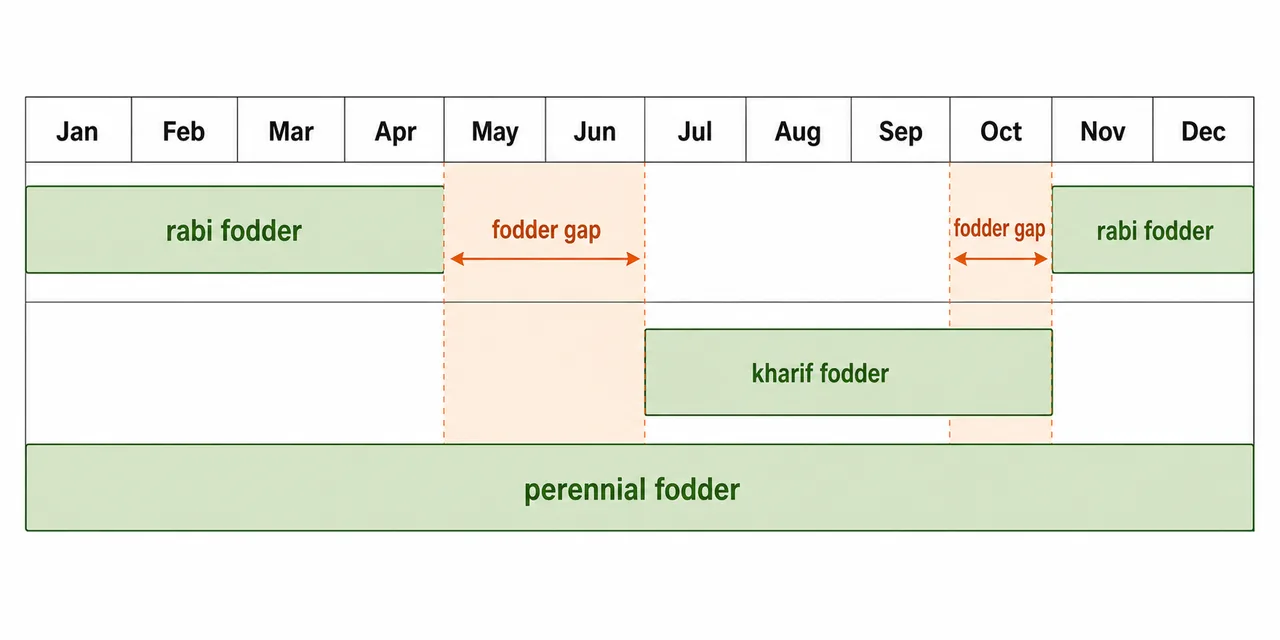
India's Fodder Gap Problem: India faces two acute lean periods every year — (1) May–June, when rabi crops are harvested but kharif has not yet grown, and (2) October–November, when kharif ends but rabi is not ready. During these windows, green fodder availability drops sharply. This is the entire rationale for silage, hay, and urea-treated straw — all covered later in this lesson. Understanding the gap explains why each conservation method exists.
Fodder Crops -- Kharif Season
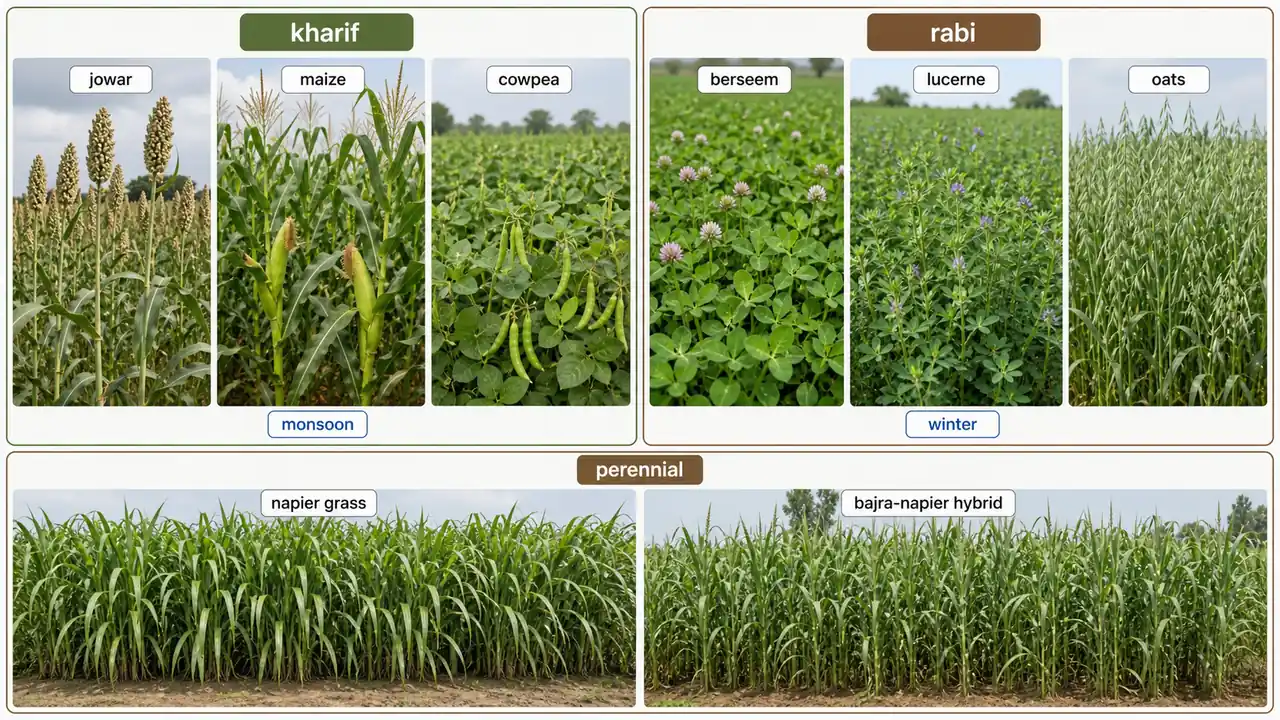
Kharif fodder crops are sown during the rainy season (June-October) and form the bulk of green fodder supply in India.
| Crop | Scientific Name | Key Features |
|---|---|---|
| Jowar (Sorghum) | Sorghum bicolor | Most important kharif fodder; high yielding; contains HCN (prussic acid) in young stage which can be toxic |
| Sudan Grass | Sorghum sudanense | Fast-growing; lower HCN than jowar; can be grazed at shorter heights; used in sorghum-sudan hybrids |
| Bajra (Pearl Millet) | Pennisetum glaucum | Drought tolerant; suitable for arid regions; quick growing |
| Maize | Zea mays | High palatability; good energy content; best crop for silage making |
| Cowpea (Lobia) | Vigna unguiculata | Leguminous fodder; high protein content; fixes atmospheric nitrogen |
| Guar (Cluster Bean) | Cyamopsis tetragonoloba | Drought resistant legume; grown in arid/semi-arid zones; improves soil fertility |
NOTE
HCN Toxicity in Jowar: Young sorghum plants contain dangerous levels of hydrocyanic acid (prussic acid). Animals should not be allowed to graze on jowar until the crop is at least 45-50 cm tall, or after the first cutting when regrowth is sufficient.
Fodder Crops -- Rabi Season
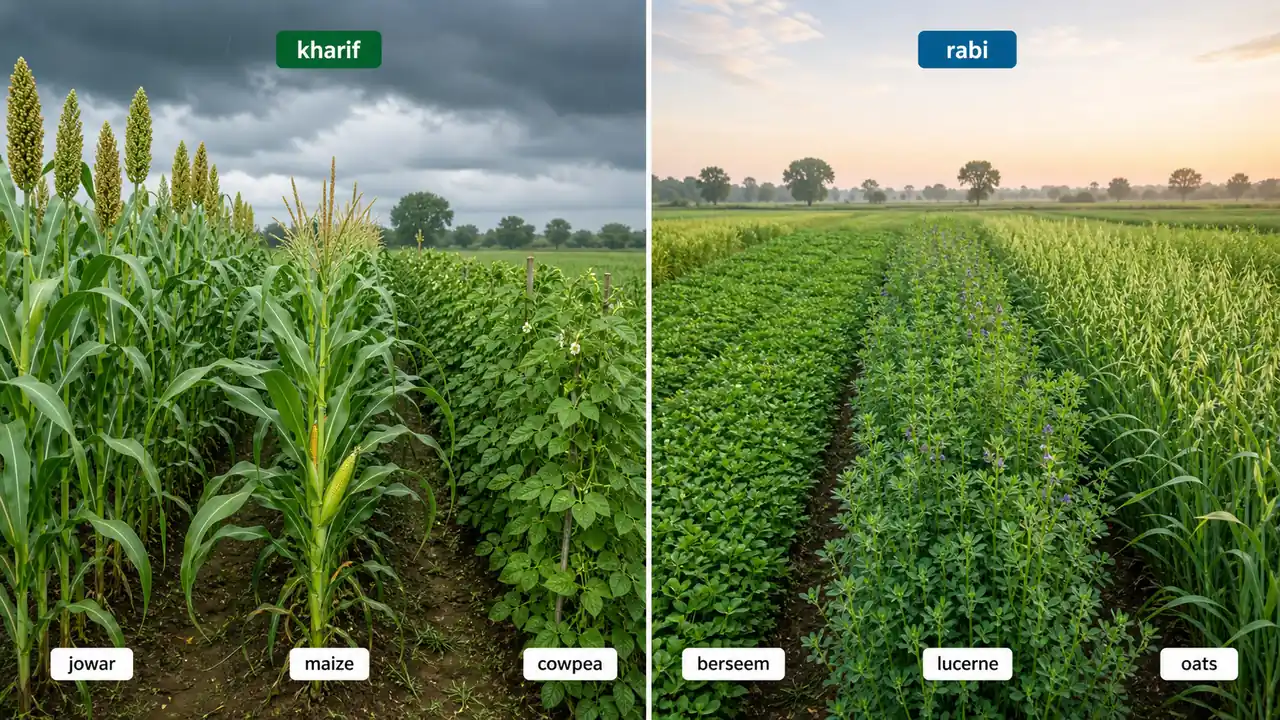
Rabi fodder crops are sown in winter (October-March) and bridge the critical fodder gap during the lean season.
| Crop | Scientific Name | Key Features |
|---|---|---|
| Berseem (Egyptian Clover) | Trifolium alexandrinum | King of fodders; 18-22% CP; gives 5-6 cuttings; best leguminous fodder; 60-62% TDN |
| Lucerne (Alfalfa) | Medicago sativa | Queen of fodders; perennial legume; 18-22% CP (early bloom); deep-rooted; 7-8 cuttings; 280-320 qt/acre yield |
| Oats (Jai) | Avena sativa | Most important rabi cereal fodder; high palatability; suitable for hay and silage |
| Mustard (Sarson) | Brassica spp. | Used as green fodder; thinnings used for fodder purpose |
| Senji (Indian Sweet Clover) | Melilotus indica | Drought-resistant; grows on residual moisture without irrigation; 16.57% CP; 60% TDN; rabi legume for unirrigated areas |
| Lathyrus / Khesari (Grass Pea) | Lathyrus sativus | Rabi legume; climate-smart; tolerates drought, waterlogging, salinity; up to 34% CP; contains neurotoxin ODAP — restrict to <30% of diet; common in eastern and central India |
TIP
Berseem is called the "King of Fodders" and Lucerne is called the "Queen of Fodders". Berseem is the most important rabi season fodder legume in India. These are very frequently asked facts in exams.
Carotene Content of Important Fodders
| Fodder | Carotene (mg/100g DM) |
|---|---|
| Agathi | 18.3 |
| Lucerne | 15.6 |
| Guinea grass | 14.2 |
| Desmodium | 7.09 |
Perennial Fodder Grasses
Perennial grasses provide green fodder throughout the year and are the backbone of the lean-season feeding strategy. Unlike kharif/rabi crops that must be re-sown each season, perennials are established once and harvested repeatedly for years.
| Grass | Scientific Name | Key Features |
|---|---|---|
| Napier Grass (Elephant Grass) | Pennisetum purpureum | Highest yielding perennial; grows 3–4 m tall; propagated by stem cuttings; 150–200 t/ha/year green fodder; multiple cuttings/year |
| Bajra-Napier Hybrid (BNH) | P. purpureum × P. glaucum | Perennial hybrid developed by ICAR/TNAU; yields 250–360 t/ha/yr — higher than pure Napier because hybrid vigour (heterosis) boosts both growth rate and tillering; better crude protein than Napier due to bajra parentage; propagated by stem cuttings like Napier (not by seed) |
| Guinea Grass | Panicum maximum | Shade tolerant — suited for orchards and plantations; good carotene content (14.2 mg/100g DM) |
| Para Grass | Brachiaria mutica | Thrives in waterlogged and marshy areas; semi-aquatic; suited for low-lying flood-prone regions |
| Sewan Grass | Lasiurus sindicus | Native perennial of hot arid Rajasthan; survives below 250 mm rainfall — one of the most drought-hardy grasses in India; CAZRI has developed improved varieties; excellent palatability and digestibility despite harsh growing conditions; forms the backbone of natural rangelands in the Thar desert region |
NOTE
Why BNH outyields pure Napier: Napier provides biomass bulk; bajra contributes rapid tillering and protein. The hybrid combines both traits. Unlike seasonal crops, BNH is established once from stem cuttings and harvested repeatedly for years — it is not re-sown each kharif season.
NOTE
Napier grass (and BNH) is often intercropped with cowpea or berseem to improve the overall protein content of the fodder mix. This combination ensures both energy (from napier) and protein (from legume) supply.
Fodder Trees
Fodder trees are a critical feed resource, especially during droughts and the dry season when conventional fodder crops are scarce. They also serve as live fences, provide shade, and improve soil fertility.
| Tree | Scientific Name | Key Features |
|---|---|---|
| Subabul (Leucaena) | Leucaena leucocephala | High protein (25-30% CP in leaves); contains mimosine (up to 9% DM in young leaves — toxic at high intake); nitrogen-fixing |
| Agathi (Agase) | Sesbania grandiflora | Highest carotene content (18.3 mg/100g DM) among fodder plants; fast-growing; important in South India; leaves and pods used |
| Neem | Azadirachta indica | Leaves used as fodder; medicinal properties; anti-parasitic |
| Gliricidia | Gliricidia sepium | Excellent green manure and fodder; nitrogen-fixing; used in alley farming |
| Moringa (Drumstick) | Moringa oleifera | Highly nutritious; rich in vitamins and minerals; fast growing |
| Mulberry | Morus alba | High palatability; traditionally used for silk worm rearing; excellent livestock feed |
Harvesting Methods for Fodder Trees
- Coppicing -- Trees are cut at base, usually 15-75 cm above ground level. New shoots develop from stumps. Most widely used method.
- Pollarding -- All branches including top are removed at a height of 1-3 metres above ground. New shoots sprout from the main stem to form a new crown. Advantage: new shoots remain out of reach of grazing livestock. Subabul, Gliricidia, Erythrina, Moringa, Mulberry, and Neem respond well to pollarding.
- Lopping -- Most branches are removed. Widely used in India but excessive and indiscriminate lopping leads to depletion of fodder resources and soil erosion.
- Pruning -- Removal of smaller branches and stems. Pruned biomass serves as fodder, fuel, and mulch. Gliricidia, Subabul, and Acacia respond well to pruning.
- Thinning -- A forestry practice to eliminate poor trees and reduce competition for light and nutrients among desirable ones.
When to use which method:
| Method | Cut Height | Use When | Key Advantage |
|---|---|---|---|
| Coppicing | 15–75 cm | Maximum biomass needed; no livestock grazing near tree | Fastest regrowth from stump |
| Pollarding | 1–3 m | Livestock are present in the same field | Shoots grow above browse line — animals can't eat regrowth |
| Lopping | Variable | Quick fodder from existing trees; avoid excessive use | Simple; no equipment needed |
| Pruning | Branches only | Moderate harvest; tree health must be maintained | Tree retains shape; minimal stress |
| Thinning | Whole tree removed | Overcrowded plantation | Improves growth of remaining trees |
Managing Forage Use in the Field
Grazing Systems
Growing the right crops (covered above) is only half the feeding equation. How animals access that forage determines whether the pasture remains productive long-term. Overgrazing the most palatable species while undergrazing others degrades pasture faster than any drought. The seven systems below represent progressively more intensive management — from the simplest (continuous) to the most controlled (Hohenheim).
Grazing management is essential for maintaining pasture productivity and ensuring sustained livestock nutrition. The choice of system depends on pasture type, livestock numbers, and management goals.
1. Continuous Grazing (Controlled)
- The number of livestock allowed for grazing is limited depending on the carrying capacity of the pasture.
- Grazing is continuous but altogether stopped when certain preferred grass species reach a minimum threshold.
- Better than uncontrolled grazing common in Indian pasture lands.
Advantages: Simple management; low fencing costs; animals select preferred species.
Disadvantages: Uneven grazing; overgrazing of palatable species; pasture degradation over time; no rest period for regrowth.
2. Rotational Grazing
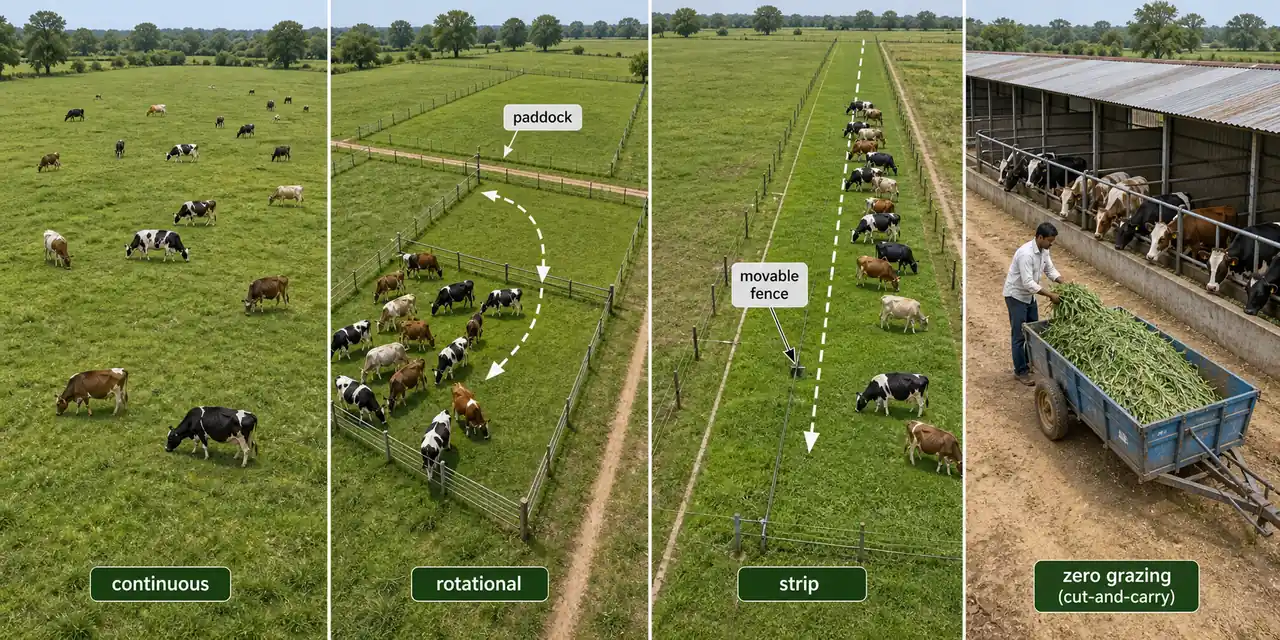
- The whole pasture is fenced into a convenient number of sub-units (paddocks). Animals are moved from one paddock to another at suitable intervals.
- This brings about uniform grazing. Quick shifting from plot to plot gives animals a steady supply of nutritive, young herbage.
- Provides sufficient rest for the pasture to recoup after each grazing.
Advantages: Uniform utilization; pasture recovery time; better forage quality; weed and parasite control.
Disadvantages: Higher fencing costs; does not provide time for seed setting and maturity; requires more management.
3. Rotational Deferred Grazing
- Beneficial when seeding is desired in annual species and when perennials do not have sufficient density.
- The whole pasture is divided into three equal compartments and fenced.
- Each compartment is grazed continuously for one-third of the total grazing season and protected through the remaining two-thirds, during which seeds mature.
- In the second year, the rotation starts from the second compartment; in the third year, from the third compartment.
Advantage: Allows natural reseeding while maintaining grazing availability.
4. Deferred Grazing
- Applicable where perennial grasses are predominant.
- Involves allowing seed formation and seed maturity in part of the pasture by delaying grazing.
- The grassland is divided into three compartments: one earmarked for seeding and the other two subjected to grazing alternately.
- Grazing is allowed in the seeded compartment only at an appropriate stage when seeds are mature and plants are not too old and unpalatable.
Advantage: Maintains perennial grass vigour and allows seed accumulation for natural regeneration.
NOTE
Rotational Deferred vs Deferred — the key distinction students confuse:
| Feature | Rotational Deferred (System 3) | Deferred (System 4) |
|---|---|---|
| Target species | Annual grasses (need reseeding each year) | Perennial grasses (already established) |
| Goal | Allow seeds to mature and fall, naturally reseeding the pasture | Allow plants to regain vigour and accumulate seeds for natural regeneration |
| Compartments | 3 equal parts; seeding compartment rotates every year | 3 compartments; one set aside, two grazed alternately |
| Trigger for use | When stand density is declining due to poor seed set | When perennial grass vigour is weakening |
5. Strip Grazing
- Animals are confined to a narrow strip of pasture using movable electric fences.
- The strip is advanced daily, giving animals access to fresh pasture each day.
Advantages: Maximum utilization of pasture; minimal wastage; very uniform grazing.
Disadvantages: High labour and fencing costs; requires daily management.
6. Zero Grazing (Cut-and-Carry / Soiling)
- Animals are not allowed to graze on the pasture at all. Instead, green fodder is cut and carried to them in the shed.
- Used in intensive dairy farming where land is limited.
Advantages: No trampling loss; maximum use of fodder; animals can be individually fed; no energy wasted by animals in walking.
Disadvantages: High labour cost for cutting and transporting fodder; requires mechanical harvesting equipment.
7. Hohenheim System
- An improved rotational grazing system developed in Germany during the First World War.
- Pasture is divided into many small plots of equal size. Grasses are raised with heavy application of nitrogenous fertilizers.
- Dairy cattle are divided into three groups: high yielders, medium yielders, and low yielders.
- They are let into the paddock by rotation so that the most nutritious immature grasses go to high yielders first, followed by medium producers, and lastly low yielders.
TIP
The Hohenheim system ensures that the best quality forage always goes to the highest-producing animals, maximizing overall farm efficiency. This is a unique exam-worthy fact.
Comparison of Grazing Systems
| System | Fencing Needed | Labour | Pasture Recovery | Best For |
|---|---|---|---|---|
| Continuous | Minimal | Low | Poor | Extensive rangelands |
| Rotational | High | Medium | Good | Improved pastures |
| Rotational Deferred | High | Medium | Excellent | Reseeding pastures |
| Deferred | Moderate | Low | Excellent | Perennial grasslands |
| Strip | Very High | Very High | Excellent | Intensive dairy |
| Zero Grazing | None | Very High | N/A | Intensive stall-fed systems |
| Hohenheim | Very High | High | Good | High-production dairy |
Silage Making
Silage is the fermented product of green forages where the acids produced by anaerobic fermentation of the sugars present in forages are responsible for preserving them. It is one of the most effective methods of conserving green fodder for use during the lean season.
- Silage retains high proportions of nutrients compared to hay because losses due to shattering and bleaching are minimized.
- Silage preserves 85% of its energy, while hay under best conditions preserves only 80% and under poor conditions only 50-60%.
- Ideal moisture content for ensiling: 65-70%.
Suitable Crops for Silage
- Best crops: Maize, Sorghum (Jowar), Bajra, Oats, Napier grass
- Crops with high soluble carbohydrate content make the best silage because sugars are needed for lactic acid fermentation.
- Legumes alone make poor silage due to high protein and low sugar content; they are better ensiled when mixed with cereals (e.g., berseem + oats, cowpea + maize).
Silage Additives
Additives are used to improve fermentation quality, especially for difficult crops:
| Additive | Type | Purpose | When Used |
|---|---|---|---|
| Molasses | Fermentation stimulant | Provides extra fermentable sugars; accelerates lactic acid production | Legume silage; low-sugar crops |
| Common salt (NaCl) | Preservative | Inhibits Clostridium; improves palatability | General use; @ 0.5% of green weight |
| Formic acid | Chemical preservative | Directly drops pH; reduces fermentation losses | Where rapid preservation is needed |
| Lactobacillus inoculants | Bacterial inoculant | Ensures lactic acid bacteria dominate from the start; reduces ammonia losses | Commercial silage; high-value crops |
| Urea | Non-protein nitrogen | Increases crude protein content of silage | Low-protein crop silage |
TIP
Molasses rate: 1–2% of the green weight (10–20 kg per tonne). for exams: molasses is the most commonly asked silage additive — it compensates for low soluble sugar content in legumes.
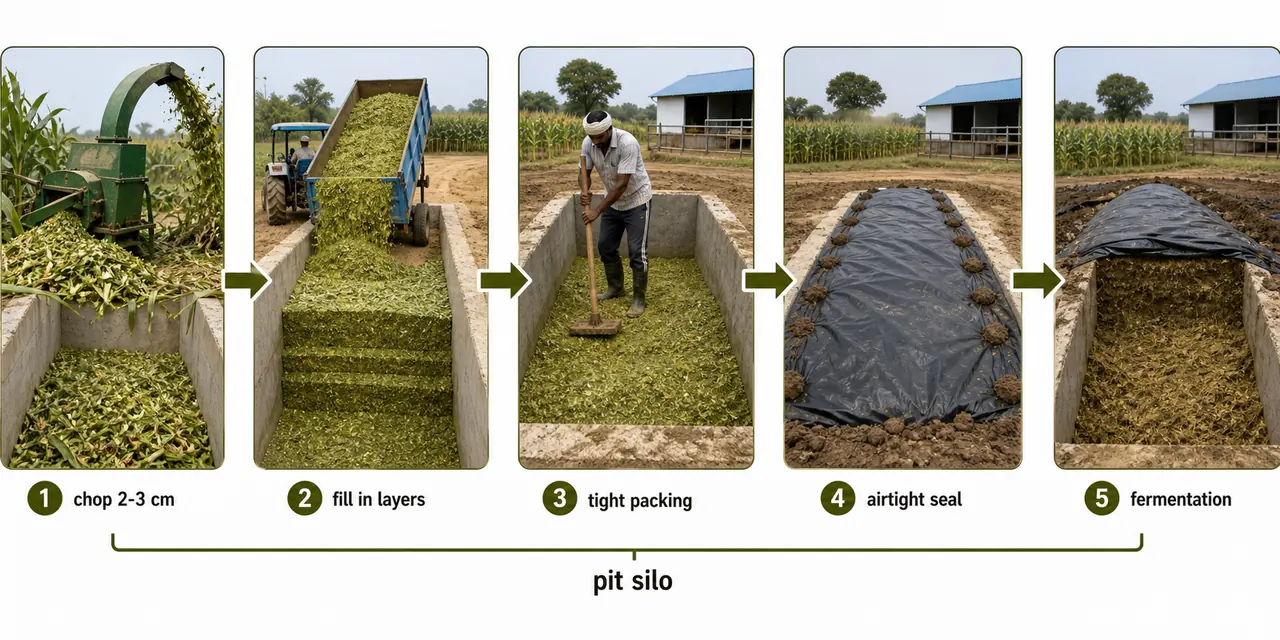
Process of Silage Making (Ensiling)
- Harvesting -- Fodder is cut at the appropriate stage (maize at dough stage, sorghum at 50% flowering).
- Wilting -- Freshly cut fodder may be wilted for a few hours to reduce moisture to 65-70%.
- Chopping -- Fodder is chopped into small pieces (2-3 cm) for tight packing and to release plant juices.
- Filling the silo -- Chopped fodder is packed tightly into the silo in layers, pressing firmly to expel air.
- Sealing -- The silo is sealed airtight with plastic sheets, mud, or weighted covers to create anaerobic conditions.
- Fermentation -- After sealing, fermentation occurs in three phases:
- Phase 1 (aerobic, brief): Residual oxygen is consumed rapidly by aerobic bacteria and plant enzymes. This phase must be as short as possible — tight packing minimises residual air.
- Phase 2 (anaerobic, transitional): Various anaerobic bacteria (enterobacteria, clostridia) become active. pH begins to drop.
- Phase 3 (lactic acid fermentation, dominant): Lactobacillus species outcompete all others in acidic, oxygen-free conditions. They convert soluble carbohydrates into lactic acid, driving pH down to 3.7–4.2. At this pH, all spoilage microbes are inhibited and the fodder is preserved.
NOTE
The key principle of silage making is exclusion of air. If air remains (due to poor packing), Clostridium bacteria persist, producing butyric acid instead of lactic acid. Butyric acid raises pH, causes foul smell, and signals failed fermentation — this is why butyric acid is the marker of bad silage. The tighter the packing, the faster aerobic bacteria exhaust remaining oxygen, allowing lactic acid bacteria to dominate.
Grades of Silage
Once fermentation is complete, silage quality is judged by three indicators that directly reflect what happened inside the silo: pH (how far lactic acid bacteria drove the acidity), ammonia N (how much protein was broken down by Clostridium), and butyric acid (the fingerprint of failed fermentation). Good silage should have a mild, pleasant aroma, an acid taste, and a slightly greenish colour.
| Grade | pH Range | Ammonia N (% of total N) | Butyric Acid | Smell |
|---|---|---|---|---|
| Very Good | 3.7 - 4.2 | Less than 10% | Absent | Good, pleasant |
| Good | 4.2 - 4.5 | 10-15% | Trace amounts | Satisfactory |
| Fair | 4.5 - 4.8 | 15-20% | Little amount | Slightly bad |
| Bad | Above 4.8 | More than 20% | High amount | Bad smell |
TIP
For exams, remember: Very good silage = pH 3.7-4.2, no butyric acid, less than 10% ammonia N. Bad silage has pH above 4.8 and contains breakdown products of amino acids like histamine, tryptamine, and phenyl ethylamine.
Types of Silo
The silo is simply the structure that creates airtight, anaerobic conditions. The type chosen depends on farm scale and budget — the fermentation chemistry is identical in all of them.
| Type | Description | Capacity | Suitability |
|---|---|---|---|
| Pit Silo (Trench Silo) | Dug below ground level; most common in India; cheapest | 20-200 tonnes | Small to medium farms |
| Tower Silo | Tall cylindrical structure above ground; vertical design | 50-500+ tonnes | Large commercial farms |
| Bunker Silo | Horizontal structure with concrete walls; open top | 50-500 tonnes | Medium to large farms |
| Bag Silo | Polythene bags used for small quantities | 50-500 kg | Small and marginal farmers |
| Stack Silo | Fodder stacked above ground and covered | Variable | Temporary use |
Conserving Fodder for Lean Periods
Hay Making
Hay is green fodder that has been cut, dried, and stored for future use. The objective of hay making is to reduce moisture in green fodders sufficiently so they can be stored without fermentation losses or spoilage due to mold growth.
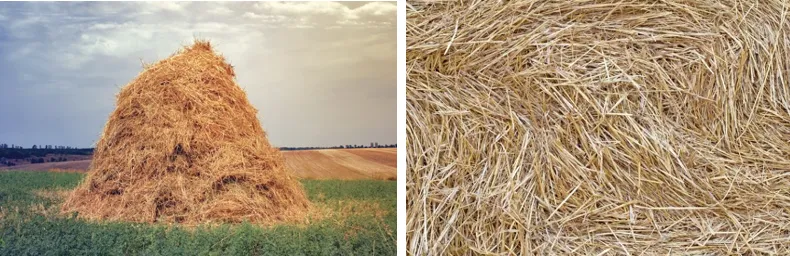
- Stored hay should not have more than 20-23% moisture. If moisture is higher, fermentation generates excessive heat, which may lead to spontaneous combustion (catching fire). Even without fire, the nutritive value is seriously affected.
IMPORTANT
Two moisture thresholds for hay — exams ask both: (1) Safe storage threshold (ICAR): hay must be dried to ≤15% moisture before long-term storage — at this level, microbial activity is negligible and hay can be stored for months. (2) Spontaneous combustion threshold: above 20–23% moisture, fermentation heat can cause fire. The ≤15% figure is the practical target; the 20–23% figure is the upper danger limit. Both numbers appear in AFO/NABARD papers.
- The stage of maturity at the time of cutting is critical for nutritive value. An early cut means more nutritive value but less yield; a late cut means less nutritive value but more bulk.
Optimal cutting stages for hay:
| Crop Type | Cut At |
|---|---|
| Grasses (oats, napier) | 10% flowering — leaf-to-stem ratio is highest |
| Legumes (berseem, lucerne) | Bud/early bloom stage — before full flower, when protein content peaks |
| Mixed grass-legume | Early bloom of legume component |
TIP
Cutting legumes at full bloom or pod stage sharply reduces protein content and increases stem proportion. For exams: legume hay = bud stage; grass hay = 10% flowering.
Methods of Hay Making
1. Sun Curing (Field Curing)
- The most common method in India.
- Cut fodder is spread in the field and turned regularly to ensure uniform drying.
- Takes 2-4 days depending on weather.
- Disadvantage: Dependent on weather; risk of rain damage; loss of carotene (Vitamin A) and leaf shattering.
2. Dehydration (Artificial Drying)
- Fodder is dried using hot air in mechanical dryers.
- Advantages: Faster process; retains more nutrients; independent of weather; better colour and quality.
- Disadvantages: High cost of equipment and energy.
Quality Indicators of Good Hay
- Green colour (indicates nutrient retention)
- Leafy with minimal stem
- Pleasant aroma (no mustiness)
- Free from mold, dust, and weeds
- Moisture content below 20%
- High leaf-to-stem ratio
Urea Treatment of Straw
Crop residues like wheat straw and paddy straw are low in nutritive value due to high crude fiber, low protein, and poor digestibility. Urea treatment is a simple and cost-effective method to improve the feeding value of poor-quality roughages.
Process
- Prepare a 4% urea solution (4 kg urea dissolved in 100 litres of water for every 100 kg of straw).
- Spread straw in layers on a cemented floor or polythene sheet.
- Sprinkle the urea solution uniformly over each layer.
- Press and pack the straw tightly to ensure proper moisture distribution.
- Cover with a polythene sheet and seal to create anaerobic conditions.
- Leave for 21 days in summer or 28 days in winter for the treatment to take effect.
- Open and air the straw for a few hours before feeding to remove excess ammonia smell.
Benefits of Urea Treatment
- Increases crude protein content from 3-4% to 8-9%
- Improves digestibility by 10-15%
- Increases voluntary intake by animals
- Softens the straw, making it more palatable
- Urea is converted to ammonia by the urease enzyme, which breaks down the ligno-cellulose bonds in the straw
TIP
The ratio to remember: 4 kg urea + 100 litres water per 100 kg straw. This is equivalent to a 4% urea solution. The ammonia released from urea breaks the bond between lignin and cellulose, improving fibre digestibility.
Urea Molasses Mineral Block (UMMB)
UMMB is a solid, lick-type feed supplement developed by ICAR/NDDB to address multiple nutritional deficiencies in cattle and buffaloes simultaneously — particularly useful for animals fed on low-quality crop residues like urea-treated straw.
Composition of a standard UMMB block:
| Ingredient | Role |
|---|---|
| Urea (10–15%) | Non-protein nitrogen (NPN) source; rumen microbes convert urea-N to microbial protein |
| Molasses (30–40%) | Energy source; binder; provides fermentable sugars for rumen microbes |
| Mineral mixture (10–15%) | Supplies Ca, P, Mg, trace minerals often absent in straw-based diets |
| Cement / lime (5–10%) | Hardening agent; limits intake rate (animals can only lick, not bite) |
| Rice bran / wheat bran | Filler; improves palatability |
Key facts for exams:
- Animals self-regulate intake by licking only — cement hardness prevents overconsumption of urea (urea toxicity risk if ingested rapidly).
- Daily intake: approximately 200–400 g/animal/day for adult cattle.
- UMMB improves rumen microbial activity, increasing digestibility of straw by 10–15%.
- Particularly beneficial during the lean season when animals survive on dry straw alone.
- Developed under the National Dairy Development Board (NDDB) technology transfer programme; widely promoted by ICAR for smallholder farmers.
IMPORTANT
UMMB vs Urea treatment: Urea treatment improves the straw itself before feeding (chemical process, 21–28 days). UMMB is a supplement given alongside low-quality roughage (immediate lick supplement). Both address the protein deficiency of straw-fed animals but via different mechanisms.
Linking Fodder and Livestock with Other Farm Enterprises
Integrated Livestock-Fish Farming Systems
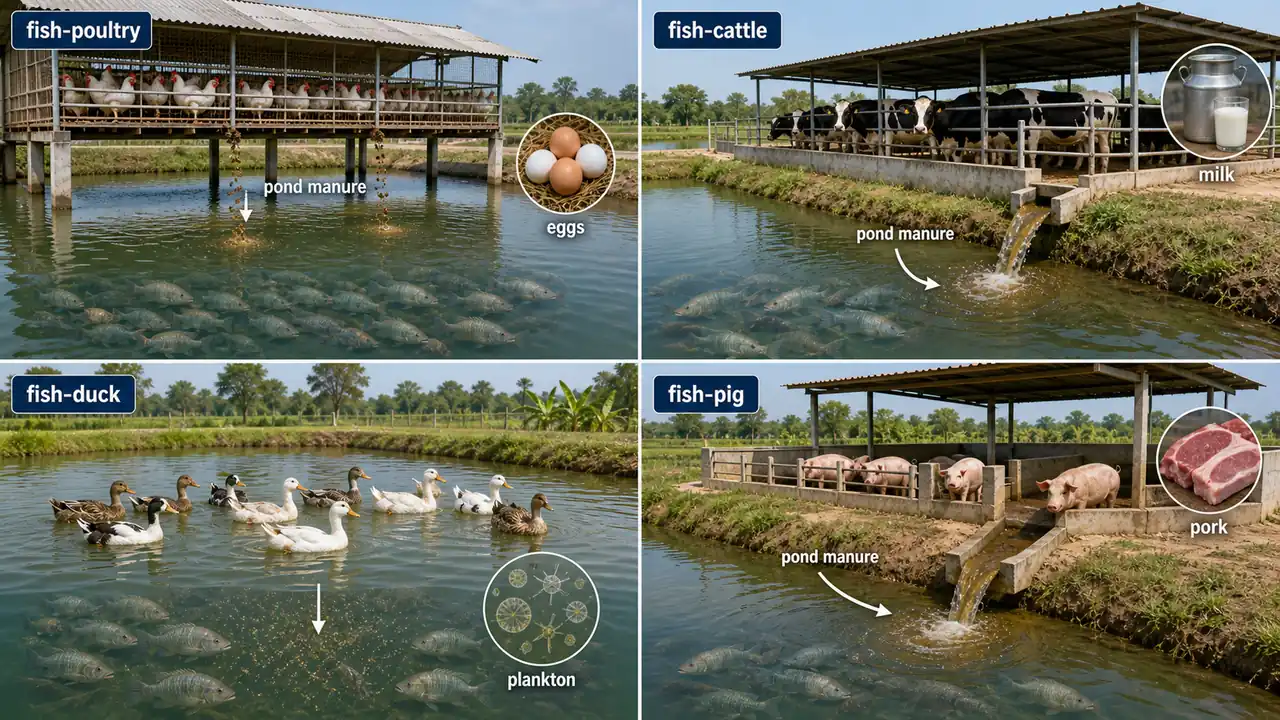
Integrated farming systems combine livestock rearing with fish culture, where animal waste serves as manure for fish ponds, reducing feed costs and maximizing resource utilization. These systems represent an efficient model of circular agriculture.
1. Fish-Poultry Integration
- Poultry droppings production in India is estimated at about 1,300 thousand tonnes, containing about 390 metric tonnes of protein.
- Poultry litter is applied to the fish pond at the rate of 50 kg/ha/day every morning after sunrise (CIFRI recommendation; TNAU recommends 30–35 kg/ha/day for smaller ponds).
- Deep litter contains: 3% nitrogen, 2% phosphate, 2% potash.
- One tonne of deep litter fertilizer is produced by 30-40 birds in a year.
Stocking Details:
- Fish stocking rate: 8,000-8,500 fingerlings/ha
- Species ratio: 40% surface feeders, 20% column feeders, 30% bottom feeders, 10-20% weedy feeders
- 30-50 layers or broilers can be raised over a 1,000 sq.m pond
- Layers start laying after 22 weeks; 250-280 eggs/bird/year
- Broilers reach market size (1.5-1.8 kg) in 7-8 weeks; 6 batches per year possible
Fish Yield: 3,500-4,000 kg/ha/year (with 6-species stocking) and 2,000-2,600 kg/ha/year (with 3-species stocking)
Recommended Breeds: Star Cross Shavar (layers), Shavar Starbro (broilers)
2. Fish-Cattle Integration
- Cow dung is the primary manure used for fish rearing.
- About 5,000-10,000 kg/ha of cow dung can be applied in fish ponds in installments.
- Waste water from cow sheds (containing dung, urine, and unused feed) can be drained directly to the pond.
- Cow dung promotes the growth of plankton, which serves as natural food for fish.
- Cow sheds can be constructed on the embankments of the fish farm or nearby.
3. Fish-Duck Integration
- Ducks serve as bio-aerators as they swim, play, and chase in the pond, maintaining dissolved oxygen levels.
- Each duck voids 125-150 gm of droppings per day, which serves as fish feed and pond fertilizer.
- Stocking density: 200-300 ducks/ha producing 10,000-15,000 kg of droppings per year.
- Duck droppings contain: 81% moisture, 0.91% nitrogen, 0.38% phosphate (on dry matter basis).
- Survival of ducks raised in fish ponds increases by 3.5% due to the clean pond environment.
- Important Indian duck breeds: Sylhet Mete and Nageswari.
Fish Yield: 3,500-4,000 kg/ha/year (6-species stocking); 2,000-3,000 kg/ha/year (3-species stocking)
Additional Production: About 18,000-18,500 eggs and 500-600 kg duck meat per year.
4. Fish-Pig Integration
- No supplementary feed is required for fish culture, saving 60% of the total input cost that is normally spent in conventional fish culture.
- Minimum pond size: 1,000 sq.m; water depth during dry period: 1 m.
- Excreta of just 3 pigs is sufficient to fertilize a 1,000 sq.m pond.
- Each pig is provided with floor space of 1-1.5 sq.m.
- Pigs attain slaughter size within 5-6 months; two lots of pigs can be raised with one lot of fish (10-12 months).
- Partial harvesting should be done three times; final harvesting after 10-12 months.
Fish Yield: 6,000–7,000 kg/ha/year — the highest yield among all integrated livestock-fish systems (CIFRI data).
Comparison of Integrated Farming Systems
| Parameter | Fish-Poultry | Fish-Cattle | Fish-Duck | Fish-Pig |
|---|---|---|---|---|
| Manure rate | 50 kg/ha/day | 5,000-10,000 kg/ha | 10,000-15,000 kg/yr | Pig excreta |
| Fish stocking | 8,000-8,500/ha | Standard | 6,000/ha | Standard |
| Fish yield | 3,500-4,000 kg/ha/yr | Standard polyculture | 3,500-4,000 kg/ha/yr | 6,000-7,000 kg/ha/yr (highest) |
| Additional products | Eggs, meat | Milk, dung | Eggs, meat | Pork |
| Feed cost saving | Moderate | Low | Moderate | 60% (highest) |
| Unique advantage | High protein litter | Plankton growth | Bio-aeration | No supplementary fish feed |
Fish Stocking and Harvesting Schedule (All Integrated Systems)
Season and region determine when fish are stocked and harvested. Winter temperatures slow fish metabolism, so northern farmers harvest before winter sets in, while southern farmers can run a full 12-month cycle.
Northern and North-Western India:
- Stock in March; harvest in October-November (severe winter reduces fish growth — early harvest avoids weight loss)
Southern, Coastal, and North-Eastern India:
- Stock in June-September; harvest after 12 months of rearing (mild winters allow year-round active growth)
References
7 sources • [1] [2] [3] [4] [5] [6] [7]
References
Summary Cheat Sheet
| Concept / Topic | Key Details |
|---|---|
| Green fodder requirement | 8–10% of live body weight daily; primary source of Vitamin A (carotene) |
| Feed availability | Cows need feed for at least 20 hours/day; 60% at night in summer |
| Fodder gap | Two lean periods: May–June (rabi over, kharif not ready) and Oct–Nov (kharif over, rabi not ready) |
| Berseem | Trifolium alexandrinum; King of Fodders; rabi; 18–22% CP; 5–6 cuttings; 60–62% TDN |
| Lucerne (Alfalfa) | Medicago sativa; Queen of Fodders; perennial legume; 18–22% CP (early bloom); 7–8 cuttings |
| Senji | Melilotus indica; rabi legume; drought-resistant; 16.57% CP; grown on residual moisture |
| Lathyrus / Khesari | Lathyrus sativus; rabi legume; climate-smart; ODAP neurotoxin — limit to <30% of diet |
| Oats (Jai) | Avena sativa; most important rabi cereal fodder; good for hay & silage |
| Jowar (Sorghum) | Most important kharif fodder; contains HCN (prussic acid) in young stage |
| Sudan Grass | Sorghum sudanense; lower HCN than jowar; fast-growing kharif fodder |
| HCN toxicity | Do not graze jowar until 45–50 cm tall |
| Napier Grass | Pennisetum purpureum; highest yielding perennial; 150–200 t/ha/year |
| Bajra-Napier Hybrid (BNH) | P. purpureum × P. glaucum; perennial hybrid; ICAR/TNAU-developed; 250–360 t/ha/yr; higher protein than Napier; propagated by stem cuttings |
| Sewan Grass | Lasiurus sindicus; perennial native grass of arid Rajasthan; survives <250 mm rainfall; CAZRI varieties; not a kharif crop |
| Guinea Grass | Panicum maximum; shade tolerant; carotene 14.2 mg/100g DM |
| Para Grass | Brachiaria mutica; thrives in waterlogged areas |
| Agathi | Sesbania grandiflora; highest carotene 18.3 mg/100g DM; important South India |
| Subabul (Leucaena) | Fodder tree; 25–30% CP (leaves); mimosine up to 9% DM in young leaves; N-fixing |
| Continuous grazing | Minimal fencing; poor pasture recovery |
| Rotational grazing | Pasture divided into paddocks; allows recovery between grazings |
| Rotational Deferred | For annuals; 3 compartments; allows reseeding; compartment rotates each year |
| Deferred grazing | For perennials; delays grazing to restore vigour; one compartment reserved for seed set |
| Strip grazing | Very intensive; fresh strip daily; excellent utilisation |
| Zero grazing (Cut & Carry) | Animals never graze; fodder cut and brought to shed; intensive dairy |
| Hohenheim system | Improved rotational; high yielders graze first on best immature grass |
| Silage | Anaerobic fermentation; moisture 65–70%; pH 3.7–4.2; chop 2–3 cm |
| Silage additive | Molasses @ 1–2% of green weight; compensates for low sugar in legume silage |
| Hay | Dried fodder; safe storage target ≤15% moisture (ICAR); spontaneous combustion risk above 20–23%; legume hay = bud stage; grass hay = 10% flowering |
| Urea treatment of straw | 4% urea solution; seal for 21 days (summer) / 28 days (winter); CP: 3–4% → 8–9% |
| UMMB (Urea Molasses Mineral Block) | ICAR/NDDB technology; urea 10–15% + molasses 30–40% + minerals; lick supplement; 200–400 g/day; cement limits urea intake |
| Fish-pig | Highest fish yield: 6,000–7,000 kg/ha/yr; 60% feed cost saving; no supplementary feed for fish |
| Fish-poultry | Deep litter: 3% N, 2% P, 2% K; apply 50 kg/ha/day; fish yield 3,500–4,000 kg/ha/yr |
| Fish-cattle | Cow dung: 5,000–10,000 kg/ha applied in instalments; promotes plankton growth |
| Fish-duck | Ducks = bio-aerators; 125–150 gm droppings/day; 200–300 ducks/ha |
| Rumen pH | Maintain above 6.0; lower pH limits fibre digestion |
| Forage DM consumption | Near 2% of body weight |
Frequently Asked Questions
What are the important fodder crops in India?
Important kharif fodder crops: Jowar (Sorghum), Bajra, Maize, Napier (Hybrid Bajra), Sudan grass, Cowpea, Guar. Rabi fodder crops: Berseem (Egyptian clover), Lucerne (Alfalfa), Oats, Senji (Japanese clover), Lathyrus. Perennial grasses: Napier, Guinea grass, Para grass, Anjan grass.
What is silage making?
Silage is preserved green fodder stored under anaerobic conditions through lactic acid fermentation. Ideal moisture for silage is 65-70%. Common silage crops: Maize, Jowar, Napier, Oats. Additives like molasses (2-3%) and common salt (0.5%) improve fermentation quality.
What are the types of grazing systems?
7 grazing systems: Continuous grazing, Rotational grazing, Strip grazing, Zero grazing (cut-and-carry), Deferred grazing, Mixed grazing, and Hohenheim system (ley farming). Rotational grazing is most efficient for dairy cattle.
What is the difference between hay and silage?
Hay is dried fodder (moisture reduced to 15-20%) preserved by sun-drying. Silage is green fodder (65-70% moisture) preserved by anaerobic fermentation. Hay retains less nutrients than silage but is easier to store and transport. Silage preserves more carotene (Vitamin A).
Lesson Doubts
Ask questions, get expert answers