🥅 Dairy Housing Management - ICAR Floor Space Norms, Loose vs Conventional Systems
Complete guide to dairy cattle housing including site selection criteria, ICAR floor space norms, thermo-neutral zone, loose housing vs conventional systems, tail-to-tail and head-to-head arrangements, and shed orientation for exams.
Site Selection and Planning Basics
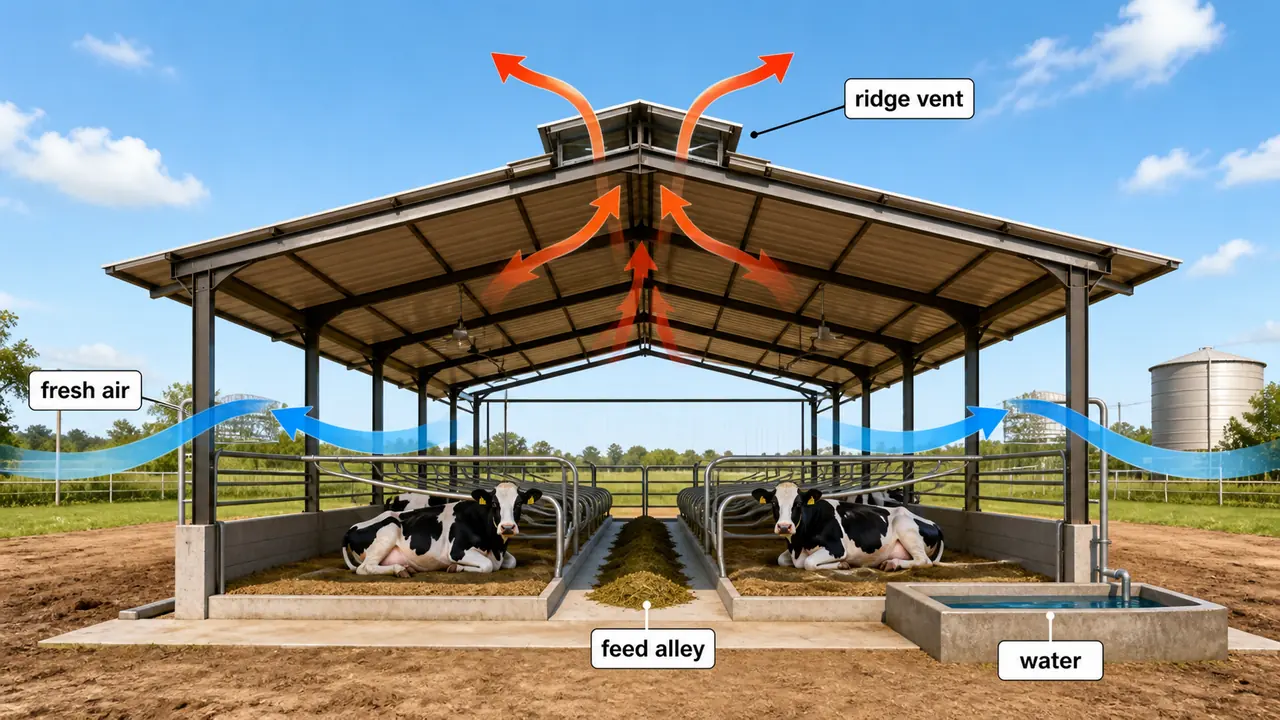
- An efficient housing of cattle requires a well-planned and adequate housing of cattle. Improper planning in the arrangement of animal housing may results in additional labour charges and curtail the profit of the owner. Good housing is not merely shelter -- it directly affects animal health, productivity, and reproductive performance.
- So during erection of a house for dairy cattle, following points should be considered:
- Topography & drainage: A dairy building should be on higher elevation than the surrounding ground to offer a good slope for rainfall & drainage for rainfall & drainage for the wastes of the dairy to avoid stagnation within. Proper drainage prevents waterlogging, which can lead to hoof diseases and breeding of flies and mosquitoes.
- Soil type: Foundation soil should not be too hydrated or desiccated. Because such soils are susceptible to considerable swelling during rainy season and exhibit numerous cracks and fissures. Ideally, the soil should be well-drained loamy soil that can bear the load of the structure without shifting.
- Exposure to sun and protection from wind: As far as possible, the long axis of the dairy barns should be in north-south direction to have maximum benefit of the sun. Protection from cold & hot weather. Direction of Cow Shed: North-South (to get maximum sun-light). The north-south orientation (long axis running N-S) means the longer walls face East and West, so both sides receive sunlight (morning and afternoon respectively), promoting hygiene and reducing dampness. This is the standard recommendation per G.C. Banerjee and most Indian exam syllabi. (Note: some ICAR publications recommend E-W long axis to reduce solar heat gain on larger walls in hot climates — if the question specifies ICAR, verify the source.)
- Accessibility: Easy accessible. Situation of the cattle shed by the side of the main road preferably at a distance 100 meters should be aimed. This distance keeps the animals away from traffic noise and dust while maintaining convenient access for milk transport and veterinary visits.
- Water supply: Abundant, fresh, clean, soft water. A dairy farm requires large quantities of water not just for drinking but also for cleaning, bathing animals, and washing utensils.
- Thermo-neutral Zone (TNZ): The range of temperatures of the immediate environment in which a cattle maintain normal body temperature without needing to use energy above and beyond normal basal metabolic rate. Within this zone, animals are most comfortable and productive. Temperatures outside this range force the animal to spend energy on heating or cooling, reducing the energy available for milk production.
- Exotic/crossbred cattle (HF, Jersey): TNZ = 5–25°C
- Indigenous breeds (Zebu, Sahiwal, Gir): TNZ = 15–35°C (better heat tolerance)
- Indian crossbred cattle are more vulnerable to heat stress than indigenous breeds, making housing orientation and ventilation even more critical on farms with HF or Jersey crosses.
Utilities and Operational Factors
- Labour: Honest, economic, regular supply
- Marketing: Dairy should be at a place from where the owner can sell his products profitably and regularly. Proximity to markets reduces transportation costs and ensures fresher milk reaches consumers.
- Electricity: Adequate supply for electric equipment in the dairy.
- Miscellaneous factors: Area should not be infested with diseases, wild animal, dacoits etc.
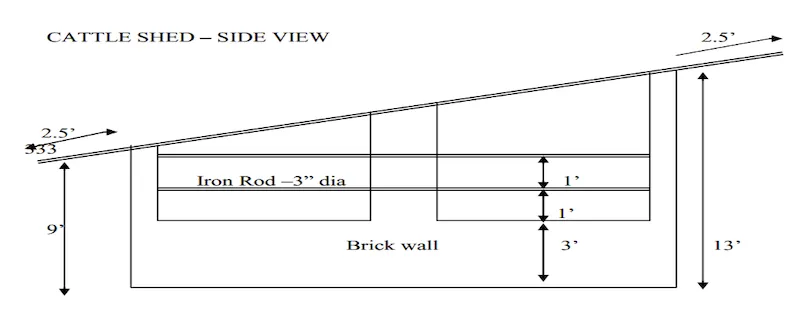
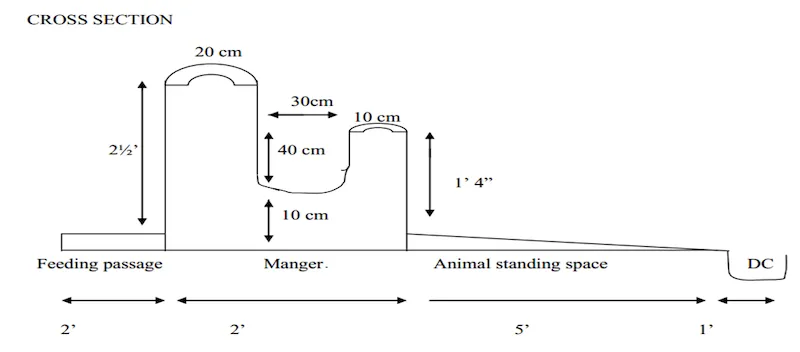
Floor Space Requirement per Animal (ICAR)
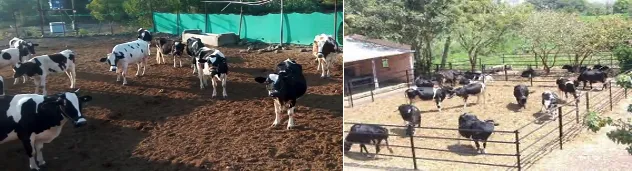
Start with this quick table in exam revision, then move to the more detailed ICAR and NABARD tables below when a question asks for age-group or special-animal norms.
| Category | Covered area (m²) | Open area (m²) | Maximum no. of animals per pen | Height of Shed in cm |
|---|---|---|---|---|
| Cow | 3.5 | 7 | 50 | 175 cm in medium and heavy rainfall and 220 cm in dry areas. |
| Pregnant Cow | 4 | 8 | 50 | |
| Buffalo | 4 | 8 | 50 | |
| Young stock (upto 3 months) | 1 | 1.5 | 30 | |
| Young stock (3 - 6 months) | 1 | 2.5 | 30 | |
| Young stock (> 6 months) | 2 | 4 | 30 | |
| Bull | 12 | 24 | 1 | |
| Down Calver | 12 | 12 | 1 |
- Down Calver: Some time before calving. Down calvers need additional space as they are in the advanced stage of pregnancy and require more room for comfortable movement and lying down.
- For square feet -- multiply the area value by 10.76
- As Murrah buffalo is large in size require 50 sq. feet (per older/state standards). Note: ICAR norm for buffalo is 4.0 m² ≈ 43 sq. ft covered area. The 50 sq. ft figure appears in some state-level guidelines and older texts — if ICAR norms are specifically asked, use 4.0 m². Since Murrah is the largest common dairy buffalo breed, it needs more space than cows for comfortable housing.
Detailed Floor Space Requirements (ICAR Norms)
| Type of Animal | Covered Area (m2) | Open Area (m2) | Max. Animals/Pen | Height of Shed (cm) |
|---|---|---|---|---|
| Bulls | 12.0 | 24.0 | 1 | 175 cm in medium & heavy rainfall; 220 cm in dry areas |
| Cows | 3.5 | 7.0 | 50 | -- |
| Pregnant Cow | 4.0 (Exams) | 8.0 | 50 | -- |
| Buffaloes | 4.0 (Exams) | 8.0 | 50 | -- |
| Down Calver | 12.0 (Exams) | 12.0 | 1 | -- |
| Young stock up to 3 months | 1.0 | 1.5 | 30 | -- |
| Young stock 3-6 months | 1.0 | 2.5 | 30 | -- |
| Young stock >6 months | 2.0 | 4.0 | 30 | -- |
IMPORTANT
Remember the key floor space values: Pregnant cow = 4.0 m2 (asked in exams), Buffalo = 4.0 m2 (asked in exams), Down calver = 12.0 m2 (exams). Bulls are housed individually with the largest covered area of 12.0 m2.
If specially mentioned according to NABARD norms for cross-breed cattle:
| Category | Covered area (m²) | Open area (m²) | Manger Space (m²) |
|---|---|---|---|
| Cow | 1.8 – 2 | 11 – 12 | 0.8 – 1 |
| Pregnant Cow | 8.5 – 10 | 15 – 20 | 1 – 1.2 |
| Bull | 9 – 11 | 15 – 22 | 1 – 1.2 |
NABARD Norms for Crossbred Cattle Housing
| Age Group | Manger Space (m) | Standing/Covered Area (sq.m) | Open Space (sq.m) |
|---|---|---|---|
| 4-6 months | 0.2-0.3 | 0.8-1.0 | 0.8-1.0 |
| 6-12 months | 0.3-0.4 | 1.2-1.6 | 5.0-6.0 |
| 1-2 years | 0.4-0.5 | 1.6-1.8 | 6.0-8.0 |
| Cows | 0.8-1.0 | 1.8-2.0 | 11.0-12.0 |
| Pregnant cows | 1.0-1.2 | 8.5-10.0 | 15.0-20.0 |
| Bulls* | 1.0-1.2 | 9.0-11.0 | 20.0-22.0 |
* Bulls to be housed individually. (Source: NABARD)
NOTE
NABARD norms provide more detailed age-wise space requirements than ICAR norms. Notice that pregnant cows and bulls need significantly more standing/covered area (8.5-11.0 sq.m) compared to regular cows (1.8-2.0 sq.m) under NABARD guidelines.
Feeding and Watering Space Requirements
Adequate feeding and watering space ensures all animals get equal access to feed and water, reducing competition and stress.
| Type of Animal | Space per Animal (cm) | Total Manger Length for 100 Animals (cm) | Total Water Tank Length for 100 Animals (cm) |
|---|---|---|---|
| Adult cattle & buffaloes | 60-75 | 6000-7500 | 600-750 |
| Calves | 40-50 | 4000-5000 | 400-500 |
NOTE
Each adult animal needs 60-75 cm of manger space and calves need 40-50 cm. Insufficient feeding space leads to bullying, uneven feed intake, and poor body condition in subordinate animals.
Floor Types
There are two main types of floors used in cattle housing:
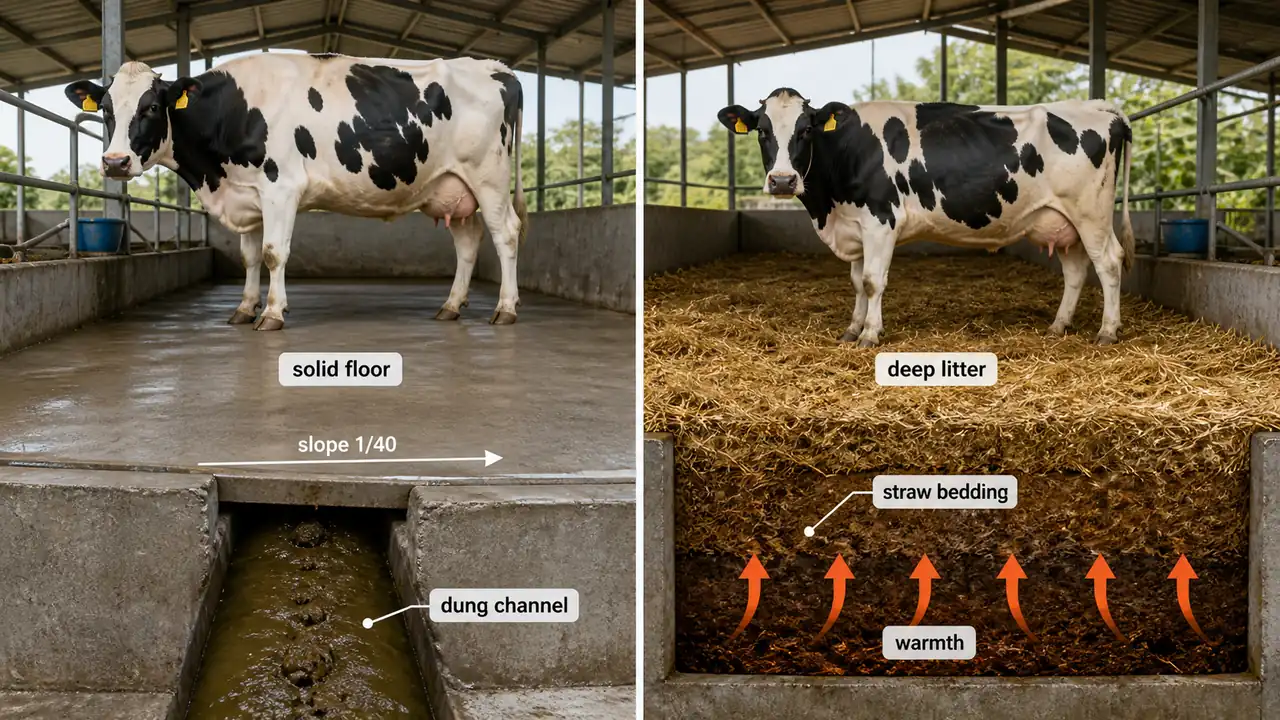
1. Solid Floor
- It is a common floor with a solid surface made out of different materials such as cement concrete, vitrified paving brick, building brick, stones and gravel.
- A slope of 1/40 is desirable in the animal standing area and a slope of 1/60 is desirable towards the dung channel. These slopes ensure proper drainage of urine and wash water, keeping the floor dry and hygienic.
- Cement concrete floors are durable and easy to clean but can become slippery. Grooving the surface helps prevent slipping.
- Brick floors provide better grip for animals but are less durable and harder to keep clean.
2. Deep Litter Floor
- It is made of bedding material arranged as dried layers.
- Straw, paddy husk, saw dust, groundnut hulls, dried leaves are spread on the floor as litter materials.
- It can be spread as a layer of 4-6 inches thickness and can be allowed to accumulate over a period of a month to 1 year.
- The litter gets mixed with excreta and decomposed, generating warmth in cold weather. This decomposed litter also serves as excellent organic manure for crop fields.
TIP
Why does deep litter generate warmth? The microbial decomposition (fermentation) of manure and bedding material is an exothermic (heat-releasing) biochemical reaction. Microorganisms break down organic matter and release heat as a by-product. This can raise the litter surface temperature by several degrees, keeping the shed floor warm in winter — an important advantage in cold northern India. This is the same principle used in composting.
IMPORTANT
For exam questions: Solid floor slope = 1/40 for standing area, 1/60 for dung channel. Deep litter thickness = 4-6 inches. Deep litter materials include straw, paddy husk, saw dust, groundnut hulls, and dried leaves.
Main Building Units
Single Row System
- In single row system, 12-16 numbers of animals can be kept.
- Length of the building: 3.80-4.25 metres.
- Suitable for small dairy farms with fewer animals.
Double Row System
- More than 16 animals can be kept in double row system.
- Length of the building: 7.90-8.70 metres.
- In double row system, up to 50 animals can be maintained in a single shed.
- The distance between two sheds should be greater than 30 feet or it should be twice the height of the building. This spacing allows adequate ventilation, sunlight penetration, and movement of machinery.
NOTE
Capacity by arrangement type:
- Tail to tail system (Out method): 28 animals
- Head to head system (In method): 36 animals
The head to head system accommodates more animals because the central feeding passage is narrower than the central milking/cleaning passage needed in tail to tail.
Types of Housing
There are two types of dairy barns in general use at present time:
Loose Housing System
- Loose housing may be defined as a system where animals are kept loose except milking and at the time of treatment. The system is most economical. This is the **most widely recommended** system for modern dairy farming because of its numerous advantages.
- Some features of loose housing system are as follows:
- Cost of construction is significantly lower than conventional type. Savings can be as high as **40-50%** compared to conventional barns.
- It is possible to make further expansion without much changes
- Facilitate easy detection of animals in heat. When animals move freely, **heat signs** like mounting behaviour are easily observable.
- Animals feel free and therefore, prove more profitable with even minimum grazing.
- Animals get optimum exercise which is extremely important for better health and production
- Overall better management can be rendered.
Conventional System
- The conventional dairy barns are comparatively costly and are now becoming less popular day by day. However, by this system cattle are more protected from adverse climatic conditions. Conventional housing keeps animals tethered in individual stalls, which provides more control but limits their movement.
- The following barns are generally needed for proper housing of different classes of dairy-stocks on the farm.
Cow Sheds
- Cow sheds can be arranged in a single row if the numbers of cows are small (less than 16) or in a double row if the herd is a large one (more than 16). Remember this threshold of 16 animals as the dividing line between single-row and double-row arrangements (consistent with ICAR single-row capacity of 12–16 animals).
- Ordinarily, not more than 80 to 100 cows should be placed in one building.
- In double row housing, the stable should be so arranged that the cows face out (tails to tail system) or face in (head to head system) as preferred. Each system has its own advantages and disadvantages, discussed below.
Tail to Tail System
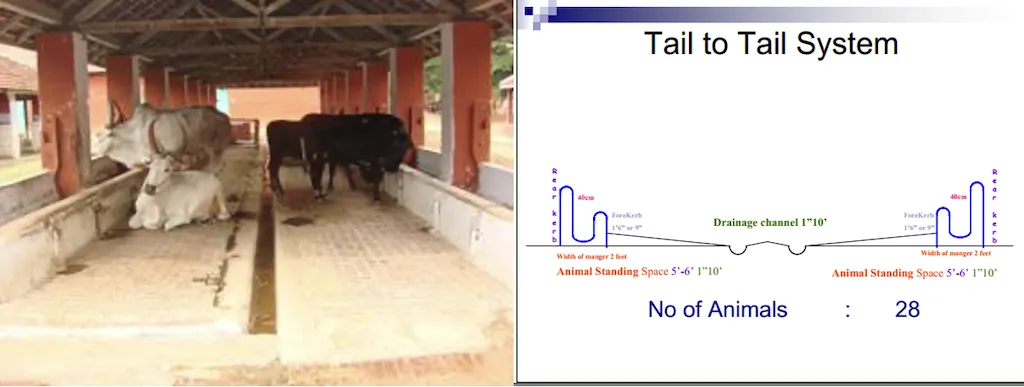
In this arrangement, the rear ends of cows in both rows face the central passage, while their heads face outward toward the walls.
Advantages of tail to tail system
NOTE
In the tail-to-tail system, supervision of milkmen is easy (they work in the central passage). In the head-to-head system, feeding is easier (single central feeding passage). Capacity: Tail-to-tail (Out method) accommodates 28 animals; Head-to-head (In method) accommodates 36 animals — because the central feeding passage in head-to-head is narrower than the milking/cleaning passage in tail-to-tail.
- In cleaning and milking the cows, the wide middle alley is of great advantage. The milker works in the central passage, making supervision and milking more efficient.
- Lesser danger of spread of diseases from animal to animal.
- Cows can always get more fresh air from outside.
- The head gowala can inspect a greater number of milkmen while milking. This is possible because milkmen will be milking on both sides of the gowala. This makes the tail-to-tail system preferred for large dairies where supervision of milking hygiene is critical.
- Any sort of minor disease or any change in the hind quarters of the animals can be detected quickly and even automatically.
Disadvantages of tail to tail system
- Spreading of diseases through digestive and reproductive system is high. Since the drainage channel runs centrally, contamination can spread if one animal has an infectious disease.
- Drainage channel is not exposed to sunlight. This can lead to dampness and microbial growth in the central area.
- Feeding of animals is laborious. Feed must be carried to both outer walls, which requires more effort and time.
Head to Head System
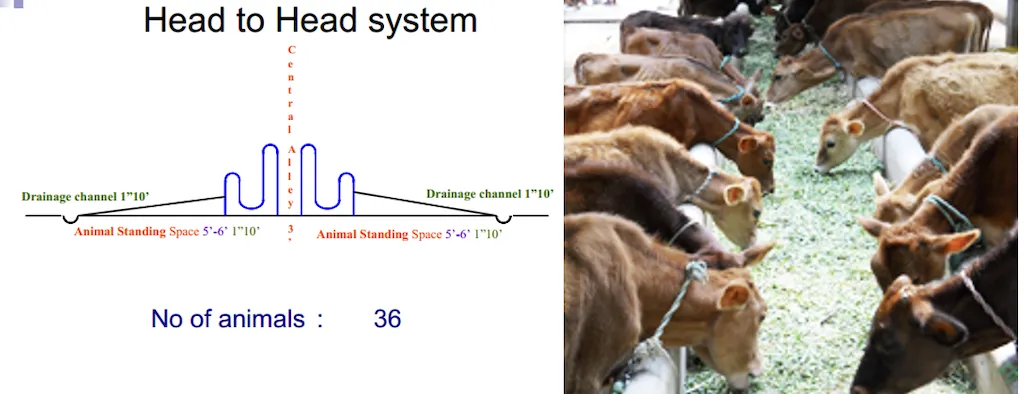
In this arrangement, the heads of cows in both rows face the central feeding passage, while their tails face outward.
Advantages of Head to Head system
- Cows make a better showing for visitors when heads are together.
- The cows feel easier to get into their stalls.
- Sun rays shine in the gutter where they are needed most. Since the drainage channels are along the outer walls, they receive more sunlight, which helps in natural disinfection.
- Feeding of cows is easier, both rows can be fed without back tracking. A single trip through the central feeding passage allows the feeder to serve both rows simultaneously.
- It is better for narrow barns.
Disadvantages of Head to Head system
- All animals don't get fresh air. The central passage can become stuffy as animals breathe toward each other.
- Spreading diseases through respiratory system is maximum. Animals facing each other are more likely to inhale infectious droplets from sick neighbours.
- Supervision of animals is not easy
- Cleaning is not easy
Different Types of Sheds on a Dairy Farm
A well-planned dairy farm requires several specialized sheds for different categories of animals and operations:
| Shed Type | Purpose & Details |
|---|---|
| Milking Barn / Milk Parlour | Number of standings required = 25% of total milch animals in the herd |
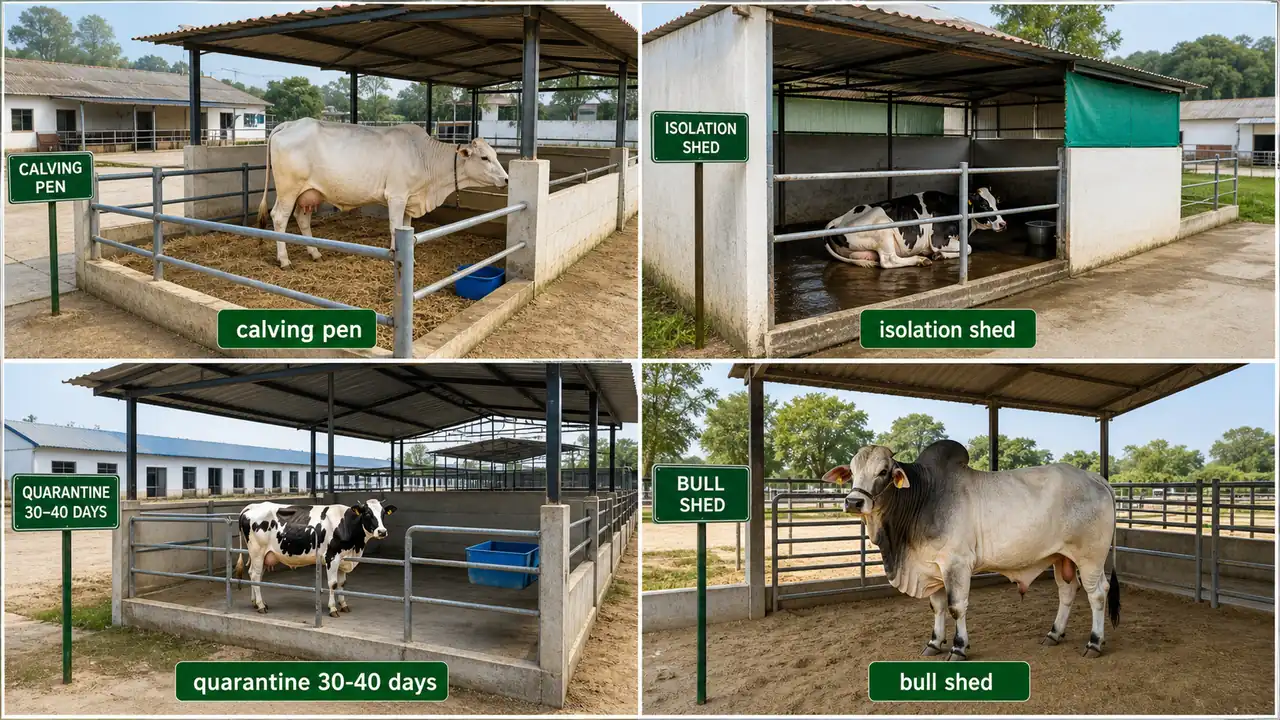
| Down Calver Shed / Calving Pen | Pregnant animals transferred 2-3 weeks before expected calving. Pen size: 3m x 4m (12 m2). Number of calving pens = 10% of total breedable female stock |
| Calf Pen | For housing young calves separately; individual pens for first 3 months |
| Young Stock / Heifer Shed | For housing young heifers separately from adult animals |
| Dry Animal Shed | In large farms, milch and dry cows are housed separately |
| Bull Shed | One bull for every 50 breedable females (natural breeding). One shed per bull. Dimensions: 3m x 4m covered area |
| Isolation Shed | For separating sick animals from healthy stock to prevent disease transmission |
| Quarantine Shed | Newly purchased animals kept here for 30-40 days to watch for disease before mixing with herd |
| Hay or Straw Shed | Adult animals consume 5-10 kg hay/straw per day; young stock consume 2-5 kg per day |
Milk Room Requirements
- For larger dairies (400-700 litres production capacity): Room size 3.7m x 5m plus an additional 0.37 m2 for every 40 litres of milk production.
- For smaller dairy units (below 100 litres): A room of 3.75m x 3m is sufficient for storing milk and concentrate feed.
IMPORTANT
Key numbers for exams: Milking barn standings = 25% of milch animals. Calving pens = 10% of breedable females. Bull ratio = 1 bull per 50 breedable females. Quarantine period = 30-40 days.
Ventilation Requirements
Proper ventilation in cattle sheds is critical for removing excess heat, moisture, and noxious gases (ammonia, carbon dioxide). Key ventilation considerations:
- Ridge ventilation: Open ridge along the roof top allows hot air to escape upward naturally.
- Side ventilation: Keeping the lower portion of side walls open (especially in tropical areas) allows cross-ventilation.
- Minimum ceiling height: 175 cm in areas with medium and heavy rainfall; 220 cm in dry areas.
- Spacing between sheds: At least 30 feet or twice the height of the building to ensure adequate air circulation.
- In hot climates, additional cooling measures like fans, foggers, and tree shade around the shed are recommended.
- The north-south orientation of sheds maximizes cross-ventilation from prevailing winds while minimizing direct solar heat gain.
Temperature-Humidity Index (THI)
THI is a combined measure of temperature and humidity used to assess heat stress in dairy cattle. It is directly related to the Thermo-neutral Zone and is an important concept for housing design in tropical India.
Formula:
THI = 0.72 × (Tdb + Twb) + 40.6
Where Tdb = dry bulb temperature (°C) and Twb = wet bulb temperature (°C).
| THI Range | Stress Level | Effect on Cattle |
|---|---|---|
| < 72 | No stress | Normal production and reproduction |
| 72–79 | Mild heat stress | Milk production begins to drop |
| 79–84 | Moderate stress | Significant drop in feed intake, reproduction affected |
| > 84 | Severe / Dangerous | Risk of death in high-producing cows |
IMPORTANT
THI threshold for dairy cattle = 72. Above 72, milk production starts declining. This is the key number asked in exams. High-producing exotic cows (HF, Jersey) are more sensitive than indigenous breeds.
Housing design implications:
- Roof insulation, ridge ventilation, foggers, and fans are used to keep THI within safe limits
- A 1-unit rise in THI above 72 reduces daily milk yield by approximately 0.2–0.4 kg per cow
- White/reflective roof surfaces reduce roof surface temperature significantly in summer
Insurance
References
6 sources • [1] [2] [3] [4] [5] [6]
References
Summary Cheat Sheet
| Concept / Topic | Key Details |
|---|---|
| Shed orientation | Long axis in north-south direction — longer walls face E & W for sunlight (G.C. Banerjee / exam standard) |
| Thermo-neutral Zone (TNZ) | Exotic/crossbred (HF, Jersey): 5–25°C; Indigenous (Zebu, Sahiwal): 15–35°C |
| Temperature-Humidity Index (THI) | No stress: <72; Mild stress: 72–79; Moderate: 79–84; Severe: >84 |
| Distance from road | 100 metres |
| Floor space — Cow (ICAR) | Covered: 3.5 m²; Open: 7.0 m²; Max/pen: 50 |
| Floor space — Pregnant cow | Covered: 4.0 m²; Open: 8.0 m² (Exams) |
| Floor space — Buffalo | Covered: 4.0 m²; Open: 8.0 m² (Exams) |
| Floor space — Bull | Covered: 12.0 m²; Open: 24.0 m²; housed individually |
| Floor space — Down calver | Covered: 12.0 m²; Open: 12.0 m² (Exams) |
| Murrah buffalo | 50 sq. ft (older/state standards); ICAR norm = 4.0 m² ≈ 43 sq. ft |
| Shed height | 175 cm (medium/heavy rainfall); 220 cm (dry areas) |
| Floor slope — standing area | 1/40 |
| Floor slope — dung channel | 1/60 |
| Deep litter thickness | 4–6 inches |
| Manger space — adult cattle | 60–75 cm per animal |
| Manger space — calves | 40–50 cm per animal |
| Manger width — cow (NABARD) | 0.8–1.0 m |
| NABARD pregnant cow covered area | 8.5–10.0 m² (much larger than ICAR 4.0 m²) |
| Single-row arrangement | <16 animals; building length 3.80–4.25 m |
| Double-row arrangement | >16 animals; building length 7.90–8.70 m; max 50/shed |
| Distance between sheds | >30 feet or twice the height of the building |
| Tail-to-tail capacity | 28 animals; dung channel in centre; easier milking supervision |
| Head-to-head capacity | 36 animals; feeding passage in centre; easier feeding |
| Loose housing | Animals in open paddock; milked only at parlour; most economical |
| Conventional housing | Animals tied in stalls; individual feeding & milking; costly |
| Milking barn standings | 25% of total milch animals |
| Calving pens | 10% of breedable females; transfer 2–3 weeks before calving |
| Bull ratio | 1 bull per 50 breedable females (natural breeding) |
| Quarantine period | 30–40 days for newly purchased animals |
| Insurance premium | Market rate: 5% of animal cost; subsidised schemes: 1.5–3% |
Frequently Asked Questions
What is the ICAR floor space for dairy cattle?
ICAR recommended floor space: covered area 3.5 m² per adult cow, open paddock 8-12 m² per cow. For calves: 1.0-1.5 m² covered, 2-3 m² open. Bulls require 12 m² covered area. Manger width: 60-75 cm for cows, height 40-50 cm.
What is loose housing system in dairy?
Loose housing allows cattle to move freely in an open paddock with a covered resting area. Advantages: cheaper construction, easy mechanization, better exercise for animals, lower labor cost. Disadvantage: individual feeding control is difficult. Recommended for herds of 50+ animals.
What is thermo-neutral zone for dairy cattle?
Thermo-neutral zone (TNZ) for dairy cattle is 13-25°C — the temperature range where cattle maintain normal body temperature without extra metabolic energy. Above 25°C, milk yield drops. Below 13°C, feed intake increases for body heat maintenance.
Lesson Doubts
Ask questions, get expert answers