🐄 Calf Care and Early Management
Complete guide to newborn calf care, colostrum feeding, identification, weaning systems, calf feeding schedules, disbudding, dehorning, deworming, castration, and calf disease management for exams.
The first six months of a calf's life carry the highest mortality risk and the highest long-term impact on productivity. Management failures during this window — inadequate colostrum, poor hygiene, incorrect feeding — permanently reduce the animal's lifetime output. This lesson follows the chronological sequence of management: pre-birth preparation (drying off the dam) → birth → first hours (colostrum) → first weeks (identification, weaning) → first months (feeding, health interventions).
Drying Off the Dam (Pre-Birth Context)
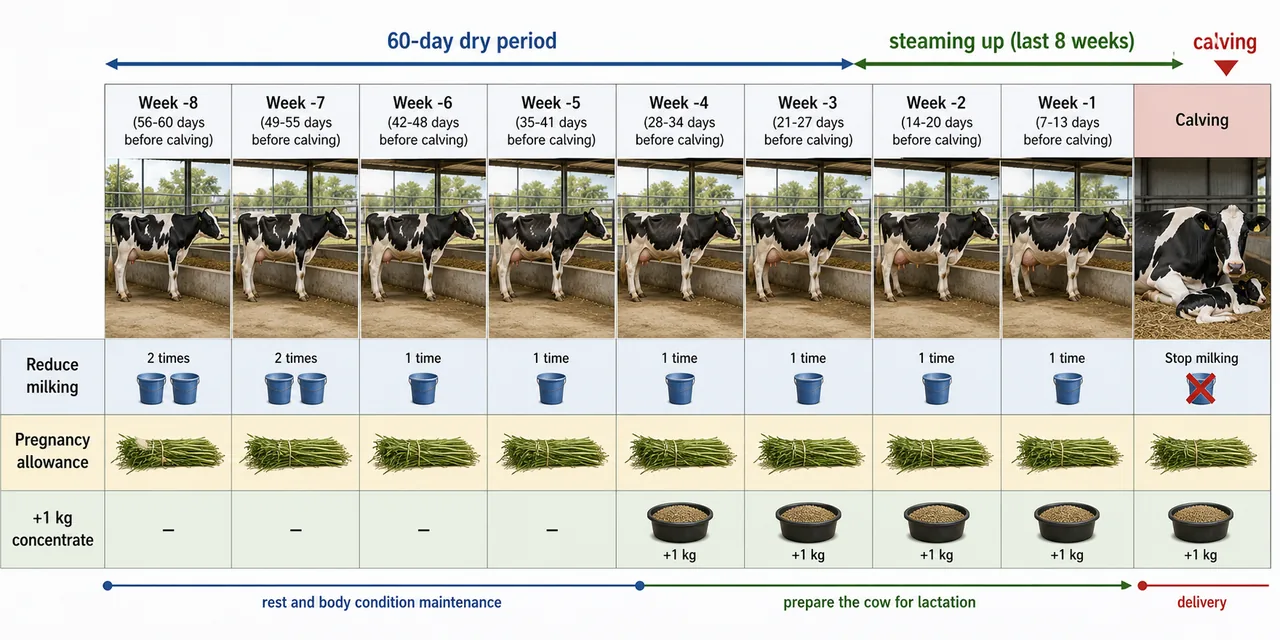
Before the calf is born, the dam must be properly prepared. The dam should be dried off 6–8 weeks before expected calving. This is not optional — it is a biological necessity.
Why the dry period matters: The mammary gland contains secretory cells (alveolar cells) that produce milk. These cells need time to undergo programmed regression and then regeneration. If the dry period is too short, secretory cells are still in the regression phase when calving occurs — the next lactation begins with fewer functional cells and lower peak yield.
Pro Content Locked
Upgrade to Pro to access this lesson and all other premium content.
₹99 charged monthly · Cancel anytime
- All Agriculture & Banking Courses
- AI Lesson Questions (100/day)
- AI Doubt Solver (50/day)
- Glows & Grows Feedback (30/day)
- AI Section Quiz (20/day)
- 22-Language Translation (100/day)
- Recall Questions (20/day)
- AI Quiz (15/day)
- AI Quiz Paper Analysis (100/day)
- AI Step-by-Step Explanations (100/day)
- Spaced Repetition Recall (FSRS)
- AI Tutor
- Immersive Text Questions
- Audio Lessons — Hindi & English
- Mock Tests & Previous Year Papers
- Summary & Mind Maps
- XP, Levels, Leaderboard & Badges
- Generate New Classrooms
- Voice AI Teacher (AgriDots Live)
- AI Revision Assistant
- Knowledge Gap Analysis
- Interactive Revision (LangGraph)
🔒 Secure via Razorpay · Cancel anytime · No hidden fees
The first six months of a calf's life carry the highest mortality risk and the highest long-term impact on productivity. Management failures during this window — inadequate colostrum, poor hygiene, incorrect feeding — permanently reduce the animal's lifetime output. This lesson follows the chronological sequence of management: pre-birth preparation (drying off the dam) → birth → first hours (colostrum) → first weeks (identification, weaning) → first months (feeding, health interventions).
Drying Off the Dam (Pre-Birth Context)
Before the calf is born, the dam must be properly prepared. The dam should be dried off 6–8 weeks before expected calving. This is not optional — it is a biological necessity.
Why the dry period matters: The mammary gland contains secretory cells (alveolar cells) that produce milk. These cells need time to undergo programmed regression and then regeneration. If the dry period is too short, secretory cells are still in the regression phase when calving occurs — the next lactation begins with fewer functional cells and lower peak yield.
- Minimum dry period: 60 days (2 months)
- Inadequate dry period: subsequent lactation yield drops by 15–25%
Method of drying off: Reduce milking frequency gradually — twice daily → once daily → alternate days — over 1–2 weeks. Abrupt cessation causes udder engorgement and mastitis.
Pregnancy allowance: Feed extra concentrate mix of 1.25–1.75 kg/day as pregnancy allowance throughout the dry period.
Steaming Up (Lead Feeding): During the last 8 weeks of gestation, feed 1 kg extra concentrate per day. Three purposes:
- Build body fat and protein reserves for the high energy demands of early lactation
- Stimulate mammary gland development (more secretory tissue = higher peak yield)
- Accustom rumen microbes to higher concentrate diet before calving — prevents digestive upsets post-calving
Laxative feed: Provide 3–5 days before and after calving: wheat bran 3 kg + 0.5 kg groundnut cake + 100 gm mineral mixture/salt.
Why laxative feed? Hormonal changes around calving (high progesterone and oestrogen) slow gut motility, causing constipation. The laxative ration: (1) keeps the gut moving to prevent impaction, (2) is easily digestible during the physiologically stressful calving period, (3) prevents milk fever through mineral supplementation.
IMPORTANT
A dry period of minimum 60 days is not optional. Inadequate dry period = 15–25% reduction in next lactation yield because mammary secretory cells do not fully regenerate.
Care of the Newborn Calf
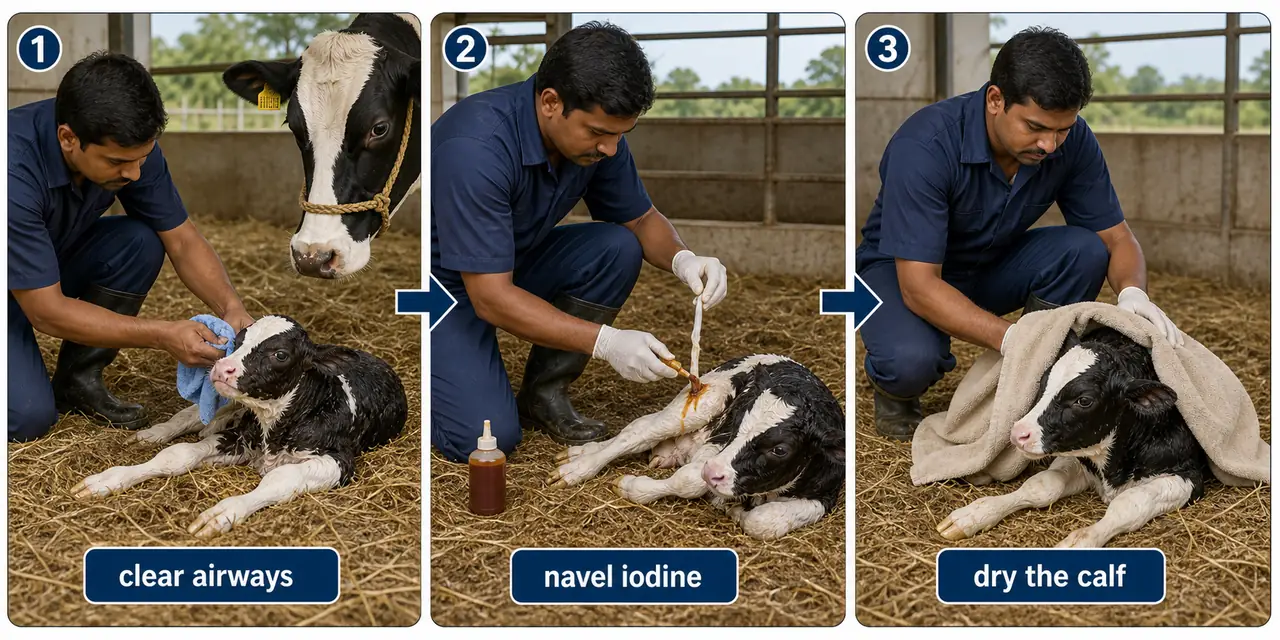
The first minutes of a calf's life require a specific sequence of actions. Each step has a clear biological rationale.
Step 1 — Clear the Airways
Remove mucus from the nose and mouth immediately. If the calf does not start breathing:
- Press and relax the chest walls alternately with hands (manual chest compressions) — stimulates first breath
- Hold calf by rear legs, lift with head down — gravity expels amniotic fluid trapped in lungs
Both techniques help expel amniotic fluid from the respiratory tract and trigger the respiratory reflex.
Step 2 — Navel Cord Care
The navel (umbilical cord stump) is a major bacterial entry point. Disinfection is critical.
- Tie the cord 2–5 cm from the body
- Cut 1 cm below the ligature
- Apply tincture of iodine, boric acid, or antibiotic to the cut end
- Repeat treatment for 2–3 days
Why this matters: untreated navels develop navel ill (omphalophlebitis) — a bacterial infection causing septicaemia and joint swelling in calves. It is a leading cause of early calf mortality.
Step 3 — Dry the Calf
If the cow does not lick the calf dry, or if the weather is cold, wipe the calf clean and dry manually.
Why: newborn calves have very limited body fat reserves. A wet calf in cold weather rapidly develops hypothermia — a dangerous, potentially fatal drop in body temperature.
Early Calf Milestones
NOTE
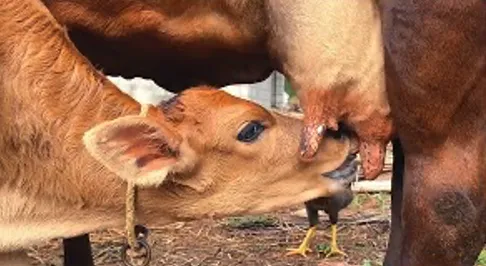
- First 2 months: calf allowed to take all milk from the mother
- 3 weeks: begins eating a little grass
- 3 months: can eat plants and ruminate — calf can be weaned at this age
- Lambs and kids suckle until 4 months but show interest in green plants from 3 weeks
Colostrum Feeding
Colostrum is the first milk secreted by the dam after calving. It is not ordinary milk — it is the calf's only source of passive immunity.
Why timing is critical: The calf's small intestine can absorb intact immunoglobulin (IgG/antibody) molecules only during a brief window after birth. This process — called passive transfer of immunity — depends on specialised intestinal cells that are present at birth and decline rapidly. IgG absorption drops sharply after 6 hours and is virtually absent by 24 hours. A calf that does not receive colostrum in this window has no immune protection.
Feeding Rates
| Animal | Colostrum Rate |
|---|---|
| Cow calf | 1/10th of body weight |
| Buffalo calf | 1/15th of body weight |
| First 30 min to 12 hours | 5–8% of body weight |
- Feed colostrum within 1–2 hours of birth
- Continue colostrum for first 3–5 days at 2–2.5 litres/day
- Whole milk: max 1/10th body weight, maximum 5–6 litres/day; continue for 6–10 weeks
- Overfeeding causes Calf Scours (diarrhoea)
IMPORTANT
Colostrum has LOW fat but HIGH protein (a common exam trap — do not confuse). Protein content is 4–5 times higher than normal milk — mostly immunoglobulins (IgG antibodies). Cow calf rate: 1/10th body weight. Buffalo calf rate: 1/15th body weight.
Composition and Functions of Colostrum
| Component | Details |
|---|---|
| Fat | LOW — buffalo colostrum fat: 4% |
| Protein | HIGH — 4–5 times higher than normal milk; mostly IgG antibodies |
| Vitamins and minerals | Provides balanced nutrition for newborn |
| Laxative effect | Helps calf expel meconium (first faecal matter) |
| Secreted for | First 3–5 days after calving |
Colostrum prevents:
- Calf Scour (diarrhoea)
- Night Blindness
- Navel Ill
Meconium
Meconium = the first faecal matter of the newborn calf — dark, tarry stool consisting of intestinal epithelial cells, mucus, and amniotic fluid ingested during gestation. It must be expelled in the first day of life.
- Colostrum's natural laxative effect normally expels meconium
- If meconium is not voided: give a mild enema — dissolve soap in 1 litre warm water and administer rectally
Identification of Calves
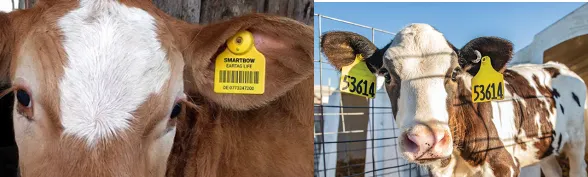
Identification is required for breeding records, health records, production records, and lineage tracking. Without reliable identification, good herd management is impossible — especially on breeding farms.
Methods of Identification
| Method | Description | Notes |
|---|---|---|
| Ear Tagging | Plastic/metal tag in ear with ID number | Most popular — readable without catching animal; easy-to-use, all-weather, inexpensive |
| Ear Tattooing | Indelible ink injected under ear skin | More permanent than tags (tags can be lost); requires close inspection; done at birth |
| Hot Branding | Hot iron marks skin permanently | Painful; done after 1 year of age |
| Freeze Branding | Extreme cold destroys pigment cells | Less painful than hot branding; produces visible white hair marks on dark skin; preferred |
| Ear Notching | Specific cuts at designated ear positions | Standardised numbering system; used in pigs and beef cattle |
| Neck Strap / Neck Chain | Number plate attached to neck collar | Simplest and most visible; common in dairy farms |
| Metal Ear Buttons | Metal tags with letters and numbers | Inserted in ear |
NOTE
Most popular identification method = Ear Tagging. Most permanent = Tattooing (done at birth). Branding (freeze or hot) done after 1 year of age.
Body Weight Monitoring
Body weight is recorded along with body length, breadth, and height to calculate milk allowance and monitor growth. Regular monitoring ensures the calf grows at the expected rate and feeding is adjusted accordingly.
- Target for crossbred calves: 400 grams/day or 2.5–3 kg/week
Housing and Feeding Through Early Growth
System of Calf Rearing
The central decision in calf management is when and how to separate the calf from the dam. Each approach has specific trade-offs.
Weaning System (Most Common Commercial System)
The calf is separated from the dam after the colostrum period (3–4 days). Feeding and management thereafter is entirely by the dairyman.
- Pail feeding used after weaning (open pail or nipple pail)
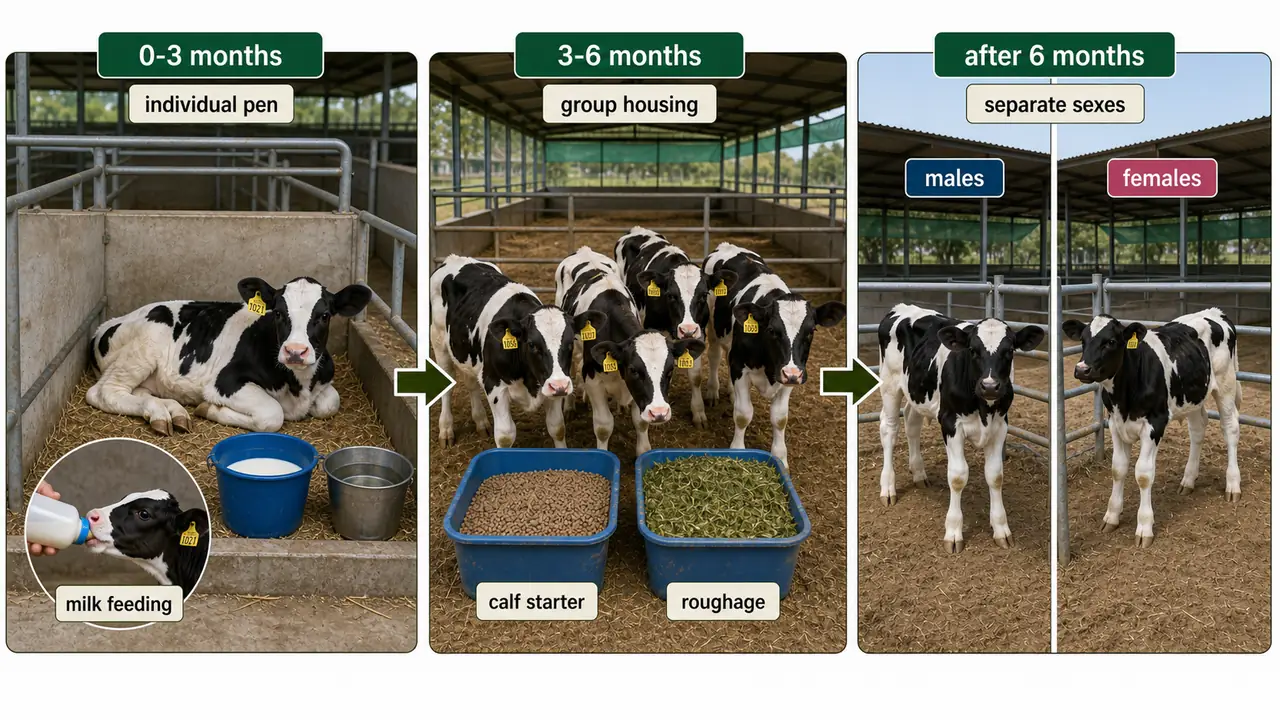
- Individual pen recommended for the first few weeks — prevents cross-sucking, disease transmission, and competition for feed
Housing by Age
| Age | Housing |
|---|---|
| 0–3 months | Individual pen |
| 3–6 months (after 8 weeks) | Group housing |
| After 6 months | Separate male and female (prevents precocious breeding) |
Advantages of Weaning System
- If the calf dies accidentally, cow milking continues undisturbed
- Calves are fed economically — only as much as necessary
- Protects calf from diseases like diarrhoea (controlled feeding prevents overfeeding)
- Actual milk yield can be recorded accurately
- Total milk yield increases — weaning is essential for maximum milk production
- Most important advantage: milking without calf is more hygienic and sanitary
Calf Feeding Schedule
Feeding follows a developmental progression. Each phase stimulates the next stage of rumen development. Early introduction of grain (calf starter) produces volatile fatty acids (VFAs) via microbial fermentation inside the rumen — these VFAs stimulate rumen papillae development, which is essential for efficient nutrient absorption throughout adult life.
Milk Feeding Phase
| Parameter | Details |
|---|---|
| Colostrum | Within 1–2 hours; 1/10th body weight (cow), 1/15th (buffalo) |
| Colostrum duration | First 3–5 days |
| Whole milk | 6–10 weeks; 1/10th body weight; max 5–6 litres/day |
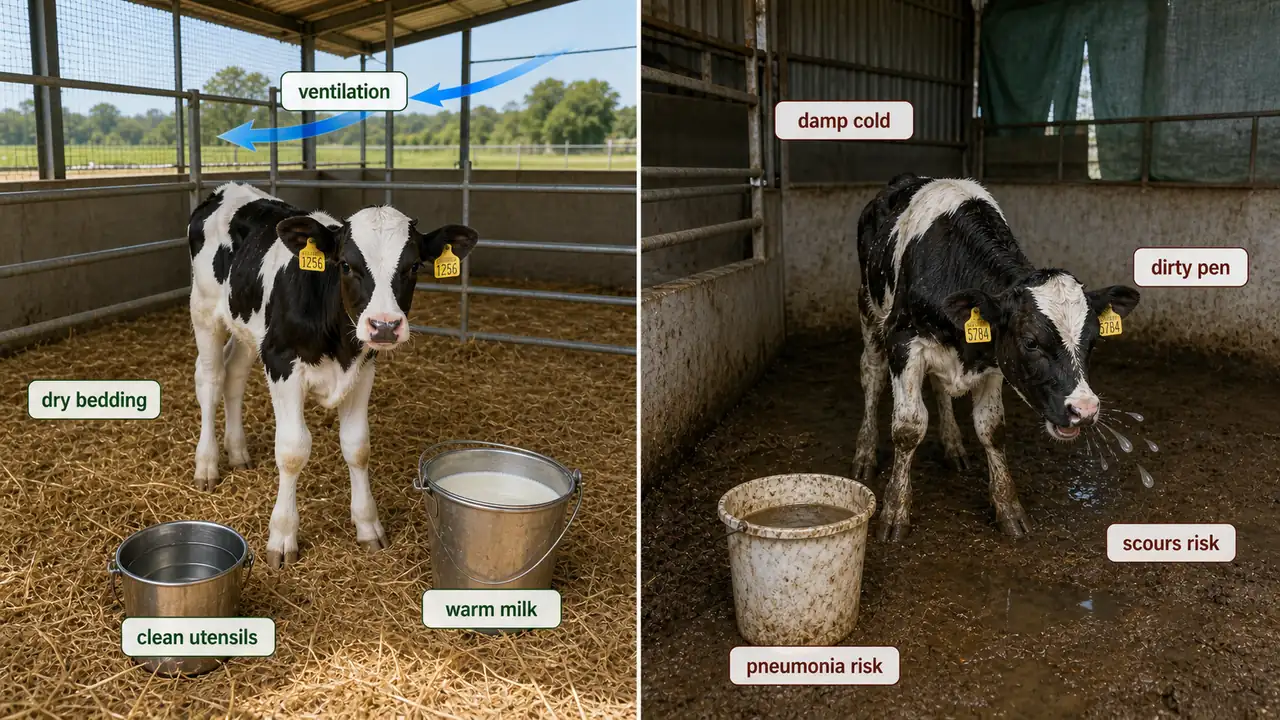
| Milk temperature | 98–102°F (36.7–38.9°C) — cold milk causes shivering and digestive upsets |
Solid Feed Introduction
| Age | Feed |
|---|---|
| After 1 month (from 3rd week) | Calf starter — ground grains, protein feeds, minerals, vitamins, antibiotics |
| 4th month onwards | Good quality green fodder and hay |
| Up to 3–4 months | Silage @ 1–2 kg/day, increase 500 gm/month |
| From 6 months | Same concentrate as adult cattle (70% TDN, 14–16% DCP) |
Role of antibiotics in calf starter: Aureomycin and Terramycin fed to calves improve appetite, increase growth rate, and prevent calf scours.
Pail Feeding Technique
- Nipple pail: Slows intake and mimics natural suckling — reduces bloat and digestive upsets. Preferred for very young calves.
- Open pail: Rapid intake can cause digestive upsets. Teaching method — place fingers in calf's mouth, after it nurses pull its head gently down into the pail.
- Temperature must be 98–102°F — mimics milk coming directly from the udder
- Never overfeed — the calf's abomasum (true stomach) capacity is limited
- A 2-month-old calf drinks 4–6 litres milk/day
- Utensils must be kept clean — contaminated utensils directly cause calf scours
Supernumerary Teat Removal
- Normal number of teats: maximum 4
- Extra (supernumerary) teats interfere with milking machine attachment
- Remove at 1–2 months of age using sterilised scissors
- Must be done before teat development begins
NOTE
Calf mortality is highest in the first month due to pneumonia, diarrhoea (calf scours), and worms. Extra hygiene and careful management during this period is critical.
Routine Physical Interventions
Disbudding and Dehorning
Why Act Early?
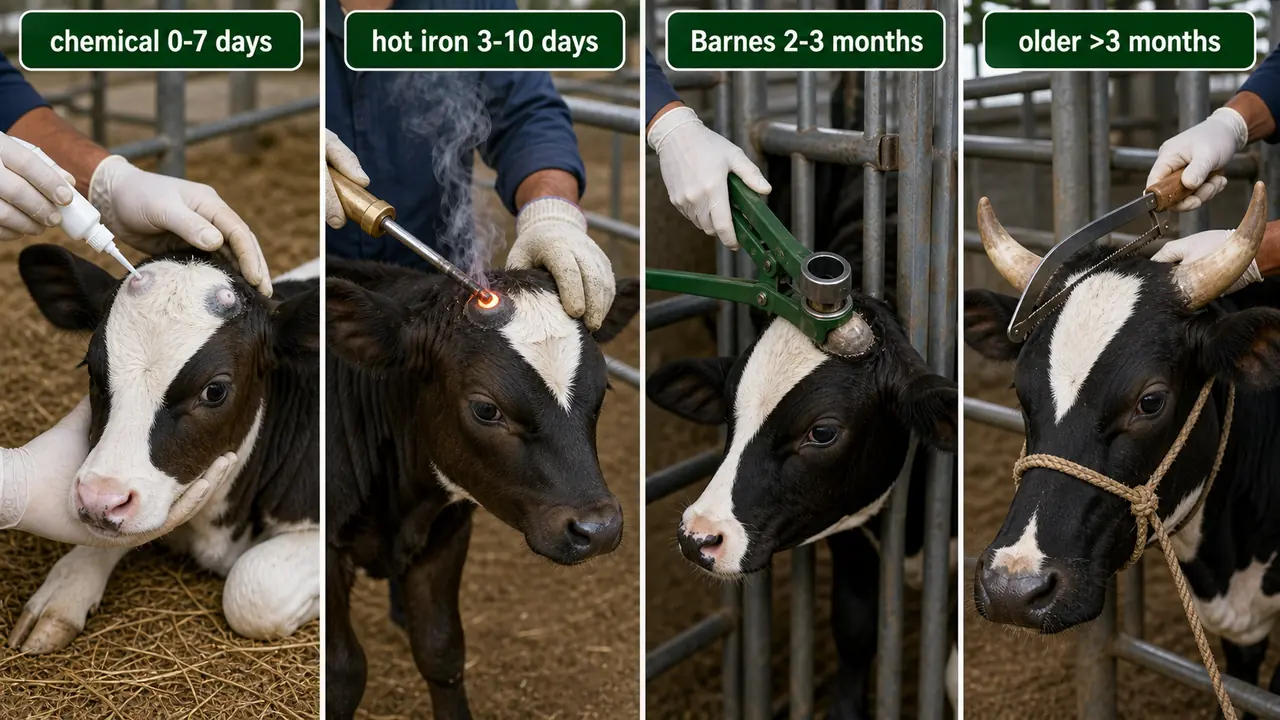
The horn bud is not attached to the skull until after approximately 10 days of age. Before attachment, it is a loose button of keratin-producing tissue sitting on the skin — it can be destroyed with minimal pain and bleeding. After it attaches to the skull and horn growth begins, removal becomes a painful surgical procedure involving bone and significant bleeding. Early intervention is therefore both kinder and safer.
Disbudding = destroying horn-producing cells before horn growth begins (within 3–10 days of birth).
Methods of Disbudding
| Method | How it Works | Best Age | Notes |
|---|---|---|---|
| Caustic potash/soda (KOH/NaOH) | Chemical burns and destroys horn-producing tissue | Newborn to 7 days | Apply petroleum jelly around bud to protect eyes; no bleeding — most gentle |
| Hot iron (electric dehorner) | 500°C rod applied for 10 seconds | 3–10 days | Cauterisation destroys horn cells and seals blood vessels — bloodless |
| Elastrator ring | Thick rubber ring cuts blood supply at base of bud | Small buds | Small buds drop in 3–6 weeks; large horns up to 2 months |
| Barnes dehorner (Keystone dehorner) | Scissor-like instrument with curved scoops pressed over bud | Up to 2–3 months | Some bleeding; used when bud has grown beyond chemical stage but before firm skull attachment |
TIP
Disbudding vs Dehorning: Disbudding = destroy horn bud BEFORE growth (within 10 days). Dehorning = remove already-grown horns (more invasive). Methods by age: (1) Caustic potash/soda — newborn to 7 days; (2) Hot iron — 3–10 days; (3) Barnes dehorner — up to 2–3 months; (4) Dehorning saw/clippers — older animals. Chemical = most gentle (no bleeding). Hot iron = bloodless. Barnes = some bleeding.
Purposes of Dehorning
- Less space needed in sheds
- Prevents bruises and injuries between animals (significant economic losses)
- Safer for operators and farm workers
- Easier animal handling and movement
- Prevents horn cancer (squamous cell carcinoma — common in Indian breeds, especially bullocks)
Disadvantages of Dehorning
- Exhibition value of well-shaped horns is lost
- Some breeds use horns for breed identification (Kankrej: lyre-shaped horns; Murrah buffalo: tightly curled horns)
- Dehorned animals cannot self-defend
Dehorning (Older Animals)
Uses specially designed clippers or a dehorning saw. More invasive — requires proper restraint, local anaesthesia, and post-operative wound care.
Deworming and Deticking
Why Young Calves Need Frequent Deworming
Young calves have immature immune systems and are highly susceptible to internal parasites, especially Ascaris (roundworms), lungworms, and coccidia. Heavy worm burdens cause poor growth, anaemia, diarrhoea, and can be fatal.
Deworming Schedule
| Age/Stage | Frequency |
|---|---|
| First deworming | 2–3 weeks of age |
| Repeat | Every 6–8 weeks until 6 months |
| Adults | Every 3–4 months |
Drug for Ascaris (roundworms): Piperazine salt — paralyses roundworms, causing them to release from the intestinal wall and be expelled in faeces.
Deticking
Ticks, lice, and mites attach to the body surface and cause:
- Irritation and blood loss
- Anaemia (from heavy infestation)
- Disease transmission: babesiosis and theileriosis (tick-borne diseases)
Regular deticking using acaricides (tick-killing chemicals): spraying or dipping. Grooming (daily brushing) also helps control ectoparasites.
Castration of Bull Calves
Castration = removal or destruction of the testicles (unsexing of the male). Eliminates testosterone production → docile animal, no unwanted breeding.
Objectives:
- Prevent unwanted reproduction
- Increase faster growth and weight gains
- Produce desirable meat type (castrated males gain more efficiently)
- Make the animal docile and easier to handle for draught work
Best age: 8–10 weeks — less stress, quicker healing, and minimal bleeding compared to older animals.
Methods of Castration
| Method | Description | Notes |
|---|---|---|
| Surgical / Orchidectomy | Scrotum opened aseptically, testicles removed, wound treated | Most reliable — complete testes removal; strict aseptic technique essential |
| Burdizzo's castrator (Bloodless) | Crushes spermatic cord 1–2 inches above testicle without cutting skin; stops blood to testes → testes atrophy | Most preferred in India; "bloodless" = no skin incision |
| Rubber ring (Elastrator) | Strong tight rubber ring around spermatic cords; cuts blood supply → scrotum and testes shrivel and fall in 2–3 weeks | Very painful; not usually recommended; optimal age: below 3 months |
TIP
Castration comparison: (1) Burdizzo = bloodless, no skin incision, most preferred in India; (2) Surgical (Orchidectomy) = most reliable, small bleeding, best for older animals; (3) Rubber ring = very painful, used below 3 months. Best age = 8–10 weeks. "Bloodless" = key exam clue for Burdizzo.
Nose Ring
- Nasal septum punctured for nose ring at 12 months of age
- Provides safe and effective control of bulls
- Pressure on sensitive nasal tissues gives effective control even of large, aggressive bulls
Disease Prevention and Management Timeline
Calf Disease Management
Most calf deaths occur in the first month from the following diseases:
| Disease | Cause | Age | Signs | Prevention |
|---|---|---|---|---|
| White Scours (Colibacillosis) | E. coli | 1–3 days | White/yellowish watery diarrhoea | Adequate colostrum (IgG antibodies) + strict hygiene |
| Common Scours (Calf Diarrhoea) | Rotavirus, coronavirus, Salmonella, Cryptosporidium, overfeeding | First month | Watery diarrhoea, dehydration | Hygiene, correct milk temperature, avoid overfeeding |
| Pneumonia | Pasteurella multocida, Mannheimia haemolytica | First weeks | Fever, nasal discharge, coughing | Dry bedding, adequate ventilation, avoid cold damp housing |
| Ringworm (Dermatophytosis) | Trichophyton verrucosum (fungus) | Any age | Circular, crusty grey-white patches on head, neck, eye area | Antifungal ointments (miconazole); zoonotic — can spread to humans |
| Internal Parasites | Ascaris, lungworms, coccidia | Any age | Poor growth, anaemia, diarrhoea | Deworming — first at 2–3 weeks, every 6–8 weeks to 6 months; Piperazine for Ascaris |
Management Practices Timeline
| Practice | Timing |
|---|---|
| Tattooing in ear | At birth |
| Disbudding / Dehorning | Within 7–10 days of birth |
| Supernumerary teat removal | 1–2 months of age |
| Castration (males) | 8–10 weeks |
| Deworming (first dose) | 2–3 weeks of age |
| Deworming (repeat) | Every 6–8 weeks until 6 months |
| Housing (individual pen) | 0–3 months |
| Group housing | 3–6 months (after 8 weeks) |
| Separate male and female | After 6 months |
| Mineral blocks | Continuously |
| Nose ring (bulls) | 12 months |
| Branding | After 1 year |
| Calf starter introduction | After 1 month (from 3rd week) |
| Green fodder and hay | From 4th month onwards |
Summary Cheat Sheet
| Concept | Key Details |
|---|---|
| Drying off period | 6–8 weeks (min 60 days) before calving; inadequate = 15–25% drop in next lactation |
| Steaming up | Extra 1 kg concentrate in last 8 weeks of gestation |
| Colostrum timing | Within 1–2 hours of birth; IgG drops after 6 hours, negligible by 24 hours |
| Colostrum rate (cow) | 1/10th of body weight |
| Colostrum rate (buffalo) | 1/15th of body weight |
| Colostrum composition | LOW fat, HIGH protein; immunoglobulins (IgG) = antibodies |
| Colostrum duration | First 3–5 days after calving |
| Navel cord | Tie 2–5 cm from body; tincture of iodine to prevent navel ill |
| Meconium | First faecal matter; expelled via colostrum's laxative effect |
| Crossbred calf daily gain | 400 g/day or 2.5–3 kg/week |
| Weaning | Calf separated from mother; most important advantage = hygienic milking |
| Calf starter | From 3rd week; promotes rumen papillae development |
| Housing (0–3 months) | Individual pen; group after 8 weeks; separate sexes after 6 months |
| Supernumerary teats | Remove at 1–2 months; normal = 4 teats |
| Disbudding age | Within 3–10 days (horn bud not yet attached to skull) |
| Castration best age | 8–10 weeks |
| Burdizzo method | Bloodless castration — most preferred in India |
| First deworming | 2–3 weeks; Piperazine salt for Ascaris |
| White scours | E. coli; 1–3 days old calves |
| Milk temperature | 98–102°F (36.7–38.9°C) |
| Identification (most popular) | Ear tagging |
| Branding age | After 1 year |
- Banerjee, G.C. — A Textbook of Animal Husbandry (8th Ed.), Oxford & IBH Publishing Co.
- NDDB (National Dairy Development Board) — Calf Rearing Guidelines
- ICAR (Indian Council of Agricultural Research) — Livestock Management Standards
- NADCP (National Animal Disease Control Programme) — Government of India, Dept. of Animal Husbandry & Dairying
Lesson Doubts
Ask questions, get expert answers