🌾 Feeding, Ration Science, and Bull Management
Complete guide to ration requirements, concentrate vs roughage, feeding schedules for all classes of cattle (dry, lactating, pregnant, growing), bull management, bullock working hours, and livestock insurance for exams.
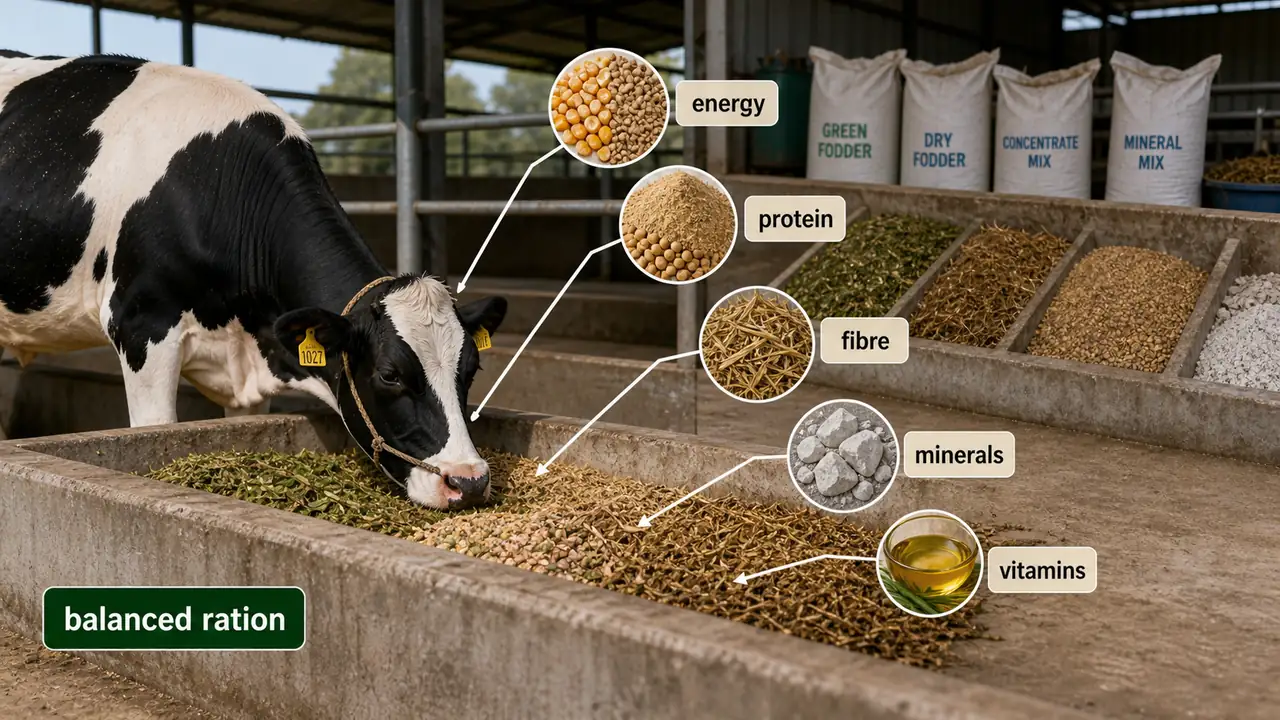
Feeding is the largest operating cost in any dairy enterprise, typically accounting for 60–70% of total production cost. Getting it right requires understanding: what a ration is, the fundamental difference between concentrates and roughages, how to balance them for different classes of animals, and how requirements shift with body weight, milk yield, and physiological stage. This lesson covers the science of cattle feeding — from basic definitions through detailed schedules for every class of animal, including bulls and working bullocks.
Ration Requirements
What is a Ration?
A ration is the amount of feed allowed to a given animal during a 24-hour period. It is fed at the rate of 2–3% of the animal's body weight per day.
What is a Balanced Ration?
A balanced ration provides all essential nutrients in the proportions and amounts required for the proper nourishment of that specific animal at its specific stage of production. It must supply:
Pro Content Locked
Upgrade to Pro to access this lesson and all other premium content.
₹99 charged monthly · Cancel anytime
- All Agriculture & Banking Courses
- AI Lesson Questions (100/day)
- AI Doubt Solver (50/day)
- Glows & Grows Feedback (30/day)
- AI Section Quiz (20/day)
- 22-Language Translation (100/day)
- Recall Questions (20/day)
- AI Quiz (15/day)
- AI Quiz Paper Analysis (100/day)
- AI Step-by-Step Explanations (100/day)
- Spaced Repetition Recall (FSRS)
- AI Tutor
- Immersive Text Questions
- Audio Lessons — Hindi & English
- Mock Tests & Previous Year Papers
- Summary & Mind Maps
- XP, Levels, Leaderboard & Badges
- Generate New Classrooms
- Voice AI Teacher (AgriDots Live)
- AI Revision Assistant
- Knowledge Gap Analysis
- Interactive Revision (LangGraph)
🔒 Secure via Razorpay · Cancel anytime · No hidden fees
Feeding is the largest operating cost in any dairy enterprise, typically accounting for 60–70% of total production cost. Getting it right requires understanding: what a ration is, the fundamental difference between concentrates and roughages, how to balance them for different classes of animals, and how requirements shift with body weight, milk yield, and physiological stage. This lesson covers the science of cattle feeding — from basic definitions through detailed schedules for every class of animal, including bulls and working bullocks.
Ration Requirements
What is a Ration?
A ration is the amount of feed allowed to a given animal during a 24-hour period. It is fed at the rate of 2–3% of the animal's body weight per day.
What is a Balanced Ration?
A balanced ration provides all essential nutrients in the proportions and amounts required for the proper nourishment of that specific animal at its specific stage of production. It must supply:
- Energy (measured as TDN — Total Digestible Nutrients)
- Protein (measured as DCP — Digestible Crude Protein)
- Fibre (provided by roughage — essential for rumen health)
- Minerals (calcium, phosphorus, salt, trace elements)
- Vitamins (fat-soluble vitamins A, D, E from green fodder)
All five must be present in correct ratios — excess of one does not compensate for deficiency of another.
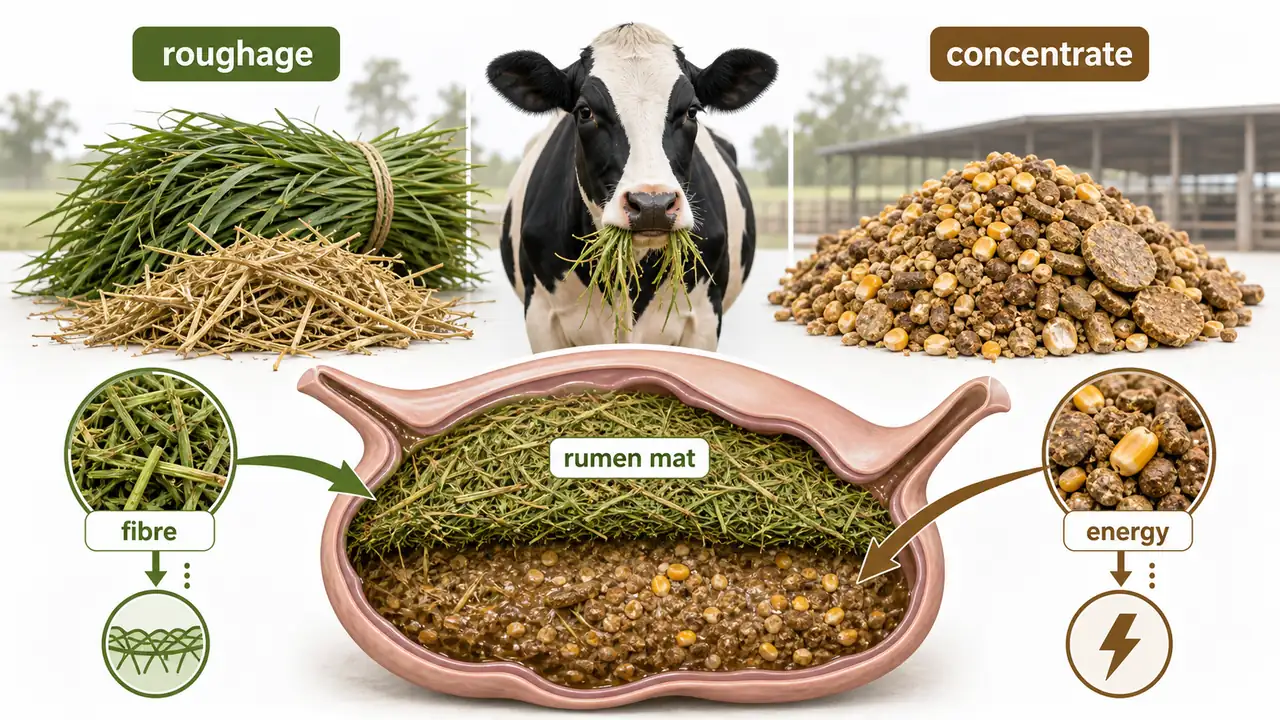
Concentrate vs Roughage
These two feed categories are the building blocks of every cattle ration. Understanding their differences is the foundation of ration formulation.
| Parameter | Concentrate | Roughage |
|---|---|---|
| Moisture | 10% moisture, 90% dry matter | Dry fodder: 10% moisture; Green fodder: 80–90% moisture |
| Digestibility | Highly digestible | Comparatively less digestible |
| Crude fibre | Less than 18% | More than 18% |
| Nutritive value per unit mass | High | Low |
| Physical nature | Compact | Bulky |
| Keeping quality | High | Dry = High; Green = Low |
Why Both Are Needed
Roughage alone can support milk production up to 4–5 kg/day. Beyond that, concentrates must be added. This is because:
- Roughage fibre is essential for rumen health — rumen pH must stay above 6.0 for normal microbial fermentation
- Too much concentrate without sufficient roughage causes acidosis (rumen pH crashes below 6.0) — dangerous and production-limiting
- Conversely, roughage alone cannot provide enough energy density for high-yielding animals
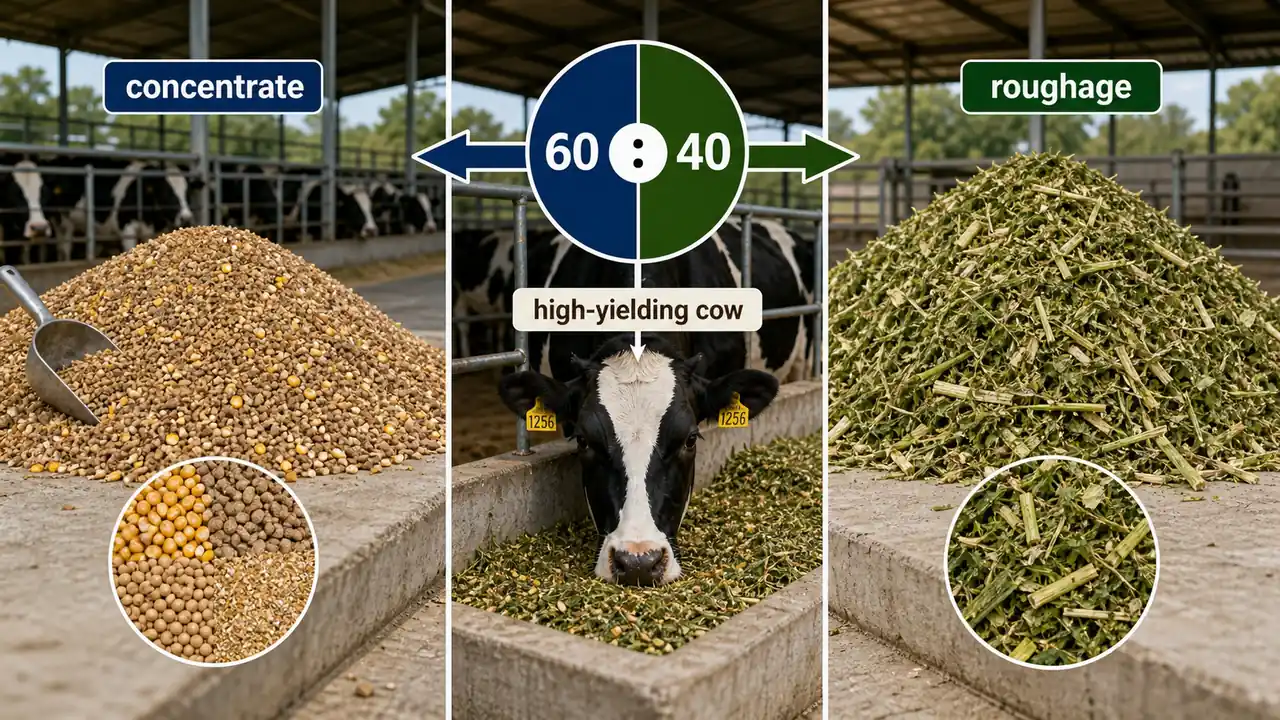
For high-yielding animals: optimum concentrate to roughage ratio = 60:40 on a dry matter (DM) basis.
Feed Substitution (Exam-Relevant)
| Substitution | Details |
|---|---|
| 20 kg grass (guinea, napier) OR 6–8 kg legume fodder (cowpea, lucerne) | Replaces 1 kg concentrate mixture (0.14–0.16 kg DCP) |
| 1 kg straw | Replaces 4–5 kg grass on dry matter basis |
IMPORTANT
For lactating cows: 1 kg concentrate mixture (providing 0.14–0.16 kg DCP and 0.70 kg TDN) is required for every 2.5–3.0 kg milk produced over and above maintenance allowance.
Feeding Plans for Different Classes of Cattle
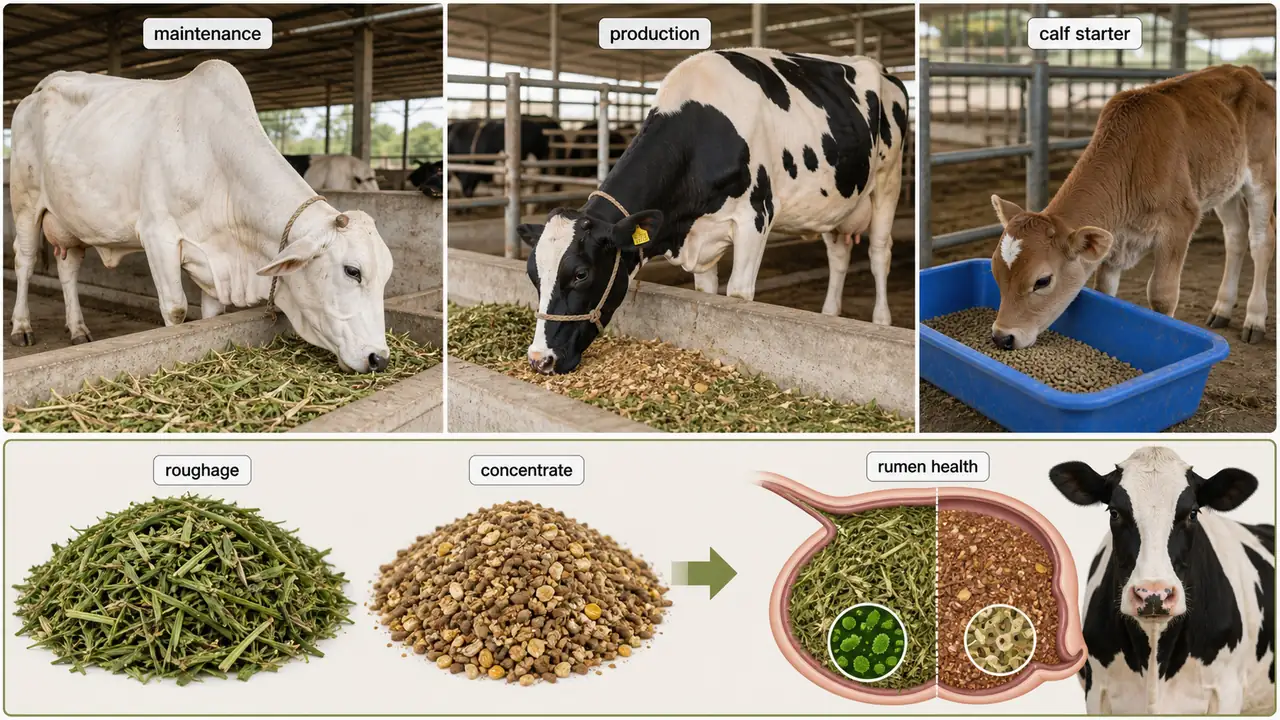
Crossbred Cow Feeding Schedule (Source: NDDB)
Feeding requirements change significantly between the lactation period and the dry period. During lactation, the mammary gland demands high energy and protein — concentrate increases with milk yield. During the dry period, the mammary gland is resting — concentrate drops sharply, but dry fodder increases to maintain rumen bulk and health.
| S.No | Animal Type | Stage | Green Fodder (kg) | Dry Fodder (kg) | Concentrate (kg) |
|---|---|---|---|---|---|
| 1 | 6–7 litres milk/day | Lactation | 20–25 | 5–6 | 3.0–3.5 |
| Dry days | 15–20 | 6–7 | 0.5–1.0 | ||
| 2 | 8–10 litres milk/day | Lactation | 25–30 | 4–5 | 4.0–4.5 |
| Dry days | 20–25 | 6–7 | 0.5–1.0 |
NOTE
During dry days, concentrate drops to 0.5–1.0 kg (mammary gland does not need production nutrients) while dry fodder increases to maintain rumen bulk and function. During lactation, concentrate rises proportionally with milk yield.
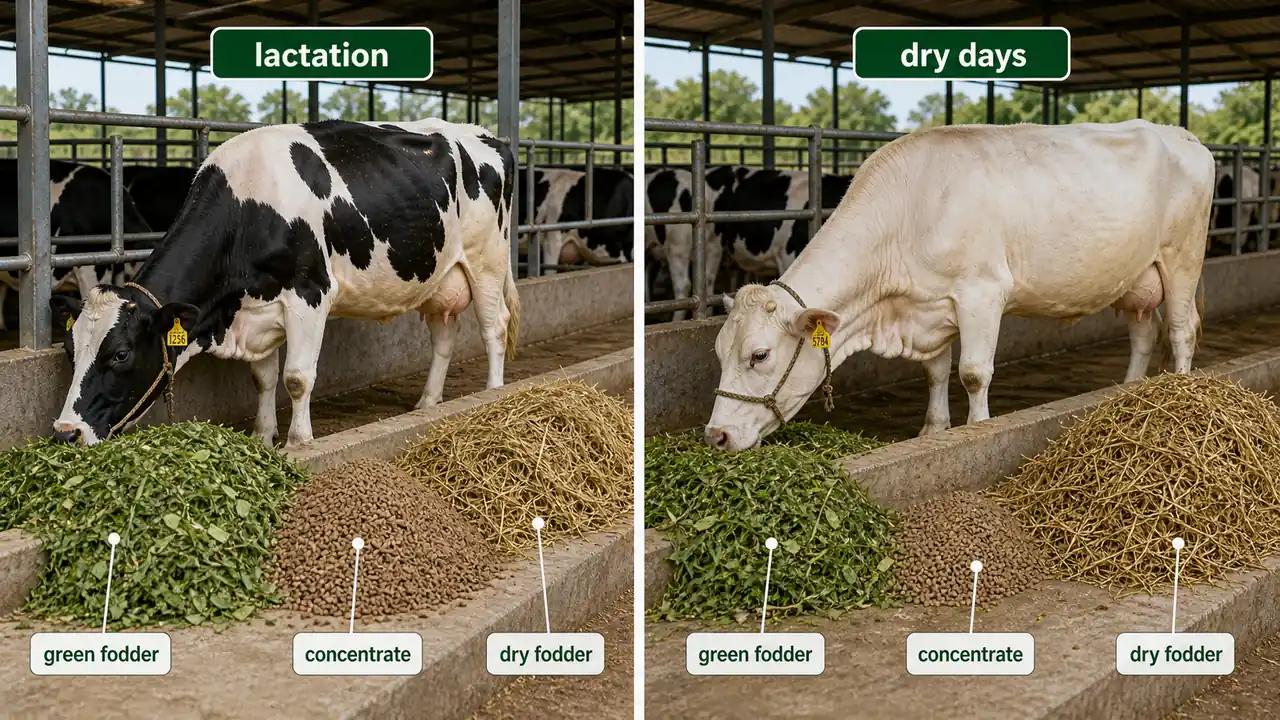
Feeding Schedule for Different Classes of Adult Cows (~250 kg body weight)
When Green Grass is Plenty
| Category | Concentrate Mixture (kg) | Green Grass (kg) |
|---|---|---|
| Dry cows | — | 25–30 |
| Milking cows | 1.0 kg per 2.5 kg milk (at 4% fat); Buffalo: 1.0 kg per 2.0 kg milk | 30 |
| Pregnant cows | Production allowance + 1–1.5 kg from 7th month | 25–30 |
When Paddy Straw is the Major Roughage
| Category | Concentrate Mixture (kg) | Green Grass (kg) | Paddy Straw (kg) |
|---|---|---|---|
| Dry cows | 1–1.25 | 5.0 | 5–6 |
| Milking cows | 1.25 + 1 kg per 2.5–3.0 kg milk | 5.0 | 5–6 |
| Pregnant cows | Maintenance + production + 1–1.5 kg from 7th month | 5.0 | 5–6 |
NOTE
For dry cows in poor condition or when fodder quality is inferior: up to 1 kg concentrate can be given. This was a specific question topic in exams.
Feeding Schedule for Growing Animals (From 6 Months)
From 6 months onwards, calves graduate to the same concentrate mixture used for adult cattle:
- DCP: 14–16%
- TDN: 70%
The concentrate composition is the same, but the quantity is calibrated to growth rate rather than milk production. Refer to the calf feeding schedule for amounts by age group (0–6 months).
Feeding and Managing Breeding Males
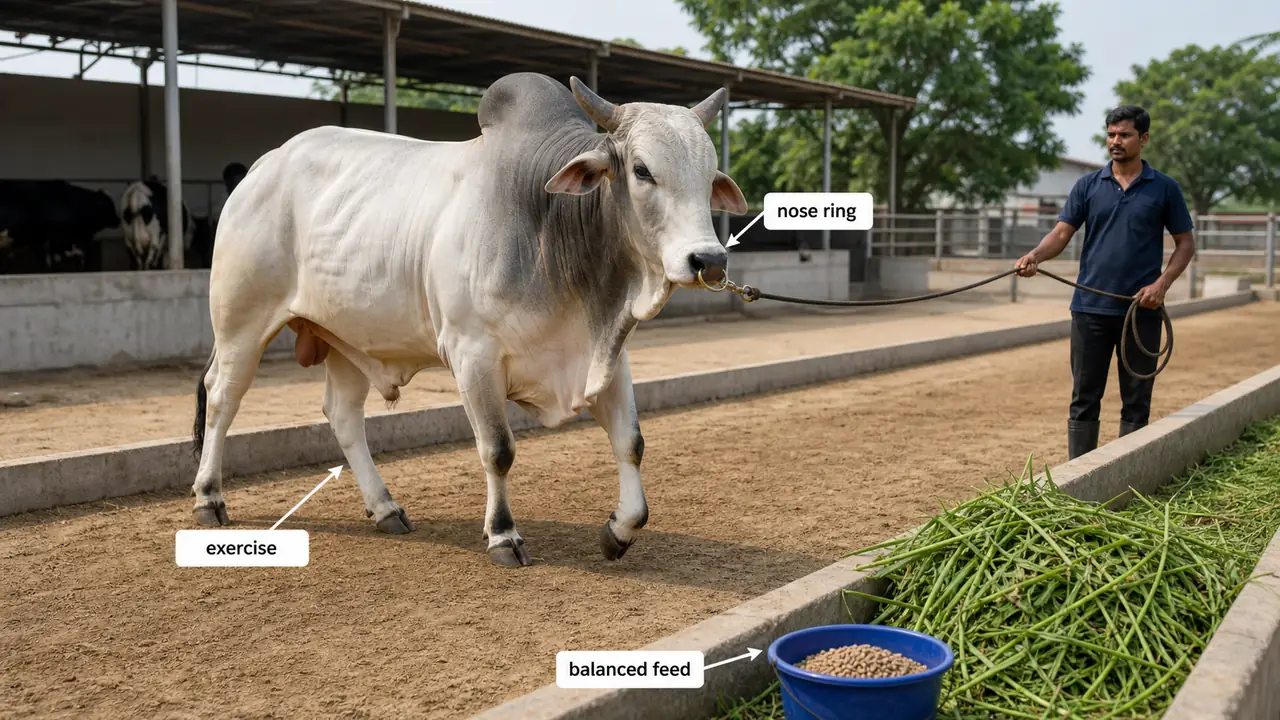
Bull Feeding and Management
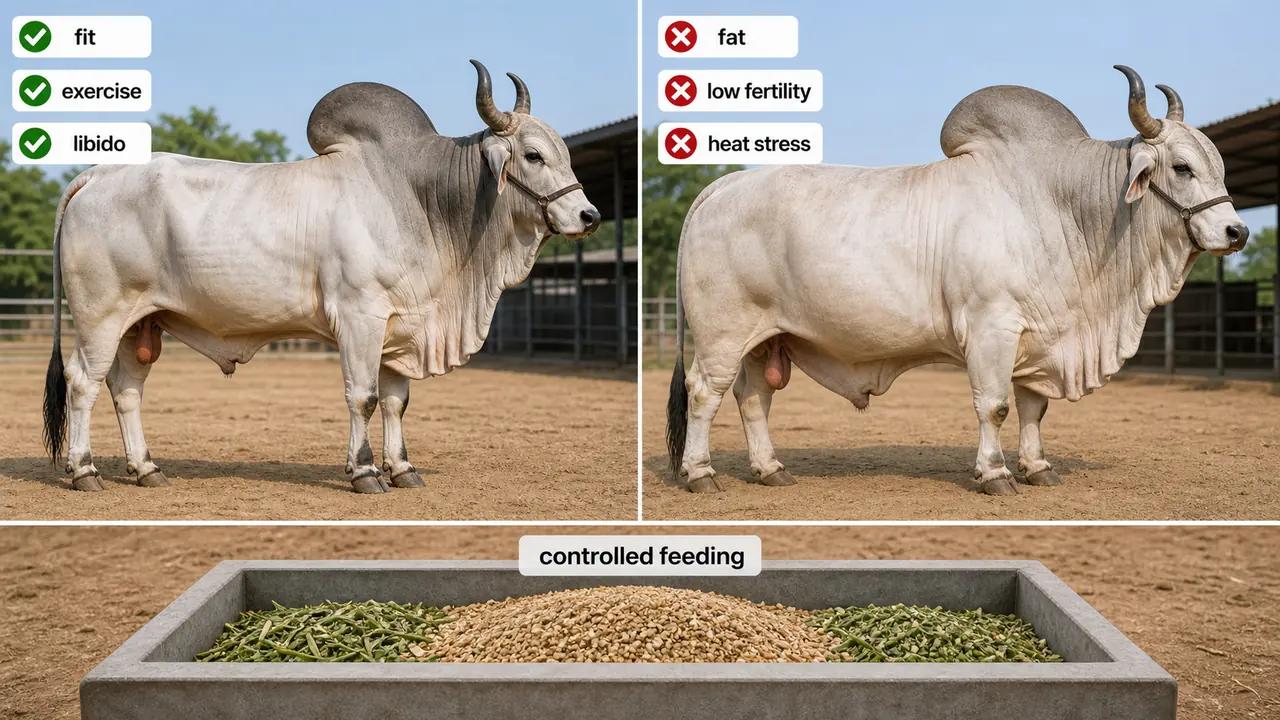
Feeding Principle: "Fit but Not Fat"
A bull's feeding must achieve a specific body condition — neither under-conditioned nor obese. This is because:
- Obese bulls show reduced libido (sexual drive) and poor heat tolerance — fat accumulation around the scrotum also raises scrotal temperature, impairing spermatogenesis
- Under-conditioned bulls produce semen of inferior quality — both libido and spermatozoa motility decline when energy reserves are depleted
Bull Feeding Schedule
| Body Weight (kg) | Concentrate Mixture (kg) | Green Fodder (kg) |
|---|---|---|
| 400–500 | 2.5–3 | 20–25 |
Care and Management of Bulls
Grooming:
- Brush body daily — removes dust, dirt, and ectoparasites (ticks, lice)
- Clean the sheath (prepuce) regularly — smegma accumulation causes local infection and may introduce bacteria into the cow during mating
- Trim hooves every 3–4 months — lameness reduces mounting ability and makes the bull reluctant to serve
Exercise:
- Exercise the bull daily for 1–2 km
- Maintains muscle tone, prevents obesity, and sustains libido
- Bulls kept in confinement without exercise become sluggish
Shoeing:
Bulls used for draught work are fitted with iron shoes to protect hooves from wear:
| Type of Work | Shoeing Frequency |
|---|---|
| Road work | Once a month (hard surface = rapid hoof wear) |
| Field work | Once in two months (soft soil = slower wear) |
Nose Ring:
- Nasal septum is punctured for a nose ring at 12 months of age
- Provides safe and effective control — pressure on sensitive nasal tissues allows effective handling even of large, aggressive bulls
- Essential for safe AI procedures and veterinary examination
Bullock Feeding and Working Hours
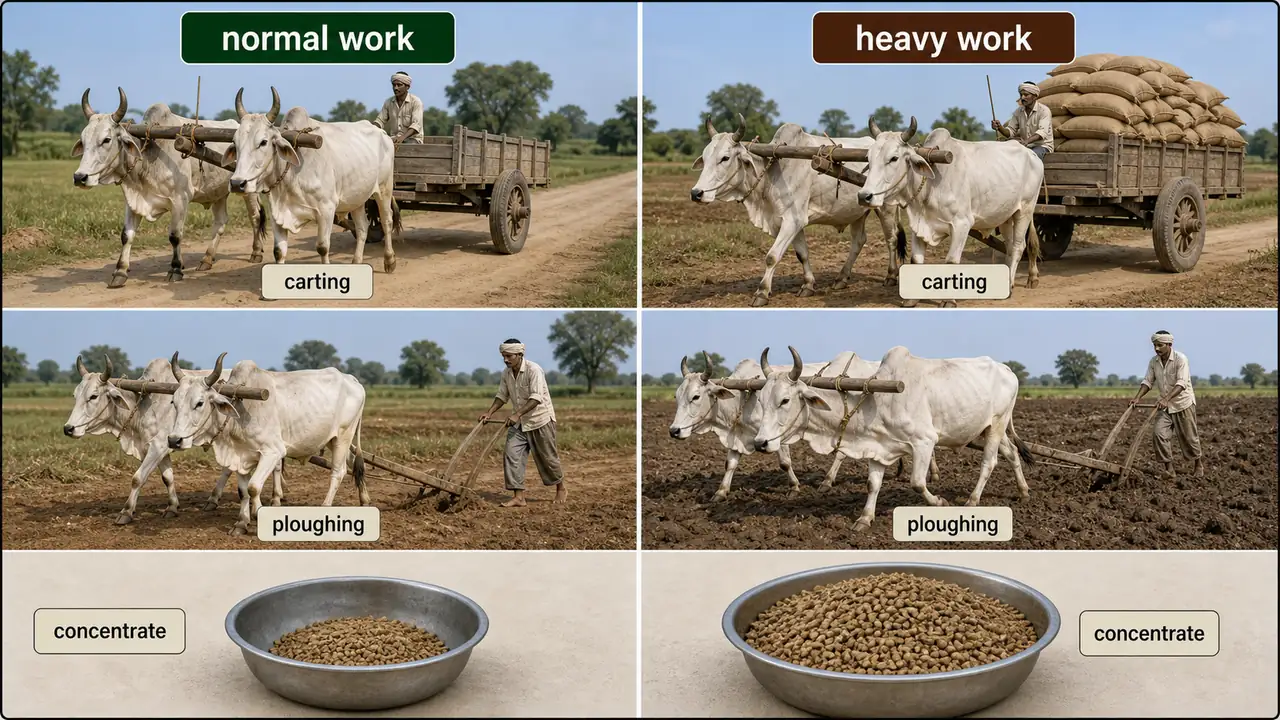
Bullocks (castrated male cattle) are used for draught work. Their feeding must be calibrated to the intensity and duration of work performed.
Working Hour Recommendations
| Work Type | Duration |
|---|---|
| Normal Work — Carting | 6 hours |
| Normal Work — Ploughing | 4 hours |
| Heavy Work — Carting | 8 hours |
| Heavy Work — Ploughing | 6 hours |
During work breaks: allow animal free grazing for rest and voluntary feed intake.
Bullock Feed Requirements
Base: sufficient roughages — 25 kg green fodder + 3–5 kg dry fodder.
Concentrate supplement by work intensity:
| Body Weight | Normal Work (Concentrate) | Heavy Work (Concentrate) |
|---|---|---|
| 300 kg | 2.0 kg | 2.5 kg |
| 400 kg | 2.5 kg | 3.0 kg |
| 500 kg | 3.0 kg | 3.5 kg |
In addition to green fodder and dry fodder: 1–2 kg concentrate base allowance for all bullocks.
Risk Protection in Animal Management
Livestock Insurance
Animals represent a substantial capital investment for dairy farmers. Insurance provides financial protection against death from disease, accident, or natural calamity — enabling farmers to recover and replace stock after unexpected losses.
- Standard insurance premium: 5% of animal cost per year
- Example: an animal valued at Rs. 50,000 → annual premium ≈ Rs. 2,500
NOTE
Insurance premiums and coverage terms vary by state government scheme and insurance provider. The 5% figure is the standard/default rate commonly used in exam questions.
Summary Cheat Sheet
| Concept | Key Details |
|---|---|
| Ration definition | Feed allowed in 24 hours; fed at 2–3% of body weight/day |
| Balanced ration | Provides all nutrients (energy, protein, fibre, minerals, vitamins) in correct proportions |
| Concentrate crude fibre | Less than 18% |
| Roughage crude fibre | More than 18% |
| Concentrate:Roughage ratio | 60:40 (DM basis) for high-yielding animals |
| Roughage alone supports | Up to 4–5 kg milk/day |
| Concentrate per milk (lactating) | 1 kg per 2.5–3.0 kg milk (over maintenance) |
| TDN and DCP (lactating ration) | 70% TDN; 16–18% DCP |
| TDN and DCP (growing, 6 months+) | 70% TDN; 14–16% DCP |
| 20 kg grass replaces | 1 kg concentrate (with 6–8 kg legume fodder) |
| 1 kg straw replaces | 4–5 kg grass (DM basis) |
| Dry cow concentrate (paddy straw ration) | 1–1.25 kg |
| Crossbred cow at 6–7 litres (lactation) | Concentrate: 3.0–3.5 kg; Dry days: 0.5–1.0 kg |
| Crossbred cow at 8–10 litres (lactation) | Concentrate: 4.0–4.5 kg; Dry days: 0.5–1.0 kg |
| Bull feeding (400–500 kg) | 2.5–3 kg concentrate + 20–25 kg green fodder |
| Bull condition | "Fit but not fat" — obesity reduces libido and spermatogenesis |
| Bull hoof trimming | Every 3–4 months |
| Bull exercise | 1–2 km daily |
| Shoeing (road work) | Monthly |
| Shoeing (field work) | Every 2 months |
| Bullock normal work | 6 hrs carting OR 4 hrs ploughing |
| Bullock heavy work | 8 hrs carting OR 6 hrs ploughing |
| Bullock green fodder | 25 kg + 3–5 kg dry fodder |
| Nose ring age | 12 months |
| Insurance premium | 5% of animal cost |
- Banerjee, G.C. — A Textbook of Animal Husbandry (8th Ed.), Oxford & IBH Publishing Co.
- NDDB (National Dairy Development Board) — Crossbred Cow Feeding Guidelines
- ICAR (Indian Council of Agricultural Research) — Nutrient Requirements of Livestock and Poultry
- National Dairy Research Institute (NDRI), Karnal — Feeding Standards for Indian Dairy Animals
Lesson Doubts
Ask questions, get expert answers