🐏 Sheep Farming - Breeds (Merino, Corriedale, Nali, Magra), Wool Types and Management
Complete guide to sheep farming covering wool-type breeds (Merino, Rambouillet, Nali), meat-type breeds (Suffolk, Dorset), dual-purpose breeds, Indian breeds (Magra, Chokla, Marwari), wool classification, shearing, housing, and Dolly the cloned sheep for exams.
-
Ovis aries
-
Family: Bovidae
-
Sheep are mostly reared for meat and wool. These are the two primary economic products of sheep farming, with some breeds also providing milk and skin as additional products.
-
Wool potential:
- Exotic breeds: 3.5-5 kg
- Indian breeds: 1-2 kg
The significant difference in wool yield between exotic and Indian breeds highlights the scope for improvement through crossbreeding and selection programmes.
-
Two types of wool obtained from sheep:
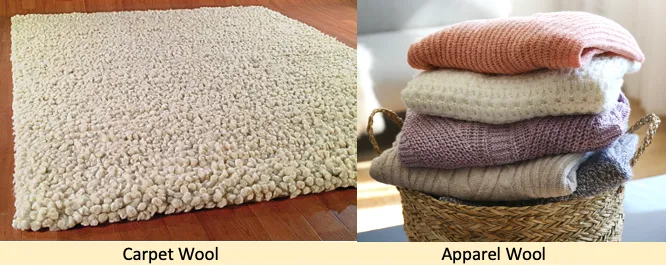
- Carpet Wool: Use for manufacturing of carpets. Carpet wool is coarser, stronger, and more durable, making it ideal for floor coverings that need to withstand heavy foot traffic.
- Apparel Wool: Use for manufacturing of cloths. Apparel wool is finer, softer, and lighter, suitable for garments, shawls, and other clothing items.
NOTE
Wool Micron Classification (highly exam-tested):
- Fine wool: < 25 microns — Merino (11–24 µm), Chokla (26–28 µm borderline), Bharat Merino (~21 µm)
- Medium wool: 25–35 microns — Corriedale (~28–31 µm)
- Coarse/Carpet wool: > 35 microns — most Indian breeds (e.g., Nali ~39 µm, Shahabadi ~52 µm)
Staple length = the natural length of a lock of wool fibre when fully extended; used to determine spinning quality. Longer staple = better for worsted spinning. Chokla staple length is ~5–6 cm.
Pro Content Locked
Upgrade to Pro to access this lesson and all other premium content.
₹99 charged monthly · Cancel anytime
- All Agriculture & Banking Courses
- AI Lesson Questions (100/day)
- AI Doubt Solver (50/day)
- Glows & Grows Feedback (30/day)
- AI Section Quiz (20/day)
- 22-Language Translation (100/day)
- Recall Questions (20/day)
- AI Quiz (15/day)
- AI Quiz Paper Analysis (100/day)
- AI Step-by-Step Explanations (100/day)
- Spaced Repetition Recall (FSRS)
- AI Tutor
- Immersive Text Questions
- Audio Lessons — Hindi & English
- Mock Tests & Previous Year Papers
- Summary & Mind Maps
- XP, Levels, Leaderboard & Badges
- Generate New Classrooms
- Voice AI Teacher (AgriDots Live)
- AI Revision Assistant
- Knowledge Gap Analysis
- Interactive Revision (LangGraph)
🔒 Secure via Razorpay · Cancel anytime · No hidden fees
-
Ovis aries
-
Family: Bovidae
-
Sheep are mostly reared for meat and wool. These are the two primary economic products of sheep farming, with some breeds also providing milk and skin as additional products.
-
Wool potential:
- Exotic breeds: 3.5-5 kg
- Indian breeds: 1-2 kg
The significant difference in wool yield between exotic and Indian breeds highlights the scope for improvement through crossbreeding and selection programmes.
-
Two types of wool obtained from sheep:
- Carpet Wool: Use for manufacturing of carpets. Carpet wool is coarser, stronger, and more durable, making it ideal for floor coverings that need to withstand heavy foot traffic.
- Apparel Wool: Use for manufacturing of cloths. Apparel wool is finer, softer, and lighter, suitable for garments, shawls, and other clothing items.
NOTE
Wool Micron Classification (highly exam-tested):
- Fine wool: < 25 microns — Merino (11–24 µm), Chokla (26–28 µm borderline), Bharat Merino (~21 µm)
- Medium wool: 25–35 microns — Corriedale (~28–31 µm)
- Coarse/Carpet wool: > 35 microns — most Indian breeds (e.g., Nali ~39 µm, Shahabadi ~52 µm)
Staple length = the natural length of a lock of wool fibre when fully extended; used to determine spinning quality. Longer staple = better for worsted spinning. Chokla staple length is ~5–6 cm.
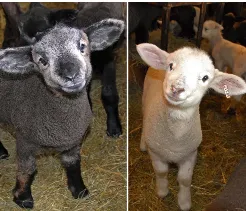
- Meat of sheep is Mutton, Hogget (A domestic sheep between one and two years of age) and Lamb. Lamb refers to meat from sheep less than one year old and is generally more tender and mild-flavoured than mutton (from adult sheep). MCQ trap: lamb = below 1 year; hogget = 1–2 years; mutton = above 2 years.
- Nutrition:
- Sheep prefer ground vegetarian grasses, legumes, and wide varieties of forages. water requirement adult sheep 2 - 4 liters. Unlike goats which are browsers, sheep are predominantly grazers, preferring to feed on ground-level grasses and legumes.
- Lambs and kids will suckle from the mother until they are 4 months old but they will start to show an interest in green plants from 3 weeks of age. This early interest in forages is a sign of developing rumen function and should be encouraged.
- Flushing is feeding extra concentrates to pregnant sheep to increases the lambing rate. Flushing is typically done 2-3 weeks before mating and involves increasing the nutritional intake (especially energy) to boost ovulation rates, resulting in more twin and triplet births.
Nomenclature
| Group | Flock |
| Adult Male | Ram |
| Adult Female | Ewe |
| Young Male | Ram Lamb |
| Young Female | Ewe/Gimmer Lamb |
| New Born | Lamb |
| Castrated Male | Weeder |
| Castrated Female | Spayed |
| Act of Mating | Tupping |
| Parturition | Lambing |
| Meat | Mutton |
- Cosset: Lamb raised without help of its mother. A cosset lamb (also called a bottle lamb or pet lamb) is typically an orphaned or rejected lamb that must be hand-reared using bottle feeding.
Breeds
👉🏻 Sheep breeds can be classified on the basis of Agro-ecological regions viz.
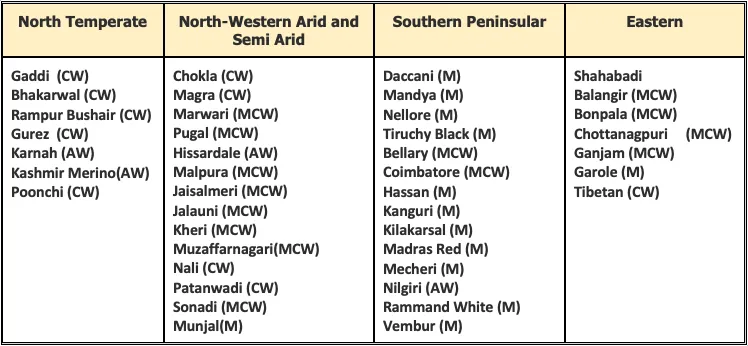 Within parenthesis is the major product of the breed. Apparel wool (AW); Carpet wool (CW); Mutton and Carpet wool (MCW); Mutton (M).
Bikaneri
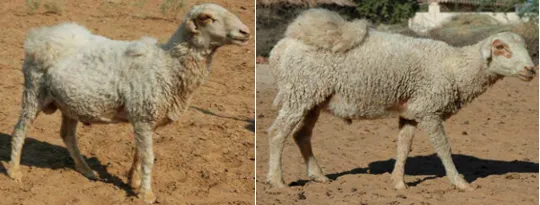 - AKA Magra.
- The Magra sheep is known as the only lustrous carpet wool-producing breed. Best Carpet Wool. The **Magra** (Bikaneri) produces a uniquely **lustrous, white carpet wool** that is unmatched by any other Indian sheep breed. This lustre gives carpets made from Magra wool a distinctive sheen.
- AKA Magra.
- The Magra sheep is known as the only lustrous carpet wool-producing breed. Best Carpet Wool. The **Magra** (Bikaneri) produces a uniquely **lustrous, white carpet wool** that is unmatched by any other Indian sheep breed. This lustre gives carpets made from Magra wool a distinctive sheen.
Chokla
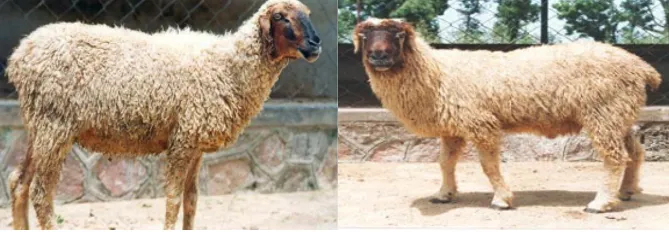 - This breed is distributed in Churu, Jhunjhunu, Sikar (Shekawati Region) & Bikaner districts of Rajasthan.
- Known as 'Merino of Rajasthan'; produces fine carpet/transitional apparel wool; clip increasingly diverted to worsted apparel sector. The **Chokla** produces finer carpet wool compared to the Magra, making it suitable for high-quality carpet manufacturing.
- AKA Merino of Rajasthan. This nickname reflects the Chokla's fine wool quality, which is reminiscent of the world-famous **Merino** breed.
- Staple length is about 5-6 cm.
- *Fibre diameter: approximately 26–28 microns — the finest among all Indian sheep breeds, earning it the "Merino of India" / "Merino of Rajasthan" title.*
- This breed is distributed in Churu, Jhunjhunu, Sikar (Shekawati Region) & Bikaner districts of Rajasthan.
- Known as 'Merino of Rajasthan'; produces fine carpet/transitional apparel wool; clip increasingly diverted to worsted apparel sector. The **Chokla** produces finer carpet wool compared to the Magra, making it suitable for high-quality carpet manufacturing.
- AKA Merino of Rajasthan. This nickname reflects the Chokla's fine wool quality, which is reminiscent of the world-famous **Merino** breed.
- Staple length is about 5-6 cm.
- *Fibre diameter: approximately 26–28 microns — the finest among all Indian sheep breeds, earning it the "Merino of India" / "Merino of Rajasthan" title.*
IMPORTANT
Chokla = finest wool among all Indian breeds (~26–28 µm). This is the most exam-tested fact about Chokla. By comparison, Merino (exotic) is 11–24 µm — still finer globally, but Chokla is unmatched domestically.
Marwari
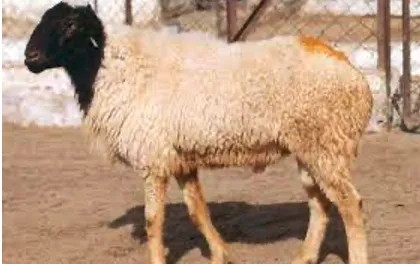 - This sheep breed is mainly distributed all over Jodhpur and parts of Jaipur districts of Rajasthan.
- This sheep breed possess long legs, black face and a prominent nose. *The black face is the key visual identifier for Marwari — a common MCQ feature.*
- **Product:** Carpet wool + mutton (dual-purpose). *Carpet wool quality is coarser, suited for rug manufacture.*
- This sheep breed has high disease tolerance, which increases the survival rate. The **disease tolerance** of the Marwari breed makes it an excellent choice for low-input farming systems where veterinary care may be limited.
- This sheep breed is mainly distributed all over Jodhpur and parts of Jaipur districts of Rajasthan.
- This sheep breed possess long legs, black face and a prominent nose. *The black face is the key visual identifier for Marwari — a common MCQ feature.*
- **Product:** Carpet wool + mutton (dual-purpose). *Carpet wool quality is coarser, suited for rug manufacture.*
- This sheep breed has high disease tolerance, which increases the survival rate. The **disease tolerance** of the Marwari breed makes it an excellent choice for low-input farming systems where veterinary care may be limited.
Shahabadi
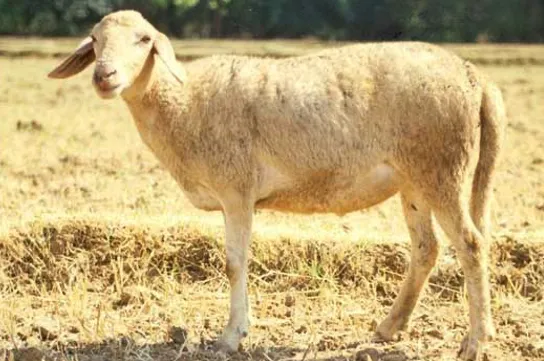 - **Distribution/Origin:** The Shahabadi sheep breed, is native to the erstwhile Shahabad (subsequently bifurcated into the Bhojpur, Rohtas and Buxar districts), Patna and Gaya districts of Bihar.
- A Bihari dual-purpose breed; produces coarse hairy wool (~0.184 kg/year, ~52 µm fibre diameter). The **Shahabadi** is native to the Shahabad region of Bihar and serves both meat and wool purposes, though its wool is coarse and hairy rather than fine.
- **Distribution/Origin:** The Shahabadi sheep breed, is native to the erstwhile Shahabad (subsequently bifurcated into the Bhojpur, Rohtas and Buxar districts), Patna and Gaya districts of Bihar.
- A Bihari dual-purpose breed; produces coarse hairy wool (~0.184 kg/year, ~52 µm fibre diameter). The **Shahabadi** is native to the Shahabad region of Bihar and serves both meat and wool purposes, though its wool is coarse and hairy rather than fine.
Nali
- Origin: Rajasthan (Ganganagar, Bikaner, Churu districts).
- Dual-purpose breed: carpet wool + meat.
- Wool yield: ~2 kg/year; fibre diameter ~39 µm (medium carpet wool).
- Wool is white, medium-stapled, and suitable for carpet manufacturing.
- At ~39 µm, Nali falls in the coarse/carpet wool range (>35 µm). It is one of the better-known dual-purpose Rajasthan breeds alongside Chokla and Magra.
Deccani
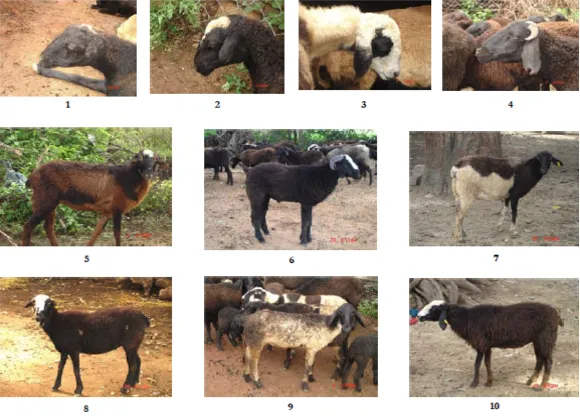 - The Deccani breed derives its name from the **region Dakkan** (Deccan) corresponding to its original spread across the Semi-arid & Deccan plateau of Telangana, Parts of AP, Northern Karnataka, Maharashtra, and parts of Northern Tamil Nadu.
- Fit for weaving Kambal as wool is of low grade. Hence, mostly used for the manufacture of rough blankets (Kambals). **Kambal** is a traditional coarse blanket widely used in rural India, and the Deccani's coarse wool is well-suited for this purpose.
- Deccani is a recognised **meat breed**.
- *Product classification: Mutton + Carpet Wool (MCW). Primarily valued for mutton in the Deccan region. Similar to Nellore in being a meat-dominant breed of peninsular India.*
- The Deccani breed derives its name from the **region Dakkan** (Deccan) corresponding to its original spread across the Semi-arid & Deccan plateau of Telangana, Parts of AP, Northern Karnataka, Maharashtra, and parts of Northern Tamil Nadu.
- Fit for weaving Kambal as wool is of low grade. Hence, mostly used for the manufacture of rough blankets (Kambals). **Kambal** is a traditional coarse blanket widely used in rural India, and the Deccani's coarse wool is well-suited for this purpose.
- Deccani is a recognised **meat breed**.
- *Product classification: Mutton + Carpet Wool (MCW). Primarily valued for mutton in the Deccan region. Similar to Nellore in being a meat-dominant breed of peninsular India.*
Trichy black
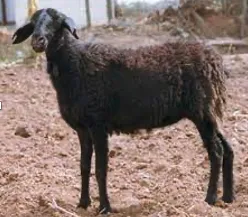 - These are distributed in Trichy, Perambalur, Dharmapuri and Salem districts of Tamilnadu.
- It is wool purpose breed.
- These are smaller breeds.
- Black coloured all over the body. The uniform **black colouration** is the most distinguishing feature of this breed.
- These are distributed in Trichy, Perambalur, Dharmapuri and Salem districts of Tamilnadu.
- It is wool purpose breed.
- These are smaller breeds.
- Black coloured all over the body. The uniform **black colouration** is the most distinguishing feature of this breed.
Mandya
- Mainly found in **Mandya** district of Karnataka.
- Relatively small animals colour white - sometimes **face is black coloured** which may extend up to neck.
- Best mutton type conformation among the Indian breeds. The **Mandya** is renowned for its excellent **carcass quality** and is considered the best indigenous breed for mutton production in India, with a compact body, broad back, and well-developed hindquarters.
Nellore
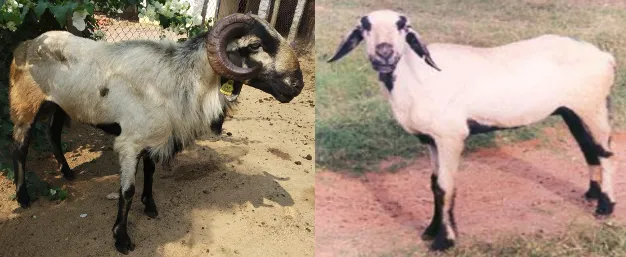 - It is distributed in Nellore and Ongole districts of Andhra Pradesh.
- It is the tallest breed of sheep in India. The **Nellore** sheep can reach a height of over 75 cm at the withers, making it the largest indigenous sheep breed.
- Resembling **goats in appearance**. The tall, leggy build and hair coat of the Nellore sheep give it an appearance that is more similar to a goat than a typical woolly sheep.
- They have little hair and **no wool is obtained** from them. The Nellore is a **hairy sheep** rather than a woolly one, and is reared exclusively for **meat** production.
- Rams are horned ewes are polled.
- It is distributed in Nellore and Ongole districts of Andhra Pradesh.
- It is the tallest breed of sheep in India. The **Nellore** sheep can reach a height of over 75 cm at the withers, making it the largest indigenous sheep breed.
- Resembling **goats in appearance**. The tall, leggy build and hair coat of the Nellore sheep give it an appearance that is more similar to a goat than a typical woolly sheep.
- They have little hair and **no wool is obtained** from them. The Nellore is a **hairy sheep** rather than a woolly one, and is reared exclusively for **meat** production.
- Rams are horned ewes are polled.
Neelagiri
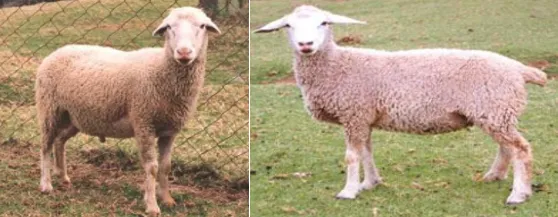 - These are distributed in Neelagiri district of Tamilnadu. The **Nilgiri** sheep is found in the cool, hilly terrain of the Nilgiri Hills in Tamil Nadu.
- It is wool purpose breed.
- Majority are found in white colors.
- These are distributed in Neelagiri district of Tamilnadu. The **Nilgiri** sheep is found in the cool, hilly terrain of the Nilgiri Hills in Tamil Nadu.
- It is wool purpose breed.
- Majority are found in white colors.
Gaddi
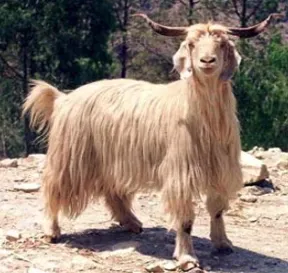 - Sheep are **small** in size, and are found in Kishtwar and Bhadarwah tehsils of **Jammu**. (Himalayan Region Breed). The **Gaddi** sheep is well adapted to the harsh **Himalayan conditions** including steep terrain, cold temperatures, and high altitudes.
- A large number inhabit the Kulu valleys in HP winter, and in summer they graze the highest elevations of them Pir Panjal Mountains, mostly in the Paddar range. This **seasonal migration** (called **transhumance**) between lower valleys in winter and high mountain pastures in summer is a traditional practice that optimises forage utilisation.
- Rams are horned, ewes hornless; fleece is generally white with brown coloured hair on the face.
- Wool is fine and lustrous; average annual yield is 1.13 kg per sheep, clipped thrice a year.
- Undercoat is used for the manufacture of high quality Kulu shawls and blankets. The fine **undercoat** of the Gaddi sheep produces the raw material for the famous **Kullu shawls**, which are a prized handicraft product of Himachal Pradesh.
- **Product classification:** Carpet wool (CW). *A migratory Himalayan breed; also found in Himachal Pradesh. Do not confuse with Bhakharwal (J&K) — both are migratory Himalayan carpet-wool breeds.*
- Sheep are **small** in size, and are found in Kishtwar and Bhadarwah tehsils of **Jammu**. (Himalayan Region Breed). The **Gaddi** sheep is well adapted to the harsh **Himalayan conditions** including steep terrain, cold temperatures, and high altitudes.
- A large number inhabit the Kulu valleys in HP winter, and in summer they graze the highest elevations of them Pir Panjal Mountains, mostly in the Paddar range. This **seasonal migration** (called **transhumance**) between lower valleys in winter and high mountain pastures in summer is a traditional practice that optimises forage utilisation.
- Rams are horned, ewes hornless; fleece is generally white with brown coloured hair on the face.
- Wool is fine and lustrous; average annual yield is 1.13 kg per sheep, clipped thrice a year.
- Undercoat is used for the manufacture of high quality Kulu shawls and blankets. The fine **undercoat** of the Gaddi sheep produces the raw material for the famous **Kullu shawls**, which are a prized handicraft product of Himachal Pradesh.
- **Product classification:** Carpet wool (CW). *A migratory Himalayan breed; also found in Himachal Pradesh. Do not confuse with Bhakharwal (J&K) — both are migratory Himalayan carpet-wool breeds.*
NOTE
Other Himalayan/hilly carpet wool breeds (exam list):
- Bhakharwal (J&K) — carpet wool, migratory, reared by Gujjar-Bakarwal community
- Rampur Bushair (Himachal Pradesh) — coarse wool, noted for its predominantly black/dark colour
- Gaddi (HP/J&K) — carpet wool, fine lustrous undercoat used for Kullu shawls
Avikalin
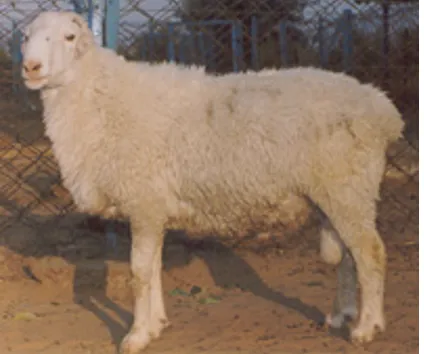 - Rambouillet × Malpura. The **Avikalin** was developed by crossing the exotic **Rambouillet** with the indigenous **Malpura** breed to combine fine wool quality with local adaptability.
- This breed is quite suitable as a dual-purpose sheep for **carpet wool** and **mutton production**.
- Rambouillet × Malpura. The **Avikalin** was developed by crossing the exotic **Rambouillet** with the indigenous **Malpura** breed to combine fine wool quality with local adaptability.
- This breed is quite suitable as a dual-purpose sheep for **carpet wool** and **mutton production**.
Hissardale
- Hissardale was evolved at the Government Livestock Farm, Hissar, through crossbreeding Australian Merino rams (male) with Bikaneri (Magra) ewes (female). Note the correct combination: Merino rams (males) were crossed with Bikaneri ewes (females), not the other way around. This is an important detail for competitive exams.
WARNING
Hissardale = Merino rams x Bikaneri ewes (not the reverse). Exam questions often swap the male and female breeds to create incorrect options.
- The rams of this breed were earlier distributed in the hilly regions of Kullu, Kangra etc.
CSWRI — Central Sheep and Wool Research Institute
- Location: Avikanagar, Tonk district, Rajasthan.
- Under ICAR (Indian Council of Agricultural Research).
- The premier institute for sheep and wool research in India, responsible for developing several improved breeds through systematic crossbreeding programmes.
- "Avikanagar" literally means "city of sheep (Avi)" — a helpful memory aid for location-based MCQs.
- Breeds developed at CSWRI Avikanagar:
| Breed | Parentage | Purpose |
|---|---|---|
| Avikalin | Rambouillet × Malpura | Dual-purpose (carpet wool + mutton) |
| Bharat Merino | Rambouillet × Chokla/Corriedale | Fine apparel wool |
| Avivastra | Crossbred | Apparel wool |
| Avimaans | Crossbred | Mutton |
Bharat Merino
- Developed by CSWRI, Avikanagar.
- Cross: Rambouillet × Chokla/Corriedale.
- Purpose: Fine apparel wool production in temperate conditions.
- Fleece: ~4.2 kg/year; fibre diameter ~21 µm (fine apparel grade).
- Suited for hilly and temperate regions of India where fine apparel wool production is viable.
Reproductive Parameters in Sheep
| Parameter | Value |
|---|---|
| Gestation period | 147–155 days (average ~150 days) |
| Age at first mating | ~7–9 months |
| Litter size | Mostly singles; some twins in improved/exotic breeds |
| Estrus cycle | ~17 days |
| Estrus duration | 24–36 hours |
| Breeding season | Autumn (short-day breeders) |
IMPORTANT
Sheep reproductive facts (MCQ-critical):
- Gestation period of sheep (~150 days) is same as goats — a common exam trap. Both are ~147–150 days.
- Estrus cycle of sheep = 17 days; goat = 21 days; cattle = 21 days. Sheep have a shorter estrus cycle.
- Seasonally polyestrous = sheep have multiple estrus cycles but only during a specific season (autumn/winter).
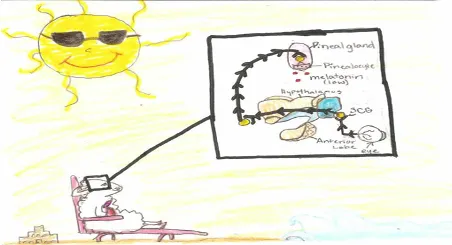
- Short-day breeders = breeding is triggered when day length decreases (autumn). The pineal gland releases melatonin in response to longer nights, which stimulates GnRH → LH surge → ovulation.
- Compare: horses and goats are long-day breeders (breed in spring when days lengthen).
Exotic Breeds
Merino
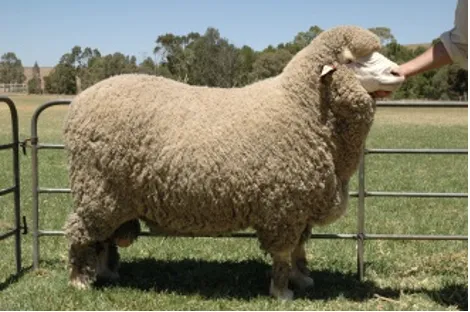 - Native of Spain. The **Merino** originated in Spain and was jealously guarded for centuries before being exported to other countries.
- Fine **wool breed**. The Merino produces the finest quality apparel wool in the world, with fibre diameter as low as **11–24 microns**.
- Approximately 40–50% of global apparel wool comes from Merino and its crosses (Source: IWTO). This statistic underscores the **global dominance** of the Merino breed in the apparel wool industry.
- **Fleece yield:** 4–8 kg/year (superior to Indian breeds' 1–2 kg). *The high fleece weight is why Merino rams were used in crossbreeding programmes like Hissardale and Bharat Merino.*
- *Why micron count matters: Lower micron = softer fibre against skin = premium apparel value. Merino wool at 11–18 µm is used for next-to-skin garments (base layers, fine knitwear); above 25 µm can feel scratchy.*
- Native of Spain. The **Merino** originated in Spain and was jealously guarded for centuries before being exported to other countries.
- Fine **wool breed**. The Merino produces the finest quality apparel wool in the world, with fibre diameter as low as **11–24 microns**.
- Approximately 40–50% of global apparel wool comes from Merino and its crosses (Source: IWTO). This statistic underscores the **global dominance** of the Merino breed in the apparel wool industry.
- **Fleece yield:** 4–8 kg/year (superior to Indian breeds' 1–2 kg). *The high fleece weight is why Merino rams were used in crossbreeding programmes like Hissardale and Bharat Merino.*
- *Why micron count matters: Lower micron = softer fibre against skin = premium apparel value. Merino wool at 11–18 µm is used for next-to-skin garments (base layers, fine knitwear); above 25 µm can feel scratchy.*
TIP
Merino vs Rambouillet — exam distinction:
- Merino — origin: Spain; finest wool globally (11–24 µm)
- Rambouillet (French Merino) — developed from Spanish Merino at Rambouillet farm, France; slightly larger body; also fine wool. Used in crossbreeding to create Avikalin (× Malpura) and Hissardale (× Bikaneri/Magra).
Rambouillet
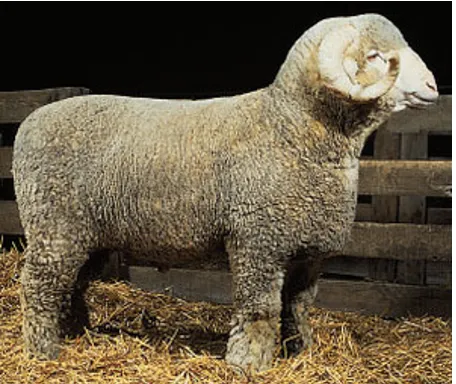 - This sheep breed was developed in France. The **Rambouillet** was developed at the Royal Farm of Rambouillet near Paris from Spanish Merino stock.
- This sheep also known as **Rambouillet Merino** or French Merino. The name reflects its Merino ancestry and French development.
- It produces an excellent **fine-wool fleece**.
- This sheep breed was developed in France. The **Rambouillet** was developed at the Royal Farm of Rambouillet near Paris from Spanish Merino stock.
- This sheep also known as **Rambouillet Merino** or French Merino. The name reflects its Merino ancestry and French development.
- It produces an excellent **fine-wool fleece**.
Dorset
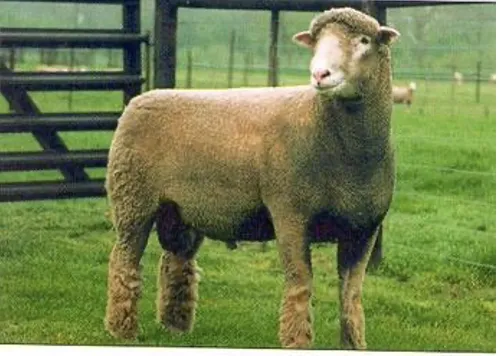 - The Dorset Horn is an endangered **British breed** of domestic sheep. The **Dorset** is notable for its ability to breed **out of season**, making it unique among sheep breeds. This trait is valuable for producing lamb at times when market prices are highest.
Corriedale
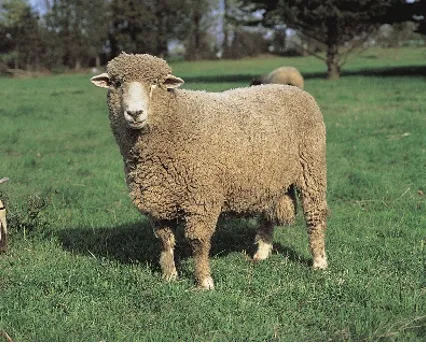 - Native of New Zealand.
- Corriedale sheep are a **dual-purpose breed**, meaning they are used both in the production of wool and meat. The **Corriedale** produces medium-fine wool that is well-suited for hand spinning, while also providing good-quality meat.
- The Corriedale is one of the oldest and most widely kept crossbred wool breeds, a Merino × Lincoln cross developed almost simultaneously in Australia and New Zealand and first brought to the United States in 1914. This cross combined the fine wool of the Merino with the larger body size and meat qualities of the Lincoln.
- *Wool fibre diameter: ~28–31 µm — falls in the **medium wool** category (25–35 µm). Used in Bharat Merino crossbreeding at CSWRI.*
- Native of New Zealand.
- Corriedale sheep are a **dual-purpose breed**, meaning they are used both in the production of wool and meat. The **Corriedale** produces medium-fine wool that is well-suited for hand spinning, while also providing good-quality meat.
- The Corriedale is one of the oldest and most widely kept crossbred wool breeds, a Merino × Lincoln cross developed almost simultaneously in Australia and New Zealand and first brought to the United States in 1914. This cross combined the fine wool of the Merino with the larger body size and meat qualities of the Lincoln.
- *Wool fibre diameter: ~28–31 µm — falls in the **medium wool** category (25–35 µm). Used in Bharat Merino crossbreeding at CSWRI.*
NOTE
Corriedale in India: Corriedale rams have been used by CSWRI for upgrading Indian breeds. The Bharat Merino (Rambouillet × Chokla/Corriedale) incorporates Corriedale genetics for medium-fine apparel wool production in temperate hill regions.
Sheep Clone
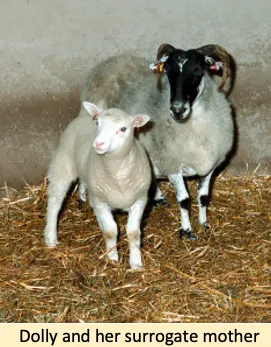 - Cloned sheep produced named as Dolly.
- Dolly the sheep was the first mammal to be cloned from an adult cell. This was a groundbreaking achievement in **reproductive biology** and **genetic engineering** that opened new frontiers in animal science.
- She was born on July 5, 1996 at the Roslin Institute in **Scotland**.
- Dolly was produced by British developmental biologist **Ian Wilmut**, who earned the title of "**Father of Cloning**". The technique used was **Somatic Cell Nuclear Transfer (SCNT)**, where the nucleus of an adult mammary gland cell was transferred into an enucleated egg cell.
- Cloned sheep produced named as Dolly.
- Dolly the sheep was the first mammal to be cloned from an adult cell. This was a groundbreaking achievement in **reproductive biology** and **genetic engineering** that opened new frontiers in animal science.
- She was born on July 5, 1996 at the Roslin Institute in **Scotland**.
- Dolly was produced by British developmental biologist **Ian Wilmut**, who earned the title of "**Father of Cloning**". The technique used was **Somatic Cell Nuclear Transfer (SCNT)**, where the nucleus of an adult mammary gland cell was transferred into an enucleated egg cell.
🔭 https://www.youtube.com/watch?v=fqeCUY42A-E
Dagging (Crutching)
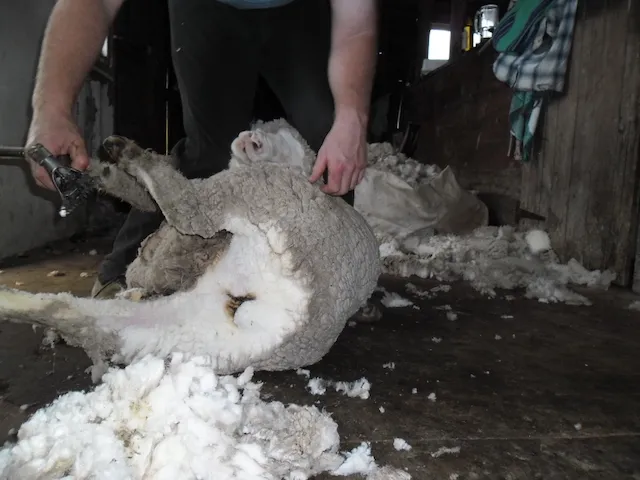 - Dagging or crutching is the cutting away of dirty, wet wool from around the tail and anus (crutch) of the sheep. **Dagging** is an essential routine management practice that prevents the accumulation of soiled wool, which can lead to serious health problems.
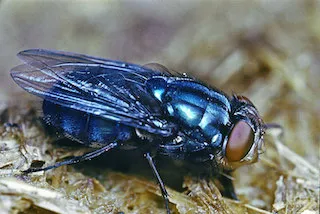
- The wet, dirty wool attracts flies especially the **blow flies** (bright green or blue in colour). **Blow flies** are attracted to the warm, moist, soiled wool and lay their eggs in it.
- The flies lay their eggs on the wool and in one or two days maggots hatch from them. This condition is known as **fly strike** (or **myiasis**), where the maggots burrow into the skin and feed on the sheep's flesh, causing severe pain, toxaemia, and potentially death if left untreated.
- Dagging or crutching is the cutting away of dirty, wet wool from around the tail and anus (crutch) of the sheep. **Dagging** is an essential routine management practice that prevents the accumulation of soiled wool, which can lead to serious health problems.
- The wet, dirty wool attracts flies especially the **blow flies** (bright green or blue in colour). **Blow flies** are attracted to the warm, moist, soiled wool and lay their eggs in it.
- The flies lay their eggs on the wool and in one or two days maggots hatch from them. This condition is known as **fly strike** (or **myiasis**), where the maggots burrow into the skin and feed on the sheep's flesh, causing severe pain, toxaemia, and potentially death if left untreated.
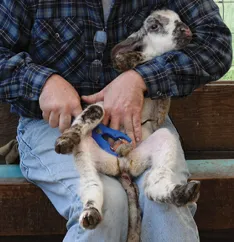
Ringing in Sheep
- Ringing - trimming wool around the sheath of the penis of the rams to facilitate mating. Ringing removes the wool that can obstruct the ram's penis during mating, ensuring successful copulation and improved conception rates in the flock.
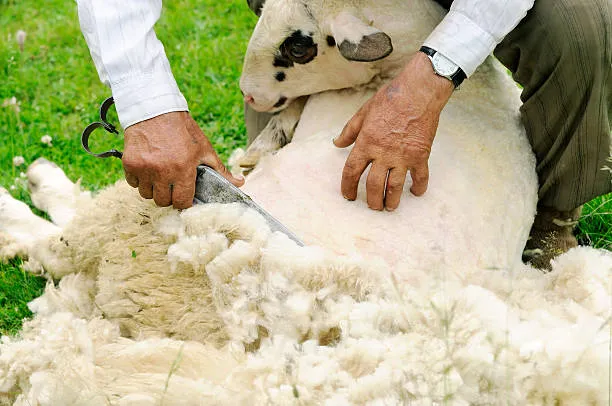
Shearing
- Shearing is the complete removal of the wool and is carried out using machine or hand shears. Shearing is typically done once or twice a year, usually before the onset of summer. It is a skilled operation that must be done carefully to avoid cuts and injuries to the sheep's skin.
- Shearing seasons in India: March–April (before summer) and September–October (post-monsoon). Spring shearing prevents heat stress; autumn shearing allows wool to grow back before winter.
- Blade shearing (hand shears) vs Machine shearing: Machine shearing is faster and leaves a thin protective layer of wool (~0.5 cm) on the skin; blade shearing cuts closer to the skin. Machine shearing is preferred for large flocks.
- Fleece weight by breed: Merino: 4–8 kg/year; Corriedale: 3–5 kg/year; Indian breeds: 1–2 kg/year. This huge difference explains why India imports fine wool for textile industries.
NOTE
Wool processing steps (exam sequence):
- Shearing — removal of fleece
- Grading/Sorting — separating wool by quality, fineness, and length
- Scouring — washing raw wool with hot water + detergent to remove lanolin (natural grease), dirt, and sweat (suint). Lanolin extracted during scouring is used in cosmetics and pharmaceuticals.
- Carbonising — treating with acid (H₂SO₄) to remove vegetable matter (burrs, seeds)
- Carding — disentangling and aligning fibres into a continuous web
- Combing — further aligning long fibres (top) for worsted spinning; short fibres (noils) used for woollen yarn
Docking
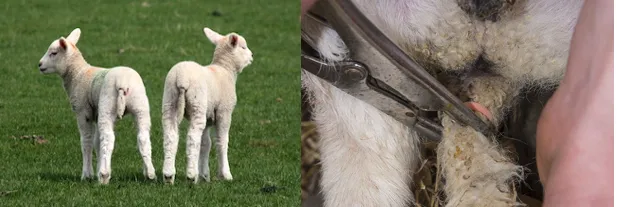
- The removal of tail in sheep is called docking. Docking is practiced primarily for hygienic reasons, as a long tail collects faecal matter and moisture, increasing the risk of fly strike.
- Done in sheep at the age of 7 to 14 days. Early docking is preferred because it causes less pain and heals more quickly in young lambs.
Seasonal Breeding in Sheeps
Most sheep are seasonally polyestrus and short-day breeders. They start their estrus when the length of the day begins to decrease. This means that sheep naturally begin their breeding season in autumn, when daylight hours shorten.
Photoperiod: the period of time during the day when there is daylight. Photoperiod regulates reproductive cyclicity in seasonal breeders. (Pathways to Pregnancy and Parturition). The pineal gland in the brain detects changes in day length through the eyes and secretes melatonin, which triggers the hormonal cascade that initiates the breeding season.
Sheep are seasonal breeders that enter into the breeding season during shorter photoperiods; thus, they are short-day breeders. This is a critical concept to understand: unlike cattle, which can breed year-round (continuous breeders), most sheep breeds are restricted to breeding during specific seasons when day length is decreasing.
Diseases in Sheep
Sheep Pox
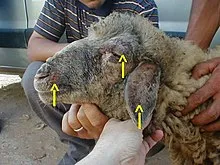 - Viral Disease. It is highly contagious and spread by contact. **Sheep pox** is caused by the **Sheeppox virus** (a member of the Capripoxvirus genus) and is one of the most serious viral diseases of sheep.
- *Sheep pox is a **notifiable disease** (must be reported to authorities). It has the **highest morbidity and mortality** among pox diseases of livestock in India.*
- High fever -- Dullness -- Isolation from herd discharge from Natural orifices
- Eyes and Nostrils with swelling of eye lids -- 'Pox' eruptions on the skin of ears, head, inside of thighs, scrotum, lower side of the base of the tail. The characteristic **pox lesions** progress through stages: macule (flat spot), papule (raised bump), vesicle (fluid-filled blister), pustule (pus-filled), and finally scab formation.
- Sheep pox vaccine developed from indigenous strain by IVRI. The **Indian Veterinary Research Institute (IVRI)** at Izatnagar has developed several important livestock vaccines, including this sheep pox vaccine.
- Viral Disease. It is highly contagious and spread by contact. **Sheep pox** is caused by the **Sheeppox virus** (a member of the Capripoxvirus genus) and is one of the most serious viral diseases of sheep.
- *Sheep pox is a **notifiable disease** (must be reported to authorities). It has the **highest morbidity and mortality** among pox diseases of livestock in India.*
- High fever -- Dullness -- Isolation from herd discharge from Natural orifices
- Eyes and Nostrils with swelling of eye lids -- 'Pox' eruptions on the skin of ears, head, inside of thighs, scrotum, lower side of the base of the tail. The characteristic **pox lesions** progress through stages: macule (flat spot), papule (raised bump), vesicle (fluid-filled blister), pustule (pus-filled), and finally scab formation.
- Sheep pox vaccine developed from indigenous strain by IVRI. The **Indian Veterinary Research Institute (IVRI)** at Izatnagar has developed several important livestock vaccines, including this sheep pox vaccine.
Blue Tongue
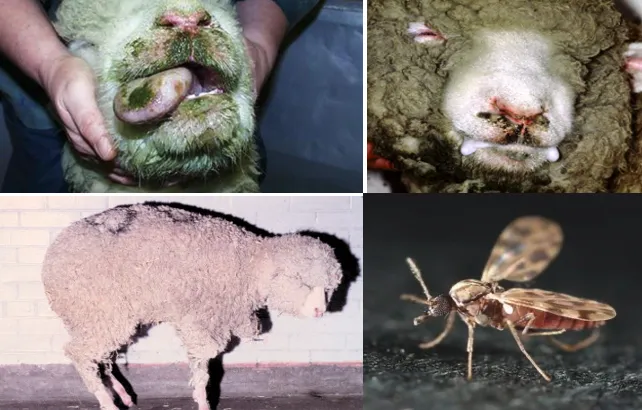
- Bluetongue is an insect-borne infectious non-contagious disease viral disease to which all species of ruminants are susceptible, although sheep are most severely affected. Bluetongue is classified as a non-contagious disease because it does not spread directly from animal to animal; it requires an insect vector.
- Cattle and goats which appear healthy can carry high levels of the virus and provide a source of further infection. These asymptomatic carriers make disease control particularly challenging.
- It is caused by Bluetongue virus (BTV).
- The virus is transmitted by the transmitted by Culicoides midges. Culicoides are tiny (1-3 mm) biting midges that are most active at dawn and dusk. They serve as the biological vector, meaning the virus replicates within the midge before being transmitted to a new host.
- Major signs are high fever, excessive salivation, swelling of the face and tongue, and cyanosis of the tongue.
- Swelling of the lips and tongue gives the tongue its typical blue appearance, though this sign is confined to a minority of the animals. The blue tongue from which the disease gets its name is caused by cyanosis (oxygen deprivation) in the swollen tongue tissues.
- Nasal signs may be prominent, with nasal discharge and stertorous respiration.
- Some animals also develop foot lesions, beginning with coronitis, with consequent lameness.
- In sheep, this can lead to knee-walking.
- In cattle, constant changing of position of the feet gives bluetongue the nickname the dancing disease. The "dancing disease" nickname vividly describes the restless shifting of weight from foot to foot caused by painful foot lesions.
- Control:
- A live attenuated polyvalent vaccine prior to rainy season. The vaccine is given before the monsoon because Culicoides midges breed prolifically in wet conditions.
- Annual vaccination.
- Routine hygiene and sanitation.
- Vector control is very important in disease prevention. Vector control includes measures such as draining stagnant water, using insecticide-treated nets, and applying insect repellents to reduce midge populations.
Stargazing
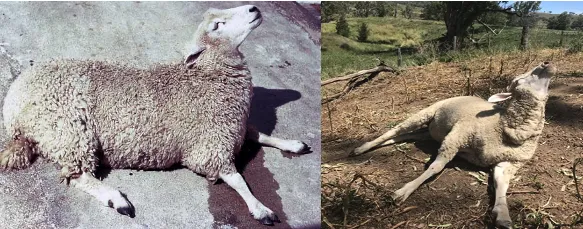 - Stargazing is a term used to describe a deceptively innocuous behavior: the head and neck are raised almost straight up, as if the affected animal is gazing at the stars. This abnormal posture is a **neurological symptom** that indicates brain or spinal cord involvement.
- This condition is common to several diseases that affect the **central nervous system**. Diseases that can cause stargazing include **polioencephalomalacia** (thiamine/Vitamin B1 deficiency), **listeriosis**, and various parasitic infections affecting the brain.
- Stargazing is a term used to describe a deceptively innocuous behavior: the head and neck are raised almost straight up, as if the affected animal is gazing at the stars. This abnormal posture is a **neurological symptom** that indicates brain or spinal cord involvement.
- This condition is common to several diseases that affect the **central nervous system**. Diseases that can cause stargazing include **polioencephalomalacia** (thiamine/Vitamin B1 deficiency), **listeriosis**, and various parasitic infections affecting the brain.
Enterotoxaemia (Pulpy Kidney Disease)
- Caused by Clostridium perfringens type D. Also called "pulpy kidney disease" because the kidneys become soft and pulpy at post-mortem examination.
- Affects well-fed, fast-growing lambs — sudden death is common. The disease paradoxically strikes the healthiest-looking animals, earning it the nickname "disease of thriving lambs".
- Control: Vaccination available; vaccinate before monsoon (see vaccination schedule below). Lambs vaccinated at 6 months, annual booster.
Foot Rot (Footrot)
- Caused by Dichelobacter nodosus (in combination with Fusobacterium necrophorum).
- Leads to severe lameness; thrives in wet, muddy conditions.
- Treatment: ZnSO₄ (zinc sulphate) footbath is the standard prevention and treatment. Affected sheep should be isolated.
Contagious Ecthyma (Orf / Sore Mouth)
- Caused by Orf virus (Parapoxvirus). Affects lips, gums, and teats of sheep and goats.
- Zoonotic disease — can spread to humans handling infected animals. Farmers and shearers are at risk; wear gloves when handling lesions.
Ovine Johne's Disease (OJD)
- Caused by Mycobacterium avium subsp. paratuberculosis.
- Chronic wasting disease; profuse diarrhoea, weight loss, bottle jaw (submandibular oedema).
- No effective treatment; control by test-and-cull strategy.
Sheep vs Goat — Key Differences
IMPORTANT
MCQ Trap: Sheep vs Goat features — these are among the most frequently tested distinctions:
| Feature | Sheep | Goat |
|---|---|---|
| Upper lip | Not cleft (smooth) | Cleft (split) |
| Beard | Absent | Present (males) |
| Tail | Hangs downward | Turns upward |
| Chromosome number | 2n = 54 | 2n = 60 |
| Estrus cycle | 17 days | 21 days |
| Feeding behaviour | Grazer (ground level) | Browser (shrubs, elevated) |
| Rumen | 4 chambers (ruminant) | 4 chambers (ruminant) |
| Scent glands | Interdigital + inguinal | Interdigital + inguinal + postorbital |
| Odour | Less pungent | More pungent (especially bucks) |
Remember: "Goats have Cleft lip, Curl tail, Chrome number 60 — sheep have 54."
India's Sheep Population Statistics
- 20th Livestock Census (2019): India has approximately 74.26 million sheep.
- Rajasthan has the highest sheep population among all Indian states. Rajasthan's arid/semi-arid climate suits wool breeds like Chokla, Magra, and Nali.
- Other major sheep states: Andhra Pradesh, Telangana, Karnataka, Maharashtra.
- India ranks among the top 5 countries globally for sheep population.
Vaccination in Goat and Sheep
| S. No. | Disease | Vaccine |
|---|---|---|
| 1. | Tetanus | Within 48 hrs. after birth |
| 2. | FMD | 2nd month of age repeated once in 6 months. |
| 3. | Sheep and Goat pox | 6 months of age repeated annually, vaccination in endemic area. |
| 4. | Anthrax | 6 months of age repeated annually, vaccination in endemic area. |
| 5. | Enterotoxaemia | 6 months of age repeated annually, vaccination should be completed before onset of monsoon. |
| 6. | PPR | 6 months of age repeated annually, vaccination in endemic area. |
| 7. | Blue tongue | 6 months of age, repeated annually. |
Indian Sheep Breeds Quick Reference
| Breed | Region | Known For | Product |
|---|---|---|---|
| Magra (Bikaneri) | Rajasthan (Bikaner) | Best lustrous carpet wool | CW |
| Chokla | Rajasthan (Shekawati) | Finest Indian wool (~26–28 µm); "Merino of Rajasthan" | CW/AW |
| Nali | Rajasthan (Ganganagar) | Dual-purpose; ~39 µm | MCW |
| Marwari | Rajasthan (Jodhpur) | Black face; high disease tolerance | MCW |
| Malpura | Rajasthan | Fine mutton; white; arid-adapted | M |
| Pugal | Rajasthan | Carpet wool; desert-adapted | CW |
| Shahabadi | Bihar | Dual-purpose; coarse hairy wool (~52 µm) | MCW |
| Mandya | Karnataka | Best mutton conformation among Indian breeds | M |
| Nellore | Andhra Pradesh | Tallest breed; hairy (no wool); goat-like | M |
| Deccani | Maharashtra/Telangana | Meat breed; coarse wool for Kambal | MCW |
| Gaddi | J&K / HP | Himalayan; Kullu shawls from undercoat | CW |
| Bhakharwal | J&K | Migratory; carpet wool; Gujjar-Bakarwal community | CW |
| Rampur Bushair | Himachal Pradesh | Coarse wool; dark/black colour | CW |
| Avikalin | Crossbred (CSWRI) | Rambouillet × Malpura; dual purpose | MCW |
| Hissardale | Crossbred | Merino rams × Bikaneri ewes | AW |
| Bharat Merino | Crossbred (CSWRI) | Rambouillet × Chokla/Corriedale; ~21 µm | AW |
AW = Apparel Wool; CW = Carpet Wool; MCW = Mutton + Carpet Wool; M = Mutton
A strict vaccination schedule is the most effective and economical method of preventing major infectious diseases in goats and sheep. Adhering to the recommended vaccination calendar significantly reduces mortality, improves productivity, and protects the farmer's investment.
References
2 sources • [1] [2]
References
Summary Cheat Sheet
| Concept / Topic | Key Details |
|---|---|
| Scientific name | Ovis aries; Family: Bovidae |
| Primary products | Meat (mutton/lamb) and Wool (carpet/apparel) |
| Wool yield — Exotic | 3.5–5 kg; Indian: 1–2 kg |
| Carpet wool | Coarser, stronger; for carpets |
| Apparel wool | Finer, softer; for clothing |
| Mutton vs Lamb | Mutton: adult sheep meat; Lamb: <1 year old (more tender) |
| Tupping | Mating in sheep (NOT coupling — that's pigs) |
| Cosset | Lamb raised without mother (bottle-fed/orphan) |
| Flushing | Extra feed 2–3 weeks before mating to boost ovulation |
| Water requirement | Adult sheep: 2–4 litres/day |
| Magra (Bikaneri) | Best carpet wool (lustrous); Rajasthan |
| Chokla | Best fine carpet wool; AKA "Merino of Rajasthan" |
| Shahabadi | Bihar; dual-purpose; coarse hairy wool (~0.184 kg/year, ~52 µm) |
| Marwari | Rajasthan; high disease tolerance |
| Deccani | Deccan plateau; meat breed; coarse wool for Kambal (blankets) |
| Nali | Rajasthan (Ganganagar, Bikaner, Churu); dual-purpose; ~2 kg wool/year; ~39 µm |
| Merino | Spain; finest wool (11–24 µm); ~40–50% of global apparel wool (IWTO) |
| Rambouillet | France; developed from Merino; fine wool |
| Corriedale | New Zealand; dual purpose (wool + meat); one of oldest crossbred breeds; Merino × Lincoln |
| CSWRI | Avikanagar, Tonk, Rajasthan; under ICAR; breeds: Avikalin, Bharat Merino, Avivastra, Avimaans |
| Bharat Merino | CSWRI; Rambouillet × Chokla/Corriedale; fine apparel wool ~4.2 kg/year; ~21 µm |
| Suffolk | England; best meat breed |
| Dorset | England; meat breed; can breed out of season |
| Hissardale | Cross of Merino Rams × Bikaneri Ewes |
| Dolly the sheep | First cloned mammal (1996, Scotland) |
| Sheep are seasonal breeders | Breed mainly in autumn (short day length triggers oestrus) |
| Shearing | Removal of fleece (wool); done 1–2 times/year |
| Bluetongue disease | Viral; insect-borne (Culicoides midge); affects sheep primarily |
| Gestation period | 147–155 days (avg. ~150 days) — same as goats |
| Estrus cycle | ~17 days (shorter than goat/cattle at 21 days) |
| Estrus duration | 24–36 hours |
| Age at first mating | ~7–9 months |
| Litter size | Mostly singles; twins in improved breeds |
| Sheep 2n | 54 (goat = 60) |
| Malpura | Rajasthan; fine mutton breed; white; arid-adapted |
| Pugal | Rajasthan; carpet wool; desert-adapted |
| Bhakharwal | J&K; carpet wool; migratory breed |
| Rampur Bushair | Himachal Pradesh; coarse wool; black colour |
| Enterotoxaemia | Clostridium perfringens type D; "pulpy kidney disease"; sudden death in thriving lambs |
| Foot Rot | Dichelobacter nodosus; lameness in wet conditions; ZnSO₄ footbath |
| Orf (Ecthyma) | Parapoxvirus; zoonotic |
| India sheep population | ~74.26 million (20th Livestock Census 2019); highest in Rajasthan |
| Wool microns — Fine | <25 µm: Merino (11–24), Bharat Merino (~21), Chokla (26–28) |
| Wool microns — Medium | 25–35 µm: Corriedale (~28–31) |
| Wool microns — Coarse | >35 µm: Nali (~39), Shahabadi (~52), most Indian breeds |
| Lanolin | Natural grease removed from wool during scouring; used in cosmetics |
Lesson Doubts
Ask questions, get expert answers