🏭 Storage Pest Management: Fumigation, Seed Treatment & Safe Storage
Complete guide to stored grain pest management — fumigation with aluminium phosphide, methyl bromide, seed treatment with malathion, surface treatment, preventive measures, storage structures (Pusa bin, CAP, silo), and exam-focused facts
A progressive farmer in Haryana invested in high-yielding wheat varieties and achieved a record harvest of 60 quintals per hectare. But when he opened his storage after four months, nearly 8 quintals had been destroyed by rice weevil and lesser grain borer. His neighbour, who had treated the grain with Malathion 5% dust before storage and fumigated the room with aluminium phosphide tablets, lost less than 1%. The difference was not in the crop grown but in the post-harvest management applied. In India, where approximately 10% of food grains are lost after harvest, effective storage pest management is not just an exam topic — it is a matter of national food security.
IMPORTANT
Post-harvest losses in India are approximately 10% of total food grains. Proper storage management through fumigation, seed treatment, and preventive measures can reduce these losses dramatically.
The Three Pillars of Chemical Storage Pest Management
Chemical control of stored grain pests rests on three methods, each with a different purpose and mode of action:
Pro Content Locked
Upgrade to Pro to access this lesson and all other premium content.
Charged once for one year · ₹1188 total
Save ₹100/month vs ₹2388/year launch price
- All Agriculture & Banking Courses
- AI Lesson Questions (100/day)
- AI Doubt Solver (50/day)
- Glows & Grows Feedback (30/day)
- AI Section Quiz (20/day)
- 22-Language Translation (100/day)
- Recall Questions (20/day)
- AI Quiz (15/day)
- AI Quiz Paper Analysis (100/day)
- AI Step-by-Step Explanations (100/day)
- Spaced Repetition Recall (FSRS)
- AI Tutor
- Immersive Text Questions
- Audio Lessons — Hindi & English
- Mock Tests & Previous Year Papers
- Summary & Mind Maps
- XP, Levels, Leaderboard & Badges
- Generate New Classrooms
- Voice AI Teacher (AgriDots Live)
- AI Revision Assistant
- Knowledge Gap Analysis
- Interactive Revision (LangGraph)
🔒 Secure one-time yearly payment via Razorpay · No hidden fees
A progressive farmer in Haryana invested in high-yielding wheat varieties and achieved a record harvest of 60 quintals per hectare. But when he opened his storage after four months, nearly 8 quintals had been destroyed by rice weevil and lesser grain borer. His neighbour, who had treated the grain with Malathion 5% dust before storage and fumigated the room with aluminium phosphide tablets, lost less than 1%. The difference was not in the crop grown but in the post-harvest management applied. In India, where approximately 10% of food grains are lost after harvest, effective storage pest management is not just an exam topic — it is a matter of national food security.
IMPORTANT
Post-harvest losses in India are approximately 10% of total food grains. Proper storage management through fumigation, seed treatment, and preventive measures can reduce these losses dramatically.
The Three Pillars of Chemical Storage Pest Management
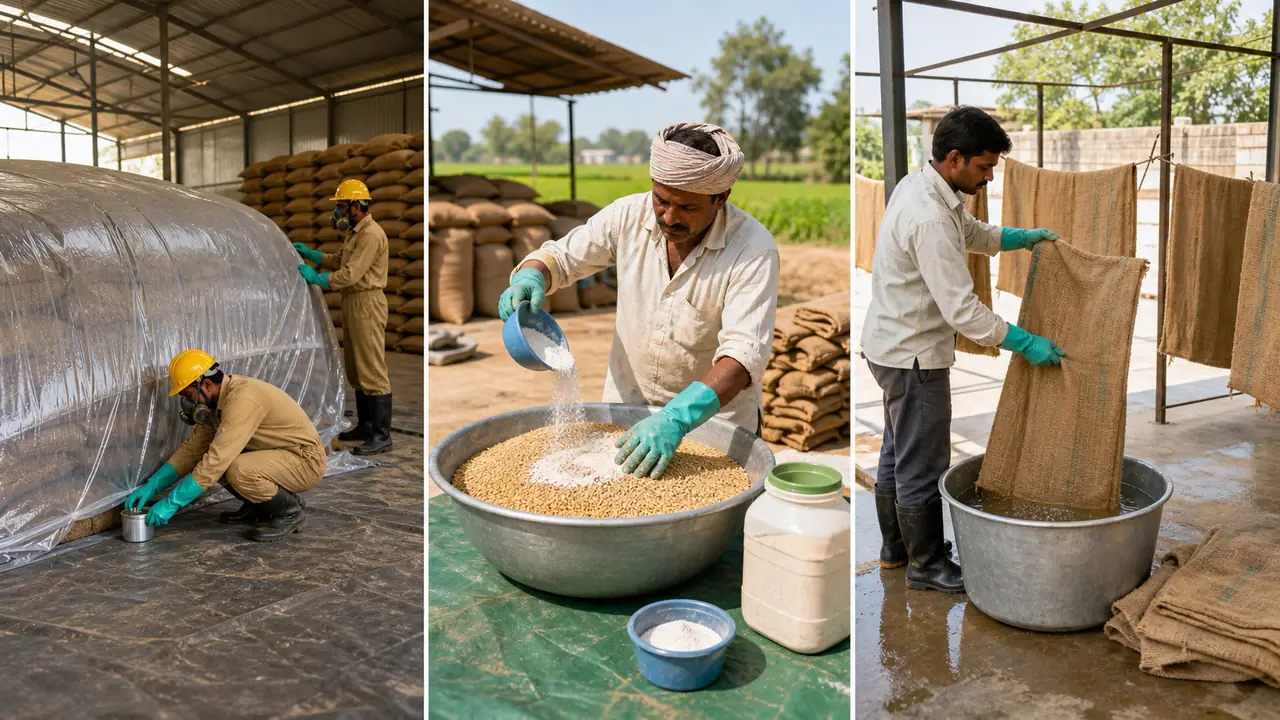
Chemical control of stored grain pests rests on three methods, each with a different purpose and mode of action:
| Method | Purpose | How It Works |
|---|---|---|
| Fumigation | Kill all pests in sealed storage | Toxic gas penetrates grain mass |
| Seed treatment | Protect grain surface from infestation | Insecticidal dust mixed with grain |
| Surface treatment | Prevent pest entry through bags | Bags dipped in insecticide solution |
1. Fumigation — The Most Effective Method
Fumigation is the gold standard for controlling storage pests in bulk grain storage. A fumigant is a chemical that produces toxic gas at normal temperatures, killing insects at all life stages (egg, larva, pupa, adult) by penetrating throughout the grain mass.
Key Fumigants
| Fumigant | Chemical Details | Key Use |
|---|---|---|
| Aluminium phosphide (Celphos) | Releases phosphine gas (PH3) | Most commonly used; warehouses and farm storage |
| Methyl bromide (CH3Br) | Colourless, odourless gas | Most suitable for quarantine purposes |
| Ethylene dichloride + Carbon tetrachloride (3:1) | Traditional liquid fumigant mixture | Older method; being phased out |
IMPORTANT
Aluminium phosphide (Celphos) is the most widely used fumigant for stored grain pest management. It releases phosphine gas (PH3) which is highly toxic to all stages of insects. This was asked in exams.
TIP
Mnemonic for fumigants:
- Aluminium phosphide = All-purpose (most common)
- Methyl bromide = for iMport quarantine
- EDC + CCl4 in ratio 3:1 = Earliest/traditional mixture
Remember: "AMP up your storage" — Aluminium phosphide is Most Popular.
How Fumigation Works — Step by Step
Understanding the fumigation procedure is important both for practical agriculture and exam questions:
- Ensure air-tightness — The storage structure must be completely sealed. Even small gaps will allow the gas to escape, reducing effectiveness.
- Calculate dosage — Based on the volume of the storage space, not the weight of grain.
- Place fumigant — Aluminium phosphide tablets are placed at intervals throughout the grain mass.
- Exposure period — Usually 5-7 days for aluminium phosphide. The structure must remain sealed during this period.
- Aeration — After fumigation, aerate the storage for 24-48 hours before any person enters.
- Safety — Always use gas masks and safety equipment. Phosphine is lethal to humans as well.
Agricultural context: In FCI (Food Corporation of India) godowns, prophylactic fumigation with aluminium phosphide is carried out on a fixed schedule — typically every 4-6 months. Each godown is sealed with polythene sheets and sand-snakes before tablets are placed.
Fumigant Comparison Table
| Feature | Aluminium Phosphide | Methyl Bromide | EDC + CCl4 (3:1) |
|---|---|---|---|
| Gas released | Phosphine (PH3) | CH3Br (itself) | Vapour mixture |
| Commonest use | General warehouse | Quarantine at ports | Traditional/older |
| Exposure period | 5-7 days | 24-72 hours | 5-7 days |
| Residue | Minimal (gas dissipates) | May leave bromide residue | Leaves residue |
| Ozone impact | None | Depletes ozone layer | None |
| Cost | Economical | Expensive | Moderate |
| Exam frequency | Very high | High (quarantine Q) | Low |
NOTE
Methyl bromide is being phased out globally under the Montreal Protocol because it depletes the ozone layer. However, it remains permitted for quarantine and pre-shipment treatments. This environmental angle is increasingly asked in exams.
2. Seed Treatment — Protecting Individual Grains
| Chemical | Application |
|---|---|
| Malathion 5% dust | Standard seed treatment for stored grains |
IMPORTANT
Malathion is the safe insecticide for vegetables, warehouses, and godowns. Malathion 5% dust is the standard seed treatment chemical for protecting stored grains. This is a commonly asked exam fact across exams, NABARD, and ICAR papers.
How to Apply Malathion Seed Treatment
- Mix Malathion 5% dust thoroughly with the grain at the recommended rate
- Ensure uniform coating on all grain surfaces — use a clean floor or drum for mixing
- Store treated grain in clean, dry containers or bags
- Re-treat if storage period exceeds 6 months — the insecticidal effect diminishes over time
Agricultural context: At the village level, agricultural officers recommend that farmers mix Malathion dust with wheat or rice before filling storage bins. The dust acts as a contact poison — any insect that touches the treated grain surface is killed.
3. Surface Treatment — Bag Protection
| Method | Details |
|---|---|
| Bag treatment | Bags dipped into 0.0125% fenvalerate or cypermethrin for 10 minutes |
Procedure
- Prepare a solution of 0.0125% fenvalerate or cypermethrin in water
- Dip storage bags into the solution for 10 minutes
- Allow bags to dry completely before filling with grain
- This creates a toxic barrier on the bag surface, preventing pest entry from outside
TIP
Exam memory aid: "Fen-Cyp at 0.0125% for 10 min" — both fenvalerate and cypermethrin are synthetic pyrethroids used at the same concentration (0.0125%) for the same duration (10 minutes). Remember the number 0.0125 and 10.
The Three Chemical Methods — A Side-by-Side Comparison
| Feature | Fumigation | Seed Treatment | Surface Treatment |
|---|---|---|---|
| Target | All pests in sealed space | Pests on grain surface | Pests trying to enter bags |
| Chemical | AlP / Methyl bromide | Malathion 5% dust | Fenvalerate / Cypermethrin |
| Mode | Gaseous (kills by inhalation) | Contact poison on grain | Contact poison on bag |
| Application | Seal storage + place tablets | Mix dust with grain | Dip bags in solution |
| Scope | Curative (kills existing pests) | Preventive + curative | Preventive |
| Duration | 5-7 days sealed | Lasts up to 6 months | Lasts several months |
Preventive Measures — The First Line of Defence
Prevention is always better (and cheaper) than cure. These measures should be applied before grain is stored.
Pre-storage Precautions
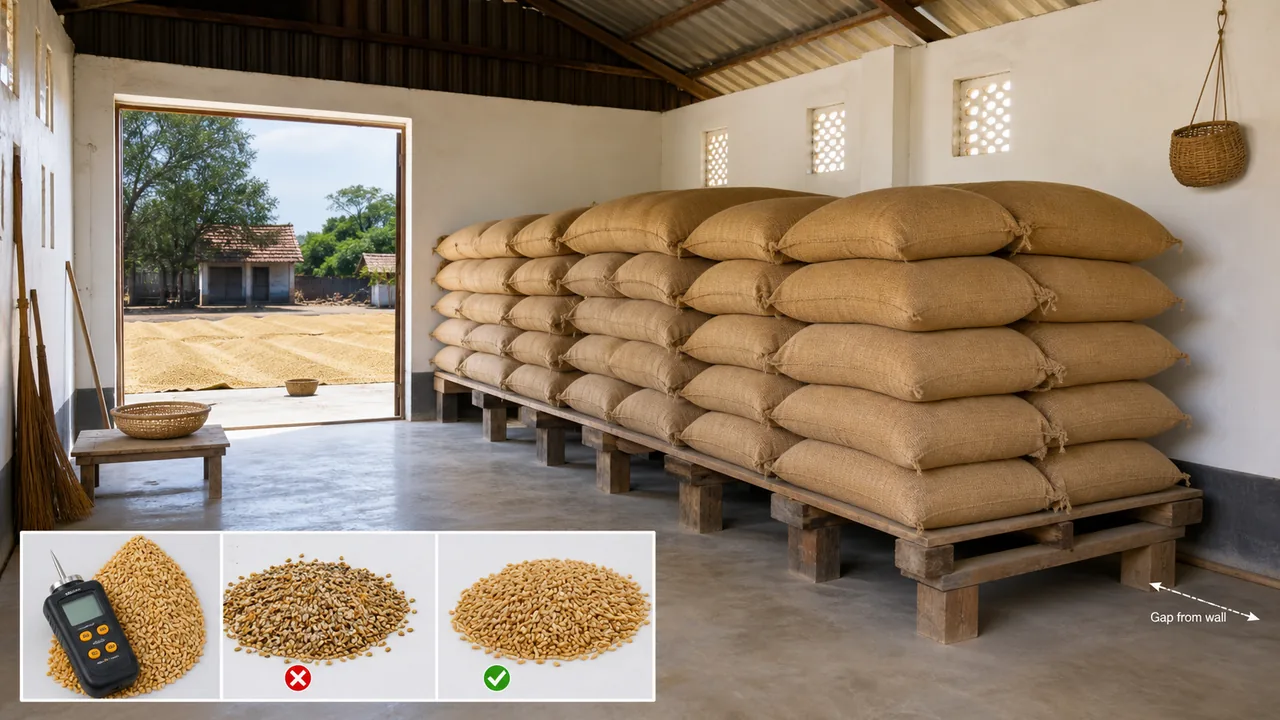
- Proper Drying — Dry grains to below 12% moisture content before storage. This single step prevents both insect and mite infestation.
- Cleaning — Clean the storage structure thoroughly. Remove old grain residues, sweepings, and cobwebs.
- Crevice Treatment — Spray insecticide solution on walls, floors, and crevices to kill hiding insects.
- Sun Drying — Periodic sun drying reduces moisture and kills some pest stages.
- Proper Stacking — Maintain a gap of at least 50 cm between the wall and grain bags, and 30 cm above the floor using dunnage.
Cultural and Physical Methods
| Method | How It Works | Agricultural Example |
|---|---|---|
| Drying | Reduce grain moisture below 12% | Sun drying on farm yards before storage |
| Cleaning | Remove old grain residues | Sweeping and whitewashing godowns |
| Aeration | Proper ventilation to prevent moisture build-up | Ventilators in modern warehouses |
| Hermetic storage | Air-tight storage reduces oxygen levels | Purdue Improved Crop Storage (PICS) bags |
| Temperature control | Cold storage below 10 degrees C | Cold storage for seeds in seed banks |
| Neem leaves | Traditional repellent mixed with grain | Farmers in UP place dried neem leaves in grain bins |
For early warning in warehouses and godowns, stored-grain infestation is commonly monitored with light traps, probe traps, and sticky traps. These do not replace fumigation, but they help detect building infestations before visible losses become severe.
TIP
The 12% Rule: Grain moisture below 12% prevents most insect and all mite infestations. This is the single most important number in storage pest management. If you remember nothing else, remember 12%.
Storage Structures in India
Different storage structures offer varying levels of protection. Knowing them is important for exams and for advising farmers.
| Structure | Description | Capacity | Protection Level |
|---|---|---|---|
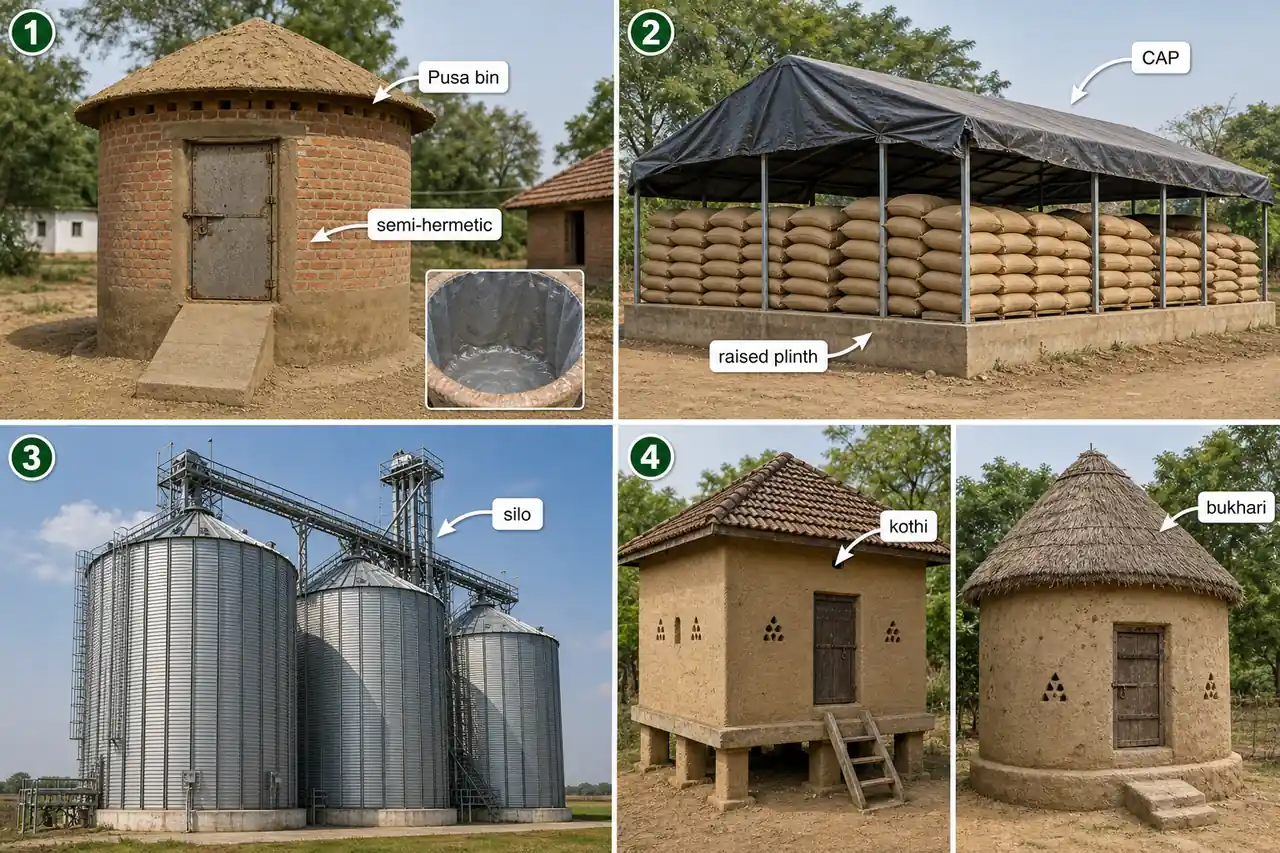
| Pusa Bin | Developed by IARI; mud and brick structure with polythene lining | 1-5 tonnes | Good (semi-hermetic) |
| CAP (Cover and Plinth) | Open-air storage with waterproof covers on raised plinths | 500-2000 tonnes | Moderate |
| Silo | Modern large-scale storage; metal or concrete | 1000-50,000 tonnes | Excellent |
| Kothi | Traditional indoor storage made of mud | 0.5-2 tonnes | Poor to moderate |
| Bukhari | Traditional underground storage pit | 1-5 tonnes | Moderate (cool) |
NOTE
Pusa Bin was developed by IARI (Indian Agricultural Research Institute), New Delhi. It uses a polythene membrane to create semi-hermetic (partially air-tight) conditions, reducing insect activity. This is a frequently asked fact.
Older storage-extension notes also associate the Pusa-bin design with Dr. S. Pradhan. In Rajasthan-oriented storage questions, names such as Bukhari and Thekka may appear, while gharalu thekka and pucca kothi are remembered as indoor storage-bin forms.
Agricultural context: The FCI stores the bulk of India's food grain buffer stock in CAP (Cover and Plinth) storage and conventional godowns. Modern steel silos are being built under the government's silo construction programme to reduce storage losses from the current 10% to below 2%.
Beneficial Insects Related to Storage — A Quick Note
Not all insects associated with stored products are pests. Some are commercially valuable:
| Insect | Product | Significance |
|---|---|---|
| Silk worm (Bombyx mori) | Silk | Sericulture industry |
| Honey bee (Apis spp.) | Honey, wax, royal jelly | Apiculture; pollination services |
| Lac insect (Kerria lacca) | Lac / shellac | Lac culture; used in paints, cosmetics |
NOTE
These beneficial insects are not storage pests, but questions about productive/beneficial insects often appear alongside storage pest questions in exams. Remember: silk worm, honey bee, and lac insect are the "Big Three" commercially useful insects.
Decision Guide: When to Fumigate vs Other Methods
How to decide the right storage pest control method:
| Situation | Recommended Method | Why |
|---|---|---|
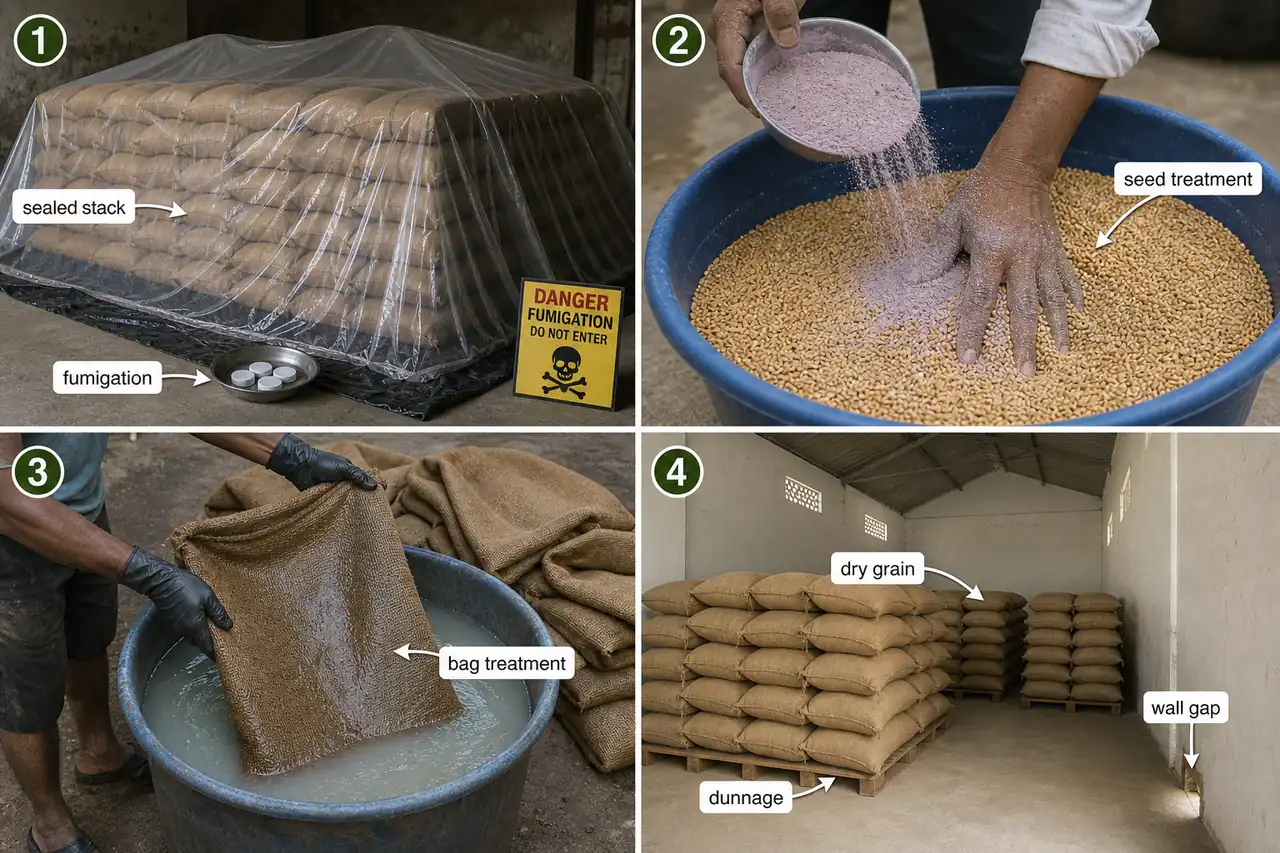
| Before storage — grain going into clean godown | Malathion 5% dust on grain surface + spray godown walls | Prevention is cheapest |
| Hidden infestation detected (>5% grains with internal damage) | Fumigation with AlP (aluminium phosphide) — 3 tablets/tonne for 5-7 days | Only fumigants reach inside grain |
| Visible adult insects crawling on surface | Malathion spray on bag surface | Contact kill sufficient |
| Organic/chemical-free storage needed | Neem leaf layering + airtight containers | No residue; works for small quantities |
| Large-scale FCI/CWC godowns | Cover fumigation with AlP; maintain 105-point proforma | Standardised government protocol |
| Export consignment requiring zero insects | Methyl bromide fumigation (being phased out) or heat treatment | Quarantine requirement |
Critical safety note for IBPS AFO aspirants: AlP fumigation releases phosphine gas (PH₃) — lethal to humans at 2 ppm. Never enter a fumigated godown without proper airing (minimum 48 hours ventilation). Fumigation must only be done by trained personnel.
Where rodents become a parallel storage problem, classical recall includes zinc phosphide as an acute bait poison and brodifacoum as a second-generation anticoagulant rodenticide.
Exam Tips and Mnemonics
TIP
"FASS" for Storage Management Steps:
- F = Fumigation (AlP, Methyl bromide)
- A = Application of seed treatment (Malathion 5% dust)
- S = Surface treatment of bags (Fenvalerate/Cypermethrin)
- S = Storage structure selection (Pusa bin, Silo, CAP)
Key numbers to memorise:
- 10% — Post-harvest losses in India
- 12% — Safe grain moisture for storage
- 3:1 — EDC to CCl4 ratio
- 5-7 days — Aluminium phosphide exposure period
- 10 minutes — Bag dipping duration
- 0.0125% — Fenvalerate/Cypermethrin concentration
- 50 cm — Gap between wall and grain stack
Summary Cheat Sheet
| Concept / Topic | Key Details |
|---|---|
| Most commonly used fumigant | Aluminium phosphide (Celphos); releases phosphine gas (PH3); exposure 5-7 days; asked in exams |
| Best fumigant for quarantine | Methyl bromide; being phased out under Montreal Protocol (ozone depletion) |
| Traditional fumigant mixture | EDC + CCl4 in ratio 3:1 |
| Standard seed treatment | Malathion 5% dust; safe insecticide for warehouses and godowns |
| Surface / bag treatment | Fenvalerate or Cypermethrin at 0.0125%; dip bags for 10 minutes |
| Safe grain moisture | Below 12%; single most important preventive measure |
| Post-harvest losses in India | About 10% of total food grains |
| Pusa Bin | Developed by IARI, New Delhi; semi-hermetic with polythene lining |
| Stacking gap | 50 cm between wall and grain bags; 30 cm above floor |
| Beneficial insects | Bombyx mori (silk), Apis spp. (honey), Kerria lacca (lac) |