🦀 Phylum Arthropoda -- Characteristics and Position of Insects
Key characteristics of the largest animal phylum, how arthropods differ from other animals, and why understanding Arthropoda is essential for identifying agricultural pests
In the previous lesson, we traced the history of entomology -- the scientists and institutions that built India's pest management framework. Now we turn to the biological foundation: Phylum Arthropoda, the enormous animal group that contains all insects along with crabs, spiders, mites, and centipedes.
Walk through any Indian farm and you will encounter arthropods at every turn -- crabs in paddy fields, spiders on cotton plants, mites on mango leaves, and of course the countless insects that can make or break a harvest. Understanding what makes an arthropod is the first step toward identifying whether a pest in your field is an insect, a mite, or something else entirely.
This lesson covers:
- Definition and etymology of Phylum Arthropoda
- 12 key characteristics that distinguish arthropods from all other animals
- Agricultural relevance -- why correct identification matters for pest control
- Arthropoda vs. Vertebrata -- a comparison table frequently tested in exams
What Is Phylum Arthropoda?
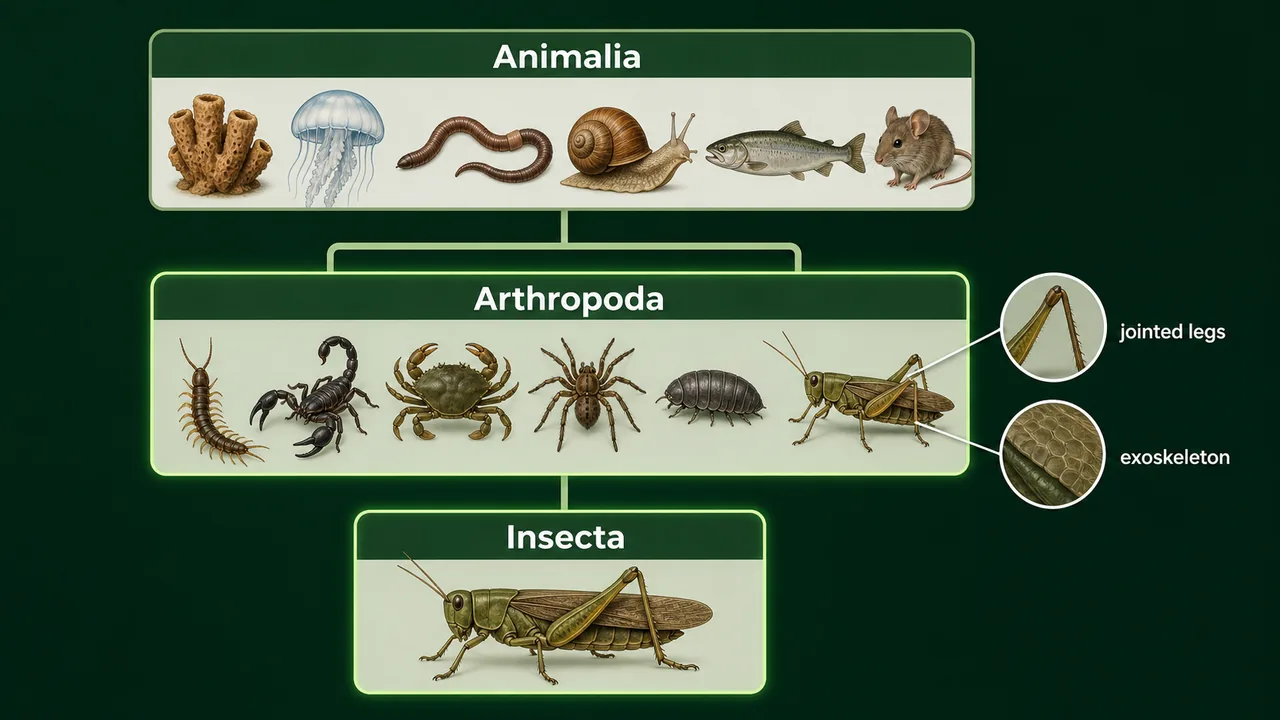
- Insects belong to Phylum Arthropoda -- the largest phylum of the animal kingdom, containing more species than all other phyla combined.
- Greek origin: Arthros (jointed) + Podus (leg) = "jointed legs" -- the single most defining characteristic of this phylum.
- Besides insects, the phylum includes crayfish, crabs, lobsters, centipedes, millipedes, spiders, mites, ticks, and scorpions.
- Standard evolutionary recall places the origin of insects in the Devonian Period of the Palaeozoic Era, based on fossil evidence of early terrestrial arthropods.
Characteristics of Phylum Arthropoda
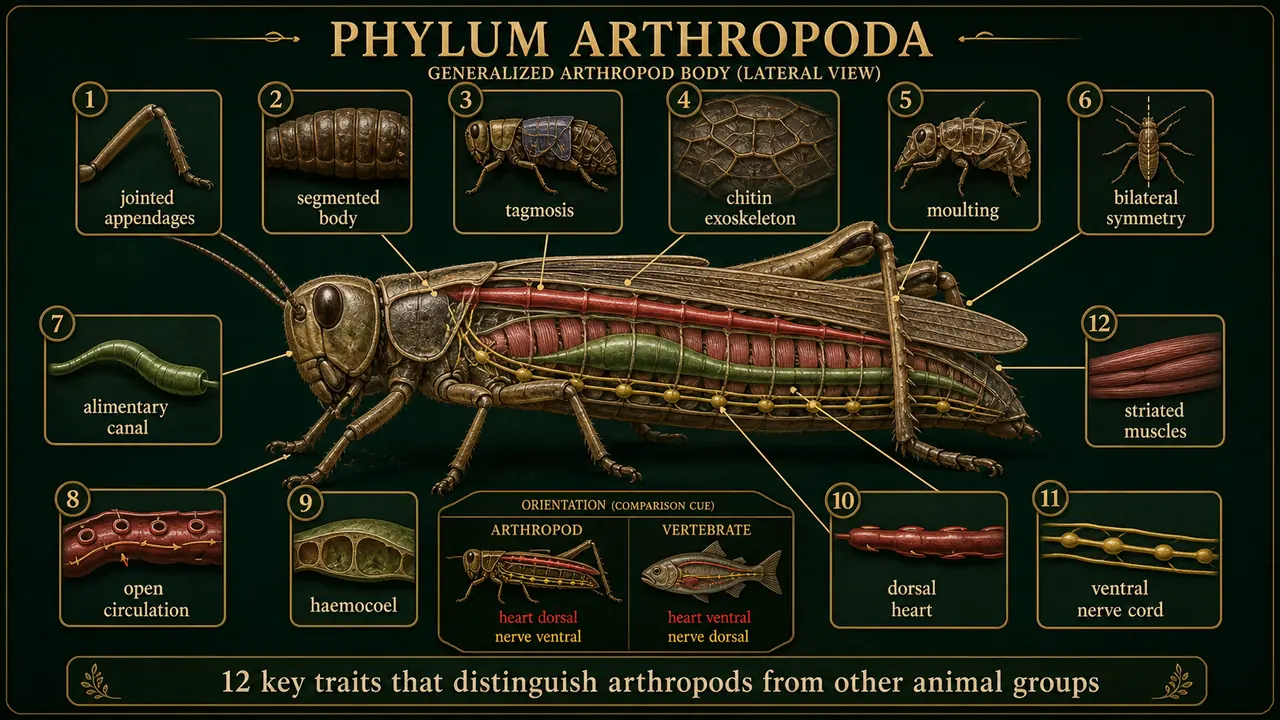
The following 12 features distinguish arthropods from all other animal groups:
| # | Characteristic | Explanation |
|---|---|---|
| 1 | Paired segmented jointed appendages | The hallmark feature -- jointed legs allow walking, swimming, grasping, and digging |
| 2 | Segmented body | Distinct segments, each potentially bearing a pair of appendages |
| 3 | Tagmosis (2 or 3 body regions) | Segments grouped into functional units called tagmata (e.g., head, thorax, abdomen in insects) |
| 4 | Chitinous renewable exoskeleton | Made of chitin (a tough, lightweight polysaccharide); shed and replaced during moulting |
| 5 | Growth by moulting | Rigid exoskeleton cannot expand, so arthropods undergo ecdysis (moulting) to grow |
| 6 | Bilateral symmetry | Body divisible into two mirror-image halves along a central longitudinal plane |
| 7 | Tubular alimentary canal | Complete one-way digestive tube from mouth to anus |
| 8 | Open circulatory system | Blood (haemolymph) flows freely through body cavities, not confined to vessels |
| 9 | Haemocoel | Body cavity filled with haemolymph that directly bathes internal organs |
| 10 | Dorsal heart with ostia | Heart on the dorsal (upper) side with valve-like openings (ostia) for haemolymph entry |
| 11 | Ventral nervous system, dorsal brain | Main nerve cord runs ventrally; brain (ganglia cluster) is dorsal -- opposite of vertebrates |
| 12 | Striated muscles, no ciliated epithelium | Striated muscles allow rapid, powerful contractions (essential for flight and jumping) |
Agricultural Relevance
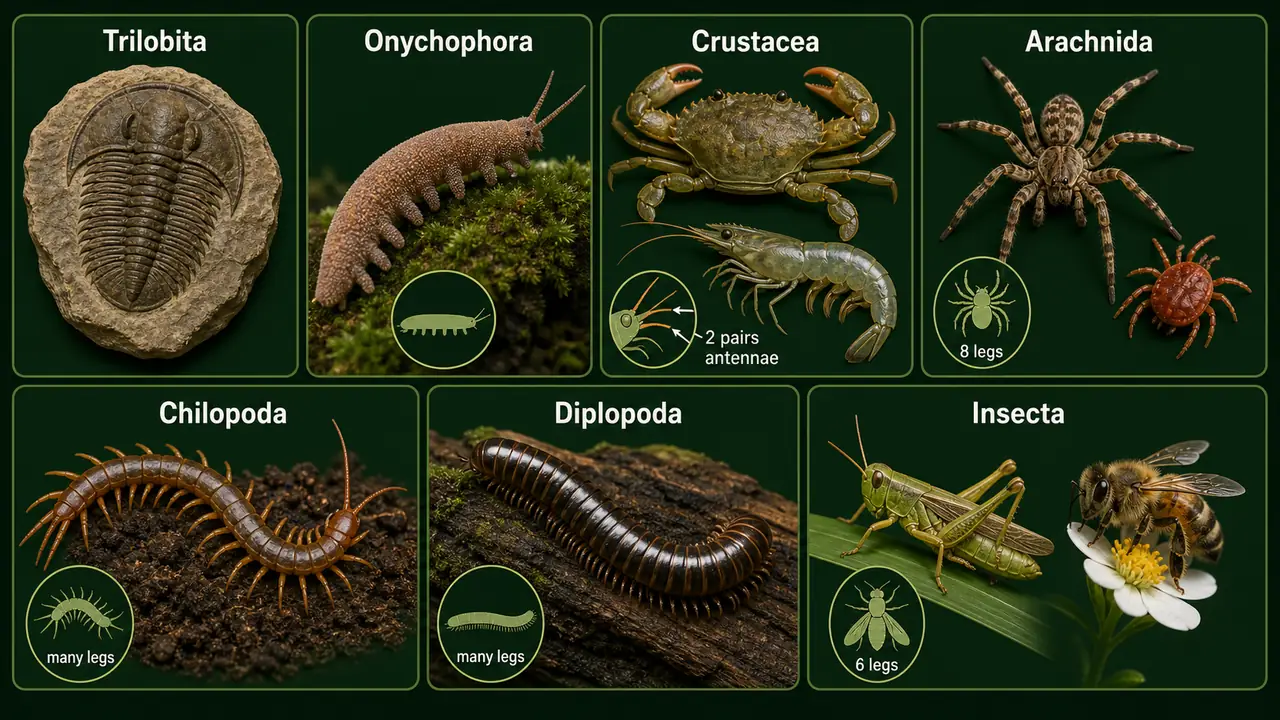
Many of the most important crop pests and beneficial organisms in agriculture are arthropods. Knowing whether a pest is an insect (6 legs), a mite (8 legs), or a crustacean helps in selecting the right control measure. For example, acaricides work on mites but not on insects, while certain insecticides are ineffective against mites.
Exam Tips
Remember "JOTE" for the 4 most-asked characteristics:
- Jointed appendages
- Open circulatory system
- Tagmosis (body regions)
- Exoskeleton of chitin (renewable)
Dorsal vs. Ventral trick: In arthropods, the heart is dorsal and the nerve cord is ventral -- the exact opposite of vertebrates. A common exam trap!
Open vs. Closed circulation: Arthropods = Open (haemolymph in haemocoel). Mammals = Closed (blood in vessels). Frequently tested in comparison questions.
Summary Cheat Sheet
| Feature | Arthropoda | Vertebrata (for comparison) |
|---|---|---|
| Skeleton | External (exoskeleton of chitin) | Internal (endoskeleton of bone) |
| Circulatory system | Open (haemolymph in haemocoel) | Closed (blood in vessels) |
| Heart position | Dorsal | Ventral (in chest cavity) |
| Nerve cord position | Ventral | Dorsal (spinal cord) |
| Growth | By moulting (ecdysis) | Continuous |
| Blood | Haemolymph (usually colourless) | Blood (red, with haemoglobin) |
| Body symmetry | Bilateral | Bilateral |
| Appendages | Jointed, segmented | Jointed (limbs) |
Explore More
- Phylum Arthropoda -- Overview
- Arthropod Characteristics
- Arthropod Classification
- Arthropoda -- Detailed Lecture
- Arthropod Body Systems
- Arthropod Diversity
- Insect vs. Other Arthropods
- Arthropod Exoskeleton and Moulting
- Open Circulatory System
- Arthropod Nervous System
- Arthropod Appendages
- Arthropod Evolution
- Arthropod Respiration
TIP
Next: Lesson 03 dives into the classification of Phylum Arthropoda -- the seven classes, with special focus on Class Insecta and how to distinguish insects from other arthropods.
References
1 source
References
Lesson Doubts
Ask questions, get expert answers