🦐 Classification of Phylum Arthropoda and Class Insecta
Seven classes of Arthropoda, position of insects in the animal kingdom, defining features of Class Insecta (Hexapoda), and how insects relate to other arthropods
In the previous lesson, we explored the 12 key characteristics that define Phylum Arthropoda. Now we zoom in on how this enormous phylum is classified into seven classes and why Class Insecta dominates the animal kingdom.
A farmer finds tiny eight-legged creatures damaging his brinjal leaves and wonders if they are insects. They are actually mites -- a different class of arthropods altogether. Knowing how Phylum Arthropoda is classified helps you quickly determine whether you are dealing with an insect, a mite, a spider, or a crustacean, which directly affects the choice of control method (insecticide vs. acaricide vs. biological control).
This lesson covers:
- Seven classes of Phylum Arthropoda -- from extinct Trilobita to the dominant Insecta
- Evolutionary relationship -- how insects relate to other arthropod classes
- Defining features of Class Insecta -- body plan, etymology, and key characteristics
- Comparison table -- insects vs. arachnids vs. myriapods vs. crustaceans
Nomenclature and Classification Foundations
- Systematics = the study of the diversity of organisms and their evolutionary relationships.
- Biosystematics = the study of the origin and differentiation of living systems.
- Phylogeny = the evolutionary history of a lineage or group.
- Taxonomy = the theory and practice of classification, including identification, naming, and characterization of organisms. The term is classically linked with A.P. de Candolle.
- Binomial nomenclature = the system of giving each species a two-part Latin name (Genus + species). First formally proposed by Linnaeus in Systema Naturae (1758).
- In exam-oriented taxonomy language, alpha taxonomy deals with discovery, description, and naming; beta taxonomy deals with arranging species into natural systems of classification; and gamma taxonomy deals with broader evolutionary relationships and variation.
- Species is treated as the basic taxonomic category.
- In older taxonomy-history recall, the formal use of the term species is often linked with John Ray.
- The current ICZN framework is often revised in exam notes as a code arranged into 90 articles across 18 chapters, laying down the formal rules of zoological nomenclature.
- In taxonomic description work, a holotype is the single specimen on which the original description of a new species is based. An allotype is the specimen of the opposite sex cited alongside that holotype for reference.
- Homonym means the same name has been used for two different taxa, while synonym means more than one name has been used for the same taxon.
- Classical species-concept labels that appear in older systematics MCQs include the typological, nominalistic, evolutionary, and biological species concepts.
- In exam-oriented systematics language, allopatric speciation means new species arise after physical isolation or a geographic barrier separates populations, while sympatric speciation means divergence happens within the same geographic area without such a physical barrier.
- DNA barcoding = rapid and accurate identification of organisms using a short standardized DNA fragment, most commonly the mitochondrial cytochrome oxidase I (COI) region. In applied entomology, it is especially useful for separating cryptic species, identifying immature stages, and rapidly confirming pest larvae.
- Cryptic species are species that remain visually or morphologically indistinguishable despite being biologically distinct.
- Thelytoky = form of parthenogenesis where unfertilised eggs develop into females only (e.g., certain parasitoid wasps, some scale insects).
- Naiad = immature aquatic stage of insects such as dragonflies and mayflies (Order Odonata, Ephemeroptera).
- Some classic order-level recall terms are also useful in systematics MCQs:
- In Orthoptera, Caelifera includes grasshoppers and locusts, while Ensifera includes crickets and katydid-like forms.
- In older classification wording for Diptera, common subgroup names include Nematocera, Brachycera, and Cyclorrhapha.
Seven Classes of Phylum Arthropoda
Phylum Arthropoda is divided into 7 classes, each distinguished by unique body plans, number of legs, body regions, and habitats.
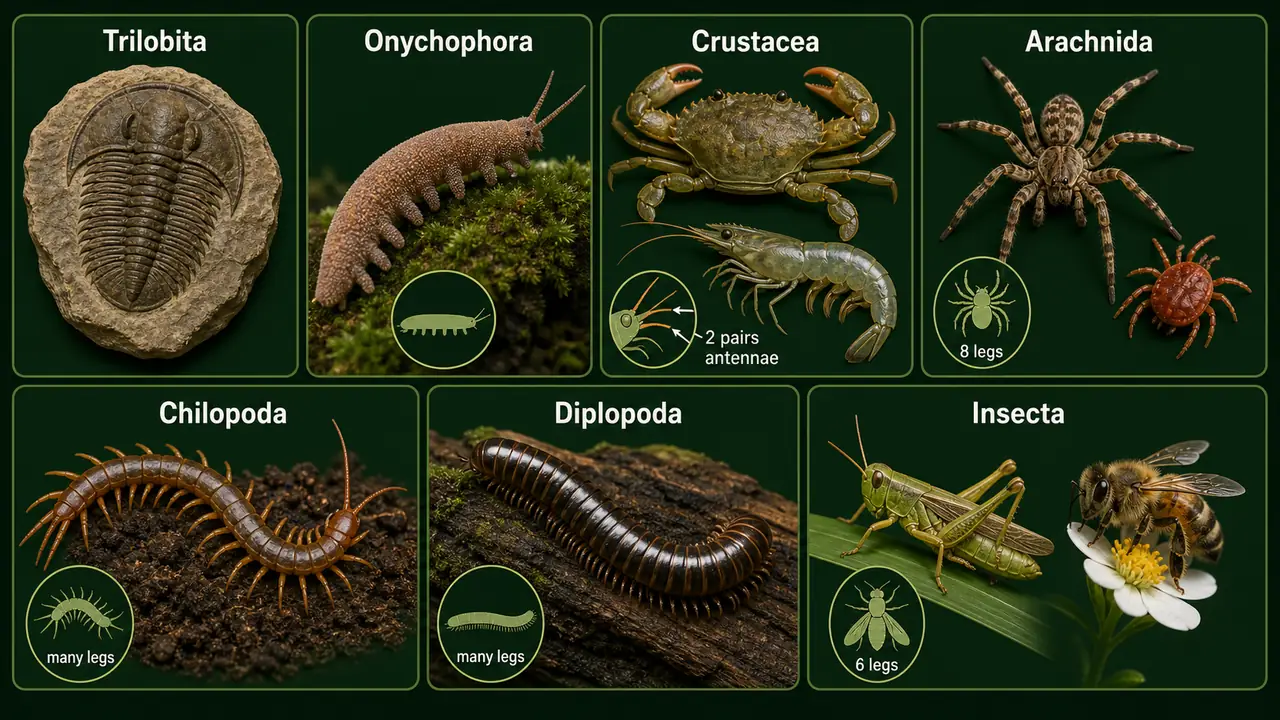
| S.N. | Class | Examples |
|---|---|---|
| 1. | Trilobita (an extinct group) | Fossil trilobites |
| 2. | Onychophora (Claw bearing) e.g. Peripatus, commonly known as Velvet Worm | Peripatus |
| 3. | Crustacea (Latin Crusta = shell) e.g. Prawn, crab, Shrimps, wood louse | Prawn, Crab, Shrimps |
| 4. | Arachnida (Greek Arachne = spider) e.g. spider, tick, mite, scorpion — 4 pairs of legs, no antennae, no wings; breathe through book lungs (scorpions) or tracheae (spiders) | Spider, Tick, Mite, Scorpion |
| 5. | Chilopoda (Chilo = lip; poda = appendage) e.g. Centipedes | Centipedes |
| 6. | Diplopoda (Diplo = two; poda = appendage) e.g. Millipede | Millipede |
| 7. | Hexapoda or Insecta (hexa = Six; poda = legs) e.g. Insects (in-internal; sect-cut) | Beetles, Grasshoppers, Butterflies, Honeybee |
WARNING
Mites and spiders are NOT insects — they belong to class Arachnida (4 pairs of legs, no antennae, no wings). MCQs may list mites among "insects" to trap you. Mites are arthropods but not insects.
Family Bombycidae (silkworms): Larvae secrete silk from modified salivary glands, extruded through a median spinneret near the mouth. Silk is a protein (fibroin) thread used to construct the cocoon.
Diplura: Among the Apterygotes (wingless hexapods), class Diplura establishes an evolutionary link between class Insecta and other Arthropoda — they lack compound eyes and have entognathous (enclosed) mouthparts, bridging the gap between hexapods and myriapods.
Evolutionary Relationship with Class Insecta
- Arthropods were initially aquatic and later became terrestrial, as proved by Class Trilobita -- an entirely extinct class of marine arthropods from the Palaeozoic era.
- Trilobite fossils demonstrate that the earliest arthropods were aquatic organisms. Over millions of years, some lineages adapted to land, eventually giving rise to terrestrial groups including insects.
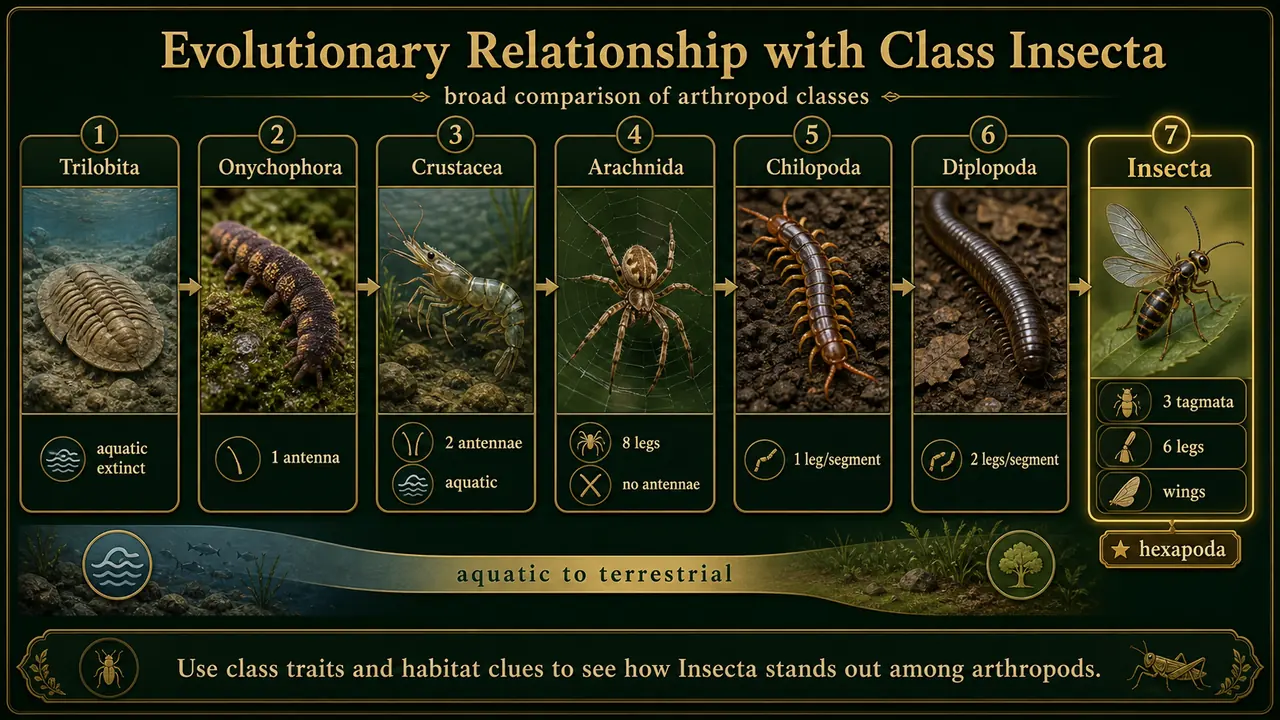
| Characters | Onychophora | Crustacea | Arachnida | Chilopoda | Diplopoda | Insect (Hexapoda) |
|---|---|---|---|---|---|---|
| Habitat | Terrestrial | Aquatic & Few Terrestrial | Terrestrial | Terrestrial | Terrestrial | Many terrestrial & very few aquatic |
| Habit | They prey upon other invertebrates, which they catch by ejecting an adhesive slime. | Herbivorous & Carnivorous | Phytophagous & Predators | Carnivorous | Herbivorous | Phytophagous, Predators & Parasitoides |
| Body Regions | Not distinct | Two: Cephalothorax & Abdomen | Two: Pro & Opisthosoma (e.g. Spider); Three: Prosoma, Meso and Metasoma (e.g. Scorpion) | Two: Head & multisegmented trunk | Two: Head & multisegmented trunk | Three: Head, thorax & abdomen |
| Antenna | 1 pair | 2 pairs | No antenna | One pair | One pair | One pair |
| Visual Organs | Not distinct | One pair: Compound eyes | One pair: Simple eyes | One pair: Simple eyes | One pair: Simple eyes | Both simple eyes and compound eyes (One pair) |
| Locomotor Organs | Many pairs of unjointed legs | Minimum five pairs of legs | Four pairs | One pair per segment (First pair of legs modified as poison claws: forcipules) | Two pair per segment (No poison claws) | Three pairs of legs on three thoracic segments and two pairs of wings on meso and metathorax |
| Mouth Parts | Non mandibulate | Mandibulate: 1 pair | Non mandibulate, but possess chelicerae | Mandibulate: 1 pair | Mandibulate: 1 pair | Mandibulate: 1 pair |
| Respiration | Cutaneous | Gill breathing | Book lungs (Scorpion) & Tracheal (Spiders) | Tracheal | Tracheal | Tracheal |
| Body Fluid | Haemolymph | Haemolymph | Haemolymph | Haemolymph | Haemolymph | Haemolymph |
| Circulatory System | Heart with ostia | Heart with ostia | Heart with ostia | Heart with ostia | Heat with ostia | Heart with ostia |
| Development | Anamorphosis | Anamorphosis | Metamorphosis absent in Scorpion; Metamorphosis present in Mites & Spider (Incomplete Metamorphosis) | Metamorphosis | Metamorphosis | Metamorphosis |
| Important Characters | Link between Annelida & Arthropoda | Calcification strengthens exoskeleton. All crustaceans have a hard exoskeleton which protects the animal from predators and prevents water loss. | Life cycle: Egg-Larva-Nymph-Adult. Larva with 3 pairs of legs and Nymph with 4 pairs of legs. The dwelling place of termites is known as Mound. | Opisthogenital gonopore present in the terminal segment | Progo genital gonopore in 3rd segment | Genital structures on 8th and 9th abdominal segments. Brain with proto, deuto & tritocerebrum |
Class Insecta (Hexapoda) -- Defining Features
Insects occupy more than 97% of the total population of Phylum Arthropoda and belong to the subphylum Hexapoda -- the most successful group of animals on Earth.
Origin of the Word "Insect"
- Latin: Insectare (in = internal, sect = cut) = "to cut into"
- This refers to the characteristic appearance of insects being "cut into" three distinct sections -- head, thorax, and abdomen.
Key Characteristics
Insects are tracheated arthropods (breathe through internal air tubes called tracheae) with their body divided into three regions (tagmata):
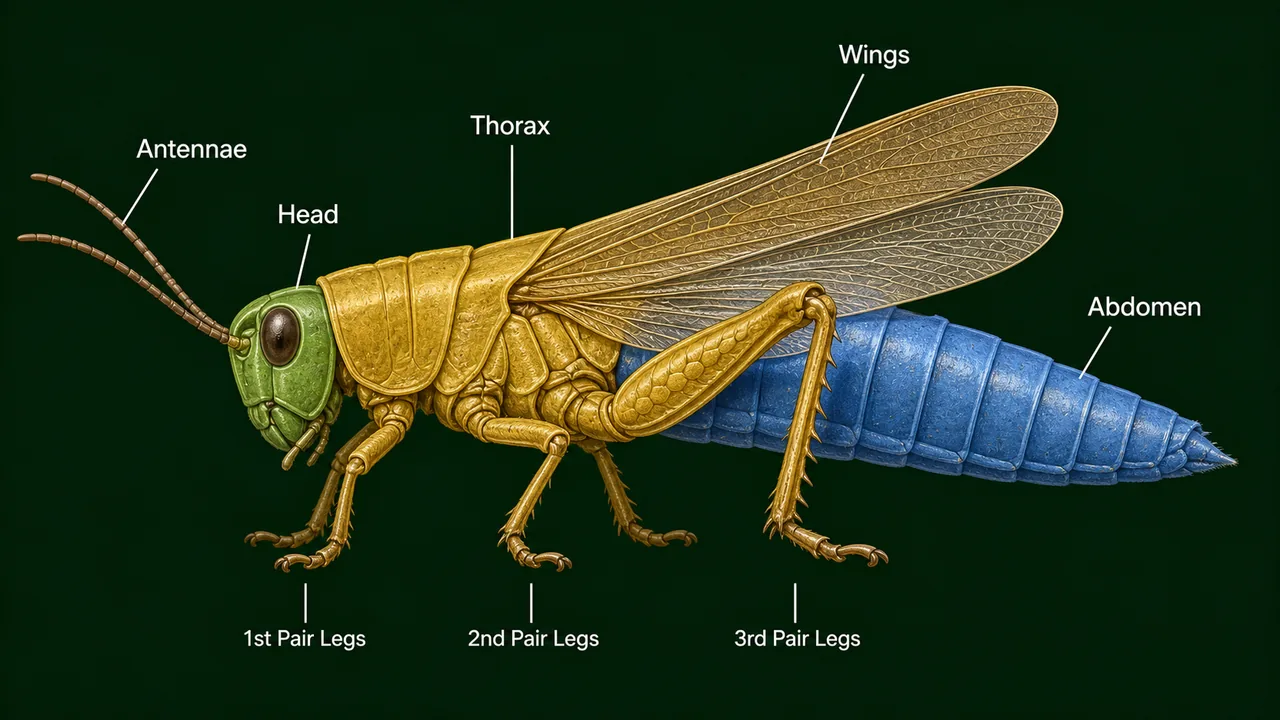
| Body Region | Segments | Key Appendages | Primary Function |
|---|---|---|---|
| Head | 6 segments (fused) | 1 pair antennae, 1 pair compound eyes, mouthparts (1 pair mandibles, 2 pairs maxillae with 2nd pair fused as labium) | Sensory perception & feeding |
| Thorax | 3 segments (prothorax, mesothorax, metathorax) | 3 pairs jointed legs; usually 2 pairs wings (on meso- and metathorax) | Locomotion (walking and flight) |
| Abdomen | 11--12 segments | No ambulatory appendages; genital structures at posterior end; trachea for respiration | Respiration & reproduction |
Insect = Head (6 fused segments) + Thorax (3 distinct segments) + Abdomen (11--12 distinct segments)
Older Textbook Division of Class Insecta
- In many classic agricultural-entomology notes, insects are placed in Phylum Arthropoda, Subphylum Uniramia / Hexapoda, Class Insecta.
- Older exam-oriented schemes often divide Class Insecta into 29 orders:
- Apterygota = 4 primitive wingless orders
- Pterygota = 25 winged or secondarily wingless orders
| Group | Key Features | Standard Examples |
|---|---|---|
| Apterygota | Primarily wingless; metamorphosis absent or very slight; pregenital abdominal appendages present; monocondylic mandibles; mouthparts usually entognathous except Thysanura | Thysanura, Collembola, Protura, Diplura |
| Pterygota | Winged or secondarily wingless forms; dicondylic mandibles; pregenital abdominal appendages absent in adults; includes both incomplete and complete metamorphosis | Most familiar insect orders |
- Thysanura (silverfish / bristletails) are remembered for two cerci plus one median caudal filament.
- Collembola (springtails) have a 6-segmented abdomen and a ventral collophore on the first abdominal segment.
- Protura lack antennae and show anamorphosis, increasing the abdominal-segment count during development.
- Diplura have paired caudal appendages and are often used as a primitive-link recall group.
| Pterygote Division | Key Idea | Typical Orders / Notes |
|---|---|---|
| Palaeoptera | Wings cannot be folded flat over the abdomen | Ephemeroptera and Odonata |
| Exopterygota | Wings develop externally; pupa absent | Orthopteroid and hemipteroid groups |
| Endopterygota | Wings develop internally; pupa present | Holometabolous orders such as Coleoptera, Lepidoptera, Diptera, Hymenoptera |
- In Ephemeroptera (mayflies), the winged pre-adult stage called subimago moults once more to become the true adult -- a unique feature among insects.
- Among older flight-origin theories, the paranotal theory is classically associated with Miller, who proposed that insect wings evolved from lateral thoracic expansions.
- Within the old exopterygote grouping, orthopteroid insects are remembered as mostly mandibulate forms in which cerci are usually present. This cluster includes common exam orders such as Orthoptera, Dermaptera, Phasmida, Plecoptera, Isoptera, and allied groups.
- The contrasting hemipteroid group is remembered for reduction or absence of cerci and a stronger trend toward piercing-sucking or otherwise specialized mouthparts. This side includes Hemiptera, Psocoptera, Mallophaga, Siphunculata / Anoplura, and related orders in older classifications.
- A few standard order-level anchors from this framework are worth retaining:
- Odonata = dragonflies (Anisoptera) and damselflies (Zygoptera); adults show a distinct nodus and pterostigma on the wing, males have secondary copulatory structures on the 2nd abdominal segment, and the aquatic immature has the characteristic prehensile mask-like labium.
- Orthoptera = grasshoppers, locusts, crickets, and mole crickets; hind legs are typically saltatorial, forewings are tegmina, and sound production by rubbing body parts is called stridulation.
- Dermaptera = earwigs with forceps-like cerci.
- Isoptera in older texts = termites, recalled for moniliform antennae and the equal size of the two wing pairs in alates.
- Thysanoptera = thrips with fringed wings and asymmetrical rasping-sucking mouthparts; only three stylets are present because the right mandible is absent.
- Diptera = true flies with only one functional pair of wings; hindwings become halteres, larvae are typically maggots, and the classic subgroup labels are Nematocera, Brachycera, and Cyclorrhapha.
- Siphonaptera = fleas, remembered for a laterally compressed body and adult piercing-sucking ectoparasitic habit on warm-blooded animals.
- Coleoptera = beetles and weevils with hardened forewings called elytra; it is commonly recalled as the largest insect order.
- Hymenoptera = bees, ants, wasps, and sawflies; fore- and hindwings are coupled by hamuli, and in Apocrita the anterior abdomen forms a petiole.
- Lepidoptera = moths and butterflies with wings covered in scales; the adult siphoning proboscis is formed mainly by the paired galeae of the maxillae, while the larva remains a mandibulate caterpillar.
Head -- Sensory and Feeding Centre
- Bears a single pair of antennae, a single pair of mandibles, and two pairs of maxillae (the second pair fused medially to form the labium).
- Bears one pair of compound eyes.
Thorax -- Locomotion Centre
- Carries three pairs of jointed legs (one pair per segment) -- hence the name Hexapoda.
- Generally bears two pairs of wings (one on mesothorax, one on metathorax).
- The meso- and metathorax together are called the pterothorax (Greek pteron = wing).
- Minor function: some trachea also open on the thorax for respiration.
Abdomen -- Visceral Centre
- Devoid of walking legs.
- Genital opening near the posterior end.
- Houses most trachea for respiration.
- Main functions: respiration and reproduction.
Other Important Features
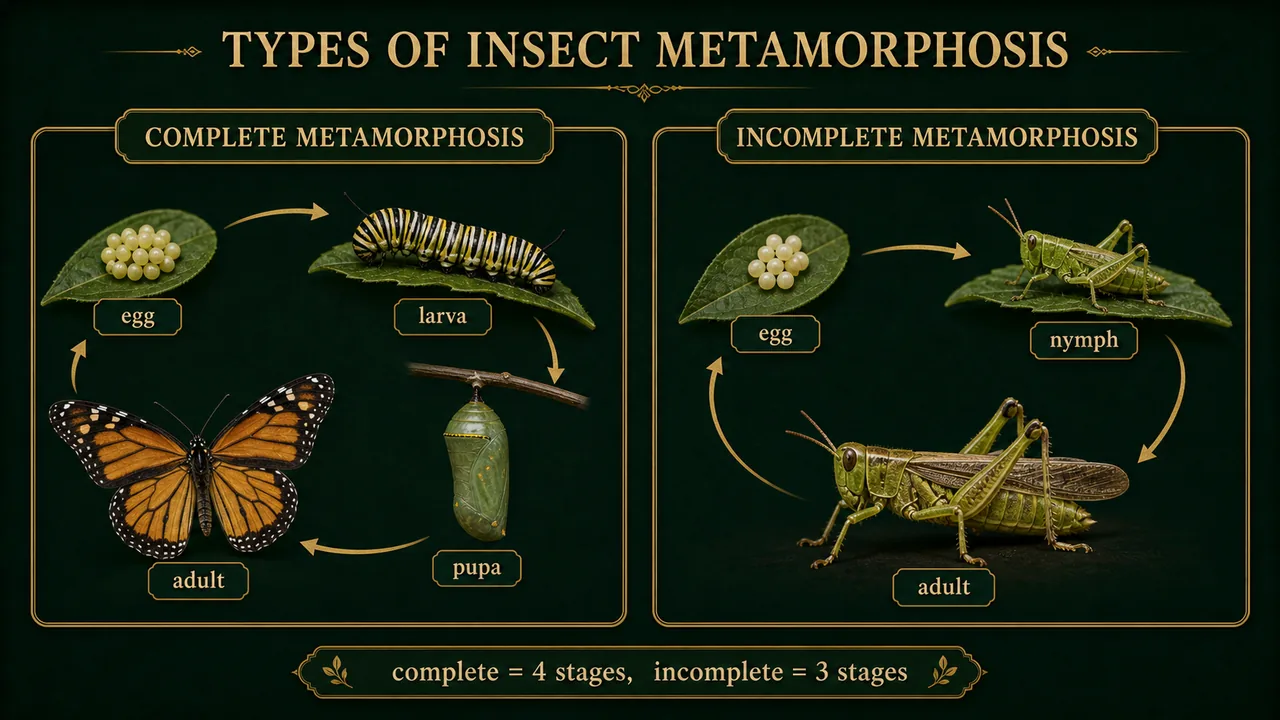
- Metamorphosis usually occurs -- most insects undergo significant structural changes before reaching adulthood (complete or incomplete metamorphosis).
- Exoskeleton made of hard cuticle (chitin) -- provides structural support, protection, and muscle attachment.
- Excretion mainly by Malpighian tubules -- slender tubes that filter waste from haemolymph and discharge it into the gut, functioning like vertebrate kidneys.
Comparison: Insects vs. Other Common Arthropods
| Feature | Insects (Hexapoda) | Arachnids (Spiders, Mites) | Myriapods (Centipedes, Millipedes) | Crustaceans (Crabs, Prawns) |
|---|---|---|---|---|
| Body regions | 3 (head, thorax, abdomen) | 2 (cephalothorax, abdomen) | 2 (head, trunk) | 2 (cephalothorax, abdomen) |
| Legs | 3 pairs (6) | 4 pairs (8) | Many pairs (15--750) | 5+ pairs (variable) |
| Antennae | 1 pair | None | 1 pair | 2 pairs |
| Wings | Usually 2 pairs | None | None | None |
| Habitat | Mostly terrestrial | Mostly terrestrial | Terrestrial | Mostly aquatic |
| Agricultural example | Bollworm, aphid | Red spider mite | Garden centipede | Freshwater prawn in paddy |
This comparison table is frequently asked in exams. The quickest way to distinguish: count the legs -- 6 legs = insect, 8 legs = arachnid, many legs = myriapod.
Exam Tips
Mnemonic for body division: "HTA" -- Head, Thorax, Abdomen. Only insects have all three clearly distinct.
97% rule: Insects make up 97% of all arthropods -- a favourite exam statistic.
"Insect = in + sect": The name itself tells you the body is "cut into" three parts.
Pterothorax = the wing-bearing thorax (meso + metathorax). The prothorax never bears wings in any living insect.
Summary Cheat Sheet
| Concept | Key Detail |
|---|---|
| Phylum Arthropoda | Largest animal phylum; 7 classes |
| Class Trilobita | Extinct marine arthropods; prove aquatic origin |
| Class Insecta (Hexapoda) | 97% of arthropods; 3 body regions; 3 pairs legs; usually 2 pairs wings |
| Word origin: "Insect" | Latin insectare = "cut into" (three sections) |
| Tagmata | Head (sensory/feeding), Thorax (locomotion), Abdomen (respiration/reproduction) |
| Pterothorax | Mesothorax + Metathorax (wing-bearing segments) |
| Breathing | Tracheal system (tracheated arthropods) |
| Exoskeleton | Chitin-based; renewable by moulting |
| Excretion | Malpighian tubules (analogous to vertebrate kidneys) |
| Metamorphosis | Most insects undergo complete or incomplete metamorphosis |
| Agriculturally important mite groups | Common plant-feeding mites are often revised under Eriophyidae, Tetranychidae, and Tarsonemidae within the acarine line |
| Mite-control clue | Mites are not insects, so serious infestations require an acaricide rather than a routine insecticide-only approach |
Explore More
TIP
Next: The next unit begins External Morphology -- starting with the insect exoskeleton and moulting, which explains how insects grow despite their rigid outer armour.
References
1 source
References
Lesson Doubts
Ask questions, get expert answers