🧠 Insect Nervous System
Neuron structure and classification, synaptic and axonic impulse conduction, central, visceral, and peripheral nervous systems
In the previous lesson, we studied the circulatory system and how haemolymph bathes internal organs. Now we examine the system that coordinates all insect activity: the nervous system -- the primary target of most commercial insecticides.
Many of the most widely used insecticides target the insect nervous system. Organophosphates and carbamates inhibit acetylcholinesterase at synapses, causing uncontrolled nerve firing and paralysis. Pyrethroids keep sodium channels open in axons, causing repetitive nerve discharge. Neonicotinoids bind to acetylcholine receptors, disrupting synaptic transmission. Understanding how the insect nervous system works is therefore essential for understanding how insecticides kill pests -- and why resistance develops.
This lesson covers:
- Neuron structure -- cell body, axon, dendrites, and synapses
- Impulse conduction -- axonic and synaptic transmission
- Three subdivisions -- CNS, visceral (SNS), and peripheral (PNS)
Overview
Electrical wiring analogy: The insect nervous system works like a building's electrical network. Sense organs are the sensors (smoke detectors, thermostats), the brain is the control panel that processes signals, and motor neurons are the wires running to effector organs (muscles, glands) that carry out actions. Insecticides that target this system are like cutting the wires or short-circuiting the control panel.
Pro Content Locked
Upgrade to Pro to access this lesson and all other premium content.
Charged once for one year · ₹1188 total
Save ₹100/month vs ₹2388/year launch price
- All Agriculture & Banking Courses
- AI Lesson Questions (100/day)
- AI Doubt Solver (50/day)
- Glows & Grows Feedback (30/day)
- AI Section Quiz (20/day)
- 22-Language Translation (100/day)
- Recall Questions (20/day)
- AI Quiz (15/day)
- AI Quiz Paper Analysis (100/day)
- AI Step-by-Step Explanations (100/day)
- Spaced Repetition Recall (FSRS)
- AI Tutor
- Immersive Text Questions
- Audio Lessons — Hindi & English
- Mock Tests & Previous Year Papers
- Summary & Mind Maps
- XP, Levels, Leaderboard & Badges
- Generate New Classrooms
- Voice AI Teacher (AgriDots Live)
- AI Revision Assistant
- Knowledge Gap Analysis
- Interactive Revision (LangGraph)
🔒 Secure one-time yearly payment via Razorpay · No hidden fees
In the previous lesson, we studied the circulatory system and how haemolymph bathes internal organs. Now we examine the system that coordinates all insect activity: the nervous system -- the primary target of most commercial insecticides.
Many of the most widely used insecticides target the insect nervous system. Organophosphates and carbamates inhibit acetylcholinesterase at synapses, causing uncontrolled nerve firing and paralysis. Pyrethroids keep sodium channels open in axons, causing repetitive nerve discharge. Neonicotinoids bind to acetylcholine receptors, disrupting synaptic transmission. Understanding how the insect nervous system works is therefore essential for understanding how insecticides kill pests -- and why resistance develops.
This lesson covers:
- Neuron structure -- cell body, axon, dendrites, and synapses
- Impulse conduction -- axonic and synaptic transmission
- Three subdivisions -- CNS, visceral (SNS), and peripheral (PNS)
Overview
Electrical wiring analogy: The insect nervous system works like a building's electrical network. Sense organs are the sensors (smoke detectors, thermostats), the brain is the control panel that processes signals, and motor neurons are the wires running to effector organs (muscles, glands) that carry out actions. Insecticides that target this system are like cutting the wires or short-circuiting the control panel.
- The nervous system enables coordination, memory, and intelligent behaviour in insects.
- It functions as a link between sense organs (which detect stimuli) and effector organs (muscles, glands that carry out responses).
- Sense organs contain sensilla -- small sensory structures responding to sounds, chemicals, weather, etc.
The Neuron -- Basic Unit
The neuron is the basic structural and functional unit of the nervous system.
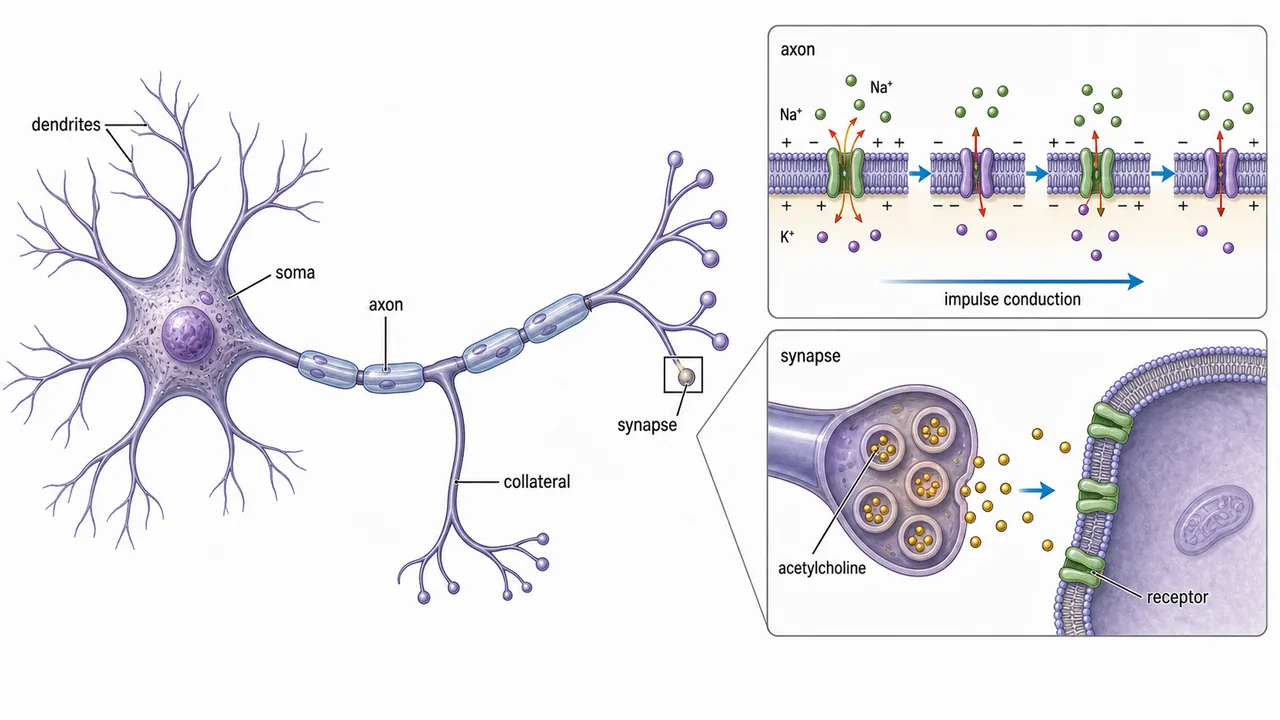
- Derived from ectoderm (same embryonic layer as the integument).
- Carries information as electrical impulses (nerve impulses / action potentials) at high speed.
Neuron Structure
| Part | Description | Function |
|---|---|---|
| Soma (Perikaryon) | Cell body with nucleus and organelles | Metabolic centre |
| Axon | Elongated cytoplasmic fibre; gives lateral branches (collaterals); ends in terminal arborizations | Carries impulses away from cell body |
| Dendrites | Group of small branches from soma | Receive impulses from other neurons or sensory receptors |
| Synapse | Tiny gap between axon terminals of one neuron and dendrites of the next | Impulse transmission via neurotransmitters (mainly acetylcholine) |
Classification of Neurons
By Structure
| Type | Structure | Complexity |
|---|---|---|
| Unipolar (Monopolar) | Single axon; no collaterals or dendrites | Simplest |
| Bipolar | Axon + either collateral or dendrite | Intermediate |
| Multipolar | Axon + several collaterals + dendrites | Most complex; extensive connections |
By Function
| Type | Direction | Also Called | Memory Aid |
|---|---|---|---|
| Sensory | Sense organs → CNS | Afferent ("carrying towards" CNS) | Afferent = Arriving at CNS |
| Motor | CNS → Effector organs (muscles, glands) | Efferent ("carrying away" from CNS) | Efferent = Exiting CNS |
| Association (Interneuron) | Between sensory and motor neurons; located in ganglia | Internuncial | Processing centres; integrate input and determine response |
Exam trap: "Motor neurons carry impulses FROM organs TO the CNS" is incorrect. Motor neurons carry impulses from CNS to organs. Sensory neurons carry impulses from organs to CNS.
Impulse Conduction
1. Axonic Conduction (Along the Axon)
| Feature | Detail |
|---|---|
| Mechanism | Ionic composition differs between inside and outside of axon |
| Resting state | Inside is negatively charged relative to outside (resting potential) |
| When stimulated | Na+ and K+ rapidly move across membrane → charge reversal → action potential propagates along axon |
Insecticide target: Pyrethroids and DDT keep sodium channels open, causing repetitive, uncontrolled nerve firing.
2. Synaptic Conduction (Across the Synapse)
| Feature | Detail |
|---|---|
| Mechanism | Impulse reaches axon terminal → triggers release of neurotransmitter (mainly acetylcholine) into synaptic gap |
| Effect | Neurotransmitter diffuses across gap → binds to receptors on next neuron → initiates new impulse |
| Termination | Acetylcholinesterase enzyme breaks down acetylcholine to stop the signal |
Insecticide targets at synapses:
- Organophosphates & Carbamates → inhibit acetylcholinesterase → acetylcholine accumulates → continuous nerve firing → paralysis and death
- Neonicotinoids → bind to acetylcholine receptors → disrupt normal transmission
Three Subdivisions of the Nervous System
1. Central Nervous System (CNS)
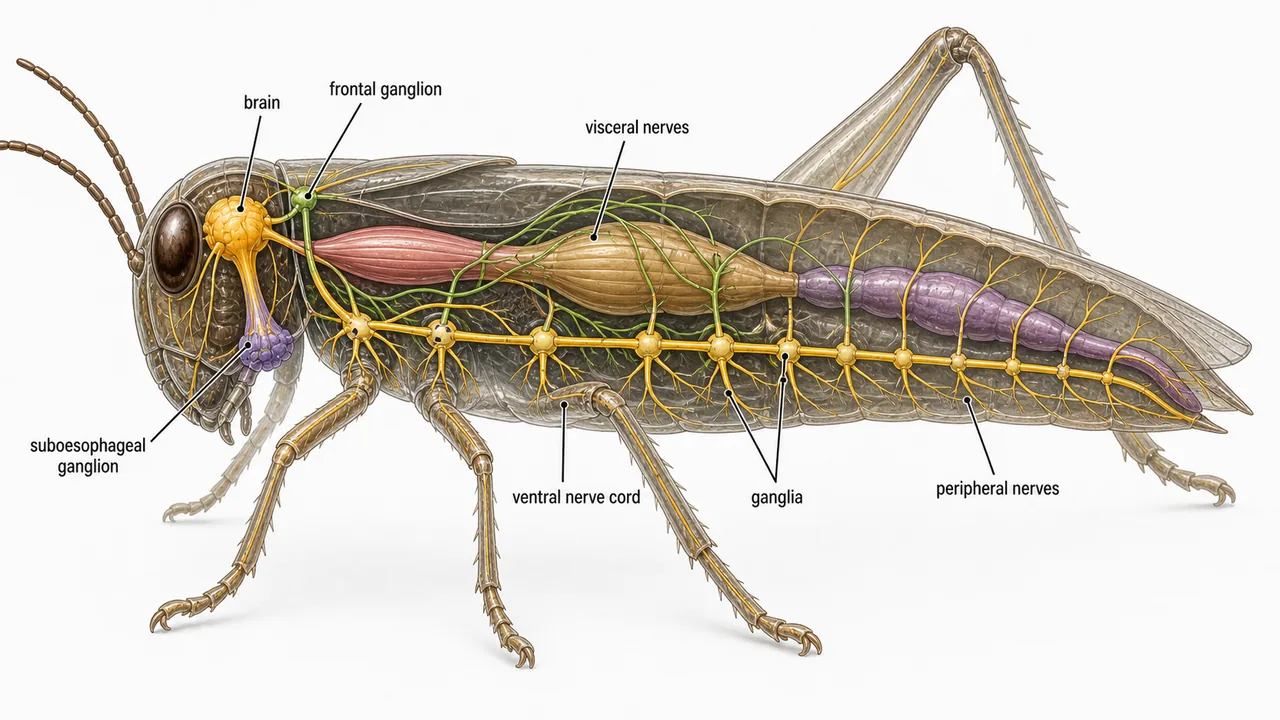
| Component | Location | Function |
|---|---|---|
| Brain (Supraesophageal ganglion) | Dorsal, in head | Primary integration centre; processes sensory information from eyes, antennae |
| Sub-oesophageal ganglion | Below oesophagus, in head | Controls mouthparts and salivary glands |
| Ventral nerve cord | Ventral side of body (entire length) | Chain of paired ganglia (one pair per segment in primitive condition); local control centres |
A ganglion (plural: ganglia) is a cluster of nerve cell bodies acting as a local processing hub. Each ganglion can function semi-independently -- a cockroach can run even after decapitation because thoracic ganglia control leg movements.
- The protocerebrum is the anterior brain region that supplies nerves to the compound eyes.
- Because the sub-oesophageal ganglion innervates the mouthparts, its paralysis prevents normal feeding.
2. Visceral / Sympathetic Nervous System (SNS)
Controls involuntary functions (gut movement, heart rate, internal organ activity).
| Subdivision | Association | Function |
|---|---|---|
| Stomatogastric (Oesophageal sympathetic) | Brain, aorta, foregut; includes frontal ganglion | Regulates gut muscular contractions (food movement) |
| Ventral visceral | Ventral nerve cord | Controls mid-body visceral organs |
| Caudal visceral | Posterior abdominal segments | Innervates reproductive organs and hindgut (egg-laying, defecation) |
3. Peripheral Nervous System (PNS)
- All motor neuron axons radiating from CNS ganglia to muscles.
- All sensory neurons from cuticular sense organs receiving mechanical, chemical, thermal, or visual stimuli.
- Essentially the "wiring" connecting the CNS to every body part.
Comparison: CNS vs. SNS vs. PNS
| Feature | CNS | SNS | PNS |
|---|---|---|---|
| Components | Brain + sub-oesophageal ganglion + ventral nerve cord | Stomatogastric + ventral visceral + caudal visceral | Motor + sensory nerves |
| Function | Main processing and control | Involuntary organ control | Signal transmission to/from periphery |
| Voluntary? | Partly | No (involuntary) | Transmits both |
Additional Nervous System Facts
- Rhodopsin = the chemical visual pigment in the rhabdom of compound eye ommatidia; essential for insect vision. Same pigment type as in vertebrate rod cells.
- Compound eyes are fixed — insects cannot move them. All directional vision comes from the large number of ommatidia covering a wide field of view.
- Cross-reference: Johnston's organ is located in the pedicel (2nd antennal segment) — detects sound (wing-beat frequency in male mosquitoes) and balance/antennal movement. Signals are processed by the deutocerebrum of the brain.
Exam Tips
Motor neurons (efferent) carry impulses FROM CNS TO organs. Sensory neurons (afferent) carry FROM organs TO CNS. Do not confuse -- this is the most common trap.
Mnemonic: Afferent = Arriving at brain. Efferent = Exiting brain.
Insecticide mode of action is directly linked to nervous system:
- Organophosphates/Carbamates → acetylcholinesterase inhibitors (synapse)
- Pyrethroids → sodium channel disruptors (axon)
- Neonicotinoids → acetylcholine receptor agonists (synapse)
Ganglion = cluster of nerve cell bodies. Each can work independently -- explains cockroach running without head.
Neuron = basic unit of nervous system. Derived from ectoderm.
Summary Cheat Sheet
| Concept | Key Detail |
|---|---|
| Basic unit | Neuron (from ectoderm) |
| Neuron parts | Soma (cell body) + Axon (carries away) + Dendrites (receive) |
| Synapse | Gap between neurons; uses acetylcholine as neurotransmitter |
| Sensory (Afferent) | Organs → CNS |
| Motor (Efferent) | CNS → Organs |
| Association (Interneuron) | Between sensory and motor; in ganglia |
| Axonic conduction | Na+/K+ ion flow → action potential along axon |
| Synaptic conduction | Acetylcholine released → binds receptors → new impulse |
| CNS | Brain + Sub-oesophageal ganglion + Ventral nerve cord |
| SNS | Stomatogastric + Ventral visceral + Caudal visceral |
| PNS | All motor + sensory nerves connecting CNS to body |
| Protocerebrum | Brain region associated with compound eyes |
| Organophosphates target | Acetylcholinesterase (enzyme) at synapse |
| Pyrethroids target | Na+ channels on axon |
| Neonicotinoids target | Acetylcholine receptors at synapse |
TIP
Next: The next lesson covers sense organs -- the specialised receptors that feed information into the nervous system.
References
1 source
References
Lesson Doubts
Ask questions, get expert answers