🫀 Insect Circulatory System
Open circulatory system, dorsal blood vessel (aorta and heart), ostia, haemocoel sinuses, accessory pulsatile organs, haemolymph properties and functions
In the previous lesson, we studied the tracheal respiratory system that delivers oxygen directly to tissues. Now we examine the circulatory system -- the open haemolymph circuit that transports nutrients, hormones, and immune cells throughout the body.
When a ladybird beetle is disturbed, it deliberately releases drops of yellowish fluid from its leg joints -- a phenomenon called reflex bleeding. This fluid is haemolymph (insect blood), which contains bitter compounds that repel predators. Unlike our closed circulatory system with red blood in vessels, insects have an open circulatory system where colourless haemolymph flows freely through body cavities. Understanding this system explains why systemic insecticides work -- they are absorbed into the haemolymph and reach every tissue the blood bathes.
This lesson covers:
- Open vs. closed circulation -- how insect haemolymph differs from vertebrate blood
- Dorsal blood vessel -- aorta and heart with ostia
- Haemolymph properties -- trehalose, haemocytes, and seven functions
Open vs. Closed Circulatory System
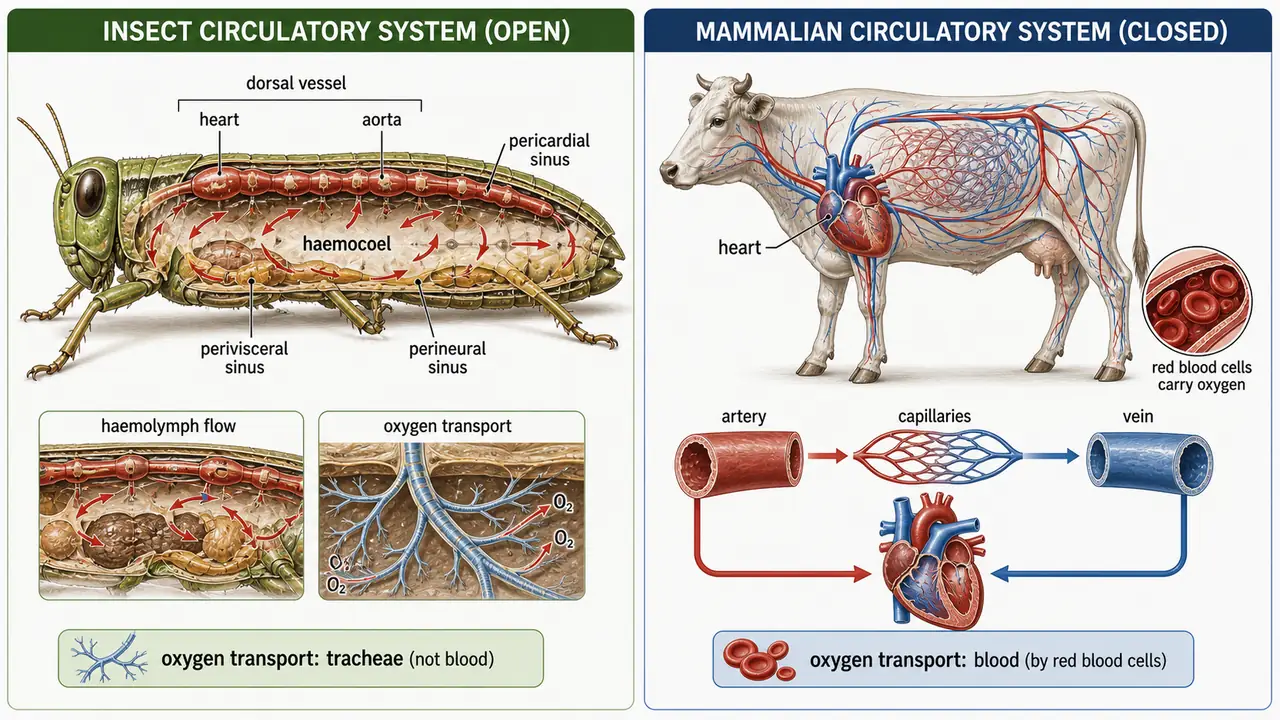
| Feature | Insect (Open) | Mammal (Closed) |
|---|---|---|
| Blood confinement | Flows freely through body cavity (haemocoel) | Confined within blood vessels |
| Blood name | Haemolymph (colourless or pale green/yellow) | Blood (red, with haemoglobin) |
| Blood cells | Haemocytes (in plasma) | RBC + WBC |
| Oxygen transport | Not by blood (tracheal system delivers O2 directly) | By haemoglobin in RBCs |
| Blood sugar | Trehalose (stable disaccharide) | Glucose |
| Heart position | Dorsal | Ventral (in chest) |
Haemocoel -- The Body Cavity
Swimming pool analogy: In mammals, blood flows through pipes (blood vessels) like water in plumbing. In insects, organs float in a pool of haemolymph (the haemocoel) -- like organs swimming in a bathtub. The heart just keeps the "pool water" circulating, but nutrients reach organs by simply soaking into them.
Pro Content Locked
Upgrade to Pro to access this lesson and all other premium content.
Charged once for one year · ₹1188 total
Save ₹100/month vs ₹2388/year launch price
- All Agriculture & Banking Courses
- AI Lesson Questions (100/day)
- AI Doubt Solver (50/day)
- Glows & Grows Feedback (30/day)
- AI Section Quiz (20/day)
- 22-Language Translation (100/day)
- Recall Questions (20/day)
- AI Quiz (15/day)
- AI Quiz Paper Analysis (100/day)
- AI Step-by-Step Explanations (100/day)
- Spaced Repetition Recall (FSRS)
- AI Tutor
- Immersive Text Questions
- Audio Lessons — Hindi & English
- Mock Tests & Previous Year Papers
- Summary & Mind Maps
- XP, Levels, Leaderboard & Badges
- Generate New Classrooms
- Voice AI Teacher (AgriDots Live)
- AI Revision Assistant
- Knowledge Gap Analysis
- Interactive Revision (LangGraph)
🔒 Secure one-time yearly payment via Razorpay · No hidden fees
In the previous lesson, we studied the tracheal respiratory system that delivers oxygen directly to tissues. Now we examine the circulatory system -- the open haemolymph circuit that transports nutrients, hormones, and immune cells throughout the body.
When a ladybird beetle is disturbed, it deliberately releases drops of yellowish fluid from its leg joints -- a phenomenon called reflex bleeding. This fluid is haemolymph (insect blood), which contains bitter compounds that repel predators. Unlike our closed circulatory system with red blood in vessels, insects have an open circulatory system where colourless haemolymph flows freely through body cavities. Understanding this system explains why systemic insecticides work -- they are absorbed into the haemolymph and reach every tissue the blood bathes.
This lesson covers:
- Open vs. closed circulation -- how insect haemolymph differs from vertebrate blood
- Dorsal blood vessel -- aorta and heart with ostia
- Haemolymph properties -- trehalose, haemocytes, and seven functions
Open vs. Closed Circulatory System
| Feature | Insect (Open) | Mammal (Closed) |
|---|---|---|
| Blood confinement | Flows freely through body cavity (haemocoel) | Confined within blood vessels |
| Blood name | Haemolymph (colourless or pale green/yellow) | Blood (red, with haemoglobin) |
| Blood cells | Haemocytes (in plasma) | RBC + WBC |
| Oxygen transport | Not by blood (tracheal system delivers O2 directly) | By haemoglobin in RBCs |
| Blood sugar | Trehalose (stable disaccharide) | Glucose |
| Heart position | Dorsal | Ventral (in chest) |
Haemocoel -- The Body Cavity
Swimming pool analogy: In mammals, blood flows through pipes (blood vessels) like water in plumbing. In insects, organs float in a pool of haemolymph (the haemocoel) -- like organs swimming in a bathtub. The heart just keeps the "pool water" circulating, but nutrients reach organs by simply soaking into them.
The body cavity filled with haemolymph is the haemocoel (not a true coelom -- it is a blood-filled space from the embryonic blastocoel).
Two fibromuscular diaphragms divide the haemocoel into three sinuses:
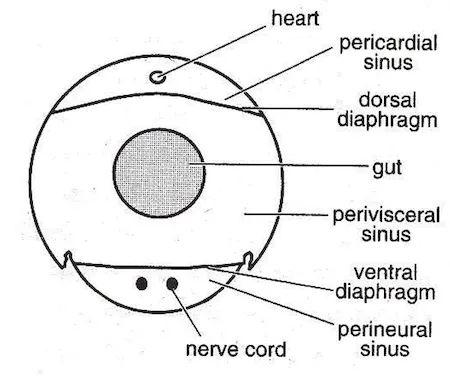
| Sinus | Position | Contents |
|---|---|---|
| Dorsal (Pericardial) | Between tergum and dorsal diaphragm | Heart (suspended by alary muscles) |
| Visceral | Between dorsal and ventral diaphragms | Alimentary canal, gonads (largest sinus) |
| Ventral (Perineural) | Between sternum and ventral diaphragm | Ventral nerve cord |
The Dorsal Blood Vessel
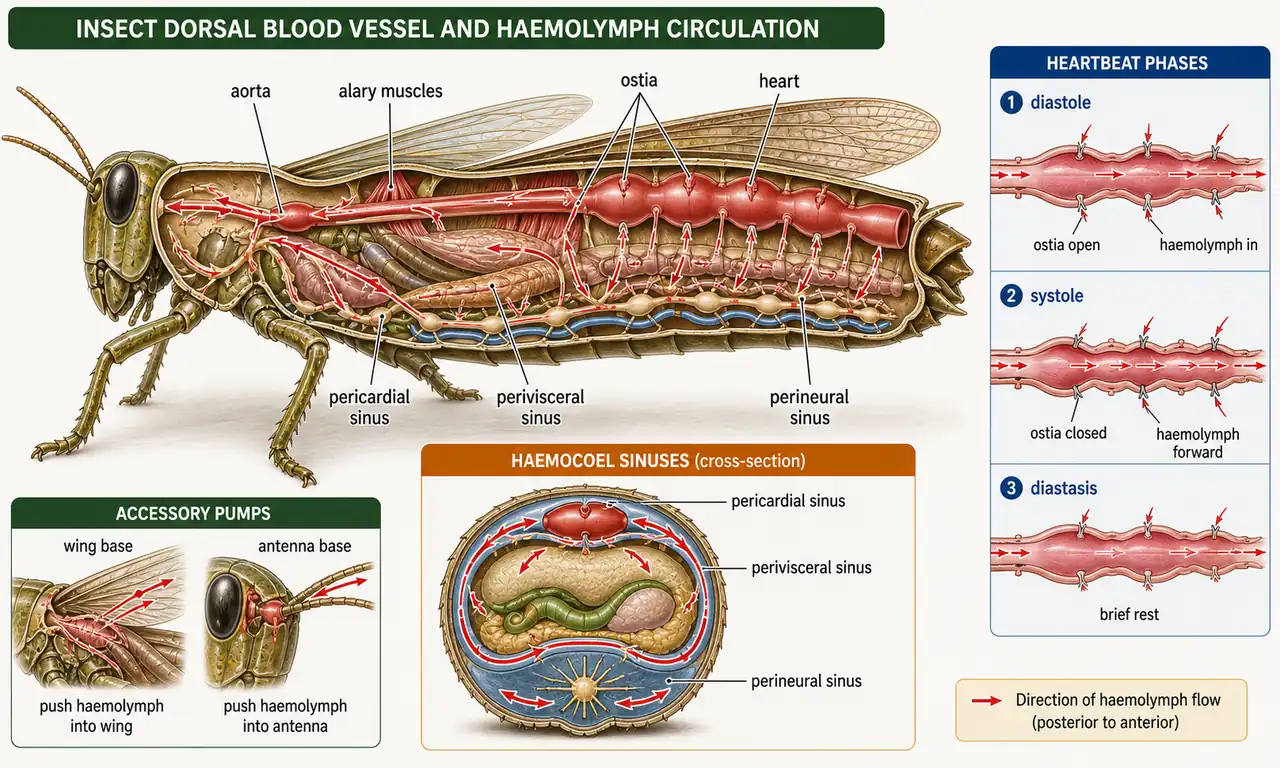
The principal blood-conducting organ -- a tube running along the entire dorsal midline, closed posteriorly and open anteriorly into the head.
Aorta (Anterior)
- Simple tube without valves or chambers in the thoracic region.
- Carries haemolymph forward from heart to head, releasing it into the haemocoel.
- Sometimes divides into 2 or more cephalic arteries in the head.
Heart (Posterior)
- Extends through the abdomen to its terminal end.
- Held in position by fan-shaped alary muscles (anchor heart + help draw haemolymph in).
- Consists of multiple chambers marked by constrictions.
- Each chamber has valve-like openings called ostia (singular: ostium) -- allow haemolymph entry but prevent backflow.
| Feature | Detail |
|---|---|
| Maximum ostia | Up to 3 thoracic + 9 abdominal = 12 pairs total |
| All 12 pairs present in | Grasshopper (Dictyoptera) -- reflects primitive body plan |
| Heart wall | Muscular (contracts to pump blood) |
Accessory Pulsatile Organs
- Sac-like structures at the base of wings, legs, and antennae.
- Pulsate independently to push haemolymph into narrow, elongated appendages.
- Necessary because the main heart cannot generate enough pressure for these distant extremities.
Process of Blood Circulation
Circulation is generally anti-clockwise -- posterior to anterior (backward to forward).
Three Phases of the Heartbeat
| Phase | Action | Mechanism |
|---|---|---|
| Diastole | Heart expands | Alary muscles contract → pull heart walls outward → negative pressure draws haemolymph in through ostia |
| Systole | Heart contracts | Heart muscles contract → compress chamber → push haemolymph forward through aorta → ostia close (prevent backflow) |
| Diastasis | Brief rest | Neither expansion nor contraction -- momentary pause between cycles |
Exam trap: "Diastasis is the contraction stage" is incorrect. Diastasis is the resting stage. Systole is contraction.
Properties of Haemolymph
| Property | Detail |
|---|---|
| Colour | Usually colourless, green (chlorophyll), or yellowish. Exception: Chironomus (bloodworm) midge larvae have red haemolymph (contain haemoglobin -- live in oxygen-poor environments) |
| Body weight | 5--40% of total body weight |
| Composition | Proteins, lipids, sugars, organic acids, phosphates, pigments, uric acid |
| Blood sugar | Trehalose (non-reducing disaccharide of two glucose molecules; stable and efficient energy storage) |
| pH | 6--7 |
| Specific gravity | 1.01--1.06 |
| Ionic composition | Phytophagous insects: rich in K (from plant sap). Carnivorous insects: rich in Na (from animal tissue) |
Functions of Haemolymph
| Function | Details | Agricultural Relevance |
|---|---|---|
| Nutrient transport | Transports minerals, digested products, hormones (not oxygen -- that is the tracheal system's job) | Systemic insecticides travel via haemolymph to reach all tissues |
| Water storage | Stores water for tissues | -- |
| Moulting assistance | Hydrostatic pressure helps inflate new cuticle and split old exoskeleton | -- |
| Encapsulation | Haemocytes aggregate around large parasites (2--3 layer capsule) → death by O2 deprivation | Defence against parasitoid eggs/larvae |
| Phagocytosis | Haemocytes engulf bacteria, viruses, fungi (principal function of haemocytes) | Insect innate immune system |
| Immunity | Produces antibodies to restrict infections | -- |
| Connective tissue | Provides lipoproteins for connective tissue formation | -- |
| Wound healing | Haemocytes extend pseudopodia forming cellular network; coagulate to form plug | -- |
| Detoxification | Haemocytes metabolise toxic chemicals | Contributes to insecticide resistance |
| Reflex bleeding | Deliberate release of haemolymph through pores/slits in cuticle; contains bitter/toxic compounds | Ladybird beetles, blister beetles deter predators |
Additional Circulatory Facts
| Fact | Detail |
|---|---|
| Blood pH | 6–8 |
| Antifreeze compound | Glycerol — accumulates in haemolymph of cold-hardy insects to prevent ice crystal formation |
| Temperature regulation | Insects are poikilothermic (cold-blooded) — body temperature fluctuates with environment |
| Favourable temperature range | 13–35°C for most insects |
| Stenothermic | Organisms with a narrow temperature tolerance range |
| Diastasis | Period of rest between two successive heartbeats (neither expansion nor contraction) |
| Compound eyes | Fixed — insects cannot move their compound eyes (unlike vertebrate eyes) |
| Rhodopsin | Chemical (visual pigment) in rhabdom of compound eye ommatidia; essential for insect vision |
| Prohaemocytes | Stem-like precursor haemocytes from which other haemocyte types are derived |
| Granulocytes | Granule-rich haemocytes commonly described as adhesive and strongly phagocytic |
Exam Tips
Open circulatory system = insects. "Insects have closed circulatory system" is incorrect.
Haemolymph does NOT carry oxygen. That is the tracheal system's job. A frequently tested distinction.
Blood sugar = Trehalose (not glucose). Trehalose is a stable disaccharide of two glucose molecules.
Grasshopper = 12 pairs of ostia (maximum primitive number). Remember: "Grasshopper = Greatest ostia."
Diastasis = rest (not contraction). Diastole = expansion. Systole = contraction.
K in phytophagous, Na in carnivorous blood -- reflects dietary source.
Chironomus = red blood (haemoglobin). The exception to the "colourless haemolymph" rule.
Summary Cheat Sheet
| Concept | Key Detail |
|---|---|
| Circulatory system type | Open (haemolymph in haemocoel) |
| Haemolymph | Colourless blood; plasma + haemocytes |
| Blood sugar | Trehalose (disaccharide) |
| Oxygen transport | NOT by blood (tracheal system) |
| Haemocoel sinuses | Pericardial (heart), Visceral (organs), Perineural (nerve cord) |
| Dorsal vessel | Aorta (anterior, thorax) + Heart (posterior, abdomen) |
| Ostia | Valve-like openings; allow haemolymph into heart; max 12 pairs (grasshopper) |
| Alary muscles | Fan-shaped; anchor heart; help draw haemolymph in |
| Heartbeat phases | Diastole (expand) → Systole (contract) → Diastasis (rest) |
| Accessory pulsatile organs | Independent pumps at base of wings, legs, antennae |
| Phagocytosis | Principal function of haemocytes |
| Prohaemocytes | Precursor haemocytes |
| Granulocytes | Adhesive, phagocytic, granule-rich haemocytes |
| Reflex bleeding | Defensive haemolymph release; toxic/bitter compounds |
| Chironomus exception | Red haemolymph with haemoglobin |
TIP
Next: The next lesson covers the nervous system -- the coordination centre that processes sensory information and controls insect behaviour.
References
1 source
References
Lesson Doubts
Ask questions, get expert answers