🫁 Insect Respiratory System
Tracheal system structure, spiracles and taenidia, mechanism of respiration, and alternative respiratory methods (cutaneous, gills, plastron, air sacs)
In the previous lesson, we studied the excretory system and how Malpighian tubules remove nitrogenous waste. Now we examine how insects obtain the oxygen needed for the metabolism that generates that waste: the respiratory system.
Fumigant insecticides like aluminium phosphide (used in grain storage) work by releasing phosphine gas that enters the insect's body through its spiracles and travels directly to tissues via the tracheal system. Unlike mammals that rely on lungs and blood to carry oxygen, insects deliver oxygen directly to every cell through a network of internal air tubes. This direct-delivery system is one of the most efficient respiratory mechanisms in the animal kingdom -- and understanding it is key to knowing how fumigants and certain insecticides work.
This lesson covers:
- Tracheal system -- tracheae, tracheoles, and taenidia
- Spiracles -- the 10-pair entry points and open vs. closed systems
- Seven types of respiration -- cutaneous, tracheal gills, rectal gills, plastron, and more
The Tracheal System
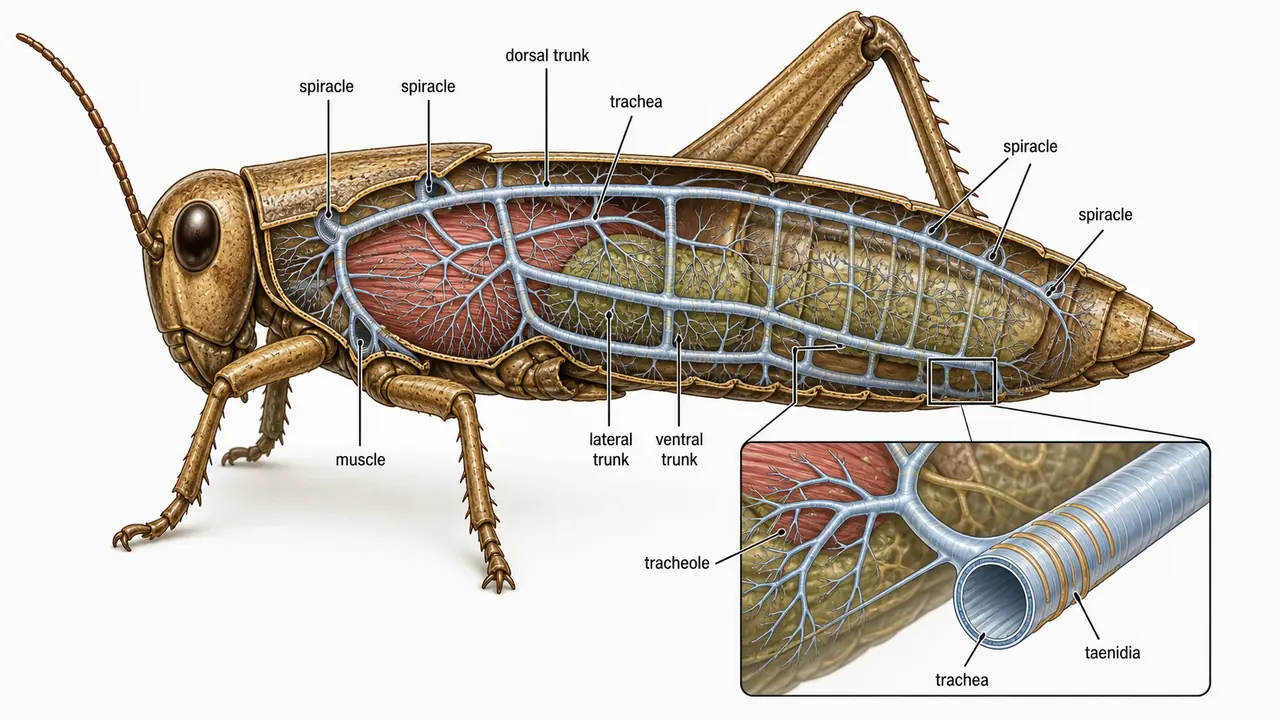
Plumbing analogy: Imagine your house had no water tank or pump, but instead had pipes running directly from the water source to every tap, every appliance, even every room. That's how the insect tracheal system works -- air tubes deliver oxygen directly to individual cells, bypassing the need for blood to carry it. It's like having a dedicated air duct to every room in a building.
Pro Content Locked
Upgrade to Pro to access this lesson and all other premium content.
Charged once for one year · ₹1188 total
Save ₹100/month vs ₹2388/year launch price
- All Agriculture & Banking Courses
- AI Lesson Questions (100/day)
- AI Doubt Solver (50/day)
- Glows & Grows Feedback (30/day)
- AI Section Quiz (20/day)
- 22-Language Translation (100/day)
- Recall Questions (20/day)
- AI Quiz (15/day)
- AI Quiz Paper Analysis (100/day)
- AI Step-by-Step Explanations (100/day)
- Spaced Repetition Recall (FSRS)
- AI Tutor
- Immersive Text Questions
- Audio Lessons — Hindi & English
- Mock Tests & Previous Year Papers
- Summary & Mind Maps
- XP, Levels, Leaderboard & Badges
- Generate New Classrooms
- Voice AI Teacher (AgriDots Live)
- AI Revision Assistant
- Knowledge Gap Analysis
- Interactive Revision (LangGraph)
🔒 Secure one-time yearly payment via Razorpay · No hidden fees
In the previous lesson, we studied the excretory system and how Malpighian tubules remove nitrogenous waste. Now we examine how insects obtain the oxygen needed for the metabolism that generates that waste: the respiratory system.
Fumigant insecticides like aluminium phosphide (used in grain storage) work by releasing phosphine gas that enters the insect's body through its spiracles and travels directly to tissues via the tracheal system. Unlike mammals that rely on lungs and blood to carry oxygen, insects deliver oxygen directly to every cell through a network of internal air tubes. This direct-delivery system is one of the most efficient respiratory mechanisms in the animal kingdom -- and understanding it is key to knowing how fumigants and certain insecticides work.
This lesson covers:
- Tracheal system -- tracheae, tracheoles, and taenidia
- Spiracles -- the 10-pair entry points and open vs. closed systems
- Seven types of respiration -- cutaneous, tracheal gills, rectal gills, plastron, and more
The Tracheal System
Plumbing analogy: Imagine your house had no water tank or pump, but instead had pipes running directly from the water source to every tap, every appliance, even every room. That's how the insect tracheal system works -- air tubes deliver oxygen directly to individual cells, bypassing the need for blood to carry it. It's like having a dedicated air duct to every room in a building.
- Insects lack lungs. Respiration occurs through tracheae -- hollow tubes floating in the haemocoel -- and their fine branches called tracheoles.
- Tracheoles penetrate into tissues and can even enter individual cells (intracellular), delivering oxygen directly to the site of cellular respiration without any intermediary like haemoglobin.
- Taenidia -- spiral chitinous thickenings inside tracheae -- prevent collapse during respiration (like the spiral wire inside a vacuum cleaner hose that keeps it from collapsing when bent). Taenidia are absent in tracheoles.
- The familiar ringed or annulated appearance of larger tracheae is due to these spiral taenidial ridges.
Spiracles -- The Entry Points
- Air enters through spiracles -- paired lateral openings on pleural surfaces of thoracic and abdominal segments.
- Total: 10 pairs (2 thoracic + 8 abdominal) in the typical/primitive condition.
- Each spiracle has:
- Peritreme -- hardened rim around the opening
- Atrium -- chamber just inside (may contain filtering hairs/sieve plates to block dust and parasites)
- Closing mechanism -- valves that open for gas exchange and close to minimise water loss
Air enters through spiracles, NOT tracheoles. Tracheoles are the fine internal branches. This distinction is a frequently tested trap.
Open vs. Closed Tracheal System
| Type | Spiracles | Gas Exchange | Found In |
|---|---|---|---|
| Open | Functional | Air enters directly through spiracles | Most terrestrial insects |
| Closed | Sealed/non-functional | Through body wall or specialised gills | Many aquatic larvae |
Spiracle Arrangement Terms
Classical entomology also names insects by how many spiracles remain functional:
| Term | Meaning | Exam Recall |
|---|---|---|
| Holopneustic | All normal spiracles functional | Typical condition with 10 pairs open: 2 thoracic + 8 abdominal |
| Metapneustic | Only the posterior spiracles functional | Commonly described as a single posterior/post-abdominal pair |
| Apneustic | Spiracles absent | Gas exchange occurs through the body surface or special respiratory structures; classic example: Chironomid larva |
These terms describe the pattern of functional spiracles, not a separate respiratory organ. In exam questions, apneustic is often paired with aquatic or soft-bodied immature stages.
Tracheal Trunks
Tracheae from spiracles join with neighbouring spiracles to form longitudinal trunks -- the main highways of the system.
| Trunk | Number | Supplies |
|---|---|---|
| Dorsal | 1 | Proximal body parts + heart |
| Lateral | 2 | Alimentary canal, legs, gonads, wings |
| Ventral | 1 | Central nervous system |
Mechanism of Respiration
| Process | Direction | Mechanism |
|---|---|---|
| Inspiration (O2 inward) | External air → spiracles → tracheae → tracheoles → cells | Ventilation (active pumping by abdominal muscles) + Diffusion (concentration gradient: high O2 outside → low O2 in tissues) |
| Expiration (CO2 + H2O outward) | Cells → tracheoles → tracheae → spiracles → outside | Reverse diffusion (CO2 moves from high concentration in tissues to low concentration outside) |
Ventilation = active pumping through rhythmic abdominal compression/expansion. Diffusion = passive gas movement along concentration gradients. Both work together.
Other Types of Respiration
1. Cutaneous Respiration (Through Body Wall)
| Feature | Detail |
|---|---|
| When | Spiracles absent; body wall thin enough for direct gas diffusion |
| Effective in | Very small insects with high surface-area-to-volume ratio |
| Examples | Protura, Collembola, endoparasitic insects |
Note: The tracheal system is entirely absent in Protura and many Collembola — gas exchange occurs solely through the body wall. Tracheae are of ectodermal origin (same as the integument), which is why they are shed and renewed during each moult.
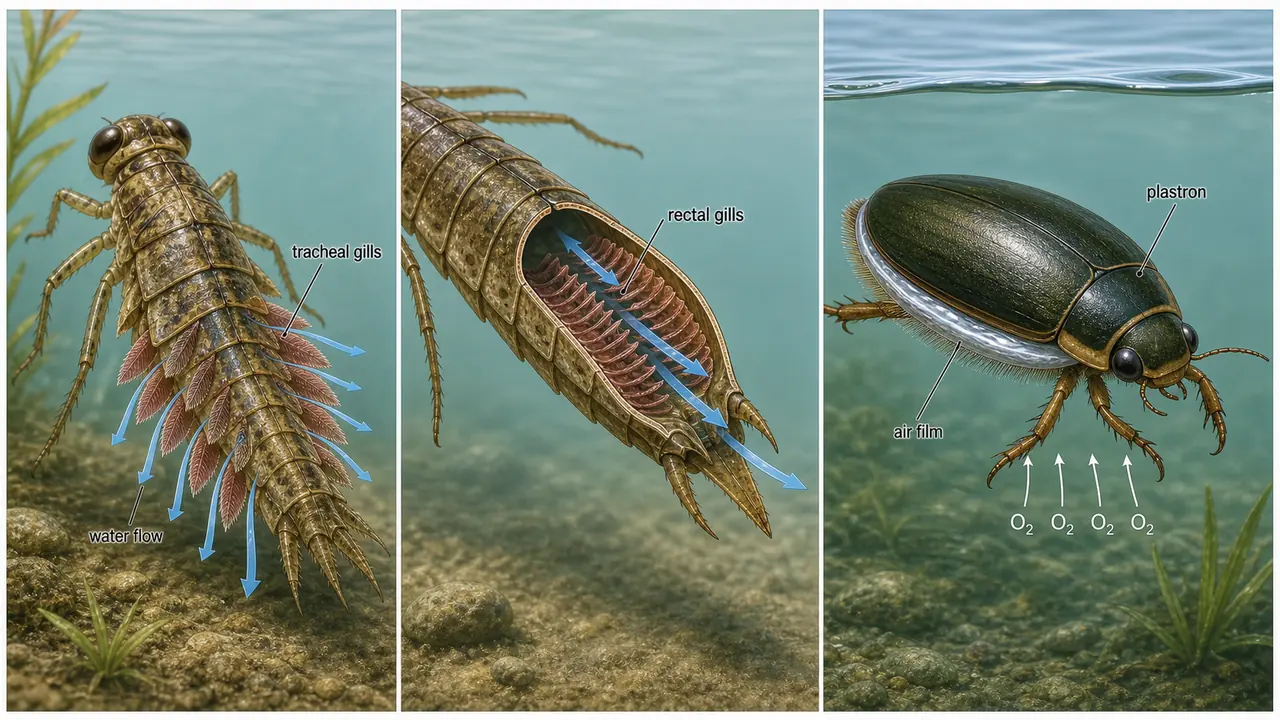
2. Tracheal Gills (Abdominal Gills)
| Feature | Detail |
|---|---|
| Structure | Thin-walled outgrowths of body wall richly supplied with tracheae |
| Shape | Lamellate (broad, flat) or filamentous (thread-like) |
| Function | Absorb dissolved oxygen from water |
| Examples | Larva of Trichoptera, nymphs of Ephemeroptera (mayfly) |
3. Spiracular Gills
| Feature | Detail |
|---|---|
| Structure | Peritreme/atrium of spiracles drawn into long filaments |
| Adaptation | Both aquatic and aerial respiration |
| Found in | Some aquatic pupae (especially in fast-flowing streams) |
4. Blood Gills
| Feature | Detail |
|---|---|
| Structure | Tubular or finger-shaped (digitiform) or eversible structures at anal end |
| Function | Primarily osmoregulation (water and ion balance), NOT respiration despite the name |
| Examples | 4--6 in larva of Trichoptera; 2 pairs + 4 shorter anal gills in Chironomid larva |
5. Rectal Gills
| Feature | Detail |
|---|---|
| Structure | Rectum modified into barrel-like chamber; rectal wall forms basal pads + distal gill filaments rich in tracheoles |
| Unique to | Dragonfly naiads |
| Dual function | Respiration (extract dissolved O2 by pumping water in/out of rectum) + Jet propulsion (forcefully expelling water for rapid escape) |
6. Air Sacs
| Feature | Detail |
|---|---|
| Structure | Balloon-like tracheal expansions; no taenidia (flexible and compressible) |
| Functions | Air reservoir for ventilation; reduce body density (aid flight); help actively pump air during vigorous activity |
| Found in | Many winged insects |
7. Plastron Respiration
| Feature | Detail |
|---|---|
| Structure | Permanent thin film of air held by hydrofuge (water-repelling) hairs, scales, or cuticular processes |
| Function | Acts as a physical gill -- as O2 is consumed, O2 partial pressure drops below surrounding water, causing dissolved O2 to diffuse from water into the air film. Insect never needs to surface. |
| Condition | Only works if water is sufficiently oxygenated |
| Examples | Aquatic beetles |
Comparison of Respiratory Types
| Type | Medium | Structure | Example |
|---|---|---|---|
| Tracheal (open) | Air | Spiracles → tracheae → tracheoles | Most terrestrial insects |
| Tracheal (closed) | Water | Sealed spiracles; gas exchange via body wall/gills | Aquatic larvae |
| Cutaneous | Air/Water | Body wall | Protura, Collembola |
| Tracheal gills | Water | Thin-walled outgrowths with tracheae | Mayfly nymphs |
| Rectal gills | Water | Modified rectum | Dragonfly naiads |
| Plastron | Water | Permanent air film (physical gill) | Aquatic beetles |
| Air sacs | Air | Expanded tracheae (no taenidia) | Winged insects |
Exam Tips
Air enters through SPIRACLES, not tracheoles. Tracheoles are the fine internal tubes that deliver O2 to cells.
10 pairs of spiracles = 2 thoracic + 8 abdominal. This is the standard number.
Taenidia prevent tracheal collapse; they are absent in tracheoles.
Dragonfly naiads = RECTAL gills (not tracheal gills). The rectum is modified for both breathing and jet propulsion.
Blood gills ≠ respiration. Despite the name, they are primarily for osmoregulation (water/ion balance).
Plastron = permanent physical gill in aquatic beetles. The insect never needs to surface if water has enough dissolved O2.
Protura = cutaneous respiration (body wall breathing). Protura have no spiracles.
Summary Cheat Sheet
| Concept | Key Detail |
|---|---|
| Tracheal system | Hollow tubes (tracheae/tracheoles) delivering O2 directly to tissues |
| Spiracles | 10 pairs (2 thoracic + 8 abdominal); external openings with closing valves |
| Taenidia | Spiral chitinous reinforcements preventing tracheal collapse; absent in tracheoles |
| Tracheal trunks | 4 total: 1 dorsal, 2 lateral, 1 ventral |
| Respiration mechanism | Ventilation (active pumping) + Diffusion (concentration gradient) |
| Cutaneous | Through body wall; Protura, Collembola |
| Tracheal gills | Abdominal outgrowths; lamellate or filamentous; mayfly nymphs |
| Rectal gills | Dragonfly naiads; rectum modified; respiration + jet propulsion |
| Blood gills | Osmoregulation (NOT respiration); Trichoptera, Chironomid larvae |
| Air sacs | Expandable tracheal reservoirs; no taenidia; aid flight |
| Plastron | Permanent air film; physical gill; aquatic beetles |
TIP
Next: The next lesson covers the circulatory system -- the open haemolymph-based system that bathes all internal organs.
References
1 source
References
Lesson Doubts
Ask questions, get expert answers