💩 Insect Excretory System
Malpighian tubules, cryptonephry, and seven excretory organs including nephrocytes, fat bodies, urate cells, and chloride cells
In the previous lesson, we traced food through the insect digestive system -- from ingestion to egestion. Now we examine how insects handle the toxic waste products generated by metabolism: the excretory system.
Stored grain pests like the flour beetle can survive in extremely dry environments -- flour has almost no free water. How do they manage? Their excretory system is so efficient at conserving water that they excrete uric acid (a nearly waterless solid) and reclaim almost all moisture from their faeces. Some even use a special arrangement called cryptonephry where Malpighian tubules wrap around the rectum to extract every last drop of water. This water-saving mastery is a key reason why storage pests are so hard to eliminate.
This lesson covers:
- Malpighian tubules -- the chief excretory organ and cryptonephry
- Nine excretory organs -- from nephrocytes to chloride cells
- Uric acid excretion -- why insects excrete uric acid for water conservation
What Is Excretion?
Think of it this way: When you eat protein, your body breaks it down and produces nitrogen-containing waste (like urea in urine). Insects face the same problem -- but they have a much harder challenge: they must get rid of this waste while losing almost no water. Their solution? Convert waste to solid uric acid instead of liquid urine. It's like the difference between throwing away a wet sponge vs. a dry powder.
Pro Content Locked
Upgrade to Pro to access this lesson and all other premium content.
Charged once for one year · ₹1188 total
Save ₹100/month vs ₹2388/year launch price
- All Agriculture & Banking Courses
- AI Lesson Questions (100/day)
- AI Doubt Solver (50/day)
- Glows & Grows Feedback (30/day)
- AI Section Quiz (20/day)
- 22-Language Translation (100/day)
- Recall Questions (20/day)
- AI Quiz (15/day)
- AI Quiz Paper Analysis (100/day)
- AI Step-by-Step Explanations (100/day)
- Spaced Repetition Recall (FSRS)
- AI Tutor
- Immersive Text Questions
- Audio Lessons — Hindi & English
- Mock Tests & Previous Year Papers
- Summary & Mind Maps
- XP, Levels, Leaderboard & Badges
- Generate New Classrooms
- Voice AI Teacher (AgriDots Live)
- AI Revision Assistant
- Knowledge Gap Analysis
- Interactive Revision (LangGraph)
🔒 Secure one-time yearly payment via Razorpay · No hidden fees
In the previous lesson, we traced food through the insect digestive system -- from ingestion to egestion. Now we examine how insects handle the toxic waste products generated by metabolism: the excretory system.
Stored grain pests like the flour beetle can survive in extremely dry environments -- flour has almost no free water. How do they manage? Their excretory system is so efficient at conserving water that they excrete uric acid (a nearly waterless solid) and reclaim almost all moisture from their faeces. Some even use a special arrangement called cryptonephry where Malpighian tubules wrap around the rectum to extract every last drop of water. This water-saving mastery is a key reason why storage pests are so hard to eliminate.
This lesson covers:
- Malpighian tubules -- the chief excretory organ and cryptonephry
- Nine excretory organs -- from nephrocytes to chloride cells
- Uric acid excretion -- why insects excrete uric acid for water conservation
What Is Excretion?
Think of it this way: When you eat protein, your body breaks it down and produces nitrogen-containing waste (like urea in urine). Insects face the same problem -- but they have a much harder challenge: they must get rid of this waste while losing almost no water. Their solution? Convert waste to solid uric acid instead of liquid urine. It's like the difference between throwing away a wet sponge vs. a dry powder.
- The process of eliminating nitrogenous waste products (harmful) from the insect body.
- Maintains internal environment and ionic balance of haemolymph.
- Without excretion, toxic nitrogenous wastes would poison the insect's tissues.
Forms of Excretory Products
| Form | Product | Example Context |
|---|---|---|
| Gaseous | CO2 | Via tracheal system |
| Liquid | Honeydew | Sap-sucking insects (aphids) |
| Solid | Uric acid / Urea | Terrestrial insects |
| Semi-solid | Allantoin | Some insects |
Key principle: Aquatic insects can excrete dilute ammonia. Terrestrial insects must produce water-insoluble uric acid to conserve water -- a critical adaptation for land life.
Excretory Organs
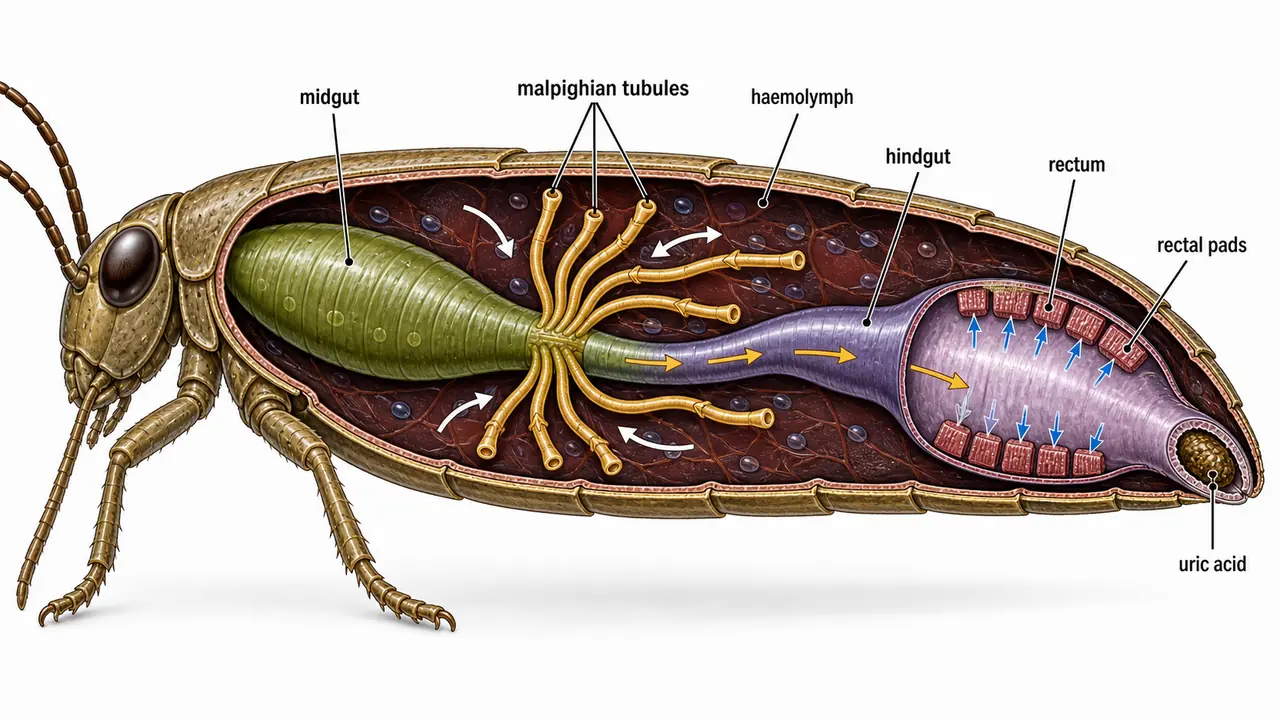
1. Malpighian Tubules -- The Chief Excretory Organ
The functional equivalent of vertebrate kidneys, filtering haemolymph and removing nitrogenous wastes.
| Feature | Detail |
|---|---|
| Structure | Long, tubular; open at proximal end into midgut-hindgut junction; blind (closed) at distal end |
| Position | Distal ends float freely in haemolymph, waving around to filter solutes |
| Primitive number | Six |
| Variation | Lepidoptera: 6; Isoptera: 2--8; Orthoptera: 2--200 |
| Absent in | Collembola and aphids |
| Discovered by | Italian scientist Marcello Malpighi (1669); named by Heckel (1820) |
Functions
| Function | Detail |
|---|---|
| Excretion | Actively transport waste (uric acid, K+ ions) from haemolymph into tubule lumen |
| Ionic and water balance | Regulate internal body environment |
| Bioluminescence | In glow worms, distal ends produce light energy to attract prey |
| Calcium storage | Store Ca needed for processes like puparium hardening |
Cryptonephry (Cryptonephridial Condition)
| Feature | Detail |
|---|---|
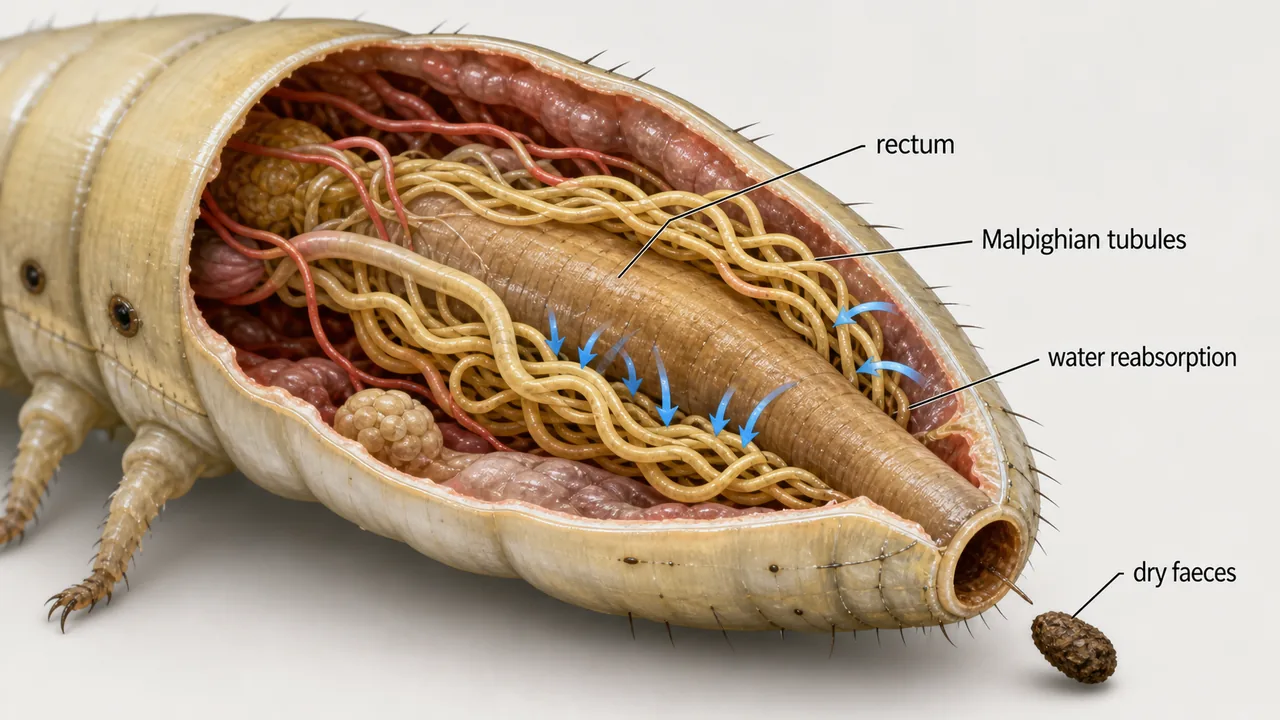
| What | Distal ends of Malpighian tubules reattach to the alimentary canal, opening into the rectum of hindgut |
| How it works | Creates a counter-current system between tubules and rectal wall, extracting water from faeces with extreme efficiency |
| Result | Insect produces very dry faeces -- survives in desiccating environments |
| Found in | Larvae of Lepidoptera (caterpillars) and larva + adult of Coleoptera (beetles) |
| Why these groups? | Many feed on dry food (stored grains, wood, dried plant material) where water is scarce |
Exam note: "Butterflies have cryptonephridial condition" is correct (butterfly larvae = caterpillars = Lepidoptera). This is a frequently tested statement.
2. Nephrocytes
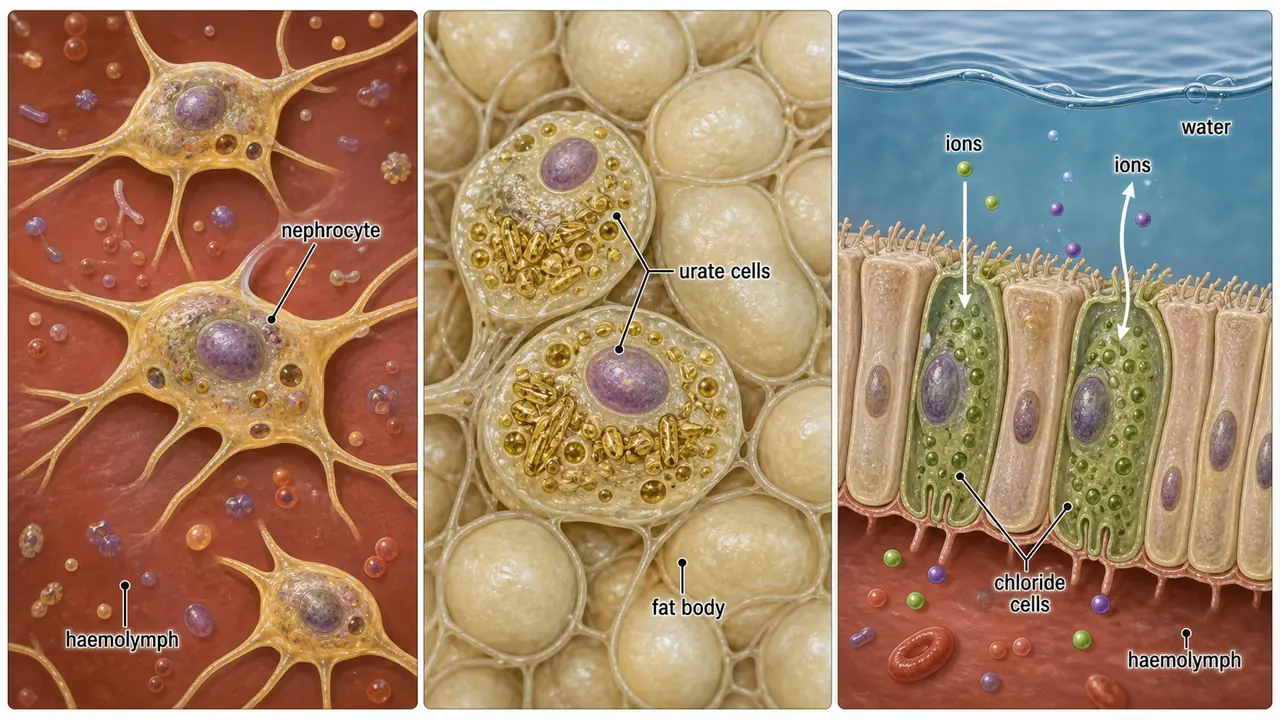
- Specialised cells scattered in the body cavity.
- Take up large molecules and colloidal particles (high molecular weight) that Malpighian tubules cannot handle.
- Function through pinocytosis (cell drinking).
3. Integument
- During moulting, waste products (uric acid etc.) deposited in the cuticle are removed as exuviae (shed skin).
- Moulting thus serves a dual purpose: allowing growth AND removing accumulated wastes.
- In insects with cutaneous respiration, CO2 is removed through the integument.
4. Tracheal System
- The primary route for gaseous excretion (CO2 removal) through spiracles.
5. Alimentary Canal
- The gut removes unwanted material, dead cells from holocrine secretion (entire cell disintegrates to release enzymes), and intima layer during moulting.
- Rectal pads in the rectum efficiently extract water, ions, and useful metabolites from faecal pellets before expulsion.
6. Fat Bodies
- Loose or compact aggregation of cells (mostly trophocytes) suspended in the haemocoel.
- The insect equivalent of vertebrate liver + adipose tissue combined.
- Functions: energy storage (lipids, glycogen), protein synthesis, and waste sequestration.
7. Oenocytes
- Specialised cells of the haemocoel, epidermis, or fat body.
- Multiple functions including excretion, lipid metabolism, and production of cuticular hydrocarbons (waterproofing).
8. Urate Cells and Storage Excretion
- Some fat body cells store uric acid as granules -- these are called urate cells.
- This phenomenon is called storage excretion: instead of expelling waste, the insect stores it.
- When dietary nitrogen is scarce, symbiotic microorganisms can break down stored uric acid to recycle nitrogen for protein synthesis.
Additional Excretory Facts
- Rectum reabsorbs water from faecal pellets before expulsion via rectal pads.
- In dragonfly nymphs (naiads), the rectum also bears tracheal gills — serving dual roles of water reabsorption and respiration.
- Rectal papillae = specialised cells in the rectal wall responsible for active water conservation (alternative term for rectal pads in some texts).
- Diuresis = the process of removing excess water from the extracellular compartment (haemolymph) — the opposite function to water conservation.
- Cryptonephridial condition = Malpighian tubules closely applied to the rectum wall, creating a counter-current moisture absorption system. Seen in stored grain beetles (Coleoptera) and Lepidoptera larvae, enabling survival in very dry environments.
9. Chloride Cells
- Found only in aquatic insects (NOT terrestrial) -- e.g., larvae of mayfly, stonefly.
- Absorb ions from the body and excrete them into the surrounding water.
- Maintain osmotic balance -- prevent haemolymph from becoming too dilute (freshwater) or too concentrated (saline).
Comparison of Excretory Organs
| Organ | Primary Function | Waste Type | Found In |
|---|---|---|---|
| Malpighian tubules | Chief excretory organ | Uric acid, ions | All insects except Collembola & aphids |
| Nephrocytes | Remove large molecules | High MW compounds | All insects |
| Integument | Remove waste via moulting | Uric acid in cuticle | All insects |
| Tracheal system | Gaseous excretion | CO2 | All insects |
| Alimentary canal | Faecal excretion + water recovery | Dead cells, waste | All insects |
| Fat bodies | Storage, synthesis, waste holding | Lipids, glycogen, waste | All insects |
| Urate cells | Storage excretion | Uric acid granules | Nitrogen-poor diet insects |
| Chloride cells | Osmoregulation | Ions | Aquatic insects only |
Exam Tips
Malpighian tubules = chief excretory organ (NOT integument). The integument is a secondary excretory route.
Primitive number of Malpighian tubules = 6. Not "a pair" -- the number varies (2--200 in Orthoptera).
Cryptonephridial condition: Found in Lepidoptera larvae (caterpillars/butterflies) and Coleoptera. The statement "butterflies have cryptonephridial condition" is correct.
Chloride cells = aquatic insects ONLY. The statement "chloride cells are found in terrestrial insects" is incorrect.
Storage excretion: Uric acid stored in fat body cells (urate cells), NOT in the rectum.
Absent in Collembola and aphids -- both lack Malpighian tubules.
Marcello Malpighi discovered Malpighian tubules in 1669.
Summary Cheat Sheet
| Concept | Key Detail |
|---|---|
| Chief excretory organ | Malpighian tubules (analogous to vertebrate kidneys) |
| Tubule position | Open at midgut-hindgut junction; blind distal end in haemolymph |
| Primitive number | 6 |
| Absent in | Collembola, aphids |
| Discovered by | Marcello Malpighi (1669) |
| Main excretory product | Uric acid (solid, water-insoluble -- conserves water) |
| Cryptonephry | Tubules reattach to rectum; extreme water recovery; Lepidoptera larvae + Coleoptera |
| Nephrocytes | Take up large molecules via pinocytosis |
| Storage excretion | Uric acid stored in urate cells (fat body); nitrogen recycled when diet is N-poor |
| Chloride cells | Osmoregulation; aquatic insects only (mayfly, stonefly larvae) |
| Dual role of moulting | Growth + waste removal (uric acid shed with exuviae) |
TIP
Next: The next lesson covers the respiratory system -- how insects deliver oxygen directly to tissues through an elegant network of internal air tubes.
References
1 source
References
Lesson Doubts
Ask questions, get expert answers