🍽️ Insect Digestive System
Structure and function of the alimentary canal (foregut, midgut, hindgut), process of digestion, filter chamber, and classification of insects by food habits
In the previous unit, we completed external morphology -- head, mouthparts, legs, wings, and abdomen. Now we begin insect physiology, starting with the system that processes the food acquired by those mouthparts: the digestive system.
When termites attack the wooden framework of a farm storage godown, they can digest the cellulose in wood -- something no vertebrate can do on its own. This remarkable ability comes from symbiotic protozoa living in the termite's hindgut, which produce the enzyme cellulase. Understanding the insect digestive system explains not only how pests feed and cause damage, but also how some insects (like honeybees converting nectar to honey in their crop) provide agricultural benefits.
This lesson covers:
- Three regions of the alimentary canal -- foregut, midgut, and hindgut
- Five steps of digestion -- ingestion through egestion
- Filter chamber -- how sap-feeding insects handle excess water
- Classification by food habits -- phytophagous, zoophagous, omnivorous
Overview
- Insects feed on solid food (leaves, wood, grains) or liquids (plant sap, nectar, blood).
- The diversity in food habits is a key factor behind their ecological success.
- Solid feeders have biting-chewing mouthparts; sap feeders have sucking mouthparts. Diet directly determines mouthpart structure.
- The alimentary canal is a long, muscular, tubular structure from mouth to anus, differentiated into three regions based on embryonic origin and function.
Three Regions of the Alimentary Canal
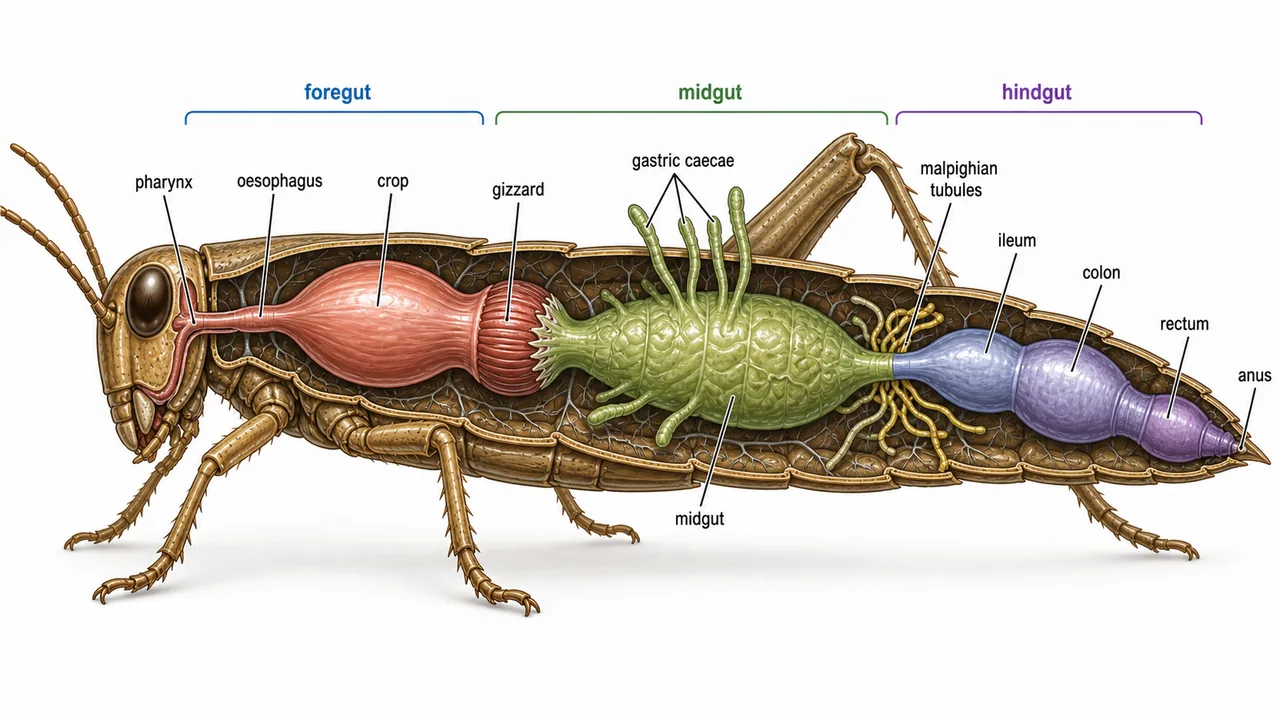
Kitchen analogy: The insect gut works like a food-processing line -- the foregut is the loading dock and pantry (receives and stores food), the midgut is the kitchen where food is cooked and nutrients extracted, and the hindgut is the waste management system that squeezes out every drop of useful water before disposal.
Pro Content Locked
Upgrade to Pro to access this lesson and all other premium content.
Charged once for one year · ₹1188 total
Save ₹100/month vs ₹2388/year launch price
- All Agriculture & Banking Courses
- AI Lesson Questions (100/day)
- AI Doubt Solver (50/day)
- Glows & Grows Feedback (30/day)
- AI Section Quiz (20/day)
- 22-Language Translation (100/day)
- Recall Questions (20/day)
- AI Quiz (15/day)
- AI Quiz Paper Analysis (100/day)
- AI Step-by-Step Explanations (100/day)
- Spaced Repetition Recall (FSRS)
- AI Tutor
- Immersive Text Questions
- Audio Lessons — Hindi & English
- Mock Tests & Previous Year Papers
- Summary & Mind Maps
- XP, Levels, Leaderboard & Badges
- Generate New Classrooms
- Voice AI Teacher (AgriDots Live)
- AI Revision Assistant
- Knowledge Gap Analysis
- Interactive Revision (LangGraph)
🔒 Secure one-time yearly payment via Razorpay · No hidden fees
In the previous unit, we completed external morphology -- head, mouthparts, legs, wings, and abdomen. Now we begin insect physiology, starting with the system that processes the food acquired by those mouthparts: the digestive system.
When termites attack the wooden framework of a farm storage godown, they can digest the cellulose in wood -- something no vertebrate can do on its own. This remarkable ability comes from symbiotic protozoa living in the termite's hindgut, which produce the enzyme cellulase. Understanding the insect digestive system explains not only how pests feed and cause damage, but also how some insects (like honeybees converting nectar to honey in their crop) provide agricultural benefits.
This lesson covers:
- Three regions of the alimentary canal -- foregut, midgut, and hindgut
- Five steps of digestion -- ingestion through egestion
- Filter chamber -- how sap-feeding insects handle excess water
- Classification by food habits -- phytophagous, zoophagous, omnivorous
Overview
- Insects feed on solid food (leaves, wood, grains) or liquids (plant sap, nectar, blood).
- The diversity in food habits is a key factor behind their ecological success.
- Solid feeders have biting-chewing mouthparts; sap feeders have sucking mouthparts. Diet directly determines mouthpart structure.
- The alimentary canal is a long, muscular, tubular structure from mouth to anus, differentiated into three regions based on embryonic origin and function.
Three Regions of the Alimentary Canal
Kitchen analogy: The insect gut works like a food-processing line -- the foregut is the loading dock and pantry (receives and stores food), the midgut is the kitchen where food is cooked and nutrients extracted, and the hindgut is the waste management system that squeezes out every drop of useful water before disposal.
| Region | Also Called | Origin | Cuticular Lining? | Primary Function |
|---|---|---|---|---|
| Foregut | Stomodaeum | Ectodermal | Yes (shed during moulting) | Ingestion and storage (the "pantry") |
| Midgut | Mesenteron / Ventriculus / Stomach | Endodermal | No (allows direct enzyme secretion and absorption) | Digestion and absorption (the "kitchen") |
| Hindgut | Proctodaeum | Ectodermal | Yes (shed during moulting) | Water reabsorption and excretion (the "recycling plant") |
Foregut (Stomodaeum) -- Ingestion and Storage
| Part | Structure | Function |
|---|---|---|
| Pharynx | Muscular organ between mouth and oesophagus | In fluid feeders, acts as a powerful sucking pump (dilator muscles create suction) |
| Oesophagus | Narrow undifferentiated tube | Transports food from pharynx to crop |
| Crop | Sac-like, dilated structure | Food reservoir -- allows rapid ingestion and gradual digestion. In honeybees = honey stomach (enzyme invertase converts sucrose to glucose + fructose) |
| Gizzard (Proventriculus) | Muscular, with cuticular teeth/denticles | Grinds solid food; absent in fluid feeders. In honeybees, functions as a honey stopper (separates pollen from nectar) |
| Cardiac/Oesophageal valve | Between gizzard and midgut | Controls food flow; prevents backflow of digestive enzymes |
Midgut (Mesenteron) -- Digestion and Absorption
The "stomach" of insects. The only region without cuticular lining (endodermal origin), which allows direct enzyme secretion and nutrient absorption.
TIP
Midgut chitin wall is absent — this is why enzymes can be secreted and nutrients absorbed directly here. The foregut and hindgut have a chitin lining (shed during moulting), but the midgut does not.
| Structure | Function |
|---|---|
| Peritrophic membrane | Non-cellular, semi-permeable sleeve of chitin + protein surrounding the food bolus. It is secreted by the midgut epithelial cells and acts as a molecular filter -- lets enzymes and nutrients pass while blocking particles and pathogens. Absent in sap-sucking insects. |
| Gastric caecae (Enteric/Hepatic caecae) | Finger-like outgrowths that increase surface area for enzyme secretion and absorption. May shelter symbiotic bacteria. |
| Malpighian tubules | Arise at the midgut-hindgut junction. Function as excretory organs (analogous to vertebrate kidneys). |
Filter Chamber
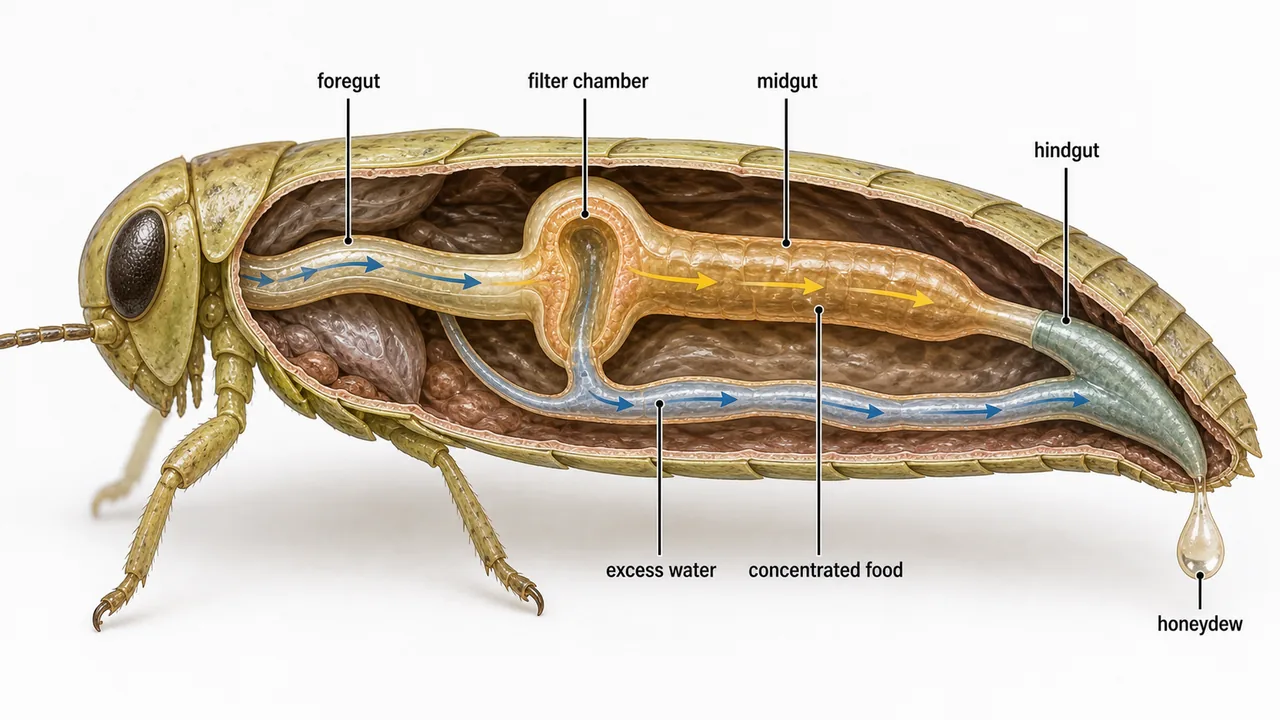
- Found in most Hemiptera (fluid feeders) that ingest enormous volumes of dilute plant sap.
- Short-circuits excess water and sugar directly from foregut to hindgut, bypassing midgut.
- Prevents dilution of digestive enzymes and concentrates food for efficient digestion.
- In classical exam wording, it is described as a compact sac-like association of the beginning of the foregut and hindgut, designed to remove excess water from sap before full digestion.
Agricultural connection: The excess water and sugar excreted by sap-sucking insects (aphids, mealybugs, whiteflies, psyllids) is called honeydew. It attracts ants and promotes sooty mould growth on crops -- a secondary damage indicator.
Hindgut (Proctodaeum) -- Water Recovery and Excretion
| Part | Function |
|---|---|
| Ileum | Initial section; absorption continues. In older termite descriptions, the hindgut ileal/paunch region is treated as a pouch-like fermentation chamber containing symbionts that help cellulose digestion. |
| Colon | Further absorption. In termites, the hindgut houses dense symbiotic microorganisms that assist cellulose breakdown. |
| Rectum | Rectal pads actively reabsorb water from faecal matter, producing dry pellet-like droppings. Critical for water conservation in terrestrial insects; in most insects, the majority of nutrient absorption occurs in the midgut, while the rectum is the main site of water recovery |
Process of Digestion (5 Steps)
| Step | Process | Key Detail |
|---|---|---|
| 1. Ingestion | Food enters oral cavity; partial digestion by salivary enzymes | Some insects use extra-oral digestion (inject enzymes onto/into food, liquify it externally before sucking up -- e.g., blowfly larvae, carnivorous bugs) |
| 2. Transportation | Peristaltic movements move food through oesophagus → crop (storage) → gizzard (grinding by cuticular teeth) | Peristalsis = rhythmic wave-like muscular contractions |
| 3. Digestion | Food enters midgut through stomodeal valve; epithelial cells secrete enzymes | Proteases (proteins → amino acids), Carbohydrases (carbohydrates → sugars), Lipases (lipids → fatty acids + glycerol). In termites, cellulose digestion occurs in colon via symbiotic cellulase |
| 4. Absorption | Microvilli of midgut epithelial cells absorb nutrients by diffusion | Undigested material passes to hindgut. Malpighian tubules absorb Na/K salts. Hindgut reabsorbs water, salts, metabolites. Liquid faeces of sap-feeders = honeydew |
| 5. Egestion | Waste discharged through anus by anal muscles | -- |
Additional Digestive System Facts
- Pre-oral food cavity (Cibarium): The food cavity formed between the mouthparts before food enters the pharynx is called the cibarium — technically the pre-oral part of the alimentary canal.
- Chitin in insect cuticle: Approximately 40% of the dry weight of insect cuticle is chitin.
- Largest alimentary canal: Found in Lepidoptera — caterpillars are voracious feeders and have proportionally the longest gut for maximum nutrient extraction.
- Honey chamber: The crop of worker honeybees is modified into a honey chamber (also called honey stomach) where nectar is stored and partially converted (invertase converts sucrose → glucose + fructose) before delivery to the hive.
- Mycetocytes and mycetomes: Insect cells that house symbiotic microorganisms are called mycetocytes, while the organ or tissue mass formed by such symbiont-bearing cells is called a mycetome.
- Holocrine secretion: Mode of secretion where cells completely burst to release their enzymes.
- This occurs in the insect midgut where entire epithelial cells disintegrate to release digestive enzymes.
Classification of Insects by Food Habits
| Category | Definition | Example | Agricultural Significance |
|---|---|---|---|
| Carnivorous | Feed on other animals (parasites, predators) | Praying mantis, ladybird beetle | Beneficial (biocontrol agents) |
| Omnivorous | Feed on both plants and animals | Wasps | -- |
| Herbivorous | Feed on living plants | Most crop pests | See subtypes below |
Herbivorous Subtypes
| Subtype | Host Range | Example | Management Implication |
|---|---|---|---|
| Monophagous | Single plant species | Brinjal fruit borer, pink bollworm (cotton) | Pest restricted to one crop |
| Oligophagous | One botanical family | Cabbage butterfly, mustard sawfly (Brassicaceae) | Crop rotation with unrelated families helps |
| Polyphagous | Multiple plant families | Bihar hairy caterpillar, gram pod borer, locust, termite, white grub | Hardest to manage -- survives on many alternative hosts |
| Saprophagous | Decaying plant matter | Drosophila, cecidomyiid flies | Role in nutrient recycling |
Exam Tips
Crop = food reservoir (storage organ). This is a correct statement -- frequently tested.
Midgut has NO cuticular lining (endodermal origin). The statement "midgut is lined by cuticular layer" is incorrect -- a common trap.
Peritrophic membrane is in midgut, absent in sap-sucking insects. Do not confuse with cuticular lining.
Malpighian tubules arise at the midgut-hindgut junction (not "in the hindgut" or "in the midgut").
Monophagous = one species. Oligophagous = one family. Polyphagous = many families. Remember: "Mono = Minimum, Oligo = One family, Poly = Plenty."
Termite cellulose digestion: Happens in colon (hindgut) via mycetomes with symbiotic protozoa producing cellulase.
Summary Cheat Sheet
| Concept | Key Detail |
|---|---|
| Foregut (Stomodaeum) | Ectodermal; cuticular lining; ingestion and storage |
| Crop | Food reservoir; honey stomach in bees |
| Gizzard | Grinding organ; absent in fluid feeders |
| Midgut (Mesenteron) | Endodermal; NO cuticular lining; digestion and absorption |
| Peritrophic membrane | Protects midgut epithelium; absent in sap-suckers |
| Gastric caecae | Increase surface area; harbour symbiotic bacteria |
| Filter chamber | Bypasses excess water in Hemiptera |
| Hindgut (Proctodaeum) | Ectodermal; water reabsorption; excretion |
| Rectal pads | Reabsorb water from faeces |
| Mycetocyte | Symbiont-bearing insect cell |
| Mycetomes | Symbiotic microorganisms in termite colon; cellulase production |
| Honeydew | Sugar-rich excretion of sap-sucking insects |
| Monophagous | Feeds on one plant species |
| Oligophagous | Feeds on one plant family |
| Polyphagous | Feeds on many plant families |
| Extra-oral digestion | Enzymes injected onto food externally |
TIP
Next: The next lesson covers the excretory system -- how insects eliminate nitrogenous waste and conserve water through Malpighian tubules.
References
1 source
References
Lesson Doubts
Ask questions, get expert answers