🫃🏼 Insect Abdomen -- Structure, Modifications, and Appendages
Abdominal segments, sclerites, genital segments, modifications in different orders, and appendages including cerci, ovipositor, prolegs, and tracheal gills
In the previous lessons, we covered the insect head (sensory centre), thorax (locomotion centre with legs and wings). Now we examine the third and final tagma: the abdomen -- the centre of respiration and reproduction.
When a queen termite's abdomen swells to over 100 times its original size to lay thousands of eggs daily, or when a female grasshopper uses her ovipositor to deposit eggs deep in the soil of a wheat field, the insect abdomen is at work. The abdomen is the centre of respiration and reproduction -- two functions that directly determine pest population build-up in agricultural fields.
This lesson covers:
- Abdominal structure -- segments, sclerites, and genital segments
- Abdominal modifications -- propodeum, petiole, physogastry
- Six types of abdominal appendages -- styli, cerci, prolegs, ovipositor, and gills
Overview
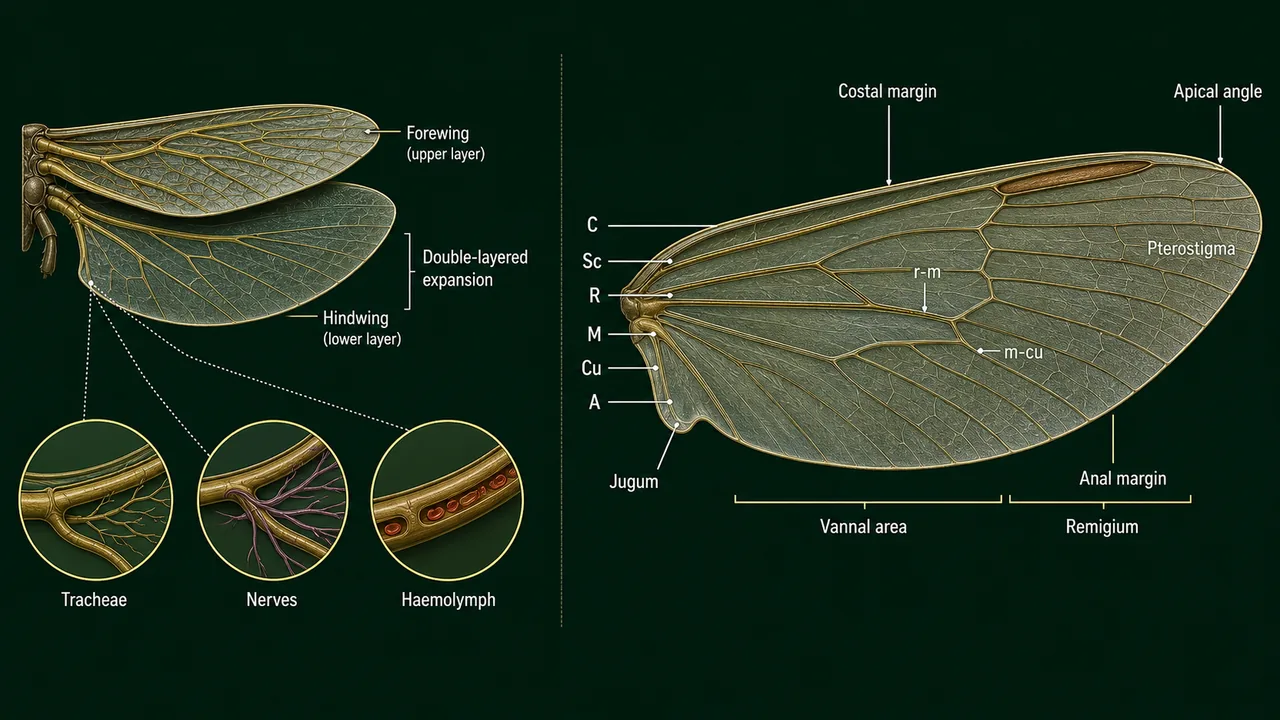
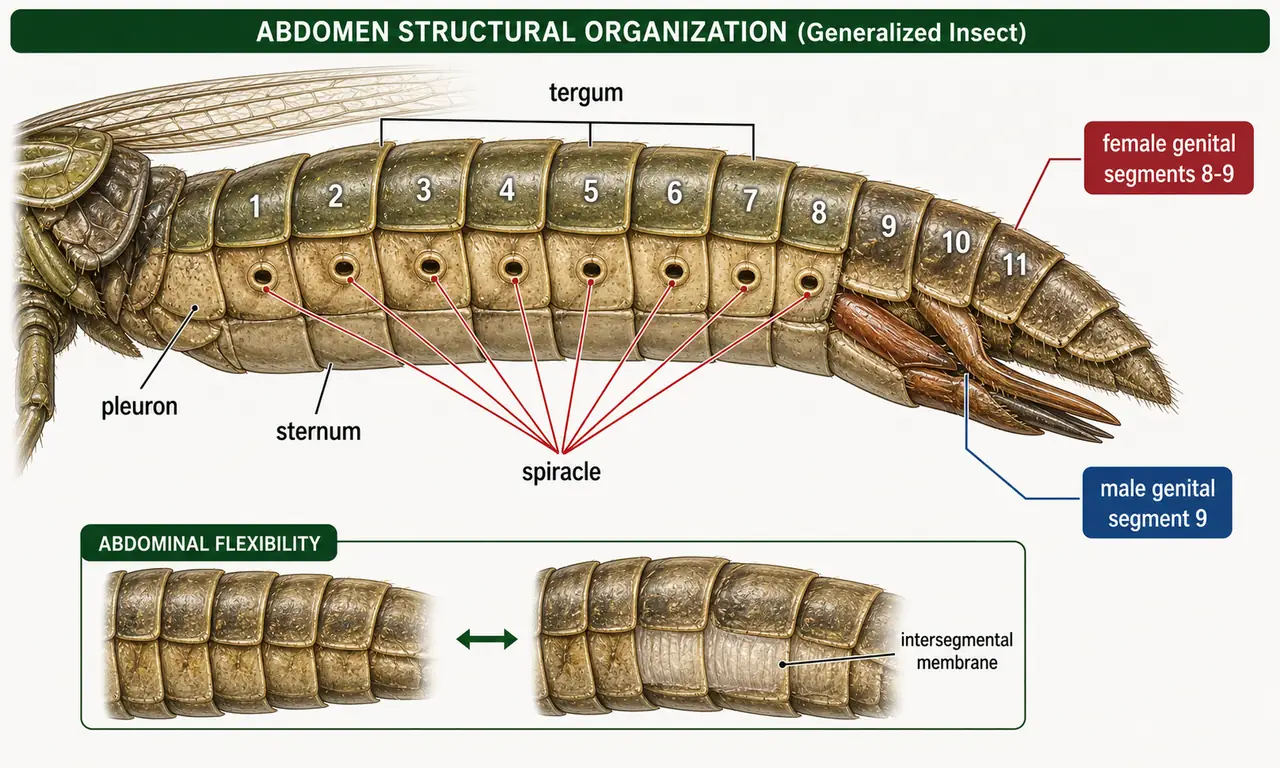
Think of it this way: If the head is the insect's brain and mouth, and the thorax is its engine room, then the abdomen is its factory and warehouse -- where food is digested, eggs are produced, and breathing happens. It's also the most flexible part, able to expand like an accordion when the insect eats a large meal or when a female is full of eggs.
Pro Content Locked
Upgrade to Pro to access this lesson and all other premium content.
Charged once for one year · ₹1188 total
Save ₹100/month vs ₹2388/year launch price
- All Agriculture & Banking Courses
- AI Lesson Questions (100/day)
- AI Doubt Solver (50/day)
- Glows & Grows Feedback (30/day)
- AI Section Quiz (20/day)
- 22-Language Translation (100/day)
- Recall Questions (20/day)
- AI Quiz (15/day)
- AI Quiz Paper Analysis (100/day)
- AI Step-by-Step Explanations (100/day)
- Spaced Repetition Recall (FSRS)
- AI Tutor
- Immersive Text Questions
- Audio Lessons — Hindi & English
- Mock Tests & Previous Year Papers
- Summary & Mind Maps
- XP, Levels, Leaderboard & Badges
- Generate New Classrooms
- Voice AI Teacher (AgriDots Live)
- AI Revision Assistant
- Knowledge Gap Analysis
- Interactive Revision (LangGraph)
🔒 Secure one-time yearly payment via Razorpay · No hidden fees
In the previous lessons, we covered the insect head (sensory centre), thorax (locomotion centre with legs and wings). Now we examine the third and final tagma: the abdomen -- the centre of respiration and reproduction.
When a queen termite's abdomen swells to over 100 times its original size to lay thousands of eggs daily, or when a female grasshopper uses her ovipositor to deposit eggs deep in the soil of a wheat field, the insect abdomen is at work. The abdomen is the centre of respiration and reproduction -- two functions that directly determine pest population build-up in agricultural fields.
This lesson covers:
- Abdominal structure -- segments, sclerites, and genital segments
- Abdominal modifications -- propodeum, petiole, physogastry
- Six types of abdominal appendages -- styli, cerci, prolegs, ovipositor, and gills
Overview
Think of it this way: If the head is the insect's brain and mouth, and the thorax is its engine room, then the abdomen is its factory and warehouse -- where food is digested, eggs are produced, and breathing happens. It's also the most flexible part, able to expand like an accordion when the insect eats a large meal or when a female is full of eggs.
- The abdomen is the third and last tagma of the insect body, forming the posterior region.
- Made up of 9--11 segments (called uromeres), with more evident segmentation than the head or thorax.
- More flexible than other tagmata because segments are connected by soft, membranous intersegmental regions allowing bending and expansion.
Abdominal Sclerites
| Sclerite | Position | Note |
|---|---|---|
| Tergum | Dorsal (upper) | In thorax, the dorsal sclerite is called notum |
| Sternum | Ventral (lower) | -- |
| Pleuron | Lateral (sides) | -- |
Genital Segments
| Sex | Genital Segments | Structure |
|---|---|---|
| Female | 8th and 9th | Ovipositor (egg-laying organ) |
| Male | 9th only | Aedeagus (penis) |
Exam trap: In males, only the 9th segment bears genital appendages. In females, both 8th and 9th do. The question "8th and 9th segments have genital appendages in male grasshoppers" is incorrect -- a favourite trick question.
Other Abdominal Features
- Usually 8 pairs of spiracles on the first eight abdominal segments for tracheal respiration.
- In grasshoppers, a pair of tympanal organs (auditory organs) are found on either side of the 1st abdominal segment, connected to the metathoracic ganglia through the auditory nerve.
Modifications of the Abdomen
Evolutionary reduction or modification of abdominal segments is a common trend in more advanced insect orders.
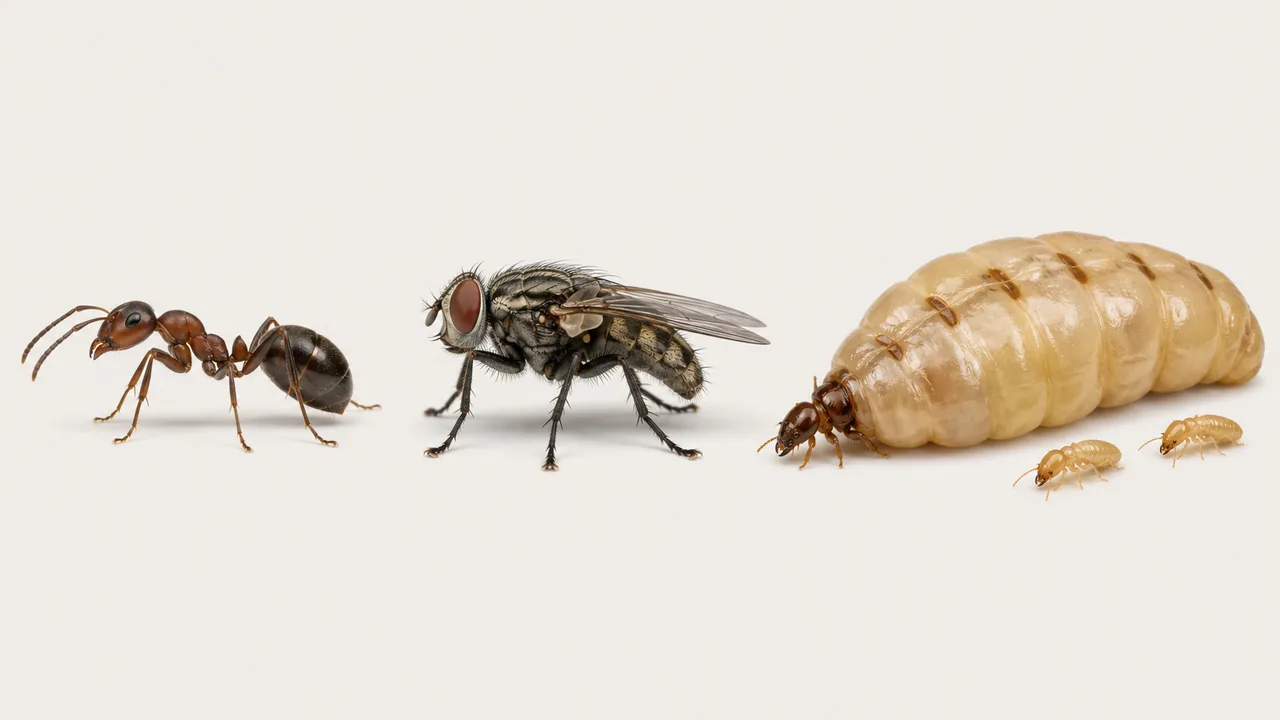
| Insect | Modification | Details |
|---|---|---|
| Springtail | Reduced segments | Only 6 segments present (S for Six) |
| Housefly | Telescoped segments | Only segments 2--5 visible; segments 6--9 retracted inside like a collapsible telescope |
| Ants, Bees, Wasps | Propodeum + petiole | 1st abdominal segment fused with metathorax = propodeum; 2nd segment forms narrow petiole (waist); rest = gaster |
| Queen termite | Physogastry | Abdomen swells enormously due to ovary enlargement; sclerites become isolated as small islands; can lay thousands of eggs per day for years |
How to read these modifications: focus first on the outline of the abdomen, not the color. A narrow waist points to petiole formation, a shortened visible abdomen suggests telescoping, and a balloon-like swollen abdomen indicates physogastry.
Agricultural note: The narrow petiole (waist) of ants and wasps is a quick field identification feature. Many parasitoid wasps used in biological pest control (e.g., Trichogramma) show this characteristic body shape.
Abdominal Appendages
Concept shortcut: if the structure helps an insect hold, sense, lay eggs, or breathe in water, think of it as an abdominal appendage rather than a mere change in abdominal shape.
1. Styli
- Paired, tube-like outgrowths on the ventral side of the abdomen of silverfish.
- Vestigial abdominal legs -- remnants of the ancestral condition where each segment bore a pair of legs.
- Found in the most primitive wingless insects (Apterygota); help in locomotion.
2. Anal Styli
- A pair of short, unsegmented structures at the end of the abdomen of male cockroach only.
- Used to hold the female during copulation.
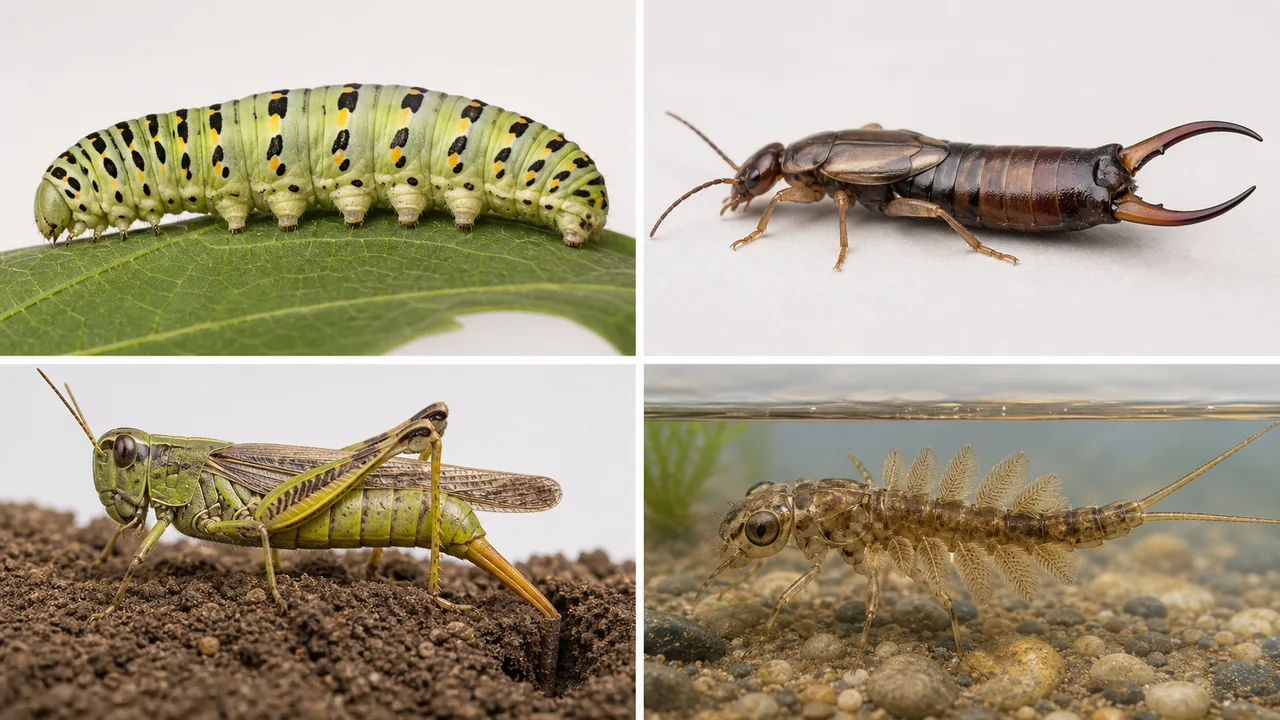
3. Tracheal Gills
Lateral outgrowths of the body wall richly supplied with tracheae, used by aquatic immature stages (naiads) to obtain dissolved oxygen.
| Type | Location | Example |
|---|---|---|
| Lateral gills | First 7 abdominal segments (7 pairs, filamentous) | Naiads of mayfly |
| Caudal gills | End of abdomen (2--3 leaf-like / lamellate) | Naiads of damselfly (dual function: respiration + swimming) |
4. Prolegs
- Unsegmented, thick, fleshy structures on larvae of moths, butterflies, and sawflies.
- 2--5 pairs normally present on the abdomen.
- Tips have the planta bearing heavily sclerotized hooks called crochets for crawling and clinging.
- Not present in adults -- shed at last larval moult.
Crop connection: The number and arrangement of prolegs helps identify caterpillar pests. For example, loopers have only 2 pairs of prolegs (on segments 6 and 10), while typical caterpillars have 4--5 pairs.
Additional Abdominal Features
Cornicles: Aphids bear a pair of tube-like structures called cornicles on the dorsal surface of the abdomen (usually on 5th–6th segments). They secrete a waxy, alarm-pheromone-containing substance. Spotting cornicles immediately identifies a pest as an aphid — no other insect has them.
Thysanura (Silverfish): Bear two long cerci + one median caudal filament = three tail-like structures at the abdomen tip.
Pediculate eggs: Eggs attached by a short stalk to a leaf surface are called pediculate eggs. Example: Bemisia tabaci (whitefly) — a major vector of leaf curl virus in tomato and yellow mosaic virus in pulses.
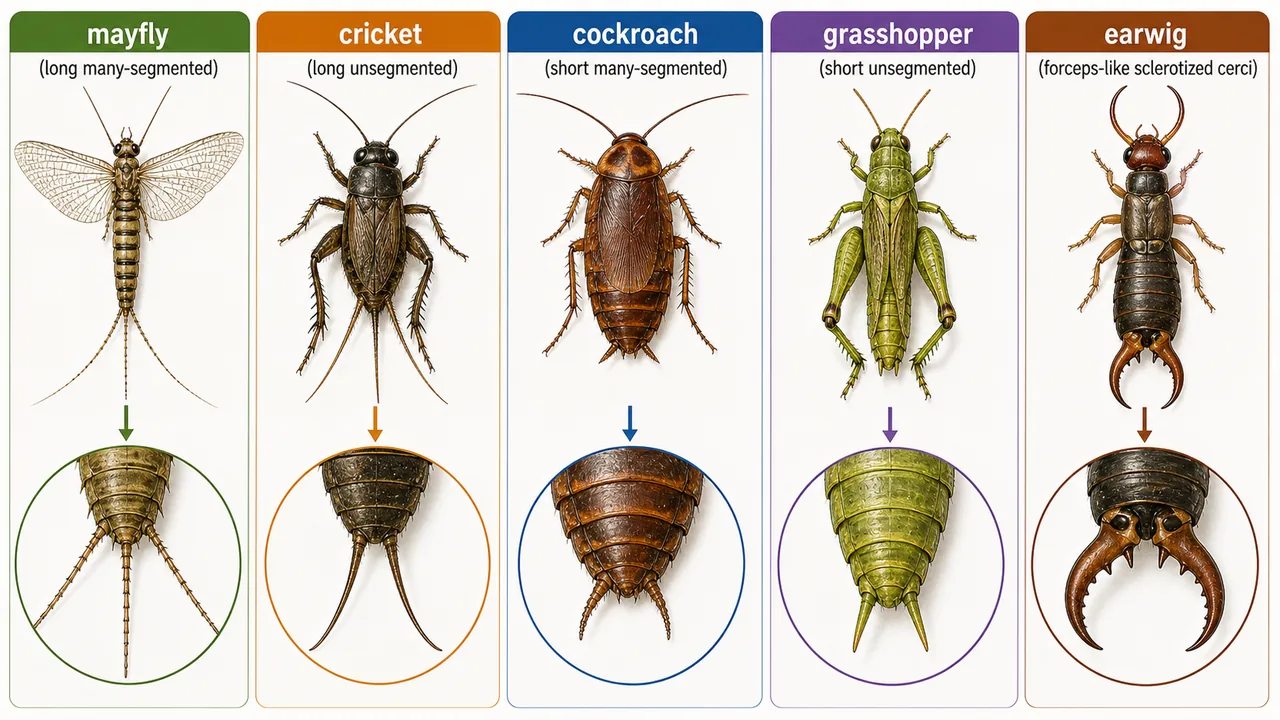
5. Cerci (Singular: Cercus)
The most conspicuous appendages on the 11th abdominal segment. They are sensory -- functioning as tactile sensors that detect air currents, vibrations, and the approach of predators from behind (a rear-facing early warning system).
| Form | Example |
|---|---|
| Long, many-segmented | Mayfly |
| Long, unsegmented | Cricket |
| Short, many-segmented | Cockroach |
| Short, unsegmented | Grasshopper |
| Sclerotized, forceps-like | Earwig (used for defence, prey capture, courtship) |
6. Ovipositor
- Egg-laying organ found in female insects only.
- Derived from modified appendages of the 8th and 9th abdominal segments.
- Allows precise deposition of eggs into suitable substrates (soil, plant tissue, host organisms).
Agricultural example: Female grasshoppers use their ovipositor to lay egg pods in the soil of crop fields. Female parasitoid wasps use a modified ovipositor (also functioning as a sting in some Hymenoptera) to lay eggs inside pest larvae.
Functions of the Three Body Regions
IMPORTANT
Functions of different segments of insect:
- Head: Sensory Function
- Thorax: Locomotion
- Abdomen: Respiration and Reproduction
Exam Tips
Genital segment trap: Males = 9th only. Females = 8th and 9th. Do not confuse.
Physogastry = extreme abdominal swelling in queen termite. A favourite definition question.
Propodeum = 1st abdominal segment fused with metathorax (ants, bees, wasps). Remember: "Propodeum is propelled into the thorax."
Cerci on 11th segment. Cerci of earwig = forceps-like (only insect with forceps cerci).
Springtail = 6 abdominal segments (S for Six for Springtail).
Summary Cheat Sheet
| Concept | Key Detail |
|---|---|
| Abdomen segments | 9--11 (called uromeres) |
| Sclerites | Tergum (dorsal), Sternum (ventral), Pleuron (lateral) |
| Female genital segments | 8th + 9th → Ovipositor |
| Male genital segment | 9th only → Aedeagus |
| Spiracles | 8 pairs on first 8 abdominal segments |
| Tympanum | Grasshopper; on 1st abdominal segment (auditory) |
| Propodeum | 1st segment fused with metathorax (Hymenoptera) |
| Petiole | Narrow waist (2nd segment) in ants/wasps/bees |
| Physogastry | Extreme abdominal swelling in queen termite |
| Styli | Vestigial abdominal legs; silverfish |
| Anal styli | Male cockroach; for clasping female |
| Tracheal gills | Lateral (mayfly), Caudal (damselfly) |
| Prolegs | Fleshy, temporary (caterpillars); crochets for gripping |
| Cerci | Sensory; on 11th segment; forceps in earwig |
| Ovipositor | Female; from 8th + 9th segments; egg laying |
TIP
Next: The next unit begins Insect Physiology, starting with the digestive system -- how insects process the food their mouthparts acquire.
References
1 source
References
Lesson Doubts
Ask questions, get expert answers