Types of Wing Couplings, Insect Wing Modifications with examples
Mind Map: Wing Modifications
When you see a beetle land on your crop, notice how it lifts its hard shell-like forewings before extending delicate flight wings underneath. Those tough forewings (elytra) are not for flying at all -- they are armour that protects the fragile flight wings beneath. This single modification explains why beetles are the most species-rich order on Earth -- their wings double as shields. Understanding wing modifications helps identify insect orders at a glance and explains how different pests move across agricultural landscapes.
Wing Coupling
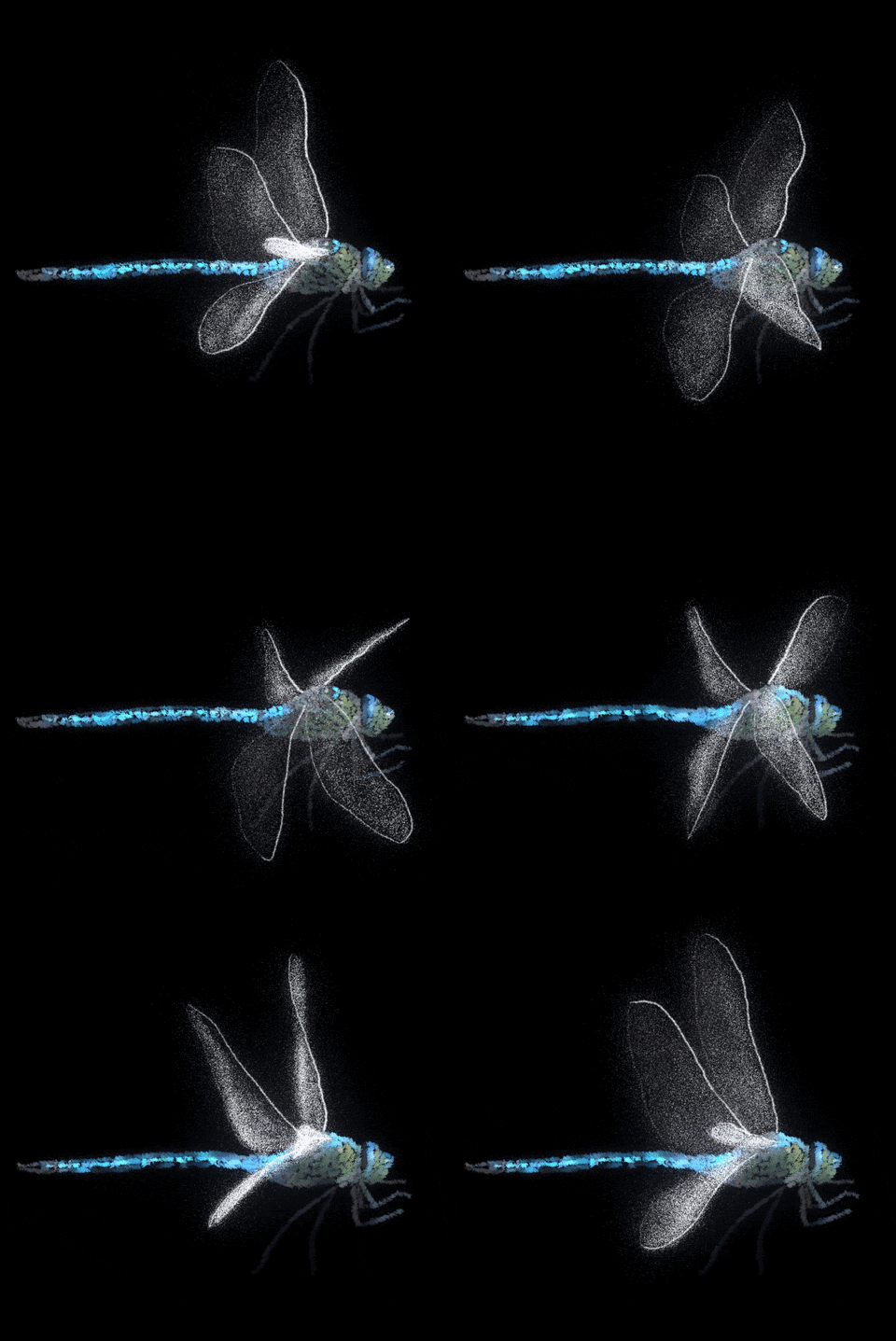
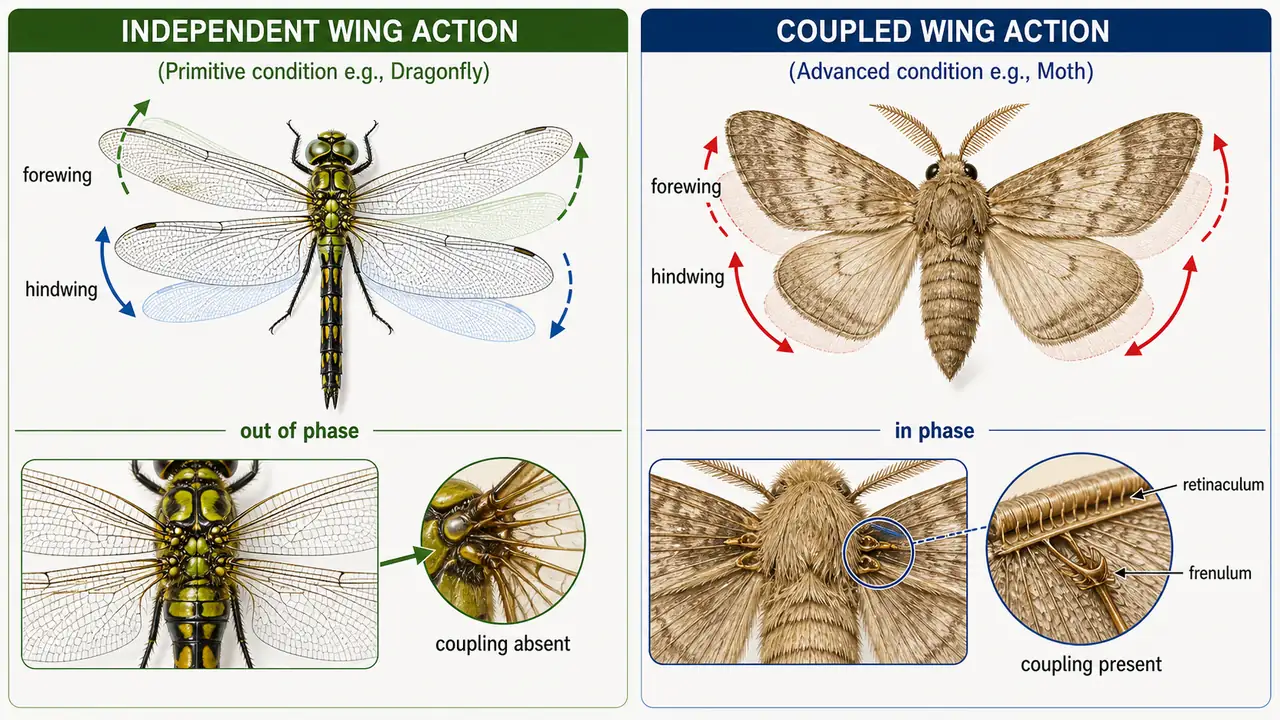
- Among the insects with two pairs of wings, the wings may work separately as in the dragonflies and damselflies.
- In these **primitive fliers**, the forewings and hindwings beat independently, which gives them remarkable manoeuvrability — they can hover, fly backwards, and change direction rapidly.
Insect Wing Ani
But in higher pterygote insects, fore and hind wings are coupled together as a unit, so that both pairs move synchronously.
This synchronization means both wings beat in the same rhythm and direction, producing more powerful and efficient flight strokes.
By coupling the wings, the insects become functionally two-winged.
The forewing and hindwing are coupled together, which improves the aerodynamic efficiency of flight.
This is because a single larger wing surface generates more lift than two smaller surfaces working independently.
For taking flight, insects need to keep both the fore and hindwings together as a single unit.
This ensures that the combined wing surface acts as one continuous airfoil, maximizing thrust and lift during each wing beat.
The structures in the form of lobes, bristles, hairs or spines that help the wings to be together are known as wing coupling organs.
These specialized anatomical structures vary considerably between insect orders and serve as important taxonomic characters for classification.
This lesson covers:
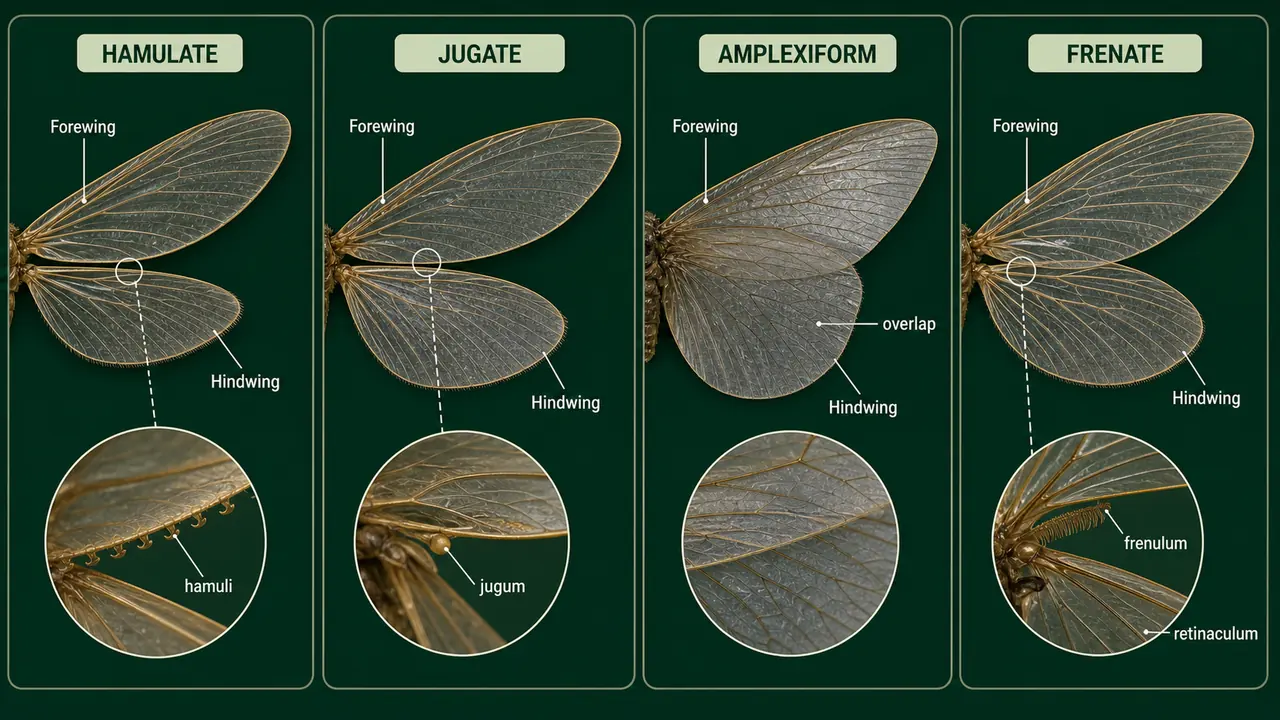
Wing coupling mechanisms -- hamulate, jugate, amplexiform, and frenate types
Nine wing types -- tegmina, elytra, hemelytra, scaly, membranous, halteres, and more
Types of Wing Coupling
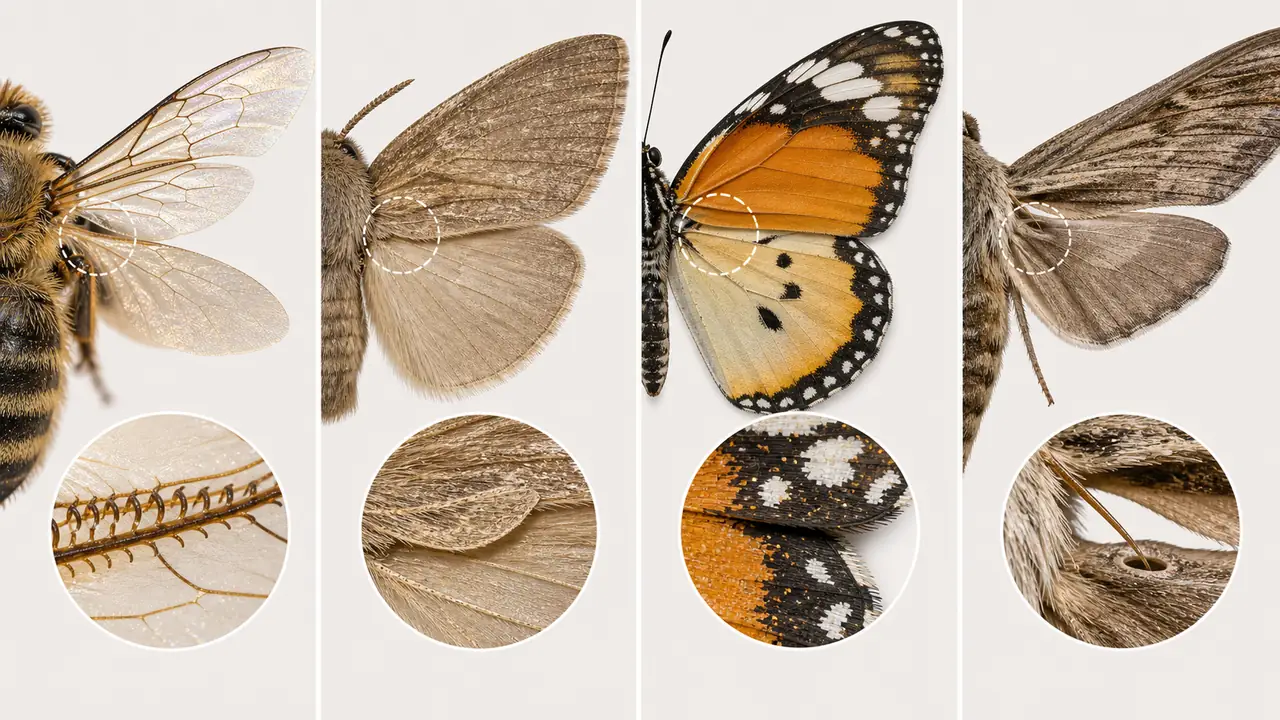
Wing coupling becomes easy when you look only for the locking organ: hooks, lobe, broad overlap, or a frenulum-retinaculum system.This second board is useful when exam questions shift from names to the actual locking structures that join forewing and hindwing.Use this motion-focused comparison to separate primitive independent wing action from the coupled wing systems of higher pterygote insects.
Fast identification rule: when a coupling mechanism uses a clearly specialized hook, lobe, or bristle, look for the matching structure on the opposite wing. If there is no discrete locking organ and the wings simply overlap broadly, think amplexiform.
1. Hamulate
- A row of small, curved hook-like structures present on the costal margin of the hind wing known as **Hamuli**.
- The word "hamuli" comes from the Latin word meaning "small hooks," describing their characteristic shape.
- They fit into the upward fold of the anal margin of the forewing which lock onto the forewing, keeping them held together (hamulate coupling).
- This interlocking mechanism creates a firm but flexible connection that holds during the vigorous movements of flight.
- The most common coupling mechanism.
- It is found across a large number of insect species, making it the **dominant wing coupling strategy** in the insect world.
- **Example:** Hymenopterans (wasps and bees).
- In honeybees, a row of tiny hamuli on the hindwing hooks into a fold on the forewing, allowing the two pairs to function as one during flight.
2. Jugate Type or Jugum Type
- The anal margin (jugal region) of the fore wing possesses a small lobe at its base called the **fibula**.
- This lobe is a **finger-like extension** of the forewing that acts as a simple coupling device.
- It rests on the surface of the hind wing or sometimes engages with spines present on the upper surface of hind wings.
- This overlapping arrangement provides a relatively loose connection compared to other coupling types, reflecting its **primitive evolutionary origin**.
- **Example:** Primitive lepidopterans of the family Hepialidae.
- These are the **ghost moths** or **swift moths**, which are among the most ancient moth lineages and retain this ancestral coupling mechanism.
3. Amplexiform Type
- It is the **simplest form** of wing coupling.
- The term "amplexiform" is derived from the Latin word *amplexus*, meaning "to embrace," which describes how the wing margins overlap each other.
- A linking structure is **absent**.
- Unlike other coupling types, no specialized hooks, bristles, or lobes are involved — the wings are held together purely by physical overlap.
- Coupling is achieved by broad overlapping of adjacent margins.
- The large surface area of overlap creates enough **friction and pressure** to keep the wings functioning together during flight.
- Costal margin of hind wing and anal margin of forewing overlap one above the other.
- This broad, expansive overlap is facilitated by the **relatively large size** of both wing pairs in butterflies.
- **Example:** Butterflies.
- Their large, broadly shaped wings naturally overlap when in flight position, making specialized coupling structures unnecessary.
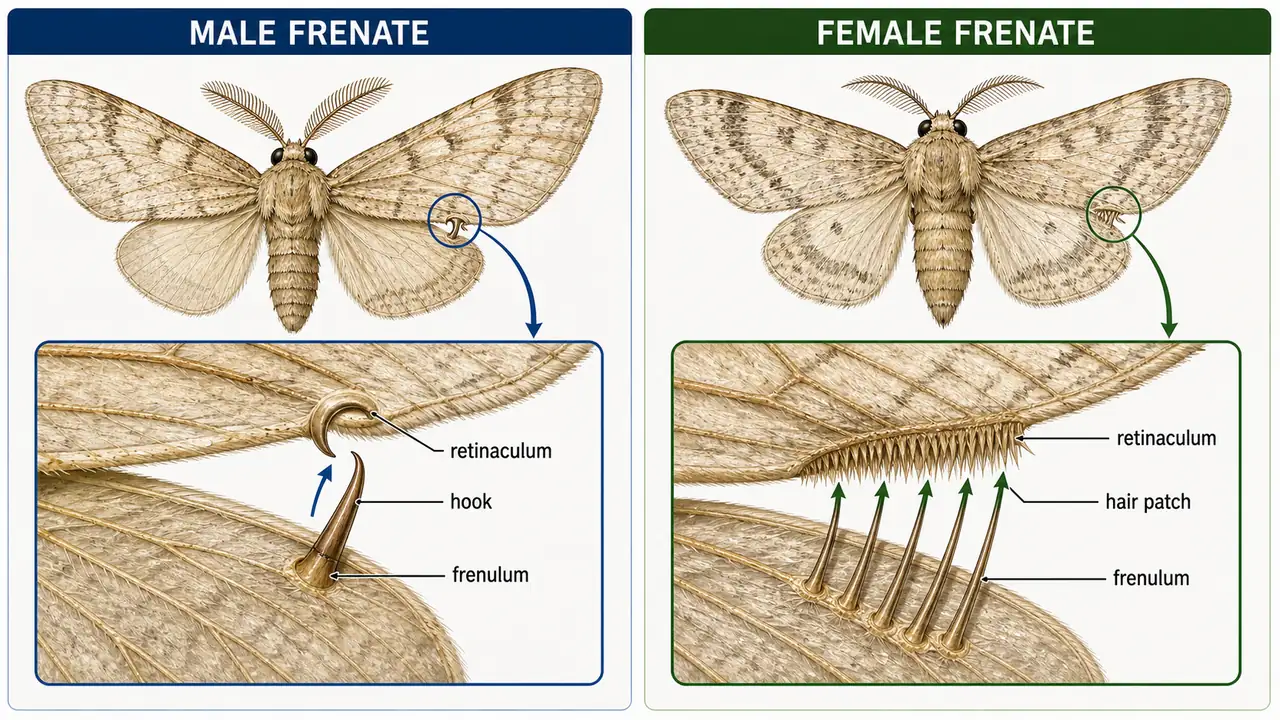
4. Frenate or Retinaculum Type
- The hind wings possess bristle or spine-like structure or group of hairs known as the **frenulum**.
- The frenulum acts as a **clasping device** that physically connects the hindwing to the forewing.
- The forewings possess hook-like **retinaculum** on the anal side.
- The retinaculum serves as the **receiving structure** — a catch or clasp that holds the frenulum in place during flight.
- During flight, the frenulum passes beneath the retinaculum and thus both the wings are kept together.
- This creates a firm, secure coupling that allows rapid and powerful wing beats — essential for the fast flight speeds achieved by hawk moths.
- **Example:** Fruit sucking moths and hawk moths.
- There are two sub types, which differ between males and females — a case of **sexual dimorphism** in wing coupling anatomy:
i. Male frenate
- Hindwing bears near the base of the costal margin a stout bristle called the **frenulum**.
- In males, this is typically a **single, strong spine** that provides a robust connection point.
- It is normally held by a curved process, retinaculum, arising from the subcostal vein found on the surface of the forewing.
- The male retinaculum is a distinct **hook-shaped structure** that firmly grips the single frenulum bristle.
ii. Female frenate
- Hindwing bears near the base of the costal margin a group of stout bristles (**frenulum**).
- In females, the frenulum consists of **multiple bristles** rather than a single spine, which is a key **morphological difference** from males.
- It lies beneath the extended forewing and engages there in a retinaculum formed by a **patch of hairs** near cubitus.
- The female retinaculum is a **tuft of specialized scales or hairs** rather than a curved hook, reflecting the different frenulum structure it must accommodate.
This sex-based comparison is the easiest way to remember frenate coupling: one stout bristle in males versus a brush-like set in females.
Wing Types
- Each order and insect family has distinctive wing shapes and features.
- These **modifications of wing structure** reflect evolutionary adaptations to different lifestyles — some wings are specialized for protection, others for flight efficiency, and some for sensory balance.
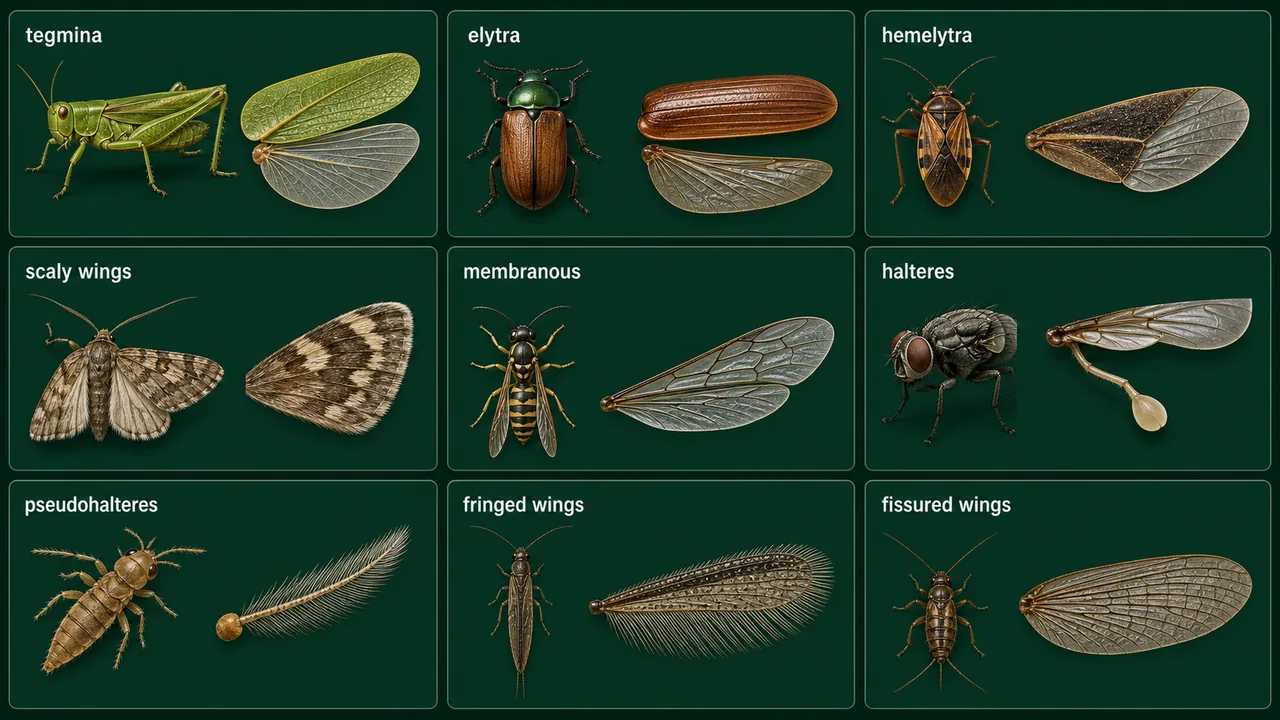
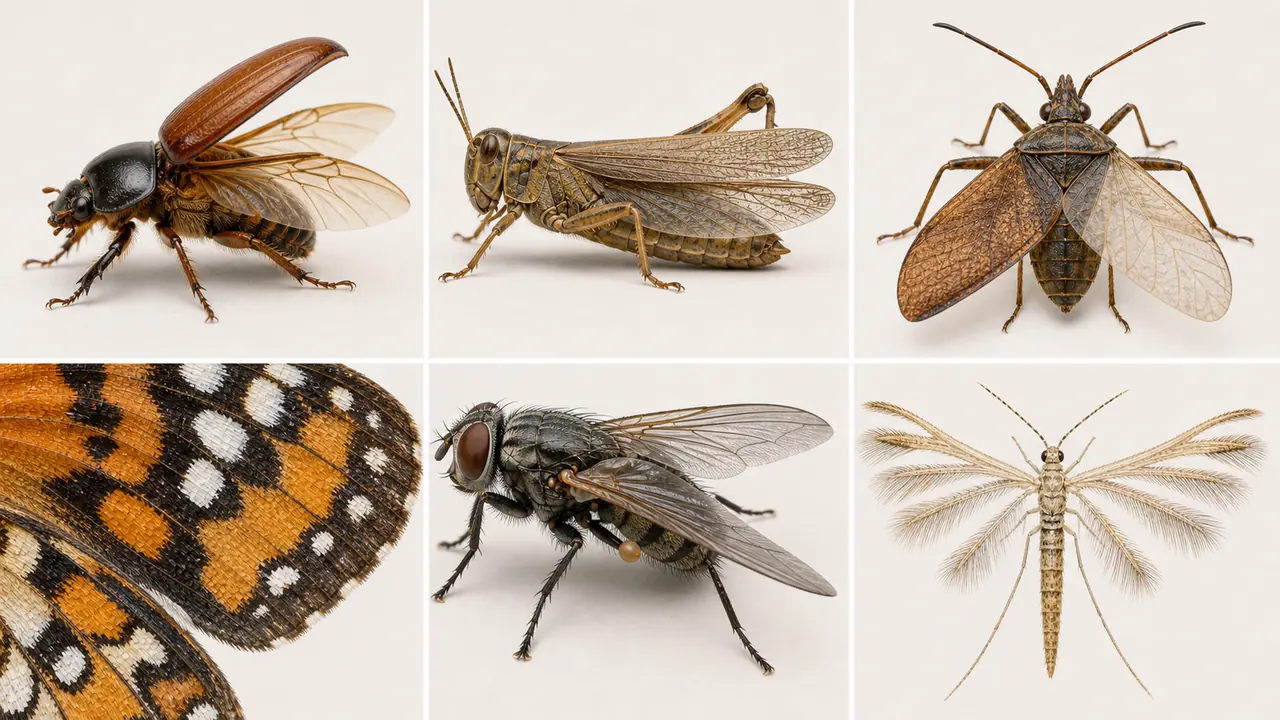
Remember wing modification by function first: protect, partly harden, carry scales, reduce into balance organs, or stretch into fringed flight surfaces.Once coupling is clear, switch to the forewing and hindwing redesigns that help you identify insect orders at a glance.
Memory shortcut: ask what the forewing or hindwing has been repurposed to do. If it becomes armour, think elytra or tegmina; if only the base is hardened, think hemelytra; if a wing shrinks into a balancing knob, think halteres.
1. Tegmina
- Forewings are **leathery**, parchment-like and tough.
- The term "tegmina" comes from the Latin *tegmen*, meaning "a covering," which describes their **protective function** perfectly.
- They protect the membranous hindwings.
- When the insect is at rest, the tegmina fold over the delicate hindwings like a **protective shield**, preventing damage from abrasion and desiccation.
- They are **not** used for flight.
- Instead, they serve primarily as **covers** — the actual flight is powered by the membranous hindwings that unfold from beneath the tegmina.
- **Example:** Forewings of cockroach, grasshopper.
- In grasshoppers, you can observe the tegmina as the **narrow, elongated** outer wings that cover the broader, fan-shaped hindwings when folded.
2. Elytra
- The wing is **heavily sclerotised**, hard, shell-like without clear venation.
- "Elytra" comes from the Greek word *elytron*, meaning "sheath" — these wings have become **hardened protective cases** rather than flight organs.
- They form a horny sheet and protect the membranous hind wings and abdomen.
- The elytra meet along a straight line down the middle of the back (the **sutural line**), creating a sealed protective compartment for the folded hindwings and the soft dorsal abdomen.
- Wing venation is lost.
- The extreme **sclerotization** (hardening) of the cuticle has obliterated the original vein pattern, as structural rigidity has replaced the need for flexible flight surfaces.
- It is **not** used during flight.
- The elytra must be raised in order to move the hind flight wings.
- Before takeoff, a beetle lifts its elytra to **expose and unfurl** the membranous hindwings, which are the actual organs of flight.
- **Example:** Forewings of beetles and weevils.
- The distinctive hard wing covers of beetles (Order **Coleoptera** — literally "sheath wings") are one of the most recognizable features in the insect world.
3. Hemelytra
- The basal half of the wing is thick (like elytra) and leathery and the distal half is membranous.
- The term "hemelytra" means "**half elytra**" (*hemi* = half), perfectly describing this dual-textured wing structure that is partly hardened and partly transparent.
- They are **not** involved in flight and are protective in function.
- The thickened basal portion provides a **rigid shield** for the body, while the membranous tip allows some flexibility when the wings overlap at rest.
- **Example:** Forewings of bugs.
- This unique wing structure is a defining characteristic of the **Order Hemiptera** (true bugs), and the distinct division into hardened and membranous regions is clearly visible in common bugs like stink bugs and shield bugs.
4. Scaly wings
- Wings of butterfly and moths are covered with small, coloured scales.
- These scales give the Order **Lepidoptera** its name — *lepis* (scale) + *pteron* (wing), meaning "**scale-winged**."
- Scales are unicellular flattened outgrowths of the body wall. Each scale is produced by a **single epidermal cell** and is attached to the wing membrane by a short stalk that fits into a socket.
- Scales are inclined to the wing surface and overlap each other to form a complete covering.
- This overlapping arrangement resembles **roof tiles** and creates the vivid colour patterns seen on butterfly and moth wings.
- Scales are responsible for colour. Wing colours arise from two mechanisms: **pigment colours** (chemicals within the scales) and **structural colours** (created by microscopic ridges on the scale surface that refract light, producing iridescent blues and greens).
- They are useful for flight. Despite being delicate, the scales contribute to **aerodynamic performance** and also help regulate body temperature.
- **Example:** Both the wings of moths and butterflies.
- If you gently touch a butterfly wing, the fine powdery substance that comes off is actually these tiny scales.
5. Membranous wings
- They are thin, transparent wings (clear venation) and supported by a system of tubular veins.
- The veins serve as **structural supports** (like the framework of a kite) and also carry **haemolymph, nerves, and tracheae** that nourish the wing tissue.
- In many insects either forewings (*true flies*) or hind wings (*grasshopper*, *cockroach*, *beetles* and *bugs*) or both fore wings and hind wings (*wasp*, *bees*, *dragonfly* and *damselfly*) are membranous.
- This is the most **primitive and widespread** wing type — it represents the basic, unmodified wing design from which all other wing types evolved.
- Always useful for flight.
- Membranous wings are the **primary flight organs** in insects. Their thin, lightweight structure combined with the reinforcing vein network makes them highly efficient aerodynamic surfaces.
6. Halteres
- In true flies, the hind wings are modified into small knobbed vibrating organs called **halteres**.
- These are remarkable evolutionary modifications — an entire wing pair has been transformed from a flight surface into a **sensory organ** for balance detection.
- They act as balancing organs and provide the needed stability during flight by acting similar to gyroscopes.
- The halteres vibrate rapidly during flight, and any change in the fly's orientation causes a **twisting force** on the haltere base, which is detected by specialized sensory receptors called **campaniform sensilla**.
- This gives the fly real-time feedback about its body position.
- **Example:** True flies, mosquitoes, male scale insect and front wings of male stylopids.
- The extraordinary aerial agility of houseflies and mosquitoes — their ability to make sharp turns and avoid swatters — is largely due to the rapid sensory feedback provided by halteres.
7. Pseudohalteres
- When forewings are modified into halteres, they are known as **pseudohalteres**.
- The prefix "pseudo" means "**false**," indicating that while these structures resemble true halteres, they are derived from the **forewings** rather than the hindwings.
- They are short and dumbbell-shaped. Their shape and function mirror that of true halteres — they serve as **gyroscopic balance organs** — but their developmental origin from the first wing pair rather than the second makes them a distinct morphological category.
- **Example:** Front wings of Strepsiptera.
- These are the **twisted-wing parasites** — a fascinating and unusual insect order where the males fly using enlarged hindwings while the reduced forewings serve as pseudohalteres, the reverse of the arrangement seen in true flies.
8. Fringed wings
- The wings are fringed with long marginal hairs giving a feather-like appearance.
- These long hairs (called **setae**) extend outward from the wing margin, effectively increasing the **functional wing surface area** without adding significant weight.
- These insects literally swim through the air.
- At the tiny scale of thrips (typically 1-2 mm body length), air behaves more like a viscous fluid — a phenomenon governed by **low Reynolds number** aerodynamics.
- The fringed wing design is actually more efficient at this scale than a solid membrane would be.
- **Example:** Both the wings of thrips.
- Thrips (Order **Thysanoptera** — literally "fringed wings") have extremely narrow, strap-like wings with characteristic long marginal fringes that are clearly visible under magnification.
Additional Wing Behaviour Notes
Butterfly keeps wings in an upright/vertical position at rest (unlike moths which hold wings flat).
Isoptera (termites) have wings that are shed (deciduous) after the mating/nuptial flight along pre-formed lines of weakness.
Fringed wings (feather-like) are found in Plume moth (family Pterophoridae) — forewings split into 2 lobes, hindwings into 3 lobes.
NOTE
Mayflies (Order Ephemeroptera) have a unique subimago stage — a winged but sexually immature pre-adult that moults once more to the true adult. No other insect order has this two-winged-stage pattern.
9. Fissured wings
- Forewings are longitudinally divided twice forming a fork-like structure whereas hindwings are divided twice into three arms.
- This dramatic **splitting of the wing membrane** into separate lobes or "plumes" is a unique and visually striking modification.
- All the forks possess small marginal hairs.
- These hairs increase the **effective surface area** of each narrow wing lobe, compensating for the reduced membrane area caused by the splitting.
- They are useful for flight.
- Despite their unusual fragmented appearance, these plume-like wings generate sufficient lift and thrust for **slow, fluttering flight** — typically used for short-distance movements and nocturnal activity.
- **Example:** Both the wings of plume moth.
- Plume moths (Family **Pterophoridae**) are easily recognized by their distinctive T-shaped resting posture, where the fissured wings are rolled and extended sideways.
- When spread, the wings reveal their characteristic **feather-like** divided structure.
Summary Cheat Sheet
Concept / Topic
Key Details / Explanation
Wing Coupling
Mechanisms (lobes, bristles, hairs, spines) that hold fore and hind wings together to function as a single unit, improving aerodynamic efficiency. Present in higher pterygotes.
Hamulate Coupling
Row of small curved hooks (hamuli) on hind wing costal margin locking into the forewing's anal margin. Most common type. E.g., Hymenopterans (wasps, bees).
Jugate (Jugum) Coupling
Small lobe (fibula) at the base of the forewing's anal margin that rests on/engages with the hind wing. E.g., Primitive Lepidoptera (Hepialidae).
Amplexiform Coupling
Simplest form, no linking structure. Achieved by broad overlapping of adjacent margins (hind wing costal margin over forewing anal margin). E.g., Butterflies.
Frenate (Retinaculum) Coupling
Hind wing has bristles (frenulum), forewing has hook/patch (retinaculum). Includes Male frenate (stout bristle held by curved process) and Female frenate (group of bristles held by patch of hairs). E.g., Hawk moths, fruit sucking moths.
Tegmina
Leathery, parchment-like protective forewings, not used for flight. E.g., Cockroach, grasshopper.
Elytra
Heavily sclerotized, hard, shell-like forewings. Protective, wing venation lost, not used for flight (must be raised to fly). E.g., Beetles, weevils.
Hemelytra
Basal half thick/leathery, distal half membranous. Protective, not for flight. E.g., Bugs.
Scaly wings
Covered with small colored scales (unicellular flattened outgrowths) overlapping each other. Useful for flight. E.g., Moths, butterflies.
Hind wings modified into small knobbed vibrating organs that act as balancing gyroscopes. E.g., True flies, mosquitoes.
Pseudohalteres
Forewings modified into halteres (short, dumbbell-shaped). E.g., Strepsiptera (front wings).
Fringed wings
Wings fringed with long marginal hairs, giving a feather-like appearance. Insects "swim" through air. E.g., Thrips.
Fissured wings
Longitudinally divided wings forming fork-like structures with marginal hairs. Useful for flight. E.g., Plume moth.
TIP
Next: The next lesson covers the insect abdomen -- the third tagma responsible for respiration and reproduction.
References
Insecta - Introduction: K.N. Ragumoorithi, V. Balasurbramani & N. Natarajan
A General Textbook of Entomology (9th edition, 1960) – A.D. Imms (Revised by Professor O.W. Richards and R.G. Davies). Butler & Tanner Ltd., Frome and London.
The Insects- Structure and Function (4th Edition, 1998) – R.F. Chapman. Cambridge University Press