🦋 Insect Wing Structure and Venation: Comstock-Needham System
Study insect wing structure and venation: Comstock-Needham system, six longitudinal veins (costa, subcosta, radius, media, cubitus, anal veins), cross veins, margins, regions, and pest identification use.
In the previous lesson, we explored insect leg modifications -- twelve types reflecting diverse lifestyles. Now we turn to the other thoracic appendages: the wings, whose evolution gave insects an unmatched competitive advantage.
Every season, locust swarms can travel thousands of kilometres across continents, devastating crops in their path. Monarch butterflies migrate across entire continents. The ability to fly is arguably the single most important factor in insect success, and it all comes down to the structure of their wings. For agricultural scientists, understanding wing venation is also a practical tool -- venation patterns are used to identify pest species down to the family or even genus level.
This lesson covers:
- Wing evolution and significance -- why flight made insects dominant
- Internal wing structure -- double-layered body wall expansion with veins
- Comstock-Needham venation system -- six longitudinal veins and cross veins
- Wing margins, angles, and regions -- terminology used in classification
Why Wings Matter
Wings give insects a decisive competitive advantage:
| Advantage | Agricultural Significance |
|---|---|
| Seek food, mates, shelter, oviposition sites | Pest moths fly to find crop fields for egg-laying |
| Colonise new habitats | Explains how pests spread to new regions |
| Escape enemies and unfavourable conditions | Makes control more difficult |
| Migrate long distances | Desert locust swarms; brown planthopper migration to India |
- Insects evolved flight approximately 350 million years ago -- even before dinosaurs.
- They had an exclusive monopoly on flight for over 120 million years, driving explosive species diversification.
Wing Basics
- Insects are the only invertebrates capable of true flight.
- Unlike birds and bats whose wings evolved from forelimbs, insect wings are entirely new structures -- outgrowths of the body wall, not modified legs.
- This is like adding an extra pair of appendages rather than converting existing ones.
- Generally, two pairs of wings are present on the pterothorax (mesothorax + metathorax).
- Forewings on mesothorax; hindwings on metathorax.
- The prothorax never bears wings in any living insect.
- Greek pteron = wing.
- This root appears in: Pterygota (winged), Apterygota (wingless), Diptera (two wings), Lepidoptera (scale wings), Coleoptera (sheath wings).
Winged vs. Wingless Insects
| Category | Definition | Example |
|---|---|---|
| Apterygota | Primarily wingless (ancestors never had wings) | Silverfish, springtails |
| Pterygota | Winged insects (including those that secondarily lost wings) | Most insects |
| Secondarily wingless | Ancestors had wings but lost them due to parasitic lifestyle | Head louse, flea |
- Wings are present only in the adult stage.
- In holometabolous insects, wings develop internally during larval stages and emerge after pupation.
- In hemimetabolous insects, external wing pads grow progressively with each nymphal moult.
- Wings are deciduous in ants and termites -- shed after mating flights along pre-formed lines of weakness.
- In true flies (Diptera), hindwings are reduced to halteres (balance organs).
- A few classical examples of wing-related sexual dimorphism are also worth remembering: males are winged while females are wingless or nearly wingless in certain coccids, webspinners (Embioptera), and some Strepsiptera.
Analogy with Other Organisms
- Insect wings and bird wings are analogous organs -- similar function (flight) but different evolutionary origin (convergent evolution).
TIP
Wings of butterfly and bird are Analogous organs — same function (flight) but evolved independently from entirely different ancestral structures. Insect wings are extensions of the integument; bird wings are modified forelimbs.
- An insect wing is an extension of the integument (body wall); a bird wing is formed from limb bones covered with flesh and feathers. Insect wings are not modified limbs -- they are entirely novel structures.
Wing Internal Structure
- A wing is a flattened double-layered expansion of the body wall with dorsal and ventral laminae (like an engineering sandwich panel -- strong yet light).
- The two laminae grow, meet, and fuse except along certain lines, forming channels for tracheae, nerves, and blood (haemolymph).
- These channel walls thicken to form veins (also called "nerves") -- the structural skeleton of the wing, like the ribs of an umbrella.

Order-Level Wing Modifications
| Order | Wing Feature | Agricultural Example |
|---|---|---|
| Coleoptera | Elytra (hard protective front wing covers; venation lost) | Beetles — white grub adults, pulse beetles |
| Diptera | Halteres (knob-like hind wings, gyroscopic balance organs) | Housefly, shoot fly, fruit fly |
| Hymenoptera | Two pairs membranous; hind wing smaller than front; hamulate coupling | Honey bees, parasitoid wasps |
| Lepidoptera | Body and wings covered by overlapping scales | Bollworms, stem borers, DBM |
Wing Venation
The arrangement (number and position) of veins on the wings is called wing venation -- extensively used in insect classification and one of the most reliable taxonomic characters in entomology.
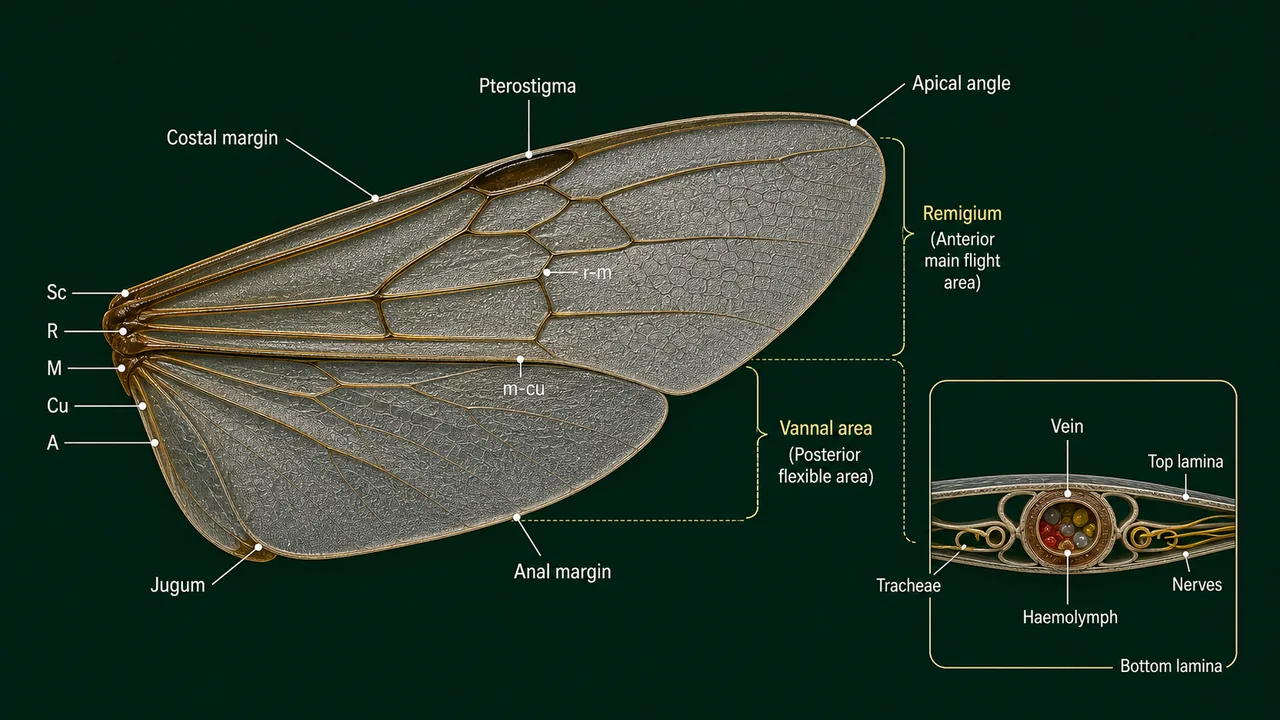
Reading order for exams: identify the front edge first (costal margin), then move posteriorly through C-Sc-R-M-Cu-A. Once the main veins are fixed in memory, the named regions become much easier to place.
The Comstock-Needham System
Veins are named according to the system devised by John Comstock and George Needham (late 1890s) -- the universal framework used worldwide.
Two Types of Veins
| Type | Direction | Function |
|---|---|---|
| Longitudinal veins | Base to margin (parallel to long axis) | Primary structural support; alternating convex (crest, ∩) and concave (trough, U) profiles create a corrugated, fan-like pattern for strength |
| Cross veins | Perpendicular, interlinking longitudinal veins | Distribute stress; prevent crack propagation |
Six Principal Longitudinal Veins (anterior to posterior)
Mnemonic: C-Sc-R-M-Cu-A (remember: "Come See Rare Mosquitoes Cut Apart")
| # | Vein | Abbreviation | Convex/Concave | Branches | Key Feature |
|---|---|---|---|---|---|
| 1 | Costa | C | Convex | Unbranched | Thickened leading edge; withstands greatest aerodynamic forces |
| 2 | Subcosta | Sc | Concave | Sc1, Sc2 | Below costa; reinforces leading-edge region |
| 3 | Radius | R | R1 = convex; Rs = concave | R1 + Rs (Rs → R2, R3, R4, R5) | Typically the strongest vein; main structural backbone |
| 4 | Media | M | MA = convex; MP = concave | MA, MP (MP branches further) | Central region; much of wing lift generated here |
| 5 | Cubitus | Cu | Cu1 = convex; Cu2 = concave | Cu1 (→ Cu1a, Cu1b), Cu2 | Posterior-middle region |
| 6 | Anal veins | A | Convex | 1--3, unbranched | Posterior and basal regions; support folding area |
- Additionally, 1--2 jugal veins (unbranched) may be present in the jugal lobe of the forewing.
Major Cross Veins
| Cross Vein | Abbreviation | Location (connects) |
|---|---|---|
| Humeral | h | Costa ↔ Subcosta (near wing base) |
| Radial | r | Subcosta ↔ R1 (leading edge area) |
| Sectorial | s | Between subbranches of Rs |
| Radio-medial | r-m | Radius ↔ Media (central wing) |
| Median | m-m | Between branches of Media |
| Medio-cubital | m-cu | Media ↔ Cubitus (posterior-central) |
Evolutionary trend: Early insects (dragonflies) had many cross veins forming a net-like reticulum. Advanced insects (bees, flies) have fewer, precisely placed cross veins -- evolutionary optimization for efficient flight.
Margins and Angles
A typical insect wing is triangular with three margins and three angles.
| Margins | Position |
|---|---|
| Costal (anterior) | Front edge; strengthened by costa; thickest and most rigid |
| Apical (outer) | Tip edge; furthest from body |
| Anal (inner) | Rear edge; closest to abdomen |
| Angles | Location |
|---|---|
| Apical angle | Between costal and apical margins (the wing tip) |
| Anal angle | Between apical and anal margins (trailing corner) |
| Humeral angle | Between body wall and costal margin (wing base -- point of articulation with thorax) |
Wing Regions
| Region | Location | Venation | Function |
|---|---|---|---|
| Remigium | Anterior (upper) part toward costal margin | Dense venation (most veins here) | Primary load-bearing structure for flight; powered by thoracic muscles |
| Vannal area | Posterior, flexible part | Sparse venation | Deforms during flight for thrust; called clavus in forewings, vanus in hindwings |
| Jugum | Innermost portion (cut off by jugal fold) | Minimal | May play role in wing coupling (jugate coupling type) |
Other Structures
| Structure | Description |
|---|---|
| Pterostigma | Pigmented spot near costal margin (e.g., in dragonflies); acts as counterweight to stabilise gliding flight |
| Axilla | Area containing wing articulation sclerites (the joint region) |
| Pteralia | Small articular sclerites in the basal membrane; form a sophisticated hinge system for wing rotation, tilting, and folding |
Flight Muscles
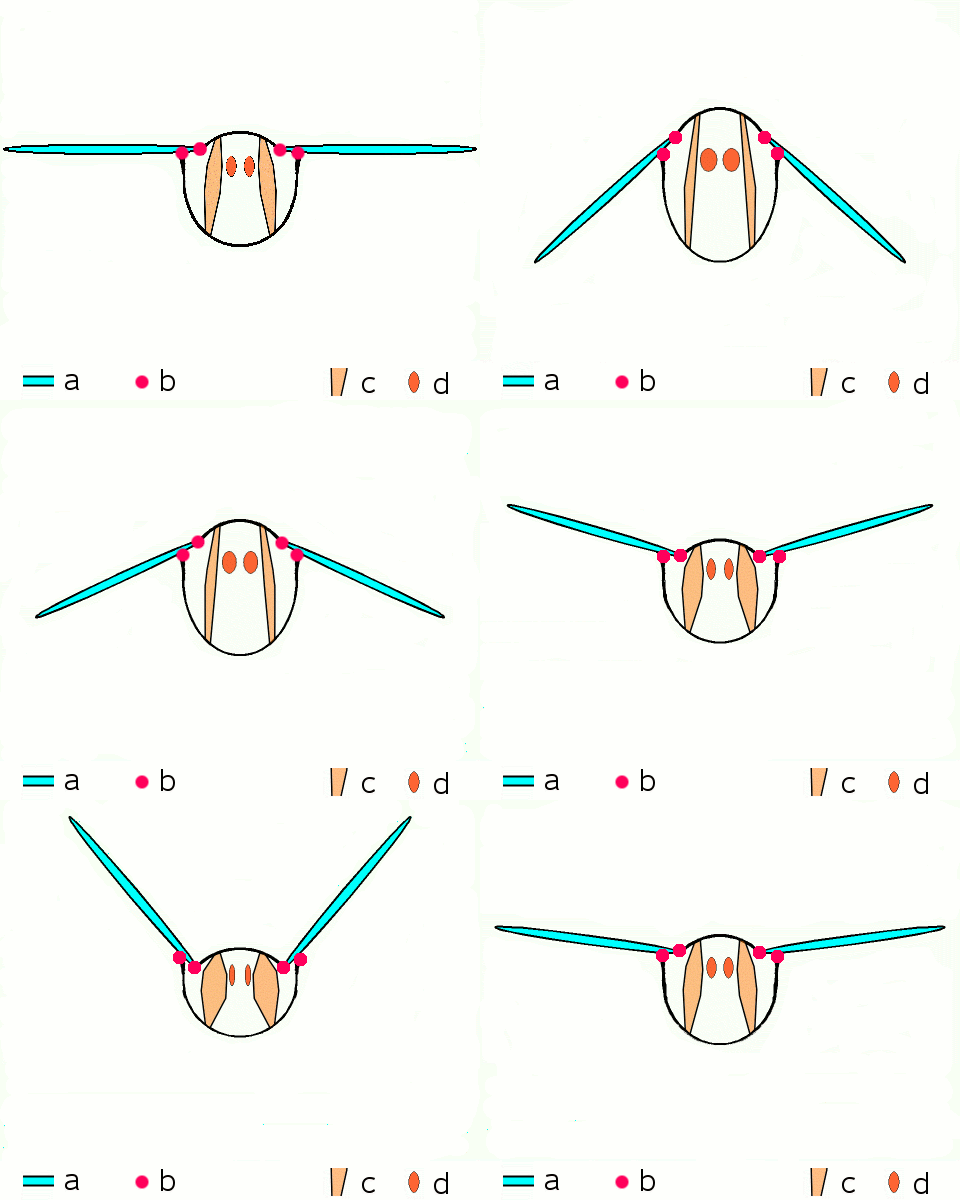
| Muscle Type | Mechanism | Used By |
|---|---|---|
| Direct flight muscles | Attached directly to wing base | Primitive fliers (dragonflies) |
| Indirect flight muscles | Deform the thorax to move wings | Most advanced insects (allows extremely high wing-beat frequencies) |
Exam Tips
Pterothorax = Meso + Metathorax. The prothorax never bears wings. This is a frequent trap.
6 longitudinal veins: C-Sc-R-M-Cu-A. The order from front (anterior) to back (posterior) is always the same.
Comstock-Needham system -- remember the two names for any question on venation nomenclature.
Analogous vs. Homologous: Insect wing and bird wing = analogous (same function, different origin). Bird wing and bat wing = homologous (same origin, similar function).
Deciduous wings: Ants and termites shed wings after mating flight. A favourite factual question.
Halteres = modified hindwings in Diptera (true flies); act as gyroscopic balance organs.
Summary Cheat Sheet
| Concept | Key Detail |
|---|---|
| Flight evolution | ~350 million years ago; insects = first and only flying invertebrates |
| Wing position | Forewings on mesothorax; hindwings on metathorax |
| Pterothorax | Meso + Metathorax (wing-bearing) |
| Wing structure | Double-layered expansion of body wall; veins carry tracheae, nerves, blood |
| Venation system | Comstock-Needham; 6 longitudinal veins: C-Sc-R-M-Cu-A |
| Strongest vein | Radius (R) |
| Cross veins | h, r, s, r-m, m-m, m-cu |
| Three margins | Costal (front), Apical (tip), Anal (rear) |
| Three angles | Apical (wing tip), Anal (trailing corner), Humeral (base) |
| Remigium | Anterior, dense venation, primary flight surface |
| Vannal area | Posterior, flexible, sparse venation |
| Pterostigma | Pigmented counterweight spot (dragonflies) |
| Apterygota | Primarily wingless (silverfish, springtails) |
| Secondarily wingless | Lost wings due to parasitism (louse, flea) |
| Deciduous wings | Shed after mating (ants, termites) |
TIP
Next: The next lesson covers wing modifications -- coupling mechanisms and the different wing types (tegmina, elytra, halteres, and more).
References
1 source
References
Lesson Doubts
Ask questions, get expert answers