🦿 Insect Legs -- Structure and Modifications
Thorax structure, five segments of insect legs, twelve types of leg modifications with agricultural examples including the specialised legs of honeybees
In the previous lessons, we covered the insect head and mouthparts. Now we move to the thorax -- the locomotion centre -- and its most prominent appendages: the legs.
A farmer observes a mole cricket burrowing through the soil of a nursery bed, damaging seedling roots. The broad, shovel-like forelegs of the mole cricket are a textbook example of how insect legs become modified for specific lifestyles. From the jumping legs of grasshoppers that help them escape across fields to the pollen-collecting legs of honeybees that enable crop pollination, leg modifications reveal how an insect lives, feeds, and interacts with agriculture.
This lesson covers:
- Thorax structure -- three segments and their appendages
- Five segments of the insect leg -- coxa through tarsus
- Twelve types of leg modifications -- from walking to swimming to pollen-collecting
The Insect Thorax
The thorax is the second and middle body region -- the locomotion centre of the insect. Think of it as the insect's engine room -- all movement (walking, flying) originates here.
| Segment | Name | Appendages |
|---|---|---|
| 1st | Prothorax | 1 pair of legs |
| 2nd | Mesothorax | 1 pair of legs + 1 pair of wings |
| 3rd | Metathorax | 1 pair of legs + 1 pair of wings |
- Meso- and metathorax together = pterothorax (Greek pteron = wing).
- Each thoracic segment has three sclerites: tergum/notum (dorsal), sternum (ventral), pleuron (lateral) -- forming a ring that provides structural integrity and muscle attachment.
Structure of the Insect Leg
All three thoracic segments bear one pair of segmented legs -- giving insects the name Hexapoda (6 legs). Having exactly six legs distinguishes insects from all other arthropods.
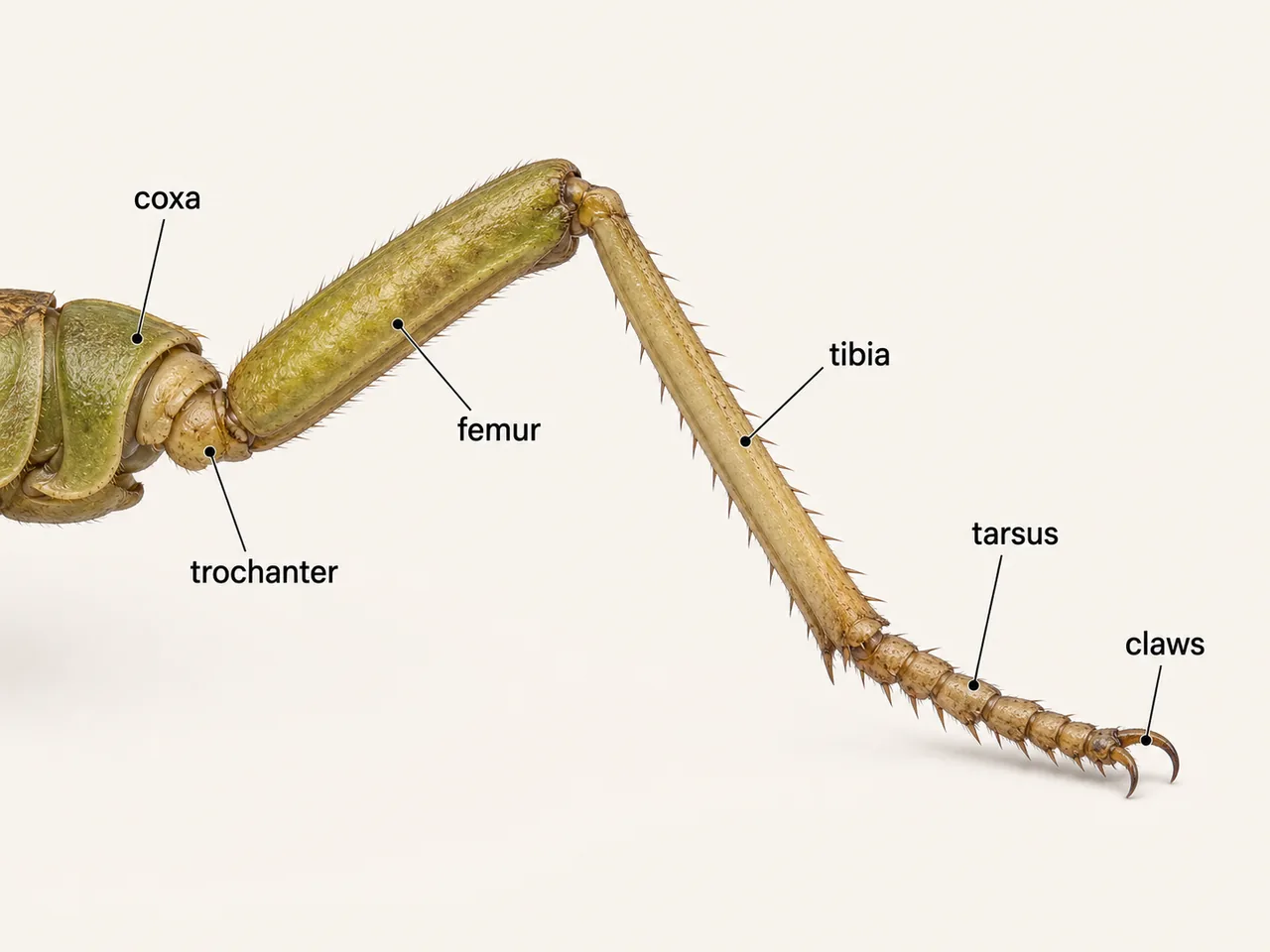
A typical insect leg has five segments (base to tip):
Reading rule: move from the body outward. Students usually confuse coxa and trochanter at the base, so identify the large femur first and then work backward to the shorter basal segments.
| # | Segment | Key Feature |
|---|---|---|
| 1 | Coxa | Proximal (basal, first); articulates with thoracic pleuron; generally freely movable |
| 2 | Trochanter | Small; acts as a pivot point between coxa and femur |
| 3 | Femur | Largest and strongest; houses major leg muscles (extensors and flexors) |
| 4 | Tibia | Long; armed with spines for climbing and grip; often has a spur near the apex |
| 5 | Tarsus | The "foot"; subdivided into 2--5 tarsomeres; 1st tarsomere (largest) = basitarsus |
TIP
"Can Trainee Farmers Teach Tilling?" — Coxa, Trochanter, Femur, Tibia, Tarsus (base to tip).
Mnemonic to remember leg segments (base to tip): Can The Frog Truly Talk -- Coxa, Trochanter, Femur, Tibia, Tarsus.
Pretarsus (Terminal Foot Apparatus)
- Beyond the tarsus lies the pretarsus or insect foot, which bears the terminal gripping and adhesive structures.
- Typical pretarsal structures include:
- a pair of claws
- lateral adhesive pads or pulvilli
- the median pad between claws, called the arolium
- a median bristle- or pad-like structure called the empodium
Protura: Since order Protura has no antennae, the front legs bear many sensilla and function as antennal substitutes for environmental sensing.
Twelve Types of Leg Modifications
The typical leg is adapted for running, but evolution has produced an astonishing variety of modifications. Each type reflects the insect's habitat, food habits, and lifestyle.
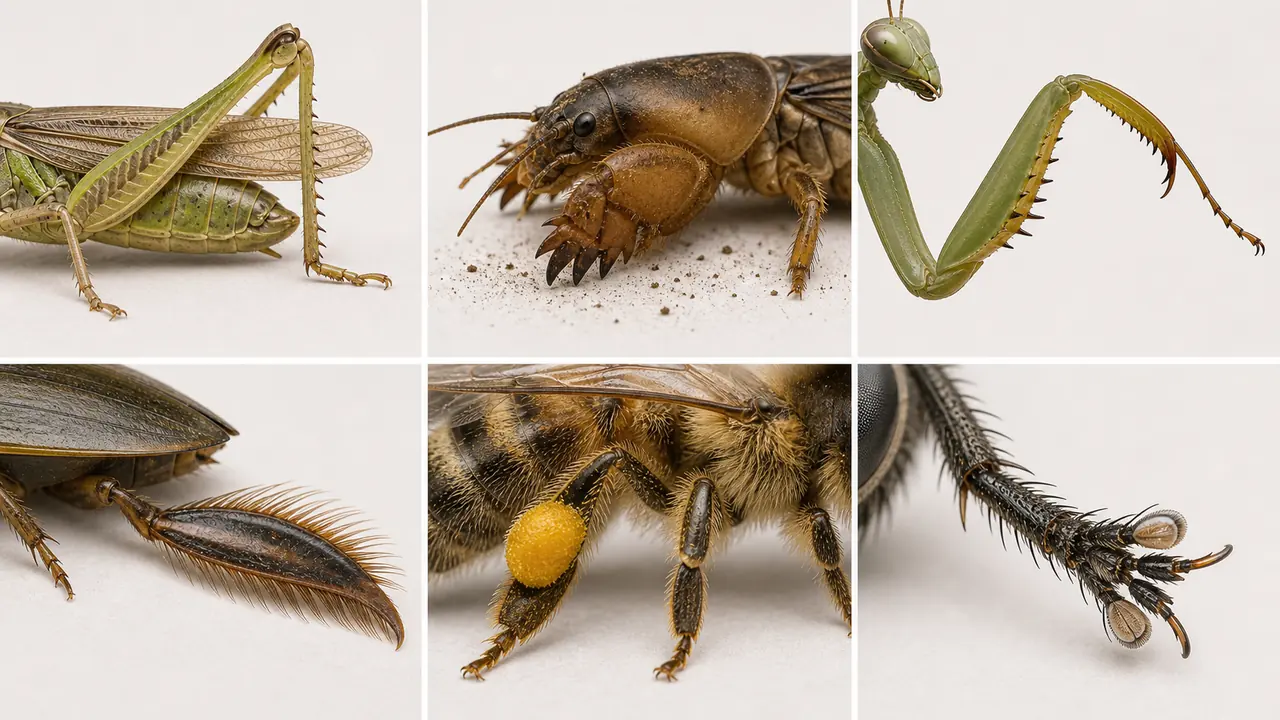
Classification shortcut: look for the most exaggerated segment. A swollen hind femur suggests jumping, a broad toothed tibia suggests digging, a spiny folding foreleg suggests grasping, and fringed flattened segments suggest swimming.
1. Ambulatorial (Walking Legs)
- Ambulate = to walk.
- The most generalised type -- slender, well-proportioned, no extreme modifications.
- Example: Fore and middle legs of grasshopper.
2. Saltatorial (Jumping Legs)
- Saltatorial = leaping. Hind femur is enormously enlarged to accommodate powerful extensor muscles. Tibia is long, slender, and heavily sclerotized with two rows of spines.
- Example: Hind legs of grasshopper. (Note: grasshoppers have ambulatorial fore/mid legs AND saltatorial hind legs.)
- Crop relevance: Grasshoppers and locusts use jumping legs to escape across fields, making them difficult to catch.
3. Cursorial (Running Legs)
- Cursorial = adapted for running. Long, slender, lightweight legs; femur not swollen.
- Cockroach can move at 4.6 km/h -- impressive relative to body size.
- Example: All three pairs of legs of cockroach.
4. Scansorial (Climbing/Clinging Legs)
- Scansorial = climbing. Tibia is stout with a thumb-like process; tarsus is single-segmented with a large claw.
- The claw works against the thumb-like process (like forefinger against thumb) to grip hair shafts.
- Example: All three pairs of legs of head louse.
5. Fossorial (Burrowing Legs)
- Fossorial = digging. Broad, flattened, heavily sclerotized with strong tibial teeth -- resembling miniature shovels.
- Example: Forelegs of mole cricket.
- Crop relevance: Mole crickets are serious pests in nursery beds (rice, vegetables), damaging seedling roots by burrowing through soil.
6. Raptorial (Grasping Legs)
- Raptorial = predatory. Forelegs are prehensile; femur and tibia work like a jackknife -- tibia folds back against the spiny femur to trap prey.
- Not used for locomotion -- only mid and hind legs walk.
- Example: Forelegs of praying mantis.
- Agricultural benefit: Praying mantids are beneficial predators in crop fields, feeding on harmful insects.
7. Natatorial (Swimming Legs)
- Natatorial = pertaining to swimming. Hind legs are broad and flattened with fringes of flattened setae acting as oars/paddles.
- Example: Hind legs of water bug and water beetle.
8. Sticking Legs
- Pretarsus has a pair of lateral adhesive pads called pulvilli under the claws, covered with dense mats of tiny glandular tenent hairs.
- Sticky secretions enable walking on smooth surfaces and ceilings (van der Waals forces + adhesion).
- Example: All three pairs of legs of housefly.
9. Basket-like Legs
- Legs are spiny and positioned just behind the head. Not used for locomotion -- dragonflies are primarily aerial hunters.
- Spiny legs form a basket-shaped cage that scoops prey from the air during high-speed pursuit flight.
- Example: Legs of dragonfly and damselfly.
- Agricultural benefit: Dragonflies are beneficial predators of mosquitoes and small crop pests.
10. Suctorial/Clasping Legs
- Tarsus is flattened with adhesive discs (suction cups) for clasping the mate during copulation in water.
- Example: Forelegs of male water beetle.
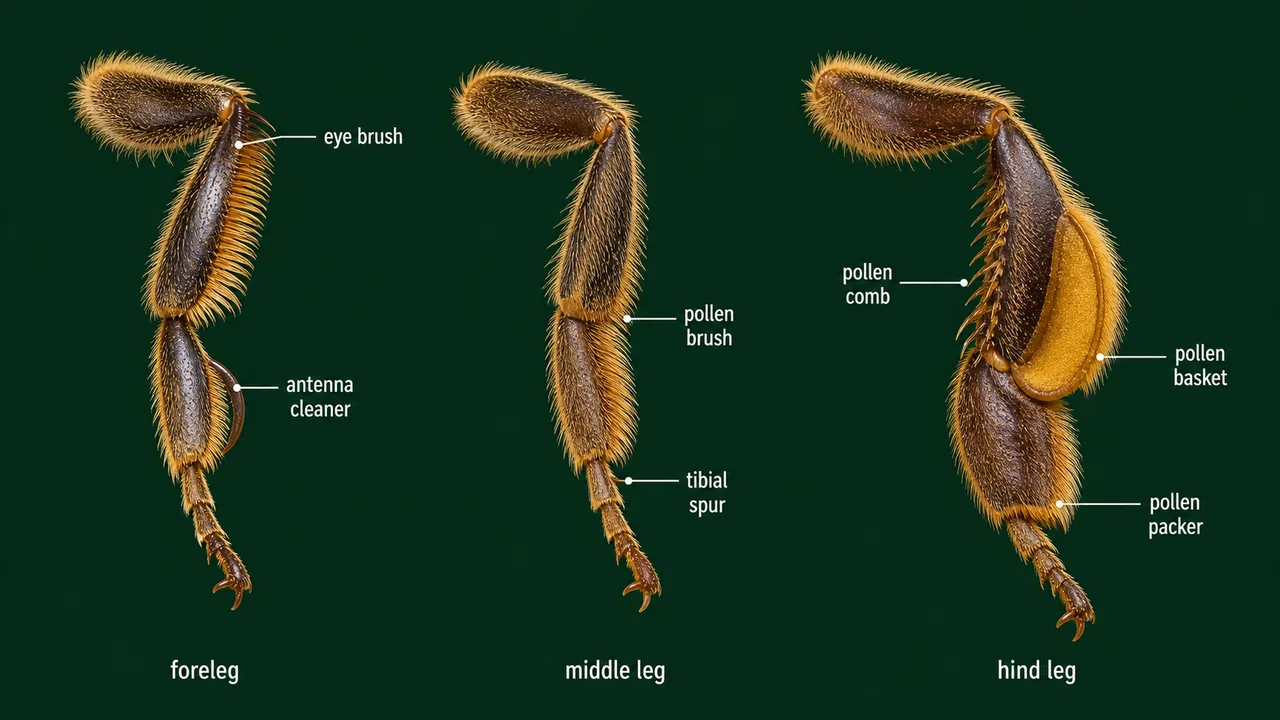
11. Foragial Legs (Honeybee -- All Three Pairs Modified)
| Leg Type | Structures Present |
|---|---|
| Fore Legs | Eye brush, Pollen brush, Antenna Cleaner |
| Middle Legs | Pollen brush, Tibial spur |
| Hind Legs | Pollen basket, Pollen packer (Pecter & Auricle), Pollen comb |
The honeybee is remarkable because each pair of legs has a different specialisation -- a beautiful example of functional differentiation.
- The hind legs of worker honeybees are especially specialized for pollen collection and transport.
| Structure | Location | Function |
|---|---|---|
| Eye brush | Hairs on tibia | Cleans compound eyes |
| Pollen brush | Bristles on basitarsus | Collects pollen from head and mouthparts |
| Antenna cleaner (Strigillis) | Velum (clasp at tibia tip) + Antenna comb (semi-circular notch with spines) | Cleans antennae -- vital for smell and communication |
Middle Legs
| Structure | Function |
|---|---|
| Pollen brush | Stiff hairs on basitarsus; collects pollen from mid-body |
| Tibial spur | Movable spur at tibia tip; loosens pollen pellets from hind leg basket; cleans wings and spiracles |
Hind Legs
| Structure | Also Called | Function |
|---|---|---|
| Pollen basket | Corbicula | Shallow cavity on outer tibia surface, fringed with long hairs; carries pollen pellets from field to hive |
| Pollen packer | Pollen press | Consists of pecten + auricle; loads pollen into corbicula |
| Pollen comb | -- | ~10 rows of stiff spines on inner basitarsus; collects pollen from mid legs and posterior body |
NOTE
A bee's primary purpose is pollination. Pollen may be used to ripen eggs or in combination with nectar to feed larvae, while nectar is a sugary substance that bees eat. Bees use their hind legs to brush, collect, and transport pollen back to the nest, depositing some on flowers as they travel and aiding in pollination.
12. Prolegs (Abdominal Legs of Larvae)
| Feature | Thoracic Legs (True Legs) | Prolegs (False Legs / Pseudolegs) |
|---|---|---|
| Location | All 3 thoracic segments | Abdomen (2--5 pairs) |
| Structure | Jointed, segmented | Thick, fleshy, not segmented |
| Persistence | Present in adult | Shed at last larval moult (absent in adult) |
| Tip structure | Claws | Crochets (hook-like structures on planta for gripping) |
| Example | All insect larvae and adults | Caterpillars (Lepidoptera larvae) |
- The last pair of prolegs on the terminal abdominal segment are called anal prolegs or claspers.
- The crochet arrangement pattern (circles, rows, bands) is important for caterpillar species identification.
Comparison of Major Leg Types
| Leg Type | Latin Meaning | Key Modification | Example Insect | Agricultural Relevance |
|---|---|---|---|---|
| Ambulatorial | Walking | Generalised, slender | Grasshopper (fore/mid) | -- |
| Saltatorial | Leaping | Enlarged hind femur | Grasshopper (hind) | Escape mechanism of pests |
| Cursorial | Running | Long, lightweight | Cockroach | Rapid pest movement |
| Scansorial | Climbing | Claw + thumb process | Head louse | Ectoparasite attachment |
| Fossorial | Digging | Broad, shovel-like tibia | Mole cricket | Nursery bed pest |
| Raptorial | Predatory | Jackknife femur-tibia | Praying mantis | Beneficial predator |
| Natatorial | Swimming | Paddle-like with setae | Water beetle | -- |
| Sticking | -- | Pulvilli + tenent hairs | Housefly | Walks on ceilings/food |
| Basket-like | -- | Spiny cage behind head | Dragonfly | Beneficial predator |
| Suctorial | -- | Adhesive disc tarsus | Male water beetle | Mating adaptation |
| Foragial | Foraging | Pollen basket, brushes | Honeybee | Crop pollination |
| Prolegs | -- | Fleshy, unjointed, crochets | Caterpillar | Larval attachment to crop |
Exam Tips
Grasshopper has TWO types of legs: Ambulatorial (fore/mid) + Saltatorial (hind). This is a common exam question.
Leg segment mnemonic: "Can The Frog Truly Talk" = Coxa, Trochanter, Femur, Tibia, Tarsus.
Corbicula = Pollen basket on the hind tibia of honeybee. Frequently asked.
Prolegs vs. true legs: Prolegs are fleshy, unjointed, temporary (shed at pupation). True legs are segmented, jointed, permanent.
Mole cricket forelegs = Fossorial. A favourite identification question.
Summary Cheat Sheet
| Concept | Key Detail |
|---|---|
| Thorax segments | Prothorax, Mesothorax, Metathorax |
| Pterothorax | Meso + Metathorax (wing-bearing) |
| Leg segments (5) | Coxa → Trochanter → Femur → Tibia → Tarsus |
| Largest segment | Femur (houses major muscles) |
| Basitarsus | 1st (largest) tarsomere |
| Tarsomeres | 2--5 subdivisions of tarsus |
| Pretarsus | Claws + pulvilli + arolium/empodium |
| Honeybee hind leg | Corbicula (pollen basket) + Pollen packer + Pollen comb |
| Strigillis | Antenna cleaner on honeybee foreleg |
| Prolegs | Abdominal legs of caterpillars; 2--5 pairs; crochets for gripping |
| Fossorial | Digging; mole cricket forelegs |
| Raptorial | Grasping prey; praying mantis forelegs |
| Saltatorial | Jumping; grasshopper hind legs |
TIP
Next: The next lesson examines the other thoracic appendages -- insect wings, their internal structure, and the venation system used for classification.
References
1 source
References
Lesson Doubts
Ask questions, get expert answers